



Abstract
The Ethiopian government has demonstrated commitment to pre-primary education through “O-classes” and child-to-child modalities, which serve 75% of children, particularly in rural areas. This study examines resource availability for “O-classes” annexed to primary schools in rural Amhara and Oromia—regions with higher gross enrollment rates yet persistent disparities. A convergent parallel mixed-methods design was employed, collecting data from 380 primary school teachers attending in-service training at Bahir Dar, Wollo, Mettu, and Madda Walabu Universities, as well as from 12 school principals and 4 district ECCE coordinators at their workplaces. Analyses (frequency, percentage, mean, SD, independent t-tests) revealed systemic deficiencies in qualified personnel, play facilities, and classroom conditions. Critically, effect sizes (Cohen’s d = 0.00–0.16) confirmed trivial regional differences, underscoring nationwide gaps in early childhood care and education (ECCE) compliance (means: 1.09–1.87). These inadequacies hinder ECCE’s poverty-alleviation potential and may negatively shape children’s attitudes toward schooling. The study urges policy reforms to ensure equitable, quality pre-primary education for rural children, who constitute the majority.
Plain Language Summary
Expanding early childhood care and education has been proven to reduce education inequality and poverty levels in low-income countries. In Ethiopia, the government has shown dedication to providing pre-primary education by introducing o-class and child-to-child modalities for 75% of children who reside in rural areas. This study examines the availability of resources for o-classes that were annexed to primary education in the rural areas of the Amhara and Oromia regions in Ethiopia. The study utilized a descriptive survey design, collecting data from 541 primary school teachers attending summer in-service training at Bahir Dar, Wollo, Mettu and Madda Walabu Universities. Frequency, percentage, mean, standard deviation, and an independent t-test were used to analyse the data. The study revealed a lack of qualified personnel, play facilities, and conducive classrooms for toddlers. This, in turn, hinders the potential of early childhood care and education in alleviating poverty and may have a negative impact on children's attitudes towards education in the future. Therefore, the study recommends a reconsideration of the existing modalities to ensure a positive educational experience for the majority of children in the country.
Introduction
A child’s development and lifelong ability to learn are heavily influenced by their early years, particularly the first five (Center on the Developing Child, 2010). Disparities in early childhood development tend to emerge early and often persist over time (Fernald et al., 2012). Research suggests that children who attend high-quality early childhood care and education (ECCE) programs are more likely to begin primary school on time, have lower rates of grade repetition, and are more likely to continue their education beyond the minimum required years (Fernald et al., 2014; World Bank Group, 2018). Furthermore, ECCE has been shown to positively impact learning outcomes in later years (Gove et al., 2018) and provides essential child care support for working parents (Samman et al., 2016).
Despite national and international commitments to prioritize ECCE, it remains an overlooked policy issue in many developing countries (Ochieng & Yeonsung, 2021; Shawar & Shiffman, 2017) and lacks adequate funding to improve access and quality (UNICEF, 2019). Convinced by existing research on the benefits of early childhood care and education, the Sustainable Development Goals (SDGs) emphasize the importance of childhood education. Goal 4.2 states that, “by 2030, ensure that all girls and boys have access to quality early childhood development, care, and pre-primary education so that they are ready for primary education” (United Nations, 2015, p. 17). Various organizations, including UNICEF, WHO, the World Bank, international NGOs, and civil society organizations, have championed early childhood education as a key driver of human capital (Chan et al., 2017; Theirworld, 2017).
Due to increased advocacy for ECCE, pre-primary enrollment rates have grown significantly, with over half of children worldwide participating in ECCE programs before starting elementary school (UNICEF, 2019). However, a global UNICEF investigation in 2019 estimated that approximately 175 million children between the ages of 3 and 6 had not started school (UNICEF, 2019). While about 50 countries mandate at least 1 year of pre-primary schooling, there are notable differences in policies and implementation. As ECCE becomes more integrated into primary education, concerns remain that by 2030, over 50% of lower- and lower-middle-income regions will not have achieved universal access to pre-primary education (UNICEF, 2019).
In response to growing global demand, organizations like the World Bank, the UK government, GPE, and UNICEF began partnering with developing countries to provide technical assistance and, later, financial support for ECCE initiatives (Neuman & Powers, 2021). In Ethiopia, UNICEF has played a pivotal role in promoting ECCE since the 1990s, helping to shape the national policy framework for early childhood care and education. This included supporting the development of delivery models such as child-to-child programs, “O-class,” and the accelerated school readiness program (Neuman & Powers, 2021).
The Ethiopian government recognizes early childhood care and education (ECCE) as a critical period for children’s development (Ministry of Education [MoE], 2021). ECCE programs focus on education, social and emotional care, cognitive stimulation, healthcare, and nutrition, with an emphasis on family and community support to ensure holistic child development (UNESCO and UNICEF, 2012). To improve the quality of early childhood education, the Ethiopian government, in collaboration with the Ministry of Health and the Ministry of Women Affairs, established the ECCE National Policy Framework and Guidelines. This framework aims to ensure that every child has a healthy start and can reach their full potential in a nurturing environment (MoE, 2010, 2015).
Significant progress has been made in expanding ECCE access in Ethiopia, largely due to the efforts of the government and international partners. In 2021, the net enrollment rate (NER) for pre-primary education reached 1,332,525 out of a school-age population (4–6 years) of 8,005,163 (MoE, 2021). For the child-to-child program, the NER was 60,874, while the “O-class” NER was also 1,332,525 (MoE, 2021). The gross enrollment ratio (GER) for kindergarten in 2021 was 622,740, representing children aged 3 to 6 years (MoE, 2021).
Various scholars have explored different aspects of ECCE in Ethiopia. Some studies have used secondary data to describe the current status of ECCE (Belay, 2018; Diale & Sewagegn, 2021; Kim et al., 2021; Tassew, 2016), while others have examined community engagement and its impact on ECCE (Dighe & Seiden, 2020; Laura & Yisak, 2011). Research has also focused on urban ECCE programs with more resources (Admas, 2019; Astatke & Kassaw, 2017) and teacher professionalism (Kassahun, 2013). These studies highlight challenges such as inefficient administration, low community participation, inadequate funding, teacher training gaps, and poor working conditions. However, this study is unique in its focus on assessing the availability of resources in rural areas of the Amhara and Oromia regions, evaluating primary schools’ compliance with the Ministry of Education’s ECCE standards.
Research Questions: two central research questions guided this study.
Do primary schools in the Amhara and Oromia regional states have the minimum resources—such as school facilities, classroom facilities, play facilities, and qualified personnel—to host “O” classes?
Are there statistically significant differences in the responses between the Amhara and Oromia regional states?
Theoretical Framework of the Study
According to Gharajedaghi (2011), systems theory is a multidisciplinary framework that goes beyond merely analyzing interactions and relationships among components within a complex system. It emphasizes understanding the behavior, dynamics, and patterns of the system as a whole. This holistic approach is essential for comprehending the complexities of early childhood care and education (ECCE), as it considers the interdependencies and collective functioning of all parts, rather than isolating individual elements (Stroth, 2015).
Systems theory highlights the presence of feedback loops and non-linear relationships, recognizing that changes in one part of a system can ripple through and impact interconnected components (Meadows, 2008). This approach allows researchers to study the interconnectedness and interdependence of elements within ECCE programs, offering a comprehensive perspective for problem-solving and decision-making (Bennett & Kaga, 2010).
Research indicates that high-quality ECCE programs are crucial for a child’s holistic development, including cognitive, social, emotional, and physical growth (Bakken et al., 2017; Rapp & Corral-Granados, 2021). These programs provide well-organized learning environments (Sando, 2019), opportunities for engagement with educational resources and activities, interactions with peers (Shin et al., 2016), and guidance from skilled educators (Fonsén et al., 2023). However, when such programs are lacking, children miss out on these essential elements, hindering the effective implementation of high-quality ECCE (Sitati et al., 2016).
Additionally, the implementation of ECCE can strain the quantity and quality of school resources (UNESCO, 2023). Studies suggest that quality inputs in ECCE lead to better outcomes (Ishimine et al., 2010). This study aims to examine the classroom provisions, availability of facilities and play resources, and the supply of qualified personnel in the “O-class” modality of pre-primary education in Ethiopia. The study addresses the challenges associated with implementing ECCE in developing countries, particularly in the context of extreme poverty. While the Sustainable Development Goals aim to ensure quality ECCE in poor countries by 2030, the actual implementation remains a significant challenge. This study contributes to the ongoing discussion on the feasibility of ECCE in developing nations.
Literature Review
Concept of Quality in Early Childhood Care and Education
Quality in early childhood education is a complex concept that elicits substantial debates among scholars, researchers, policymakers, and practitioners (Layzer & Goodson, 2006). Defining quality remains challenging due to its dependence on contextual factors and the developmental level of different countries (Akareem & Hossain, 2016). However, global perspectives generally categorize early childhood care and education quality into two dimensions: structural quality and process quality (Hanno et al., 2021; Patricia et al., 2022).
Various frameworks have been proposed to assess quality in early childhood education and care. These frameworks consider factors such as meaningful interactions, parental involvement, and lessons learned within the learning environment (OECD, 2006; Pianta et al., 2005). Additionally, they focus on the physical characteristics, instructional practices, overall classroom atmosphere, and instructor credentials (Pianta et al., 2005). The components of structural quality also include continuing education initiatives, teaching practice guidance, and support systems that facilitate learning in a familial setting (OECD, 2006).
Process quality, on the other hand, centers on the educational experiences of children in early childhood education and care. It encompasses teaching methods, effective instructional strategies, teacher-child relationships, curriculum programs, learning assessments, and psychological and social support (Burchinal et al., 2010). Process quality emphasizes the interactions and discussions that children have with teachers and peers within ECCE programs (OECD, 2006).
The OECD (2006) highlights the significance of curriculum in promoting improved quality and the education and development of young children. Overall, the concept of quality in early childhood education is multifaceted and encompasses both structural and process dimensions, with various factors influencing its definition and assessment.
Early Childhood Care and Education in Ethiopia
Early childhood care and education (ECCE) in Ethiopia has been shaped by efforts from the Ministry of Education (MoE), in collaboration with private entities, non-governmental organizations, communities, and religious organizations, to improve accessibility and availability (MoE, 2016). The MoE’s introduction of programs like kindergartens, O-classes, and child-to-child programs aimed to address the shortage of formal early childhood education in rural areas (Fantahun, 2016; Mulugeta, 2015). However, there remain concerns about the effectiveness and quality of these programs.
The O-class initiative, in which children attend a preparatory year before entering primary school, has expanded rapidly, but its quality has been questioned. O-classes are typically attached to primary schools and provide a single year of early education, yet studies have highlighted the inadequacies in resources, teacher preparation, and infrastructure (Rossiter, 2016). According to MoE (2021), 75% of children enrolled in pre-primary education in the 2021/2022 academic year were attending O-classes and child-to-child programs. Only 25% of children were in kindergartens, which are primarily located in urban areas. This unequal distribution raises concerns about the quality of pre-primary education accessible to the majority of Ethiopian children in rural settings, where resources are even scarcer (MoE, 2015).
Research by Fantahun (2016) and Mulugeta (2015) has also pointed out the challenges faced by O-classes, particularly in terms of teacher quality and the sufficiency of materials. These issues are exacerbated by the reliance on child-to-child programs, where older children (typically in grades 5 and 6) assist younger children in preparing for school. This approach, while innovative in resource-limited contexts, presents several challenges. Critics, such as Mulugeta (2015), question whether the older students themselves have adequate literacy and numeracy skills to effectively teach younger children. The informal nature of this system has led to questions regarding its efficacy in preparing children for primary school (MoE, 2021). Moreover, the MoE has yet to provide comprehensive assessments of the program’s success, raising further doubts about its sustainability and impact (MoE, 2021).
In contrast, the kindergarten program, which spans 3 years (nursery, lower kindergarten, and upper kindergarten), is primarily run by private and religious institutions. This program is designed for children between the ages of 3 and 6 and is generally considered of higher quality than the O-class and child-to-child programs due to its structured curriculum and trained teaching staff (Fantahun, 2016; Mulugeta, 2015). However, as Mulugeta (2015) and Fantahun (2016) point out, access to kindergarten remains limited, particularly for children in rural areas. The discrepancy between urban and rural ECCE offerings perpetuates educational inequality, as the majority of rural children lack access to structured, quality pre-primary education.
Further research has underscored the broader implications of these disparities. According to Rossiter (2016), O-classes were initially designed to serve 6-year-olds, but in practice, children as young as 4 or 5 are often enrolled, which raises concerns about the appropriateness of the curriculum and teaching methods. This mismatch between age groups and curriculum is a significant issue, as younger children may not be developmentally ready for the academic demands of O-classes (Tirussew & Belay, 2016).
Despite the MoE’s efforts to address early childhood education, scholars agree that the rapid expansion of O-classes and child-to-child programs has outpaced the provision of necessary resources and teacher training (Mulugeta, 2015; Rossiter, 2016). The lack of qualified teaching staff in these programs, particularly in rural areas, continues to hinder the effectiveness of early childhood education in Ethiopia. Furthermore, the MoE’s reliance on informal education approaches, such as child-to-child programs, has yet to be critically evaluated in terms of its long-term impact on children’s readiness for primary school and beyond (MoE, 2021).
The literature reveals that O-classes have expanded rapidly but suffer from inadequate resources, teacher training, and infrastructure. Research is needed to assess if primary schools in the Amhara and Oromia regions have the minimum resources for O-classes, providing empirical data on existing gaps. This will help stakeholders understand the conditions of early childhood education. The literature also highlights disparities in access to quality ECCE programs between urban and rural areas, with rural children facing greater inequality. By examining resource availability differences between these regions, the research can inform policymakers about targeted interventions to address disparities and promote educational equity.
Determinants Influencing the Quality of Preschool Education in Ethiopia
Inadequate Budget to ECCE
Lack of budget can significantly impact the quality of early childhood education in any country, including Ethiopia (Kim, 2022; Tirussew & Belay, 2016; UNICEF, 2019). In Ethiopia specifically, the allocated budget for early childhood care and education (ECCE) was only 3% of the total education budget (Kim, 2022). This translates to each O-class child having access to less than $1 annually. In general, funding for ECCE is inadequate (Kim, 2022; Tirussew & Belay, 2016; Tirussew et al., 2018).
Inadequate Health Practices and Cleanliness: Proper healthcare and hygiene are essential in preschools, but many facilities in Ethiopia lack appropriate infrastructure, especially for children with disabilities (Astatke & Kassaw, 2017). There is a scarcity of child-sized toilets, inadequate cleanliness, and a lack of accessible water sources (Astatke & Kassaw, 2017; Tirussew et al., 2009). These shortcomings prevent schools from effectively fulfilling their responsibilities in terms of healthcare and sanitation.
Insufficient Training Provided to Educators and Caregivers: The importance of teachers’ training in education cannot be overstated. However, in Ethiopia, most preschool teachers receive inadequate or minimal training (Mulugeta, 2015; Tirussew et al., 2009). The qualifications of teaching staff often have little relevance or only slight relevance (Astatke & Kassaw, 2017; Fantahun, 2016; Haile & Mohammed, 2017; Tigistu, 2013). Furthermore, caregivers in private kindergarten schools lack pre-service or in-service training (Astatke & Kassaw, 2017). Moreover, accessible training institutions are scarce (Haile & Mohammed, 2017), and the training provided is often too theoretical and insufficient to prepare practitioners for real-world work settings (Tigistu, 2013).
Implementation of Age-inappropriate Curriculum: In Ethiopia, the presence of a developmentally inappropriate curriculum disregards the ages, personalities, and learning styles of children (Teka et al., 2016). One of the challenges is the unavailability of suitable books and materials for children (Teka et al., 2016). Lack of culturally relevant storybooks further exacerbates this issue (Astatke & Kassaw, 2017; Haile & Mohammed, 2017). Another obstacle is the use of a foreign language, typically English, in private preschools, hindering the integration of local stories into the curriculum (Astatke & Kassaw, 2017). Moreover, parents’ unrealistic expectations, such as insisting on English fluency, often prioritize teaching English over other educational experiences, leading to a negative impact on the overall quality of preschool education (Fantahun, 2016).
Unbalanced Staff-to-Child Ratio: The staff-to-child ratio is another factor affecting the quality of ECCE services. In Ethiopia, the teacher-to-child ratio in preschools is typically high (Mulugeta, 2015; UNESCO-IICBA, 2010). This imbalance hampers individualized attention and quality interactions between teachers and children (Essa, 2011). When one adult is responsible for too many children, both the children and adults suffer. Lower ratios enable better interaction and allow for more personalized attention to each child.
Obstructive Work Condition: Creating favorable work environments and ensuring job satisfaction play a vital role in enhancing the quality of early childhood care and education (ECCE). However, research conducted in Ethiopia revealed that the inadequate salaries of teachers and frequent turnover of educators pose significant challenges that may undermine ECCE practices and its overall quality (Astatke & Kassaw, 2017).
Inefficient Educational Administration and Management: Effective leadership and organizational structure also significantly impact ECCE quality. However, many personnel and directors working in ECCE lack relevant qualifications (Tigistu, 2013; Tirussew et al., 2009). Trained leaders are often not assigned to manage preschools, leading to ineffective school management (Belay, 2018).
Lack of On-going Oversight and Program Assessment: Supervision and program evaluation are crucial for enhancing the quality of early childhood care and education (ECCE). However, research reports indicate a lack of monitoring to uphold curriculum standards and preschool facilities, as well as the training of preschool teachers (MoE, MOH & MoWA, 2010; UNESCO-IICBA, 2010). Effective supervision involves consistent checking and monitoring to ensure successful curriculum implementation (Akinrotimi & Olowe, 2016). A strong monitoring and evaluation system is essential for assessing the provision of necessary services to children, evaluating service delivery, and assessing overall system performance (Richter et al., 2014).
Lack of Parent and Community Involvement: According to Fantahun (2016), there is a lack of clarity and practice regarding parental and community involvement in preschools in Ethiopia. Many preschools do not actively engage with local communities, and parental involvement is limited (Belay, 2018). Additionally, Fantahun (2016) points out the absence of explicit guidelines specifying how families and communities should contribute to preschool education.
Despite known challenges like inadequate funding, poor teacher training, and unbalanced student-teacher ratios, these issues persist and hinder preschool education quality. This study aims to provide evidence that these problems remain unresolved and require specific regional and institutional solutions. While extensive literature exists on early childhood education challenges, there is limited empirical investigation into the actual conditions of “O” classes within primary schools, particularly concerning minimum resource standards. By examining whether primary schools in the Amhara and Oromia regions have the necessary resources for “O” classes, this study fills an empirical gap and could influence targeted policy interventions.
Materials and Methods
This study employed a convergent parallel mixed-methods design to comprehensively examine the provision of facilities and personnel in rural O-classes. While the initial descriptive survey design (Johnson & Christensen, 2008; Nassaji, 2015) provided a systematic snapshot of resource availability, we integrated qualitative interviews to explore “deeper systemic reasons” behind observed gaps (Creswell & Clark, 2017). Findings were merged during interpretation using thematic mapping to explain quantitative patterns. This approach aligns with recommendations to combine quantitative breadth with qualitative depth in educational research (Tashakkori & Teddlie, 2010).
Sample and Sampling Techniques
The researcher employed a purposeful sampling technique to select the Amhara and Oromia regions, which accounted for 59.7% of pre-primary gross enrollment in Ethiopia (MoE, 2021). These regions were chosen due to their large population, advanced development, and availability of resources such as qualified personnel and higher revenue generation (House of Federation of the Federal Democratic Republic of Ethiopia, 2012). This selection aligns with Open System Theory, which posits that regions and institutions within the educational system are influenced by and interact with broader socio-economic factors.
Data were collected from primary school teachers attending in-service training at higher education institutions during the summer of 2022 (July and August). The in-service training, held at universities, provided a convenient setting to reach a large number of teachers. Four government-owned universities were selected through simple random sampling: Bahir Dar and Wollo universities from the Amhara region, and Madda Walabu and Mettu universities from the Oromia region. These institutions were chosen to represent the government-owned university system in their respective regions, acknowledging their role within the larger educational ecosystem.
The sample size was initially determined using Yamane’s (1967) sample determination formula, with a maximum of 400 participants. To reflect the study’s focus on comparing the two regions, the sample was first stratified by region. The sample was allocated proportionally based on the population of teachers in rural areas within each region, with 50% of the sample drawn from Amhara and 50% from Oromia. This proportional allocation ensures that the sample accurately reflects the distribution of teachers across different regions, consistent with the principles of Open System Theory.
After determining the sample size for each region, the next step was to allocate the sample across universities within each region. The allocation was done evenly across the four selected universities—Bahir Dar and Wollo for Amhara, and Mettu and Madda Walabu for Oromia—to ensure balanced representation. To account for potential non-responses, an additional 10% of samples were added to each group, resulting in 110 teachers selected from each university and a total sample size of 440.
Teachers were selected using a systematic sampling technique. The list of teachers from each university was obtained, and the total population was divided by the required sample size (110) to calculate the sampling interval (k). A random starting point was chosen, and every k-th teacher was selected until the target number of 110 teachers per university was reached. This systematic approach ensures that the sample captures the diverse experiences and perspectives within the educational system, as highlighted by Open System Theory.
To complement the quantitative data and address potential limitations of only surveying in-service teachers, the researcher conducted purposive sampling for qualitative interviews (Bryman, 2016). This involved:
Twelve rural school principals (six per region), selected to represent diverse school sizes and resource levels. Their perspectives helped mitigate coverage gaps by providing insights about non-participating teachers while enhancing data triangulation (Patton, 2014).
Four regional ECCE coordinators (two per region) from District Education Offices, who provided crucial systemic perspectives. Their input revealed policy-implementation disconnects (e.g., budget delays, procurement issues) that survey data alone could not identify.
Instrumentation and Methods of Data Analysis
The research utilized structured questionnaires for quantitative data collection and semi-structured interviews for qualitative insights, allowing for methodological triangulation. The questionnaire, adapted from Ethiopia’s National Early Childhood Care and Education Standard (2020), consisted of two main sections: the first collected respondents’ background information while the second assessed the availability of play facilities, school infrastructure, classroom resources, and qualified personnel. Teachers responded using a 3-point Likert scale (1 = disagree, 2 = undecided, 3 = agree), which was selected based on evidence suggesting it achieves reliable psychometric performance (Chachamovich et al., 2009) without significantly compromising validity (Jacoby & Matell, 1971; Lehmann & Hulbert, 1972). Sample items included “classrooms have child-sized tables and chairs” for classroom facilities and “teachers have a diploma in ECCE” for personnel qualifications.
To ensure instrument reliability and validity, the questionnaire underwent rigorous testing. A pilot study with 100 primary school teachers at Madda Walabu University demonstrated strong internal consistency (Cronbach’s α = .86), exceeding the recommended threshold of 0.70 (Ursachi et al., 2015). Three field experts evaluated the tool to establish content validity, ensuring alignment with ECCE standards and appropriate question formulation. The quantitative data collection involved self-administered questionnaires distributed to 380 primary school teachers during in-service training sessions at four universities. Data analysis employed SPSS version 23, using descriptive statistics (frequencies, percentages, means, and standard deviations) to summarize background characteristics and resource availability. Independent t-tests compared regional differences between Amhara and Oromia, with all assumptions (normality, independence) verified per Cohen et al. (2007). Effect sizes were calculated using Cohen’s d (range: 0.00–0.16) to quantify the magnitude of any observed differences, following Cohen’s (2013) guidelines for interpretation (small = 0.2, medium = 0.5, large = 0.8).
To complement the survey data and address potential sampling limitations, the study incorporated semi-structured interviews with 12 school principals and 4 district ECCE coordinators conducted between November and December 2023. These interviews served three critical purposes: investigating unanticipated policy implementation challenges, providing qualitative explanations for quantitative findings (Flick, 2018), and examining disparities between policy mandates and actual conditions. Conducted in-person at workplaces, the 30 to 45 min sessions followed a protocol developed from survey results, focusing on three key areas: systemic challenges (“What barriers hinder classroom facilities?”), policy implementation gaps (“How are ECCE standards applied in rural contexts?”), and practical solutions (“What cost-effective strategies have improved resources?”). This approach achieved an optimal balance between methodological structure and exploratory flexibility (Creswell & Poth, 2016).
The qualitative data analysis followed established procedures to ensure rigor. All interviews were audio-recorded, transcribed verbatim, and professionally translated for Amharic content. Using NVivo 13 software, the researcher applied Braun and Clarke's (2006) thematic analysis framework, beginning with inductive coding to identify emerging patterns (e.g., “funding delays”). Through iterative analysis, 10 preliminary themes were consolidated into two core categories: implementation challenges and policy gaps. The study employed multiple validation strategies, including member checking with participants and establishing strong intercoder reliability (κ = 0.82). Crucially, the qualitative findings were systematically mapped to quantitative results, enabling richer interpretation of survey outcomes. For instance, interview data provided contextual explanations for low special needs resource scores observed in the questionnaire data, revealing systemic procurement and training issues that teachers alone might not recognize.
The mixed-methods approach proved particularly valuable for addressing potential sampling biases inherent in teacher surveys, such as limited awareness of administrative challenges or self-reporting tendencies. By integrating perspectives from both teachers and administrators, the study achieved more comprehensive understanding of the complex factors influencing resource availability. The quantitative results showed consistent patterns across regions (with trivial effect sizes), while qualitative data revealed these as nationwide systemic issues rather than region-specific disparities. This methodological integration strengthened the study’s validity and provided robust evidence that facility and personnel inadequacies represent a national challenge requiring policy-level solutions, particularly for rural areas where most Ethiopian children access early education.
Ethical Considerations
This study incorporated multiple safeguards to minimize risks to participants while maximizing societal benefits. All data collection methods were designed to eliminate physical, psychological, and professional risks through complete anonymity (no personal identifiers collected), non-sensitive questioning (focusing only on resource availability), and voluntary participation with withdrawal rights. The significant benefits - informing Ethiopia’s ECCE policy for 59.7% of pre-primary learners (MoE, 2021) through identifying rural resource gaps – outweighed the minimal risks, as participants contributed to systemic improvements without individual burdens (30–45 min time commitment). Informed consent was obtained through appropriate methods for each approach: survey participants received written disclosures with implied consent upon submission, while interview participants (principals/coordinators) provided recorded verbal consent after reviewing study details.
Institutional cooperation was secured through official university letters per Open System Theory’s emphasis on multi-level stakeholder engagement. All participants were assured that authorization by officials didn’t compromise their voluntary participation rights, maintaining ethical standards across individual and institutional levels. Confidentiality was preserved through pseudonymization of interview data and aggregated reporting, protecting both participants and their institutions within Ethiopia’s educational ecosystem while enabling crucial policy-relevant findings about rural O-class resources.
Results
The study enrolled 440 primary school teachers from Bahir Dar, Madda Walabu, Mettu, and Wollo universities. However, the final sample size consisted of 380 participants, resulting in a response rate of 86.4%, which is considered high (Babbie, 1990). Out of the total respondents, 194 (51%) teachers were from the Oromia region, while 186 (49%) were from the Amhara region. The majority of participants, 256 (67.3%) teachers, were male (Table 1).
Respondents’ Background Data.

Source. Field survey.
Regarding marital status, 315 (82.8%) teachers were married, while the remaining 65 (17.2%) were either single or divorced. In terms of having children aged 4 to 6 attending early education in primary schools, 241(63.4%) teachers reported having children in this age group, while 139 (36.6%) teachers did not have children of this age enrolled in primary education.
The aim of the study was to investigate potential discrepancies in adherence to the early childhood care and education (ECCE) standards set by the Ethiopian Ministry of Education in the Amhara and Oromia regions. Specifically, the study focused on the provision of school facilities, classroom facilities, play facilities, and qualified personnel as outlined in the ECCE standards.
To assess adherence to the ECCE standards, primary school teachers rated their perceptions on a Likert scale. The scale ranged from 1 to 3, with 3 indicating strong adherence and 1 indicating non-adherence. Mean responses were then calculated to determine whether the primary schools met the government’s ECCE standards. If the mean score was equal to or greater than 2.1, it indicated that the schools met the ECCE standard. On the other hand, if the mean score was 2.0 or less, it indicated that the schools did not meet the ECCE standard. This approach was adapted from Sitati et al.’s study in 2016. In order to compare the responses from different regions, independent t-tests were conducted. The purpose of these tests was to determine if there were statistically significant differences between the responses from the Amhara and Oromia regions regarding the condition of these facilities.
Classroom Provisions
In accordance with the ECCE standard of 2020, six items were included under the provision of quality classrooms. Respondents were asked to indicate their level of agreement with these quality classroom provisions. Table 2 below presents the calculated mean, standard deviation, and means comparisons in two regions.
Supply of Classrooms.

Source. Field data.
As shown in Table 2, respondents rated various items related to ECCE classrooms. These items include the following: classrooms with 30 or fewer children (mean 1.82), classrooms that are conducive to the teaching-learning process (mean 1.75), classrooms that are conducive for special needs students (mean 1.3), classrooms with child-sized tables and chairs (mean 1.57), classrooms furnished with a teacher’s chair, table, and cupboard (mean 1.41), and classrooms with adequate tables and chairs for children (mean 1.34). It is evident that these items did not meet the national standard. The mean values and average mean value for all items in both regions indicate that the existing “O” classes do not comply with the national ECCE standards. The values in Table 2 were bolded to highlight the specific items with the lowest mean scores across the two regions, indicating the most critical areas of deficiency in classroom supplies.
Independent t-tests revealed no statistically significant differences between Amhara and Oromia in classroom provisions (all p > .05). Cohen’s “d” values (range: 0.06–0.12) further confirmed trivial effect sizes, suggesting that the lack of compliance with ECCE standards (means: 1.30–1.82) is a systemic issue affecting both regions equally. For instance, classrooms for special needs students scored critically low (mean = 1.30, “d” = 0.11), underscoring nationwide gaps in inclusive education infrastructure.
To substantiate the quantitative findings, the researcher conducted semi-structured interviews with school principals and district ECCE coordinators. Given the critically low ratings for classrooms favorable for special needs students (mean = 1.30) and adequate child-sized tables/chairs (mean = 1.34), principals were asked: “What specific challenges prevent creating inclusive environments despite national standards?”
One principal highlighted systemic funding gaps:
I think the O-class model of ECCE is impractical because there is no specific budget allocated for this program. The O-class is attached to primary schools, which themselves struggle to provide quality education. This seems politically driven rather than needs-based.
Another principal emphasized training deficiencies, “The Ministry of Education designed the O-class modality without trained tutors for special needs education. Most students lack teachers with basic ECCE qualifications, let alone specialized training.”
Given the failure to meet facility standards (all means < 2.0), coordinators were asked: “Where do you see the greatest disconnect between policy expectations and on-the-ground realities?” One coordinator critiqued the policy formulation process, “For me, the policy ignores contextual realities. Before implementing O-classes, the Ministry should have assessed prerequisites like play facilities, trained teachers, and physical infrastructure. Without addressing these, quality early childhood education is unattainable.”
Quantitative and qualitative findings jointly reveal systemic shortcomings in ECCE classroom provisions across both Amhara and Oromia. Mean scores (1.30–1.82) fall below national standards, with no significant regional differences (p > .05, d = 0.06–0.12). Critically low scores for inclusive classrooms (mean = 1.30) highlight structural gaps. Interviews confirm these findings: principals cite inadequate funding and lack of trained personnel, while coordinators criticize policy design that overlooks local realities—rendering quality, inclusive early education an unfulfilled mandate nationwide.
Provision of School Facilities
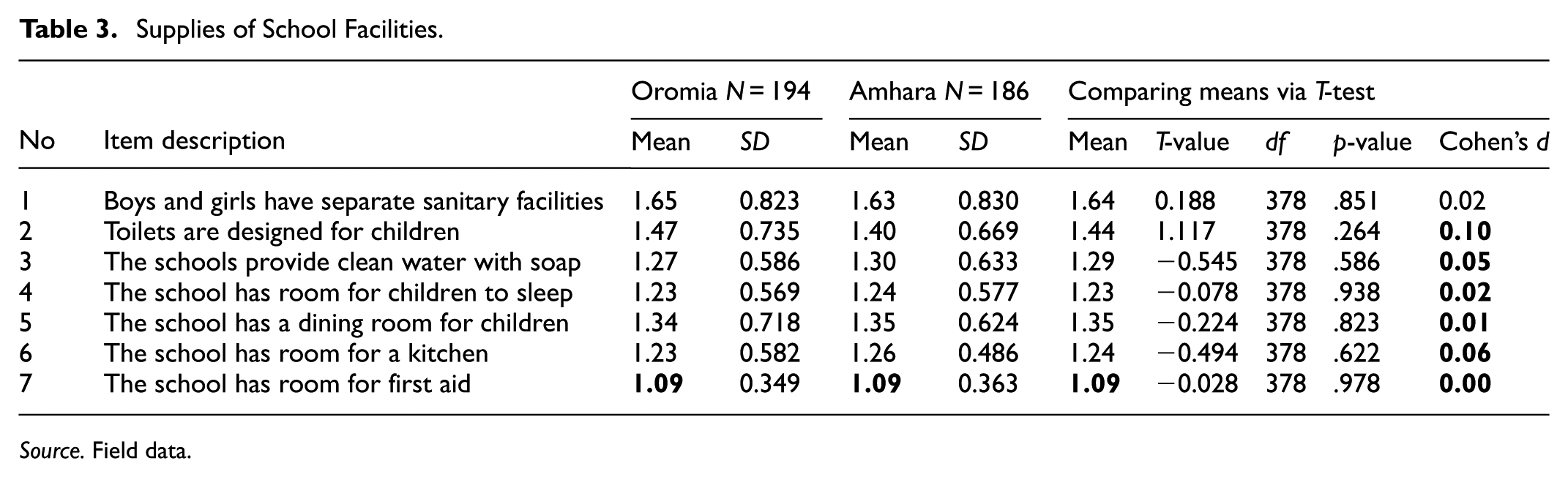
Seven school facility items were examined to determine whether there was a statistically significant difference in adherence to the national early childhood care and education standard between the Amhara and Oromia regions. The indicators were calculated using means and standard deviations, which are summarized in Table 3. The values in Table 3 were bolded to highlight the specific items with the lowest mean scores across the two regions, indicating the most critical areas of deficiency in classroom supplies.
Supplies of School Facilities.
Source. Field data.
Respondents rated several items related to facility provisions below the standard. These include boys and girls having separate sanitary facilities (mean 1.64), toilets designed for children (mean 1.44), and schools providing clean water with soap (mean 1.29). Similarly, the availability of rooms for children to sleep (mean 1.23), a dining room for children (mean 1.35), a kitchen (mean 1.24), and a first aid room (mean 1.09) were also rated as below-standard facilities. According to responses in Table 3 above, it is evident that the primary schools in both the Amhara and Oromia regions do not meet the requirements of the national ECCE standard.
Quantitative analysis revealed systemic non-compliance with ECCE standards across all school facilities (means: 1.09–1.64). Despite minor mean variations (e.g., Oromia scored slightly higher on toilets [1.47 vs. 1.40]), independent t-tests showed no statistically significant regional differences (all p > .05). Cohen’s d values (range: 0.00–0.10) confirmed these differences were trivial, suggesting that facility inadequacies are a nationwide crisis rather than region-specific. For instance, the near-zero effect size for first aid rooms (d = 0.00) underscores identical deficiencies in both regions.
To substantiate the quantitative findings, the researcher interviewed school principals from schools that scored low (1.09) on first aid availability, asking how maintenance budgets were determined and what competing priorities existed. One principal responded, What budget are you talking about? Children aged 4–6 are expected to rely on the primary school budget since their education is tied to it. The ministry allocates only 50 Ethiopian birr (0.38 dollar) per primary school student annually. Because of this, our priority is primary school students.
Additionally, district ECCE coordinators were asked how first aid policies were being operationalized in rural areas. One coordinator argued, “Thinking about first aid for children aged 4–6 is a luxury because the system has not allocated budget for them. It seems the policy fails to consider the realities of Ethiopia’s context.”
Quantitative and qualitative findings reveal a nationwide failure to meet ECCE facility standards, with all mean scores between 1.09 and 1.64 and no significant regional differences (p > .05; d = 0.00–0.10). Interviews confirm this systemic neglect: principals report that minimal budgets prioritize older students, leaving O-class children overlooked. District coordinators echo this, citing policy gaps and financial constraints that render first aid and other basic services for young learners unattainable, despite national guidelines.
Provision of Play Facilities
This section evaluates the availability and quality of play facilities in primary schools across Ethiopia’s Amhara and Oromia regions, focusing on compliance with national early childhood care and education (ECCE) standards for “O-classes.” Seven key indicators were assessed, with all receiving average scores below 2.0, indicating a widespread failure to meet minimum standards. The values in Table 4 were bolded to highlight the specific items with the lowest mean scores across the two regions, indicating the most critical areas of deficiency in classroom supplies.
Supplies of Play Facilities.

Source. Field data.
Specifically, the evaluation included the appropriateness of play and learning materials (mean = 1.49), adequacy of outdoor play areas (1.72), safety of outdoor surfaces (1.76), provision for children with special needs (1.28), structural safety of equipment (1.57), sufficiency of play resources (1.26), and maintenance and cleanliness of playgrounds (1.43). These results are presented in Table 4.
Mean scores ranged from 1.26 to 1.76, reflecting consistently inadequate provision. While Oromia showed slightly higher scores in areas like playground cleanliness (1.49 vs. 1.38), the difference was not statistically significant (p = .057, Cohen’s d = 0.16). Likewise, the provision of adapted materials for children with special needs remained critically low across both regions (mean = 1.28), with minimal variation (p = .157, d = 0.13).
These findings suggest that the lack of adequate play facilities is not confined to one region but reflects a systemic issue that requires national-level intervention. To understand the reasons behind these deficiencies—particularly the lack of appropriate equipment and accommodations for children with special needs—interviews were conducted with school principals and district ECCE coordinators.
One principal explained, “We consider O-class children as secondary customers since we are here for primary school students. These children lack dedicated budgets, and we lack the facilities to support them.”
Another principal added, “At district meetings, we’re told to support O-classes, but it’s mostly symbolic. Schools aren’t prepared to serve these children.”
A district ECCE coordinator elaborated on the systemic nature of the issue, “We assume that bringing children to school is better than leaving them at home, even when facilities don’t meet their needs. These schools were built for children aged 7 and up, not for early learners.”
Quantitative data shows critical deficiencies in play facilities (all scores < 2.0), with minimal regional differences. Qualitative insights reveal systemic neglect: O-classes are deprioritized, lacking budgets and age-appropriate infrastructure. Officials admit policies are poorly implemented, leaving schools ill-equipped for early learners. The disconnect between policy goals and reality highlights unmet needs due to institutional gaps.
Provisions of Qualified Personnel for ECCE
Under a provision of quality personnel, four items were presented to the respondents, and their responses are shown in Table 5. Primary school teachers in Amhara and Oromia were asked to rate whether the qualification of personnel for ECCE aligns with the national ECCE standards. Both groups of teachers from the two regions confirmed that the ECCE qualification does not comply with the national standard. For example, the respondents rated the items; teachers have a diploma in ECCE (1.87), supportive teachers have a certificate in ECCE (1.71), schools have certified teachers in special need education (1.33), and schools have trained health professionals (1.14). All the mean scores are below 2.0, indicating that the respondents believe that the qualification of ECCE personnel does not meet the requirements of the government standards (Table 5). The values in Table 5 were bolded to highlight the specific items with the lowest mean scores across the two regions, indicating the most critical areas of deficiency in classroom supplies.
Supplies of Qualified Personnel for ECCE.

Source. Field data.
The analysis reveals critical shortages in qualified ECCE personnel across both regions, with all mean scores falling below compliance standards (1.14–1.87). Independent t-tests showed no statistically significant regional differences (all p > .05), though ECCE diplomas approached marginal significance (p = .099). Crucially, Cohen’s “d” values (0.02–0.14) confirmed trivial effect sizes – even the largest difference (ECCE diplomas, “d” = 0.14) represents less than 1/7th of a standard deviation. This triad of evidence (substandard means, non-significant p-values, and negligible “d”) demonstrates that personnel qualification gaps are systemic rather than region-specific.
To corroborate the quantitative findings, the researcher interviewed school principals about why schools lack certified teachers for special needs students. One principal stated, “Primary schools do not have certified teachers for special needs students. At the moment, it is difficult to find them anywhere in the country due to a lack of training.”
Upon hearing this, the researcher asked how hiring decisions were made. The same individual explained, “We assign teachers who are tired of teaching primary school students to work with these O-class children. Since we lack the budget, we cannot recruit new teachers—and even if we had the budget, there is a shortage of certified special needs educators.”
Recognizing the severity of the problem, the researcher asked the district ECCE coordinator about policy concerns, such as how inclusive education policies were being implemented in rural areas. One coordinator replied, “The O-classes are designed to at least keep children in a safe school environment. It is difficult to accommodate special needs education without a dedicated budget. I believe the district education office should involve the community in this process, as the government alone cannot cover all educational needs.”
The findings reveal a nationwide shortage of qualified ECCE personnel, with all indicators scoring below standards and no significant regional differences. Effect sizes were negligible, indicating systemic gaps. Interviews confirmed that budget constraints and lack of trained staff force schools to reassign unqualified teachers to O-classes. Inclusive education policies remain under-implemented due to limited funding, highlighting the need for national reforms in teacher training, recruitment, and community-supported solutions.
Discussions
This study examined the adequacy of primary school resources for accommodating “O” classes in Ethiopia’s Amhara and Oromia regions. Using systems theory as a guiding framework, the study reveals that deficiencies in human resources, infrastructure, policy alignment, and financial support are not region-specific but systemic, indicating a broader national crisis in the delivery of early childhood education.
A central finding is the acute shortage of qualified personnel across both regions. Respondents reported limited access to trained teachers, support staff, health professionals, and specialists for children with special needs. These results echo prior studies (Mulugeta, 2015; Tirussew et al., 2009) that highlighted inadequate qualifications among early childhood educators in both public and private settings. Similar findings by Birhanu et al. (2021), Haile and Mohammed (2017), and Tigistu (2013) point to pervasive structural weaknesses in teacher training and professional development. From a systems perspective, such human capital deficiencies may contribute to a feedback loop in which reduced instructional quality contributes to disengagement, poor learning outcomes, and reinforced inequality (Burroughs et al., 2019; Jackson & Holzman, 2020; Mupa & Chinooneka, 2015).
Infrastructure challenges exacerbate these issues. This study found widespread deficits in clean and child-friendly facilities—particularly restrooms, sanitary accommodations for girls, and access to first aid. These deficits align with earlier findings (Tirussew et al., 2009), and correlate with health complications such as urinary tract infections and diarrhea (Sinmegn Mihrete et al., 2014; Vernon et al., 2003). According to systems theory, such environmental failings directly affect attendance and learning. Additional studies (Muhati-Nyakundi, 2022; Tirussew & Belay, 2016) confirm that poor sanitation and water access can reduce participation, particularly for female students. Luby et al. (2018) further connect water quality issues to illnesses that frequently disrupt school attendance.
Quantitative data reinforce these findings. Mean scores for facility adequacy were critically low (1.09–1.64), and no significant regional differences were observed (p > .05; Cohen’s d = 0.00–0.10), indicating national-level shortcomings. Stakeholder interviews revealed three converging issues: physical infrastructure gaps, severely limited budgets (as low as 50 birr or 0.38 USD per primary student), and policy failures, such as the omission of first aid from essential services. These factors interact in ways consistent with previous literature (Burroughs et al., 2019; Woodhead et al., 2017), showing how systemic infrastructure inadequacies compromise both health and academic outcomes.
Beyond infrastructure gaps, classroom environments—particularly for students with disabilities—highlight another dimension of systemic neglect. Mean scores for special needs accommodations (1.30) were the lowest of all measures, mirroring Tirussew and Belay’s (2016) reports of overcrowding (e.g., 130 students per classroom). Notably, no regional differences emerged (p > .05; d = 0.06–0.12), reinforcing that these are nationwide policy failures, not local anomalies. Interviews revealed that many schools were repurposed for O-classes without modifications for young learners, exacerbating inequities for children with disabilities—a concern previously raised by Birhanu et al. (2021) but still unaddressed.
These structural deficits are interconnected. Systems theory highlights how the failure of one subsystem—whether infrastructure, human resources, or policy—can cascade into broader institutional dysfunction. Jackson and Holzman’s (2020) analysis of educational inequality similarly identifies these interlocking failures as mechanisms that perpetuate systemic disparities, especially among vulnerable populations.
The lack of age-appropriate play areas and materials constitutes another major barrier. This study recorded low scores for playground cleanliness and equipment availability (1.26–1.76), with no regional variance (p > .05; d ≤ 0.16). Prior research (Haile & Mohammed, 2017; Tirussew et al., 2009) emphasizes that the absence of safe, stimulating play environments undermines physical, cognitive, and social development. Pellegrini and Smith (2004) linked play to cognitive skills such as problem-solving, while Ginsburg (2007), Rubin et al. (2016), and Brown et al. (2013) highlight its role in emotional regulation and stress management.
Policy context further complicates the picture. Paradoxically, the O-class program—designed to bridge urban-rural gaps—exacerbates disparities due to inadequate rural infrastructure and pedagogical unpreparedness. Heckman et al. (2010) argue that early childhood education is often seen as a luxury in low-income countries, a perspective evident in Ethiopia’s O-class design and implementation. A single preparatory year cannot substitute for a comprehensive 3-year ECCE curriculum (MoE, 2015), especially in schools lacking basic infrastructure and pedagogical readiness. Moreover, travel distance remains a structural barrier—young children often walk 3 to 4 km to school on unsafe roads, further limiting accessibility.
The broader national education landscape provides additional context for these challenges. As of 2021, over 2.2 million children aged 7 to 14 in Ethiopia remain out of school (MoE, 2021). Only 6.2% of Grade 2 and 3 students achieve reading fluency with comprehension (American Institutes for Research, 2019), and just 3.3% of secondary students scored above 50% on the 2022 university entrance exam. Rossiter et al. (2018) found that nearly half of O-class participants are under the target age of six, further stretching schools already unequipped for early childhood instruction. Tirussew and Belay (2016) caution that such integration may overwhelm existing systems and dilute the quality of education for all students.
This study advances the evidence base on Ethiopia’s ECCE crisis by demonstrating that resource gaps—from teacher shortages to hazardous sanitation—persist uniformly across regions (p > .05; d ≤ 0.16). While prior studies (e.g., Birhanu et al., 2021; Tirussew et al., 2009) documented similar challenges, our regionally disaggregated data reveal no meaningful progress in addressing these systemic failures. Crucially, the interplay of these deficits (e.g., untrained teachers + overcrowded classrooms + absent policies) creates a self-reinforcing cycle of inequity, as predicted by systems theory (Jackson & Holzman, 2020). Given this evidence, piecemeal interventions (e.g., isolated teacher trainings or latrine construction) are unlikely to succeed. Instead, Ethiopia’s O-class program requires a coordinated, multisectoral overhaul—one that prioritizes real-time data, age-appropriate design, and budget allocations aligned with children’s needs. Without such systemic reforms, the country risks perpetuating the very disparities the O-class initiative was meant to resolve.
Conclusions
This study highlights the critical challenges facing Ethiopia’s preschool childcare “O-classes” in rural primary schools across the Amhara and Oromia regions, revealing systemic deficiencies in qualified personnel, inadequate facilities (including sanitation and clean water), and a lack of age-appropriate learning resources, all of which hinder student engagement, academic performance, and overall well-being. Through a systems theory lens, these issues reflect interconnected subsystem failures—such as underfunded budgets, untrained teachers, and policy misalignment—that perpetuate educational inequality nationwide, with no significant regional disparities (p > .05). Overcrowded classrooms, unsanitary conditions, and the enrollment of underage children (4–5 years old) in primary schools further strain resources, undermining the effectiveness of O-classes as a substitute for the 3-year urban kindergarten program accessible to only a privileged minority. Stakeholder interviews underscore systemic neglect, with O-classes treated as “secondary priorities,” exacerbating disparities in early childhood development. To address these gaps, the study calls for integrated reforms, including targeted investments in teacher training and infrastructure, decentralized policymaking, and holistic frameworks aligning ECCE with health and social services. These measures are essential to break the cycle of educational inequity and ensure quality early learning as a foundation for Ethiopia’s future development.
Implications for Practice, Policy, and Research
Implications for Local Level Practice
This study highlights the urgent need to improve early childhood care and education (ECCE) resources in rural Ethiopia. Significant gaps exist in personnel qualifications, classroom facilities, sanitation, and learning materials for “O-classes” in the Amhara and Oromia regions. Practitioners should enhance early childhood educator training and the physical learning environment. Immediate interventions are needed, such as installing proper sanitation facilities and providing child-sized furniture and learning tools. District education offices, school administrators, and community stakeholders must prioritize these areas to ensure young children receive the foundational skills necessary for development, preventing ongoing educational inequality and underachievement.
Implications for Policy
This study reveals critical policy gaps in Ethiopia’s early childhood education. The expansion of “O-classes” in rural areas aims to bridge the urban-rural educational gap, but 1-year pre-primary education is inadequate compared to urban 3-year kindergarten programs. Policymakers must revisit the ECCE framework to address these disparities. Comprehensive reforms are needed to ensure equitable resource distribution and qualified personnel across rural and urban areas. This includes increasing budget allocations, incentivizing early childhood educator training and retention, and fostering partnerships with NGOs and international organizations to improve infrastructure, teacher training, and learning materials in rural areas.
Implications for Research
The study identifies several research areas needing further exploration. Longitudinal research is required to assess the long-term impact of current ECCE policies on educational outcomes in rural Ethiopia. Comparative studies between rural and urban settings could provide insights into bridging the education gap. Additionally, research should evaluate the effectiveness of various early childhood education models in enhancing academic, social, emotional, and physical well-being. Future studies should also examine the role of community engagement and local governance in supporting ECCE, and explore alternative education delivery methods, such as community-based preschools, mobile units, or digital tools, for hard-to-reach areas.
Implications for International Level
This study highlights the global challenge of providing equitable early childhood education, especially in low-income countries. Ethiopia’s shortage of qualified teachers and inadequate facilities mirrors issues in other developing nations. International organizations like UNESCO, UNICEF, and the World Bank can use these findings to promote inclusive policies for rural and disadvantaged populations. Global funding bodies should support infrastructure, teacher training, and resources to reduce poverty and inequality. Collaboration between donor agencies and the Ethiopian government could address funding gaps. This study also informs the global effort to achieve SDG 4, emphasizing the importance of early childhood education in low-income countries.
Limitation of the Study
The study has two key limitations. First, sampling bias arises from relying on teachers in university-based training, potentially excluding those in remote or under-resourced schools, while purposively sampled administrators may offer perspectives unrepresentative of frontline realities. Second, self-reporting and measurement constraints stem from using a 3-point Likert scale, which may miss nuanced resource disparities, and the risk of social desirability bias in responses. The lack of direct observational data further limits objective validation of reported conditions. These factors may affect the generalizability and precision of findings.
Footnotes

Ethical Considerations
This study adhered to strict ethical guidelines by ensuring participant anonymity, voluntary participation, and minimal risk (non-sensitive questions, 30–45 min time commitment).
Consent to Participate
Informed consent was obtained via written/verbal methods, and data were pseudonymized. Institutional approvals were secured, balancing societal benefits (informing Ethiopia’s ECCE policy for 59.7% of pre-primary learners) with participant protections.
Author Contributions
The author conceptualized the study, conducted all data collection and analysis, and wrote the manuscript in its entirety.
Funding
The author received no financial support for the research, authorship, and/or publication of this article.
Declaration of Conflicting Interests
The author declared no potential conflicts of interest with respect to the research, authorship, and/or publication of this article.
Data Availability Statement
The data supporting this study’s findings are included within the manuscript. No additional datasets were generated or analyzed beyond those presented