



Abstract
Contributing to recent work in the critical sociology of childhood, this article presents an ethnographic and discursive analysis of the multitude of cultural meanings associated with child-centeredness in US American early childhood education. Specifically, the article focuses on Waldorf education, a private educational alternative focused on “protecting childhood” from the perceived dangers of modern society. Although marketed as an alternative to the standardized and testing-laden environment of public education, the Waldorf philosophy has much in common with dominant US American ways of constructing childhood that reifies a Western, White, middle-class protected childhood as the most legitimate and healthy context of development. However, being “child-centered” does not necessarily mean the liberation of the child from regulatory discourses and practices; in fact, child-centeredness can often function to shape children in specific, adult-sanctioned ways. Instead, I argue, the field could benefit from a move toward discourses and practices of child liberation.
Introduction
This article contributes to recent work by scholars in the critical sociology of childhood and childhood studies (Burman, 2007; Cannella, 1997; Kincheloe, 2002; Lubeck, 1996; Steinberg and Kincheloe, 1998) who have conceptualized childhood as a constantly shifting, socially and culturally constructed category rather than a universal, unvarying fact (James and Prout, 1997; Kehily, 2008). Such an understanding, according to Kehily (2008), “offers the potential for interdisciplinary research that can contribute to an emergent paradigm wherein new ways of looking at children can be researched and theorized” (p. 1). Specifically, the article focuses on Waldorf education, a private educational alternative invented by Austrian philosopher Rudolf Steiner in 1919 and relatively common in the landscape of US alternative education. Steiner perceived significant problems with the educational system of his time, criticizing schools for “enshroud[ing] education with regulations and […] destroy[ing] the natural and essential authority relationship between adult and child” (Blunt, 1995: 20). Although Waldorf education is marketed and generally viewed as an educational alternative where children are liberated from the authoritarian constraints of public schooling, Steiner’s perspective reveals a lesser known reality—that Waldorf education, ultimately, reinscribes a hierarchical “authority relationship between adult and child” that regulates children in unexpected ways.
Marketed as an alternative to the standardized and testing-laden environment of public education, Waldorf education is instead focused on “protecting childhood” from the perceived dangers of modern society. In doing so, it creates a niche market of “alternative” parents attracted to the notion of protecting children from various perceived “threats” to childhood, including the tendency to “hurry” the child to learn academic subjects before they are ready, the influences of media and technology, the separation of children from the natural world, and the ever-present danger of sexuality and other “adult” themes, as I show in this article. The Waldorf philosophy taps into the larger, dominant cultural concern about the loss of innocence in childhood, which is blamed primarily on the increasing influences of media, technology, and advertising (Corsaro, 2003; Kehily, 2008; Kincheloe, 2002). Waldorf schools are created as sheltered environments away from the supposed dangers of the modern world, and within this shelter children are taught the ideals of cooperation, social responsibility, and reverence for beauty and nature.
Despite appearing “alternative,” however, in this article I argue that the Waldorf philosophy has much in common with dominant US American constructions of childhood, reifying a Western, White, middle-class protected childhood as the most legitimate and healthy. I argue that the Waldorf classroom teacher at the heart of this study, Rachel, used discourses of child-centeredness and developmental appropriateness to justify regulating Waldorf children in ways that privileged dominant experiences of childhood. In doing so, I focus on Rachel’s construction of the Waldorf philosophy, which inevitably takes on its own character due to Rachel’s own unique socialization and educational history. However, Rachel positioned herself as following the philosophy closely and reported that she engaged regularly in professional development at the local Rudolf Steiner College (RSC). RSC’s online application materials emphasize that a strong foundation in anthroposophy (the spiritual philosophy underlying Waldorf education) is a prerequisite to entering its teacher-training program (Wilson, 2014). Furthermore, Rachel expressed to me that she did not think that applying Waldorf education to the public schooling system would work, because it would force Waldorf teachers to abandon anthroposophy, which she viewed as extremely important for the development of children and teachers alike. Therefore, throughout the article I present Rachel’s perspective and the Waldorf philosophy as interchangeable, with the acknowledgement that some slippage between pedagogical ideals and local realities is to be expected.
Critical reconceptualizations of children’s development and learning
In critically examining the construct of child-centeredness in Waldorf education, this article contributes to recent work by critical scholars of childhood that rethinks the assumptions underlying Western early childhood education. This reconceptualization is occurring in the context of several key cultural, political, and social shifts: the postmodern turn that interrogates what we think we know about children, child development, and teacher preparation practices (Burman, 2007; Cannella, 1997; Lubeck, 1996), increasing globalization and the corporate construction of childhood that complicate the ways we think about children’s knowledge and learning (Kincheloe, 2002), and an array of empirical insights that reconceptualize young children as more sophisticated and capable than developmental psychologists once assumed (e.g. Repacholi and Gopnik, 1997).
This article draws from the anthropology of childhood (Lancy, 2008; Rogoff, 2003) and the critical sociology of childhood (James and Prout, 1997; Kehily, 2008), both of which make use of the postmodern process of epistemological deconstruction (Lubeck, 1996) to understand childhood as a social and cultural construction rather than an unvarying universal “fact.” With the postmodern turn in human development and childhood studies (Burman, 2007; Cannella, 1997; Lubeck, 1996) also came the understanding that children’s lives and developmental pathways vary considerably across cultures, that childrearing varies based on different developmental goals for children (Rogoff, 2003), and that conceptions of who the child is rely on parental ethnotheories (Harkness et al., 2000) that view children as innocent, vulnerable “cherubs,” as evil, mischievous “changelings,” or as adult-like “chattel” to be used pragmatically for economic gain (Lancy, 2008). These developments in understanding childhood have encouraged us to pay attention to the specific ways childhood is constructed in different cultural contexts, including the field of early childhood education in the United States. As Rogoff (2003) points out, the case of middle-class European American communities had long been overlooked as subjects of cross-cultural study because developmental psychologists and anthropologists predominantly came from these communities and viewed their own practices as natural rather than as social and cultural constructions specific to the unique developmental niche of the privileged dominant culture.
In alignment with critical scholars’ approach to decentering and deuniversalizing Western assumptions about children’s development, this article seeks to understand the ways childhood and relations of power are constructed and regulated in an under-researched type of alternative educational environment: Shining Star Daycare, a Waldorf daycare for children ages 18 months to 4 years in a university town in northern California, owned and operated by the main teacher, Rachel. Waldorf education, invented by Austrian philosopher Rudolf Steiner in 1920s’ Germany, emphasizes a vague notion of “protecting childhood” from the perceived dangers of modern society and theorizes child development as unfolding in 7-year developmental stages that when examined critically place limitations on understanding the capacities of young children and function to justify adult control of children’s activities (Wilson, 2014). This article combines an in-depth ethnographic examination of Waldorf early childhood education through participant observation with critical discourse analysis of documents from one Waldorf daycare, practitioner writings about Waldorf education, and an interview with Rachel. I argue that while Waldorf educators attempt to provide children with a very different experience than they would have in conventional early childhood settings, they do not fundamentally re-envision dominant US middle-class privileged notions of children as innocent, vulnerable “cherubs” (Lancy, 2008) who must be protected and controlled by adults. While attempting to reconnect children with nature, protect them from technology and overstimulation, and situate pedagogy in a spiritual realm outside of state curricula and accountability measures, Waldorf practitioners’ beliefs about children still fall under the dominant US middle-class child-centered philosophy, in which childhood and play must be nurtured (and, by implication, regulated) in specific ways for children to develop along an optimal trajectory.
Being “child-centered,” I argue, does not necessarily mean the liberation of the child from regulatory discourses and practices; in fact, child-centeredness can often function to shape children in specific, adult-sanctioned ways. The Waldorf approach, perhaps somewhat surprisingly, has much in common with the fundamentals of the mainstream paradigm of developmentally appropriate practice (DAP) specified by the US National Association for the Education of Young Children (NAEYC, 2009)—which has been critiqued from a variety of perspectives (Graue, 2005; Henry, 1996; Hoffman, 2000; Lee and Tseng, 2008; Lubeck, 1996, 1998). Although not the focus of this article, DAP provides the context from which it is possible to situate the Waldorf construction of childhood. As shown in Table 1, important similarities between the approaches exist: the reliance on a discontinuous stage theory of development that assumes the existence of critical periods and universal applicability, the privileging of play (though for different purposes), the importance of child-centeredness, and the pivotal role of the classroom teacher in setting the form and structure of the learning environment. However, important differences exist, which form the basis for the creation of a niche market contrasting with the public schooling model. DAP is unique in emphasizing the pedagogization of play (Rogers, 2010), the importance of school readiness, the reliance on Piagetian constructions of the child as a cognitively active learner, and the emphasis on Vygotskian scaffolding approaches in the preschool classroom. In what follows, I focus specifically on the philosophy of Waldorf education to set the context for my discussion of how childhood was regulated through discourses of child-centeredness at Shining Star Daycare. It is my goal to critically interrogate the dominant models of childhood found within conventional and alternative early childhood education spaces and to assess whether such conceptualizations of childhood promote or hinder the empowerment and liberation of children.
Comparison of Waldorf educational philosophy and DAP.
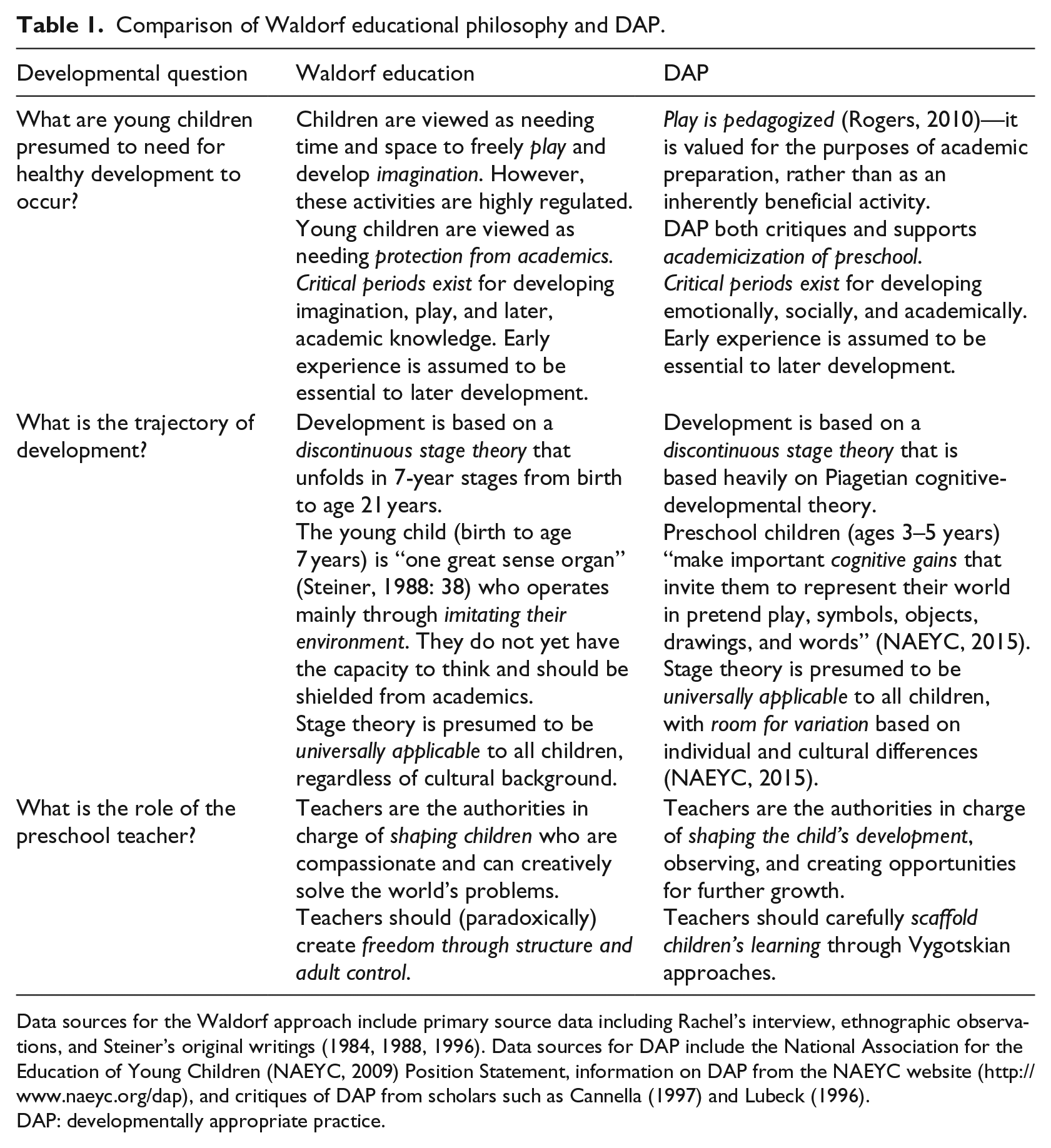
Data sources for the Waldorf approach include primary source data including Rachel’s interview, ethnographic observations, and Steiner’s original writings (1984, 1988, 1996). Data sources for DAP include the National Association for the Education of Young Children (NAEYC, 2009) Position Statement, information on DAP from the NAEYC website (http://www.naeyc.org/dap), and critiques of DAP from scholars such as Cannella (1997) and Lubeck (1996).
DAP: developmentally appropriate practice.
Waldorf education: “protecting childhood”
The main reason [to send children to Waldorf schools] is that Waldorf schools honor and protect the wonder of childhood. Every effort is expended to make Waldorf schools safe, secure and nurturing environments for the children, and to protect their childhood from harmful influences from the broader society. (Americans for Waldorf, 2008)
In the current era of increasing privatization, choice, and disparities in US schools (Hursh and Martina, 2003), it is particularly timely for anthropologists to “study up” (Nader, 1972) to better understand and critique the discourses and practices that circulate in these private, privileged educational spaces. Through “choice” mechanisms, privileged parents opt out of the public school system altogether and enroll their children in Waldorf education, supposedly a radical alternative to the dominant form of schooling in its focus on “protecting childhood,” exposing children to nature, and implementing a “developmentally appropriate” curriculum (Barnes, 1980; Steiner, 1984, 1988, 1996). This article begins to construct a critical analysis of Waldorf early childhood education in the context of discourses of “child centeredness,” “developmental appropriateness,” and conceptions of appropriate adult authority and control of young children. I argue that the vision of childhood that Waldorf education tries to “protect” is based on romanticized White, middle-class ideas of children’s nature and development that are far removed from the diversity and complexity of children’s lived experiences in the 21st century.
The Waldorf approach is based on a child-centered pedagogy, where child-centeredness is defined as an approach that “focus[es] on the developmental needs of the child, respect[s] the child as an individual, and provide[s] children with ample opportunities to exercise choice to develop a sense of individual agency” (Hoffman, 2013: 75). Such an approach, which is the norm in Western cultures such as the United States, exists within the larger societal construct of a neontocracy, where the attentions, institutions, and cultural productions of the society are focused on its youngest members, rather than its elders (Lancy, 2008). The individualism of the US dominant culture factors into the child-centered philosophy as well. While Tobin et al. (2009: 1) argue that “preschools are relatively new social institutions charged with the task of turning young children into culturally appropriate members of their society”—and, I would add, socializing them for appropriate participation in K-12 institutions of schooling—the phenomenon of child-centered early childhood education elaborates on the neontocratic model beyond socialization of children for school participation. This child-centeredness—particularly, the construct of “the child” at the center of this model—requires critical analysis if we are to understand the implicit cultural models of childhood that guide parenting and schooling in the United States.
The Waldorf model of schooling is based on a developmental stage theory, invented by Steiner, that unfolds in 7-year phases. In the first stage (birth–7 years), children are viewed as mainly concerned with play and imitation, and as not yet capable of thought; in the second stage (7–14 years), children are viewed as needing emotional and physical connections to their academic subjects through hands-on learning; and in the final stage of childhood (14–21 years), adolescents are viewed as needing intellectual stimulation (Steiner, 1988). Steiner, like Waldorf practitioners today, claimed that the Waldorf model of education is based on a “holistic” approach to children (Edmunds, 2004; Steiner, 1988) in which children are educated by means of “head, heart, and hands” rather than merely through academic means. This approach is based on Steiner’s critique of his contemporaries’ emphasis on intellectual thought to the exclusion of spirituality and feeling (Steiner, 1984). Steiner’s approach was to attempt a marriage of science and spirituality—what he called “spiritual science” or “anthroposophy”—that would lead to a more complete, holistic understanding of the human experience. Ironically, however, anthroposophy contains a very rigid stage theory of child development as unfolding in 7-year stages that imposes a unitary understanding of childhood rather than acknowledging the multiplicity of developmental pathways. For example, Steiner (1988) emphasizes the importance of the linear succession of a child’s learning to walk, talk, and then think. If these tasks are not learned in this particular order, Steiner argued, then future development will be compromised. Here, Steiner rearticulates the familiar “critical periods” discourse typical of mainstream theorizing (Cannella, 1997).
According to the Waldorf stage theory, academic learning, particularly literacy learning, should be delayed until children reach the second stage of childhood, at 7 years of age (Barnes, 1980; Edmunds, 2004). At this point, children are understood as “ready” to take on more intellectual demands but not mature enough for full intellectual engagement until 14 years of age. Instead of using textbooks, Waldorf students create their own drawings and representations of the material in notebooks of their own creation. Waldorf curriculum is presented in a “spiral with the subjects occurring and recurring in correspondence with the child’s maturity from year to year” (Barnes, 1980: 330). Waldorf educators claim that students learn the material more deeply this way, approaching it differently each time they encounter it because of the different developmental stage they are currently experiencing (Barnes, 1980). Lessons are organized in a “block” schedule, where the morning’s “main lesson” is an intensive extended period devoted to a single academic subject. The nature of this main lesson changes every few weeks. The main teacher stays with each class throughout the years of elementary school, celebrating the passage of seasons and years and developing long-term relationships with the students (Barnes, 1980; Leichter, 1980).
The early childhood context in Waldorf education is characterized by “protecting the senses” of young children, who are understood as not yet fully “awake” cognitively in their first stage of development (Rachel, 22 January 2007, Interview). Emphasis is placed on creating a calm, “home-like” environment in which children are protected from the busy modern culture of the outside world. Pastel colors, dimly lit rooms, flowing silks, toys made of wood, and nature artifacts from the current season adorn the Waldorf daycare setting. As in all Waldorf classrooms, no technology is to be found, as it is believed to distract children from fully experiencing their childhood and engaging in imaginative play. Books are also conspicuously absent, since children do not officially begin to learn to read until 7 years of age. A typical day in a Waldorf early childhood setting is characterized by a carefully timed schedule that includes regular meals, circle time, timed group trips to the bathroom, stories and songs, outdoor play time, a walk, art activities, nap time, and various chores—such as chopping vegetables—that the older children complete.
Waldorf early childhood education is intended to shelter children from the world and to return to a prior moment in historical time where children were not “hurried” to learn academic subjects until later in childhood. This notion of “not hurrying” the child at first appears to be an important counternarrative to the dominant US “racetrack metaphor” (Rogoff, 2003: 162) of development that values reaching developmental milestones at young ages as indicative of intelligence and later success. At the same time, it is also important to acknowledge that resisting the “hurrying” of children is in itself a privileged, White, middle-class notion of childhood as a protected stage where children are given the luxury of time to, in Rachel’s terms, “be free to play and live in to their childhood so that they really have a full experience by age seven, when they’re ready to sit down, they’re ready to sit down and really take it in” (Rachel, 22 January 2007, Interview). Here, the notion of not hurrying the child, somewhat ironically, is tied to later school success, as the best preparation for school is understood as having the luxury of time to “play and live in to their childhood.” Of course, school success is something that these White, middle-class children coming from college-educated families can look forward to, regardless of whether they are “hurried” or not. In what follows, I critique the Waldorf approach to early childhood education as resting on a particular notion of child-centeredness and developmental appropriateness that regulates childhood much in the same way that mainstream US American early childhood settings do, producing a child who conveniently fits and therefore reifies the (White, middle-class) Steinerian developmental stage theory.
Research setting and methods
The Waldorf setting from which the empirical data are drawn in this article, Shining Star Daycare, was composed exclusively of White, middle-class children. Children ages 18 months to 4 years attended the private daycare and were admitted after a trial period and a parent–teacher conference assessed the “fit” of the child and the family to the Waldorf environment, including a willingness on the part of the parent(s) to continue the Waldorf method at home. Rachel, the main teacher, and Caitlin, the assistant teacher, were both White, middle-class women and had both attended RSC and continued to educate themselves on Steiner’s philosophy. Approximately half of the children at Shining Star would continue on to attend the local Waldorf elementary school.
My negotiation of entry into Shining Star Daycare was facilitated by the parent of one of the 4-year-old children enrolled at the daycare, Annika, for whom I was providing childcare during my time as a graduate student. Annika’s mother introduced me to the main teacher, Rachel, who approved the study and assisted me with communicating with parents and requesting their informed consent to observe, but not interview, their children. This limited role was due, in part, to Rachel’s concern with protecting the children from any disruptions in their routine or play. At Shining Star, I was positioned mainly as a volunteer, as I helped with occasional tasks in between taking field notes in my notebook and participating at mealtimes and circle time. The analytic questions that guided data collection and analysis for the original study were as follows: How do Waldorf practitioners construct childhood and child development? What is the relationship between the Waldorf construction of child development and the power relationships between adults and children?
To investigate these questions, I utilized ethnographic methods (Carspecken, 1996; Denzin and Lincoln, 2008) focused on culture and relations of power between adults and children. Over the course of a 9-month period, I collected observational data in the form of detailed ethnographic field notes (Carspecken, 1996; Emerson et al., 1995) one to two times per week for a total of 22 visits of 1–2 hours each and collected documents and artifacts from within and outside the setting. These artifacts included writings about Waldorf education by Rudolf Steiner (1984, 1988, 1996) as well as present-day Waldorf researchers and practitioners (Barnes, 1980; Edmunds, 2004; Leichter, 1980). A key source of data that I draw upon in this article is an audiorecorded interview with the main teacher, Rachel, which I then transcribed and analyzed in conjunction with the emergent themes from the larger ethnography. The interview provided key insights into the way Rachel conceptualized Waldorf philosophy and how she approached her pedagogical practice.
I analyzed the data by following Glaser and Strauss’ (1967) method of constant comparative coding, constantly checking my concepts against any counterexamples that may point to alternative interpretations and checking each instance of coding with the ones that preceded it. In doing so, the frame of the hegemony of White, middle-class childhood in theorizing about children in the United States became salient. I compared the emergent themes to the larger cultural critique of the epistemological and ontological basis of early childhood education practice in the United States (Burman, 2007; Cannella, 1997; Lubeck, 1996, 1998) as well as critiques of DAP and child-centeredness (Graue, 2005; Henry, 1996; Hoffman, 2000; Lee and Tseng, 2008).
Constructing young children’s vulnerability and developmental (in)appropriateness
Field note, 16 February 2007
When she is finished setting up, Rachel comes back down the stairs again and starts talking to me about how there is a “9-year change” in child development. By age 9, she explains, “they come to earth” and start to feel separation between people that they previously hadn’t felt. The feel isolated and don’t have unity, she explains. She calls this process a “gradual wakening up” that continues in eighth grade and into adolescence. She says it has something to do with the development of the prefrontal lobes in the brain at this point in development, and that children must learn how to deal with these changes because otherwise it can lead to cynicism in high school. This cynicism is countered by studying lots of biographies of people who have done great things in the world to inspire children. You have to “feed their idealism,” she says. At this age, she says, turning to Sallie, who she is now holding in her arms because she is crying after Amber hit her on the head with a doll, you get “little windows of adolescence in how they respond to things” [presumably the present situation is an example of this], and you have to deal with them “in the right way” so that their development proceeds in a positive direction.
In the Steinerian stage theory of child development, the young preschool-age child is theorized in a way that romanticizes the experience of childhood and holds all children to the standard of White, middle-class innocent and protected childhood. Much in the same way that Piagetian and conventional psychology’s versions of childhood were “exported to the Third World” and thereby presumed “some kind of universal experience for all children” (James and Prout, 1997: 4), the Waldorf conception of childhood also universalizes children’s “needs” within a Western, middle-class child-centered paradigm. The Waldorf conception of young children universally represents them as fundamentally vulnerable, highly impressionable, easily overwhelmed, and not quite “awake” to the world until they enter the next stage of development, signaled by the change in teeth that occurs at approximately 7 years of age (Steiner, 1988). In short, children are theorized as in need of protection by adults above and beyond routine concerns for safety and universal needs for food, shelter, and love. As anthropologist of childhood David Lancy observes, “biology provides great latitude for culture to shape its ends” (Lancy, 2008: 8), and the Waldorf conception of childhood uses biological explanations to legitimate the cultural assumptions regarding children and their “needs” in a “child-centered” early childhood educational environment, as in Rachel’s neurologically based explanation of developmental needs in the field note above.
The vulnerability of children to an ill-defined set of threats is one of the fundamental components of the Waldorf understanding of childhood and society. Steiner (1996) critiqued his contemporary society for succumbing to “a materialistic attitude” (p. 2) and intellectualism at the expense of spirituality that, he argued, was leading to “the breakdown of our civilization” (p. 2). Steiner (1984) was also resistant to technological and scientific innovations, which he saw occurring at the expense of human intuition, imagination, and spiritual knowledge. Such resistance to technological and scientific innovations is preserved in the attitudes of Waldorf practitioners in the present day, who seek to shelter young children from technology such as televisions, computers, phones, and even clocks. Rachel shared with me that “there’s a lot of challenges to childhood these days,” invoking an image of childhood—and children—as an endangered species under threat of extinction. The main challenge to childhood, Rachel explained, is that “children come sometimes really overstimulated” by media and society, and that it is the Waldorf teacher’s job to figure out “how can we best soothe that” (Rachel, 22 January 2007, Interview). Rachel saw a particular danger in the influences of media on children’s play:
And then attitude, well, I see it with some, there’s some song from, I think it’s from, I don’t know, some Disney movie, and you can see how ((laughs)) inappropriate it is. Some of the movies that are supposedly geared for children, are for little children, it’s really adult humor a lot of the time, and they’re singing some song about, “I like to move it move it,” and it’s a real jivey kind of song, and these are three and four year old girls doing this kind of stuff. And I just say no, you can sing that somewhere else, because it gets them all going into this kind of thing that’s way out there, and also then they kind of lose focus on their play. So if there’s too much, if there’s conversations about movies or something, I try to let it go, if it’s going too far and they’re just focusing on that, I’ll try to bring it back to something else or I’ll start a story about an animal, something in nature that will redirect them back to something a little more childlike. […] You can’t totally screen it out, so how to keep in balance, you know? It’s their culture and they’ll have to deal with their culture, but how to protect them for a certain amount of time so that they can develop into whole children. (Rachel, 22 January 2007, Interview)
Here, Rachel constructs young children as vulnerable to what she perceives as a dangerous (adult) sexuality as portrayed in a particularly provocative song, “I like to move it” from the DreamWorks (not Disney) film Madagascar (2005). Rachel portrays the kind of play that emerges from engagement with such media as not developmentally appropriate for young children, a threat to their children’s more appropriate focus on play. Here, Rachel constructs some types of play—play that deals with “child-like” themes such as animals and nature (which, ironically, is what the film she references is about)—as more legitimate than play that deals with more mature, adult-like themes such as sexuality or “adult humor.” In this supposedly child-centered environment, where the children’s needs and interests take center stage, it is actually the adult legitimation of some play over others—rather than children’s exploration of the full range of play—that directs the Waldorf definition of childhood. The child here is constructed as an extremely sensitive, vulnerable being who is overstimulated and damaged by the outside world and must be soothed by the structure and process of Waldorf education to develop in a healthy way. This is much more teacher-directed than it would first appear.
Privileging critical periods and early experience
As Rachel explained in the excerpt from my field notes cited above, the Waldorf model of childhood is based on a notion that the young child is in a process of “coming to earth” from heaven and is not yet quite “awake” to the world. Childhood, according to Rachel, should be “dreamy,” connecting to the Waldorf notion that young children are not entirely capable of cognitive activity until the age of 7 years or later. She related to me an example of one of her sons, Charlie, who—in very non-Waldorfian fashion—had taught himself to read at the age of 4.5 years by reading the baseball box scores in the newspaper. She mused that because of this, he was “more awake,” and as a result, “he wasn’t a good player early on” (Rachel, 22 January 2007, Interview). Drawing upon a critical periods discourse here, Rachel discussed how, early on, Charlie lived in his head rather than in his heart (where young children are supposed to focus their energy) and had a difficult time being creative in play. She shared her perspective on the necessity of waiting until 7 or 8 years of age to introduce more cognitive tasks to children:
Well, um, right, they, you can push them to read early on, but ideally they’re more ready, neurologically, I think is the word, when they’re 7 and 8. So pushing them early, we’re creating different pathways, so we’re kinda, it’s a big question mark, what are we doing there by doing that? And what are they missing out on? So um, so it’s not that it’s, I guess the thing is, play is important, and reading is important, but they each have their, a better time, a right time to work on it, yeah. To have that opportunity. (Rachel, 22 January 2007, Interview)
Here, and throughout the interview, Rachel appropriates the discourses of neurological development and critical periods to justify the existence of Steinerian developmental stages and to support the Waldorf position of delaying academic learning until the second stage of childhood. She emphasizes that both the “head” (reading) and the “heart” (play) are important, but that there is a “right time”—in other words, a critical period—to develop each in sequential order. Cannella (1997: 65) critiques the critical periods discourse and argues that “the ways of focusing on early experience may disempower people and even ultimately limit human possibility.” Cannella argues that emphasizing the primacy of the child’s early experience can serve to place blame and social control on the mother (or, in Steiner’s case, the teacher) when development goes “wrong.” Such a perspective also divorces the different domains of development from one another and treats them as prerequisites for one another. In a typically Western, White, middle-class fashion, the Waldorf theory treats chronological age as a key marker of development (Rogoff, 2003), and, although academic learning is delayed for longer than in mainstream contexts, the ultimate goal of this practice is for the child to be able to “live in to their childhood … so that by age seven they’re ready to sit down and really take it in” (Rachel, 22 January 2007, Interview). Academic learning, then, is still the important ultimate goal of childhood development—not a surprising finding within the context of the privileging of formal schooling within Western developmental theorizing and research (Rogoff, 2003).
In addition to defining play in specific, adult-sanctioned ways, Waldorf educators also emphasize the child’s need for other creative activities such as movement, art, and music, but define these as needing to occur in specific ways and in a specific order. At Shining Star, the children’s art time consisted of a watercolor painting activity in which the children were restricted to using only one color. Using more colors would be too overstimulating for the children, Rachel explained. She also enforced silence at the table when children were painting (and during other activities such as mealtimes and circle time) by repeatedly encouraging the children to focus on the colors: “shh,” Rachel would say quietly, “the colors are talking” (field notes, 6 November 2006). She explained that
at this age I’m only doing one color, towards the end of this year those who are moving on to kindergarten, I’ll give them the opportunity to combine some colors, because in kindergarten they’ll start combining on their own, and then they get to observe, wow, yellow and blue, on their own they get to observe, that makes green. (Rachel, 22 January 2007, Interview)
Here, Rachel represents young children at preschool age as not being able to cognitively handle the combination of two different colors in a painting activity. She represents painting as an activity that must be regulated by adults to protect young children from sensory overload. At the same time, she also represents kindergarten-age children as Piagetian “little scientists” who learn through experience and manipulating color on their own. An interesting contradiction emerges here within this child-centered paradigm: while (kindergarten-age, and to some extent preschool-age) children are permitted to explore their experiences of color on their own, they must do so within carefully prescribed, developmentally appropriate ways that reflect adult perceptions of what children are and are not capable of at specific ages.
Framing adult authority and structure as child-centered
Culturally specific constructions of developmental appropriateness are also reflected in the large amount of structure, or “form,” that is created in the Waldorf school. Besides painting activities, the entire day in a Waldorf daycare is carefully planned so as to be heavily routinized and protect children from the burden of having to make too many decisions about what to do or how to do it (because they are not conceived of as ready for this kind of decision-making until at least 7 years of age). Rachel explained the highly structured day by arguing that “since the children know the routine, they’re now free to play and be themselves, they don’t have to worry about what’s coming, they know what my expectations are, and they’re free to be themselves” (Rachel, 22 January 2007, Interview). A contradiction emerges here between freedom and structure—the assumption is that children can only be free to play (in specific ways, of course) when adults provide a very structured environment in which this can occur. The Waldorf play environment is relatively free; in unstructured play times, children are often left to their own devices to negotiate the content and form of play, to resolve conflicts together, and to roam around the space freely. At the same time, the conception of the “ideal child” is strict and rigidly defined, leading to a situation where children are free to play, but only free within strict boundaries and definitions of childhood and play. Steiner argued that particularly in the second stage of childhood (7–14 years of age), the authority of the teacher is paramount, although an authoritarian approach also shows up in Waldorf early childhood education, where the classroom is perceived as decidedly “not a democracy,” in Rachel’s words (Wilson, 2014). Steiner’s (1988) contradictory argument is that the unquestioned authority of the teacher is necessary for children to develop into healthy, free human beings:
As far as the child between the change of teeth and puberty is concerned, authority is an absolute necessity. It is a natural law in the life of the child’s soul. And whoever at that particular stage has not learned to look up with a natural sense of surrender to the authority of the adults who brought him up and who educated him can never grow into a free human being. Freedom can be won only through voluntary surrender to authority during childhood. (p. 61)
Here, Steiner draws a direct connection between the experience of unquestioned adult authority in childhood and the development of freedom later in life, although “freedom” and “free human being” remain undefined. Steiner constructs his view of the necessity of adult authority as “natural law,” leaving little, if any, room for alternative explanations. The language in this passage is, in itself, strict and authoritarian: “surrender,” “natural law,” and “absolute necessity” imply that if parents and teachers do not follow this “law,” their children will never be “free.” This contradictory perspective on childhood freedom and adult authority permeates the Waldorf model (Wilson, 2014).
Shaping childhoods based on White, middle-class liberal values
The teacher’s role in Waldorf education, according to Rachel, extends beyond authority, structure, and protection of childhood, however. In a particularly interesting twist on child-centeredness, Rachel expressed that the goal of Waldorf education was actually to shape individual children to be compassionate, creative beings who can solve the world’s problems. In the context of her discussion of developing play (associated with the heart, and therefore compassion and creativity) in advance of reading (associated with the head, and therefore intellectualism), Rachel mused,
It’s harder to feed that part of the brain once the age is passed. It’s a little harder to develop that. That’s where compassion and understanding lie in the brain, so, that’s kind of interesting. What kind of people can we make? …. They create their own thing, which leads to that kind of creative thinking that we hope will help solve the world’s problems, we need that kind of creative thinking and we need compassion and so, to have compassionate people you need to teach in a different way. You don’t learn it rote, you learn it through art. (Rachel, 22 January 2007, Interview)
Here, Rachel’s discussion of critical periods opens up into a discussion of the adult role as not just protecting, but as actively shaping the outcome of the child’s development. Her use of the verb “make” reveals an active process of the adult using child-centeredness to intentionally shape the child’s personality and future in specific, adult-sanctioned ways. This theme is echoed in psychologist Kessen’s (1979: 818) critique that
child psychologists […] have taken the Romantic notion of childish innocence and openness a long way toward the several forms of ‘If only we could make matters right with the child, the world would be a better place.’ The child became the carrier of political progressivism and the optimism of reformers.
Waldorf education, fueled by White, middle-class liberalism, attempts to do just this.
Regulating children’s language at home and school
The parents’ role in maintaining the Waldorf approach to protecting and shaping children’s experiences is considered to be equally important as the teacher’s. One of the key components of the Waldorf philosophy is that the protection from media and academic learning must be extended into the home environment—an interesting reversal of the typical Eurocentric discourse of encouraging academic learning early on in the home to prepare children for the school years. However, the Waldorf conception of parent involvement is consistent with the Eurocentric view of the need for alignment between home and school practices—and that the definition of “best practices” in the home must originate with the values of the school environment. Ultimately, too, the forms of discourse expected at home are those that align most closely with middle-class discursive practices. Rachel shared her logic here:
I don’t know, I just think at home, the idea of not having media in the house or trying to limit it, will definitely increase conversation because you’re not watching this there, that you really, and reading, it would increase, should increase the amount of reading and conversation that goes on. Which would be better for language development, I would think. (Rachel, 22 January 2007, Interview)
Here, Rachel assumes that language development is directly threatened by media use. While it is the case that family conversation prepares children for the language-rich demands of school (Hart and Risley, 2003), Rachel overlooks the fact that media can also be language-rich and does not necessarily detract from language development, at least in the toddler years. The research evidence shows that language delays are found in infants ages 8–16 months who are exposed to media, while there are no significant effects of exposure to media in toddlers ages 17–24 months (Zimmerman et al., 2007). Regardless, Rachel presumes that the White, middle-class model of maximizing conversation and reading with young children is the model by which all children’s development should be measured.
In addition to privileging Eurocentric parenting methods when it comes to language, Rachel also subscribes to a specific, middle-class version of “politeness” that she believes is important for the young children in her daycare to be socialized into:
All the social language development that we try to model, you know, “please,” and we really work on manners, that’s really important for civilization ((laughs)) you know, that, some areas have gone by the wayside. And, an awareness of each other, but in the language, the connection, I’ve read that there’s a connection with movement, and our hands particularly, our limbs, legs and arms and hands, and the connections in the brain to language. (Rachel, 22 January 2007, Interview)
Again privileging a White, middle-class form of language development and leveraging the authority of neurological research, Rachel connects the notion of “civilization” to the development of “manners” in young children. At the table, I often observed children’s language being policed in this way. If children spoke loudly, spoke about anything having to do with modern technology, spoke about how things were done differently at home, or spoke during certain activities where silence was valued (at the table, or during painting), the teachers often responded by silencing children. For example, the song at the beginning of each meal—“welcome, welcome, welcome to our table, quiet, quiet [whispered], put your hands together”—explicitly socialized children into being quiet at the table.
Field note, 16 February 2007
All of the children are seated around the table, eating breakfast, and Rachel is at the head of the table. A new mother is also sitting at the corner of the table next to her child, Lianna, who will be joining Shining Star soon. Up until this point, the mother has been talking the most, telling about their life at home. Lianna whines, “I’m tired” and Rachel responds with, “I’m sorry, I understand” Angelica, meanwhile, is saying “I don’t like this,” referring to her food, and she says it three times before Rachel responds, saying simply, “we heard you.”
Here, when Lianna and Angelica spoke outside the frame of polite middle-class discourse, they were silenced by the main teacher, Rachel. Children were often reminded, especially at the table, to use their “golden words” or “golden manners,” which indexed White, middle-class politeness discourse. These manners included ensuring the use of “please,” “thank you,” “excuse me,” not speaking while someone else was speaking, and bodily surveillance such as holding utensils in the “correct” way, as in the following example from breakfast:
Field note, 13 November 2006
Caitlin serves the oats to the children and to me, asking each child if they would like some cinnamon on their oats (all of the children say yes). Gena, tasting the oats, says, “that reminds me of cinnamon apples,” and Caitlin, in the process of passing out the food, says, “excuse me, I’m talking” to Gena. When everyone is seated and eating, Gena begins playing with her food, and Caitlin says, “you may use your golden manners, Gena” and launches into a discussion of how “I see Sallie and even Joseph” are eating properly, and to “look at how Joseph is holding his spoon.” She then turns directly to Gena and says, “hold it how we do in school.” (Field note, 13 November 2006)
Especially within the context of mealtimes and other structured activities such as painting and circle time, children were encouraged to be quiet and to focus on the task at hand, and, if they chose to speak up, to do so in a manner considered “polite” or “golden” by white, middle-class discursive standards. In this way, the discourses and practices circulating in the Waldorf early childhood education environment served to legitimate a particular white, middle-class Eurocentric version of childhood—that of “what John Holt some years ago described as the mythic ‘walled garden’ of ‘Happy, Safe, Protected, Innocent Childhood’ which all children ideally inhabited (Holt, 1975: 22–23)” (James and Prout, 1997: 2).
From child-centeredness to child liberation
We teach courses in human growth and development as if we know what there is to know about other human beings. We function as if the questions have been answered; and we attempt to create children who fit within these answers. (Cannella, 1997: 46)
Through analysis of ethnographic evidence from Shining Star Daycare and Waldorf education documents from Rudolf Steiner and others, I have shown that Waldorf education reproduces many of the key assumptions of the conventional approach to early childhood education predominant within US society. Through a child-centered model that views the individual needs, desires, and actions of the child as central to the pedagogical process, Waldorf education—like conventional early childhood education in the United States—reifies the Western, White, middle-class ideal of the “mythic ‘walled garden’ of ‘Happy, Safe, Protected, Innocent Childhood’” of Holt’s analysis. Waldorf education romanticizes the young child as vulnerable and in need of protection, particularly from the dangers of media, cognitive overstimulation, and adult sexuality. While Waldorf education may appear to be child-centered in the sense of retaining a focus on play, in reality only certain types of play are sanctioned and viewed as evidence of “normal” development.
This universalization of children’s development and experience becomes problematic because “the construction of childhood actually reifies those who are younger into simple predetermined entities who are to be regulated, denying their human complexities and ambiguities, and their right to be heard and respected as equal human beings” (Cannella, 1997: 158). As Steiner (along with conventional developmental psychology) constructed childhood in universalizing ways, they missed the complexity of childhood and the right of children’s voices to be heard alongside those of adults. Constructing a prototypical child, Cannella (1997) and Lubeck (1996) argue, reifies the White, middle-class form of childhood while silencing the experiences and perspectives of children whose development does not look or feel the same.
Waldorf education, while claiming to be child-centered, ultimately relies on more teacher-directed methods than they would originally appear to proclaim. Child-centeredness in this case, therefore, is ultimately not about child empowerment and liberation. Instead, it is about creating and reifying a particular type of child, and then regulating children in a way that fits the White, middle-class model of safe, innocent, and protected childhood. If early childhood education, both conventional and alternative, is to become truly focused on the goal of social justice, then definitions of childhood and child-centeredness must be broadened to include all possible pathways of development, not just the White, middle-class version. As Cannella (1997: 165) argues, “to hear younger human beings, we must challenge our conceptions of them as the Other, those who are heard only within the constructions that we have created of them, or those who cannot speak for themselves.” This requires moving from a notion of child-centeredness to a notion of child liberation. Such a vision can only be crafted in collaboration with, rather than on behalf of, children from all walks of life.
Footnotes
Funding
The author(s) received no financial support for the research, authorship, and/or publication of this article.