



Abstract
In accordance with the white patriarchal foundations of the early childhood education field of the global north, Chile’s early childhood education has a colonial and androcentric origin which has been left unquestioned. Reviews of Chilean early childhood education omit/ignore other socio-political agendas, such as class, gender, and ethnicity that still shape the current landscape. This article reconstructs the foundations of Chilean early childhood education through a reconceptualized mestiza history of the present. This approach challenges the neutrality of Chilean early childhood education and seeks to reclaim it by examining the underpinning regimes of truth that re-colonize children and women moving within and inhabiting the field. Analyses show how two main strands shape(d) early childhood education and care: social (and currently, multiagency) policies, and curriculum and pedagogy. The relationship between these strands has been recursive and contradictory and overlapping over time. However, their mixture creates an illusion of literal transposition as a syncretic effect, which under close examination exposes its fault lines.
Keywords
Introduction
(…) a set of upper class aunties created the group Mazapán, inserting in TV the didactic of the kindergarten to cheer up the smurfs. They were five or six blonde aunties that conquered kids’ TV audience with their refined guitar play. In this Eden of good boys and pink girls, there was no space for Indian witches, nor unrefined and ugly princesses. Everything was sweet marzipan, which is a type of confectionary eaten in the upper-class neighborhoods, where these good looking and skinny fairies handed charm and fantasy to the rich infancy. There was too much kindness of a drama-less queen in these sweet-gazed university-educated girls. The complex space of childhood seemed reduced to nothing more than a merengue sky, where Mazapán aunties trilled their small moral catechism which has dumbed down children with so much tiruli and cuchuchú. (
Lemebel, 2003
, personal translation)
Mazapán (spanish 1 for marzipan) is a chilean children’s music band composed by female artists who, since the late 1970s, have proposed a different musical panorama for children. All its members are qualified musicians who articulate different instruments, musical genres, and styles, with “child-friendly” lyrics involving children’s experiences and interests, for instance, animals, pretend play, manners, or habits. Mazapán’s music permeated the childhood of several generations (including mine), particularly throughout the dictatorship in Chile, and it still is extremely popular in nurseries and among parents. However, as Lemebel (2003) rightly notes in the quote above, this was a privileged group who succeeded during the dictatorship period in drawing on available imaginaries, of how children, childhood, and educators (tías 2 ) should be.
This article reconstructs the foundations of chilean early childhood education (ECE) through a mestiza reconceptualization of a history of the present (Foucault, 1977), to challenge the official ECE narrative. Unpacking how the incidents of socio-historical processes still shape the present is a strategic move to problematize the categories used to differentiate child and female subjects and regulate them. To do so, I draw on an eclectic mestiza toolbox of theories and research approaches, and inspired by three authors (Huinao, Montecino, and Lemebel), I trouble the historical foundations of chilean ECE, challenging its neutrality and seeking to reclaim it by examining the underpinning regimes of truth that re-colonize any person moving within and inhabiting the field. This analysis shows how two main strands shape(d) early childhood education and care (ECEC): social (currently, multiagency) policies, and curriculum and pedagogy. However, their mixture creates an illusion of literal transposition as a syncretic effect.
Syncretism illustrates how particular colonized cultures have forcefully appropriated rituals and systems of belief, by articulating them with their own (Montecino, 1997). These combinations are not an exact replica and become naturalized through time by the hegemonic (re)production in everyday practices. Nevertheless, their normative character is subverted by the same meanings that are supposed to be suppressed. Additionally, syncretism has a subversive potential because its everyday appropriation and adaptation unlocks possibilities of transgression.
Echoing this syncretic effect, the article’s main headings represent traditional children’s songs, as a leitmotif, acknowledging both its historical rooting and the syncretic rationale that reconceptualizes (appropriates and modifies) them. For instance, the title of this article is a reconceptualization of a traditional “ronda” 3 by Ana Tijoux and Shadia Mansour (2014), 4 where they acknowledge the racial (white horse) aspect of this song and expel it back to its own origin.
Finally, this article aspires to enact a form of reconceptualization of ECE capable of considering other socio-political agendas, such as class, gender, and ethnicity. Therefore, it illustrates how the current curricular framework of chilean ECE (MINEDUC, 2001a) is constituted by a mixture of diverse and even contradicting discourses which have in common the control and (re)production of (child and female) subjects.
Arroz con leche, la señorita sabe coser, sabe bordar, pero no se quiere casar. An eclectical mestiza toolbox

This article is influenced by “Borderland-mestizaje feminism” (BMF, Saavedra and Nymark, 2008). Understood as an “extension of knowing and being” (Saavedra and Nymark, 2008: 78), BMF acknowledges how inquiry is embodied and performed. As a tool, it opens a site to embrace feminist poststructural theories and to challenge and reconstruct them toward more inclusive and transformative approaches.
Prompted by Koro-Ljungberg’s (2012) call for the creation of new methodological spaces, this article seeks to challenge how research narratives are traditionally done and presented. The linear narrative of the article has been maintained, but the format is transformed through the juxtaposition of diverse texts, theory, language(s), and images, in a process of nepantla (Anzaldúa, 1999). Nepantla is a Nahuatl term that Anzaldúa appropriated to talk about the liminal and confusing spaces we inhabit and travel through a “place of possibility where we gain insight from our insider/outsider subjectivities” (Calderón et al., 2012). It also enables us to rethink links between past~present and how we can inhabit both our practices and reading of history. Living in nepantla reminds us to learn from our borderland experiences (Delgado Bernal et al., 2012): I am a mestiza. I am a “kiltra”
6
nepantlera, because my “chilean” contradictions enable me to navigate within and through different subjectivities, spaces and times. I write from~within
7
the borderlands.
Inspired by Anzaldúa’s work and writing style, the format of each section aims to “enact an interrogation” (Berila, 2005) of our taken-for-granted ideas about ECE. I explore how to “give up the notion that there is a ‘correct’ way to write theory” (Anzaldúa, 2009a: 73), entangling different text formats that call for a flexible reading processes, and to examine our own relationship with the theories and topics raised by this inquiry.
By creating an eclectic theoretical toolbox, poststructuralism, and Chicana feminismos, there is a deliberate aspiration to provoke and to “rupture rigid binary and hierarchical thinking” (Calderón et al., 2012: 514). Following Foucault’s notion of toolbox (Fenech and Sumsion, 2007), methods are not applied as doctrines, but are re-assembled. Notwithstanding the amalgamation with white western theories, as a kiltra nepantlera I position myself and the discursive frameworks this article draws upon, within several, overlapping and contradicting worlds. It aspires to reclaim pedagogies that acknowledge the fluidity of young, gendered, sexual, classed, and mestizxs’ subjectivities.
The (re-appropriated) methodology acknowledges the hybridity of knowledge production and the discursive positions of the subjects involved (Meloni González, 2012). Methodological mutations aim to subvert research practices that invisibilize the nos/otras (Us/Them, Anzaldúa interviewed by Keating, 2006) in inquiry. In other words, how “we’re in each other’s world, how we’re each affected by the other, and how we’re all dependent on the other” (Saavedra and Nymark, 2008: 268). This approach may appear messy, but it is a deliberate decision to open and shift our ways of thinking: Re-clamo mi experiencia y conocimiento(s) de la educación parvularia, infancia y la profesión. Aunque me vea blanca, esta mezcolanza abre espacios para examinar(nos). I (ab)use language(s), mezclo géneros and types of evidence
Through reconceptualist approaches (Bloch et al., 2014; Kessler and Swadener, 1992; Pinar, 1998; Taguchi, 2006; Taylor, 2011), ECE can also become a site from where to transform unjust conditions and practices (MacNaughton, 2005), which promote the fabrication of hegemonic subjectivities. However, Salazar Perez and Saavedra (2014) and Salazar Perez (2015) have foregrounded how the (white) homogeneousness of the (reconceptualist) ECE field invisibilizes poor, and (post)colonial perspectives. Their urgent call to acknowledge difference resonates with Lorde’s (2003) incitement to use it as a source of polarities that can enable creativity and dialog.
These critiques are relevant for the chilean context, as a constant long-term investment in ECE has been made as a remedy for social inequality and exclusion (OECD, 2009; UNESCO, 2009). Drawing on Pinar (1995) and Popkewitz’s (2012) theorization, the following section presents the current landscape of chilean ECE. Schooling, curriculum, and political reform will be frequently articulated and will also draw on Foucault’s notion of populational reasoning, suggesting how the production of children who need rescuing has been developed to justify the creation and promotion of ECE, and consequently intervention and the shaping of subjectivities following eurocentric, white and male standards.
En la Ronda de San Miguel, ella se ríe y NO irá al cuartel. The present of chilean ECE
The chilean education system is composed of four levels: ECE/Educación Parvularia (from birth to approximately 6 years), primary education (8 years in duration, compulsory), secondary education (4 years in duration, compulsory), and higher education. The ministry of education (MINEDUC) is responsible for policy design and funding of ECE and divides it into three sublevels organized according to age. The names of the sublevels referenced development and growth phases (e.g. Sala Cuna—Crib Room; Medio Menor/Mayor—Lower and Upper Medium; Transición—Transition). In recent years, ECE has become a state priority, and both the OECD (2009, 2011) and UNESCO (2009) have acknowledged the continuous coverage expansion, emphasis on quality in its services, and its comprehensive approach within the last 20 years (Staab, 2013; Umayahara, 2011).
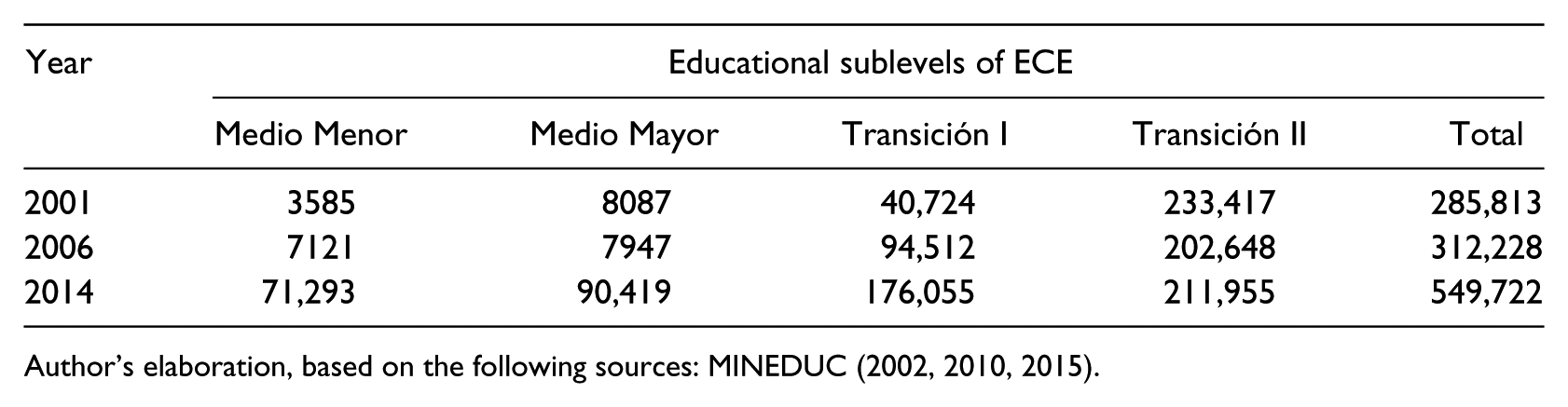
Author’s elaboration, based on the following sources: MINEDUC (2002, 2010, 2015).
Chile has been widely celebrated for being the first country in Latin-America to expand ECE to the general population (Adlerstein, 2012; MINEDUC, 1998; Peralta, 2011). Latest figures from MINEDUC (2015) indicate that 247,361 children (6 months to 4 years) are enrolled in public and publicly subsidized ECEC centers. Overall, there are 4151 ECEC centers, 1711 of which are publicly subsidized by JUNJI and 58 by INTEGRA, 8 representing 42.61% of the total. JUNJI (state organization) and INTEGRA (private foundation with public funding) are two autonomous institutions that offer services from Sala Cuna Menor to Medio Mayor (3 months to 4 years). Nurseries from both organizations are the main providers of free ECE for children whose families have been assessed as vulnerable and poor.
Social and educational policies in EC
The chilean ministry of education argued that the spirit of the reform aimed to ensure equity and quality in the system (MINEDUC, 1998), partially in response to the economic shift in education (Avalos, 1996; Leiva, 2017). For Apple (2010), current reform trends show that they are generally driven and highly influenced by globalized economy and market needs. Specifically, in ECE, Ailwood’s (2008) analysis of the australian context explores how educational reforms are entangled with different discourses and liberal economic purposes. She discusses how ECEC practices became public and “subject to accountability, quality and efficiency measures” (p. 536), to target the most vulnerable population and ensure quality of services. This evidence is important to critically engage with the Chilean socio-political and economic context which impacted on the rapid transformations ECE has faced in the last decade.
The trajectory of the current EC curriculum intersects with the social trajectory of the Chile Crece Contigo program (Chile grows with you, CCC), sharing similar (scientific) foundations and purposes. This program was made possible because of the educational reform begun in 1996, which involved all educational sectors and for the first time included specific measures for ECE. As a national comprehensive multiagency program, CCC offers protection to young children “as of their first gestation medical check-up in the public health system” (Peralta, 2011). This program integrates social, health, and education policies and services for the vulnerable segment of the population.
ECEC is institutionalized as a nodal point where health, social, and education policies intersect (Staab, 2013). CCC pushes a political agenda that makes this intersection evident and emphasizes the production of a narrative of a democratic society with understandings of the child and ECE. This article argues that understandings of “the child” and ECE follow a (post)colonial trajectory in which white, heteronormative, classed, and machista conceptions are already installed.
The concept of comprehensive in ECEC
The concept of “comprehensive” (holistic) informs both social and educational strands and legitimates practices that affect subjects’ lives. For instance, it was promoted as a curricular modality (“Currículo Integral,” Peralta, 1987) aspiring to capture all the humanist elements of ECE precursors, progressive education, and developmental trends. Later in 2001, the national curricular framework (CFECE; MINEDUC, 2001a) used the notion of “integral”/comprehensive education to promote well-being and development (UNESCO and MINEDUC, 2004) and was further reinforced with complementary curricular documentation (Learning Progress Maps, MINEDUC, 2008) and multiagency policies encapsulated in CCC (Frenz, 2007; Staab, 2013).
In 2014, the state drew again on the comprehensive signifier when installing a legal framework that guaranteed the right to quality ECE for all children, stimulated families’ commitment to (their?) children’s early learning process, and the improvement of the “coordination and efficiency of state’s efforts and resources” (MINEDUC, 2014, personal translation). This investment implied universalizing access to ECE provision in publicly subsidized nurseries.
Both curricular and social trends of comprehensive education/services/development are responses to broader international (economic) trends (Salazar Perez and Cannella, 2010), and in this case, their implementation responds to the particularities of the chilean educational context. They establish a truth (Foucault, 1982), which shapes educational realities and lives of subjects. Chile’s recent history of colonization and now neo-colonization by global neoliberal discourses operating through local ones (Quijano, 2000) demands that we look at what discourses are available in chilean ECE (Galdames, 2011). “Tías”/aunties (female EC educators) follow the curricula to enact the micromanagement of children (their development, learning, and behaviors) and become accountable for this production (Ball, 2006), while also responding to socio-cultural expectations of the (progressive) female career: Yo fui~soy una tía. My classroom, children and familias were one of the numbers. We didn’t dimension how our existence within the space of the nursery was calculated and shaped. No teníamos mesas, ni extintores, ni agua. Pero fuimos inaugradxs con bombos y platillos. Niñxs “Chile Crece Contigo” llegaban certificadxs a ser matriculadxs, mientras otrxs, “sólo” vulnerables, quedaban en lista de espera. Competíamos. Por. (Sobre)vivir. Between the state’s demands, everyday care and the precariousness of a subsidized nursery, I was torn. Navegamos simultáneamente en diferentes momentos socio-políticos e históricos.
Corre corre la guaraca, quienes miran para atrás no se dejan pegar en la pelá. History of the present: colonialism and romanticism in the chilean ECE context
What happened to make young children and their (need for) education an issue for state consideration and intervention through curriculum and institutionalized schooling? To resist thinking about this question in a purely linear manner, this analysis draws on Foucault’s idea of history of the present (1977). He claims that it is critical “to know the historical conditions which motivate our conceptualization. We need a historical awareness of our present circumstance” (Foucault, 1982). However, this notion will be reconceptualized considering the ideas of other female writers. Graciela Huinao, Mapuche poet, explains that “in Chile there are two histories that walk parallel paths. (…) At the end, who tells the history of the Mapuche people, is the [c]hilean people” (Huinao, 2012). Similarly, Montecino’s anthropological research (2010) provides evidence to support Huinao’s statement. Additionally, I draw on Lemebel, a chilean queer chronicler, novelist, poet, performer, and activist. He wrote several fictionalized chronicles which, based on historical archives, highlighted the indigenous, homosexual, and female narratives in official historical accounts, as an attempt to “queer” hegemonic heteronormative, androcentric, white, and male chilean history (see, for example, Lemebel, 2013). These writers inspired me to think and revisit the past through a diversity of genres and resources.
To understand the present of ECE, this article examines how current conditions were made possible because of their origins in chilean history. To unpick how the incidents of these socio-historical processes still shape the present is a strategic move to locate individuals in discursive spaces and to problematize the categories used for the discipline of subjects and their self-regulation (Popkewitz and Brennan, 1998): Perhaps the only thing I can say is about the written intention from a body that has not been politically inaugurated in our continent, for it to babble shared signs and scars. (
Lemebel, 2000
)
ECE in Chile was first directed toward privileged populations, for instance, german settlers (JUNJI, 2006), while simultaneously the catholic church provided services to poor children in the second half of the 19th century (Peralta, 2012, 2016). For both privileged and vulnerable populations, ECE was framed within romanticist thought: froebelian and pestalozzian, both heavily influenced by Rousseau (Cannella, 1997; Peralta, 2008) and functioned under christian salvation themes (Rojas Flores, 2015). Public state-funded institutions were based on catholicism, and froebelian (protestant) philosophy was the foundation of the german settlers’ kindergarten (Figure 1). These two experiences constitute the pedagogical and curricular basis of chilean ECE to this day. Peralta (2012), one of the most important scholars of the chilean ECE field, recounts in chronological order the different shapes and influences the chilean ECE and its curriculum have taken. She offers an illustrative example of how pedagogical practices based on romanticized notions of “the child” are still positively promoted or evaluated in positive/negative binaries. For instance, she declares children as intrinsically free, and that schooling and the introduction of skills is negative and detrimental to the natural need for free play.
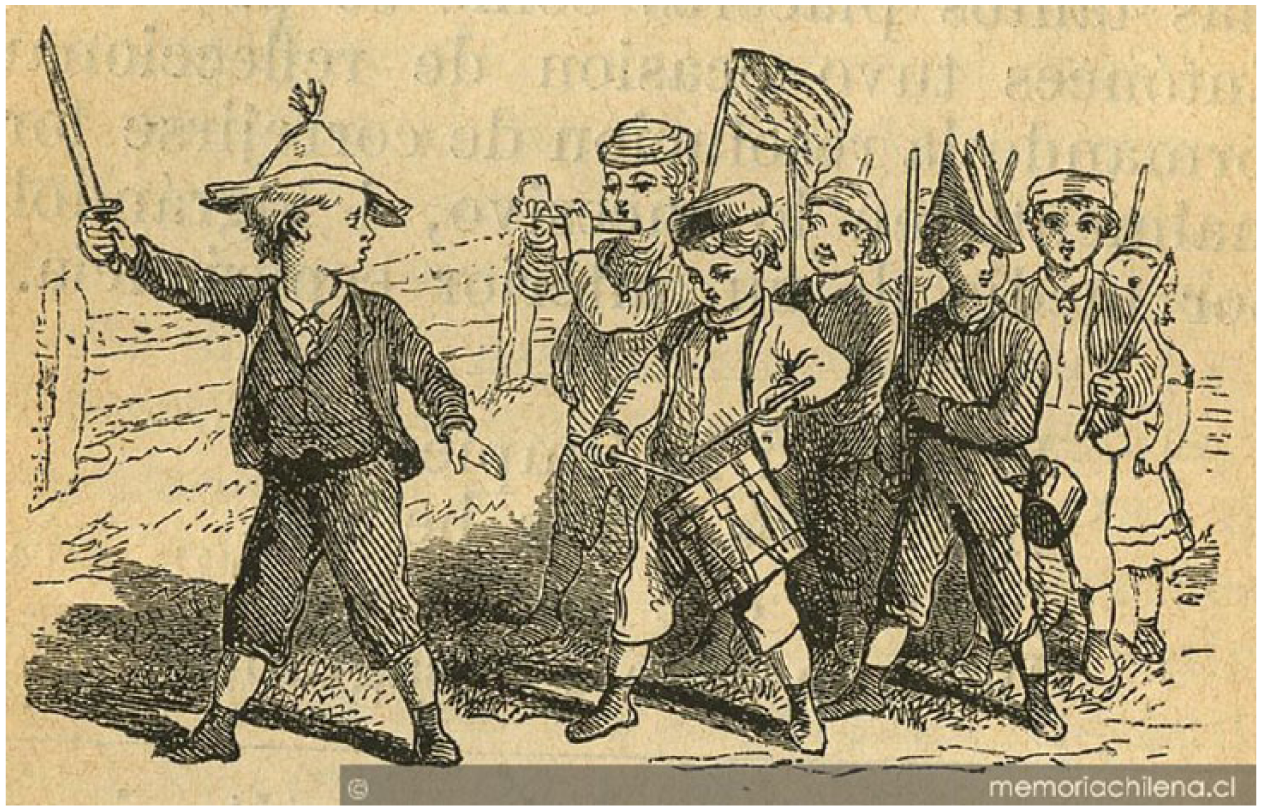
Niños jugando a ser soldados [Children playing to be soldiers] . Available at Memoria Chilena, Biblioteca Nacional de Chile; image retrieved from: http://www.memoriachilena.cl/602/w3-article-86287.html. Accessed on 12/4/2017.
The state as a “carer”
In countries like England, France and Germany, the state is a careful gardener who sees in each child a delicate plant which will become later a robust tree in the jungle; and which needs to be held, fed and strengthened. (Extract from “Ultimas Noticias” Newspaper, in
Illanes, 1991
)
Rojas Flores (2010) explains that by the end of the 19th century, chilean modernization and development had a direct impact on the creation of the first social policies. Actions of the state and the private sector were combined to offer services to children. Although or precisely because it was argued that a population’s morality depended on economic and social elements, education became the chosen vehicle (Illanes, 1991).
Toward the turn of the 19th century, and based on assessments of the little worth and immorality of the “Chilean population” (Vicuña Mackenna, 1865), european colonies (particularly german and english) were invited by the chilean government to settle in Chile and improve its culture and population. The importation of progressive agendas was promoted, like the construction of the first steam train (Bizzarro, 2005) and the control of the Mapuche people in the south. The Araucanía territory was pacified (Millán, 2011; Sosa, 2015) from Mapuches by homogenizing the population into a chilean (whiter) one. Similarly, a few decades later parliament discussed the necessity of “pacifying” the (deprived) youth population (Illanes, 1991). Mestizaje (racial and cultural mixture) in Latin-America became in some cases a strategy for whitening the population, and it was considered necessary for nation-building (Quijano, 2000). Montecino (2010) explains that these efforts to modernize Chile “tended to ‘pull thick veils’ over our cultural mestiza reality” (p. 93).
For Millán (2011), the Mapuche muteness in historical narratives like this one is based on the contradictions a Mapuche cosmovision could bring to a colonial, patriarchal, and racist worldview. She suggests that historians’ silence has made them accomplices of eurocentric trends, therefore not acknowledging how parallel narratives and articulations have constituted our current (whitewashed) cultures.
The creation of the state-funded chilean public schooling (Rojas Flores, 2001) and the first public popular EC services (Peralta, 2012) were tightly linked to modernist notions of the rational individual (Redon and Angulo Rasco, 2015) and progressivist curriculum design and implementation. These parallel trajectories entwined to produce a new way of thinking about the identity category of “the child” and “the (female) educator,” who they are, and must become.
Salvation themes were re-inscribed toward the state, and romanticist thought, embodied as froebelian and montessorian curriculum (Peralta, 2012), was the educational discourse binding both strands. “Populational reasoning” was established as a way of thinking about a chilean population—(deprived) youth and women—which was not being controlled or profitable/useful for progressivist agendas. In this sense, Montecino (2010) argues that historians’ reconstruction of Chile’s creation as a nation made classist categories intersect with ethnicity to establish a way of being chilean: “The created imagery by these historians define the national men as white” (p. 119, personal translation).
The discourse of the “chilean child,” informed by all the previously mentioned ideas, was put into force through the institution of schooling. For instance, Maluschka introduced in Chile the froebelian approach, also creating the foundations for EC initial teacher education (Muñoz, 2014). It is interesting to notice Maluschka’s “appropriation” of Froebel’s “gifts” (a series of didactic materials): she “chileanized” these by painting them in the colors of the national flag (white, blue, and red). Patriotic symbols for nation-building were painted upon european and white discourses of “the child,” “the educator,” and education.
The universalization of “the child” also links to her production as a social being. Similarly, Hultqvist and Dahlberg (2001) state that the curricular discourses which made “the child” knowable and disciplined were hybrids circulating in europe and their colonies from the 17th century onward.
Note the similarities in the previous images (Figure 2 and 3). They represent Chile’s colonial history (from the 16th to the 19th century) reflected in chilean ECE. Assumptions of “domestication” of inferior primitive people, chilean mestizxs, specifically children, through education~salvation, legitimized and perpetuated similar knowledge through post-colonial trajectories in an independent, modern, and liberal republic of the south (Quijano, 1992).
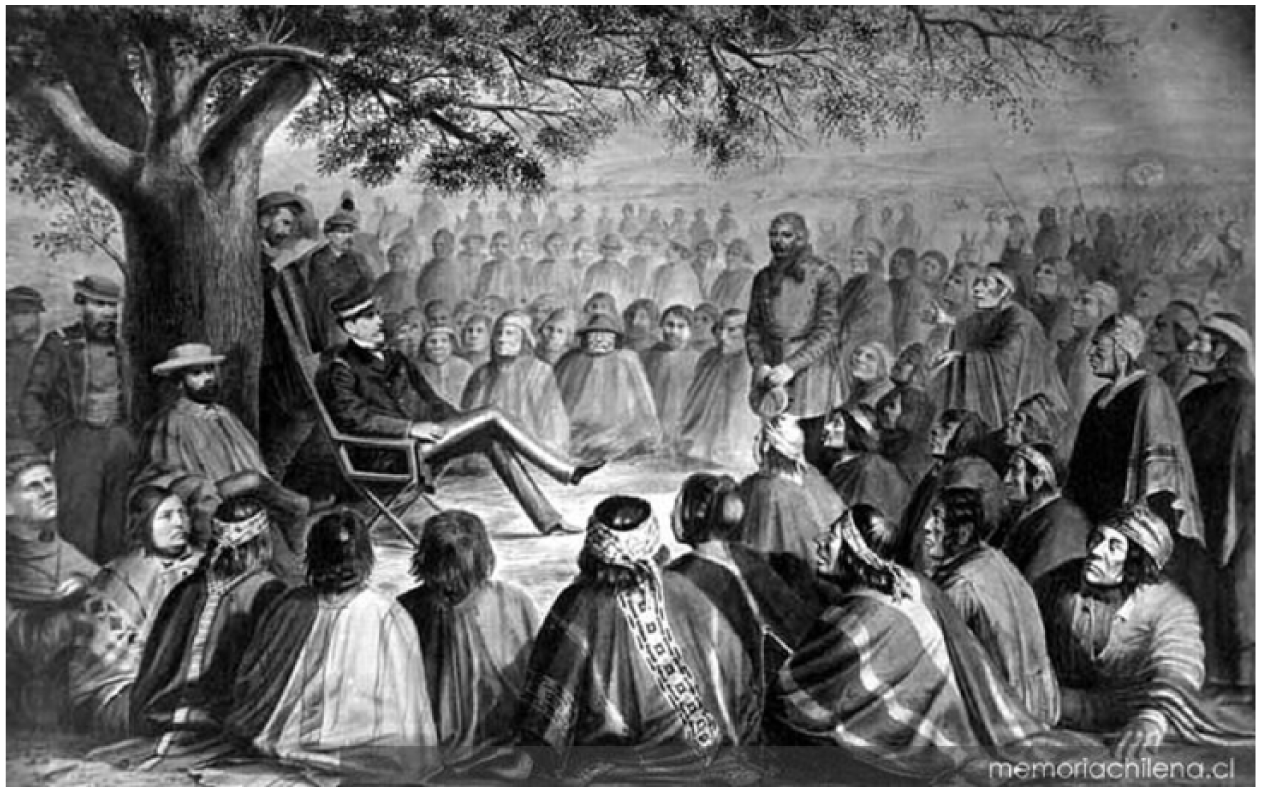
Parlamento celebrado en Hípinco entre el Coronel Saavedra y todas las tribus costinas y abajinas, representadas por sus principales caciques : 24 de diciembre de 1869 [Parlament celebrated at Hípinco, celebrated between Coronel Saavedra and all the coast and lower tribes, represented by their main caciques (chiefs): 24 December 1869] . Available at Memoria Chilena, Biblioteca Nacional de Chile; image retrieved from: http://www.memoriachilena.cl/602/w3-article-98654.html. Accessed on 12/4/2017.
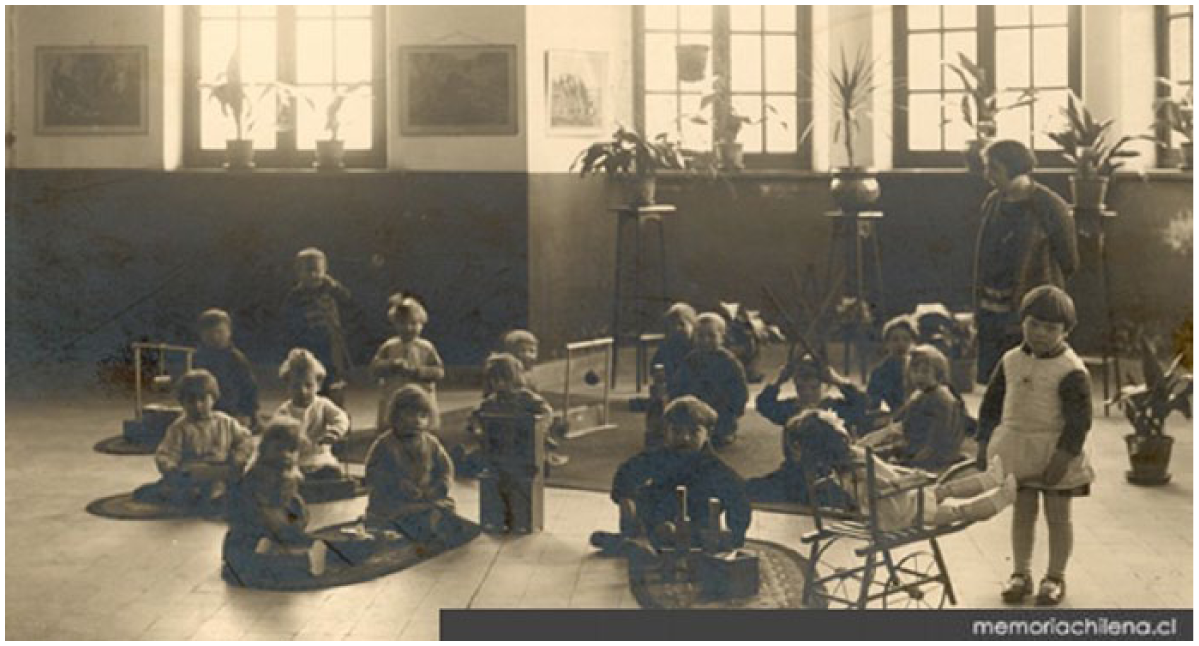
Jardín infantil de la Escuela Nº 1 de Niñas, hacia 1905 [Nursery at Girls’ School Nº 1, circa 1905]. Available at Memoria Chilena, Biblioteca Nacional de Chile; image retrieved from: http://www.memoriachilena.cl/602/w3-article-74379.html. Accessed on 12/4/2017.
Duerme, duerme Negrito, que tu Mama está en el Campo (…) y si el Negro no se duerme viene el Diablo Blanco, ¡y zás! te educa. Populational reasoning of children and female educators through “comprehensive care”
Populational reasoning (Popkewitz and Bloch, 2001) is a useful concept to unpack changes in the chilean ECE field. The Curricular Framework (CFECE) emerged in 2001 after educational reform in 1996. Like other educational levels, the inputs for CFECE were related to socio-political promotion of democratic values, findings from neurosciences, and psychology of learning (Silva, 2002).
Shortly before the launch of the CFECE, MINEDUC published a document about the field (MINEDUC, 2001b). The text was emphatic that ECE existed throughout Chile’s history, as indigenous traditions of female childcare and childrearing were observed throughout the territory. Both MINEDUC (2001b) and Peralta (2003) emphasize how indigenous people developed EC “ethno-education,” centered on offering comprehensive care to their children. This rhetorical move suggests the assumption that culturally, education and care in early years has always been present, and that it is linked to maternal care. It also implies that ECE has an inherent nature, and therefore is compatible with later educational (christian) approaches introduced by (neo)colonization.
(Female maternal) care still is a central signifier in chilean culture (Gajardo and Oteíza, 2017), which explains cultural artifacts, such as this magazine extract. The magazine article emphasizes that the female EC educator teaches and disciplines children in a way that “children’s defects disappear and so they gradually end up being normal little kids.” She is considered “a mother for others’ children (…) who carries a spirit of understanding, dedication and abandonment of herself, which is only present in women” (Revista Eva, personal translation; Figure 4). These assumptions still echo through academic statements like the following: “Definitely, keeping all the proportions of the case, the [female] early years practitioner is an extension of the mother” (Muñoz, 2014, personal translation).
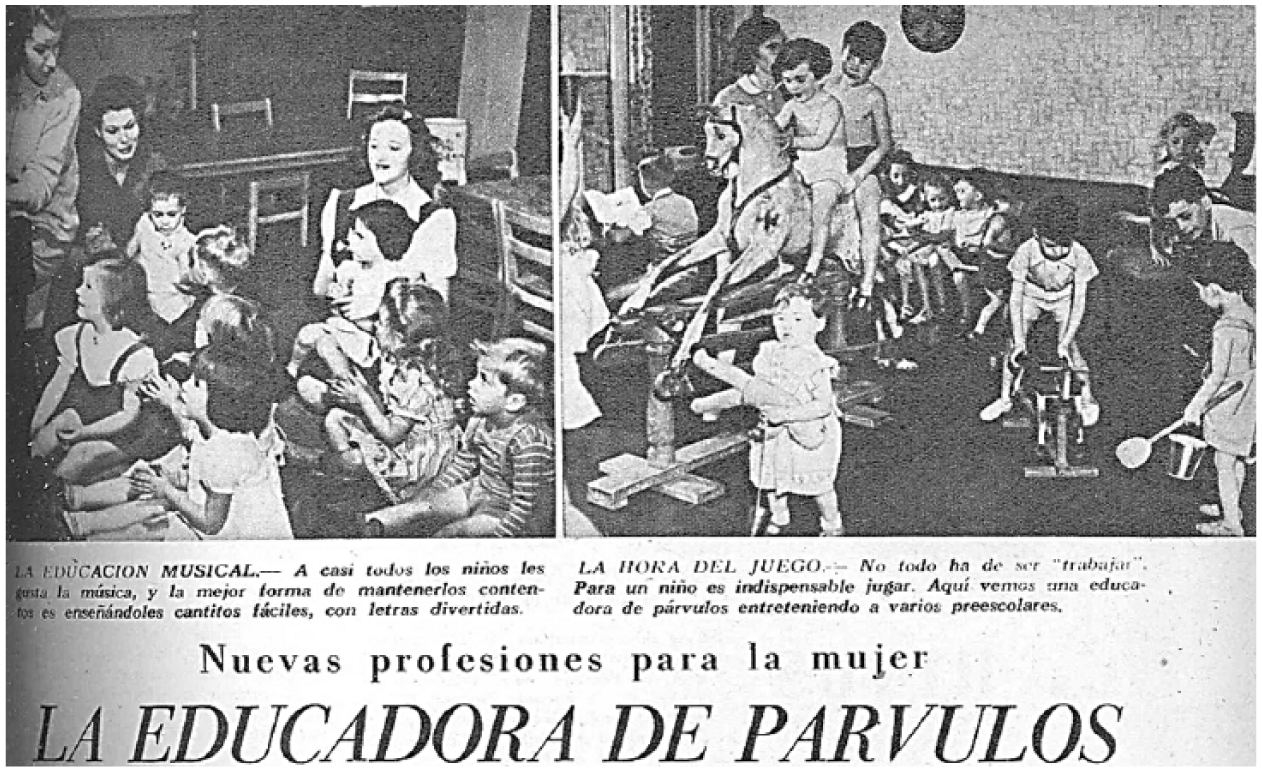
Nuevas profesiones para la mujer : la educadora de párvulos [New professions for women: The female early childhood educator] . Available at Memoria Chilena, Biblioteca Nacional de Chile; image retrieved from: http://www.memoriachilena.cl/602/w3-article-75833.html. Accessed on 12/4/2017.
For Viviani (2016), female practitioners are expected to have a strong vocation, to always be joyful and love their children. Love and joy can be linked to Froebel’s philosophy (Peralta, 2012), in which female practitioners’ essence is assumed to be closer to nature and therefore also to children. Consequently, these ideas also shape female practitioner’s appearance: Usando delantal, mi cuerpo no era mío. The tía-body hidden under green fabric belonged to the state, children and families. Bajo ese delantal, todxs nos vemos igual. Our discreet earrings and pulled-up hair unite us, but (professional) differences emerge between sneakers and heels. En todas las supervisiones fui evaluada como chascona: “¡Una profesional no se ve así!.” Regulations pull me and my hair back to my infancy and present: “Una Señorita
9
no se comporta así.”
Female practitioners working in the public and publicly subsidized sector (belonging to JUNJI) are assessed and held accountable for the fulfillment of JUNJI’s regulations. Their professionalism is linked both to practices of care and progressive pedagogies, as well as the production of a pre-defined feminine (conservative) appearance. Short or pulled up hair has hygienic advantages and models a type of professional female that must be aspired to.
The “Protocol Manual for Security and Care of Children” (JUNJI, 2007) establishes for practitioners (educators and assistants) that as the visible faces of the institution, they follow and enforce hygiene norms. The first protocol (Institutional Image) suggests a particular female professional appearance, as shown in Figure 5.

“Protocol No 1: Institutional Image” (JUNJI, 2007: 2).
The depicted subject is white and anonymous, suggesting a universalized, but at the same time local and specific of the chilean ECE context, discourse of the female ECE professional. Personal appearance is linked to the apron, 10 which following the regulations must be clean and tidy. Additionally, practitioners must keep their personal hygiene in “optimal conditions”: short and clean nails without any polish, no rings, dangling earrings, nor short necklaces. Even shoes (comfortable flats or low heels with a round tip) are pre-defined which suggest a way of moving their bodies, standing and shaping it subservient to children’s (and the state’s) needs. The emphasis on a gendered appearance may be one of the unforeseen effects of european (white) humanist pedagogies that emphasized the idea of a practitioner as a role model, an idea promoted in the CFECE regarding the EC educator (MINEDUC, 2001a).
An unproblematized, apolitical, and im~explicitly maternal stance informs our intentions as educational workers. Additionally, the appropriation of universalized developmental theories is closely linked to trends promoted during dictatorship (JUNJI, 2006). In this period, the socio-economic system and social services like education were reconfigured (Leiva, 2017; Pinkney Pastrana, 2009), and new strategies to control the young population were promoted. For instance, public ECE provision expanded its coverage to combat child malnutrition (MINEDUC, 1998) and adopted Highscope Curriculum (JUNJI, 2006), based on piagetian cognitive developmental theory and Dewey’s principle of learning through activity. Nowadays, CCC reinforces this curricular approach.
Furthermore, another accessible ECE provider, INTEGRA, emerged in the 80s as Funaco, 11 focused on providing occupation to impoverished female population and controlling child malnutrition. Children, their families, and communities were now “at risk” (Swadener, 2005) and required the state intervention at all levels of their lives.
The following poster from CEMA Chile (1979) is called your children must learn (Figure 6). Note the depiction of the traditional (white) family that smiles and educates a population which is brown, poor, and possibly cannot smile while surviving the first years of dictatorship.
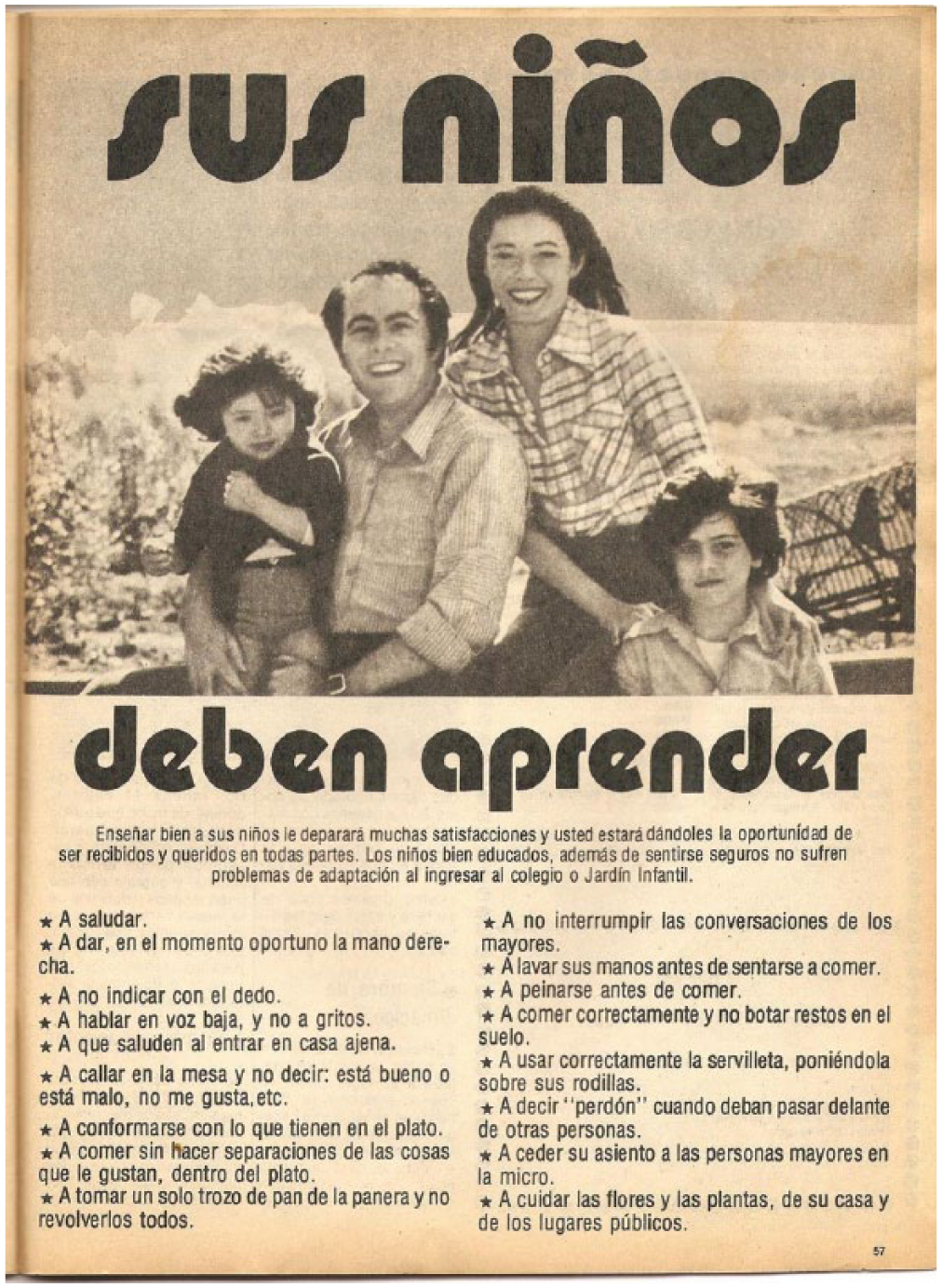
CEMA CHILE, 1979; image retrieved from: http://4.bp.blogspot.com/-BfHrnn1d_g/TZJrygmHiJI/AAAAAAAABlk/3yQ-jhXfCRY/s1600/Cema+003.jpg.

The poster specifies what behaviors parents must teach their children to ensure them “the opportunity to be well received and loved anywhere.” Besides greeting practices, children should, for example, “Be satisfied with what they have on their plate” and “Not interrupt grown-up conversations.” This poster illustrates how within chilean ECEC, civilizing discourses were entangled with the education of young child subjects, toward the control of their feelings, dispositions, and thoughts of circulating adultist morals and norms.
Populational reasoning was based on two strands: multiagency intervention (education, health, and social protection) and complementary developmental theories which focused on (normal) growth and behavior to guarantee learning in later stages of schooling. Umayahara (2006) makes this link in CFECE clear, as she identifies that its stated aim is to offer “scientifically guided education” (Umayahara, 2006: 24). These two strands became crossed and entangled through the operation of a simultaneous dominant (neo)liberal rationale which demanded expansion of the ECE field to the whole population (Staab, 2013). This expansion was linked to market liberalization policies that were applied to all social areas during the 1980s.
These two strands are the main ideas that inform chilean ECE and the CFECE because it legitimates the intervention in young children’s lives, in all the possible imaginable spheres. This control and constitution aims toward development and progress of the country, which following neoliberal trends (Connell and Dados, 2014) enables globalized discourses to colonize in a new manner (Leiva, 2017; Quijano, 2011). It explains why syncretic merge is promoted toward certain values and principles that shape subjects. It has become an institutionalized voice (Cannella, 1997). Female practitioner’s lives and subjectivities are also impacted, as the tía draws on traditional understandings of femaleness, care, and maternity and follows new trends that pre-suppose these.
Peralta (2012), Adlerstein (2012), UNESCO and MINEDUC (2004), and JUNJI (2006) do not discuss nor relate the evidence to the historical and political context that feeds into the ECE field or CFECE. Colonization, dictatorship, its radical effect on the national economic rationale, and its impact on schooling and human rights, is omitted and its consequences are only mentioned when emphasizing the democratic values promoted by educational reform in the 90s. Ironically, Millei (2007) explains that current democratic learning environments emphasizing guidance (facilitating) approaches to classroom discipline disguise power relations and deepen control over children rather than releasing it.
¡Caballito blanco, vuelve pa’ tu Pueblo! Reclaiming the foundations of Chilean ECE
¡Caballito blanco, vuelve pa’ tu pueblo! no te tenemos miedo tenemos vida y fuego, fuego nuestras manos, fuego nuestros ojos, tenemos tanta vida, y hasta fuerza color rojo. (…) somos este sur y juntamos nuestras manos (Ana Tijoux—Somos Sur)
Cannella and Viruru (2004) argue that ECE spaces have been the object of (re)colonization. Take for instance academic disciplines and research framing the field of ECE (Salazar Perez and Saavedra, 2014), which establish definitions of education, “the child,” curricula, and pedagogies and impact directly on lives and subjectivities of every person who inhabits these spaces.
In this article, a mestiza approximation of a “history of the present” of chilean ECE was developed to map the current landscape. The field is shaped by a variety of socio-political agendas. Rooted in Chile’s history and marked by globalized trends, it produces dominant discourses of the child, which frame classrooms and shape practitioners’ subjectivities.
Neoliberal discourses operate through colonial trajectories (Quijano, 2011) and validate and perpetuate oppression by operating though local institutions like chilean ECEC through multiagency initiatives that converge within the chilean ECE institution. EC policies contribute to shape a notion of “the child,” constituting children as restricted subjects: in lack, savage, developing, and/or immature, and with little capacity of agency (Galdames Castillo and Poblete, 2014). ECEC has become one of neoliberalism’s technologies for control and domination of children as a future workforce (Dahlberg et al., 2007).
In relation to these global forces, Montecino’s (1997) conception of syncretism may be useful. She defines it as a fusion of “symbols and cultures” (p. 105), which illustrates how particular colonized cultures have forcefully appropriated rituals, symbols, and systems of belief, by articulating them with their own, like Latin-American people who were conquered by Spanish Catholics. These mixtures are not an exact replica of the original, sometimes are used for other purposes, and become naturalized through time by their continual hegemonic (re)production in everyday practices (Quijano, 1992). However, their normative character is subverted by the same meanings which are supposed to be suppressed: ethnic minorities resisted catholic discourses of salvation by performing the rituals but discursively ascribing their own beliefs. Montecino (1997) suggests that within syncretism and constant merging of symbols, mestizos and “mestizas have re-enacted the social” (p. 49). She identifies within the mestizo ethos a “marian allegory” (Montecino, 1997), which goes beyond the religious congregation, and also has impacted on women’s identity constitution. Further research into female EC educators’ subjectivities could provide insights if this variable shapes current practices. 12
The following example from an EC classroom illustrates how a syncretic effect is produced to reclaim a traditional song that enables practitioners and children to shift from the dominant rationale: We’re sitting in the morning circle, singing different songs. Vijenje taught us a song “of the fireman and the cook.” It seems to be very, very old and traditional, everybody loves it, but me. Sometimes they sing it several times in a row. Today, some children request it again, they start to sing.
The fireman sold his hose, so he could marry the [female] cook/
The [female] cook sold her apron, so she could marry the [male] general/
The [male] general sold his sword, so he could marry the beautiful Lady/
The beautiful Lady sold her fan, so she could marry Don Federico/
Don Federico said no, the beautiful Lady fainted …
(interrupting) wait, wait, we changed the ending!
Yes, we did!
How was it? … Ah yes!
Don Federico said yes, the beautiful Lady doesn’t care!
HAHAHAHAHAHAHAHAHAHA! (laughing all together)
(Fieldnotes Extract, 05/12/2013) 13
In the extract, practitioners successfully distanced themselves from normative discourses related to femaleness of the tía. They possibly used this instance to talk about issues that are frequently deemed inappropriate for young children, by conservative white middle-class trajectories and ECE contexts. By drawing on humor, practitioners created “secondary adjustments” (Corsaro, 1990), aligning to the rules while also transgressing these to achieve other purposes. At first glance, they complied with the imaginaries that the traditional children’s song brought along, but on closer examination they possibly exposed their disagreement with the grand narratives.
One of the children, Vijenje, shared the fireman song with the classroom and it became an instant hit. However, its lyrics were never unpacked regarding their colonial origin and the sexist and classist issues that the song portrayed. On the contrary, insinuations about the beautiful señorita’s hysterical reaction to male rejection were overlooked and became the source of contagious “innocent” giggles. While observing the classroom for the last time, children asked to sing the song again, but the tías changed the lyrics from: Don Federico said yes, the beautiful Lady peed herself! to the beautiful Lady doesn’t care!
Interestingly, the phrase in chilean Spanish that practitioners chose to sing—¡La bella dama no está ni ahí!—to express the indifference of the lady, can also be literally translated as “the beautiful lady isn’t there!” Practitioners playfully articulated through this colloquial expression of indifference, how they possibly distanced themselves from sexist figures of the chilean woman that they promoted in the classroom. Perhaps they were refuting the traditional gendered discrimination and dependence implied in the lyrics, creating an emancipatory position in which they invited children to participate.
“Rebellious female” (Kirkwood, 1987) practitioners engaged with taboo topics through sarcasm and humor, distancing themselves from the tía and the (ignorant and innocent) child, although with significantly different effects upon them and children. Children may have also engaged in subverting this rationale by joining in with their laughter.
This extract can illustrate how within everyday classroom space educators and children can challenge and reclaim the foundations of a field that was never meant to include them. If we “abandon the old definitions, in the same way [we] discovered the truth about Santa Claus,” we can “discover that there is a history, an idealized version of all those things about which we refused to reflect upon” (Hija de Perra, 2015).
The current challenge may rely in confronting our kiltra~mestizx in our practices, to create a choir in which we can claim the speech and consciousness of ourselves, claim the action, and declare where else we can navigate to (Kirkwood, 1987). Because, as Anzaldúa explained about the “mestiza consciousness” (Anzaldúa, 2009b), we do not have to renounce or choose a side, but can also learn to entangle, weave, and create new possibilities.
Footnotes
Acknowledgements
The author would like thank the editors and the anonymous reviewers for their helpful and thoughtful comments. She would also like to thank Daniel Leyton for comments on earlier drafts of this article and Alvaro Gonzalez Torres for his continuous support, comments, and feedback.
Funding
The author(s) disclosed receipt of the following financial support for the research, authorship and/or publication of this article: The author appreciates the financial support from CONICYT (CONICYT, Becas Chile, 72120210).