




Abstract
This article draws on the literature in development economics, psychology and sociology to explicate how decolonised early childhood education and care services can reverse the metacolonial cognition lingering in the postcolonial era. In particular, the author shows that colonial institutions persist even after formal colonisation has ended through the application of de facto power. Self-knowledge developed during early childhood impacts adult socio-economic life outcomes. Thus, decolonising early childhood development and care by ensuring positive representations of self will improve self-perceptions and self-awareness. The implications for practice and policy are discussed within the context of deploying decolonised early childhood development and care services to raise a new generation of confident Africans to accelerate the development of the continent and regions with similar histories of colonisation.
Keywords
Introduction
Africa is projected to record significant economic growth (Broadberry and Gardner, 2013). Indeed, the African Union has set some transformative goals for Africa which, when achieved, will mean that the continent will become more prosperous (African Union, 2015a). Among other things, the African Union aspires to have an ‘Africa whose development is people-driven, relying on the potential of African people, especially its women and youth, and caring for children’ (African Union, 2015a: 16). As a result, if Africa is to grow its economy to cater adequately for its peoples, there is a need to invest heavily in its human resources (Musonda and Zhang, 2015; Oppong, 2015). In order to ensure sustainable growth and development, Africa must make investment in ‘stable and resilient child development’ and must see this investment as ‘critical to the realisation of the economic prosperity of Africa’ (Oppong, 2015: 24). Thus, early childhood experiences can, ultimately, be said to be important for the economic prosperity of Africa. This need has, indeed, been recognised by the African Union (2015a, 2015b) in its aspirations in Agenda 2063.
The first six to eight years of the life of every human are said to be critically important (Boydell et al., 2017; McDougall and Vaillancourt, 2015; Moss, 2001; Nelson, 2012). However, Moss (2001) argues that the focus should be extended to cover ‘the period from birth up to the end of compulsory schooling at least’ (8). Among many reasons, Moss argues that ‘[m]any issues in the field of “early childhood education and care” . . . might very profitably be extended not only to older children but also to that predominant institution of childhood: the school’ (9). This is because the developments that take place tend to have a lasting effect on the life of the individual. As a result, early childhood development constitutes a critical phase of life which acts as the bedrock for the later physical development of the child, their well-being and their educational achievements in life. Early childhood development experiences can affect a child’s later intellectual capacity, social behaviour and personality. Nelson (2012) reports that negative early childhood experiences are noted to cause fundamental changes in several regions of the human brain, including the hippocampus (affecting learning and memory) and the prefrontal cortex (affecting executive functions such as decision-making and problem-solving). Similarly, Boydell et al. (2017) indicate that several studies in developmental psychology have reported that exposure to harsh and coercive behaviours contributes to the development of antisocial behaviour and violence among children, and such behavioural patterns can persist into adulthood. Similarly, the American Academy of Pediatrics (2014: 1) documents evidence that ‘adverse childhood experiences (ACEs) can contribute significantly to negative adult physical and mental health outcomes and affect more than 60% of adults’ in the USA. Moreover, McDougall and Vaillancourt (2015) have presented evidence that victimisation in childhood and adolescence has long-term adult outcomes.
On the other hand, there is evidence that positive early childhood experiences have salutary effects on the adult life of a child. For instance, Orth (2018) provides evidence, from a cohort study of 8711 US participants from birth to age 27, to the effect that the family environment in early childhood has an impact on self-esteem into adulthood. Using the 1970 British Cohort Study at age 42, Goodman et al. (2015) also conclude that social and emotional skills developed in childhood have long-term effects on adult life. For instance, they report that self-perception and self-awareness had positive effects on mental health (well-being and life satisfaction), socio-economic outcomes (income, having a top job, wealth and education), and physical and behavioural health outcomes (less obese, less drinking and smoking). Goodman et al. (2015: 7) define self-perception and self-awareness as relating ‘to a child’s knowledge and perception of themselves and their value, their confidence in their current abilities and a belief in their efficacy in future tasks’, which is operationalised to include self-efficacy, self-esteem and a locus of control. In a study with 272 children where the children were required to talk about their future aspirations and career choices, the family environment (particularly socio-economic status) was shown to impact parents’ perceived efficacy and academic aspirations, which, in turn, impacted the children’s career trajectories through the children’s perceived efficacy and academic aspirations (Bandura et al., 2001). Again, the children’s perceived efficacy was found to be more predictive of their occupational self-efficacy and preferred choice of work life than their actual academic achievements (Bandura et al., 2001).
African scholars – notably, African philosophers – have often conceived the notion of the self in terms of personhood (Adjei, 2018; Ibanga, 2020; Kpanake, 2018; Wingo, 2017). However, Kpanake (2018) argues that the ‘concept of the person does not refer directly to the self . . . but to the cultural construction of the person as a social entity, along with moral and juridical notions of agency and accountability’ (199). Further, Kpanake suggests that Africans tend to express their personhood through connections to spiritual agency, social agency and self-agency. It should be noted that the importance of spiritual and social agencies does not negate the role of self-agency – defined as the ‘locus of agency that is responsible for introspection, feeling, and questioning’ – in the African context (204). It is within this domain of self-agency that concepts of self-efficacy, self-esteem and a locus of control are relevant. Thus, the discussion of the self in Africa still benefits from concepts of self-evaluation as the self is that ‘entity that one is proud of and seeks to improve’ and ‘is responsible for the individual’s social presence, and accommodates the life essence’ (205).
The implications of the extant literature are that any negative childhood experiences that can have detrimental effects on a child’s development need to be identified, understood and addressed. At the same time, there is a need to identify the positive experiences that promote healthy growth and development. One such negative effect is the lingering effect of colonialism (metacolonial cognition) and its impact on the sense of self and lived experiences of people of African descent and other peoples whose great-grandparents experienced colonialism, apartheid and slavery. This article seeks to examine the role that early childhood education and development can play in a restorative process of addressing metacolonialism in postcolonial personhood.
Early childhood development, care and education in Africa
Early childhood can be described as the phase of human growth and development that spans from birth to about eight years old (Oppong, 2017; Santrock, 2018). This phase of growth and development is characterised by significant physical development, including brain development (Santrock, 2018). Substantial evidence exists in support of the long-term adult effects of development which takes place during this stage of life (Bandura et al., 2001; Boydell et al., 2017; Goodman et al., 2015; McDougall and Vaillancourt, 2015; Nelson, 2012; Orth, 2018). It has also been established that the immediate social and physical environment influences development during this stage of life (Bandura, 1994, 1997; Bandura et al., 2001; Orth, 2018; Santrock, 2018). Early childhood education and care is, therefore, the education or socialisation and care services provided to children from birth to eight (Kamerman, 2006). The importance of early childhood education and care has been instantiated with the setting of target 4.2 of Sustainable Development Goal 4 (‘Equal access to quality pre-primary education’), which seeks to ensure that ‘[b]y 2030 . . . all girls and boys have access to quality early childhood development, care and pre-primary education so that they are ready for primary education’ (SDG-Education 2030 Steering Committee Secretariat, n.d.).
Although Africa has the youngest population in the world, it is still a region that reports one of the ‘highest infant mortality rate[s], with children likely to suffer from chronic malnutrition and an inadequate food supply, experience severe poverty, likely to live in the midst of armed conflict and/or becoming an AIDS orphan’ (Kamerman, 2006: 25). It has also been documented that pre-primary enrolment rates are about 10% for most African countries, although Mauritius has a rate of about 90% and Congo and Djibouti less than 1% (Kamerman, 2006). Childcare services are provided by the private sector and to a great extent viewed as ‘a luxury, primarily the responsibility of families and communities’ (Kamerman, 2006: 25). In its ‘Continental education strategy for Africa 2016–2025’ (CESA 16–25), the African Union admits that Pre-primary education is the pillar on which future learning and training are grounded. However, it is a neglected area in terms of policy and investment. The sub-sector is therefore characterized by disparities, poor management and lack of coherent curriculum and linkages with primary education. It is a sub-sector that deserves a special attention in CESA 16–25. (African Union, 2016: 14)
This signifies low public investment in early childhood education and care services in most parts of Africa.
To enable Africa to achieve ‘Aspiration 2’ of its Agenda 2063 (‘An integrated continent, politically united and based on the ideals of Pan-Africanism and the vision of Africa’s Renaissance’), the African Union (2015b: 7) recognises the role of early childhood education. Specifically, the African Union Commission requires African governments to actively promote universal access to quality pre-primary (early childhood), primary as well as secondary education (African Union, 2016). In line with its implementation plan, CESA 16–25 was developed to match the aspirations set out in Agenda 2063. The CESA 16–25 Early Childhood Education and Development Cluster has been created and has a working group. Similarly, the Africa Early Childhood Network, a professional network focused on the promotion of excellence and collaboration in protecting children’s rights, was established in 2015, with its secretariat in Nairobi, Kenya. The Africa Early Childhood Network (2020) has also set up a Regional Research Technical Team, which, among other things, is to provide strategic advice on regional research priorities and programmes, including guidance on the development of a regional research strategy for the CESA 16–25 Early Childhood Education and Development Cluster. The implications of these developments and the challenges identified are that public investments in early childhood care services and a coherent curriculum linked with primary education are needed in Africa. More importantly, this should be linked with ‘Aspiration 1’ – realising ‘A prosperous Africa based on inclusive growth and sustainable development’ (African Union, 2015b: 6). This quest should be understood within the context that a positive family environment in early childhood results in higher self-esteem (Bandura, 1994, 1997; Bandura et al., 2001; Orth, 2018), while positive self-perceptions and self-awareness (including self-esteem) in childhood are known to have salutary effects on mental health, socio-economic outcomes, and physical and behavioural health outcomes, even in midlife (Goodman et al., 2015). These outcomes of positive self-perceptions and self-awareness constitute, in essence, improved living conditions associated with economic development. Thus, early childhood education and care in Africa should aim to improve social and emotional skills, including positive self-perceptions and self-awareness.
Metacolonial cognition
‘Metacolonial cognition’ is used in this article to imply the self-knowledge, beliefs and representations of the self that accompany metacolonialism. Bulhan (2015: 224) introduces the concept of metacolonialism and defines it as follows: ‘a socio-political, economic, cultural, and psychological system that comes after, along with, or among the earlier stages of colonialism . . . Metacolonialism revives an old system of colonial exploitation and oppression that masquerades in the more savory euphemism of globalization’. It has been demonstrated that metacolonialism affects how formerly colonised individuals see themselves, even though formal colonisation has ended (Bulhan, 2015; Oppong, 2019). A consequence of metacolonialism is the resulting contested reality and memories of formerly colonised people (Bulhan, 2015). In particular, there is an invalidation and vilification of most things about ‘the colonized, including their culture, their epistemology, their ontology – indeed their very existence as human beings’ (Bulhan, 2015: 245). Thus, the colonised are left with a fractured and displaced sense of self that leads to self-doubt about their abilities as humans and their place in the world when formal colonisation has long ended. In this sense, metacolonial cognition refers to a sense of self or self-knowledge among members of formerly colonised societies that represents the self as inferior, inherently dangerous, weak and less capable compared to members of the societies that perpetrated the colonisation or those who are like them. Africa is a diverse continent. As a result, metacolonial cognition will exist in varying degrees among its people and across different societies. It is, therefore, wrong to assume that each and every African experiences the same degree of metacolonial cognition; individual, neighbourhood, community and country-level differences may exist in the degree of metacolonial cognition experienced across the continent.
Given that formal colonisation ended approximately 50 years ago in most parts of Africa, why is metacolonialism possible? Oppong (2014) demonstrates the intergenerationality of the learned helplessness associated with colonisation through the socialisation process. In development economics, Acemoglu et al. have accumulated empirical evidence in support of the persistence of colonial institutions into the postcolonial era, which has an impact on the economic performance of formerly colonised persons (Acemoglu et al., 2001; Acemoglu and Robinson, 2006, 2008). Acemoglu and Robinson (2006) argue that there are two sources of power available for the control of people: de jure power and de facto power. Acemoglu and Robinson (2006: 326) define de jure power as the ‘type of political power allocated by political institutions (such as constitutions or electoral systems)’ and de facto power as emerging from ‘the ability to engage in collective action, or use brute force or other channels such as lobbying or bribery’. More specifically, they argue that colonisation ended with the curtailing of de jure power but colonial beneficiaries in Europe continue to exert influence through the use of de facto power, deploying global institutions or internationalisation or liberalisation as new forms of re-enacting colonial institutions (Acemoglu and Robinson, 2006, 2008). A more recent study shows that colonial institutional persistence continues to influence health disparities in Africa (Brown, 2018). When the evidence of institutional persistence from development economics (Acemoglu et al., 2001; Acemoglu and Robinson, 2006, 2008; Brown, 2018) is integrated with psychological studies about the long-lasting effects of early childhood experiences (Bandura, 1994, 1997; Bandura et al., 2001; Boydell et al., 2017; Goodman et al., 2015; McDougall and Vaillancourt, 2015; Nelson, 2012; Orth, 2018) and the intergenerationality of adverse experiences during colonisation (Bulhan, 2015; Oppong, 2014, 2019), it becomes clearer that early childhood education and care is one of the agents, amongst others, that can counter metacolonialism. It is particularly useful to think of the fact that positive childhood experiences result in positive self-perceptions and self-awareness (Bandura, 1994, 1997; Bandura et al., 2001; Orth, 2018), and these positive self-perceptions and awareness contribute to improvements in life outcomes, including socio-economic improvements (Bandura, 1994, 1997; Bandura et al., 2001; Goodman et al., 2015). Integrating the development economics literature on institutional persistence, psychological evidence of the long-term effects of early childhood experiences and the sociological literature on socialisation (Crisogen, 2015; Haralambos and Holborn, 2013; Lillehammer, 2010; Lillehammer and Murphy, 2018; Page, 2005), a new framework for understanding the linkages between early childhood development and metacolonial cognition emerges (see Figure 1). I will return to the sociological literature on socialisation in the course of the discussion of the framework.
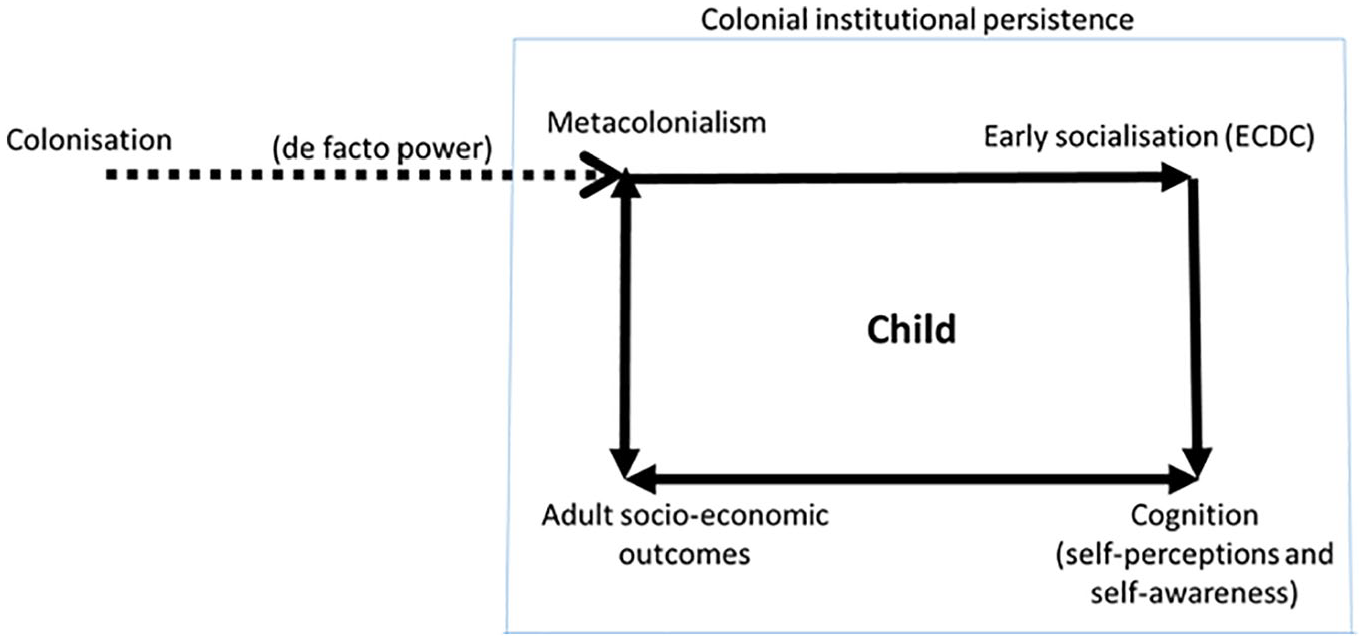
Framework for understanding the linkages between early childhood development and metacolonial cognition.
I argue here that, based on the extant literature, it is plausible to say that, although colonisation has ended, former colonisers continue to exert influence on former colonies through the application of de facto power as well as the lingering effects or elements of colonial institutions (Acemoglu et al., 2001; Acemoglu and Robinson, 2006, 2008; Brown, 2018). This institutional persistence generates metacolonialism (Bulhan, 2015; Oppong, 2019), which distorts the self-knowledge of formerly colonised persons. Although many of those who directly experienced the struggles for freedom and associated abuses have passed away, these experiences, distorted self and contrived designs for living (subsequent culture developing in response to colonisation, apartheid and slavery) are transmitted to the next generation through socialisation. Lillehammer (2010: 9) defines socialisation as ‘the whole process of learning throughout the course of human life . . . knowledge and understanding of the material and immaterial influence of socialisation on the actions of children and adults and on the interrelationships in the worlds between them’. Socialisation can take the form of primary, secondary, anticipatory or professional adult socialisation or resocialisation (Crisogen, 2015; Haralambos and Holborn, 2013; Page, 2005).
Of particular importance in the framework presented in this article are the primary and secondary forms of socialisation which take place within the immediate family environment (primary) and among peers in both the community and early childhood education centres (secondary), respectively. In essence, primary socialisation ensures that a child assimilates social norms and values at an early age (Crisogen, 2015; Haralambos and Holborn, 2013; Lillehammer, 2010; Lillehammer and Murphy, 2018) and, importantly, becomes the ‘informational and emotional baggage of any individual’ later in life (Crisogen, 2015: 331). Lillehammer (2010) describes how the socialisation process shapes agency in childhood and enables children to learn to become people in their environment. This is, indeed, consistent with Orth’s (2018) findings that the family environmental influence on self-esteem persists into adulthood. Notwithstanding the different forms of socialisation, various agents play a role in the socialisation of the child – namely, the family, school, religion, mass media, peer groups and occupation later as an adult (Haralambos and Holborn, 2013). The family, school, religion, mass media and peer groups are important agents in the socialisation of a child. Religion plays a role in terms of religious education (such as Sunday schools and madrasas) and social media and traditional media content and early childhood education centres shape the self-perceptions and self-awareness of the child for better or worse. In some sense, one can think of the activities of all the agents of socialisation as constitutive of not only influence on but also of the services that make up the spectrum of early childhood education and care; this is because these agents all contribute to child socialisation. Regardless of the agent of socialisation – material or immaterial, verbal or non-verbal, explicit or implicit, visual or other senses (auditory, tactile, olfactory or gustatory), facts or myths, direct or indirect, the arts (including storytelling and songs) or non-art forms – modes of influence are applied, knowingly or unknowingly, in the socialisation process (Haralambos and Holborn, 2013; Lillehammer, 2010).
Returning to the framework (Figure 1), primary and secondary socialisation processes through various agents, using varied modes, will shape the self-knowledge of the child. This influence is no longer disputed (see Bandura, 1994, 1997; Bandura et al., 2001; Lillehammer, 2010; Orth, 2018). For instance, based on a cohort study of 8711 US participants, Orth (2018) provides evidence in support of the long-term effect of the family environment in early childhood on self-esteem into adulthood (from birth to age 27). Similarly, psychoanalytic theory and neo-Freudians agree that the nature of early childhood experiences shapes behavioural patterns and personality in adulthood (Crowne, 2009). For instance, Sigmund Freud presents identification with a same-sex parent as a coping mechanism for children and a way to overcome the guilt associated with Oedipus and Electra crises, and further describes different forms of personality that result from fixations at different stages of the psychosexual stages of personality (Crowne, 2009). Identification helps to strengthen the Superego by ensuring that the child adopts the behavioural patterns of the same-sex parent, resulting in the learning of societal norms (Crowne, 2009). Similarly, object relations theorists intimate that individuals develop mental representations of themselves, others and their relationships with others during early childhood, and these representations influence their interpersonal relationships throughout life (Ainsworth, 1969; Fairbairn, 1952). It is for this reason that, sometimes, intimate partner violence is traced to early childhood experiences. Perhaps it is worth stating that deconstructive readings of psychoanalytic theory suggest that there has been an overreliance on logocentric practices (viewing language as an essential expression of an external reality) in conceptualising the psyche, with an overemphasis on trauma in one’s past, while others have questioned Freud’s essentialist representations of gender and sexual identity (Scharnberg, 2009; Trumbull, 2012). In spite of the fact that psychoanalytic theories have limitations and may not be attractive (Crowne, 2009; Israëls and Schatzman, 1993; Scharnberg, 2009; Wolpe and Rachman, 1960), they still provide a useful framework for thinking about how early childhood education and experiences impact life outcomes. There is also empirical evidence in support of some of the claims made by persons associated with the psychoanalytic tradition (Bandura, 1994, 1997; Bandura et al., 2001; Boydell et al., 2017; Goodman et al., 2015; McDougall and Vaillancourt, 2015; Nelson, 2012; Orth, 2018).
It is worth noting at this point that current early childhood education practices in Africa occur within the context of colonial institutional persistence and metacolonialism (Bulhan, 2015; Oppong, 2015, 2019; Serpell, 2018). It can therefore be inferred that publicly funded early childhood education and care services focused on building positive self-knowledge provide an opportunity to address metacolonialism, which affects cognition, including self-knowledge, with its attendant impact on the socio-economic outcomes of individuals. In other words, a decolonised early childhood education should make use of content and practices that inculcate in African preschoolers and children positive self-knowledge (positive self-perceptions and self-awareness) in order to raise a new generation of Africans who can contribute to the socio-economic transformation of their society and are confident in themselves and African ways of living. It should inculcate in them a high sense of self-determination, autonomy, self-respect, and respect and confidence in others like themselves. As the theoretical and empirical literature suggests, the quality of education and care at this stage of life impacts life outcomes in adulthood. Given that education is not neutral and serves a particular purpose, the programming of early childhood education and care in Africa and similar regions of the world should prioritise positive self-perceptions and self-awareness, as well as collective identity. This will result in what Khosi Jiyane calls ‘black psychological empowerment’, which she defines as involving feeling capable as a black person to pursue one’s interests without injuring the community, coupled with self-respect and care for other black people (personal communication, 22 April 2020).
Proposed early childhood development and care implementation architecture
In this section, I attempt to develop an implementation architecture for early childhood development and care (ECDC) as a means to mainstream decolonial discourse in the programming of ECDC services in Africa and regions of the world with similar histories. Recognising the importance of early childhood experiences for developing positive self-knowledge and socio-economic life outcomes in adulthood (Bandura, 1994, 1997; Bandura et al., 2001; Boydell et al., 2017; Goodman et al., 2015; McDougall and Vaillancourt, 2015; Nelson, 2012; Orth, 2018) and the nature of socialisation (Crisogen, 2015; Haralambos and Holborn, 2013; Lillehammer, 2010; Lillehammer and Murphy, 2018; Page, 2005), as well as the fact that ECDC has received limited attention in policy and investment, coupled with access problems, poor management and lack of a coherent curriculum and articulation with primary education in Africa (African Union, 2016) and the nurturing care framework (World Health Organization, 2018), I propose an implementation architecture which depicts the institutional arrangements required for successful implementation of decolonised ECDC services in Africa (see Figure 2).
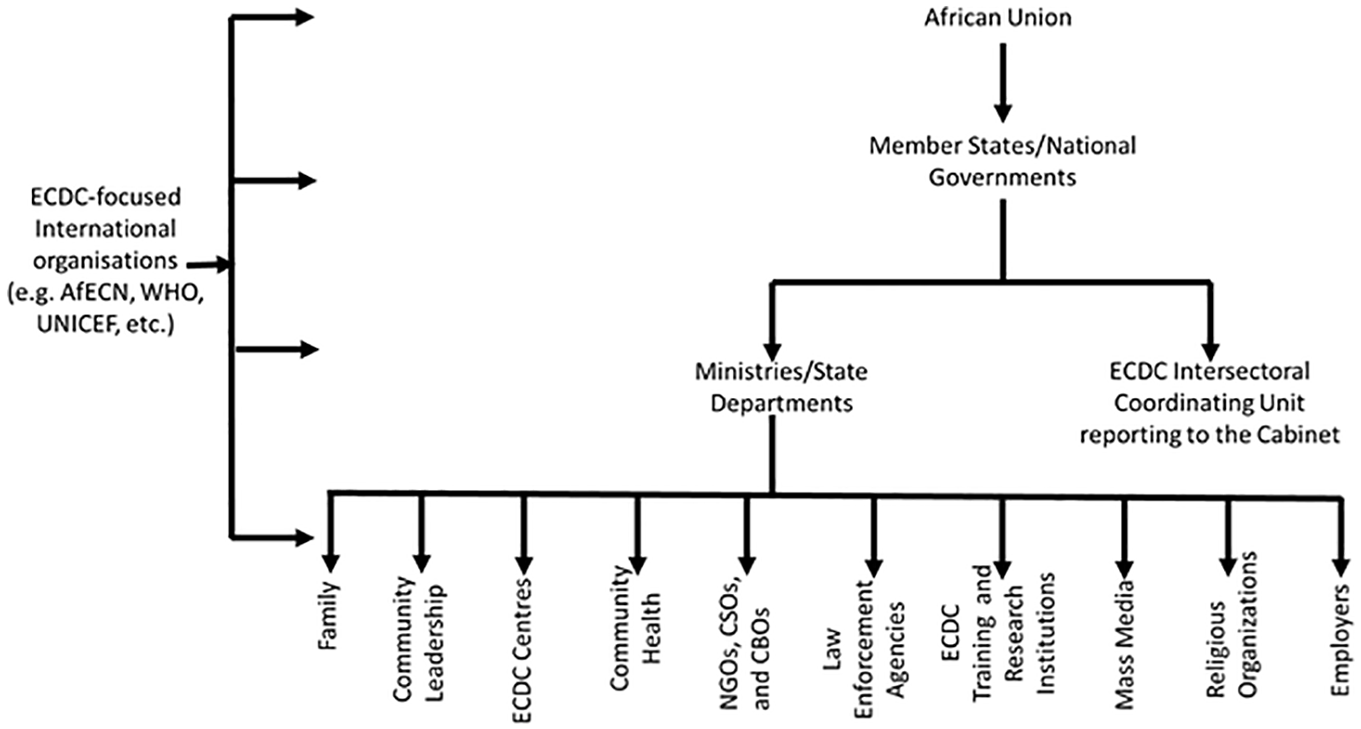
Proposed ECDC implementation architecture.
The model presented in Figure 2 is an ecological model which recognises the web of influence on ECDC associated with the following: the macro-environment (continental bodies, international organisations, cultural values and beliefs), the exo-environment (mass media, the legal system, state political institutions) and the micro-environment (family, school, community, religious organisations). It acknowledges the continental approach to improving ECDC services in Africa and depicts the cascading influence on policy that derives from the continental body, the African Union. This model also holds that if ECDC services are to be improved, as well as target the relevant outcomes, a continental framework should guide the member states in developing and implementing suitable nationwide ECDC policies and programmes. This creates the context for sourcing funds to finance ECDC programmes and a focus on large-scale or scalable improvements in the continental standard of living, without leaving some behind. These state-level programmes should influence the various institutions that a child may directly or indirectly interface with at the community level. However, the model is an implementation architecture and therefore ‘hardware’ that can be used to implement any kind of ECDC policies and programmes with appropriate adaptations. As a result, the ‘soul’ of the architecture (its ‘software’) lies in its link to eradicating metacolonial cognitions and improving self-perceptions (positive self-perceptions). In effect, the content of the programming ought to be linked to the idea that adult socio-economic outcomes partly depend on decisions to exploit opportunities, which partly depend on self-perceptions that are dependent on the self-perceptions developed through early socialisation. Thus, we can improve adult socio-economic outcomes through improving self-perceptions that evolve during early socialisation. It is at this point that the implementation architecture has the greatest chance of making a meaningful generational impact on a community or country. In the remainder of this section, I will discuss the elements of this institutional framework, as well as what the guiding principles of the implementation should be.
To provide effective implementation of ECDC programmes focused on improving the self-knowledge of children in Africa, the following principles should be observed: (1) leadership commitment; (2) multisectoral and multimodal approaches; and (3) consistency in ECDC messaging across sectors and modes of learning. Leadership commitment is needed for any intervention at any level to be effective. As a result, the African Union (2015, 2016) prioritising ECDC through Agenda 2063 and CESA 16–25 is helpful and has the potential to encourage national governments to show a similar commitment. A multisectoral approach is also needed for effective ECDC programming and implementation (World Health Organization, 2018). A multimodal approach is equally needed because there are different forms in which messaging takes place, and they also have the potential to influence a child’s self-perceptions and self-awareness (Haralambos and Holborn, 2013; Lillehammer, 2010). Another important principle is consistent ECDC messaging across sectors and modes of learning; this stems from the fact that paradoxical or incongruent communication undermines the effectiveness of a message (Dehasse, 1997; Prescott and Wilson, 2011), and the credibility of a source is crucial for effective communication for behavioural change (Bolsen et al., 2019).
This architecture for implementation of ECDC is generic and can be adapted for use in most parts of the world. It is also important to understand that because states are not created equal in terms of governance structures, and to allow for decentralisation, local government authorities (including state governments in federal systems) should have ECDC intersectoral coordinating units at the appropriate level. Again, ECDC-focused international organisations can work at any level within the architecture with the appropriate approval and within the national framework for ECDC; this will ensure that their support (technical and financial) will work towards achieving national objectives. This is to say that ECDC international organisations can work directly at the implementation or policy levels, depending on their preferred approach to ECDC programming, as well as the forms of support they intend to provide. However, it needs to be emphasised that programmatic approaches by international organisations are also frequently imported from other cultural contexts, which might in itself be a form of colonisation. As Moss et al. point out, an ECDC international organisation usually adopts a particular paradigmatic position which might be described as hyper-positivistic. It values objectivity, universality, predictability and what can be measured. It chooses to work with certain disciplines – notably, particular branches of psychology (child development) and economics (human capital). It accepts a certain economic and political model that presumes a world of more of the same, for which we must ‘future-proof’ children through the application of human technologies to attain universal goals. (Moss et al., 2016: 346)
Thus, this questions the values that ECDC international organisations bring into programming around the world. As a result, ECDC international organisations should adopt a process consultation model, as opposed to an expert-led model, when working with communities and governments. For instance, Ejuu et al. (2019) show that community perspectives of quality indicators or exit-level outcomes or competencies for ECDC differ significantly from ECDC centre operators. As a result, they recommend that the community should be viewed as a key stakeholder in formulating indicators of ECDC quality or learning outcomes to ensure the acceptability, adoption, appropriateness, feasibility, fidelity, implementation costs, penetration and sustainability (Proctor et al., 2011) of such programmes.
To improve delivery, ECDC international organisations are encouraged to adopt monitoring and evaluation frameworks that allow for monitoring at the outcome level (effect) instead of the output level (services delivered, infrastructure constructed, handouts given, etc.) (Oppong, 2016). The logical framework approach has been suggested as an appropriate planning and monitoring and evaluation framework to ensure that projects actually improve outcomes (Oppong, 2016). This shift in project-implementation mindset is needed to improve ECDC service delivery. However, given that education ‘is, first and foremost, a political practice, and policy is the product of politics’ (Moss et al., 2016: 346), there is the potential for ECDC international organisations to impose what they value as outcomes in the programming as well. To avoid this, adopting the process consultation model of treating the beneficiaries as experts of their own communities, life experiences and aspirations will improve what will become the programme outcomes.
Within the current dispensations of Agenda 2063, Sustainable Development Goal 4.2 and the CESA 16–25 Early Childhood Education and Development Cluster, it is clear that there are both global and regional directions and commitments to mainstreaming quality ECDC in Africa. Given that quality indicators are contested with regard to which are more valuable, community involvement and a process consultation approach are needed to develop a set of expectations that reflect the ‘official’ and ‘local’ indicators of quality. This implies that ECDC quality indicators must become more flexible and amenable to countries and communities. Thus, what appears to be needed is for member states to develop frameworks to unify the ECDC curricula in their respective countries, increase the articulation of the curricula with primary education, increase access to ECDC services, and invest more at both the policy and implementation levels. To ensure that the ECDC curriculum prioritises the development of positive self-perceptions and self-awareness, the same should be made an objective, and a set of criteria for screening content for ECDC should also be developed. This will ensure that ECDC centres and national curriculum committees, commissions or agencies will have a framework to guide their work. In order to ensure that ECDC issues are mainstreamed and considered cross-cutting issues across various ministries or state departments, ECDC intersectoral coordinating units should be established. The placement of these units may vary between countries. However, it might be more useful to place them under the Office of the President, as a permanent desk. This will enable them to ensure that each ministry considers ECDC in their policy formulation and implementation.
Cascading down to the implementation partners, regulatory or supervisory authorities for community leadership (such as chiefs and clan heads), ECDC centres, community health centres, non-governmental organisations, community-based organisations, civil society organisations, law enforcement agencies, ECDC training and research institutions, mass media and religious organisations, as well as employers, should have ECDC focal persons who ensure that the policies implemented across these entities have planned for ECDC. For instance, if labour laws and policies do not provide for family-friendly policies, such as paid maternity and paternity leave, day-care centres and flexible work schedules, it will be difficult for families to adequately care for children from birth to aged eight. Thus, central and state government leadership and commitment is required for systemic changes to take place within a given society. The family represents the unit that interacts with other implementation partners for and on behalf of the child. ECDC programming at the community level can target the family, particularly mothers (World Health Organization, 2018), for improved outcomes.
Guidance for developing self-efficacy in children is needed to inform practices in families, ECDC centres and religious organisations that provide children with religious education if ECDC services are to contribute to reversing the vicious cycle of metacolonialism and underdevelopment in Africa and regions with similar histories. Bandura (1994: 71) describes self-efficacy as ‘people’s beliefs about their capabilities to produce designated levels of performance that exercise influence over events that affect their lives. Self-efficacy beliefs determine how people feel, think, motivate themselves and behave’. It has been suggested that self-efficacy can be altered through the following four building blocks or primary sources: (1) enactive mastery experiences; (2) observing others (vicarious experiences); (3) direct persuasion by others; or (4) positive emotions and mood or ‘physiological and affective states from which people partly judge their capableness, strength, and vulnerability to dysfunction’ (Bandura, 1997: 79). The US National Association of School Psychologists (2010), for instance, recommends that adults can help children develop self-efficacy through challenging the negative thoughts that children have about their abilities; teaching children to set realistic goals and strategies for persisting, in spite of obstacles; teaching children to identify and accurately assess their contributions, as well as celebrate such contributions; praising children for the efforts and strategies they use to achieve success; giving children opportunities to control their environment through enactive mastery experiences; and being honest and realistic in providing feedback, such that adults acknowledge the struggles faced by a child and identify specific strengths a child might use when faced with similar situations in the future. These recommendations can be adapted to guide the practices in primary and secondary socialisation (the family and ECDC centres and children’s religious education programmes, respectively). This has the potential to enhance the self-perceptions and self-awareness of children with the attendant effects on adult socio-economic status. This is not possible if the adults involved have low self-efficacy (Bandura et al., 2001). Given that parental self-efficacy (and, by extension, that of significant others) is influenced by their socio-economic status (Bandura et al., 2001), tackling poverty in socially excluded communities, as well as resourcing and paying early childhood educators well, creates the necessary preconditions for enhancing self-efficacy in children. Given that pedagogy is a political discourse (Moss et al., 2016), there is never any neutral knowledge or practices. Thus, one would expect the same of the literature and practices that have evolved around Bandura’s (1994, 1997; Bandura et al., 2001) self-efficacy. We must therefore acknowledge the sociocultural dimensions to building positive self-perceptions. In other words, the National Association of School Psychologists’ (2010) recommendations for building positive self-perceptions may be more specific to the US context rather than universal. In this regard, implementation partners, ECDC centres, non-governmental organisations, community-based organisations, civil society organisations and ECDC international organisations must engage with communities to understand the practices that will meet the implementation outcomes of acceptability, adoption, appropriateness, feasibility, fidelity, implementation costs, penetration and sustainability (Proctor et al., 2011).
Given that a key principle for effective ECDC implementation in accordance with the proposed architecture is consistent ECDC messaging across sectors and modes of learning, one might wonder how such a common message may be identified. The process of identifying decolonised ECDC messaging should start with asking ourselves as black people what the negative attributes are that the world (including ourselves) believes to be true about us and what the positive perceptions are that the world does not want to believe to be true about us. Similarly, identifying action and inaction on the part of black people that contributes to the negative stereotypes and prejudices in messaging and appropriate behavioural modification will complement the efforts to improve self-perceptions. Identifying these themes and selecting appropriate content across the different modes and agents of socialisation will be effective in such a decolonial enterprise. It is not to be assumed that there will be an easy consensus on what beliefs are important for inclusion in the curricula in the various countries in Africa; the African Union Commission is not expected to articulate these valued beliefs and perceptions, but can provide research support to member countries. It is the responsibility of each member state to articulate in a framework how they want themselves to be perceived, as well as how they want their new generation to be perceived by non-blacks, to guide the process of decolonising the ECDC curriculum and pedagogical practices. What is important is to deploy as a guide the essence of ideal societies that African philosophers have imagined and continual stakeholder engagement to resolve conflict arising therefrom. For instance, religious organisations provide ECDC services in the form of Sunday schools (Christians) and madrasas (Muslims). The framework for improving children’s self-perceptions developed within ECDC intersectoral coordinating units should guide the messaging about self-perceptions in their religious education.
Conclusion
The link between colonisation and self-perceptions is not a thought experiment but an issue that has been supported by empirical studies. Understanding that self-perceptions and self-awareness in early childhood have implications for socio-economic outcomes in adulthood signifies an urgent need to deploy ECDC services in a more unified fashion to combat metacolonial cognitions as early as possible. The principal argument is that carefully calibrated ECDC services can be utilised to reverse the vicious cycle of metacolonialism and underdevelopment in Africa and regions with similar histories. To do so effectively, an ECDC-focused implementation architecture is needed to coordinate programmes between levels and across sectors. In this article, I have presented one such architecture as a guide. This implementation architecture should be applied with the guidance of the following principles: (1) leadership commitment; (2) multisectoral and multimodal approaches; and (3) consistent ECDC messaging across sectors and various modes of learning. An important feature of this architecture is the creation of ECDC intersectoral coordinating units to be responsible to the Cabinet and for coordinating ECDC programming across sectors within each country. It is also important that ECDC training and research institutions invest in contextually relevant research and the training of early childhood educators using contextually relevant knowledge to support ECDC efforts within the continent of Africa (Oppong, 2015; Serpell, 2018). It needs to be emphasised that the quest for contextually relevant research must also recognise the dynamic interplay between programmatic choices (of outcomes and quality indicators) and the availability of contextualised research. The implication is that contextualisation should move beyond the creation of knowledge to the use of it in ways that are compatible with community values yet still seek to improve livelihoods. The Association of African Universities also has a role to play in providing guidance to member universities in prioritising ECDC research or mainstreaming ECDC issues as cross-cutting issues in various research projects being undertaken across the continent. Three questions that researchers can try to answer in their research are: (1) How does what I am studying impact early childhood development? (2) How do we mitigate the negative impact on children? (3) How do we enhance the benefit for children? In this regard, the Africa Early Childhood Network (2020) is filling a gap in Africa through its ECDC Research Mentorship Programme and Regional Research Technical Team. It is equally hoped that the African Union Commission will find this ECDC implementation architecture useful for providing guidance to member states in the implementation of the pre-primary education component of CESA 16–25. Further, there is a call to book publishers to begin to examine the content they publish for use in ECDC services. Factual stories that elevate a sense of self are needed to improve perceptions of the self; evidence already exists in support of the impact that stories have on self-knowledge (Gavi, 2009, 2014).
Working within the indigenous psychology tradition in Africa, I could be accused of making use of western literature to make sense of the phenomenon of metacolonial cognition. However, current thought on this issue is that the essence of indigenising psychology ought to be expanding the existing narrow perspectives about human nature to include other equally valid representations (Bradya et al., 2018; Nwoye, 2017; Oppong, 2019; Rada et al., 2018). I would add here that re-imagining new meanings that explicate the experiences of people, utilising existing ideas in new ways but recognising their underpinning assumptions, is relevant to the cause of indigenisation, decolonisation and the decolonial turn in subaltern scholarship. Thus, one can introduce new concepts and theories that break with existing ones or reuse existing concepts and theories in new and unimaginable ways, or do something at their intersections. Mpofu (2002: 181–182) argues that it is still important to study western theories and concepts because studying theories ‘developed in Western societies could spur the development of theories unique to African settings’; the similarities between cultures are increasing due to globalisation and theories developed in one context may become applicable to other settings; avoiding studying theories developed in western societies ‘on the basis that they were not developed in one’s own culture is to fall into [the same] ethnocentric trap that could severely limit professional competence with culturally diverse clients’; and many critics do not always ‘have the evidence that the [western] theories would not work for some people in other cultures and tend to have ‘a romantic view of their own or other cultures as cut in stone or unchanging’ .
Footnotes
Acknowledgements
The opinions expressed in this article are solely those of the author.
Funding
The author acknowledges the Africa Early Childhood Network, based in Nairobi, Kenya, for its financial support during his tenure as one of its research fellows.
