



Abstract
Recent scholarship on motherhood has tried to trouble the idea that mothering is a set of instinctive “natural” behaviors that all women are born knowing, positing it rather as a set of fundamentally cultural practices, enacted within social and political contexts and intimately related to thinking about citizenship, responsibility, and human development. In this article, the authors draw from a yearlong study of motherhood in the Arabian Gulf nation of Qatar to support those efforts. Approximately, 280 women completed a survey regarding their perceptions of motherhood and follow-up in-depth qualitative interviews were conducted with 30 participants. A large number of respondents indicated that they employed domestic helpers to help with their children. Although domestic help was common, most of the “intimate” tasks involved in raising children, such as bathing, toileting, and putting children to bed were carried out by the mothers themselves. As many participants had large families (about half of the women surveyed had at least four children living with them), mothers often expressed a strong sense of being overwhelmed, but at the same time, welcoming their responsibilities as God-given. The authors suggest that as the nation of Qatar reconstructs itself, notions of families are also being reconstructed; however, women are being disproportionately being charged with the responsibility to create the “perfect” family.
If my husband or sons are driving, I let them take the children. But if it’s the driver … we have a driver but I don’t leave the kids alone with him. I need a driver because now we are going to six schools … my office building is the 7th place we go every day … but if they are with the driver, I am in the car. My youngest children are boys, 5 and 9, but I don’t leave them with driver alone. Sometimes if my husband is at home, and he is supposed to pick them up, I remind him, I say don’t forget Nasser in school … but he does, sometimes he forgets. Then I have to send the driver. I don’t like the driver to go to the school, to class … the teacher might think “doesn’t the child have a mother.” … motherhood is a complex site of women’s oppression and a potential location for women’s creativity and joy.
Recent scholarship on motherhood has tried to trouble the idea that it is a set of instinctive “natural” behaviors that all women are born knowing, positing it rather as a set of fundamentally cultural practices, enacted within social and political contexts and intimately related to thinking about citizenship, responsibility, human development, and patriarchy (Selin, 2014). Such scholarship has tried to contradict widespread global discourses of “intense mothering” that suggests that mothers must locate themselves primarily and supremely as mothers before they are anything else (Hays, 1998). The discourse of intensive mothering has proved extremely resilient across time and culture, as women from diverse backgrounds report feeling the pressure to conform to these ubiquitous standards (Elliott et al., 2015) despite the fact that they tend to draw from the experience of Euro-Western middle-class women and even within those confines, tend to be somewhat ridiculed as excessive (Nelson, 2010) and reflective of helicopter parenting (Davis, 2015).
In this article, the authors draw from a yearlong study of motherhood in the Arabian Gulf nation of Qatar. Over the past two decades, the government of Qatar has engaged in an intense effort to remake the nation and many of its social and cultural institutions. The reforms are designed to facilitate its transition into a future in which its (now) abundant natural resources, the source of much of its wealth, will inevitably be exhausted. The ultimate goal is to reposition Qatar as a knowledge-based economy that will produce well-educated citizens who are capable of not just of participating in but of leading the future global economy (Guarino and Tanner, 2012). Many of the reforms are also designed to benefit those identified specifically as Qatari citizens although they make up only about a quarter of the population of Qatar itself. As some respondents in our study noted, there has been a great deal of informal encouragement among Qataris to have more children and to encourage those children to obtain a higher education aspiring to fulfill Qatar’s National Vision. Thus, the changes have had a major impact on Qatari families. This study therefore set out to explore how discourses of motherhood are being created, shaped, encountered, and perceived in modern-day Qatar.
Intensive mothering challenged
Feminist research on motherhood often refers back to the work of Adrienne Rich’s book “Of Woman Born” published in 1986, which set forward the provocative idea that more was known about the air and the sea than was known about “the nature and meaning of motherhood” (Stitt and Powell, 2010). Rich’s work has inspired many scholarly works that have expounded on her original idea that mothers’ experiences are deeply influenced by the institutions of “motherhood” which are centered in patriarchal discourses of control and normativity (O’Reilly, 2004). Early feminist academics thus tied the rise of the discourse of intensive mothering to a need to control women’s actions and bodies. As many scholars (Douglas and Michaels, 2004, Hays, 1998; O’Reilly, 2004) show, intensive mothering is a set of ideas that focus on three aspects of the act of being a mother: that children only develop “normally’ when they are constantly taken care of by their (biological) mothers; that mothers need require expert guidance (mostly from male authorities such as pediatricians and academics) to carry out these tasks appropriately; and that mothering is both a task that takes an enormous amount of time and effort over many years, yet every moment counts, as even one false step can affect a child forever. From such a point of view, mothers are led to believe that they have no choice but to make this their most important responsibility. A related technology of power is what Ruddick (1989) has called maternal thinking, which requires that women be the ones to constantly keep track of what their children are doing, what they need, and how to fulfill those needs. As Hallstein and O’Reilly (2014) have put it, this kind of thinking cannot be easily turned off, no matter where the mother is or what she is doing and invades all the domains of her life, and keeping her “under control.” Hays (1998) argues that whether or not mothers actually engage in such behaviors or attempt to conform to these ideals, it is the dominant discourse against which they (and others) often measure their lives. The pursuit of such an (impossible) ideal, also severely restricts women’s abilities to garner independence, both economic and otherwise, for themselves and their children. Hays has also pointed some of the contradictions inherent in contemporary constructions of motherhood, in that it is the one sphere in which human beings are expected to continually act against their own self-interests, by putting the interests of others ahead of their own.
More recent scholarship indicates that discourses of intensive mothering have maintained prominence despite many challenges. The success of these discourses, in that many women now spend more time with their children than ever before and are now focused more on being mothers than ever before seems to have increased the urgency of the message rather than the opposite (Green, 2015). MacDonald (2010) has commented on what she calls a “cultural lag” between beliefs about motherhood and the actual lives of mothers. Along with other feminist scholars, MacDonald calls for scholarship that recognizes the complexity of working women’s lives, where modeling independence and the value of work become part of the lore of good mothering. However, as Gibson (2014) has said discourses of “patriarchal, restrictive, cisnormative and heteronormative motherhood” have proved nimble enough to resist alternatives, reasserting themselves through new narratives (p. 6). For example, feminist scholars suggest that acts of caring for children, which create multiple opportunities afforded by the close proximities between mothers and children for autonomy and authority have always posed a challenge to patriarchy (Wiedenbeck, 2015). These challenges were brought under regulation through the construction of socially sanctioned policies and discourses related to caring for children that formed the bedrock of institutions of motherhood. The maintenance of patriarchy, often cloaked under the guise of proper social order, required that the activities of mothers be kept under close surveillance, and re-framed in ways that emphasized the expectations of the role while minimizing the power it could possibly have (Wiedenbeck, 2015) Hallstein and O’Reilly (2014) point out that despite the fact that more and more women are part of the workforce, the act of becoming a parent continues to have more consequences for mothers than it does for fathers, suggesting that the expectations of the institution of motherhood persist despite the influence of “second wave” feminism. Rochman (2012) comments on how women themselves are led to perpetuate these discourses, as “intensive” mothers see themselves as the only ones competent enough to parent their children, often rejecting even their own spouses’ expertise. As Hallstein and O’Reilly (2014) have suggested, as feminism has moved, if only infinitesimally, from the margins to the mainstream, women have been given somewhat more leeway in choosing whether to mother and if so how. In many parts of the Western world, however, even as the lives of women and men without children have come to resemble each other more, this similarity does not extend to life post-parenthood (Hallstein and O’Reilly, 2014). As Green (2015) states, Despite many cultural contradictions and diverse parenting arrangements and practices, intensive mothering remains the normalised cultural and political standard by which motherhood, mothering and mothers are evaluated. (p. 198)
We recognize that the discourse of intensive mothering mostly reflects voices of privilege, for as Elliott et al. (2015) have pointed out, for women of color, particularly from poor communities who are discouraged from reproducing, the very act of being a mother itself can be seen as subversive. According to Macdonald (2010) polls conducted as recently as 2005 in the United States reveal that whereas over 70% of respondents believe that if at all possible women should stay home and care for their children, poor women are simultaneously vilified for accepting public assistance to stay home with their children. Bermudez et al.’s (2014) review of the literature on motherhood illustrates how it reifies the perspectives of White middle-class women; when other accounts are presented, they often focus on issues such as the struggles of single Latina or African-American mothers, rather than on the strengths of diverse families, which movements such as Chicana feminism foreground. Other studies of Hispanic women have shown that women associate motherhood with positive feelings despite circumstances that the mainstream literature would identify as challenging (Lucero-Liu and Christensen, 2009).
Motherhood in Arab cultures
In this section, we draw from the limited scholarship available to a Western audience on motherhood in Arab cultures to try to provide some contextual information for our study. We summarize important ideas that relate to concepts of the family, religion, values, and economic factors in the Arab world. We recognize that as many authors (Al-Jayyousi et al., 2014; Said and Sharify-Funk, 2003; Vandello, 2016) point out, such ideas vary vastly based on culture of origin within the Arab world and thus have tried to focus on texts specific to the Arabian Gulf whenever possible.
Family is an important consideration in the literature: according to Vandelo (2016), Islamic collectivism is particularly focused on the family, both immediate and extended: therefore, any important decisions that women make are made with the family in mind. Furthermore, according to Gelfand et al. (2012), Arab cultures are often described as “tight” cultures, characterized by a high emphasis on order, discipline, and adherence to social norms. According to Abu-Lughod (1999), family hierarchies emphasize unity and identity, within which care and protection are afforded particularly to children and operate within a philosophy of protective paternalism. Thus, motherhood within the Arab-Islamic ethos is often interpreted through a framework of communitarianism, where the family and community are overarching structures that often supersede individualism and individual rights. From this point of view, feminism must be situated within a communitarianism frame and must “speak” from that discourse (AbuKhalil, 1993).
Religion is another important part of discourses of motherhood in Arab cultures as they often draw from the principles of Islam (AbuKhalil, 1993). In religious texts and practices, love toward children is emphasized as a divine gift and responsibility toward the family as a fundamental duty (Al-Jayyousi et al., 2014). There are specific instructions in religious texts for mothers on how to teach their children, how to discipline them, and how to become a friend to one’s children and these have become part of popular culture. Motherhood is also often associated with values. Ghazal (2015), for example, has examined discourses of motherhood reflected in Arabic literature and concludes that values such as silence, purity, and sacrifice are most commonly associated with mothers. Strength is characterized by the ability to bear many children while silently enduring pain, and sacrifice by the ability to sacrifice one’s children for the greater good if needed, such as for nationalist causes in Palestine or, in a modified sense, to meet the state goal of expanding the number of citizens in Qatar. Finally, purity is marked by the use of the body as a vehicle for bearing children rather than for individual pleasure. Ghazal characterizes these discourses as being “based on an agenda that sustains patriarchy and that supports nationalism” (p. 19).
As a social institution, as James-Hawkins et al. (2016) explain, motherhood in Qatar is sometimes seen as part of a patriarchal “bargain,” where women exchange the ability to bear children for financial support (Kandiyoti, 2007; Moghadam, 2003). Increased educational opportunities for women in Qatar in particular are therefore justified as being in the interests of strong families rather than as for the individual advancement of women. Women have been strongly encouraged to pursue an education but not necessarily a career. James-Hawkins (2016) has described policies that show that the Qatari government encourages women to choose full-time motherhood over paid employment.
As this very brief overview illustrates, contemporary discourses on motherhood in the Arab world closely resemble those of intensive mothering. We would suggest that given the recent turn toward Westernization in Qatar, with the large-scale importation of Western models of education and healthcare, commercial products and resources, there is no shortage of authorities telling women what to do as mothers and what can happen if they do not live up to those expectations. Our study supports this conclusion for although many of the women we interviewed found joy in their experiences of mothering, the institution of motherhood was something they found challenging to grapple with.
Our study
As mentioned above, in this article, we draw data from a yearlong survey and interview-based study of motherhood in Qatar. Based on the literature reviewed above, we developed a survey on the experience of motherhood was for women in Qatar. The survey was pilot tested, translated into Arabic, and then sent in both languages, both electronically and by hard copy, to 280 women. The study was advertised on social media and through announcements to among students in Qatar’s National Public University and at local schools. Follow-up in-depth qualitative interviews were then conducted with 27 women and 3 men who volunteered to be interviewed. The interview participants were recruited from among those who responded to the questionnaire. This article focuses on the data gathered from the qualitative interviews. The survey data presented here are intended to form a backdrop for the study.
The respondents solemnly affirmed they were mothers through their signatures on the informed consent documents which then allowed them to respond to the surveys and participate in the interviews. The socio-demographic information of women in this study is given in Table 1. The average age of the mothers was 34.7, and 82.7% were married. Approximately, 60% had completed or were obtaining an undergraduate degree and 20% had finished high school. “Large” families were common (although the women never referred to family size), as 37.7% of the women had four children living with them and 15% had six children living with them. The background data also indicated that all women and their children came from family units although those units differed. For example, those who were widowed or divorced were living in family units in which children received support from extended family members. It was common to have other family members living with the family, most commonly the children’s paternal grandmother. Some (about 2%) had other wives of their husband living with them. About 80% of respondents answered questions about income and one-quarter of those had annual income over $100,000. Wealth is not a topic that is openly discussed in Qatar, particularly with outsiders, but Qataris are believed to be the world’s richest people (Bates, 2013).
Socio-demographic information.
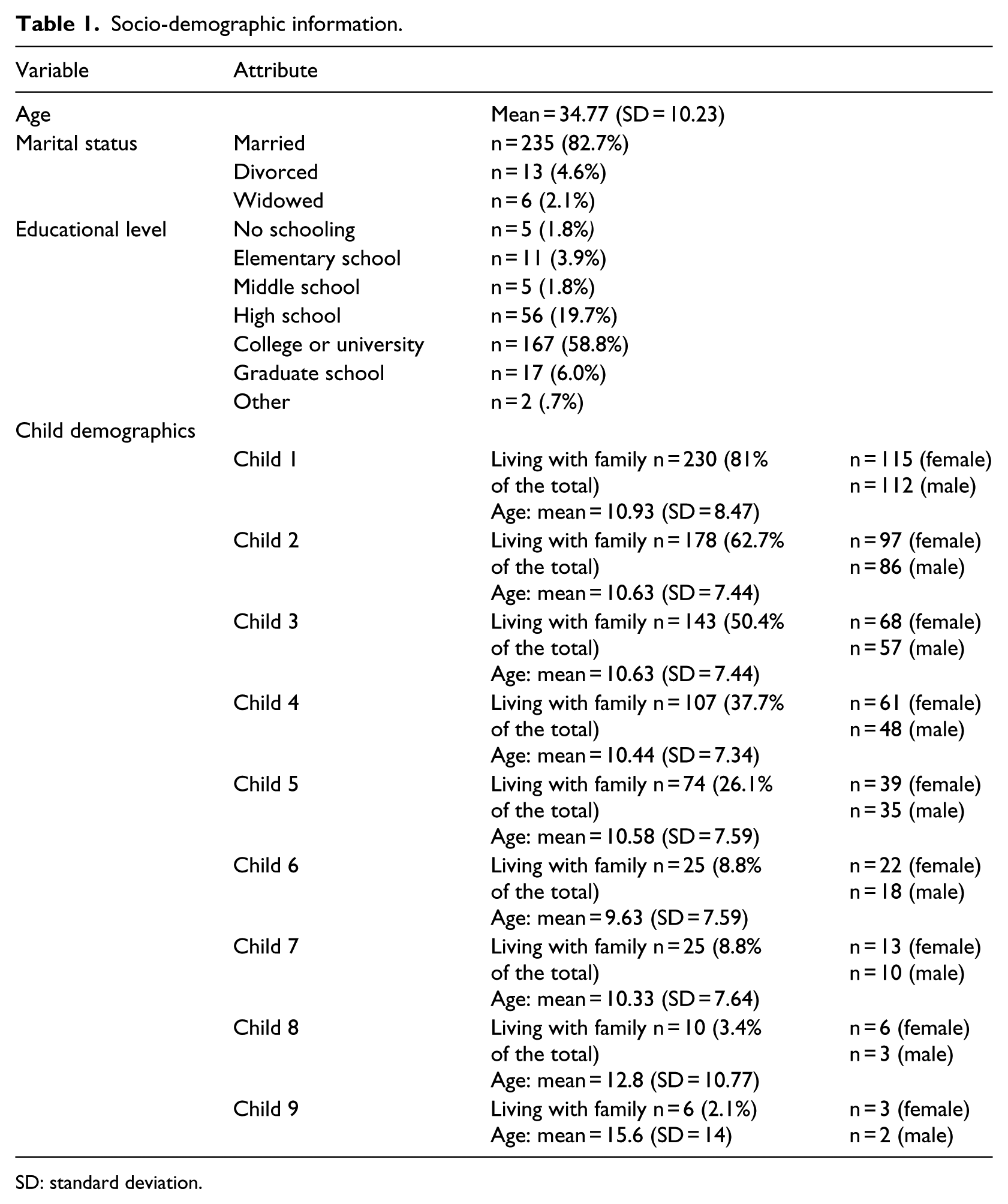
SD: standard deviation.
To summarize, the background data indicate that all women in this study were financially supported to where they received needed support in their children’s upbringing. A great majority of our participants were highly educated and demonstrated awareness about the issues involved in taking care of their children. Unlike demographics one might find in Euro-Western countries, all women had financially stable lives and would be considered “mature” and responsible individuals.
As mentioned above, interviews followed the collection and analysis of the survey data. These interviews were open ended in nature, in that although we developed an interview protocol to follow, we did not adhere to it strictly but rather focused on listening to the stories of our participants. These interviews were conducted in a variety of places such as on the university campus and in offices, but interestingly never in anyone’s home. As we have written about elsewhere (Nasser and Viruru, 2012), research in Qatar has often been seen as something that can be made part of Qatar’s landscape without disrupting its socio-cultural context. This article attempts to present the insights gleaned from those interviews. One further note of explanation: very early on themes that emerged from the data showed a deep ambivalence toward the roles of fathers in Qatar. To honor that insight, we recruited and interviewed three Qatari fathers to talk about their perspectives on motherhood. Those perspectives form part of our analyses as well.
Our study shows that the intersection of discourses of intensive motherhood with indigenous discourses of motherhood in the Arabian Gulf combines to create a complex set of conditions for mothers in Qatar. Responses from our participants show that most of them felt under pressure to do everything and be everyone to their children. Below, we describe the themes that emerged from our data.
The many faces of intensive motherhood
Fatherhood in question
One of the most interesting themes that our data revealed was that although many of the women seemed to have positive relationships with their own fathers, they were less positive about the roles their spouses played in their children’s lives. Although the women recognized that there were deep cultural roots that underpinned non-participation, such as the segregation of spaces by gender, a very deep sense of frustration with male behavior came through very clearly in our data, particularly with ways indigenous to the Gulf. It was clear that the women we interviewed disproportionately felt and assumed the responsibility of producing the number and kind of citizens that the state now requires and chafed against some of the restrictions that both existing social mores and newly created institutions have imposed upon them. For example, at least two mothers brought up their frustration with the long standing but still-existent taboo on boys revealing the names of their mothers to strangers. The mothers were much more critical although of the very limited role that fathers played in the lives of their children. When asked to describe the roles fathers played, the responses were varied: In Qatar, you must know about the man. He thinks about himself. How can I help my family: just give them money. Not too much. Children are not feeling about their father. If they want to talk, they talk to me … you are mother, you are father. 80 percent financial. If he is in the house, he holds her for about half an hour and that is usually when I am putting dinner on the table. On the weekends its when I am making lunch, and she happens to be awake. I do wish he was more involved. I think about that all the time. He is alive but he’s not here in my world For emergencies. The funny thing is that when their father is there, they don’t have the usual problems with brothers and sisters … no one snatches toys or teases their sisters … when their father is there, they are polite, he is the angel and I am the devil.
Although there were some mothers who had more positive feelings toward fatherhood, they were definitely in the minority.
Doing all the work
Our study revealed that without question most of the work of caring for children is done by mothers, family members, and their domestic helpers. Almost all of the women who participated in our study described themselves as busy, stressed, over-worked, and often struggling to keep up with the demands placed on them as mothers. As they said, it left with little time for anything else. Speaking of everything she had to do as a mother, one of our participants responded: Who said that? Who made the rules? One women described her daily routine in the evenings: Sometimes I finish dinner, put the baby to sleep, tell stories, check YouTube if there are any stories about what they are studying in school … then I go see my mother-in-law … give my husband dinner, then take my youngest child to bed. My husband says I sleep like a dead woman. This is my story. it affects my body. But I am strong. Wa’Allah (by God) the woman she should go direct to Paradise.
Frustrations with social policies
Many of our respondents were frustrated with social policies in Qatar that seemed to work against their interests. For example, motherhood itself was not always a voluntary status or something the mothers themselves had chosen to become. On a side note, abortion and some forms of birth control are illegal in Qatar (United Nations, n.d.) To quote one respondent, when asked whether she could change anything about being a mother: I can’t say what I am thinking … its just too bad. I didn’t choose to be a mom. It shocks me still, after all these years. I got pregnant the first time it was not planned. 2 weeks after getting married. It was a big shock. I always felt like I shouldn’t be doing this. I always wondered if I had the choice would I have really done it? The decision is to have a baby is like having a tattoo on your face … I am not sure if I would have wanted to do it.
Commenting on birth control, another respondent commented, Birth control is used … we have different methods. I didn’t use it myself as my husband doesn’t agree with taking it, he thinks that pills can affect me in the future. That is the way he thinks. I showed him many studies but he says no. A lot of people do use birth control. One of my relatives asked me why I don’t use it and I said my husband doesn’t agree with it and then she said why did you even tell him, do it behind his back.
The concerns of the respondents also stretched much beyond just the choice to become mothers; as many of them commented, they could not see why the state’s abundant resources were not used to make the lives of mothers easier. Why for example, they questioned were there not more flexible working hours for mothers; why were there no state run child-care centers of high quality, as were found in the neighboring United Arab Emirates; why did they receive only 2 months of paid maternity leave and why were their workloads altered when they became pregnant. As one participant said, From the time I was pregnant, I could feel the level of trust and the complexity of work given to me drop dramatically. I felt so judged: “she is pregnant, she will go to appointments, take maternity leave”, so I was given no complex work and no big projects and even allowed much less involvement in ongoing work. I was trying to tell them that I am pregnant but that doesn’t mean that I can’t use my brain, I can still analyze consumer usage patterns and can read an excel sheet.
Particularly significant in the findings above is the extent to which the state regulates maternal leave, suggesting a patriarchal device to keep women at bay and encourage them to stay at home. As discussed earlier although Arab-Islamic perspectives emphasize communitarianism as a positive family value, they also play a significant role in regulating women’s lives, translating into policies and infrastructures that limit women’s abilities to balance work and family life. Arab feminists would argue that women should be able to challenge the current state of things, working from within Islamic principles and seek the equity needed to claim their rights as mothers and wives (Foley, 2004).
Trusting no one
One of our initial questions while undertaking this study was to see how the easy availability of domestic help influenced women’s perceptions of motherhood. In all, 70% of the women we surveyed had domestic help to assist in household tasks, and close to half of them employed nannies to help them with their children. However, most of the mothers we surveyed were deeply ambivalent about entrusting their children to their nannies and housekeepers. Most mothers said that they did not allow the nannies to help with them the more intimate tasks of childcare, relegating them mostly to supporting roles. Many mothers commented that they did not leave their helpers alone with the children under any circumstances although the helpers were often mothers themselves. As our respondents put it, I do everything, the cooking and taking care of the child, changing diapers. I think it is better, plus my child is very precious I don’t trust anyone with her. If I have to go to a medical appointment I leave her with my mom not with the maid. After 6 or 7 years I got one nanny to help with the house not the babies. Not even one percent were they left with the nanny. I am very stressed on this issue. I don’t leave baby with the housekeeper. From bathroom to bed … I feed them, bathe them, change dresses, cleaning, washing, teach them … send to school and bring them back She looks after them if I am sleeping, and if I go out but I don’t leave her home alone with them … either they go to my sister’s house, or sister in law or mom.
Ultimately, it seemed as though the mothers in our study felt that other than their own families, they really had no one to turn to, when it came to bringing up their children: neither husbands, nor the help, nor the state could be trusted to support them.
Conclusion
Feminist scholarship on motherhood has shown that although it is an experience that many women treasure, it has also been a site through which power and control over women has been enacted. Perspectives gained from a yearlong study of motherhood in the Arabian Gulf nation of Qatar suggest that Western images of mothers as beings who locate themselves primarily as mothers have blended well with local traditions, to create institutions that limit the possibilities afforded to women. Although most of the women in the study valued and celebrated their status as mothers, they were also deeply frustrated by the lack of support that they were given, and as the title of the article suggests, perhaps believed that the only rewards they would receive would be in Paradise.
Footnotes
Funding
The author(s) disclosed receipt of the following financial support for the research, authorship, and/or publication of this article: This research was supported by a grant from the Qatar National Research Fund.