



Abstract
Nunangat pedagogies concern the adoption of teaching practices informed by relationships with land, water and ice. In this article, the researcher examines an opportunity to disrupt Global North dominance in the Inuit homeland through engagements with fox. Nunangat methodologies require consultations with Elders and hunters especially concerning knowledge that is not accessible via the Internet or at the library. A rhizomatic analysis is used to connect the presentation of the various research narratives and analysis of encounters with fox. These strategies are employed to facilitate occasions to re-conceptualize early childhood practices in ways which enable recognition of the vitality and viability of local Indigenous ways of knowing and being.
This article reports on a research project in which the investigator, collaborators and participants purposefully sought to relate with nunangat in negotiating pedagogies for Inuit early childhood education (ECE). Nunangat is an Inuktitut term that incorporates land, ice and water. Specifically, this article examines how this intentional engagement with nunangat resulted in opportunities to grapple with the complexities of and shifting relations between Arctic foxes and Inuit entanglements with ECE in Inukjuak, a community of 1600 mostly Inuit people in Nunavik, northern Quebec, Canada. Thinking with nunangat in proposing pedagogies for young children in the context of settler colonialism creates occasions to consider the construction of curriculum from Inuit perspectives, to access Inuit knowledge, to use Inuit language and to learn about inequities in Inuit-settler relations and about tensions between nunangat pedagogies and Euro-Western pedagogical theories, such as developmentally appropriate practice (DAP).
Working with nunangat methodologies involves adopting an approach to research that is deeply informed by Indigenous methodologies (Battiste, 2008; Blackstock, 2010; Ermine et al., 2005; Hart, 2010). The research presented in this article was designed with Inuit collaborators with the purpose of responding to community priorities in a helpful way. In nunangat methodologies, a turn to land, water and ice provides a strategy that requires consultation with Elders and hunters regarding information that cannot be found online or in libraries. Meanings are considered in discussion with local knowledge holders, in relationship with nunangat. Furthermore, working with nunangat methodologies calls for analysis that positions the researcher to consider many possibilities. The adopted analytical approach is rhizomatic (Deleuze and Guattari, 1987; Sellers, 2015), a rhizome being composed of many connected parts. The idea is to bolster connection making, to prompt puzzling and to enhance meaning making. The contents of this article could be considered an assemblage (Deleuze and Guattari, 1987) that is a series of events enacted through the text. In this document, the reader will encounter short narrative reflections and stories interspersed with historical vignettes, as well as data from the research and analysis. In places, the pronoun ‘I’ is employed. This is done to express the author’s (partial) perspectives concerning the events and encounters examined in the research, as well as to better engage with the situated knowledges (Haraway, 1988) of the encounters.
This research article begins with an opening vignette – a brief pedagogical moment in which an educator and the pedagogical counsellor from Tasiurvik Child Care Centre in Inukjuak, an Inuk Elder, and the researcher take a group of 4-year-old children to trap a fox. This vignette is followed by a section that provides some background into the problematics of fox trapping in Inuit Nunangat (the official term used by Inuit Tapiriit Kanatami – an organization that refers to itself as the ‘national voice of Canada’s 60,000 Inuit’ (Inuit Tapiriit Kanatami, 2016, para. 1) – to recognize Nunavik, Nunatsiavut, Nunavut and the Inuvialuit region of the Northwest Territories as the regions and territories in which Inuit live and have lived for millennia). The background section also describes the research context of the Tasiurvik and Natturaq child care centres in Inukjuak and highlights both the failure of Euro-Western ECE pedagogy to respond to the needs of Inuit children in these centres and the mechanisms through which Euro-Western ECE practices such as DAP perpetuate colonialisms. Then, in a section that discusses fox trapping as a means of thinking with nunangat, the author first positions the work and then explores rethinking curriculum engagements through three lines of inquiry: relating with nunangat as a foundation for well-being, ongoing settler colonialism and nunangat pedagogies. This latter topic clarifies the author’s principles of nunangat pedagogies. After outlining the research activities, the author ‘thinks with nunangat by learning with fox’, a section that illuminates some tensions in the work, and then ‘thinks with nunangat to create spaces for Inuit perspectives in early childhood education practice’. In the article’s concluding section, the author discusses possibilities for this work to contribute to undoing Global North dominance in childhood studies.
Opening vignette
The text that follows is presented as an invitation to the reader to come into the heart of the research project. The vignette is compiled from research and field journal notes assembled while I worked on my doctoral dissertation, Thinking with Nunangat in Proposing Pedagogies for Inuit ECE (Rowan, 2017):
We have decided to take four 4-year-olds enrolled in the local child care centre fox trapping. It is part of a strategy to access Inuit knowledge in ECE: We trap a fox. As we sit on the floor of the child care centre gym examining the anatomy of the trapped fox and watching out for migrant lice, the administrator remembers how proud the children in her family were when their father came home with fox. The pedagogical counsellor reminds us about the traders exchanging a single musket for a pile of furs, which the traders squeezed down tight to increase the number of pelts they received for that gun.
This article begins with the short vignette about fox trapping, above, as a strategy to demonstrate how thinking with nunangat can open up possibilities for articulating Inuit perspectives in early childhood practice. In the story, the child care centre administrator remembers feelings of pride she shared with her siblings when their father returned home with a fox. In this instance, the fox-trapping event and subsequent cleaning and preparation activities provide a platform for memory sharing. As the conversation continues, a story exposing serious colonial inequities is spoken as the pedagogical counsellor describes the circumstances of the fur exchange, where the fur trader tries to collect as many furs as possible to exchange for the gun by pushing down hard on the furs. Uncomfortable feelings of the past injustices are remembered and unease is felt in limbs and tummies. In this article, the author intentionally connects stories of fox trapping and encounters with ECE as a strategy for considering the effects of colonizing dominances in early childhood practice, and to develop an argument for proceeding otherwise.
Background
We came to fox trapping with 4- and 5-year-old children at the child care centre on the inspiration of Elder educator Elisapi Weetaluktuk. On the evening of the first formal research meeting with the Elders and educators, I presented photos of a series of ptarmigan-trapping excursions in which I had participated with Sami kindergarten children in northern Norway during the winter of 2014. These photos featured a Sami trapper instructing the children on the techniques of trapping, and then, at a later date, returning to the tundra to retrieve the trapped birds. In discussing the possibilities, these photos might suggest for our work in Nunavik, Elisapi voiced her interest in taking the children for fox trapping. In this section, I provide some background information about Inuit, fox trapping and colonization to demonstrate the viability of connecting fox trapping, nunangat pedagogies and colonization as part of a rhizoanalysis intended to trouble Global North/South dynamics in ECE.
Prior to contact and colonial interest in the fur trade, fox fur was used as trim on clothing and was eaten by some Inuit as part of their regular diet; others ate fox only during times of hunger. At least two types of Inuit-designed traps are known. One is set up as a cairn using rocks and/or ice blocks, and another is shaped like a box, suitable for trapping a single animal (Bennett and Rowley, 2004). British anthropologist Brody (1991) suggests that before the fox trade became vital to the economy of an Inuit family, fox trapping and skin preparation were probably part of a woman’s work and situated at the edges of Inuit lives. Fur traders, however, valued fox (Vick-Westgate, 2002), and Inuit started to trade fox in the late 1800s for objects produced through Euro-Western technologies, including guns, needles and kitchen supplies. The fox trade peaked in the 1920s, and in 1991, the Hudson’s Bay Company traded its last fur (Canadian Broadcasting Corporation, 1991). Inuk activist and author, Watt-Cloutier (2015), describes how participation in the fox trade precipitated a shift from practising self-sufficient hunting for family and friends to trapping fox fur for trade. This shift, Watt-Cloutier explains, led to many changes, including nutritional ones. In describing the changes, Brody (1991) explains succinctly, ‘It was trapping that broke Inuit economic self-reliance, trapping for the fur trade’ (p. 151). Jenness, writing in 1959 (as cited in Brody, 1975), was unequivocal: The new barter economy – furs in exchange for the goods of civilization – made life harder instead of easier, more complicated instead of more simple. The commercial world of the whiteman had caught the Eskimo in its mesh, destroyed their self-sufficiency and independence, and made them economically its slaves. (p. 32)
The consequences of dependency on the commercial world of the White man meant that the collapse of the fox market, which occurred over 20 years from the 1920s through to the end of the Second World War, was extremely difficult for many Inuit (Olofsson, 2004). Watt-Cloutier (2015) argues that these hardships played an important role in prompting Inuit to move away from their camps and closer to government settlements and supports, which included the possibility of welfare and family allowance cheques.
The fox trade represents an important dimension in the history of Inuit colonization. Trapping fox with young children in an early childhood programme provided a valuable opportunity to begin to consider the impact of colonization in the context of contemporary early childhood practice, as depicted in the opening vignette.
Inukjuak today has two child care centres, Tasiurvik and Natturaq, with a combined total of 125 spaces serving children from 6 months to 5 years. Most of the children in the community speak Inuktitut as their mother tongue. The more than 20 members of the staff are all local Inuit hired from the community. The service is overseen by a non-profit parent majority board. When the first of these two centres, Tasiurvik Child Care Centre, was opened in 1998, the building was designed by southern architects, furnished with materials and equipment from urban Canadian suppliers, and inspected by the government of Quebec. Staff are trained with content which, for the most part, is based on Euro-Western theories of child development, learning and care (Rowan, 2014a, 2016), such as DAP.
One critique of DAP (Copple and Bredekamp, 2009) is that it perpetuates humanistic and Eurocentric ideas about individual growth and the mother–child dyad (Burman, 2008; Fleer et al., 2008; Gonzalez-Mena, 2008). I am concerned with the contemporary purposes, productions and doings of Inuit ECE, grounded as they are in Euro-Western theory and structure (Rowan, 2016), which serve to perpetuate colonialisms (Tuck and Gaztambide-Fernández, 2013; Tuck and Yang, 2012). Indigenous Australian scholar Atkinson appears to share my worries when she laments the exclusion and marginalization of Indigenous knowledges within early childhood settings. Atkinson (2009) notes that it is difficult for educators to acknowledge the ‘influence of the early childhood center itself in perpetuating colonial understandings of “race”’ (p. 148). I believe that Inuit knowledges, languages and culture ‘must be available, must be lived, must be embodied to be known’ (Rowan, 2013: 187). Through a purposeful resituating of practice, I intentionally strive to engage with Inuit ideas and understandings, as they relate to ECE, as integral to a decolonizing ethic. I have done this by working on curriculum guidebooks (Avataq Cultural Institute, 2006), supporting educators in making Inuktitut language books for children (Rowan, 2010), and through my master’s research with ilitsigatsait (learning stories; Rowan, 2011).
This article describes how we came to observe, think, work, trap, skin, eat, share stories, write, photograph and video engagements with people, materials, weather and foxes while negotiating complex multidimensional relationships inside and outside the Tasiurvik and Natturaq child care centres. The section below begins with a staff member from Tasiurvik Child Care Centre talking about her memories of fox trapping.
Fox trapping as thinking with nunangat
Back in the days when we still used to walk everywhere, I had a fox trap. One day we were walking to check our fox traps and I could see my trap far in the distance on the mountain. As I looked from afar, I could see that there was a black fox in my trap. While I walked, I became increasingly excited, especially as I moved closer and closer. On approaching, I anticipated removing the fox from the trap and bringing it home. Then, when I was almost there, I saw that what I thought was a black fox was really a crow. Somehow that crow had managed to get caught in the trap. (Minnie Weetaluktuk, child care centre cook, recorded in research journal, 19 November 2014: 130)
From ilitsigatsait (learning stories) to nunangat (land, water and ice)
In 2011, I wrote my master’s thesis (Rowan, 2011), which focused on the possibilities of learning stories as a meaningful approach to ECE. I worked in close collaboration with Maaji Putulik, the local pedagogical counsellor, and Aani Augiak, the care counsellor from Kativik Regional Government (KRG). Maaji, Aani and I found that learning stories, which consist of photos and text featuring children and events around the child care centre, served three main purposes. They provided a functional tool for accessing Inuit knowledge and engaging with Elders, a viable mechanism for building multidimensional relationships among families, children and teachers, and a valuable Inuktitut language resource (Rowan, 2013, 2014b). In conducting narrative interviews with the research collaborators and educators, several important concerns emerged. These included that Inuit children were not getting out on the land to the extent that Inuit children once did, that there was a lack of Inuit materials at the centres, that Inuit language and culture were intertwined, and that there is a relationship between culture and pride. I noted in my thesis that many educators have been actively voicing an interest in incorporating cultural knowledge at the centre, and are seeking to purchase [procure] cultural materials and connect with Elder’s information about Inuit cultural ways. They are also talking about the possibility of engaging in taking children fishing and out on the land. The educators also noted how, through activities at the care centre, and by documenting these with learning stories, children can come to see cultural ways and insights into cultural knowledge that they might not otherwise experience. (Rowan, 2011: 128)
The learning stories project served as a catalyst to wanting to go further in accessing and living Inuit ways of knowing and being at the child care centre. In 2014, I returned to Inukjuak. Tasiurvik Child Care Centre director Asinajak Qinuajuak, pedagogical counsellor Maaji Putulik and I had developed a project in which the key question asked was as follows: Could photos, videos, and educator-written stories depicting the experiences of young children on the land and by the water in the vicinity of Inukjuak be used to contribute to early childhood educational practices and curricula that are better informed by Inuit worldviews? (Service de garde Tasiurvik Inc, 2014: 2)
Our overall purpose was to develop approaches to working at the Tasiurvik Child Care Centre that were more deeply informed by Inuit ways of knowing and being than were the current practices. By organizing, documenting and reflecting on experiences with nunangat for young children, we investigated whether this approach had the potential to contribute to place-connected pedagogies (Gruenewald, 2003a, 2003b; Somerville, 2007, 2010; Somerville et al., 2011) for Inuit ECE – pedagogies that would facilitate engagements with ways of knowing and being relevant to the community (Cummins, 2014; Manyak, 2004) and through which a decolonizing ethic in practice could be lived.
To do this work, we met parents to listen to their cultural, linguistic and educational aspirations for their children (Rowan, 2009). We hired an Elder educator and consulted with a project Elder. The Elder educator suggested ideas for many events and took part in fox trapping, fishing, willow branch collecting and many more. The project Elder provided overall big-picture ideas and advice, and she also provided historical information about experiences with traders and specific Inuktitut technical language, place names and much more. We worked with educators to articulate land-based interests, planning and doing land-based events, creating documentation and materials, and following up with children. We cultivated opportunities for children to live events with nunangat. We sought to employ and validate Inuit approaches to care and education.
Having now positioned the research and elaborated on its purposes, in the next part of the article, I consider some of the theories that positioned us to rethink curriculum engagements.
Rethinking curriculum engagements
One of the motivating factors that propelled me to take up this research was to find ways to get children and educators beyond the fenced-in playground of the child care centres. I had been concerned about the quality of outdoor play time at the centres. During the daily hour of outdoor play, as many as 70 children might gather to play inside a 10-foot tall fence on sandy soil or ice or snow. The playground had some toys and equipment the play area extends along the length of the child care centre. It was a congested and, from my view, often unproductive space, where not much of interest was happening. So, when we took the children fox trapping, I was absolutely delighted (Figure 1).
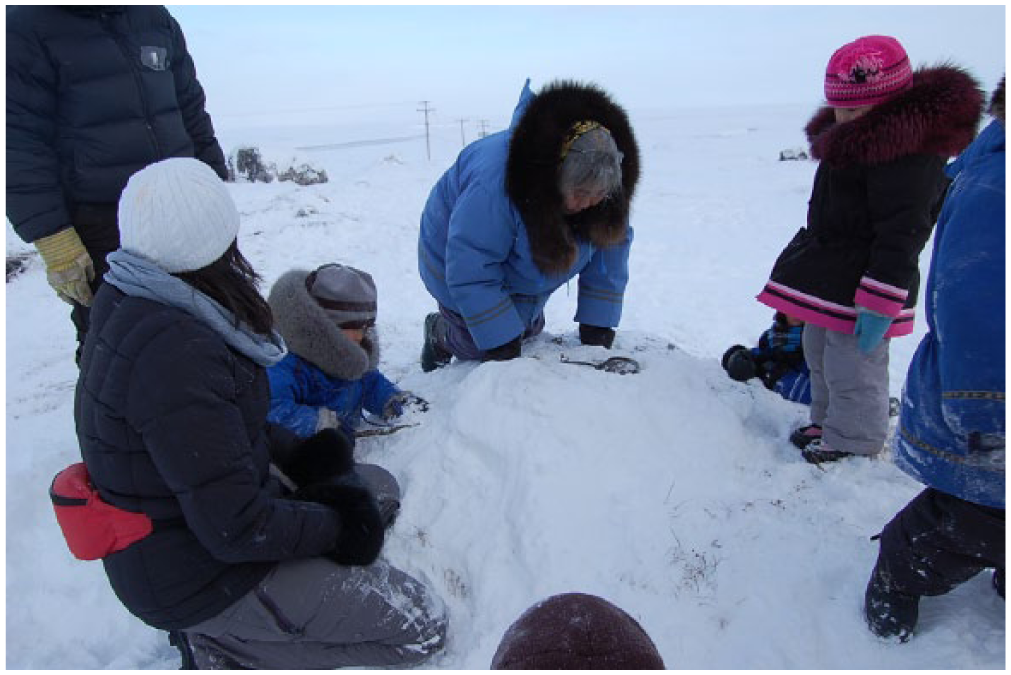
Fixing the trap. Photo credit: author.
I see trapping, skinning and eating fox in early childhood practice as acts of reclaiming Inuit knowledge embedded in relationships with nunangat. Nishnaabeg scholar Simpson (2014) writes about reclaiming land as pedagogy, both as process and context for Nishnaabeg intelligence, in order to nurture a generation of Indigenous peoples that have the skills, knowledge and values to rebuild our nation according to the worldviews and values of Nishnaabeg culture. (p. 1)
Simpson (2014) suggests how thinking with land as an approach to teaching can provide a way to access Nishnaabeg knowledge. In so doing, she provides theoretical sustenance to my framework, in which I propose to think with nunangat. This position is fortified by thinking with Inuk scholar Price (2008), who advises that ‘the things to learn [are] the lessons that come from interacting with the land’ (p. 129), and with Cree scholar Greenwood (2009), who recognizes the potential of ECE as a site for cultural rejuvenation. There are enormous possibilities in thinking with nunangat and adopting nunangat pedagogies (Rowan, 2015b) as methods of deeply engaging with Inuit ways of knowing and being in early childhood practice. Doing ECE with nunangat, children, Elders, educators and foxes provides a way of linking to place-specific and Inuit ways of knowing and being – ways that can be drawn into rethinking curriculum engagements.
I have chosen to engage with three main ideas in theorizing this work. The first concerns the Inuit conceptualization of land as animate and sentient, a being with which one engages relationally. The second troubles ongoing settler colonialism, particularly as it relates to Inuit ECE curriculum. The third considers the principles of nunangat pedagogies, which provide the theoretical framework for the practical negotiation of this research project. I briefly discuss these three key strands below.
Relating with nunangat as a foundation for well-being
Inuit have been living in, on and with nunangat (the land, sea and ice) for millennia (Bonesteel, 2008; Kuptana, 2013). Throughout these millennia, Inuit have developed complex multidimensional relationships with nunangat. Pokiak (2013) describes the land and sea as having voice, while Stairs (1992) writes about an eco-centric identity. Smith (2009) speaks about the value of ice in providing Inuit access to marine mammals throughout the many months during which the Arctic sea is frozen. Ice provides a reliable surface for extended travel, a source of potable water, blocks for building and so much more. Land is understood as having many roles, attributes and capacities, including teacher, nurturer, disciplinarian and provider (Price, 2008; Watt-Cloutier, 2000; Williamson, 1992). For most Inuit living in the Inuit homeland, the relationship with nunangat has provided a foundational basis for physical, emotional, cognitive and spiritual well-being. Chambers (2008), writing about a particular group of Inuit children, explains that ‘Kangiryuarmiut children are educated to watch and listen to animals, birds, plants water, snow, wind, and astronomical beings as well as other human beings’ (p. 121). It has been in relationship with nunangat that Inuit develop knowledge, produce language, hone skills and adopt responsibilities. Nunangat, within the Inuit paradigm, is a communal responsibility, and a vibrant relationship with a caring land is a foundation for well-being.
Ongoing settler colonialism and its impact on curriculum
Settler colonialism, seemingly in complete disrespect of Indigenous relational land ethics, purposefully takes over Indigenous lands. Tuck et al. (2014) explain that ‘settler colonialism is a form of colonization in which outsiders come to land inhabited by Indigenous peoples and claim it as their new home’ (p. 6). Through settlement processes, Indigenous land becomes property, and multidimensional, communal Indigenous relationships with land are undermined (Chamberlin, 2003; Tuck and Yang, 2012). Settlers have employed various theories to justify their actions. These include manifest destiny, the doctrine of discovery and the concept of terra nullius (Tuck et al., 2014; Tuck and Gaztambide-Fernández, 2013; Tuck and Yang, 2012; Whitehouse et al., 2014). The effect of settler colonial takeovers has been that many Indigenous people have been alienated from their lands. Furthermore, among Indigenous populations in colonized places, healthy lives have been compromised, as evidenced by high rates of infant mortality, social service apprehension, and incarceration and by low life-expectancy numbers (Duhaime, 2008; Whitehouse et al., 2014). Wolfe (2006) names these factors in discussing settler colonialism and the ‘logic of elimination’ (p. 387), while Tuck and Gaztambide-Fernández (2013) more specifically describe curriculum as a project of replacement, which is of concern in this article. One serious curriculum-related issue, according to Tuck et al. (2014), is settler colonial states’ ‘refusal to recognize themselves as such, requiring a continual disavowal of history, Indigenous peoples’ resistance to settlement, Indigenous peoples’ claim to stolen land, and how settler colonialism is indeed ongoing, not an event contained in the past’ (p. 7). Of prime concern is the role that curricula play in cultivating and perpetuating colonial injustices. Calderon (2014) decries ‘dominant settler ideologies of land [that] leave little room for Indigenous-informed frameworks and little to no possibility for decolonizing work in education’ (p. 25). The ontological and epistemological orientation of current curricula, for example, Quebec’s Educational Program for Childcare Services (Ministère de la Famille et des Aînés, 2007), informed as it is by a settler colonial ethic (Whitehouse et al., 2014), must be completely revised if Indigenous knowledges and practices are to become integrated into educational systems and the replacement project thwarted. One way of engaging in serious paradigmatic shifts towards Indigenous curricular frameworks is by thinking with nunangat (Calderon, 2014; Rowan, in press, 2015b; Tuck et al., 2014; Whitehouse et al., 2014).
Nunangat pedagogies
Motivated by a profound concern with ways in which curricula, such as the one being used in Quebec to guide pedagogical practice in ECE noted above (Ministère de la Famille et des Aînés, 2007), serve to propagate ongoing inequities through the normalization of settler colonial practices, I proposed nunangat pedagogies as a strategy for presenting Inuit ideas in education (Rowan, 2015b). Nunangat pedagogies represent a way to engage with land education in Inuit places. The five main principles embrace the following key ideas:
Pedagogies are accessed and learned in relationship with nunangat (Aylward, 2012).
Elders have years of experience with nunangat and provide a fundamental bridge between learners and the land (Qikiqtani Inuit Association, 2010).
Inuktitut language connects with Elders and nunangat, and using it in pedagogical practice legitimizes and validates local knowledges (Cummins, 2014).
Thinking locally through situated pedagogies enables access to Inuit ontologies and epistemologies while recognizing globalized realities (Cenkl, 2012; Massey, 1994).
Meaningful materials are those used in the community (Hennig and Kirova, 2012) on and with nunangat.
These principles are elaborated in the section ‘thinking with nunangat to create spaces for Inuit perspectives in ECE practice’. They inform the remainder of this article.
Research activities
The research discussed in this part of the article is grounded in and informed by the pedagogical principles articulated above. The activities I describe below were part of an action research project that involved 23 educators and staff, more than 100 children, 20 excursions with nunangat and a series of culturally informed centre-based activities. Focusing on the events pertaining specifically to fox, I provide an overview of the main components of the research project and then weave participant reflections with highlights related to the learning. I begin with an excerpt from a report I prepared for the Tasiurvik Child Care Centre board about the white fox-trapping events (Rowan, 2015a): The preparation of the tiriranniajaq (white fox pelt) was the culmination of a series of activities led by Elder educator Elisapi Weetaluktuk concerning tirriranniaq (white fox). First, the fox trap was set on a hill about a ten-minute drive from Inukjuak. Educator Sarah Samisack and four children from the oldest group at Natturaq Child Care Centre participated in setting up the trap and returned the next day to discover a white fox. The trapped fox was brought back to Natturaq, where Elisapi, Sarah, and the pedagogical counsellor, Maaji Putulik, began the task of preparing the meat and pelt. The process progressed over a two-week period during which the children at Natturaq had many opportunities to come into the gym and watch the preparation of first the meat and then the pelt and to examine some of the body parts. The pelt was dried on a wooden rack on the balcony of the infants’ room and then brought over to Tasiurvik, where the children in the oldest group had the opportunity to work with Elisapi on removing the pelt from the rack. (Adapted from Rowan, 2015a)
When I travelled to Inukjuak in the fall of 2014, I knew that we planned to work closely with Elders, children, parents and educators and to think with nunangat by engaging in outdoor events. I did not know that fox would become a prominent player in the work. Shortly after my arrival in the village, a meeting was organized with the staff of the two child care centres. At the meeting, I showed a PowerPoint presentation featuring excursions with young children and teachers I had been involved within the Norwegian part of Sapmi. 1 The photos featured two significant events: ptarmigan 2 trapping and a visit to a reindeer herder’s place. Following the presentation, the Elder educator suggested that she would like to go fox trapping with the children. Then, at the next staff meeting held the following week, the educators were invited to suggest activities connected to the land that they might like to engage in with the children in their groups and the project team. One of the educators indicated an interest in taking the children in her group of 4- and 5-year-olds fox trapping. So, at the intersection of the Elder educator’s suggestion and the educator’s interest, fox trapping became a very real possibility. By the end of the 8-week project period, six outdoor trapping excursions directly involving about seven educators and 20 children had taken place. We set up two traps, one for a white fox and another for a red fox. We checked the traps and discovered that we had trapped a white fox. We retrieved the trapped fox, prepared the fox meat and pelt, dried the fox pelt, prepared the pelt for display and use, and ate the fox meat. A series of related indoor events was also organized.
In the process of engaging with the fox, many photos and video clips were taken. The educators made 11 learning stories, Maaji made an eight-page booklet showing all about fox trapping and a poster featuring the fox trap with specific Inuktitut terminology, I made a children’s story about following fox tracks along the river, and a short video titled Mikigaq (fox trap) was produced and screened. In my capacity as researcher, I wrote in my journal daily in an effort to remember conversations, activities and events. I compiled one-page reports on each excursion to inform the future curriculum, wrote up field notes, including some favourite photos and engaged in a series of narrative conversations with key players: the Elder educator, the pedagogical counsellor, a parent board member and educators. The fox trapping and related activities opened to a very tangible way of living land education and facilitating pedagogies of decolonization.
Thinking with nunangat by learning with fox
The next part of the article explores opportunities that thinking with nunangat nurtured in terms of biology lessons on the anatomy of the fox, observations of fox habitat and strategies for trapping fox. Learning with nunangat pedagogies in these ways also activated tensions between the dictates of DAP in the early childhood centres and the commitment of the research project to engage with nunangat. These tensions specifically concerned being outside in the cold weather, starting to skin the fox during naptime, and differences of opinion and attitude about eating the fox (Figure 2).
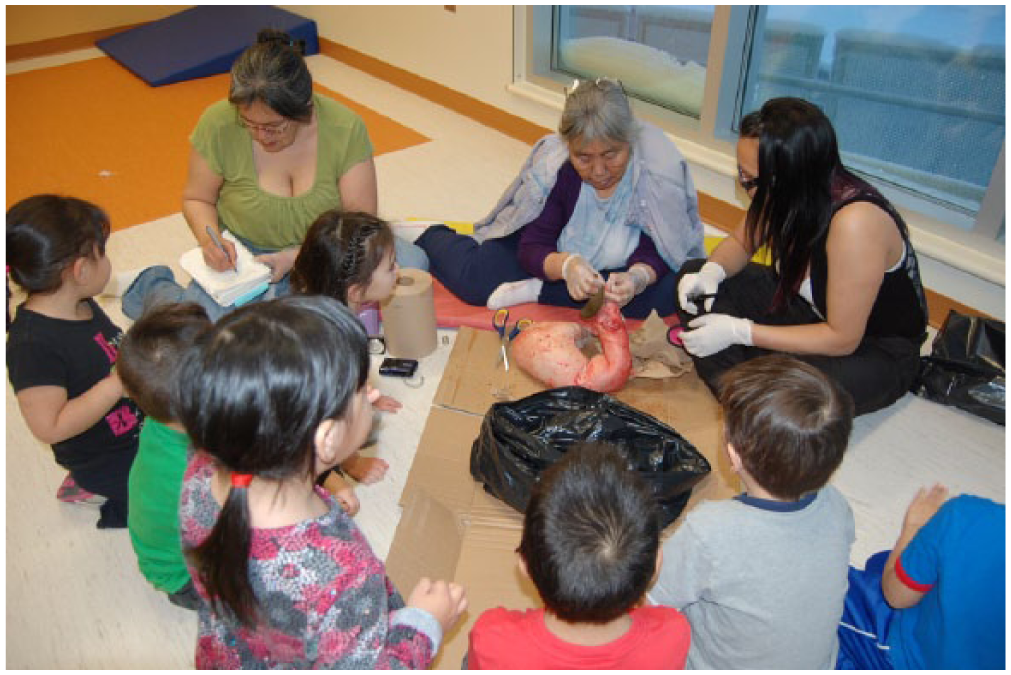
Preparing the fox. Photo credit: author.
In the process of working with the fox, we learned much about the skills required, the materials needed and the specific technical Inuktitut language to be used concerning each of the steps in the fox trapping, pelt drying and meat preparation processes. At one point, the 4- and 5-year-olds, wearing latex gloves, passed around and examined the fox’s inner ear. As we learned together about the anatomy of the fox, I came to appreciate the size of this small mammal for study purposes with young children. Pedagogical counsellor Maaji Putulik took careful notes and made a poster featuring arrows and text identifying the main parts of the fox trap in Inuktitut. The educators very much appreciated this teaching tool. They recommended in the interview process that infrequently used Inuktitut language words be put on posters and charts and positioned strategically around the child care centre as mnemonic devices.
All of us who participated in the fox-trapping events learned much about red and white foxes. The first group trapped a white fox after 1 day, while the second group, over 5 days, never did manage to trap a red fox. Adults and children made comparative observations, noting that the white foxes are trapped near the salt water shores of Hudson’s Bay and that the red fox is found further inland. We came to understood that red fox are generally smarter, bigger and stronger than white fox. The fox-trapping events provided an opportunity for the children and adults to think about the process of fox trapping and the relationship between the trapper and the fox. Educator Annie Nastapoka explained that fox trapping made for a new beginning, because now that the children had been fox trapping they would be interested in doing so again in the future. Evidence of this interest came when one of the girls who trapped the white fox went home and asked her parents to take her fox trapping. Annie also noted learning about placing flowers on the trap and using a big rock to secure it, emphasizing that she was anxious to learn more about fox skinning and was interested in doing more fox trapping with the children.
Many educators noted that the children appeared to be happier and more relaxed when on the land. Pedagogical counsellor Maaji Putulik described the children as both ‘excited and scared to see the trapped fox’. She found the fox-trapping activities a way to learn more about Inuit culture. As an example, one parent spoke about her feelings when she went to pick up her child at the centre and found the children watching the Elder educator cleaning the fox and preparing the skin. The parent explained, Once you grow up you try to remember what your grandmother or what your mother did with the fox, and skinning the fox is a natural, traditional Inuit way of living. You know you use the fur to keep your parka warm or for mitts. To carry on with that lifestyle it is very important to have Elders at the centre for the children to see that. Then when they grow up they can think about that and remember – ‘I remember watching my grandmother or an Elder at the day care one time doing this, I wonder how’. It makes you want to learn. (Parent interview, May 2015)
Fox trapping and preparation also created a space in which stories of colonial inequities could emerge, as evidenced in this excerpt from my research journal: While Maaji and Elisapi prepared the fox in the centre gym, Nellie Palliser joined us to chat. We shared some fox stories. Nellie said, ‘The children would be so proud when their father brought home a fox’. Maaji spoke about how a hunter could trade a pile of pelts as tall as a musket or rifle for a single musket or rifle. Nellie speculated on the inequities and about just how rich some traders could become while Inuit were not being fairly compensated. (Research journal, pp. 137–138)
As the above excerpt demonstrates, fox trapping provided a space in which the value of fox trapping to Inuit could be made visible and some of the complexities of colonial relationships could be spoken.
Through fox trapping, we learned about the skills and materials required. We learned about fox anatomy and developed observational and comparative understandings of fox environments and behaviours. We learned about, created and used materials to support specific technical Inuktitut terms concerning the fox trap and much more. We gained insights into Inuit ways of knowing and being, as well as an appreciation for children’s relaxed comportment on the land. All of these learning opportunities lead to sustaining relational land connections in the future.
Tensions
In the process of negotiating the fox-related events, cold weather, schedules and eating the fox all produced tensions with which we grappled. On reflection, I think that some of these tensions emerge at the intersection of Euro-Western and Inuit views. I think this is what Somerville (2010) refers to as the contact zone of contestation. These intersections in the contact zone may be places where the insidious structuring and invisible impositions of DAP compromise, disrupt and make difficult an easy rollout and adoption of practices and theories informed by Inuit ways of knowing and being.
Below, I briefly address three situations we encountered, in an effort to open up the issues and pose some preliminary questions.
Cold
After several weeks of organizing, a plan to go fox trapping with a group of young children from Natturaq Child Care Centre had been finalized, and the day had arrived. This excerpt from my field notes describes the day: It was a cold morning, and within a few minutes of calling the centre to confirm that we would proceed with the fox-trapping plan, the assistant director called to cancel, saying the weather was too cold. Maaji Putulik, the pedagogical counsellor, turned immediately to the Internet and checked the temperature, which was −19 Celsius (C). The centre has a policy that stipulates that −25 C is the point at which children do not have to go outside. So I called the centre director back, asking specifically if the educator, Sarah Samisack, would agree to take four children who would travel in the child care centre van. Happily, Sarah agreed. (Adapted from field notes, 18 November 2014: 6)
How does it happen that weather becomes too cold for young Inuit children to go outdoors? Until the establishment of government-constructed municipalities between 1960 and 1980, Inuit children grew up outdoors on the land, water, ice and snow. Weather was rarely too cold. Fox trappers need to have hands that can work in cold weather to manipulate the trap. Inuk activist, Watt-Cloutier (2015) has written a book titled The Right To Be Cold, which addresses ongoing issues of colonialism and climate change. Inuit children have the right to be cold, to know cold, to live outdoors in cold. Being in cold has very much been an Inuit way. Being in cold requires opportunities to be outside in the cold, to have proper clothing, to be with people who accept cold as a part of life. Fox trapping provided a place where both the children and adults engaged with cold.
Schedules
Life at the child care centres in Inukjuak is organized around meals, staff breaks, naptime, circle time, outdoor time and free play. This schedule can lead to complications when there is a fox to be skinned. Staffs have a 15-minute break in the morning and another in the afternoon, and 1 hour for lunch. On the day the fox was trapped, Elisapi Weetaluktuk took her scheduled lunch break and then returned to the child care centre. This excerpt from my research journal describes what happened next: After lunch Elisapi, Maaji, and I went up to Natturaq so Elisapi could skin and gut the fox. Elisapi was very anxious to remove the fox’s feet as soon as possible, otherwise the skin would be ruined and the guts would soon be starting to expand. Unfortunately, this was the children’s naptime, and when I peeked into the playroom, I saw the children sleeping. I wanted the children to fully participate in all aspects of the fox-cleaning activities. The educator was very concerned because she had told the children they would watch the preparation, but Elisapi could not wait. She said she needed to do the work now. Fortunately, the children began to wake up about an hour later, so they witnessed much of the action. (Research journal, p. 136)
The above situation leads to questions about how, if we want to engage with Inuit ways of knowing and being in care settings, we can rethink schedules and timetables. Can we trouble the structure of routines to accommodate the urgencies of pelt preparation?
Complexities of eating the fox
A series of encounters took place concerning the eating of the fox that provoked my attention and suggested fox eating as a site of contestation. First, I asked the Elder educator about eating the trapped fox that was being skinned. She answered, ‘I am going to take it to my friend’s place and we are going to eat it there’. I wondered in reply, ‘Maybe we could ask the educator of the children who trapped the fox if the children might like to eat it, if that would be ok, and your friend could come?’ When I asked the educator if she would like to eat the fox with the children, she was clear: ‘I am not eating that fox. I know where it has been. And I am sure the parents of the children in this group do not want their children eating that fox either’. Some adults in the community worry that the foxes, many of which live under front porches and sheds throughout the village, are eating garbage. As someone said, ‘I would not want to eat a fox that has been eating trash’. I understand that foxes are most interested in eating mice and lemmings. That night as I return home in the dark, I witness a fox eating a caribou skin in the middle of the road.
Several people have told me how they used to really enjoy eating fox. I note that it seems that people have stopped eating fox, and ask why. My niece told me, ‘I used to love to eat fox, even more than goose, but I have not eaten fox since my grandfather died in 2001’. Another woman told me, ‘I love to eat fox, but have not had any since my dad got old’. And a third said, ‘My mom says the fall is the best time to eat fox. There are times of the year when foxes should not be eaten, but the fall is a good time. The foxes are fat’.
On the evening of an educators’ meeting in early December, about 14 educators, the pedagogical counsellor, two Elders and the researcher ate fox at the child care centre. On the following day, I asked a young substitute educator, ‘Did you eat the fox last night?’ She replied, ‘No, I have never eaten fox, and I don’t want to’. Later, I ran into one of the long-time educators, who had not made it to the meeting. I said, ‘We ate the fox last night. Too bad you missed that’. She replied, ‘I ate so much fox when I was young – I had enough’. A non-Inuk father noted, ‘I would not allow my child to eat fox – too close to dog’.
The fox was delicious. Eating it opened up complexities around food – and what constitutes edible/desirable food – that require much more attention (Nxumalo et al., 2012). I see eating the fox at the child care centre as part of a process of complex reclamation made possible through nunangat pedagogies, but I wonder as follows: ‘What would be required to serve the fox to the children?’
Naming the tensions with cold, schedules and fox as food highlights places where Inuit and Euro-Western understandings meet. It also points the way to comprehending strategies for reconceptualizing practice with Inuit perspectives. Next, I reference the five principles of nunangat pedagogies I outlined above as a strategy to consider how spaces for Inuit perspectives in early childhood practice were cultivated through this project.
Thinking with nunangat to create spaces for Inuit perspectives in ECE practice
The first principle of nunangat pedagogies is that they emerge from the land. By purposefully going onto the land to set the trap on a cold day, an opportunity was taken up to feel the cold, to work and learn in the cold. Going onto the land provided an important strategy for engaging with Inuit approaches to living, learning and being.
A second principle of nunangat pedagogies is that Inuit Elders provide a bridge between learners and the land. In this example, the idea for fox trapping originated with the Elder educator. The fox-trapping idea led to a series of engagements involving land, snow, moss, fox traps, hunter, Elder educator, children, parents and educators. These engagements enabled access to a body of knowledge, skills and language required for working with fox, which included trapping, skinning, preparing the pelt, eating and sharing stories about fox.
A third principle is that nunangat pedagogies use Inuit languages. The fox-trapping events required use of appropriate, specific, technical fox-trapping language. The pedagogical counsellor made a poster featuring Inuktitut words for the parts of the fox trap. In the process of trapping the fox, we learned about setting up and using a fox trap and how to decorate the trap with flowers and secure it with a big rock. We learned about the anatomy of the fox and carefully examined the body parts. We learned how to prepare the pelt to use for making the warm clothing required for life in a cold weather climate, all in Inuktitut.
A fourth principle of nunangat pedagogies is that they are situated, place-based pedagogies that recognize local knowledge and consider global influences. The fox-trapping work created spaces for fox-trapping stories to be shared, for foxes to be eaten, and for inequitable colonial relationships to be made visible and considered within early childhood practice. Eating the fox with a large group of educators and Elders gave fox eating a presence at the child care centre and among the diners. We watched as the Elder educator cracked the skull and ate the brain. We learned about eating fox while we ate. This food consumption is an important way in which space was created through this work for Inuit ways of knowing and being. Also, the urgency with which the fox preparation needed to proceed after lunch on the day the fox was trapped created some tensions concerning the schedule, in that waiting for the children to arise from their naps was not an option. In this tension, we learned that working with animals can be time sensitive and that attending to the dead fox takes precedence over the centre schedule. Challenging the routinized schedule is another way of bringing land-connected Inuit knowledge into the working life of the child care centre.
The fifth principle of nunangat pedagogy is that it uses meaningful materials of the place. The fox trap, pelt and drying rack are all meaningful materials of the place in which the child care centres are situated. Working with these materials connects back through each of the other principles of nunangat pedagogies because the materials we used supported the local trapping experience, which facilitated the acquisition and use of precise Inuktitut language terms, which came about on the inspiration of the Elder, because we opted to purposefully think with nunangat.
Contributing to undoing Global North dominance in childhood studies
The work presented in this article used a series of experiences centred around fox trapping as a way to show how engaging with nunangat pedagogies can provide a strategy for negotiating places for Inuit knowledges in Inuit ECE. Discussing the tensions we dealt with helps to disrupt ongoing colonization through ECE. Going into the cold and trapping the fox, proceeding with the fox pelt preparation while the children napped, and eating the fox at the child care centre are actions that are integral to the adoption of a decolonizing ethic in ECE.
We took photos, made videos and wrote stories about the fox. We lived experiences inside and outside the child care centre. The documentation attests to the recognition of early childhood practices that are deeply informed by Inuit worldviews, and opens up to the possibility of curricular experiences that are connected to the knowledges and practices of Inukjuak.
In this work, there was a sense that children, educators, pedagogical counsellor and researcher were learning together with the Elder. This engagement with local knowledge and practice sparked a desire among all participants for more nunangat-related knowledge and opened up many opportunities for sharing local stories. I think this work contributes to undoing Global North dominance in childhood studies because it makes Inuit trapping practices accessible inside a government-regulated service. This is important because, since the advent of daily Euro-Western schooling in the 1960s, time on the land for Inuit has been drastically reduced. The transmission of Inuit knowledge has been disrupted. The fox-trapping events are thus significant and complex acts that make visible and trouble colonial heritages and presences while making space for Inuit-articulated interests and priorities in early childhood encounters.
Footnotes
Funding
The author(s) disclosed receipt of the following financial support for the research, authorship and/or publication of this article: This research was conducted with funding from the Government of Canada. The author was a Vanier Canada Graduate Scholar from 2012–2015. Furthermore, the in community research took place with the assistance of funds from Kativik Regional Government through the Esuma Stay in School Program.