




Abstract
This study investigates the role played by parents as mediators of young children’s access and engagement with digital technologies. In Belgium, Germany, Latvia and Portugal, qualitative in-depth interviews were conducted with 10 families in each country, including one child between 6 and 7 years old. Our findings show that parents of young children mainly play the role of ‘gatekeepers’ when it comes to facilitating and constraining access to and use of digital technologies. Parents’ perceptions of the efficacy of digital technologies as responsible entertainment and as educational tools influence the technologies available at home and accessible to the child. These perceptions in turn impact parents’ mediation strategies with regard to children’s actual use of digital technologies, with restrictive mediation – of time and less of content – and supervision applied most. The power exerted by parents over access and use may be understood as a limitation of the children’s rights. On the other hand, parents are not always concerned with the right of protection as they believe – sometimes incorrectly – that they are in control of the content their children are exposed to.
Introduction
Children are increasingly being born in digital homes, and they become accustomed to being stimulated by digital technologies from an early age (Holloway et al., 2013). Apart from the (now) traditional television, which still plays an important role in the entertainment of children in the home (Lauricella et al., 2015), they are easily attracted to smartphones and tablets (Genc, 2014; Plowman et al., 2008). For children, new digital technologies have a double-sided nature: they can be powerful tools of empowerment and self-expression, almost endless sources of information and social resources, but at the same time, they hold multiple dangers to which children are particularly vulnerable (Holloway et al., 2013; Livingstone et al., 2015).
Children’s development and hence their appropriation of media are affected by social relationships and the world around them. Already in the 1970s, researchers such as Bronfenbrenner (1979) acknowledged multiple social systems at various distances that impact an individual’s life, including a microsystem (e.g. family), mesosystem (e.g. school), exosystem (e.g. school community) and macrosystem (e.g. dominant ideologies). Although each of these social systems can impact children’s appropriation of digital technologies, the key in understanding how children negotiate their digital technology use is the family context (Plowman et al., 2008; Stephen et al., 2013). Parents in particular play a crucial role in their adoption of digital technologies and in the development of digital literacy (Bittman et al., 2011; Livingstone, 2007; Plowman et al., 2008). With this research, we address the following research question: How do parents mediate the access and engagement of young children with digital technologies?
Thus, this study focuses on the parent–child relationships within the home context. More specifically, we study the balance between inherent risks and opportunities, and the tension between the rights to provision and to protection of children as provided in the Convention on the Rights of the Child (CRC) (United Nations High Commissioner for Refugees (UNHCR), 1989). As such, this is one of the first studies that aims to integrate the literature on parental mediation with a framework on children’s rights. The research particularly addresses the case of children under 8 years old as this age range has been under-represented in the academic literature (Holloway et al., 2013; Plowman, 2015).
Theoretical overview
Children’s rights: provision versus protection
Although childhood has been studied and analysed from various theoretical perspectives, in this article we refer to the agreed definition of childhood that was adopted by the 1989 CRC (UNHCR, 1989). In the CRC, the child is transformed from a ‘passive object to be protected and cared for’ into ‘an active social subject with rights, a person in a process of growing, whose evolutive capacity must be respected and protected’.
With the take-up of Internet and digital technologies by children, the next step has been to extend the principles of the Convention in the new digital era. Children’s specific digital needs and vulnerabilities have been acknowledged in policy documents such as the European Strategy for a Better Internet for Children (2012), the European Union (EU) Agenda for the Rights of the Child (2011), and the General Data Protection Regulation (GDPR), as well as in academic research. The EU Kids Online project for instance investigated the ways children use new media, with a particular focus on evidence about the conditions that shape online risk and safety (Livingstone and Haddon, 2009; O’Neill et al., 2011). In addition, the CRC already includes specific rights that are relevant to the children’s digital sphere. The three pillars of the CRC convention – Protection, Provision, Participation – helped us to categorise the children’s rights that emerged from our field work and to relate them to the parental mediation strategies that parents put into place for ensuring their protection (Table 1).
Livingstone’s (2014) categorisation of children’s rights in the digital sphere against CRC’s three pillars.
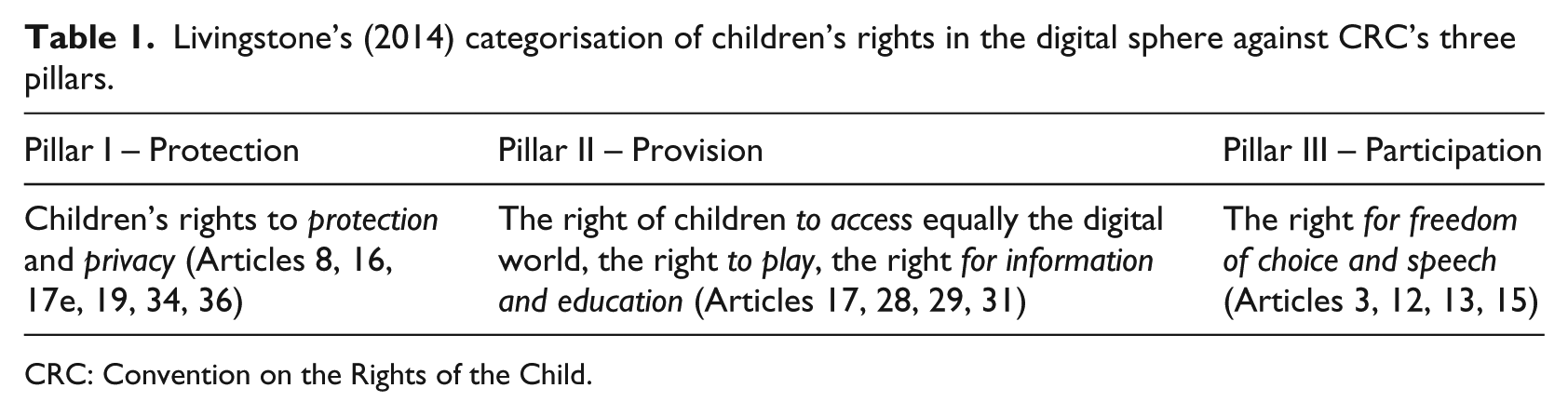
CRC: Convention on the Rights of the Child.
Parents’ perspectives on digital technologies
The above framework on children’s rights of access (Pillars II and III) and protection (Pillar I) highlights the opportunities and risks associated with digital technology use. Although the framework is likely not on the radar of many parents, they also have varied and ambivalent attitudes to the role of technologies in the child’s life and, as a result, struggle with children’s rights of provision and protection. Many parents seek to balance the educational aspirations they have for their children with their fears of harmful consequences of excessive use. According to Plowman (2015), parents’ attitudes towards children’s engagement with technologies can be categorised as either guarded or well-disposed. Researchers emphasise that parents of young children tend to have positive perceptions and attitudes towards the integration of digital technologies in the home and their children’s engagement with them (Plowman et al., 2008), hence stressing the need for provision. In fact, today’s parents are Prensky’s (2001) ‘digital natives’ – meaning that they have grown up with digital technologies themselves. Following this new perspective on education, Goh et al. (2015) corroborate that parents are usually permissive when it comes to allowing young children to use computers, smartphones, tablets and consoles in the home. However, research reveals some of the parents’ fears and internal struggles: many parents are uncertain about the potential harm of digital technologies, in particular related to excessive screen time and nature of violent (video game) content (Plowman and Hancock, 2014; Zaman et al., 2016). Likewise, research by Nikken and Schols (2015) reveals that offline activities are often more valued than online activities, even though the boundaries between offline and online activities are becoming increasingly blurred (Marsh, 2014). These negative perceptions thus align with the pillar of protection.
Children, technology and parental mediation
Given the ambivalent perceptions of parents towards digital technologies, parents may experience a need or desire to understand their children’s media use and to develop educational strategies to maximise the benefits and minimise the risks (Nikken et al., 2007).
Research on the parental mediation of digital technologies has focused mostly on teenagers. Livingstone and Helsper (2008) identified four factors that characterised parental styles of mediation of the use of Internet by teenagers: active co-use (using the Internet together, helping children to understand what to do when faced with an issue), interaction restrictions (general restrictions, such as time limitations), technical restrictions (content restrictions, such as banning certain sites or preventing attacks through filters and firewalls) and monitoring (checking children’s online activity). Nikken and Jansz (2014) created a similar, empirically grounded classification of five styles of mediation. Like Livingstone and Helsper, they distinguish between restrictive mediation in terms of time and content, and monitoring or supervision. Co-use is distinguished from active mediation based on the distinction of consuming together and really helping children to understand what to do when faced with an issue.
In this study, we focus on the parental mediation of young children’s use of digital technologies and relate it to a framework on children’s right of access and protection. Based on the literature, we propose a continuum going from gatekeepers to scaffolders to understand parental mediation in relation to children’s rights. Gatekeepers emphasise restrictive mediation and truly act as a gateway to the technology. As a result, the emphasis is on protection and provision. Scaffolding, on the other hand, refers to a transactional process where parents discover the optimal level at which to instruct the child, intervening in such a way that the child can succeed at the task but also gradually learns the skills to complete the task independently (Conner and Cross, 2003). Hence, scaffolders facilitate a broad range of parental mediation strategies, with an emphasis, however, on a more supportive and instructive position. It involves trying to enact both rights of protection and access in a more negotiated manner. This continuum was also apparent in recent European research, whereby more Nordic families could be categorised more clearly as scaffolders and families in more southern countries as being closer to gatekeeping (Chaudron et al., 2015).
Methodology
Method and procedures
This study builds on data from one European research project (Chaudron et al., 2015).
Given the exploratory nature of the research and, consequently, the emphasis on selecting information-rich cases, purposive sampling was used. Families with at least one child aged 6–7 who interacted with digital technologies at least once a week were targeted. Nevertheless, younger and older siblings could be present during the interview. The goal was to obtain a diverse sample in terms of children’s ages and gender, family composition, ethnicity and socioeconomic status. For this article, data were used from 10 Belgian, 10 German, 10 Latvian and 10 Portuguese families, resulting in a total sample of 68 parents and 39 children from the target group aged 6–7 and five interviewed children under the age of 6. In addition, further context was provided by indirectly or directly observing 32 children outside the target group in the interviewed families.
The interviews were conducted in the home of the participants, with the exception of three interviews that were conducted at the facilities of a community service or parish centre at the request of the families. Each family was visited by two researchers. One researcher interviewed the child(ren), focusing mostly on the answers of the child from the age group targeted, while the other researcher interviewed one (in most cases the mother) or both parents. An entire session lasted between 1.5 and 2.5 hours.
All interviews followed an observation protocol that was structured around four sections. First, researchers introduced themselves and briefed both parents and children on the procedure (interview structure, audio recording, confidentiality, informed consent forms, etc.). Subsequently, parents and children identified the structure of a typical week and weekend day by matching time and activities using stickers. This allowed researchers to understand the prominence of media in the family as well as to gain the trust of parents and children. After this, parents and children were interviewed separately (possibly in separate rooms). While the interviews with parents largely followed the pattern of a traditional semi-structured interview, innovative and age-appropriate interview practices were used to understand the prominence and negotiations as regards media in the family from the children’s point of view. Within these interviews, each research team had some freedom to make adaptations according to specific interview contexts and needs (e.g. country, culture, family context, etc.) as one of the aims of the project was to discover new techniques to research young children’s appropriation of digital technologies. Commonly used tools and activities used by all researchers include a card game displaying digital devices, children showing and demonstrating the (use of) digital technologies available at home and/or a so-called ‘Digital tour’ of the house. 1 Finally, all family members came together and researchers asked whether there was anything they wished to add to the interview. Researchers asked for basic demographic information and handed over goodie bags to thank the participants.
Data analysis
Each interview was transcribed verbatim and analysed according to the principles of thematic analysis (Braun and Clarke, 2006). Although analysis was conducted separately in each country, the coding of data was based on a protocol of analysis jointly constructed by the consortium partners. What’s more, participating researchers from various countries compared and discussed the coding and results in both face-to-face and computer-mediated meetings. All results provided in this article have been set against the individual findings in each of the countries.
Findings
Children’s rights in digital technology use: Provision and protection
Children have access to a wide range of devices: smartphone, game consoles, tablet, computer or TV. Although parents are not aware of conventions or initiatives concerning children’s rights and digital media, such as the CRC, it is clear that parents struggle to find a balance between provision and protection. In line with Plowman (2015), our findings show that most parents of young children play the role of ‘gatekeepers’ when it comes to facilitating and constraining access and use of digital technologies. Parents’ perceptions of the efficacy of digital technologies as responsible entertainment and as educational tools influence the technologies available at home and accessible to the child (provision). At the same time, most children desire access to digital devices and pressure parents into negotiating it (participation). In this sense, the power exerted by parents over such access can be understood as a limitation of the children’s rights; to the extent that parents use their power to control access to digital technologies, this may be seen as a limitation of children’s rights (provision and participation). On the other hand, very young children should be protected from early access or unregulated use of information and communications technology (ICT) (protection) (American Academy of Pediatrics (AAP), 1999, 2011; Dreier et al., 2014). This tension between right of protection and right of provision highlights the relevance of this study.
This tension is also fuelled by incomplete information. Just as with older children (Livingstone and Haddon, 2009) – but to a lesser extent – there is a discrepancy between what children actually know and do with digital technologies and what parents think they know and do. We observed instances where children knew devices’ passwords or could download apps without parents’ awareness:
She [6 year-old girl] downloads them herself, because she knows how to find them in Google Play. She learns it from her friends or chooses applications that look interesting. She tends to download, try and if she doesn’t like it, she searches for a new one. […] (Father from Latvia, 50)
Most of the parents in our sample feel that their children are protected for now, mostly because the youngest children (usually under 6 years old) lack skills such as reading and writing and also because some of them do not engage in social networking yet, which is where parents believe they are most exposed to dangers:
There are bad things, but they do not affect us yet. We know that sooner or later we will have to deal with them, but they don’t have access to them yet, and do not know them. The Facebooks, and Twitters, […]. The contacts with strangers on the internet. That is going to be very difficult to manage, and I believe that is a big downside of digital technologies. (Father from Portugal, 39)
However, children are tech-savvy and resourceful. They develop their own strategies for searching content, managing memory and dealing with advertising. This is a trial–error process not exempt from risks. In general, children are more exposed to inappropriate content at this young age on YouTube and search engines. The autocomplete feature and the suggestions are the main causes leading to exposure to violent and/or sexual content. This potential risk is illustrated by the pictures below (Figure 1) which were taken while a boy from Belgium was showing us how he typically used the Internet on his dad’s laptop. This is not an exemplar of ‘risk’ but rather one of many possible images that children come across and this may raise risks that need to be considered.

Pictures came up while a child from Belgium was using dad’s laptop.
Given those findings on permissive mediation and trial–error usage, the right of protection is certainly relevant for young children even though parents do not always acknowledge the need.
Children’s and parents’ perception of digital technologies
For children, digital technologies, in particular the tablet, represent a space for entertainment but also, because most children are allowed to use these devices independently and generally without close monitoring, a space of freedom and escapism from the ‘world of adults’.
In terms of risks, children mainly emphasise the fragile nature of digital technologies themselves, thereby showing awareness of the costs that are involved in purchasing such technologies:
I can play sometimes [with dad’s [i-]Phone], but usually I cannot.
Why not?
Because once I was playing with and I let it fall. I was very little, […]. So, I didn’t know it was made of glass. (Girl from Belgium, 6)
The parents’ perceptions are generally ambivalent, recognising advantages and disadvantages. Most parents point to the educational value inherent in digital technologies and describe them as indispensable tools for the future. A minority of parents stated that even when children engage with non-educational digital content, they always learn. They develop different skills from school context ones, independence, problem-solving, collaborating or hand–eye coordination. Parents recognise the educational potential:
They stimulate memory, and also make them explore, they adapt to a game because they intuitively explore it. (Mother from Portugal, 39)
While many parents recognise the potential educational value inherent to digital technologies, in practice – and in line with children’s dominant perceptions – the devices are mainly used as ‘toys’, ‘games’ or something to ‘entertain’. Although there is certainly (pedagogical) value in playing games, watching videos on YouTube and taking photos/making videos (e.g. Beavis and O’Mara, 2016), it arguably also reflects an under-exploration of their full pedagogical potential.
The positive perceptions, however, are often set against more negative views on the impact of digital technologies on children’s lives. Many parents, for instance, express nostalgia for their own childhood, claiming that they prefer children to engage in physical or outdoor activities whenever possible:
Kids don’t play like we used to play … On the street … They’re not able to make friends because they are constantly looking at their smartphones and tablets. I don’t think they are enjoying their childhood to the fullest. (Mother from Portugal, 28)
What parents fear the most regarding excessive use of digital technologies is the lack of physical exercise, of good sleep, social isolation and their negative psychosocial consequences:
It’s about what they miss out on, eh. At the moment you are doing that [sitting in front of a screen] you can’t do anything. You can’t get bored, you can’t play, you miss out on social contacts. Those are things you can’t do ‘alone alone’. (Mother from Belgium, 37)
Some children also recognise some of the effects that digital technologies, in particular games, can have on them, such as difficulties in managing frustrations:
I can’t play anymore, because I threw the remote control up against the ceiling.
You threw the remote control up to the ceiling? Why?
Because it got out of my hand.
It got out of your hand? And now you are not allowed to play computer games anymore?
With the TV.
But are you still allowed to watch TV?
Yes, watching TV is still allowed. (Boy from Germany, 4)
Parents are less concerned regarding dangers that may stem from inappropriate content. Finally, parents are aware of dangers such as contact with strangers, invasion of privacy, cyberbullying and paedophilia, but they believe these are concerns for the future, as they feel their children are not exposed to them at such an early age.
In sum, parents have various ideas on the benefits and dangers of digital technologies. The benefits appear to be poorly understood, while concerns are related to time use, allied to their perception of children being insufficiently skilled to reach inappropriate content.
Parental mediation styles and resulting practices
Parental mediation is shaped, on one side, by perceptions of digital technologies and, on the other, by tensions, between parents themselves, as mother and father do not always share the same views, and between parents and children.
The ambivalent perceptions of parents are visible in their struggle to manage children’s right of provision and right of protection. Because most parents allow their children to perceive digital devices as toys and fail to recognise that young children are digital-savvy, their concerns focus more on restricting time than on restricting or discussing content.
However, there are some differences, even in the same family. Mothers tend to be more restrictive in general and controlling of content, while fathers can be more flexible and less strict. Dads share digital gaming sessions with their children especially if they are, or were, gamers themselves. Contrastingly, mothers are more permissive in allowing children to use their own devices.
In line with the above-described focus on screen time instead of content, most parents restrict the time their children spend on digital devices either by forcing the child to stop playing if they intuitively feel the child has ‘had enough’ or by setting rules. A more extreme example of rules was found in a family from Belgium (Figure 2):
It is as follows [each day], if he does his homework well, because that is the problem [there is a reward system]. The reward system is that, if he does it in a reasonable amount of time and without making a fuss, he earns half an hour of ‘screen time’. […] For example, if he does his homework in an orderly fashion three times, then he has an hour and a half. Then he can choose one time an hour and a half or three times half an hour. (Mother from Belgium, 38)

Time-timer employed by the Belgian Family Delta to control time spent on the tablet and laptop.
Time rules are often grounded in the daily rhythm of family life, such as not being allowed to play until homework is done, before bedtime or during school days. Some level of supervision and monitoring was also observed in our study, consistently with previous research from Nikken and Jansz (2014). Most parents also claim to ‘keep an eye’ on their children during their technology use and/or to take sporadic ‘tours’ through children’s personal devices, monitoring the apps installed and occasionally asking children to delete what they find inappropriate, mostly violent games.
Some mothers also state they pay attention to sounds, thus monitoring games and videos remotely:
Do you look after your daughter when she’s watching TV?
I always listen and see what she’s watching, and if I don’t like something, I turn it off.
And how about using the computer?
It is the same, I can see what she is doing more or less by passing by. It’s not like she can do whatever she wants. (Mother from Latvia, 39)
Restrictive mediation and supervision appear preferred mediation strategies of parents for young children. A minority of parents expressed concerns about very close monitoring being problematic, as it might be a violation of the children’s privacy and have a negative impact on the parent–child relationship, particularly on trust.
Active mediation, and hence participation, the third pillar of the CRC, was observed less frequently. Although most parents believe in dialogue, they have not covered most risks and dangers with their children yet, referring to it as ‘too early’.
They also trust that children will tell them about problems that may occur, yet some children described problematic episodes – contact with violent, scary or sexual content – that they have not discussed with their parents. Instead, instructive mediation with younger children is often limited to teaching children how to overcome difficulties and how to navigate content and activities, thus acting as ‘gatekeepers’ not only for provision but also for skill development. The mediation is more frequent when children begin to use the devices. After a while, children are trusted to be left alone to explore the device:
We started watching YouTube […]. There are a lot of non-stop videos […]. Most times we decide between 10 and 15 minutes is enough. I was at her [daughter aged 3] side all the time at the beginning. I admit that this changed recently. I am not longer at her side all the time when she watches but still keep track on my watch. (Mother from Germany, 32)
This freedom of engagement experienced by most children – although respecting their right to provision – can be considered against their right to protection, as it leaves them potentially exposed and vulnerable to screen dangers.
Parents in our sample, with the exception of several tech-savvy fathers from Germany, are generally unaware of methods, techniques and features they might use to control, monitor and filter digital engagement or consider them only relevant when children grow older. This can again be explained by the observation that most parents believe they are fully in control of their children’s media use at this young age, when this is in fact not (always) the case.
In conclusion, a thin line separates parents’ duty and desire to protect their children from digital technology dangers and the restriction of access they impose in doing so. Perhaps the greatest danger lies in the unsupervised use of digital technologies, as parents are often not fully aware of the activities that children perform online.
Discussion and concluding remarks
The results of this study show that a wide range of technologies and intensive use of them is considered as a norm in many households (Holloway et al., 2013), and young children are using these digital technologies actively. Children are given access to digital technologies at a young age, but it is not always clear whether these devices are meant to be only tools for entertainment or whether they should also provide educational activities. Children improve technical skills quickly, independently and successfully (Frechette and Williams, 2015). Their technical skills correspond to the particular age, and the reasons for using technologies are associated with entertainment rather than performing deliberate learning activities.
In line with Nikken and Jansz (2014) and Plowman et al. (2008), our results show that parents’ perceptions and attitudes play a crucial role in young children’s adoption of digital media and in the development of their digital literacy. As Plowman et al. (2008) and Genc (2014) already underlined, parents’ perceptions and choices regarding digital technologies shape the digital landscape in which children live. Although non-educational reasons can influence the purchase of technologies (availability, affordability, fashion and trends, social circles), we also found that parent’s perceptions are key to parental mediation style and therefore to children’s provision and protection in respect of digital technologies. In line with Nikken and de Haan (2015) and Plowman (2015), we see that negative perceptions result in greater difficulties for parents in mediating their children’s engagement with digital devices, while parents with positive perceptions tend to be more confident in their mediation. Our analysis linking parents’ perceptions and mediation strategies shows that the more parents are confident with digital technologies themselves, the more they perceive them as positive and the more confident and active they are in their mediation. On the contrary, parents who lack digital skills and knowledge are less confident, find greater difficulties in managing their children’s access and protection, and are more fearful of losing control. These parents often chose more restrictive and controlling mediation strategies.
Parents’ understanding and logical courses of action in our sample vary between two positions: restrictive and permissive:
Restrictive: parents who highlight more negative aspects in the use of digital technologies and who are more passive in their use of technologies. In such a model, raising children is more dominated by prohibition and rules linked to the use of digital technologies. Similar to results of Nikken and Schols (2015), parents value offline activities more than online activities.
Permissive: parents who use technologies actively themselves and value their children’s digital technology use. Nonetheless, at the current developmental state of their children, most parents in this category give relatively little thought to the content and in most cases only superficially reflect on the consequences of technology use (Goh et al., 2015). Parents in this model prioritise the provision of technologies and pay secondary attention to the child’s emotional safety. They are not very worried about negative effects as they perceive the digital technology use of their child as safe (Plowman et al., 2010; Plowman and Hancock, 2014; Zaman et al., 2016). In a few instances, this permissive parenting style turned into true scaffolding whereby parents instructed and communicated with their children about the content of media.
In terms of strategies regarding access and protection to/from digital technologies, most parents thus centre on a rational mediation style. It combines restrictive mediation (mainly on time, less on content), supervision and occasionally dialogue. They value supervision (Nikken and Jansz, 2014) and dialogue more than control – and hence are aware of and understand some of the risks involved in digital technology use – but mainly perceive the need for dialogue for older children. They feel their children are not at risk yet and are confident that they would report any issues. Children are not (much) purposefully guided and often only remotely supervised during digital activities. Their main emphasis on safety concerns damage to the technology and health issues such as eye problems and overuse. Most are not yet familiar with the technical safety guidance that Nikken and Jansz (2014) have highlighted. Parents with positive perceptions of digital technologies believe that their children can also learn a lot by using the devices themselves, but it is unclear for them how such a learning experience can be successful. The protection of the child without compromising its provision (access, information, education) and participation (freedom), however, likely requires an in-depth understanding of the scope, challenges and also positive opportunities provided by digital technologies. Only then is a further development towards a true scaffolding role possible.
The data identified an intriguing gender contrast in the parenting approach that should inspire future research. Fathers are often technically competent technology users and delegate more freedom to their children, while mothers are more conservative technology users, who develop more detailed provisions of use for children and often for spouses as well so that it would be an example for children.
As we can see, much is still to be done to balance young children’s engagement with digital technologies in order to optimise their rights in protection, provision and participation (Table 1). This confirms the necessity to have a purposeful plan on preparing teachers and parents to work with digital technologies. It also requires a structured and pedagogically justified process, where these tools could be used not only for leisure but also for educational activities. Other studies conducted in Denmark and the Netherlands following the same protocol in the same European project (Johansen et al., 2016; Van Kruistum and van Steensel, 2016) report that when schools embed digital technologies in teaching, parents are more likely to have clear views on their educational purposes and are more disposed to support their usage at home. In those instances, we see a shift of parents from ‘gatekeeper’ towards ‘scaffolders’ that adopt an instructive and supportive position towards digital technologies. They tend to look at the content and see the links between the use and consequences. They are more demanding with regard to children as users and do not only limit the number, types or duration of use of the technologies but also ask children to critically assess the role of technologies in general according to their age, their positive and negative features, as well as orient children towards self-discipline with regard to the technology use by providing assistance in the virtual reality. Such supporting strategies that allow the youngest children’s protection, provision and participation in their digital rights should be further studied as they surely pave the way towards effective digital rights for young children. Finally, we also encourage researchers to further develop strategies to interview children on their media use.
Footnotes
Funding
The author(s) received no financial support for the research, authorship and/or publication of this article.