




Abstract
This article contributes to the literature in critical special education by examining the perspectives of early childhood educators on inclusion and inclusive education. Six early childhood educators were interviewed, and the interview transcripts were analyzed using thematic analysis informed by Derridean deconstruction. Themes were identified across the interviews regarding the roles and relationships between educators, families, and children labeled with disabilities. These themes were clustered to form four overarching meta-themes highlighting axiomatic assumptions regarding expectations for inclusion: acceptance as advocacy, conformity as agency, othering as vulnerability, and knowledge as expertise. These meta-themes describe, in part, the regulatory practices that operate under the guise of “inclusion” in early childhood education to “normalize” children deemed to have deficits. To counter regulatory practices, we introduce the notion of relational inclusion as a generative, yet not unproblematic, alternative for reconceptualising the participation of learners. One goal of relational inclusion is to expand conventional notions of inclusion in ways that enable all children to participate and contribute to the culture of the classroom.
Introduction
Inclusive education gained international political attention with the Salamanca Statement (UNESCO, 1994), although attention to inclusion as a human right has been increasing at least since the 1960s across a range of countries, including the United States, the United Kingdom, Australia, and Canada (e.g. Hodgson, 2012). There is now a global movement demanding the inclusion of children labeled with disabilities in all levels of public education. Inclusion in public education systems, assumed to be a universal good for all children, is reinforced through strategies, such as government policies, teacher education curricula, and classroom and school practices. Despite growing public policy and sentiment supporting inclusion, however, the marginalization of children deemed to learn differently than their peers continues in public education. Critical perspectives on inclusion suggest that this marginalization is, in part, perpetrated by contemporary practices of inclusion and the pedagogies from which they have originated (Broderick et al., 2005; Graham and Slee, 2006; Lindsay, 2007; McDermott, 1996; Mehan, 1996).
The subject of inclusion is significant in educational research, and literature originates from a variety of conventional and critical perspectives (Avramidis and Norwich, 2002; Dunne, 2009; Odom et al., 1996). Conventional perspectives on inclusion have been grounded in a medical model of “normal” development, a perspective represented through the dominant discourse of normal development that intersects with discourses of disability. Conventional practices of inclusive education, often associated with special education, view disability through a lens that pathologizes difference from the assumed norm of development (Slee, 2001). These practices are grounded in frameworks that construct disability as a biological and individual deficiency that sets persons apart from their peers (Allan, 2010; Artiles, 1998; Valencia, 2010). According to these frameworks, individuals are assigned labels of disability that are assumed to be a result of their biological deviance from what is classified as the norm. The medical model of disability, and its accompanying discourse, is frequently applied to practices of education through the field of special education; a field undergoing calls for a paradigm shift that challenges the location of disability in an individual child with a recognition of the role of social construction in the production of disability and disabling conditions (Trent et al., 1998).
Critical perspectives on inclusion, on the other hand, are founded upon a social model of disability (Allan, 2010). The social model of disability emerged to challenge the conceptualization of disability as a characteristic that resides within an individual, and to critically engage with discourses surrounding disability such as “the formidable tragedy discourse … that depicts disability as a deficit, a tragedy and abnormal, and something to be avoided at all costs” (Allan, 2010: 605). This social model of disability regards disability as not only a biological state of being, but as a sociopolitical identity: it does not deny the existence of a biological aspect to disability, rather it argues that what disables a person is not their biology, but rather disabling conditions and restrictions set by society (Broderick et al., 2005) and that these conditions have a productive effect, contributing to the social construction of differences in learners (McDermott, 1996; Mehan, 1996). Critical perspectives problematize inclusive education—as the practice of imposing a hegemonic perspective of normal development on children—to be a new form of marginalization (Slee, 2014) given the regulation and erasure of difference through practices, such as applied behavior analysis and modification.
There is an expansive collection of research concerning the practices of inclusive education (e.g. Avramidis and Norwich, 2002). Predominantly, research focuses on K-12 education and the perspectives of educational professionals who work with children and youth from Kindergarten to Grade 12. There is significantly less focus on inclusive education and the perspectives of educational professionals in pre-K environments, defined within the local context of our study as educators who work with children from birth to age five in an early childhood care and education environment (Community Care and Assisted Living Act, 2004). Despite the fact that early childhood educators (ECEs) constitute a significant proportion of educational professionals, and frequently work with children who are deemed to learn differently, they are underrepresented in educational research concerning inclusion. Indeed, there is a notable lack of research on regulatory attitudes and practices in inclusive education within the domain of early childhood education, at the birth to age-five levels. As the first individuals who are responsible for providing inclusive education in most children’s lives, ECEs have a significant impact on children deemed to learn differently from their peers; thus, investigating their perspectives on inclusion as a practice in early childhood education is likely to provide insights into how inclusive education contributes to the regulation of children and childhood.
Based upon research that investigated ECEs’ perspectives on inclusion and inclusive education, this article examines the axiomatic assumptions upon which these interpretations rest. The first section, “Theoretical framework,” outlines the theoretical framework. The second section, “Methodology,” articulates the research methodology and form of analysis, including the epistemological justifications behind the research process. An account of themes derived from interviews with research participants is offered in the third section, “Inclusion and Inclusive Education: Themes and Meta-Themes.” This section includes four meta-themes generated by looking across the interviews (see Dalkilic, 2014). In the fourth section, “Discussion: How Inclusion Excludes,” these four meta-themes are discussed, and the marginalizing aspects of inclusive practices are considered. The article concludes by introducing the notion of relational inclusion derived from this research as a possible alternative to current practices of inclusive education.
Theoretical framework
Although the notion of inclusion has gained significance on a global scale, arguments are complicated by whether inclusion is defined as a human right or as the most efficacious mode of learning for children (Lindsay, 2003). In addition, the matter of how inclusion is enacted remains unclear due to the vagueness in policies, regulations, and strategies for assessing implementation (Dunne, 2009). This vagueness is argued to be both a cause and a consequence of inclusion being regarded as a universalized concept. Inclusion is discussed broadly by policy-makers, researchers, and practitioners alike, as if there is consensus on the concept, and often without consideration of the possible epistemological divides between definitions (Slee, 2001), as well as the differing conditions under which inclusion is practiced and the differing needs of children and families. Interestingly, Dyson (1999) noted that, unlike other fields that are premised on a set of research questions, inclusion is premised on an answer: that “inclusive education is superior in one or other way to non-inclusive education” (p. 43).
Although there are problematic aspects to the assertion of a single, universalized, notion of inclusion in contemporary policies and practices, it is important to acknowledge that the argument that inclusion should be universally applied was intended as an equity-oriented approach and the policies and practices emerged in opposition to institutional segregation (Culham and Nind, 2003). When inclusion gained its global momentum as a result of the Education for All Act of 1990 (Khan, 2011), followed by UNESCO’s (1994) Salamanca Statement, the roots of the notion of inclusion—formerly synonymous with integration—stemmed from the Western movement of normalization (Avramidis and Norwich, 2002). The normalization movement, which sought to challenge institutionalized segregation, resulted in the principle of integration: placing children labeled with disabilities among peers without disability labels in schools, to the fullest extent that was deemed to be appropriate for the child (Avramidis and Norwich, 2002).
Adopted by nations and international bodies, the principle of integration is exemplified in policies such as Free Adequate Public Education (FAPE) for children with disabilities in the Least Restrictive Environment (LRE), as part of the United States Education for All Handicapped Children Act (EAHCA) of 1975, later revised as the Individuals with Disabilities Education Act (IDEA) in 1990 (O’Laughlin, 2013). This principle outlines the right of children with disabilities to be offered free public education, including special education aids if necessary, in an environment “with their nondisabled peers to the maximum extent appropriate” (O’Laughlin, 2013: 4).
The significance of the Western movement of normalization, as pioneering the objection to institutionalized segregation, cannot be underestimated. However, the policies that have stemmed from this movement have been interpreted in a variety of ways, some of which are competing and contradictory (Culham and Nind, 2003), across country, culture, and context. Along with general special education policies, the move to universalize inclusion has the side effect of removing contextual factors from discussions of how inclusion may be enacted, as well as the conditions under which inclusive education is best and for whom (Artiles, 2003; Trent et al., 1998). Vaguely drafted policies are considered to be understood in the same manner and to the same extent by all those who enact them, despite not necessarily being so, and thus policies and practices concerning universal inclusion operate under a corollary assumption that inclusion is also universally understood (Dunne, 2009).
The research that this article presents aimed to problematize the assumption of a universal interpretation of inclusion, and examine how this assumption may govern and restrict alternate, non-universal enactments of inclusion. In addition, this research was centrally concerned with the binary structure through which inclusion/exclusion is often positioned in contemporary discourses. The view of inclusion as a universal human right implicitly manifests a similarly universal notion of exclusion, as the opposing end of a binary, thus foreclosing on the opportunity to inquire into the extent to which different learning opportunities and environments may be efficacious for specific children for some or all of their educational experience. The binary structure positions the subject of inclusion abstractly as beyond discussion or debate in a similar manner claimed by discourses that assume value-neutrality and/or objectivity (see, on abstractionism, Slife, 2004). The binary of inclusion/exclusion is one of the many examples of binaries formed by discourses that impact contemporary perspectives on inclusion; these binaries, often considered to provide an objective outlook, hinder dialogue and the consideration of alternative perspectives in discussions of inclusion.
Methodology
The critical qualitative study reported here was conducted through active interviews (Holstein and Gubrium, 1997) with six ECEs who had worked in early childhood education settings across Canada. Each of the six ECEs participated in one interview of approximately 60 minutes and the transcript of their interview was shared with them for clarification and confirmation. The study employed theoretical thematic analysis (Braun and Clarke, 2006) informed by Derridean deconstruction (Macleod, 2002) and aimed to inquire into the dominant practices of inclusion assumed to be “natural, true, unquestionable, right, moral, or beyond approach” by asking educators about their perspectives (Dunne, 2008: 25). Our epistemological location was not aligned with the aim of producing generalized results, and was instead concentrated on thorough analyses of the participants’ perspectives on inclusion. Participants were recruited for this study based on purposeful sampling and snowball sampling methods (Cohen and Arieli, 2011; Merriam, 1998). Criteria for participation included having valid early childhood education certification, and experience providing inclusive education to a child deemed to have autism in an early childhood education environment.
Active interviews were conducted with the research participants (Holstein and Gubrium, 1997; Talmy, 2010). Active interviews are situated speech events, where knowledge is co-constructed between the interviewer and the participant at the time of the event (Talmy, 2010). The construction of knowledge between the participants in an active interview is impacted by the multidimensional interaction of social power between the interviewer and the participant, as well as what both participants bring to the interview. In accordance with these principles, data generated in this study were treated as participants’ perspectives on inclusion that were, in part, products of the social context of the interview.
After a set of transcript conventions was developed that was appropriate for theoretical thematic analysis, and the interviews were transcribed, a theoretical thematic analysis was conducted with interview transcripts (Braun and Clarke, 2006). This form of analysis was used to construct prominent themes relating to educators’ perspectives on inclusion that were identified within the interviews. In addition, Derridean deconstruction was used to inform the analysis of the transcripts. Regarded as a method of troubling the hegemony of axiomatic assumptions, in particular binary assumptions, deconstruction allowed for the consideration of alternative ways of being both between and outside of the dominant binaries identified (Macleod, 2002). In this study, deconstruction allowed for the interrogation of binaries implicit in research participants’ perspectives on inclusion, as well as potential perspectives that may have been unaccounted for by the dominant position in the binary.
Inclusion and inclusive education: Themes and meta-themes
The themes identified within the interviews, presented as typologies, related to the characteristics of educators, specialists, children with labels, and parents involved in and impacted by inclusion in early childhood education settings. In addition, these themes related to the characteristics of the early childhood education environment itself, and the specific goal that inclusion aims to achieve. In order to examine binaries implicit in research participants’ perspectives on inclusion, a second set of themes was constructed as opposites of those derived from interviews. These themes were characterized based on whether they were seen to facilitate inclusion, to hinder inclusion, or to be a passive element impacted by inclusion—without facilitating or hindering inclusion—within the early childhood education environment. Table 1 represents themes that were identified in the interviews, as well as their constructed binary counterparts (Dalkilic, 2014).
Identified themes across the data set.
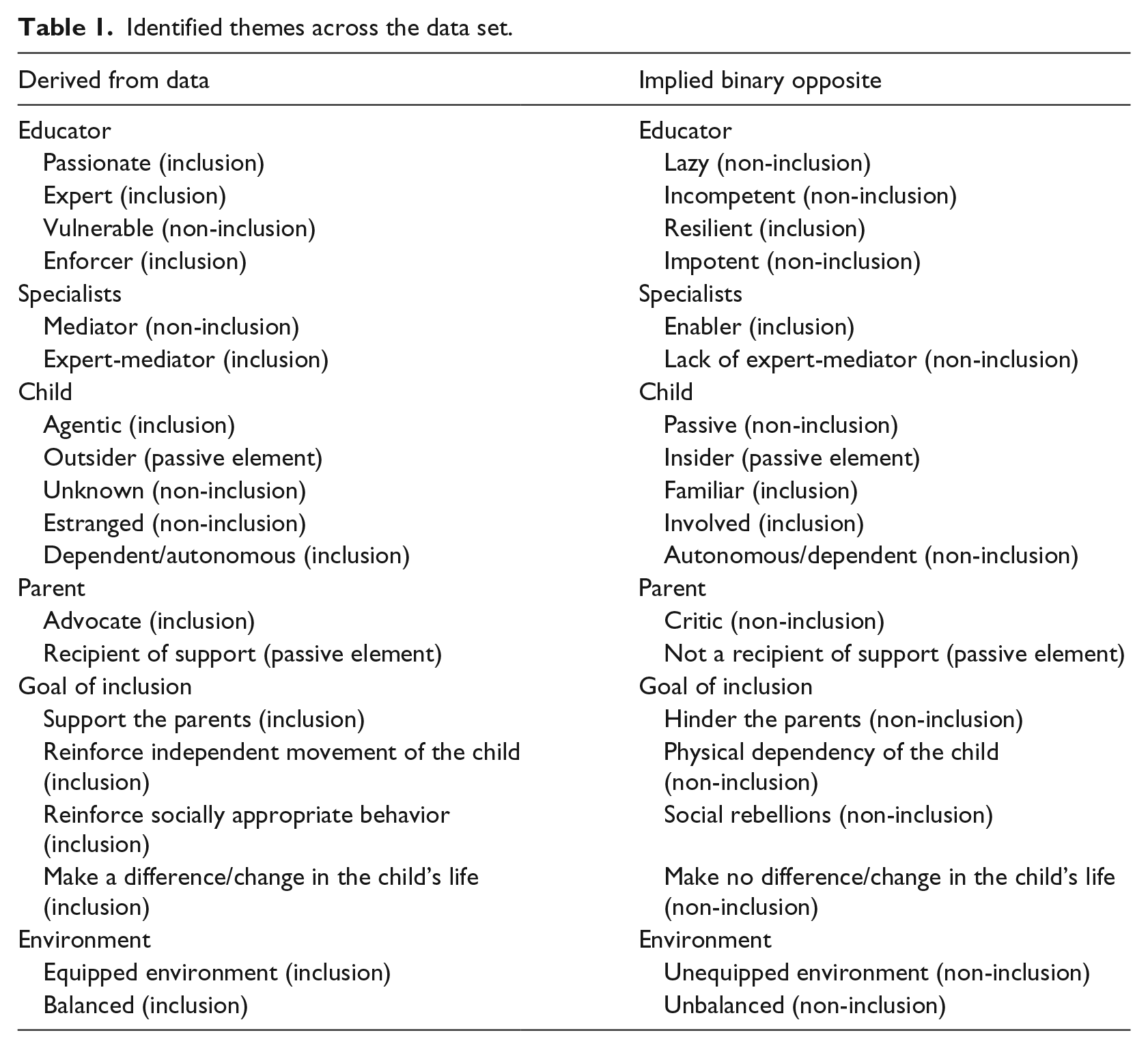
The various themes describing characteristics of roles—such as educators, parents, and children—were clustered to form four overarching meta-themes across the interviews. These meta-themes—acceptance as advocacy, conformity as agency, othering as vulnerability, and knowledge as expertise 1 —highlighted the research participants’ expectations regarding interactions between educators, parents, and children with labels within an early childhood education environment in inclusion (Dalkilic, 2014). The meta-themes were examined within the context of hegemonic practices on early childhood special education, and their potential consistencies with dominant discourses on inclusion were noted. There was no hierarchy or order of progression constructed between meta-themes, as these meta-themes were observed to be containing elements of one another, and all four meta-themes highlighted assumptions concerning interactions between the educator, child, and parents in inclusion.
Acceptance as advocacy
The meta-theme of acceptance as advocacy highlighted the participants’ perspectives that the acceptance of a child’s difference and deficiency is a necessary first step to advocacy. This entails both that the educator and parents accept an educator’s observations that a child’s development and/or behavior deviates from the norm and that the educator accept the classification rubric of the educational system. Acceptance, particularly the acceptance of parents, was viewed as necessary in order to advocate for the child’s inclusion. For example, in one of the interviews, a participant repeatedly expressed her gratitude toward a parent who, rather than “[wanting to] do the denial, had been “proactive” by “[being] honest about her son’s issues” (Int 1, Line 113–116). In the construction of this meta-theme, the acceptance of the child’s label by both the parent and the educator was regarded as the foundation for fostering a supportive and inclusive environment for the child.
The parent’s acknowledgment that his or her child’s development deviated from the norm, and the communication of the challenges associated with resulting behaviors, were regarded as necessary to enlist the aid of the educator in facilitating inclusion. The educator’s role within acceptance as advocacy was for him or her to identify the child’s label and the challenges associated with it. In contrast, the parents’ role was to accept the educator’s perception of their child in order to receive necessary resources in working with these challenges. Examples of resources included information and professional knowledge that the educator used to create a more inclusive environment, and/or financial aid for the parents and school to better provide care in an inclusive environment. In the childcare and education settings of the participants, a label was required in order to access resources, including instructional time and expertise. Advocacy by the parent required explicit acceptance of and agreement with the educator’s categorization of the child, in order to access a label and the associated resources. This notion also surfaced in the conventional literature wherein parental initiative in communication with the educator concerning their child was seen as implicit acceptance of the label and integral for successful inclusion (Dettmer et al., 2005).
Conformity as agency
The meta-theme, conformity as agency, emphasized the necessity of working to conform to social expectations of what is normal as a necessary condition for agency. Within the expectations of roles outlined for the child, two criteria stood out: the child’s regulation of his or her own behavior, and his or her endeavors to fit in with peers. The child, aware of his or her own deviant behavior to a certain extent, was expected to work in collaboration with his or her parents, educator, and specialists, to change this behavior. The connotation of agency in this construction did not involve the child’s desire or comfort level with the behavior or the expectations of behavior. Indeed, as was noted within the participants’ interviews, children who fit the expectations of roles outlined in conformity as agency expressed their discomfort with acting according to instructions. However, performing as they were asked, or conforming to the expectations of adults around them, was what allowed them to be seen as an agent within their early childhood education environment. For example, one educator, while discussing a memorable child to whom she provided care, expressed that what impressed her greatly and was “kind of a shining star” quality was that, despite not necessarily fitting in with his peers effortlessly or comfortably, he “always tried” his best to do so; according to the accounts of this educator, the child “[knew] what he [liked]” and communicated his discomfort with tasks expected out of him, such as “[participating] in the circle” or “making friends,” but “was generally smart enough” and made himself fulfill these tasks given his capabilities (Int 1, Line 147–152). Agency was bestowed when he was seen as trying to conform; when he was seen as not trying to conform, his behavior was deemed misbehavior, rather than an agentic response to a difficult situation.
Although conformity as agency centered on the child’s actions, the parents and the educator were seen to also perform a certain conformity with the system of diagnosing and labeling children, as well as their own institutional contexts, and this was perceived as how they too obtained agency. Their conformity, however, did not directly impact them to the degree that a child’s conformity—as the object of inclusion—impacted him or her.
Othering as vulnerability
Othering as vulnerability was constructed to highlight how an early childhood education setting can become non-inclusive. The main idea outlined by this theme was that the othering, or marginalization, of a child who was deemed to learn differently from his or her peers contributed to the formation of a non-inclusive setting. The creation of non-inclusion was linked to the concept of othering by the vulnerability that the educator and the child were both faced with, as a result of the marginalization of the child. The recursive relationship between the vulnerability of the educator and the vulnerability of the child in creating non-inclusion was central: as the child was regarded as different and placed in a vulnerable position by the virtue of this, the educator increased his or her own vulnerability to the child’s perceived deviation from standards of normalcy and, thus, was more prone to further othering the child from his or her peers.
The vulnerability that the child faced stemmed directly from not being regarded by the educator as a part of the classroom due to his or her perceived differences. On the part of the educator, the vulnerability was rooted both in a child’s observed divergence from the norm and in the educator’s insecurity in providing care to a child whose behaviors and characteristics were unfamiliar. Educator’s own insecurity, ironically, further isolated and othered the child. According to one of the research participants, not knowing “how to approach [the child]” (Int 3, Line 90) led to an inability to “relate to the child as a child first” and inadvertently created a non-inclusive environment for the child (Int 3, Line 40).
The othering of children was multi-faceted and occurred across expectations and practices. One form of othering identified was the educators’ apparent fascination with the advanced performance of children on some tasks in relation to their peers. Throughout the interviews, educators discussed at length the extreme skills or knowledge children had exemplified in certain areas in comparison with their peers. Though seemingly benevolent on the educator’s part, the focus on a child’s unusual skills in relation to his or her peers seemed to reinforce the isolation of the child from his or her peers and the educators.
Knowledge as expertise
The subject of the final meta-theme, knowledge as expertise, surfaced in relation to expertise in inclusive practices. Across the different perspectives on inclusion present in the interviews, an expert in inclusion was characterized as someone who possessed both professional and empirical knowledge in working with a child who had been given a particular label. An expert was someone who had information on the characteristics associated with particular labels, as well as experience working with children who were deemed to be different learners from their peers. Connecting back to the idea of othering as vulnerability, expertise was argued to facilitate inclusion by reducing the vulnerability of the educator to the otherness of the child.
As this characterization of an expert also involved having experience working with children with labels, the idea of expertise was not necessarily restricted to educators. Parents also were seen as having expertise in the inclusion of their children, as they had more experience—or empirical knowledge—with reference to the particularities of their child. However, throughout the interviews, parents were often depicted as the passive recipients of the educators’ support in inclusion. This was due to the educator’s professional knowledge about a child’s label, and the characteristics associated with this label. Educators were responsible for acknowledging that parents had their own expertise to provide in order for inclusion to be more successfully facilitated within an early childhood education environment. However, as the educators possessed professional knowledge on the label as well, their professional knowledge, as well as their responsibility for administering inclusion and supporting the child with a label and his or her family, was considered more valuable than the expertise of the parents (see, for related discussion, Barton, 1996).
Discussion: How inclusion excludes
Further discussion of the meta-themes summarized in the previous section, “Inclusion and Inclusive Education: Themes and Meta-Themes”—acceptance as advocacy, conformity as agency, othering as vulnerability, and knowledge as expertise—gives insight into some of the ways in which inclusion paradoxically reinforces practices that reduce and regulate the range of what is considered to be “normal” developmental abilities and behaviors in early childhood education. In this section, we highlight two ways in which the normative discourse underlying inclusion is infused in early childhood education contributing to a set of regulatory practices that further marginalize children who are deemed to be “outside” the normal distribution for development and behavior.
The first manifestation of regulatory practices in inclusive early childhood education culminates in the move to normalize and manage the development and behavior of the individual child as separate from her or his social context. This practice draws upon a narrow range of expectations of normal development and behavior that is further reduced in scope by the structure of K-12 schooling and the expectation that early childhood education will prepare children for K-12 schooling. It is buttressed by the regulation of educators and parents given the specific roles made available to them under inclusion. This practice forms the nexus of all four of the meta-themes. For the child, the educator, the parent, and the specialist, agency is a function of conforming to the school system—from diagnosis to label to behavioral supports—with the most potentially problematic effects on the most vulnerable: the child. The child with a label must submit to normative expectations and, in turn, the parents must accept what the system offers the child in order to advocate for the child’s learning needs. The way the school system is structured reifies the binaries of self or other, individual/social, universal/contextual, and parental/professional, thus, reinforcing approaches that set child, educator, parent, and specialist in opposition to each other. Individual children have problems. Individual parents must accept. Individual educators can be held accountable. These roles are neither connected by a social network of relationships, nor does the existing social system created by schools have any positive effect on the outcome of the actions of these individuals.
The separation of the child from the social context has at least three consequences. First, it erases the affordances and constraints in the child’s social context, along with the relationship between the child and his or her context (Artiles et al., 2006). It erases the culture of the child, the ways in which cultural differences between the home and the school may contribute to perceived deficiencies, as well as the ways in which the culture may be useful as a resource for the child and family. Second, it diminishes attention to the role of the school system in producing what are considered to be abnormal or deviant behaviors in the first place. From even the most traditional developmental perspective, a perspective that defines development as an individual and biological process (see Vadeboncoeur, 1997), normal development is inclusive of a range of evolving physical, social, cognitive, and emotional capacities. This range is highly circumscribed by expectations of students in formal schooling. The child who does not conform to social expectations at the same rate as his or her peers, and the rate sanctioned by the structure of schooling, is marginalized. It is the child who is labeled with a disability as if the social context does not matter. What enables inclusion is the regulation or fixing of the individual child’s divergent behaviors according to a particular classification of behaviors. Third, child, educator, parents, and specialist are each complicit in regulative practices by necessity. For example, while the educators saw their main role as facilitating inclusion, however varied their interpretations, the child was primarily an object upon which inclusion was enacted. Both the educator and the child conformed to inclusive practices, and by doing so, they were enlisted to regulate themselves, but they were not encouraged to see themselves in relationship.
The perceived necessity of a label of disability, especially a formal label, to facilitate inclusion is a second manifestation of regulatory practices in dominant discourses of inclusion. This is illustrated by the requirement that in order to be the beneficiary of inclusive education, to be included, a child must first be othered or excluded. Formal exclusion occurs first by labeling and marking a child as different from his or her unmarked peers. This necessity was observed in the construction of multiple meta-themes. In acceptance as advocacy, the desired result was official support in the form of services provided by a government body to enable inclusion. This result was only achieved by the acceptance of a child’s difference relative to his or her peers, which would lead to the child formally gaining a label of disability. In knowledge as expertise, in conjunction with othering as vulnerability, the educator’s knowledge of the characteristics and challenges that may be associated with particular disability labels gave him or her expertise in including a child labeled with a disability based upon professional knowledge. The possibility of the educator being placed in a vulnerable situation due to insecurity stemming from working with an atypical child was lowered by familiarity with the label, and therefore the educator could include the child more effectively in the classroom.
Labels of disability in inclusion can be used to impose regulatory attitudes and practices through their implications. The necessity of a disability label in the facilitation of inclusion, as outlined above, implies that inclusion should be implemented only when a child labeled with a particular disability is present in a classroom. Therefore, how inclusion is implemented is regulated by how the child is labeled. In other words, the disability label becomes the determining factor of the ways in which inclusion will be facilitated, and inclusion may be expected to be carried out in the same manner across contexts due to the identification of the label as an attribute of the child. As an absolute marker of a particular child’s state of being, the educator’s knowledge of the label earns him or her power over the parents’ knowledge of their particular child (Barton, 1996). Here, the label of disability becomes regulatory as it overlooks children’s individuality. Once “normal” development is outlined, the existence of children who do not fit this developmental trajectory is implied. Notions of typical and atypical development are presented, through a narrow view of children’s development informed by developmental psychology, as “the real” of children and child development (Walkerdine, 1984). Supporting this narrow view of child development as such becomes the purpose of early education and the ethical obligation of ECEs.
The regulatory practices of inclusion share a common foundation in the medical model of disability and in a binarist conceptualization. These practices of early childhood education are regulatory, largely because they are based in an understanding of labels of disability as indicating an abnormal biological and individual condition. They focus on normalization through assimilating the child seen as different to the environment and the classroom. In addition, they depend on binarist views. One pole of the binary is privileged over the other: the typically developing versus the atypically developing child, acceptable versus unacceptable behaviors. Framed by the medical model’s claims to objectivity and scientific rigor, and limited by a binary conceptualization, the possibilities for dialogue and discussion regarding differences that are not by default regarded as deficiencies are severely constrained.
Conclusion
This article drew upon six ECEs’ perspectives on inclusion and inclusive education, and critically investigated the paradoxical nature of contemporary discourses on inclusion. Through an analysis of meta-themes generated across interview data—acceptance as advocacy, conformity as agency, othering as vulnerability, and knowledge as expertise—and the axiomatic assumptions underlying them, two manifestations of regulatory practices related to inclusion were identified. Several links between these practices and hegemonic discourses impacting conventional perspectives on inclusion were discussed. Conventional perspectives on inclusion adhere heavily to regulatory practices. These practices, such as decontextualizing the child and holding the child responsible for being deficient, the reliance on a label of disability to govern the educator’s perspective of the child, and the necessity of the label in determining the manner of implementing inclusion, further marginalize children by placing restrictions on educators’ perspectives on children and their behaviors. Attention to regulatory practices highlights how conventional perspectives on inclusion counter the promise of inclusion, and instead further marginalize children who are deemed to be different learners from their peers.
Although the constructed narrative of the typically developing child holds its hegemony in early childhood education discourses, it is the assumption that inclusion can be universally defined, understood, and applied that reduces dialogue on inclusion and topics related to inclusive education. Discussions of the difficulties of implementing inclusion, when regarded from what is assumed to be a singular view on a multidimensional subject, may by necessity erase the various contextual factors that shape the perspectives on and enactment of inclusion, as well as silence discussion altogether. Furthermore, a universalized outlook on inclusion inhibits dialogue on the possibility of inclusion existing in different and varied forms.
As a critical alternative to the regulatory practices of inclusion that stem from conventional perspectives, we suggest the necessity of rethinking inclusion. To date, and derived from our research, our work has emphasized the significance of considering inclusion relationally; thus, we introduce a notion of relational inclusion. This notion is named so, as the core idea forming it is to adjust how inclusion is implemented based on participants such as the individual educator, parent, child, the environment, and the relationships between these participants. Although relational inclusion is a concept under development, we have five principles in mind as a foundation.
First, relational inclusion side steps the issue of universal human rights, by arguing that the central issue under consideration should be what is most efficacious for the child’s opportunities to learn. Thus, relational inclusion is not assumed to be universal, or to look the same for every child. In addition, inclusion based on the principle of the least restrictive environment may not necessarily provide the child with the richest opportunities for learning.
Second, in relational inclusion, the label of disability at hand is prevented from regulating the educator’s perspective of the child, thus allowing for the educator to regard the child beyond his or her label. Instead of interacting solely with the specific label of disability, the educator’s relationship with the child contributes to the specific form of inclusion being enacted. This requires that the relationship between the child and educator is placed at the center of learning opportunities and builds on the strengths of the relationship between the child and his or her parents or caregivers. It also highlights the necessity of taking culture and context into consideration.
Third, a notion of relational inclusion aims to counter the rigid binarism that influences conventional perspectives on inclusion, and lessen the prevalence of regulatory practices that originate from these binaries. Parameters of inclusion are defined with consideration of the particular individuals and contexts within which children and families are to be included, as opposed to treating inclusion as a singular and universally applicable process. This outlook allows for the inclusion to exist as a multidimensional concept. Relational inclusion acknowledges variegated ways of enacting inclusion that fall between and outside of a simple universal inclusion/exclusion binary.
Fourth, a notion of relational inclusion aims to be a democratic form of inclusion: the goal of relational inclusion is not for the child labeled with a disability to assimilate to the image of a typical child, and erase characteristics of himself or herself. Instead, relational inclusion aims to open classrooms to the possible existence of difference, and for this difference to be retained without it being isolated from the general culture of the classroom.
The fifth principle of relational inclusion is the need for both an ontological shift and an ideological shift in educating professionals who will work closely with children deemed to be different learners than their peers. An ontological shift is required more generally to ensure that educational professionals and families come to see themselves in relationship. In North America, as in many other places, individualism dominates educational and legal institutions and, thus, to move toward a relational ontology will require collaborative effort. An ideological shift is required away from the indoctrination of professionals into one singular notion of inclusion that is monitored to ensure its most efficient enactment. Instead, this ideological shift suggests that professionals who will be working in educational environments are taught to respond to the needs of the child and children with whom they will be interacting, that they will be provided with the necessary resources and supports, that classroom size and composition will be considered of the utmost importance, and that the relationships between educators and families will be fostered as well.
Our nascent notion of relational inclusion is not a panacea that will satisfy all individuals. The proposal does not address the call for a universal definition of inclusion; instead, inclusion is regarded as a context-based relational process. In addition, a notion of relational inclusion removes agency from more centralized authorities, such as policy-makers at the federal and provincial levels, giving and requiring of individual educators, parents, and children more agency and responsibility. These aspects of relational inclusion may be regarded as disabling the monitoring of how inclusion is enacted by professionals to ensure its efficiency and effectiveness, as well as challenging the structure of schooling as it currently exists.
Though just the beginning of a concept, we think that a notion of relational inclusion, like current notions of relational justice (Christensen and Dorn, 1997) and relational agency (Edwards, 2007) may enable us to begin to make inclusion into an inquiry-based field, rather than continuing its historical approach as an answer to the problems of deinstitutionalization and segregation (Dyson, 1999). We need alternatives to counter the regulatory practices that hold hegemony over contemporary perspectives on inclusion, and their resulting marginalizing effects on children. Thinking about inclusion relationally may contribute to this effort.
Footnotes
Funding
The author(s) received no financial support for the research, authorship, and/or publication of this article.