




Abstract
Child workers on Nicaragua’s coffee plantations have become researchers, generating knowledge which leads to action to help solve some of the severe social problems that affect the rural communities where they live and work. This article first looks at how child researchers are seen in the existing literature. It then traces the history of the approach used, known as Transformative Research by Children and Adolescents, from its origins in ‘Children’s Consultancy’ in the United Kingdom in the 1990s, through its adaptation to the Nicaraguan context and subsequent metamorphosis into today’s transformative research approach. It discusses the concept of ‘transformation’ in social research, and CESESMA’s alternative ‘four transformations’ framework, with its emphasis on a coherent concept of empowerment. It then identifies four things child researchers need from their adult supporters: appropriate and effective research methodology, skilled and sensitive process facilitation, technical support and a responsible attitude to child protection that recognises but does not exaggerate risks. It concludes by highlighting some challenges to be addressed in further developing and extending the approach.
This article discusses how children and adolescents 1 from Nicaragua’s coffee-growing zone have become researchers, generating knowledge to help solve some of the severe social problems that affect the rural communities where they live and work, and considers the validity and effectiveness of the facilitation approach used.
The article will first look at how child researchers have been seen in the existing literature. It will then trace the history of the Transformative Research by Children and Adolescents approach from its origins in ‘Children’s Consultancy’ in the United Kingdom in the 1990s, through its adaptation to the Nicaraguan context and subsequent metamorphosis into today’s transformative research approach. It will discuss the idea of ‘transformation’, which is often mentioned but seldom explained in research literature, and the alternative framework for understanding transformation put forward by CESESMA, with its emphasis on a coherent concept of empowerment.
It will then identify four things child researchers need from their adult supporters: appropriate and effective research methodology, skilled and sensitive process facilitation, technical support and a responsible attitude to child protection that recognises but does not exaggerate risks. To conclude, it will highlight some challenges to be addressed in further developing and extending the approach.
Thinking about children as researchers
A number of ways have been suggested for analysing the relationship of children to research. Christensen and Prout (2002) identified four ways of seeing children in the research literature: ‘The child as object, the child as subject and the child as social actor … and a nascent approach seeing children as participants and co-researchers’ (p. 480). Kellett (2010a) proposes a slightly different four-fold distinction, identifying research on, about, with and by children. Drawing on James, Jenks and Prout’s (1998) account of how childhood has historically been theorised, she sees these four research approaches as products of a historical evolution: Instead of research on children as we saw in early developmental psychology experiments, or research about children in explorations of socially constructed childhoods, or research with children in the participatory agendas driven by Every Child Matters, came the prospect of research by children. Research by children goes a step further than children as participant or co-researchers. (Kellett, 2010a: 22)
Alderson (2008) identified three broad ways in which children assume the role of researcher. The first is at school, where doing research projects is now commonly part of the curriculum. Here, the emphasis is usually on what the children themselves learn from the process, rather than publishing the findings or using them to advocate for change. The second way is when children participate in adult-run research projects, where it is increasingly common for them to be offered roles as ‘co-researchers’. What this actually means, and the amount of decision-making power devolved to children, varies from project to project. However, Alderson (2008) says that ‘besides providing data in their traditional role as research subjects, increasingly, children help to plan questions, collect, analyse or report evidence, and publicise the findings’ (p. 279).
The third way for children to become researchers is in research projects which are mainly initiated and directed by children themselves. This approach does not lend itself to the constraints of academic, university-based research (though there are exceptions), so most of this type of research is facilitated by adults working in the non-governmental organisation (NGO) sector. While a search of the academic literature suggests a paucity of this kind of research, there are examples to be found in the practitioner-orientated and campaigning literature (Funky Dragon, 2011; GRFG Drafting Committee, 2008) and on NGO websites. A review carried out for the Scottish Executive in 2005 discovered a raft of small, often one-off projects involving children and young people as researchers in the UK. These are usually funded by voluntary agencies or local authorities and are focused on issues relevant to national or local policy such as young people’s health or housing needs. (Brownlie et al., 2006: 12)
The term ‘child-led research’ is sometimes used to describe this kind of work (Kellett, 2012; Save the Children, 2010). However, this can be misleading if the nature and degree of leadership exercised by children and adults, and their relationship to each other in the research processes, are not problematised. What may be described as an adult ‘facilitator’ role is usually a powerful one, involving a degree of leadership in relation to the children’s research project that is obscured by the ‘child-led’ label. For this reason, the term ‘children as researchers’ or ‘research by children’ is preferred here, allowing for various blends of child and adult leadership.
Returning to Alderson’s (2008) analysis, comparing the UK experience with examples from elsewhere, she concludes that ‘Child researchers tend to be more adventurously involved in poor and war-torn countries’, and suggests that this may be because ‘Limitations on child researchers lie not in their incompetence, but in adult attitudes and constraints imposed (concern for protection above participation)’ (p. 288). CESESMA’s work with child researchers in Nicaragua would seem to support this conclusion.
Another of Alderson’s (2008) observations is that ‘Young researchers are usually keen to produce findings that will achieve changes in, for example, provision of services, and respect for their rights. They therefore often emphasise the follow-up stages of disseminating and implementing the findings’ (p. 278), in other words, an action-research orientation. Alderson contrasts this with university research which tends to concentrate on collecting and analysing data and writing reports. She considers a lack of funding for the follow-up work that turns research into social action to be one of the barriers to children’s participation in research.
Another major issue in the literature on child researchers is what Brownlie et al. (2006) refer to as the ‘participation versus rigor’ debate (p. 13). Dyson and Meagher describe the problem thus: The research process has inherent within it certain quality demands which some (perhaps many) young people find difficult to meet. The more fully they are involved in research, therefore, the less likely it is that the research will meet those demands adequately. (Dyson and Meagher, 2001: 65)
The barriers that this raises, particularly where children are involved in data analysis, are described by Coad and Evans (2008) who speak of ‘the resistance from academic institutions, sponsors, policy-makers and professional researchers working in conventional research paradigms to more participatory approaches’ (p. 50).
In response to this, some adult supporters focus on providing adequate training and preparation for child researchers (Kellett, 2005), and others on giving children advisory rather than leading roles (Casas et al., 2013; Lundy and McEvoy, 2012). The widely supported view that ‘Children are experts in their own lives’ (Mason and Danby, 2011) suggests that they are therefore already well-qualified to engage in research related to their daily lives. Uprichard (2010), however, urges that ‘It is equally important to involve children in research that goes beyond childhood’ (p. 3) because ‘Including children in more general social research … will re-describe children as agents that are even more powerful than they have so far been constructed through research practice’ (p. 11).
Having trained and supported children as researchers for over 10 years (see Smith and Greene, 2014: 139–148), Mary Kellett has identified four main reasons for espousing and promoting the ‘research by children’ approach: Children succeed in getting responses from within their peer group in ways that would not be possible for adult researchers because of power and generational issues. Their work adds to the body of knowledge about children’s experiences from a genuine child perspective. The dissemination of research carried out by them and, crucially, owned by them, is an important vehicle for child voice. The experience of participating as active researchers is an empowering process that leads to a virtuous circle of increased confidence and raised self-esteem, resulting in more active participation by children in other aspects affecting their lives. (Kellett, 2010b: 197)
The extensive literature on the ethics of involving children in research focuses mainly on children as subjects of adult-run research. However, the 2011 edition of Alderson and Morrow’s handbook on the subject also discusses ethical issues in involving children as researchers. These include issues in the recruitment and selection of child researchers, appropriate training and support for child researchers, issues of payment and rewards (especially where volunteer child researchers work alongside paid adult researchers) and the problem of raising expectations that research will be taken seriously by decision-makers, which are subsequently frustrated (Alderson and Morrow, 2011: 55–57).
Much of the ethical discussion focuses on the need to protect children engaging in research from possible harm. Skelton (2008), however, identifies a tension between ethical frameworks based on protection and the autonomous participation rights established in the United Nations Convention on the Rights of the Child (UNCRC). For example, some university ethical guidelines require that children be approached via an adult ‘gatekeeper’ such as a school head, whereas the children themselves may not want such a person to control their access to a research opportunity (Skelton, 2008: 29).
Roots: Children’s Consultancy in the United Kingdom
The approach now known as ‘Transformative Research by Children and Adolescents’ has its roots in the Article 31 Children’s Consultancy Scheme developed in the United Kingdom in the late 1990s to support children aged around 8–12 years taking on the role of expert consultants to advise senior management of arts, cultural and recreational institutions. Although not written up in the academic literature at the time, some of these early experiences have been described in the practitioner literature (Shier, 1998, 1999a, 1999b).
The Children’s Consultancy model was developed as a human rights–based approach, linking Article 31 of the UNCRC (the right to play and to participate freely in cultural life and the arts) with the underpinning principle in Article 12 – namely that children have the right to express their opinions on all matters that affect them and adult decision-makers must give due weight to the opinions expressed. At that time, the managements of many arts and cultural organisations, taking on board new ideas about children as service users with rights, were seeking expert advice on how to make their programmes and facilities more child-friendly. The Article 31 Children’s Consultancy Scheme proposed that children themselves are the best-informed experts on what is child-friendly and what isn’t: They know from first-hand experience what works for children and what doesn’t, what’s fun and what’s boring, what makes them feel included or excluded (Shier, 1999a).
These ideas were linked to the childhood studies paradigm change of the past quarter-century (see, for example, James and Prout, 1997). The traditional paradigm saw children and young people as having limited capability due to their limited social and intellectual development. They therefore needed to be taught, protected and disciplined until, with the passage of time and a good education, they acquired the capacity to think and act for themselves. The new paradigm recognises that from their earliest years, children have significant capabilities which enable them to act as the main protagonists in their own development. The development of their capacities is enabled and driven by their experience of action and the effects of their action in the world. Drawing on these ideas, the Children’s Consultancy approach took it for granted that children had the capability to take on the role of expert consultant, provided they had access to sensitive facilitation, appropriate methodology and sufficient technical support (Shier, 1999a).
Starting with a pilot project in 1997 at the Victoria and Albert Museum in London, this methodology was tried and tested over 30 times throughout the United Kingdom, with child consultants offering expert advice to the management of some of the most prestigious cultural institutions in the land. For example, in 1998, child consultants were commissioned by the British Waterways Board to research the potential of the English canal network for children’s recreation; in 1999, child consultants from the New-Age Traveller community were commissioned by The Children’s Society to advise on play and recreation opportunities for traveller children, and in 2000, child consultants advised the management of the Tower of London on how to make it less boring for younger visitors. Subsequent examples found in the literature include young consultants in Birmingham advising on early years services (Clark et al., 2003: 23), young consultants advising on improving play spaces in Southwark (Sachdev, 2003: 26, 31) and young consultants advising on the redevelopment of Manchester City Art Gallery (Stevenson, 2005: 72).
Children’s consultancy in Nicaragua, 2007–2011
Starting in 2007, Nicaraguan NGO CESESMA adapted the Children’s Consultancy approach to the local context and began to apply it in its work with the region’s young coffee plantation workers. The following are three examples.
Children and adolescents from Santa Martha coffee plantation researching the problem of violence
The first team of child consultants in Nicaragua was commissioned in 2007, as part of the national response to the 2006 UN special report on violence against children. The consultancy team was made up of 12 girls and boys aged 10–16 years living and working on Santa Martha Coffee Plantation in Yasica Sur. They researched the problem of violence as experienced by children on the plantation by interviewing 59 children and adolescents living and working on the plantation and analysing the data collected to produce a report with extensive recommendations for change. The team presented their report to a national conference on prevention of violence against children in August 2007, where they were able to put their recommendations directly to the government minister responsible for children and families, and challenge her to tell the conference what she and her department intended to do about the issue. It is not known what effect this had on government policy, but the Children and Families Department did introduce new programmes to protect vulnerable children shortly afterwards (Jacobs, 2008). The following year, the children retold their experience in words and pictures for publication. In answer to the question, ‘What would you say to those adults who say that children can’t be Consultants because they don’t know anything and will be manipulated by adults?’ they replied, ‘We would tell them they are very much mistaken, because we can too. They should stop abusing their power and give us the space. Put us to the test and they’ll see if we can or not’ (Young Consultants of Santa Martha, 2009: 229).
‘Children and adolescents defending our right to play’ campaign
In 2009, children and adolescents formed three action-research teams to carry out an appraisal of play opportunities in their communities and assess the factors that prevented them exercising their right to play. The children’s research was published in the Mexican journal Rayuela (CESESMA, 2013), and also cited as evidence in the report ‘Children’s Right to Play’ (Lester and Russell, 2010), which was influential in persuading the UN Committee on the Rights of the Child to produce a General Comment on the right to play.
Young consultants of Santa Martha coffee plantation reunite to research the relationship between business and human rights on the plantation
The same year, 2009, the team of young consultants from Santa Martha coffee plantation accepted a commission from Trócaire, the Irish Catholic Development Agency, to research the relationship between business and human rights on the plantation. Their report, ‘Rights and Wrongs’, was published by CESESMA (Young Consultants of Santa Martha, 2011) and picked up by other NGOs both inside and outside Nicaragua. In 2011, when the UN Committee on the Rights of the Child began work on General Comment No 16 on children’s rights and the business sector, the Young Consultants sent their report to the Committee. Of the dozens of contributions the Committee shared on its website, theirs was the only one researched and written by children.
From children’s consultancy to transformative research: conceptual and methodological development
In 2011, recognising the potential of the Children’s Consultancy approach to contribute to the empowerment of children and adolescents, while also aware of its limitations, CESESMA (2012) tested a modified version it called ‘Transformative Research by Children and Adolescents’. Two aspects of the previous approach were seen as limiting the young consultants’ empowerment. First, an adult always told them what topic they were going to research, instead of supporting them in deciding this for themselves; and second, once they handed in their report, there was no commitment to follow-up or further action to support them in getting their recommendations implemented.
To overcome these limitations, two changes were made to the original model. At the beginning of each project, the teams of young researchers (no longer ‘young consultants’) decided for themselves what topics they wanted to research. They were encouraged to reflect on the problems that affected their communities and identify areas where they felt there were possibilities for change driven by research evidence. Through this process of reflection, they reached a consensus on the topics they wanted to research.
The other new element was that after completing their research reports, each team of young researchers was supported in developing an action plan to disseminate their findings and follow up their recommendations. These included actions that the young researchers could undertake without adult help, such as discussing their findings with other people in their village, and also actions that required adult support, such as requesting a hearing before the Municipal Children and Youth Committee, or contacting the media to undertake interviews. The supporting organisation made a commitment to accompany and facilitate the young researchers in implementing their action plans. It is in this second, action phase that the children and adolescents start to contribute to the transformation of their lives and their communities. They do not do research for its own sake but rather ‘transformative research’.
To test this new approach, four teams of child researchers were formed and supported in planning and carrying out action-research projects. For the first time in CESESMA’s work, the children themselves chose their research topics. The team from El Plomo decided to look at the concept of ‘Respect’, and how lack of respect in families and communities leads to violence; the Yasica Sur team decided to research ‘The violence that children and adolescents suffer in the home’; the Samulalí team chose ‘Parents who hit their children: Why do they do it and what are the alternatives?’; and finally, the Yúcul team chose the topic of alcohol and its relation to violence in the community. As well as producing research findings and recommendations, the four teams drew up action plans to publicise the results of their research and push for the implementation of their recommendations from local community up to national level. They presented their reports first in their home villages and subsequently in municipal, and in some cases national, forums. The four reports were compiled and published in book form by CESESMA in Nicaragua in March 2012, and an English translation, ‘Learn to live without violence’, was published in the United Kingdom in September the same year (CESESMA, 2012).
All four teams used their research to advocate for change, but the one that made the most impact was the team from Yúcul. They presented their findings to the government’s newly formed ‘Family Life and Security Commission’, which decided to make the alcohol problem a top priority for local action. Local government and party officials admitted they had been aware for the issue for years, but it wasn’t till the children came forward with their research that they felt forced to act on it. The local police also took action – confiscating illegal liquor and closing at least two unlicensed cantinas. A popular national television channel then featured the young researchers on the evening news, and since then, the local authority and police have ensured no new liquor licences are granted in the Yúcul area.
Based on these experiences, CESESMA has set out the guiding principles that characterise its Transformative Research approach:
It is founded on a human rights–based approach.
It recognises that the foremost experts on children’s everyday lives are children themselves, but also that, as researchers, they can learn more about a topic, expanding and deepening their existing knowledge.
CESESMA’s experience suggests that children readily take on board and identify with the idea of themselves as researchers and understand what this role implies. The role of the adult is therefore seen as facilitating and accompanying the research process.
Children and adolescents are supported in planning, organising and carrying out their own research, and provided with technical support and resources similar to those which adult researchers would typically expect (although it is understood that the way in which this support is provided must be appropriate to the age and experience of the children and adolescents involved).
Children and adolescents produce their own research report in their own words, and also control how it will be designed and presented (e.g. selecting drawings and photographs to illustrate their findings). If a formal report prepared by adults is required as part of a project, this is prepared and presented separately and the two are not confused.
The organisation that supports the young researchers must make a commitment to continue to accompany and support them in drawing up and carrying out an action plan to disseminate their findings, and promote the implementation of their recommendations (summarised from CESESMA, 2012: 52).
CESESMA’s four transformations
CESESMA calls this approach ‘Transformative Research’, but what does it mean to say that research is ‘transformative’? The ‘Transformative Paradigm’ in social research is associated with the work of Donna Mertens (2007, 2009), who sees it as expressly concerned with issues of human rights and social justice. In development studies, transformative participation, or ‘participation as empowerment’, which is seen as transforming both people’s reality and their sense of it (White, 1996), has been contrasted with oppressive, even tyrannical styles of top-down or instrumental participation (Hickey and Mohan, 2004; Kesby, 2005). Recently, Tisdall (2013) and Teamey and Hinton (2014) have speculated about possible linkages between children’s participation and transformative processes in society.
‘Transformation’ is also central to the theory of ‘transformative learning’, where it implies that an individual is able not just to acquire new knowledge but to change the frame of reference that they habitually use to understand the world (Mezirow, 1997). As propounded by Mezirow and his followers, however, this is exclusively a theory of adult learning, where children are categorically excluded (Mezirow, 1990). Freire’s pedagogy of the oppressed is also seen as generating transformation and has been interpreted more flexibly (Freire, 1970; Tibbitts, 2005).
With nods to all of these, but based mainly on its own experience of supporting and facilitating children as action researchers, CESESMA has proposed a framework for describing how children can bring about transformations through their engagement in research. CESESMA believes that this approach can produce four distinct kinds of transformations: (1) Empowerment of the young researchers, (2) transforming adult attitudes, (3) reflexive learning that transforms adult facilitators and (4) transformative social change through follow-up advocacy, campaigning or community action (CESESMA 2012: 52). These will be considered in turn.
First transformation: Empowerment of the young researchers
As mention above, Kellett (2010b: 197) also identifies this as one of the main benefits of engaging with children as researchers. But if the occurrence of empowerment is to be described as a transformation, there needs to be clarity about what this means. The word is often found in discourses on participatory research, but is seldom adequately defined in this context. It certainly has something to do with acquiring power, but what does this power consist of and how is it acquired? CESESMA and the University of the North of Nicaragua have developed a definition linking three factors with together lead to empowerment. These are conditions/opportunities, capability, and attitude; as shown in the diagram in Figure 1.
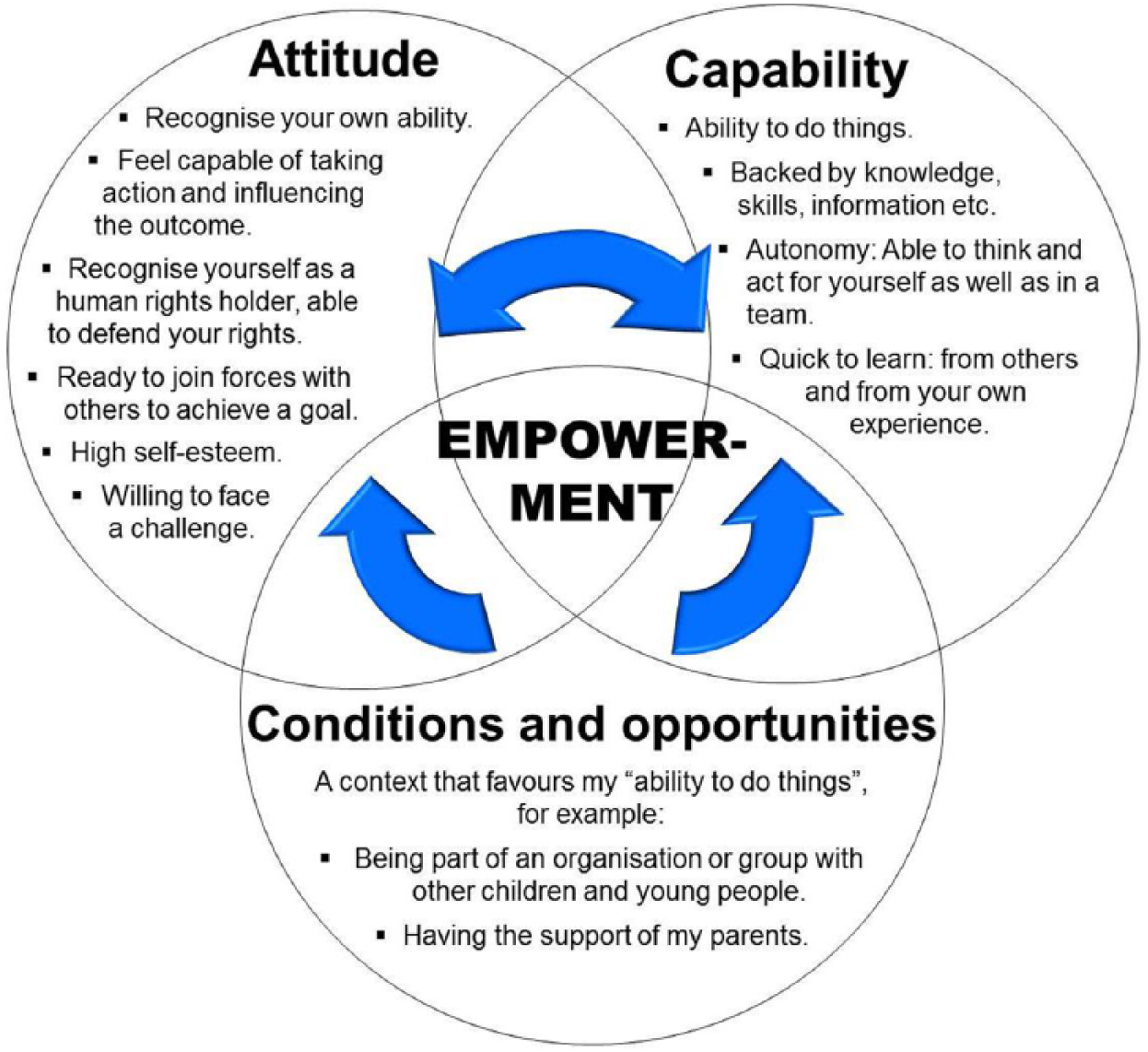
Empowerment, as conceived by CESESMA/UNN (based on CESESMA/UNN (2010: 44), translated from Spanish by the author).
CESESMA sums up the diagram as follows: In order to be ‘empowered’ a boy or girl must be in conditions where they can have an influence, must have the knowledge and abilities required in order to have an influence and, above all, must feel themselves capable of having an influence. (CESESMA/UNN, 2010: 44)
The Transformative Research by Children and Adolescents approach links and reinforces all three circles:
Conditions. The act of becoming a member of a team (which also needs their parents’ approval) establishes the conditions for the child or adolescent to start to make a difference to the problems that affect them. It affords their own space where conditions are created that will later enable them to influence decisions in adult-run spaces (CESESMA/UNN, 2010: 22–23; Shier, 2008).
Capability. The research process provides new knowledge and skills, and strengthens existing ones. Young researchers acquire knowledge about their research topic, and develop skills in communication, self-expression, research methods, data analysis and teamwork among others (CESESMA, 2012: 48–49).
Attitude. The young researchers’ self-recognition and belief in themselves as researchers raise their self-esteem, which in turn enables them to make a personal commitment to the team (CESESMA, 2012: 48–49).
Second transformation: Transforming adult attitudes in the community and beyond
Their parents and teachers, and the leaders of their communities, see what these children and adolescents are capable of achieving, and this forces them to rethink old-fashioned ideas about what children can and cannot do, and recognise their potential role as drivers of change in the community. Changes in attitudes lead to changes in behaviour, for example, children being permitted to participate in local community decision-making structures where they were previously not considered capable (CESESMA, 2012: 56–57).
Third transformation: Reflexive learning that transforms adult facilitators
Facilitating and supporting the young researchers is a learning experience for the adults of the CESESMA team, generating new knowledge and skills in relation to the facilitating role, and strengthening relationships based on mutual understanding, respect and solidarity with the children and adolescents (CESESMA, 2012: 56–57).
Fourth transformation: Transforming society through community action
With the continuing support and accompaniment of committed adults, young researchers can draw up and implement action plans to disseminate their findings and promote the implementation of their recommendations. The results achieved by the team of young researchers from Yúcul mentioned above are perhaps the most impressive example to date.
What child researchers need from adult supporters
An important lesson learnt is that children and adolescents can be effective researchers. They have the capability to investigate a topic, to gather and analyse data and, by doing this, to generate genuinely new knowledge, thus contributing to real-world change just as the best adult researchers do. However, to do so effectively, they require four specific things from the adults who support them: methodology, facilitation, technical support and protection. Each of these will now be considered further.
An approach to research methodology that is both effective in the field and suited to the experience and abilities of the young researchers
In the world of academic research, researchers can select from a wide range of established methodologies and indeed develop new ones. This is a challenge for child researchers without academic grounding in research methodology. In contrast to the approach developed by Mary Kellett (2005) at the Open University in the United Kingdom, CESESMA’s Transformative Research model does not seek to offer initial training in research methods, but rather reduces things to the most basic level, by asking the child researchers to think about questions such as ‘What information do we need?’ ‘Who has this information?’ and ‘How can we get it?’ The children are then supported in a structured process of learning by doing.
2. Skilled, sensitive process facilitation
Effective research by children requires competent adult facilitators. In particular, they need to be skilled in communicating with children and adolescents – with an emphasis on listening. Facilitators also need to be sensitive when it comes to maintaining an appropriate balance between work and fun. Being a researcher involves work and is not (generally speaking) a game. At the same time, for most child researchers (certainly for those involved with CESESMA), it is a voluntary commitment and not a task imposed by a teacher; children do it because they want to, not because they have to. This means the process must be interesting, attention-holding and include an element of fun; but at the same time, it must be orderly and focused with a view to obtaining a final result – often by a deadline. A challenge for the facilitator, therefore, is to maintain the right balance between focus and fun (or between work and play). The facilitator also needs to judge when to provide direction and when to resist giving direction so young researchers can learn to manage their own processes (Shier, 2009: 225).
Finally, since a skilled facilitator knows how to manipulate children in order to achieve the kind of results he or she is hoping for, it is important that the facilitator acknowledges this fact and recognises the risk that they may use manipulative tricks without meaning to. They must be vigilant in relation to their own and their colleagues’ practice, to avoid such unintentional manipulation.
3. Technical support at least as good as that typically provided to adult researchers
This includes providing young researchers with official researcher credentials in the form of an identity card or badge and a clipboard, getting interview forms printed and distributed for data collection and facilitating teams of young researchers in producing their final reports collectively using a computer and digital projector and an application such as PowerPoint. If there is going to be a published final report, this must be edited, designed, produced and disseminated to a high technical standard, where again adult support is necessary.
This focus on technical support is significant as CESESMA works with children and adolescents in remote rural areas with limited technical resources. Lack of access to information technology limits the ability of poor rural people to influence decision-makers in order to claim their rights and improve their quality of life. Creating opportunities for rural children and adolescents to share their research findings and promote their recommendations using the technology of the metropolitan world is a way of narrowing this ‘digital divide’.
4. A responsible attitude to child protection that recognises, but does not exaggerate, risks
Doing social research is not without risks. Child researchers cannot do their work behind closed doors, but have to go out into the community to carry out interviews and other types of data-gathering. In CESESMA’s experience, child researchers mainly interview people already known to them, but this is not always the case. The risks can be greater when the research touches on sensitive or taboo subjects, where children may find themselves in conflict with people in positions of power or authority in the community, such as the Catholic Church or illegal liquor sellers.
The children’s fundamental right to speak out and be heard (UNCRC Article 12) is not in question, and therefore, responsibility for the protection and security of child researchers is an important part of the adult facilitation role. For adult facilitators, there is always a tension between protection and empowerment, which reflects two different approaches to safeguarding children: One is to try to prevent them from encountering any kind of risk; and the other is to educate and empower them so that they can understand and assess the risks of everyday life and take action, individually and collectively, to protect themselves. (Shier, 2010: 33)
In facilitating Transformative Research projects, CESESMA has tended to adopt the second approach, talking with children about the risks and how to deal with them. Some basic rules are agreed; for example, when children do interviews in the community, they should work in pairs, accompanied by a trusted adult. Parents are always kept informed about what their sons and daughters are up to, and give their consent (in fact they are generally very supportive). While it is important to provide the best possible protection for child researchers, an attitude of unwarranted fearfulness or exaggeration of risks should not be allowed to stop children going out and doing real research.
Conclusion: Future challenges
While these examples support the view that action research by children can indeed be transformative in different ways, the experience has also highlighted three continuing challenges. First, almost all invitations offered to children to become researchers (apart from school projects) come from adults who have already decided what it is they want researched, so the children are asked to investigate an adult-determined topic. CESESMA has struggled to persuade funders to finance child researchers investigating topics that they themselves identify as priorities.
Second, supporting child researchers in the follow-up action phase, where, with research findings in hand, they move from the researcher role to that of advocate, activist and agent of social change, brings new challenges. For example, arranging for a team of child researchers from a remote coffee plantation to travel to the capital city, which may be the only way they will be taken seriously by the relevant decision-makers, is expensive in terms of staff-time, transport and accommodation costs, child protection arrangements and more.
The third challenge is that of measuring the impact of children’s research: both the empowerment effect on the children themselves and their impact as agents of change in their communities and beyond. The first requires gathering evidence to provide a concrete demonstration of empowerment. The second requires evidence to show how children’s research findings are taken on board by policy-makers, or otherwise influence outcomes in their communities. Although there is plentiful evidence of this, it is largely anecdotal, like the case of the young researchers from Yúcul described above. The challenge is to demonstrate the workings of cause and effect, from children researching social issues and generating new knowledge, to the eventual impact of that knowledge as a force for change achieved through advocacy and social action.
Footnotes
Acknowledgements
This article is based in part on a keynote presentation given at the International Children and Youth Research Network conference in Preston, UK, in September 2012, which in turn drew on an article in Spanish given at the international symposium on Ethnographic Encounters with Children and Adolescents in Educational Contexts at La Salle University, Bogotá Colombia in October 2011.
Funding
The article discusses research funded by the Common Fund for Support to Civil Society for Democratic Governance in Nicaragua.
Notes
Author biography
 .
.