




Abstract
From the Palestinian uprisings to the Arab Spring, politics in the Middle East is often spectacularly represented by the visual images of (male) youths battling state forces in the street. This article seeks an examination of political and cultural change in the region from a different perspective by asking how the everyday lives of young(er) people – boys and girls alike – are implicated in such transformation. In doing so, this article seeks to highlight how young people act as agents of change not only in ‘The Street’, but also in the more mundane and intimate spaces of alleyways, doorsteps and homes. Through an examination of the everyday mobility of Palestinian girls and boys in a West Bank refugee camp, this article demonstrates how questions over access to space in the camp are central to the lives of young people, as well as to broader political struggles in Palestine and the region. Girls living in Balata Camp often see restrictions to their access to space as being the result of both internal Palestinian social inequality as well as the overarching geography of occupation and displacement. Girls often advocate for greater access to space in the camp by making appeals to both the Palestinian national struggle as well as Islamic ethics of gender equality and justice. By arguing that healthy girls and boys are better able to grow and resist occupation with new and spacious places of play in the camp, these young people mark a significant departure from the politics of older generations who have steadfastly avoided outward improvements to the camp out of a desire to maintain their refugee identity and right of return. Beyond their advocacy for greater access to space, girls in Balata also use a variety of embodied tactics and strategies to evade, resist and make do with the spatial restrictions imposed upon them. Counterintuitively, many girls use their spatial restriction to their advantage by using their time at home to study. Many hope that their academic achievement will enhance both their upward and lateral mobility later in life. In contrast, although boys are viewed as having the privilege of greater mobility in the camp, many boys complain that they have no quiet places to study and that the streets they play in are often violent and crowded. With mounting family obligations and dismal employment prospects, many boys see little hope in achieving a better life through education. By looking at how girls and boys negotiate access to everyday space, this article demonstrates how children’s lives are implicated in the broader politics of public space and gender in the Middle East.
Introduction
The events of the Arab Spring, as they have come to be known, have stimulated renewed attention to the role of youth in popular political organizing in the Middle East and beyond. Much of this attention has focused on youth activism through social media and the spectacular protests that took place throughout the Arab world. However, little attention has been given to how the everyday lives of young people are implicated within these events as well as the social, political and economic conditions which gave rise to them. Although the uprisings in Tunisia, Egypt, Libya, Yemen, Syria, Bahrain and elsewhere have since been met with various challenges and setbacks – including violent crackdowns, armed insurgency, civil war, the reinstatement of military rule, and Western military intervention – the political questions that these events have thrown open remain more relevant now than ever. This includes access to and use of public space for contesting entrenched political and social power, as well as the public role of women in such contestations. Although rarely acknowledged, these are issues that tangibly impact the everyday lives of children in the region, and which children actively negotiate both through their embodied practices, as well as through their ability to formulate and express opinions on such matters.
As many commentators have noted, the events of the Arab Spring have, for once, overshadowed the politics of the Israeli occupation of Palestine in the region. Although activists in Egypt and elsewhere have often cited the youth-led Palestinian intifadas as one source of inspiration for their own political mobilization, demonstrations against the Palestinian Authority during the height of the Arab Spring (2010–2012) were limited and subdued. This is despite the fact that there remains popular resentment among Palestinians, especially today’s young ‘Oslo Generation’, at the failure of the so-called peace process to deliver the desired results. While the political demands of Palestinians under occupation are distinct from the demands of their fellow Arabs struggling against other forms of authoritarianism, they share many common elements. Common between them are demands for personal and national autonomy, security and dignity, including the right to travel, study, work, choose political leaders, speak and live without fear of imprisonment, torture, harassment, exile, death or other forms of violence and oppression. Indeed, though the Arab Spring uprisings confronted the political power of the authoritarian state, they also opened up space to question and renegotiate related forms of social oppression including patriarchy, nepotism and other forms of age and gender-based discrimination and inequality. This article seeks to examine how young people in Palestine encounter, make sense of and resist such intersecting forms of power – both the occupation and internal social hierarchies and inequalities – in their everyday lives. In doing so, this article shifts the focus of analysis away from ‘The Street’, and towards the more intimate, mundane spaces of homes, alleyways and doorsteps. Specifically, this article examines children’s everyday mobilities in a Palestinian refugee camp and how access to and movement through space is shaped by and works to shape children’s gender, age and refugee identity.
Drawing upon research carried out between 2010 and 2012 with Palestinian girls and boys aged 10 to 13 living in Balata Refugee Camp in the West Bank (as well as their adult caretakers, including parents, older siblings, teachers and youth workers), this article demonstrates that although Palestinian refugee girls experience severe restrictions to their mobility and access to space in the present, they nevertheless seek to use their spaces of confinement in the home to their future advantage. Many girls use the space of the home to study, thus resulting in greater academic achievement and ambition than their male peers. Accordingly, parents are affording greater investment in girls’ education. Likewise, rather than viewing academic success solely as a personal achievement, many girls see this success as contributing to family honour, as well as to the Palestinian national cause. Similarly, many girls use the rhetoric of national struggle, as well as the Islamic discourse on gender equality, in advocating for the creation of more spaces for girls in the camp. In so doing, girls today may be signalling a departure from older generations in redefining new forms of struggle against occupation and new measures of gender equality.
Body moving, body feeling
Studies of mobility in Palestine tend to focus on the restrictions imposed upon Palestinians by the Israeli occupation. Technologies such as military checkpoints, bypass-roads, watchtowers, floodlights, X-ray machines and ID cards form what Halper (2000) calls the ‘matrix of control’, which restricts the mobility of Palestinians while enabling the unfettered movement of Israeli settlers. This relational understanding of ‘relative im/mobilities’ underscores how the mobility of some is always defined in relation to the immobility of others (Harker, 2009). In this way, mobility serves as a key marker of difference and identity. As such, mobility is a politically contested resource that is experienced and resisted at multiple scales (Cresswell, 2011; Cresswell and Uteng, 2008). The absence of geopolitical sovereignty of a Palestinian state, for example, is experienced at the level of the body in the form of humiliating inspections and never-ending boredom as ordinary Palestinians wait at checkpoints and borders (Bontemps, 2012). Everyday, embodied experiences of checkpoint inspections and border crossings serve to re-inscribe a Palestinian identity predicated on collective experiences of statelessness, exile and occupation (Abourahme, 2011; Khalidi, 1999).
However, Palestinian refugee children, like the girls and boys from Balata Refugee Camp who participated in this study, do not regularly confront checkpoints, road blocks or other closures throughout their daily routines. The everyday mobility of most children from Balata is restricted to the camp itself. It is the boundary of the camp that divides the world into ‘inside’ and ‘outside the camp’, to use a commonly heard phrase. Apart from the rare shopping trip to nearby Nablus, an occasional visit to family members who live outside the camp, or the yearly school trip to the springs of Wadi Badan, school-aged refugee children rarely travel beyond Balata’s boundaries. As such, it is not a wall or checkpoint that marks the everyday im/mobility of Balata’s young people, but rather the mundane spaces of home and street. It is through crossing the boundaries of doorways and alleyways that girls and boys in Balata encounter the gender and age hierarchies that structure their lives and actions. Nevertheless, these everyday barriers and thresholds are also structured by and understood within the overarching geographies of displacement and occupation that prevent the return of refugees to their land in historic Palestine.
Writing prior to the Arab Spring, Asef Bayat (2010) presciently argued that in addition to being a vital space for sub-altern economic activity and popular political discourse, the street also serves as a site of a youth-driven cultural revolution against social conservatism. However, what might be seen as a space of liberation and dissent to young men may be viewed as a space of harassment and restriction to young women. Indeed, in Balata Refugee Camp, girls, boys and parents often portray the street as a morally questionable place where older male youths congregate in displays of machismo style and conspicuous consumption – showing off their mobile phones, jeans and ‘spiky-look hair’ while smoking and hanging about. As such, girls and younger boys often find such spaces and performances threatening and uninviting. The privileging of the street in Middle Eastern urban studies as the site of subversive politics ignores the exclusionary gender dynamics undergirding this space. Moreover, this view discounts the home and other intimate spaces as sites of political contestation. The home serves as a nexus of communication flow and social gathering where national politics is discussed, and where cultural and religious norms are both reproduced and negotiated (Abu-Lughod, 2005). Rather than segregating home and street, it is perhaps more useful to approach both spaces as co-constructed through complex, often messy interrelation (Matthews, 2002). As the sections below will illustrate, the spaces of street and home, and their varying levels of privacy and publicity, are constructed, reinforced and negotiated through affective regimes of honour and shame.
In her study of Palestinian refugee girlhood in Lebanon, Fincham (2010: 44) contends that it is ‘through narratives of honour and shame and disciplinary regimes of surveillance that Palestinian females are policed into compliance through culture’. Indeed, as a lengthy lineage of literature from both social-cultural and cultural psychological perspectives attests to, familial honour is a central feature of Middle Eastern and Mediterranean culture and family life (Antoun, 1968; Campbell, 1964; Dodd, 1973; Gilmore, 1987; Peristiany, 1965). However, there is a danger in portraying women and girls as the victims of culture rather than as participants in its reproduction and redefinition. As Baxter (2007) observes, this ‘honour-as-problem-for-women-and-progress’ paradigm ‘obscures the rights and strengths of women and the obligations and anxieties of men’ (emphasis added) (p. 738). Here Baxter (2007) is not making the claim that men and women are necessarily equal in the rights and responsibilities owed to one another. Rather, she argues that men and women both are complicit in maintaining but also challenging gender norms, including notions of honour. In this view, honour involves rights and responsibilities, as well as ‘certain beliefs, attitudes, and behaviours’, that men and women uphold together (Baxter, 2007: 746). Both men and women are required ‘to act and be acted upon, to dominate and be dominated’ for the sake of the family honour (Baxter, 2007: 745–747). Likewise, although the honour-as-problem paradigm focuses on female sexual purity as the source of familial honour, this honour-as-way-of-life view acknowledges other aspects of honour and respectability including displays of generosity, hospitality, reciprocity, strength, dignity, humility, deference and agreeability (see also Joseph, 1993, 1996, 1999).
Being honourable brings with it various social, psychological and emotional rewards, such as good social standing, respect and confidence. The alternative to honourable living is a life of shame and embarrassment. Although honour and shame are social values that reside within the structure of the family, they are also embodied affects that exceed conscious control. Shame can permeate space and serves to regulate bodily comportment and mobility (Sedgwick, 2003). Although the affect of shame may compel bodies in certain directions, other affective impulses such as boredom, curiosity, ambition and desire can act as ‘free radicals’ that propel bodies in other directions. This opens the possibility of bending the rules of honour and redefining social mores in the process (Brown et al., 2011; Sedgwick et al., 1995; Sullivan, 2001). The following sections will illustrate how notions of honour and shame regulate and restrict girls’ mobility in Balata Refugee Camp, but also how girls draw upon other discourses, such as Islamic ethics and the Palestinian national struggle, in order to push the boundaries of shame and honour, and achieve greater physical and social mobility. In addition, the subsequent section will demonstrate how girls make do with their spaces of confinement in the present, by hopefully preparing for academic success in the future.
Gender, space and mobility
Between 2010 and 2012, the author conducted extensive ethnographic research with Palestinian refugee girls and boys aged 10–13 in Balata Refugee Camp. Research was conducted in partnership with three local community centres serving young people in the camp, and included interviews with youth workers, teachers, parents and other adults. Two research groups of 6 children each (two groups of boys, two groups of girls and two mixed groups) were organized at each of the centres. Over a period of 2–3 months, the children met 2–3 times per week to conduct a variety of creative research activities including focus group interviews, mental mapping, journaling, photo diaries, photo tours and, at the participants’ insistence, videos. The purpose of these activities was to examine children’s everyday mobilities and spatial practices, emotions that children associate with various spaces in the camp, and how children’s daily lives and practices are imagined within broader spatial-temporal imaginings of national space and history. The age of late-childhood was chosen for this study in order to understand how children’s everyday mobilities shift as they transition away from being considered children (aTfal) and into becoming young men and women.
Given the age of these research participants, it is no surprise that the experience of spatial differentiation became a salient topic in the research groups. In a mixed boys’ and girls’ research group, 11-year-old girl Raghad shared a passage from her journal during a week in which participants were asked to make notes about their daily routines, the places they visited, and any thoughts, observations or feelings they had. Like almost all the other girls who participated in this research, the issue of what she called tefriq, the inequitable differentiation between boys and girls, was an issue of great concern to her: There was a family that consisted of a father, a mother, two sons, and a daughter. The family gave more advantages to the boys in treatment and everything in the family. […] The girl was prevented from visiting her friends because her parents thought she would learn something bad. They didn’t know that rather than protecting her, they were actually weakening her. Rather than doing right, they were causing her to be in error. The reason for this was their wrong ideas. Finally, we address our parents and tell them ‘Allah has ordered you not to give advantage to boys over girls’.
In the Middle Eastern cultural context, broadly defined, girls find their access to public spaces more limited, their mobility restricted, and the modesty of attire more of an issue as they mature into adolescence (Fernea, 1995; Gregg, 2005). In this passage, however, Raghad draws directly from her understanding of Islamic religious ethics, which encourages equal treatment of sons and daughters, to contest what she sees as unfair differentiation between boys and girls.
Many parents in Balata Camp contend that they strive for equal treatment of their children, though most admit they are more protective of their girls. As some parents are quick to point out, the tendency to overprotect girls is common in many cultures, and is not unique to Arab, Middle Eastern or Muslims societies. Still, many parents in Balata feel that girls are subject to stricter control due to the lack of privacy in the camp, and the precariousness of life under occupation. In other words, they see a direct connection between the restrictions placed on girls in Balata and the restrictions of the occupation. As Saleh, a youth worker in Balata, explained in a focus group interview, All the places that we could go to outside have been made forbidden to us by the occupation, so there are no public places to go to that aren’t crowded. There are lots of beautiful places, like the ocean, for example, in Jaffa or Haifa. All my life, I’ve never been to the ocean. It’s forbidden. In Nablus, the only public places we have are small, like the Happy Childhood Park or Jamal abdel Nasser Park. Even this is a something unique for the children in Balata: to leave the camp to go to one of these parks for the day. It’s okay for families to go there with girls – they keep the young guys out – but the space is too small. The girls can’t play comfortably. […] By the time girls are as young as ten-years-old we have to start protecting them from so many things in the camp – life is more dangerous here.
In this view, the restriction of space caused by displacement and occupation creates a general lack of privacy thus further restricting girls’ mobility. Even places such as public parks are difficult to get to and must be policed to create pockets of privacy for girls to comfortably play.
Many children similarly contend that girls are placed under stricter control in the camp due to lack of privacy and insecurity. In a focus group interview, 12-year-old Deema compared play in the camp with play outside: I don’t play in the camp. The only place we have to play is the streets, but the streets of the camp are crowded with impolite boys. But if I go to my grandfather’s house outside the camp I play outside around his house – in the streets – it’s normal. Here in the camp it’s a scandal! It’s not forbidden, but people will talk. They think differently here. The space is different. It’s too close. Not comfortable.
Here, Deema explains that although girls are not expressly forbidden from playing in the streets, the threat of familial shame is enough to restrict outside play. Her view that girls are afforded more freedom of movement outside the camp, as well as fewer impositions on their attire and behaviour, is a view shared by many other girls her age. In addition, some parents also observed that during times of relative political calm, parents in Balata were more relaxed with their restrictions on girls. This suggests a relationship between political instability and familial insecurity that manifests itself in terms of tighter restrictions on girls’ mobility.
However, rather than seeing restrictions to mobility as an unavoidable aspect of refugee life under occupation, girls see their desire for equal access to space as being part of the larger Palestinian struggle for freedom and self-determination. The construction of equivalence between Palestinians’ immobility under occupation and girls’ immobility in the camp was made in a mixed research group. In the group, the issue of tefriq was once again raised. Taghrid and her friend Abeer discussed how the inability to play freely affected them physically and psychologically. As Taghrid explains, ‘We go from the school, to the youth centre to home. That’s our whole lives. We’re not allowed to play in the streets’ (Figure 1). She added, ‘if all I do is sit at home all day, I’m gonna go crazy’. Her friend Abeer explained that although girls play in front of their houses or on the rooftops, they cannot go into the streets because ‘the neighbours will talk and say she’s a bad girl, or it’s shame’. Taghrid argues that if it is shame for girls to play in the street then they must be provided with their own ‘special’ or ‘private’ places (amakan khasa). As Abeer put it, There must be equality for boys and girls. Boys must have the same benefits as girls, not more. I’m not saying we should be out in the streets, but give us a special place for us to play equal to the boys.
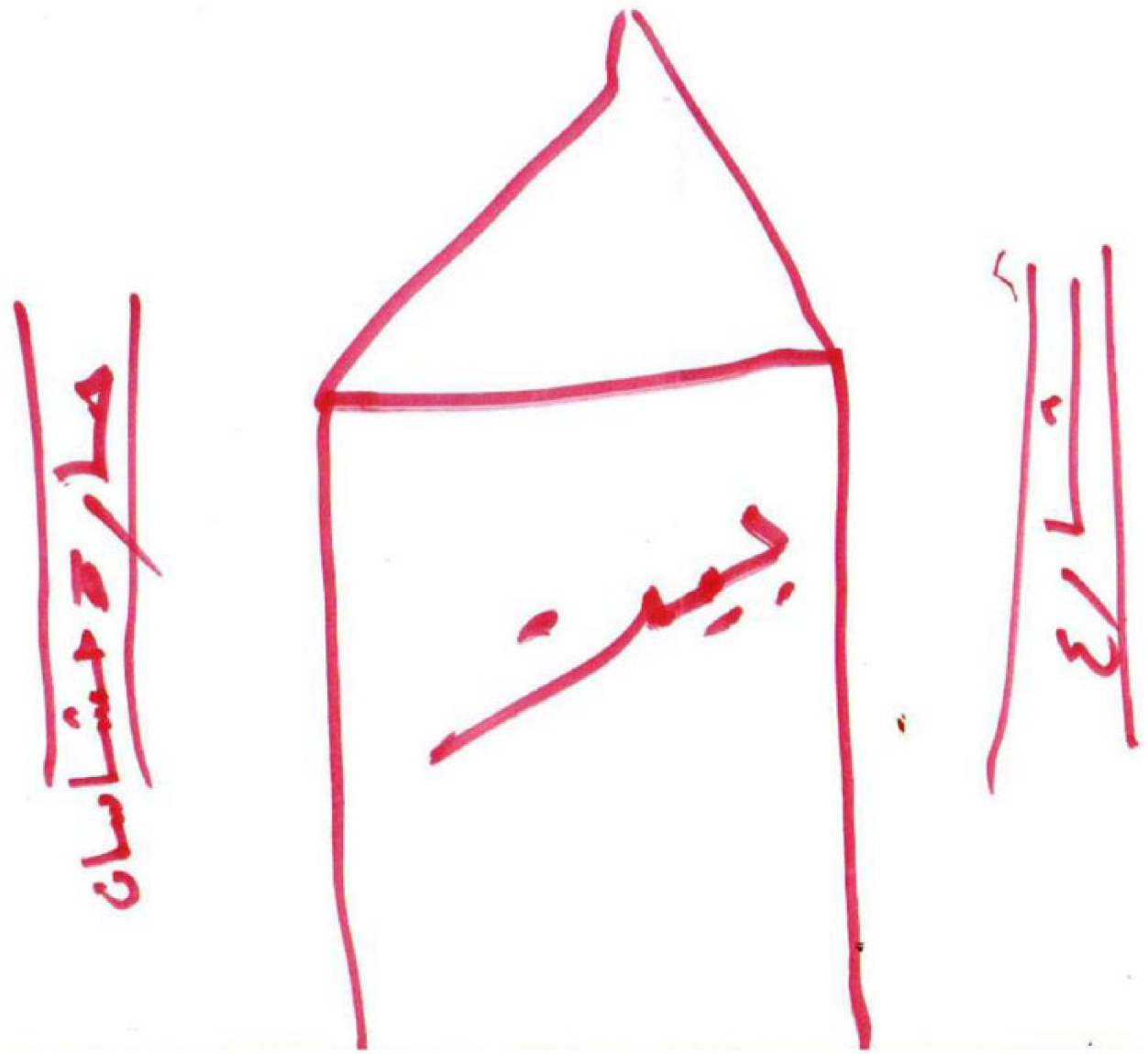
This is a mental map of the camp drawn by a participant in a girls’ research group. It consists of the girl’s house bordered on either side by the street and the neighbourhood.
Beyond merely advocating for a more favourable accommodation with gender segregation, what Taghrid and Abeer are suggesting is perhaps something more profoundly political. While Palestinian refugees take great pride in creating private homes in the camp, they have historically been wary of any attempts to improve the public facilities of the camp, which might be taken as a sign of acquiescence to the permanence of their exile. For example, residents of Jenin Camp protested United Nations Relief and Works Agency (UNRWA) plans to widen the streets of the camp following its destruction in 2002. Not only would wider streets allow for easier access to Israeli jeeps and tanks but eliminating the camp’s characteristically narrow alleyways would make it indistinguishable from the rest of the Jenin conurbation, thereby threatening the specificity of the place as a camp and of the residents as refugees. In advocating for spatial equality between boys and girls in camp, these girls, and many like them, are calling for the construction of new spaces to accommodate such arrangements. However, the girls see this not as surrender of the struggle of Palestinian refugees, but as part of its core mission to achieve freedom of movement and self-determination.
Both boys and girls who participated in this research expressed the need to create new places of play that would include special or private outdoor places for girls. When asked why the two girls’ schools in the camp did not suffice, Taghrid and Abeer once again explained that although girls use the school playground during recess, boys use it freely after school and for their sports training in the afternoons and weekends. As Abeer clarified, ‘it’s not that it’s forbidden [for girls to play there], it’s just that it’s not considered private enough, so we can’t use it’. On a photo-tour of the camp, the girls demonstrated what they meant. The girls’ school yard consists of a wide open courtyard, bordered by apartment buildings overlooking the playground (Figure 2). Abeer explained, There is a big area for boys to use here, but we can’t use it because it’s too open. It doesn’t seem open, but look, people can look down at us from their houses up there. You see? We train in the small sports hall inside during PE and we can only use this big space during school recess when there are teachers and when we are wearing our uniforms. But it’s so crowded with girls we can’t play anything. The boys come in and use this space after school.
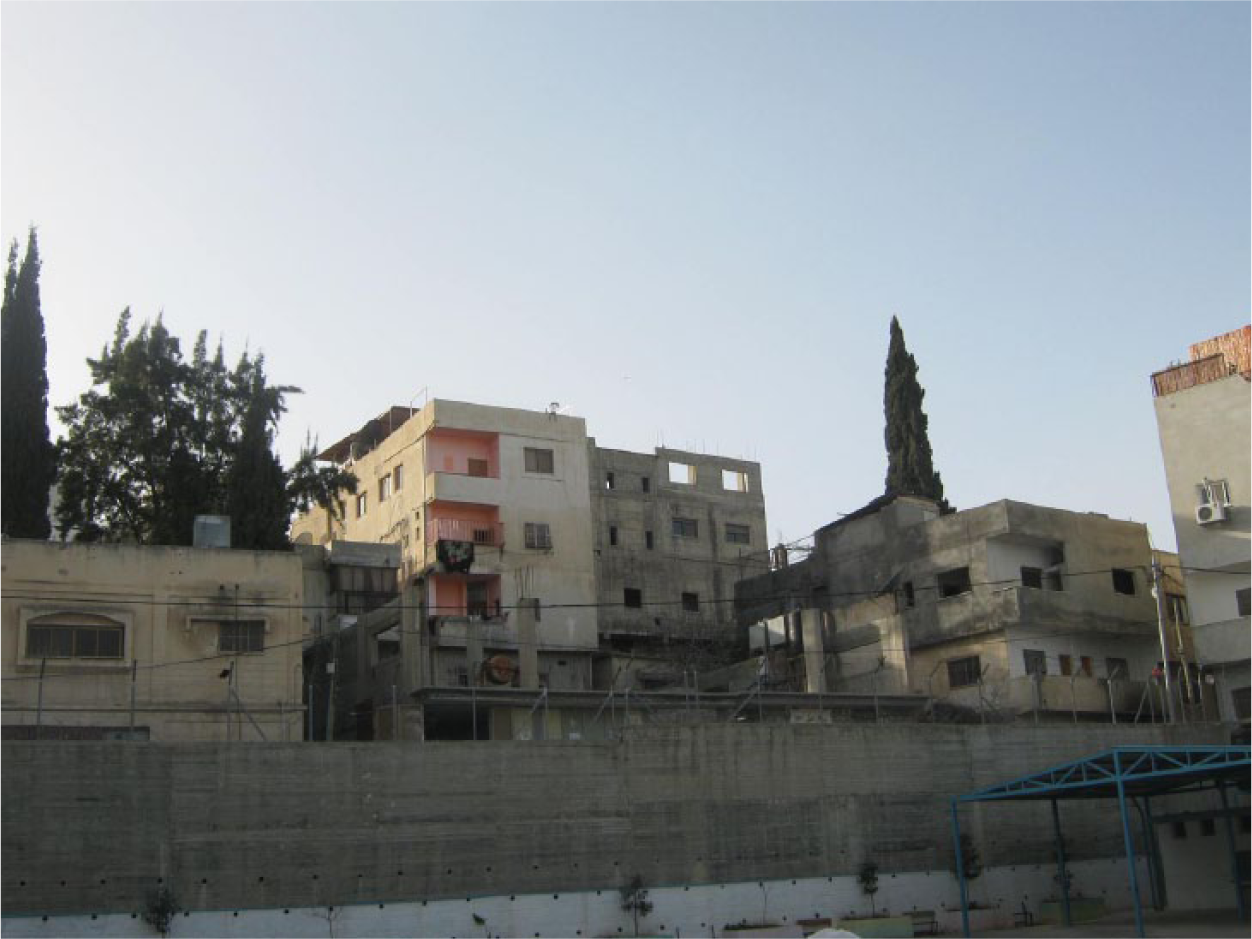
Abeer’s photo of the houses overlooking the playground at the girls’ school.
As she spoke, as if on cue, the guards at the school came in to ask the girls to leave so that the boys could hold their sports training. ‘See?’ Abeer said, ‘we have a place to play but someone else controls it’.
Abeer decided that this scene of boys playing in the girls’ space was a perfect depiction of the issue of tefriq that we discussed in the focus group, so she began photographing the boys playing. Taghrid, however, was growing more and more uncomfortable. ‘Yallah, Abeer let’s go. Khalas, enough, all the boys are looking at us!’ Taghrid had turned her body inward towards Abeer, her eyes cast downward, and hands tightly gripping Abeer’s arm. Abeer shook off her friend and walked closer towards the boys immersed in the act of capturing this scene, safely observing from behind the camera. For Taghrid, however, Abeer’s interest in the scene only intensified the shame. Taghrid walked away, arms folded across her chest, biting her thumb. Finally, Abeer was satisfied with her shot, and ran to catch up with Taghrid. Abeer concluded, We all suffer from lack of space. It is part of the occupation. We can’t go back to our land. But we girls suffer the most from this. We must all work together to change this situation. All of us.
Here, rather than being the ultimate victims of occupation and family honour, girls are depicted as central to the Palestinian national struggle, which itself is seen as part of a broader yearning for freedom and equality that everyone must play a role in advancing.
Violence on the street, longing for home
Although the girls who participated in this research see themselves as advocating against spatial arrangements that unfairly disadvantage girls, boys too contend with restrictions imposed upon them by older youths and adults. Boys in Balata Camp must constantly negotiate their play-spaces with adults while being chased out of alleys and other spaces by irritated neighbours and relatives. Likewise, boys must police the areas around their homes, protecting the space from outsiders, and defending the honour and privacy of their family. As one father explained, ‘Just walking to school and back is like a battle for boys. The streets are crowded, and just one bad word can start a fight’. The freedom boys enjoy to play in the street comes with the cost of having to defend the privacy and honour of one’s home and family.
In a mixed group of boys and girls, 11-year-old Ibrahim raised the issue of violence. In his mental map of the camp, Ibrahim drew his home and his neighbours’ houses and in between them two stick figures obscured by a blur of scribbled lines labelled ‘violence’ (Figure 3). Ibrahim explained, The streets are all violence. You leave the house, violence. Neighbours yell at us, boys fight in the street, maybe some boys come from another neighbourhood and make problems, or maybe someone’s cousin makes a problem with another family, and it’s war, so everybody fights. It’s all violence.
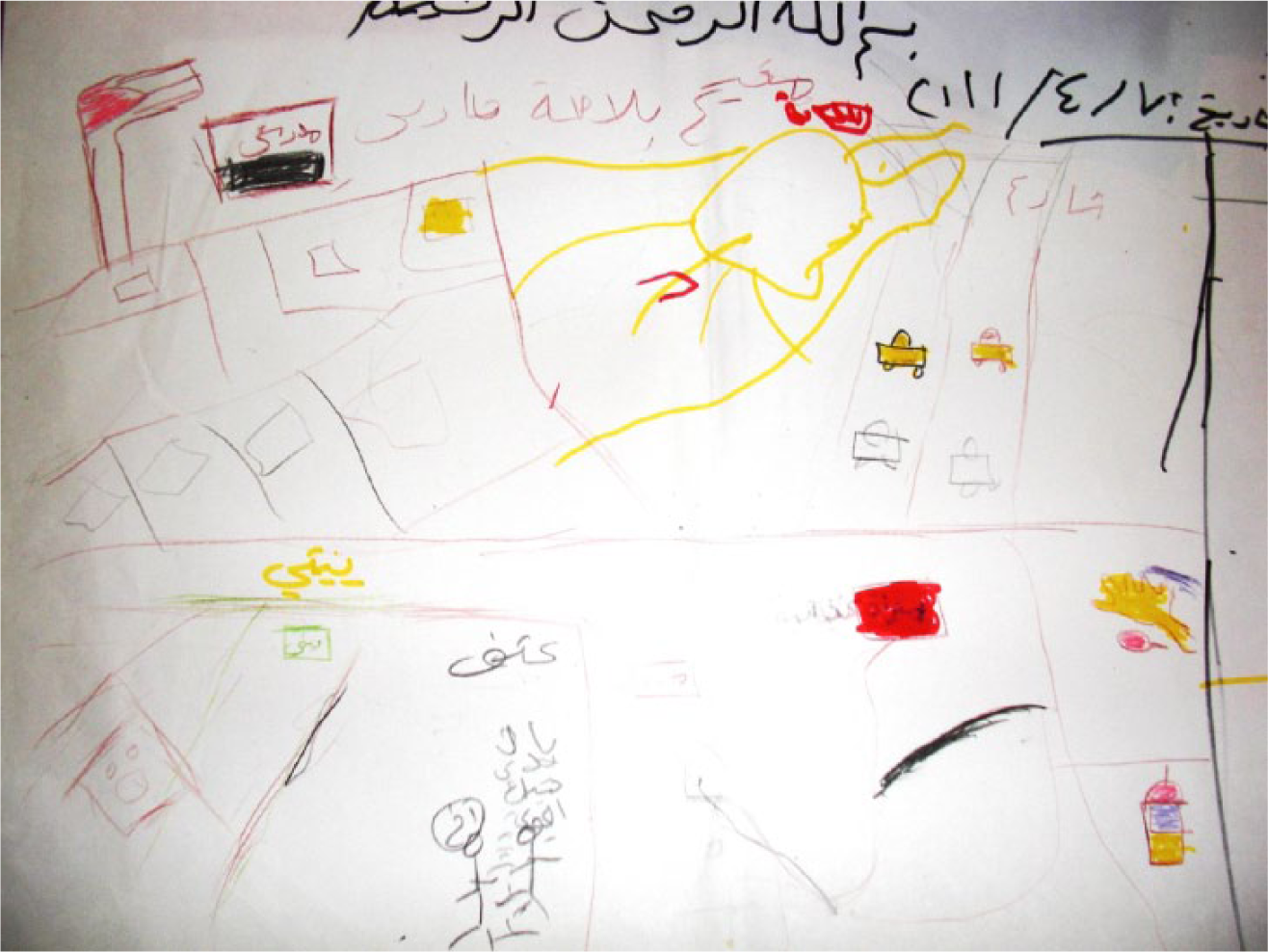
Ibrahim’s mental map suggests he enjoys greater mobility than girls his age. In addition to his house, it features the school, the taxi rank, the fruit and vegetable souq, a juice stand and even the municipal electric grid. However, at the centre is the word ‘violence’ accompanying a fight between his brother and another boy.
Here, rather than being spaces of carefree play and freedom, the street is depicted as a volatile site that must be constantly negotiated and defended.
Ibrahim explained that even spaces that would seem intuitively welcoming to children, such as the nearby park, are as restrictive as the streets inside the camp (Figure 4). As Ibrahim explained, describing a picture of the park from the outside, I hate the park! I had a problem there. I snuck in there and the man caught me and he said I can’t be there, and I said why, and he said because I didn’t pay a shekel, and I said to him ‘hey man, what are you talking about one shekel?’ And then he went for me and I ran and he chased me, but I escaped!
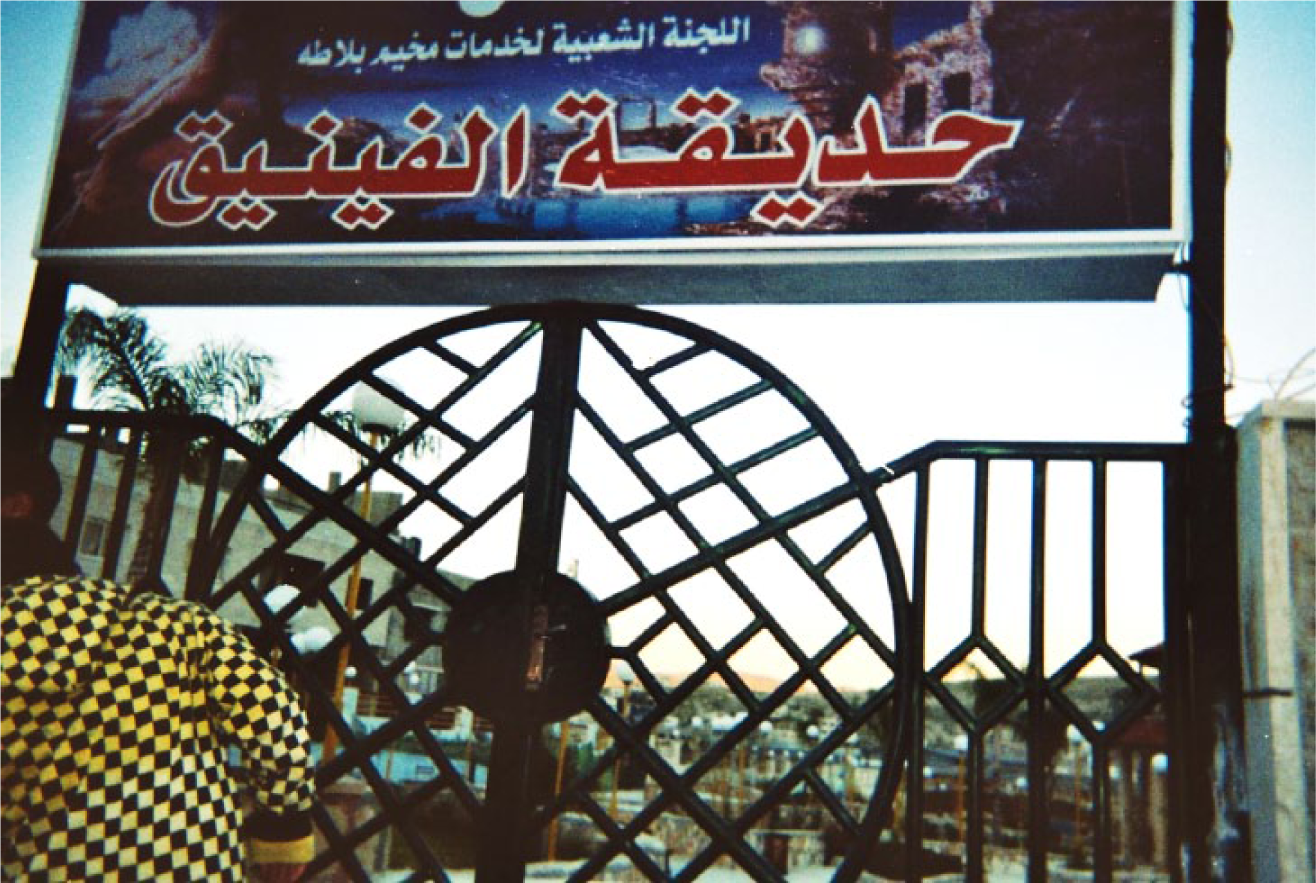
The locked gate at the park, from Ibrahim’s photo diary.
Built only within the last few years adjacent to the camp, the new park provides a small green space with gardens and walking paths for families. However, as many parents complain, although the cost of entry is only one shekel, the park is prohibitively expensive for families with many children, especially when factoring in the costs of drinks and snacks. Also, many girls and young boys complain that the park usually has a lot of young guys crowding around and smoking argileh, making it an uncomfortable place for them as well.
Perhaps somewhat paradoxically, while girls long to be able to play outside in the streets as boys do, the violence and pressure of the streets causes many boys to long for the quite space of home. In a research group conducted with students from Balata Boys School, the boys proposed making a film about the challenges that boys face in finding places to play. Before making the film, they created a storyboard narrative to plan the shots (Figure 5).
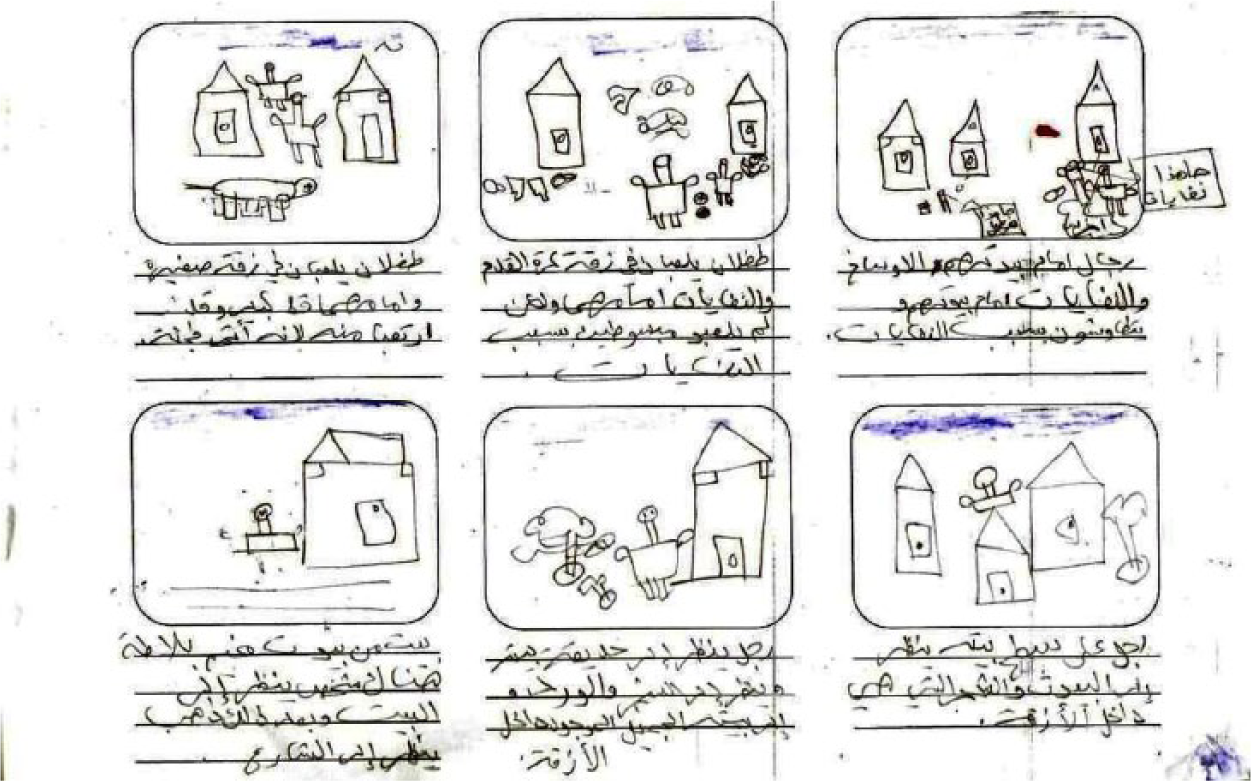
The boys’ storyboard for their research film.
In the boys’ storyboard, the film shows two boys trying to play in the small alleyways of the camp. In the alleyways, they encounter the fawda (chaos) of the streets such as rubbish and arguments. The street scenes stand in contrast to the calm and serene view from the roof of the house, where the film ends. The story, the boys tell me, is about how they long for a place far away from the chaos of the streets. While girls feel trapped inside their homes and unable to breath, boys feel choked by the streets, searching for the comfort and security of home, nature, and an elevated perspective that allows them to see beyond the confines of the camp.
Making do with boredom
Although girls often lament being confined to the home and unable to go out to the streets, they nevertheless use various tactics to expand their mobility around the camp. As Dalia (age 12) from a girls’ research group explains, girls sometimes use their position as parental helpers to do their own exploring around the camp: Sometimes I get bored helping my mother in the house. But, I always agree when she asks me to do a chore outside, like take something to my aunt’s house, or buy something from the store. I’ll take a long time, and see my friends, and if my uncles see me I’ll just tell them I’m doing something for my mom. If I come back a little late, it’s normal.
Indeed, it is not uncommon to see girls walking unaccompanied in streets. However, in such circumstances, girls are usually carrying a bag of groceries, a note or money, indicating that they are on a parentally sanctioned chore, thus transforming what would be a shameful act into an act of obedience (Figure 6).
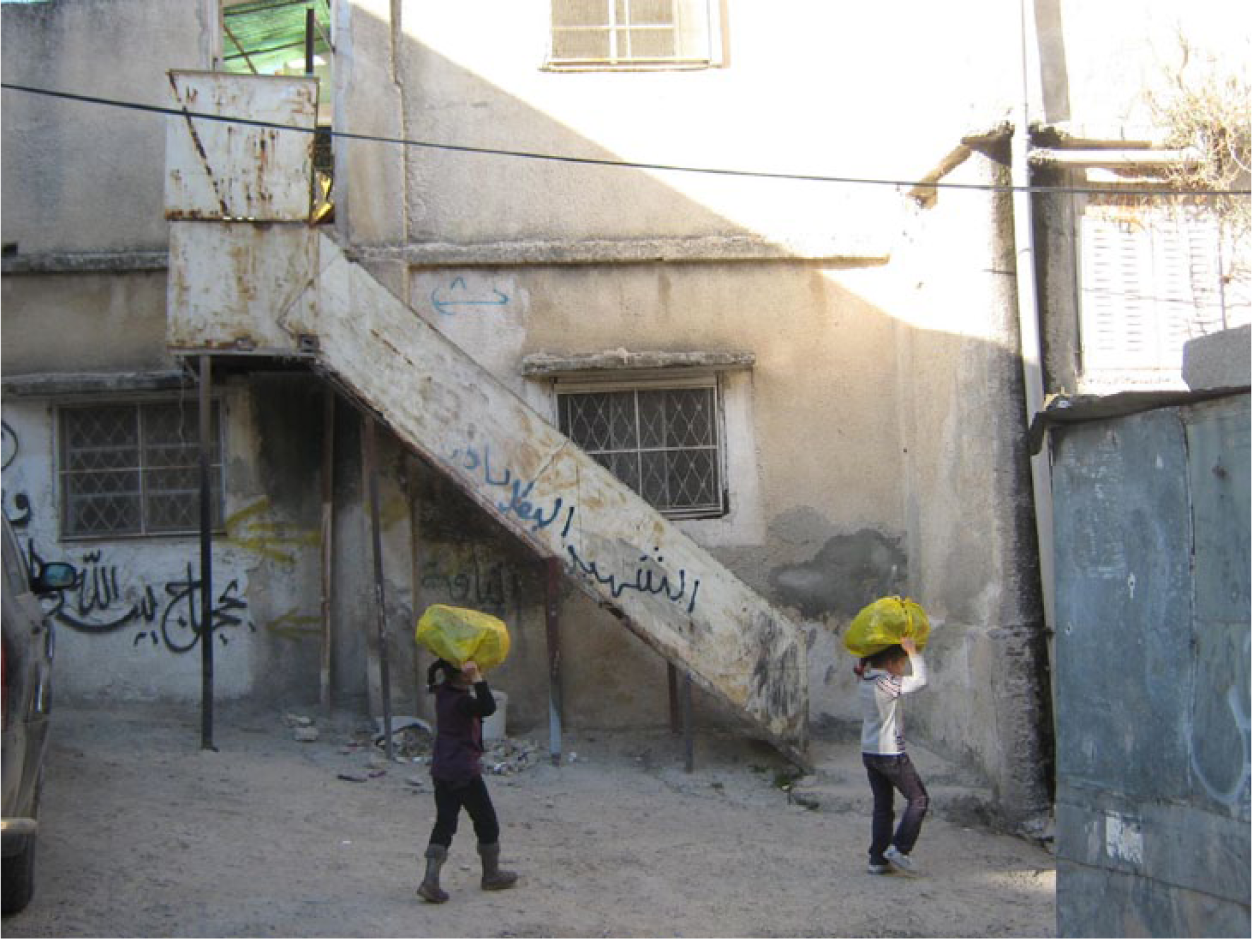
Doing chores or having fun?
Although girls face restrictions that limit their mobility outside the home, not only do they find ways of expanding that mobility when they can, but they also use their time and space in the home to their advantage. For example, girls have space to study at home, whether on the roof or in their shared rooms. In their leisure time, girls often enjoy playing computer games (Figure 7) and watching television, the American TV programme ‘Hannah Montana’ being a favourite. The time they spend on the computer and watching English-language television may, in part, account for the generally better level of English that Palestinian girls have compared to boys. Many parents hope that these language skills will provide greater educational and employment opportunities in the future.
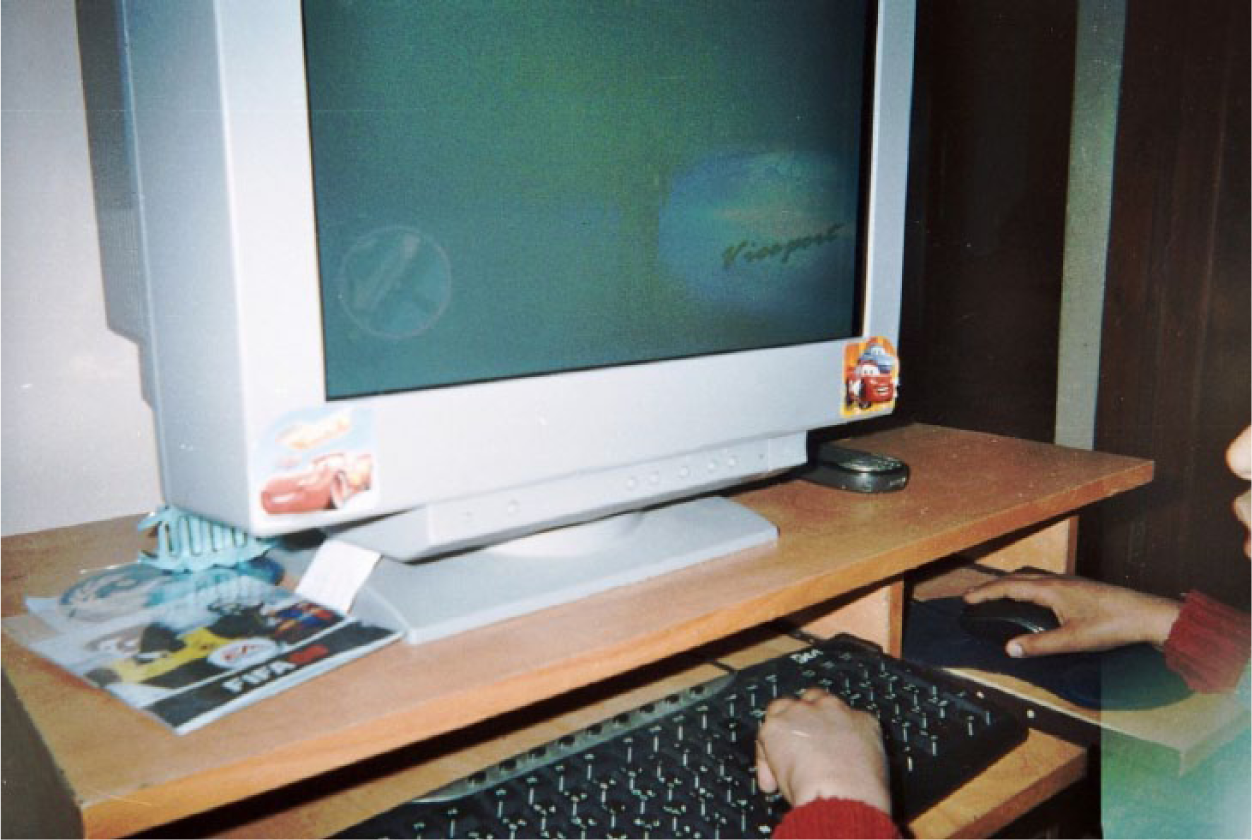
From a girl’s photo diary – playing on the computer.
For example, in an interview with Abu ‘Adl, an UNRWA school teacher and father from Balata, he suggests that girls regularly outperform boys on school leaving exams because they spend more time at home and have their own places to study. Furthermore, he contends that the greater academic promise exhibited by girls earns them more privileges at home: Nowadays, parents are less concerned with boys. Boys have sports, or they spend all their time playing in the streets. But our girls do not leave the house. Their lives revolve around studying and education and they feel that if they do well maybe they can get out. So parents sometimes feel more invested in girls’ education. If parents have a boy and a girl, the old thinking was to invest in the boy because the girl will just be married off. But girls are the lucky ones now. Parents invest in the ones likely to succeed, the ones who have potential in this life and work hard: the girls. I know people who even take out loans just to send their daughters to university. And sometimes the sons will help pay for his sisters education. That’s common. It’s something great for a family to say their daughter is studying engineering or English or something in university.
As this father explains, the restrictions placed on girls can also be seen as a form of parental care. Furthermore, though girls’ education was once seen as a waste of time and money as their only future was to get married and have children, today the value of educating girls is seen as a social value in and of itself. Unlike property or wealth, education and learning is not something that can be taken by a husband or his family after marriage. As many parents contend, this provides an extra layer of future security for their daughters.
The view expressed above is a common one among parents in Balata Camp. In another focus group interview, Khadija, a young social worker, agreed saying that girls and young women her age are enjoying more freedom and independence today because of their academic achievements: Girls today are enjoying much more freedom, and I don’t mean just more freedom than before, but actually more than boys. Girls can travel to study, there are sponsored trips abroad for girls who study hard, and they have opportunities to look forward to. The boys, they have too many things to worry about nowadays, to build their future, it distracts from their education. They see even educated men struggling to survive. The guys must eventually work to get money, to support their families and build a home. But the girls can put all their focus on education. The most important thing for her is education.
In this view, the patriarchal family structure is seen as restrictive to boys as well. While boys must prepare for a job to earn money and build their own home, girls have the potential for more upward mobility through education. Khadija’s brother agrees. As he put it, rather than pursue their education, ‘guys have to start working to build a house and then, khalas, their life is fixed’, literally, as it were, in concrete.
Therefore, although boys are afforded more lateral mobility in the streets as children, as older youths and adults, they are confined to the home by having to support their parents and siblings, building upon the family home and starting their own families. Their mobility is upward but stationary, as they build another level on their family home. Many girls, however, are now being encouraged to pursue their studies – abroad if possible – with parents going to extreme lengths to support girls’ higher education. In an economy of social value that rewards families for the high academic achievement of their sons or daughters, many parents invest their scarce resources in the child they feel most likely to succeed. With few external distractions facing girls, they are often seen as having the best chance at scholastic success. In this way, girls’ mobility extends outward and upward as a university student with greater access to a professional career, more valuable marriage prospects and, potentially, travel abroad.
Nevertheless, it must be said that for many girls in Balata Camp, the hope of studying at university or travelling abroad remains an ambition that relatively few will achieve. Many boys and girls seek out opportunities to travel abroad through youth exchanges facilitated by cultural societies and youth clubs. For some, this may open other doors for further travel and study. With good grades and test scores, a select few may obtain scholarships to study at a Palestinian university, and some may even get funding to study in the United States, United Kingdom or Europe. Many young women who participated in this research often cited a neighbour or relative who had achieved similar success as a source of inspiration. Many others, however, will have to rely on their parents and relatives to finance their education at a local university of technical college. An increasingly popular option for many young men and women is joining the swelling ranks of the Palestinian security service, which offers college tuition credits to young recruits. Regardless of the difficulties they face, the girls who participated in this research all have high hopes for the future. There were many aspiring doctors, lawyers and engineers among the participants of this research. Almost all of the girls who took part in this research said that achieving success in the future was a way to make their families proud and to advance the cause of their people. For Palestinian refugee girls, education is not just a means of personal fulfilment but also a source of familial and even national pride.
Conclusion
Girls and boys alike are both constrained and compelled by the relative im/mobilities that their age and gender afford them. The cultural expectations for girls to be shy, polite and modest compel girls to experience a sense of bodily shame when entering mixed-gender spaces, enforced by regimes of familial surveillance. Nevertheless, girls also use the cultural expectations from them to help their parents and be good students to gain access to otherwise restricted space. Likewise, girls use their confinement to the home as an advantage by using that space to study in the hope of achieving academic and professional success in the future. Given the value that Palestinian refugees place on academic achievement, girls hope that studying will pay off in the form of greater social and spatial mobility in the world, including study, travel and employment, later in life.
Furthermore, as illustrated above, boys too contend with lack of space and restrictions on their movement. While cultural expectations compel them to defend their homes, families and neighbourhoods, violently if necessary, many seek the peaceful comfort and security of the home and natural spaces. This general lack of space that boys and girls both contend with is perceived within an overall framework of occupation and displacement. Girls in particular see the demand for gender equality in spatial mobility as being part of the national struggle against occupation, and a broader struggle for freedom and equality. Moreover, girls also appeal to notions of gender equality in Islam to advocate for greater access to space. By advocating for access to public space, while also respecting religious norms concerning gender mixing, the girls who participated in this study engaged in political discussions regarding religion and the place of women in the public sphere similar to those that have animated so much political debate throughout the Arab Spring. Moreover, by advocating for new green spaces and gender-friendly spaces of play, refugee boys and girls alike are setting themselves apart from older generations of Palestinian refugees. In arguing for improvements to the camp, young people are not advocating acquiescence, but rather are seeking ways to improve daily life, thus strengthening the health and resiliency of young people to better resist occupation. Whether their roofs, bedrooms or school playgrounds, girls in Balata camp are keen to use the spaces available to them today in order to push the boundaries of their own mobility, and that of all Palestinians, further in the future.
Footnotes
Acknowledgements
The author wishes to acknowledge the help and support of Anna Secor for her valuable advice and feedback, as well as the anonymous reviewers who provided insightful comments on earlier drafts of this article. In addition, the author would be remiss not to acknowledge the support provided by Hakim Sabbah, Abdelkarim Zawawi and Jeremy Wildeman of Project Hope, as well as Salah Assi, Fadi Alshoubi, Mohammad Bustami and Davey Davis for their assistance. Finally, the author extends his sincere thanks to the parents, families, schools, community centres and young people of Balata Refugee Camp, without whom this research would not have been possible.
Funding
This research was made possible by the National Science Foundation through a Doctoral Dissertation Research Improvement (NSF-DDRI) award entitled: ‘Doctoral Dissertation Research: Imaginary, Emotional and Everyday Spaces of Palestinian Childhood and Youth’ (NSF 1003446), as well as funding from a Research Fellowship provided by the Palestinian American Research Center. Additional support was provided by a European Research Council Advanced Grant entitled: ‘Youth Citizenship in Divided Societies: Between Cosmopolitanism, Nation, and Civil Society’ (ERC 295392).