




Abstract
The emergence of augmented reality (AR) and gamification in higher education has gained relevance by virtue of their usefulness in learning spaces. Prior research has examined these technologies separately, but less is known about the impact of combining AR and gamification in the area of web development. This article examined how different educational materials on web development influence students’ motivation and learning in higher education. The educational materials included lecture notes, an AR prototype, and an AR prototype with gamification. A web-based experiment involving 95 students demonstrated that using AR could enhance students’ motivation compared to conventional educational materials, such as lecture notes. However, compared with using only AR, the combination of AR and gamification did not enhance students’ motivation or learning. The findings may serve as a basis to further AR in higher education and support authors in the design of AR in course literature.
Introduction
Augmented reality (AR) is an emerging form of experience that represents a combination of digital technologies that produce and display digital content over a physical environment (Fidan and Tuncel, 2018; Fuchsova and Korenova, 2019; Tzima et al., 2019). AR can be defined as a system that fulfills three essential features: physical and virtual combination, real-time interaction, and three-dimensional recording (Wu et al., 2013). In other words, it is a collection of different technologies that combine to enhance a user’s perception of the physical world through virtual information (Alonso-Rosa et al., 2020; Lebeck et al., 2017).
The progress of the COVID-19 pandemic has led to the increasing leverage of AR solutions in classrooms and remote learning environments in higher education (Nesenbergs et al., 2021). By layering virtual information over the physical environment, AR has the potential to enhance individuals’ engagement and learning experiences in educational tasks (Chang et al., 2019b). The digital markups in AR allow users to perceive the physical world by adding digital data in a single, seamless environment, which has been shown to improve individuals’ knowledge and understanding of what is happening around them (Fernandez, 2017; Singhal et al., 2012; Yuen et al., 2011).
Technological advances have raised the boundaries of traditional classrooms, and AR is an example of a new type of innovation in higher education (Sáez-López et al., 2020). It mainly provides students with new interaction possibilities that focus on their presence and attention (Chang et al., 2019a, 2019b). AR has positively impacted students’ motivation and performance because it provides them with a new form of social interactivity, connectivity, and context-sensitivity (Nincarean et al., 2013). With the help of a computer or mobile screen, AR can improve a student’s environment, allowing them to interact and visualize theories and concepts that are difficult to understand (Martín-Gutiérrez et al., 2015). Motivation in the context of learning strongly correlates with learning effectiveness. Obtaining strong encouragement throughout tasks allows students to maintain focus for a longer time, resulting in better and more efficient learning (Chang et al., 2019b).
While prior research has demonstrated the beneficial aspects of augmented reality and gamification for teaching and learning, there is less empirical research focused on how AR can be combined with textbooks and gamification to enhance and maintain students’ motivation through the novelty effects of AR learning environments. The proposed research focuses on the area of web development with specific reference to color theory and the color system hue, saturation, and lightness (HSL). The reasoning for this is that previous research has identified that theoretical concepts in web development are experienced as complicated, difficult to understand, and could lead to a lack of motivation among students (Faraon et al., 2020; Gomes et al., 2012; Watson and Li, 2014).
Based on previous reasoning, this article is guided by the following research question: How do different educational materials about web development affect students’ motivation and learning in higher education? The educational materials of interest are lecture notes, an AR prototype, and an AR prototype with a gamification quiz. The research question is addressed using a web-based experiment and is further described in the methodology section.
Background
Augmented reality
Augmented reality (AR) is an emerging technology that creates a virtual layer in which digital and physical objects can interact through wearable technologies or head-mounted displays (Fidan and Tuncel, 2018; Fuchsova and Korenova, 2019; Tzima et al., 2019). The term augmented reality was first coined in 1990 by developers Tom Caudell and David Mizell, who produced an augmented reality system that could indicate potential drilling holes in an aircraft fuselage (Rese et al., 2017). While Milgram’s mixed reality continuum, a taxonomy of different ways to combine authentic and virtual elements has been revisited by Skarbez et al. (2021), it continues to provide an overview that shows that AR is situated closer to the physical world as it enables interaction with visual objects in a physical environment (Milgram and Kishino, 1994), see Figure 1. An updated taxonomy of the reality-virtuality continuum, ranging from an authentic environment to a completely virtual environment, was adapted from Milgram and Kishino (1994).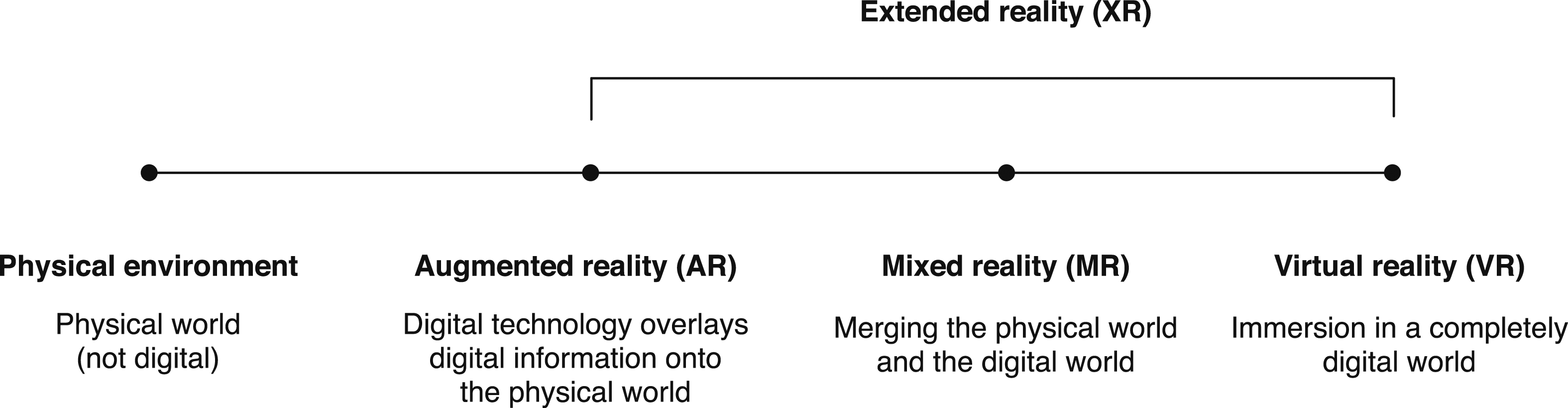
By using AR technology, people can interact with virtual content in new ways by enriching physical environments with virtual objects and information (e.g., sound, text, video, 3D objects). Through a design that fulfills three essential features: real and virtual combination, real-time interaction, and three-dimensional recording, AR can be perceived as a mixture of technologies (monitoring properties, handheld devices, and display systems) that enhance users’ perception of the physical world (Fidan and Tuncel, 2018; Wu et al., 2013). Augmented reality applications capture user input from the user environment, such as video, audio, or depth sensor data, and overlay output like visual, audio, or haptic feedback, to seamlessly add value and enhance interaction with physical reality (Alonso-Rosa et al., 2020; Lebeck et al., 2017).
AR technology has been limited by its large and inaccessible wearable technology. However, over the past few decades, more user-friendly and portable hardware has become available. The accuracy of registration, image quality, and device size have reached a satisfactory level, leading to the rapid adoption of AR technology (Dey et al., 2018). Even if AR has been around for decades (Jingen Liang and Elliot, 2021), the market for this technology, both hardware and software, is still dynamic and in the formation stage. The forecast concerning the demand for AR indicates that the technology will expand and develop in different fields, companies, and individuals (Davydov and Riabovol, 2019).
AR technology has been used in various fields, for example, in medicine (e.g., planning surgery and patient treatment) (Eckert et al., 2019), culture (e.g., museums and art galleries) (tom Dieck et al., 2018), tourism (e.g., providing people with rich and engaging content for destinations) (Cranmer et al., 2020), retail (e.g., enhancing customers’ shopping experience by creating a three-dimensional augmented experience) (Poushneh, 2018), logistics (e.g., assisting for the planning of logistics systems) (Wang et al., 2020), and education (e.g., offering 3D visualizations to contribute with visual context to literature) (Khan et al., 2019).
While the technology for AR is still developing, there are also limitations to it. One is the display size, which is relatively small compared with virtual reality (VR) applications (Lovreglio and Kinateder, 2020). Current AR applications often struggle with two concerns: tracking and recognizing (Lovreglio and Kinateder, 2020). The AR application needs to know where the device and the user are and track their movements. For this purpose, the technology needs to rely on external or internal sensors, both of which have limitations. For example, the technology for internal sensors is still limited in terms of its refresh rate and range, restricting it to static indoor use (Lovreglio and Kinateder, 2020). The cost of developing and maintaining AR applications is also a disadvantage (Li and Shang, 2019; Lovreglio and Kinateder, 2020). Designing and creating virtual scenarios are complex and require expertise. As AR is still developing, the technology needs constant updates to stay up-to-date (Lovreglio and Kinateder, 2020). Despite the current limitations of AR technology, it has proven to positively impact motivation and performance, for instance, in the area of education, as it provides a new form of social interaction, connectivity, and context-sensitivity (Di Serio et al., 2013; Erbas and Demirer, 2019; Khan et al., 2019). AR has also been demonstrated to support students in gaining more cognitive, affective, and participatory knowledge (Mei and Yang, 2019).
Although considerable research has been devoted to demonstrating how augmented reality can enhance learning in several academic disciplines (e.g., biology, health science, engineering) (Arulanand et al., 2020; Moro et al., 2017; Weng et al., 2020), little attention has been paid to how it may be combined with other technologies to maintain students’ motivation and to learn in the area of web development in higher education, specifically when learning the color system hue, saturation, and lightness (HSL). For this reason, the next section will describe and illuminate gamification as a potential that could be used to maintain and potentially enhance students’ motivation through progress mechanics (e.g., points, badges, leaderboards) and game principles (e.g., interactivity, feedback).
Motivation and gamification in learning contexts
Motivation is a human dimension that has been suggested to explain why people try to reach and retain these goals (Keller, 2010). In the educational area, some define motivation as a “process whereby goal-directed activity is instigated and sustained” (Schunk et al., 2010: p. 4), while others as “an internal state that arouses us to action, pushes us in particular directions, and keeps us engaged in certain activities” (Ormrod, 2016: p. 424). Motivation is typically divided into two types: intrinsic and extrinsic (Ryan and Deci, 2000).
Intrinsic motivation can be characterized as behavior driven by long-term internal rewards or engaging in entertaining activities (e.g., self-satisfaction, curiosity, interest) (Ryan and Deci, 2000). Factors such as challenge, curiosity, control, competition, and recognition have been identified to influence intrinsic motivation. Participation is encouraged through the desire to interact with technology and experience fun, challenging, and unique academic activities (Gopalan et al., 2017). In contrast, extrinsic motivation refers to behavior or engagement in short-term activities to achieve external rewards, such as money, fame, grades, and praise (Cerasoli et al., 2014; Legault, 2016; Ryan and Deci, 2000).
In recent years, one way to promote motivation and learning in education is through gamification (Koivisto and Hamari, 2019; Sailer and Homner, 2020). The term gamification did not enter the mainstream vocabulary until 2010 (Dichev and Dicheva, 2017) and could broadly be defined as the application of game-design elements in a non-gaming context (Deterding et al., 2011; Passalacqua et al., 2020). Game design elements include mechanics (i.e., the rules or components), dynamics (i.e., the behavior of the player with mechanics), and aesthetics (i.e., the emotional responses of the player) (Landers et al., 2018). The idea of gamification is to make solutions, services, and activities fun by offering meaningful choices, feedback, and autonomy (Nicholson, 2012).
While intrinsic and extrinsic motivations have often been studied separately in gamification, researchers argue that both must be considered to promote behavioral change (Cerasoli et al., 2014; Kingsley and Grabner-Hagen, 2018; Zichermann and Cunningham, 2011). For example, when students read physical course literature, they run primarily through extrinsic motivation to achieve a separable outcome (e.g., getting good grades and approval from the teacher) (Zhan and Andrews, 2014). However, intrinsic motivation has been shown to positively affect the learning process because it represents an activity’s engagement with one’s sake (Legault, 2016; Lens and Rand, 2000; Liu et al., 2019). Therefore, adopting different game design elements should be carefully considered when designing a gamification environment where people do not feel controlled or pressured. If extrinsic incentives make an individual feel controlled or pressured, it is possible that the motivation to perform a task decreases (Cerasoli et al., 2014).
Common game design elements associated with gamification are points, awards, ranks, leaderboards, stories, and feedback (Deterding et al., 2011). A fundamental element is points, which have a notional value and contribute to feedback and rewards. Awards or badges usually serve as a secondary reward system, as a visual representation of achievement. Rank systems and leaderboards demonstrate usernames in order, together with a display of points or achieved goals that indicate users’ progress (Groening and Binnewies, 2019).
Furthermore, game-design elements such as challenge (Carenys et al., 2017), mystery (e.g., creating a gap between the known and unknown to arouse curiosity within the user) (Tinedi et al., 2018; Wilson et al., 2009), assessment (e.g., providing a user with feedback to inform progress) (Oliver, 2017; Wilson et al., 2009) and control (e.g., giving a user to affect an outcome) (Guillén-Nieto and Alesón-Carbonell, 2012; Kikot et al., 2014) have demonstrated to enhance student’s learning experiences and make them feel excited about learning (Oliver, 2017; Wilson et al., 2009).
Research has also shown that using elements such as fantasy (e.g., creating images that do not exist in the physical world allows users to interact without fear of real-life consequences) (Garris et al., 2002), representation (e.g., using visuals and graphics to represent concepts and provide information) (Doney, 2019), and sensory stimuli (e.g., using audio or visuals for performance feedback) (Tinedi et al., 2018) are beneficial in the learning process (Oliver, 2017; Tinedi et al., 2018; Wilson et al., 2009).
Although gamification has demonstrated positive effects on cognitive, motivational, and behavioral learning outcomes (Sailer and Homner, 2020), some concerns have been identified. For example, gamification may fail to engage users and lead to participation issues. In other words, a gamification proposal that is not seamlessly designed in a unified manner with existing procedures and tools may not be successful in the long term (Pedreira et al., 2015). Another possible concern is that reward responses may encourage users to behave in the desired way only when they are compensated. Hence, the gamification layer may overwhelm the main activity and obscure it (Knaving and Björk, 2013). Prior studies have also shown that gamification engagement often decreases over time. One explanation for this is that providing novel information helps maintain interest in gamification, but if such information is scarce, this may pose a challenge to preserve its long-term use (Hanus and Fox, 2015; Koivisto and Juho, 2014; Mollick and Rothbard, 2013).
Despite these concerns, implementing gamification in education could increase students' engagement in the learning process, result in a better understanding of a subject (Campillo-Ferrer et al., 2020), and have positive effects on learning outcomes (Connolly et al., 2011; Song et al., 2018; Wang and Lieberoth, 2016).
Augmented reality and gamification in higher education
The emergence of augmented reality (AR) and gamification in higher education has gained significant relevance thanks to their demonstrated usefulness in learning spaces (e.g., increased student engagement, interactivity, enjoyment, motivation, interest in and commitment to a subject) (Ferriz-Valero et al., 2020; Moro et al., 2017; Santos-Villalba et al., 2020; Weng et al., 2020). While current studies have investigated these technologies separately, there is limited research examining AR and gamification as a combined design in the higher education context.
One study explored the use of AR and gamification in environmental education at Chinese universities (Mei and Yang, 2019). Using a geolocation-based game, students can follow in-app clues to reach predetermined destinations. Once the students arrived, they received interactive and informative digital content about the campus environment to increase their knowledge and awareness of environmental issues. At the same time, students were provided with English questions about biodiversity and sustainable lifestyles. The purpose of the game design was to meet the following two learning objectives: (1) direct students’ attention to the environmental aspects of their campus life instead of the technology itself, and (2) master English expressions related to the campus environment (Mei and Yang, 2019). The results demonstrated that the combined strategy could engage students in environmental awareness and knowledge about subject content while contributing to their enhanced learning experience and developing their environmental understanding and reflective thinking skills (Mei and Yang, 2019).
Other studies have shown that AR in higher education can increase students’ motivation to learn and contribute to improved academic achievement (Lee, 2012; Vallera, 2019; Walker et al., 2017). For example, students in fashion education were provided with the opportunity to use AR technology through their smartphones to deepen their design skills with video and audio embedded in the course literature. The findings showed that the added value of AR in a learning environment strengthened students’ functional, aesthetic, and creative skills in fashion design. Researchers have argued that AR does not isolate students from the physical world. Instead, it contributes to interactive technology that could raise students’ curiosity and boost their will to explore creative paths (Elfeky and Elbyaly, 2021; 2018).
AR technology has also been adopted to examine how it can impact bioscience students’ understanding of structural biology. 3D models were used so that students could obtain a visual representation of protein molecules and provide a better understanding of their structures. This teaching approach was engaging and enriching for students’ learning processes and outcomes (Reeves et al., 2021).
Furthermore, research on gamification has shown significant benefits in higher education. One of the compelling reasons to ‘gamify’ a classroom is to increase student engagement (Canhoto and Murphy, 2016; Veltsos, 2017), encourage students to pursue their own goals, and engage in challenging tasks (Huang and Hew, 2018). However, research has presented mixed results on gamification efforts in higher education (Dicheva et al., 2015; Seaborn and Fels, 2015). A potential reason for these results is the different contextual factors, such as player qualities, the design of the gamified system, and the match between the motivational affordances embedded in the system and users’ overall goals and interests (Hamari et al., 2014; Hamari and Koivisto, 2015).
Previous findings have shown that whether students are motivated and engaged in gamification is highly related to the interaction level between game components (e.g., design, layout, materials, and tasks) (Deif, 2017). Gamification design needs to avoid abstract and complex tasks and focus on concrete, achievable tasks to motivate students and increase their satisfaction during the learning process (Deif, 2017). It is also essential to provide immediate feedback by awarding points for the correct answer, as it can contribute to the learning process (Sailer and Sailer, 2021). To achieve this, perceived usefulness and attitudes toward using gamification constructs must be considered together to predict student engagement (Rahman et al., 2018). When designing an effective AR learning tool, creating a sustainable link between AR and higher education is essential, as the technology must be established with a cognitive approach. It is crucial to integrate an appropriate combination of visual objects and words to support each other so that students can better understand what they are learning (Abad-Segura et al., 2020).
Related research in computer science has utilized gamification to enhance student motivation (Ahmad et al., 2020). In the study, the following game elements were used: points (the most fundamental component to enhance motivation), badges (to signify a student’s achievement to acknowledge efforts), rewards (incentives a student receives after a challenging task to enhance self-satisfaction), levels (to indicate a student’s process), ranks (used as milestones to show how well a student is progressing), and leaderboards (to display students' ranks for social comparison). The results of the study showed gamification to be an effective tool in teaching, as students’ learning outcomes and satisfaction were found to be positively affected by the implementation of the aforementioned game elements (Ahmad et al., 2020).
In contrast to the previous results, the use of badges produced both positive and negative effects. In one study, digital badges were used in a programming course to investigate their impact on motivation and social recognition, and to encourage student attendance (Facey-Shaw et al., 2020). The results indicated that badges did not increase student motivation. However, the survey and data showed that badges were positively received. Researchers argue that the challenge is to sustain rather than increase motivation throughout a semester (Facey-Shaw et al., 2020). In another study, Zhou et al. (2019) reported increased participation in badge use and recommended focusing on design rather than competition to motivate learners. Empowering students to control their learning is crucial for using badges as a motivational element (Davis and Klein, 2015).
Methodological approach
Research design
Prior research has not adopted an experimental approach to discover possible causal effects of AR in learning contexts (Chiang et al., 2014; Gopalan et al., 2016; Khan et al., 2019; Solak and Cakir, 2015). This study applied a between-subjects web-based experiment to measure participants’ motivation and learning of the HSL color system using different educational materials. Participants in this research were pseudo-randomly assigned to one of three groups: (1) reading lecture notes, (2) reading lecture notes followed by using an AR prototype, and (3) reading lecture notes followed by using an AR prototype with a gamification quiz, see Appendix A. Two unique QR codes were generated for the second and third educational materials to access the AR prototypes.
Participants
A total of 114 participants studying for a 3-year bachelor’s degree in informatics were invited to participate in the experiment. After processing the data for incomplete or missing values and outliers, 95 participants remained in the final dataset. A total of 70% of the remaining participants were female (n = 67). 28% were male (n = 27), and 2% did not want to disclose their gender (n = 1). Participants were between the ages of 20 and 53 years (M = 26.48; SD = 5.69). The participants in the first group (lecture notes) comprised 24 females and 10 males with an age range of 21–48 years (M = 27.79; SD = 6.20). Those in the second group (augmented reality) consisted of 18 females, 12 males, and 1 undisclosed, and had an age range of 20–33 years (M = 24.84; SD = 3.05). The participants in the third group (augmented reality with gamification) consisted of 25 females and 5 males. Their age ranged from 21 to 53 years (M = 26.70; SD = 6.83). Historically, most participants admitted to the 3-year bachelor’s degree program were females; therefore, the division between females and males was skewed.
Participants chose between participating anonymously and without compensation or being compensated with a gift card worth $10, redeemable in a large chain of supermarkets, by providing their email addresses. The distribution of gift cards necessitated the partial waiver of anonymity. Because the evaluation area concerned students in higher education and due to the circumstances related to the COVID-19 pandemic, it was necessary to adopt the following criteria for participation in the experiment: enrollment in higher education, access to a smartphone, and connectivity to the internet.
Materials and measures
The materials consisted of lecture notes and two AR prototypes. The materials can be found in Appendix A, and the measures are included in Appendix B-E. The AR prototype can be found here: https://forskningonline.se/color/ar-colors.html. The AR prototype with gamification is available here: https://forskningonline.se/color/colors-hsl-quiz.html, see Figure 2. Based on the experimental condition, the AR prototype either included or excluded the gamified quiz at the bottom of the mobile screen. The first screen (a) of the design concept illustrates the AR simulation, visualized by four cubes defining HSL values. The fourth cube (color) represents the color resulting from HSL values. The second screen (b) represents the first step of the gamification quiz in which a student must choose an answer corresponding to the presented question. The third screen (c) shows a matching question in which a student drags and drops colors to match them with their corresponding HSL values. The fourth screen (d) shows an estimation question in which a student recreates a color by estimating its HSL value. The fifth screen (e) displays the final step of the quiz, including a badge and the total score of the quiz.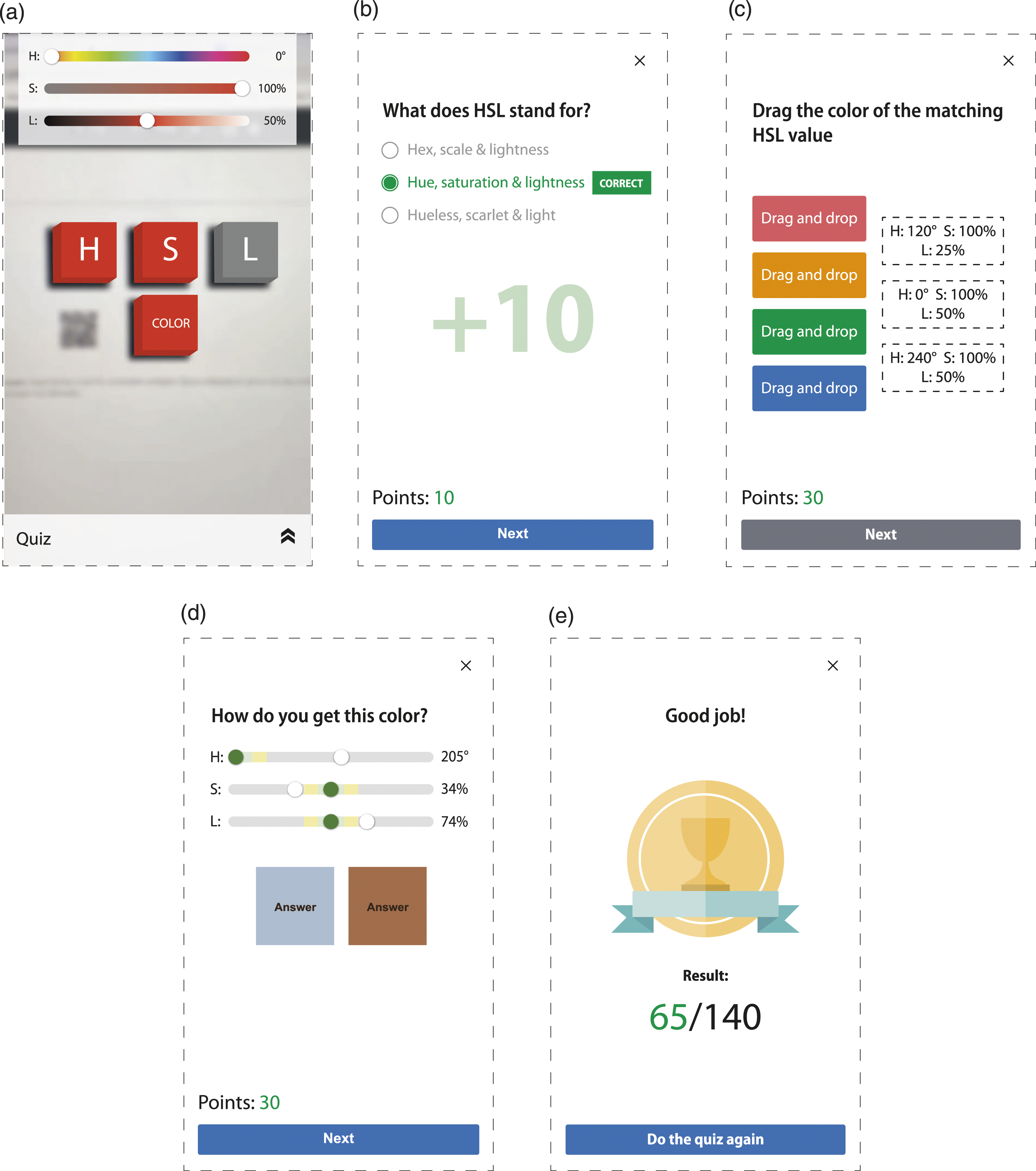
Depending on the experimental condition, one- or two-page pdf covering the HSL color system was used as lecture notes. The first page consisted of an introductory text of HSL and a figure illustrating the three parts of HSL. The second page included four markers used with the AR prototype and the gamification component. Three markers were dedicated to the three parts of HSL and the remaining marker was used to present the resulting color. A link to the AR prototype was embedded using a QR code; see Appendix A.
Depending on the experimental condition, the AR prototype either excluded or included a gamification component. The prototype was developed as a mobile web application based on the A-Frame framework (aframe.io). While other frameworks were available, for example, TensorFlow (tensorflow.org/js), A-Frame was chosen due to its support in showing 3D models over markers. Markers can be described as rectangles with thick borders and a pattern on the inside. The pattern consisted of the letters “HSL” and the word “Color,” see Appendix A. Markers were generated using the AR Marker Training tool, which produced the image files used in the lecture notes. The pattern ratio in the AR Marker Training tool was set to 50% to stabilize the potential shaking of the 3D models in the AR prototype when viewed on a smartphone. The gamification component in the AR prototype consisted of 11 self-generated questions divided into three categories: multiple choice (5), matching HSL values with colors (3), and estimating HSL values based on given colors (3), see Figure 3. The answers to all the questions were randomized, and the participants’ responses were saved in a database without any identifying data. The AR prototype with the gamified quiz included multiple choice, matching, and estimation questions. The first screen (a) displays information text as a pop-up that informs a student to pay attention to the value of each color control. The second (b) presents a new design for 3D models, whereby the terminology of the HSL color system is expanded to its full descriptive terms, replacing previously abbreviated single-letter identifiers. This update features relocated color controls and a percentage icon. The third (c), fourth (d), and fifth (e) display the questions, where the fifth (e) is improved, along with new minimize and close icons. The sixth (f) represents the final step of the quiz, which includes a badge and total points.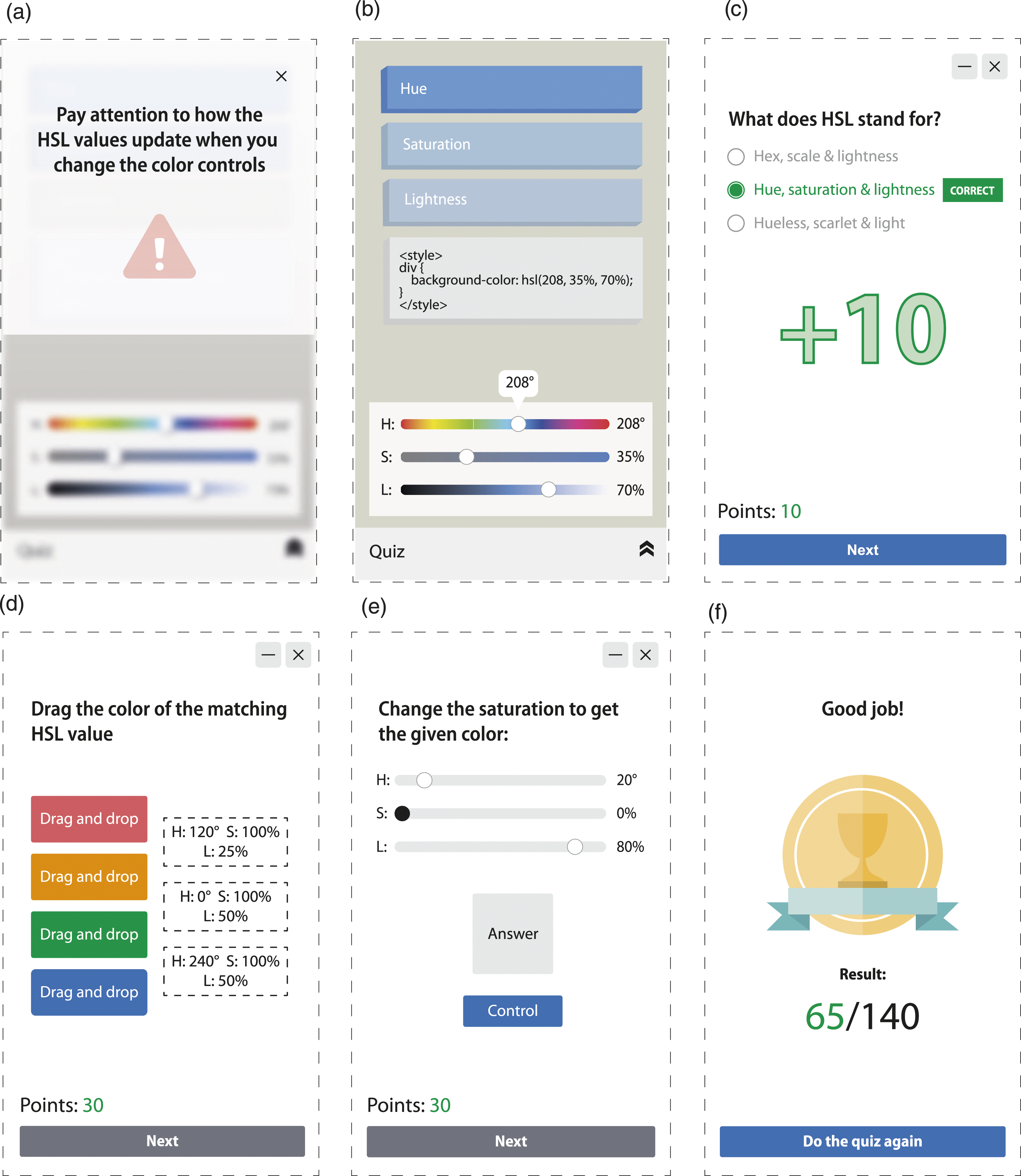
The measures used to assess participants’ motivation and learning were an online survey and learning analytics of gamification. The online survey consisted of two demographic items (age and gender) and three modified versions of the 36-item Instructional Materials Motivation Survey (IMMS) that were adapted from Khan et al. (2019).
The IMMS was developed to measure students’ learning motivation based on the attention, relevance, confidence, and satisfaction (ARCS) model (Keller, 1987). It consists of 36 items divided into four subscales: attention (12 items), relevance (9 items), confidence (9 items), and satisfaction (6 items); see Appendix B for the IMMS and its scoring guide. The IMMS has been validated in previous research when assessing the impact of a particular technology on students’ learning motivation (Di Serio et al., 2013), including the use of AR technology in educational contexts (Chiang et al., 2014; Di Serio et al., 2013; Gopalan et al., 2016; Solak and Cakir, 2015). The IMMS has a documented reliability coefficient of 0.96 (Di Serio et al., 2013: p. 589).
The three modified versions of the IMMS were rated on a Likert scale ranging from 1 (completely disagree) to 5 (completely agree). The first version was adapted to assess participants’ motivation for the lecture notes (Cronbach’s alpha = .87), the second version for the AR prototype (Cronbach’s alpha = .95), and the third version for the AR prototype in combination with the gamification component (Cronbach’s alpha = .93), see Appendix C-E. Cronbach’s alpha showed a value of 0.85 or higher for all three measures, indicating satisfactory internal consistency reliability (Cronbach, 1951).
Finally, to measure the influence of gamification, the web-based experiment implemented learning analytics in the third group to provide insights into participants’ comprehension of the lecture notes when using augmented reality with gamification. Learning analytics refers to the “measurement, collection, analysis, and reporting of data about learners and their contexts, for purposes of understanding and optimizing learning and the environments in which it occurs” (Siemens, 2013). Another simple yet comprehensive definition of learning analytics is “about collecting traces that learners leave behind and using those traces to improve learning” (Baker et al., 2012). In this study, learning analytics was implemented by collecting participants’ answers to questions in the gamified quiz to study their comprehension and use this data to improve the design of future gamification. The collected quantitative data was anonymized and included non-identifiable data such as question responses, accuracy, and the total score of the gamification quiz.
Procedure
Participants were invited to participate in the study through the learning management system Canvas and Facebook. Participants who met the inclusion criteria, see section Participants, were sent a welcome letter depending on the group they were randomized into. Each group received a customized welcome letter that included information about the purpose of the study, access information to the different types of educational materials (lecture notes, an AR prototype, or an AR prototype with a gamification quiz; see Appendix A), estimated length to complete the survey, and contact information to the authors. The three modified versions of the IMMS, one for each group, were created using Qualtrics XM and included in a welcome letter. Upon opening the survey, participants were informed about the purpose of the study, instructions on what they would evaluate, and that it would take approximately 45-60 min to complete it. Once the experiment was completed, the data was exported from Qualtrics Research Core and imported into the statistical package for the social sciences (SPSS) for further data processing.
Ethical considerations
This study adhered to the four ethical research requirements recommended by the Swedish Research Council (2017). The four requirements are information, consent, confidentiality, and usage. The participants were informed about the purpose of the study, the content of the experiment, and that participation was voluntary. The participants were further informed that they could withdraw from the experiment at any time. Consent from participants was obtained by asking whether they agreed to participate in the experiment. The confidentiality requirement was achieved by collecting demographic data about the participants, such as age and gender. Participants who chose to be compensated with a gift card worth $10, redeemable from a large chain of supermarkets, were asked to provide their email. The distribution of gift cards necessitated the partial waiver of anonymity. Finally, the usage requirement meant that the study used the gathered data only for scientific research. All data collected from the participants were used in this study and was not shared with any third party.
Results and analysis
Three modified versions of IMMS were used to examine the differences between the three types of educational materials in this study: (1) lecture notes, (2) AR prototype, and (3) AR prototype with a gamification quiz. In the following section, the results from the data analyses are presented. In addition, as recommended by Greenland et al. (2016) and Wasserstein et al. (2019), a surprisal value (s) will be provided where applicable. The dependent variable was motivation score, and the independent variable was educational material.
A one-way analysis of variance (ANOVA) indicated differences in motivation between the first, on the one hand, and second and third groups, on the other. There was homogeneity of variances, as assessed by Levene’s test for equality of variances (p = .06). Specifically, participants who used AR (M = 3.69; SD = 0.56) or AR with gamification (M = 3.67; SD = 0.51) reported higher motivation than those who only read lecture notes (M = 3.31; SD = 0.37), F (2, 92) = 6.721, p < .005, s = 8.97, ηp2 = 0.13. The value of 0.13 for partial eta squared is considered a small size effect (Cohen, 1988).
Tukey's post-hoc analysis revealed that the difference in motivation between the first and second groups (0.38, 95% CI [0.10, 0.67]) was statistically significant (p = .005, s = 7.64). The difference in motivation between the first and third groups (0.37, 95% CI [0.08, 0.65]) was also statistically significant (p = .008, s = 6.97), but no other group differences were statistically significant. Additional analyses of motivation scores showed no differences according to age or gender. The results suggest that using AR in higher education increases motivation compared to learning materials such as lecture notes but does not seem to be enhanced by the adoption of gamification.
Furthermore, the learning analytics provided insights into participants’ comprehension of the lecture notes when using augmented reality with gamification. The following data were saved in a database: participants’ responses to the different questions, accuracy, and the total score of the gamification quiz. The gamification quiz consisted of 11 self-generated questions divided into three categories: (1) five multiple choice questions, (2) three questions matching HSL values with colors, and (3) three questions estimating HSL values based on the given colors. The accuracy for the first category was 80%, 44.5% for the second, and 30% for the third. The gamification quiz had a maximum score of 140 points because specific questions generated more points than the others. An analysis of the total score showed that the overall accuracy of the gamification quiz was 58% (M = 81.15; SD = 35.61). These results suggest that questions designed to require further cognitive resources may affect the accuracy of the gamification quiz. Another potential explanation could be that the participants did not spend sufficient time on the AR prototype to comprehend the theoretical content. They could also not return to the AR prototype for rehearsal purposes once the quiz started, which may have led to answers based on educated guesses rather than comprehension.
Discussion
This article examined how different educational materials on web development affect students’ motivation and learning in higher education. The educational materials included lecture notes, an AR prototype, and an AR prototype with a gamification quiz. The quiz introduced students to the HSL color system using three types of questions: multiple choice, matching, and estimation of HSL values. It included gamification elements, such as points, badges, a progress bar, and visual and audio feedback.
Previous research on AR has demonstrated the potential to enhance individuals’ engagement, motivation, and learning in educational tasks (Chang et al., 2019b; Reeves et al., 2021). The results of the web-based experiment corroborate those of previous studies and suggest that using AR with or without gamification could increase students’ motivation compared to traditional materials such as reading lecture notes. Students’ motivation may have been enhanced because of the interactions between the instructional content and virtual objects in the AR learning environment. Creating virtual spaces that enable intuitive interactions, feelings of immersion, and a sense of physical presence are essential factors that facilitate learning (Hsiao and Rashvand, 2011). Another explanation is that incorporating AR into learning environments could support students in developing practical and creative thinking. By contributing with interactive technology, AR can increase students’ curiosity and willingness to explore various learning paths (Elfeky & Elbyaly, 2021; 2018).
Research on gamification has revealed mixed effects on motivation. While it has been demonstrated that gamified quizzes could positively affect motivation in learning contexts (Sailer and Sailer, 2021), other studies have found no effect (Mekler et al., 2017; Mitchell et al., 2020). This study corroborates earlier research and shows that the combination of AR and gamification does not affect students’ motivation or learning. The design and types of questions may not have provided optimal challenges and corresponded to students’ prior knowledge and skills (Zainuddin et al., 2020). Another explanation could be a ceiling effect of the IMMS, where a large percentage of participants in the current study reached maximum scores on motivation. It may also be plausible that the AR and gamification quiz was not experienced as seamless and unified by participants, but rather as an add-on, which could also add further explanation to the non-observation of significant improvements in motivation (Pedreira et al., 2015).
Learning analytics, which provided insights into the participants’ comprehension of lecture notes when using AR with gamification, showed that the overall accuracy of the quiz was 58%. A breakdown reveals a notable difference between the first type of questions (multiple choice), on the one hand, and the second and third types (matching and estimating HSL values), on the other hand. For the first category, the accuracy was 80%; for the second category, 44.5%; and for the third category, 30%. The matching and estimation questions seem to have failed to provide optimal challenges and may have affected the students’ motivation and learning.
Regarding methodological considerations and limitations, the current study faced time constraints that led to a relatively short intervention with limited measurement items and game design elements. Furthermore, the experiment was not conducted in a classroom setting or was embedded in a lecture, which could have influenced the results. Novelty effects of gamification cannot be ruled out in the current study, and long-term gamification implementation is needed to examine these potential effects (Bai et al., 2020). The wording of the self-generated questions and answers in the gamification quiz might have influenced the participants’ responses, and future directions may consider adopting standardized questions and answers. In contrast, the major strengths of this study include a pseudo-randomized between-subjects design and the high internal consistency reliability of the measurements. The web-based experiment was adopted to circumvent social desirability bias and to uncover possible causal effects of using AR and gamification in higher education.
AR can contribute with additional context and a deeper understanding of theoretical content, which could make learning easier and more accessible to individual students. Future work should consider exploring different paths when designing gamified quizzes for higher education. Instead of adopting a linear approach, as in the current study, it may be more viable to let students choose, customize, and explore educational content based on their needs and preferences. In addition, there is potential to examine how designerly hands-on exercises in groups may be combined with AR technology and gamification to enhance students’ motivation, strengthen their feelings of being professional practitioners, and support their creativity to craft innovative artifacts.
Conclusions
This article explored how different educational materials on web development affect students’ motivation and learning in higher education. The results showed that AR could enhance motivation, but its combination with gamification did not seem to impact motivation or learning and requires further investigation. The AR prototype with gamification represents the potential for implementing digital technology with conventional educational materials to broaden students’ possibilities in their learning processes. From a theoretical perspective, this study provides insights into how AR, with or without gamification, affects motivation and learning using a distinct combination of game design elements (points, badges, progress bar, visual and audio feedback) for a particular part of a subject (the HSL color system in web development) in a specific context (higher education). The results of this research could serve as a basis to further AR in higher education and support authors in the design of AR in course literature.
Supplemental Material
Supplemental Material - Augmented reality and gamification in higher education: Designing mobile interaction to enhance students’ motivation and learning
Supplemental Material for Augmented reality and gamification in higher education: Designing mobile interaction to enhance students’ motivation and learning by Elsa Ivarson, Vilma Erlandsson, Montathar Faraon and Samy Khatib in E-Learning and Digital Media.
Footnotes
Declaration of conflicting interests
The author(s) declared no potential conflicts of interest with respect to the research, authorship, and/or publication of this article.
Funding
The author(s) received no financial support for the research, authorship, and/or publication of this article.

Supplemental Material
Supplemental material for this article is available online.
Author biographies
References
Supplementary Material
Please find the following supplemental material available below.
For Open Access articles published under a Creative Commons License, all supplemental material carries the same license as the article it is associated with.
For non-Open Access articles published, all supplemental material carries a non-exclusive license, and permission requests for re-use of supplemental material or any part of supplemental material shall be sent directly to the copyright owner as specified in the copyright notice associated with the article.
