




Abstract
Quality course management is integral to establishing a thriving online learning environment. Increasing demand for online learning has resulted in different approaches to online course management. The academic coaching model is an approach that provides instructional support for learners within online courses. This research examines the attributes, behaviors, preferences, and attitudes of online faculty who use academic coaches as members of an instructional support team. The aim was to identify effective strategies or best practices for successfully integrating the academic coach team model within online courses. A sequential exploratory mixed method research design was employed, and seven themes emerged: coach selection process, coach-student ratio, communication between coaches and faculty, responsibilities of coaches, student communication, grading, and benefits and risks of using a coach. Results are presented herein that offer interested faculty guidance about using academic coaches as members of an online instructional support team.
Introduction
Across the United States, overall student enrollment is declining at higher education institutions, but online course enrollment is escalating (Whitford, 2021). Over the last 20 years, the number of online courses has increased gradually, and expanded rapidly during the nearly universal transition to online learning due to the pandemic (Lehan et al., 2018). The quality of online courses is a key concern brought about because of this recent growth. The quick shift to online learning may have resulted in some courses that need improvement to meet quality standards (Bonfield et al., 2020; Kim et al., 2021).
Online courses must meet quality design and delivery standards to ensure student satisfaction and retention. Students enrolled in online courses tend to have a higher dropout rate (Lehan et al., 2018). Shared learning is the cornerstone of quality online course design and delivery. Instructors facilitate collaborative learning by incorporating learner-to-learner and learner-to-instructor interactions resulting in the need for a foundation to develop an online learning community (Palloff & Pratt, 2007). By providing opportunities for online students to feel connected with others, the possibilities for success increase. Impactful, effective delivery of online courses is needed to support the retention of the large, diverse, non-traditional student population enrolled in online classes (Kim et al., 2021).
Quality course design and delivery combine to provide an environment where students can learn to become interdependent and independent online learners (Palloff & Pratt, 2007). An online student who feels welcomed and supported by the instructor is more likely to succeed. With the increase in online courses, instructional support assistance has become more common to enhance effective course delivery. Teaching assistants have been noted to be critical members of the teaching and learning team, regardless of the course delivery modality (Center for Teaching and Learning, n.d.). Academic coaches implemented as teaching assistants for instructional support could play an invaluable role in online student support. However, little is known about implementing an academic coach team approach to instructions support within online courses. There is an overall scarcity of literature related to online instructional support research. Few published studies address how an instructor might incorporate the skills of an academic coach in the online course. More information about how faculty deploy academic coaches as critical instructional support team members within online courses. More scholarly attention to best practices for utilizing the team approach for instructional support within online courses is needed.
Literature review
The Community of Inquiry (CoI) instrument is a valid, reliable measurement tool commonly used in research about online course delivery (Arbaugh et al., 2008; Avery et al., 2020). The CoI instrument measures cognitive, social, and teaching presence as reported by students. Cognitive presence (CP) is the meaning created by reflecting on course content and dialogue with fellow students. Social presence (SP) happens through communication within a protected environment. Teaching presence (TP) facilitates cognitive and social presence (Garrison et al., 2000, 2001). DeNoyelles et al. (2014) explains that CP, SP, and TP must all be present for a positive online course student experience. In a 2-year longitudinal study, students enrolled in courses taught using a co-teaching model with multiple instructors – a form of academic coaching – reported consistently higher ratings of SP, CP, and TP when compared to students enrolled in courses using the traditional one instructor teaching model Abbitt et al. (2018); Caskurlu et al. (2020) published a meta-analysis study that reported a moderately strong correlation between teaching presence and higher student satisfaction with the online course.
Instructional support for students
Besides teaching presence, there are multiple other factors impacting online student satisfaction. Lehan et al. (2018) compared student retention for online students who received academic coaching at an online learning center versus those who did not use a matched sample study (n = 160). Students who attended academic coaching sessions were 2.66 times more likely to remain in the program. Findings suggest that the online learning center offered critical academic assistance that a single online instructor could not provide to every student. Other research supported these results, where student-instructor engagement significantly contributed to student success and retention (Allison & Johnson, 2020; Bigatel & Edel-Malizia, 2018; Cho & Cho, 2014).
Impact of faculty support
Online instructors must deal with multiple demands within the online environment. Formative assessment and a sense of community are significant factors for meaningful student engagement in online courses Palloff & Pratt (2007); Kim et al. (2021) described how creating online instructional teams with specialized learning assistant roles supported online instructors with formative assessment and community building. In this study, online learning researchers (OLRs) and online instructional managers (OLMs) support the solo online instructor to meet the needs of a large and diverse student population. This research was based on the reality that online instructors do not often have undergraduate or graduate teaching assistants or effective models for deploying those resources. They assumed that using an instructional support team approach would increase the chance for students to receive prompt feedback, individualized attention, and guidance on their progress (Kim et al., 2021).
Foroughi et al. (2018) described the challenges of launching an accelerated MBA program. The transition to the accelerated format was due to increased student enrollment and an institutional shift to educational programs of shorter duration. The institution required accelerated courses to be developed based on Merrill’s Framework for effective course development. One of the framework’s ten principles speaks to the importance of feedback provided to the students. It was understood that learning is promoted when students are offered timely, clearly communicated, and consistent quality feedback (Foroughi et al., 2018). The MBA program incorporated academic coaches within their online courses for instructional support to provide prompt, valuable feedback. However, no model discussed the implementation of academic coaches. Each faculty member determined how many coaches to use, which coaches’ background was most appropriate for the course, and the coaches' responsibilities. The authors stated that the benefit of adding an academic coach to a course had to outweigh the risk, particularly if the coach was being used for the first time (Foroughi et al., 2018).
Instructional support also impacts online teaching satisfaction. Hampton et al. (2020) stated that instructor self-efficacy (SE) was the belief that the online instructor can “manage personal behaviors and cognitive processes for instructional effectiveness” (p. 302). This feeling of SE is considered necessary for success as an online instructor. The study findings suggested that instructional support is one extrinsic factor leading to increased SE in online teaching ability. The continued growth of online courses means more instructors with perceived online teaching SE are needed (Hampton et al., 2020).
Martin et al. (2019) completed eight interviews with award-winning online faculty to identify their perspectives on course design, assessment, evaluation, and facilitation practices. These faculty had received recent awards from the Online Learning Consortium (OLC), the Association for Educational Communications and Technology (AECT), and the United States Distance Learning Association (USDLA). The interviews addressed how these award-winning faculty designed courses, assessed student outcomes, completed evaluations, and facilitated their online courses. The interviewees agreed that adopting best practices and standards for online courses helped create a quality course with engaging content (Martin et al., 2019). Also agreed upon was the need for timely feedback and instructor availability and presence. Yet, there was no mention of how an instructional support team might help online instructors to achieve these quality benchmarks.
Herodotu et al. (2019) studied the use of online course predictive analytics to alert instructors about students who may not persist. The researchers concluded that predictive analytics could guide faculty to both an appropriate and timely intervention when a student is in danger of failing. However, using this data is challenging and time-consuming for the online instructor (Herodotu et al., 2019). Academic coaches could provide the support needed to free up time for instructor engagement with real-time predictive analytics.
The multiple demands of online teaching make it difficult for instructors to create and manage a highly interactive learning environment (Palloff & Pratt, 2007). Nevertheless, student achievement is known to improve with active engagement within a well-managed community of learners (Garrison, 2009). Employing an instructional support team approach should provide the assistance needed for better instructor engagement and management. This literature review reveals a gap in the research about the known best practices for using academic coaches, as members of the instructional support team, within the online course environment.
Research purpose
This research examined the attributes, behaviors, preferences, feelings, attitudes, opinions, and knowledge of faculty who use academic coaches for instructional support within the online course. The significance of this research is that the knowledge gained should provide needed guidance about best practices for using academic coaches as instructional support team members within the online course. Identifying best practices and quality standards exhibited by online faculty regarding utilizing academic coaches for instructional support in the online course should lead to valid benchmark information that can be used to guide faculty new to the team approach. Critical evidence can be disseminated regarding how an instructional team, including an academic coach, might work together most effectively.
Methodology
Research design
A sequential exploratory mixed methods research design was employed to address the research questions. This type of design aims to develop and apply a quantitative survey measure grounded in qualitative data; thus, two phases were completed (Creswell & Clark, 2018). During the first phase, qualitative semi-structured interviews of experienced online faculty were conducted and analyzed, and the second phase involved the distribution of a qualitative survey to a broader set of faculty members.
Participants
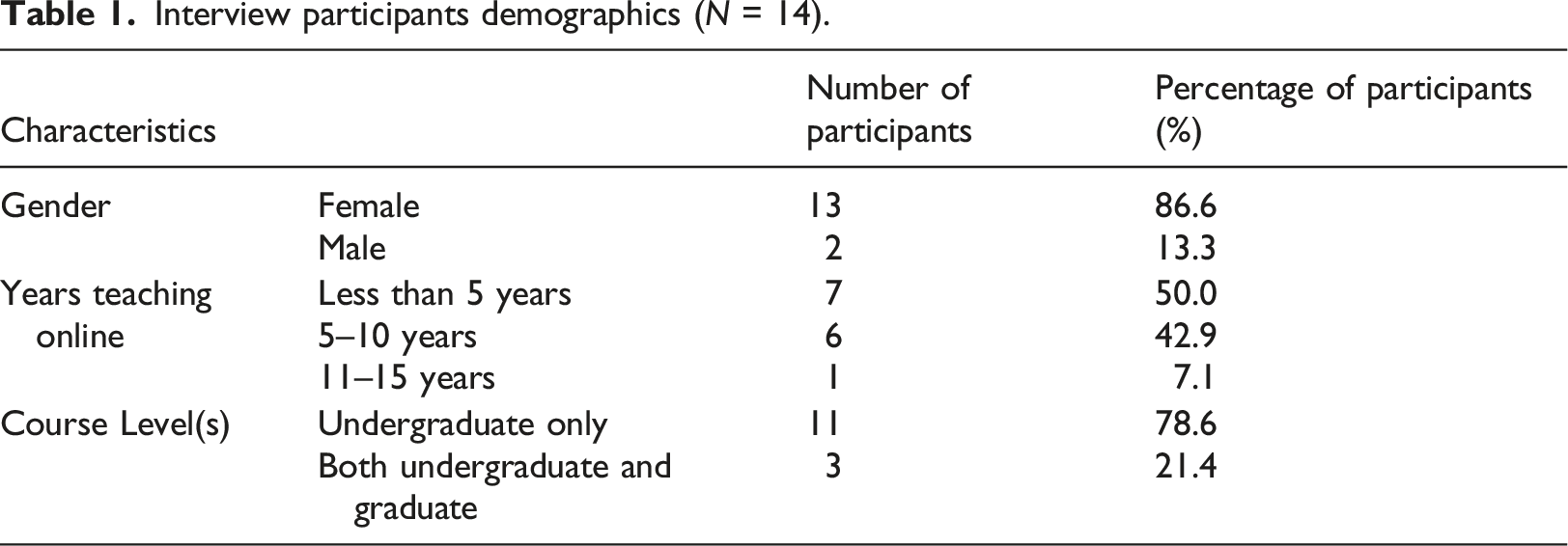
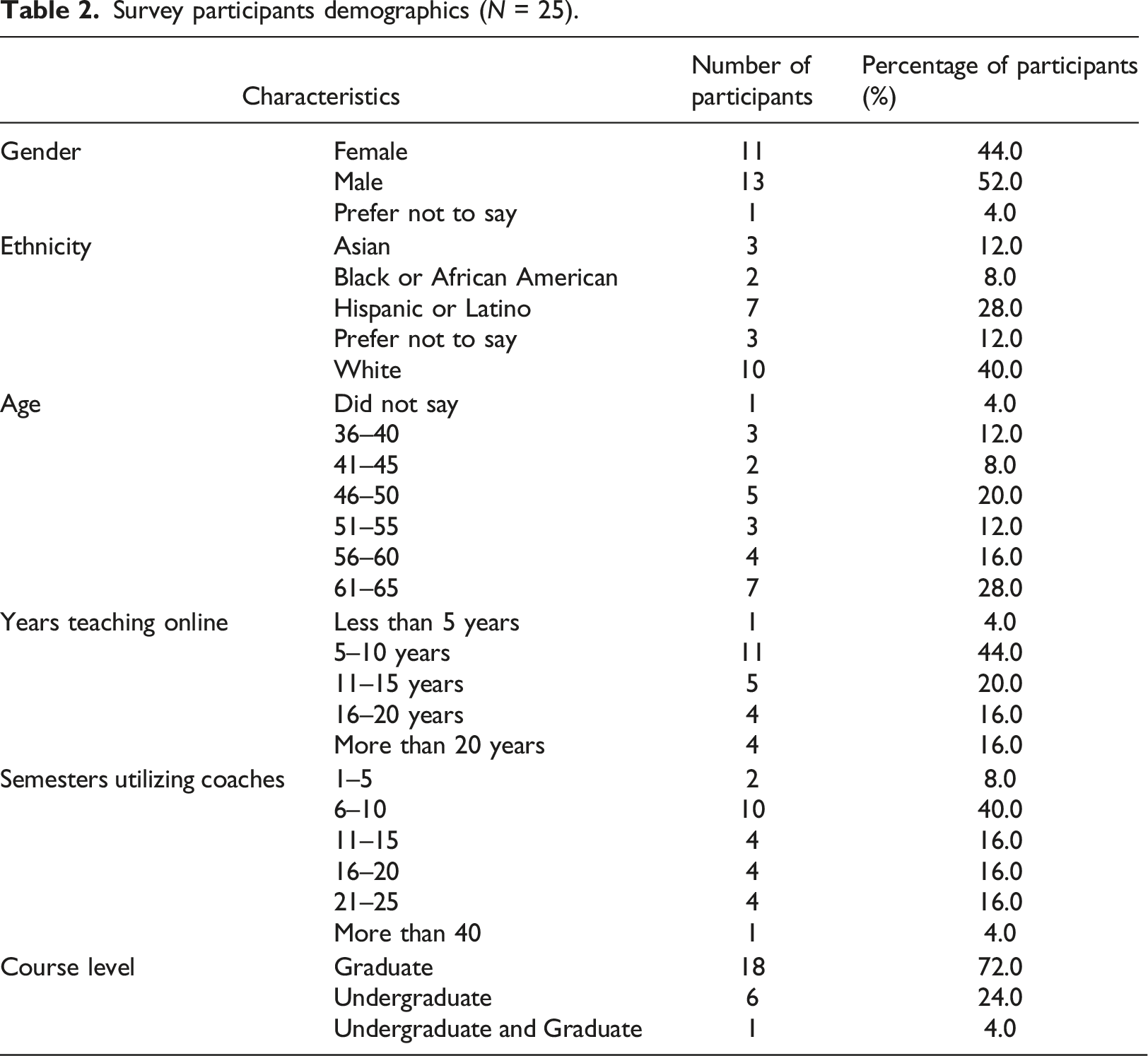
Participants for this research were faculty teaching online and using academic coaches for instructional support at a public Hispanic-Serving Institution in the southern United States. Eligible participants were solicited via convenience sampling methodology for both phases of this research.
Phase 1 qualitative participants
Interview participants demographics (N = 14).
Phase 2 quantitative participants
Survey participants demographics (N = 25).
Data collection and instruments
Phase 1 qualitative interview
Qualitative data were collected through 15 semi-structured interviews. The IRB approved interview guide was used for guidance. All interviews were conducted via secure Zoom links, with cameras off to protect participant identity. Each interview was recorded and transcribed verbatim for analysis, as described in Brinkman and Kvale (2014), with the assistance of a graduate research assistant. After transcription verification, the qualitative data were analyzed using ATLAS.ti software (ATLAS.ti.com, 2021).
Phase 2 quantitative survey
The instrument was designed using themes and categories identified in the qualitative data and gaps identified during phase 1. The researcher-created survey contained 30 questions; which included instructor background data, demographic information, and questions related to themes identified in phase 1. The survey was deployed using the Qualtrics platform (Qualtrics, 2020), and data were gathered anonymously.
Data analysis and results
Phase 1 qualitative results
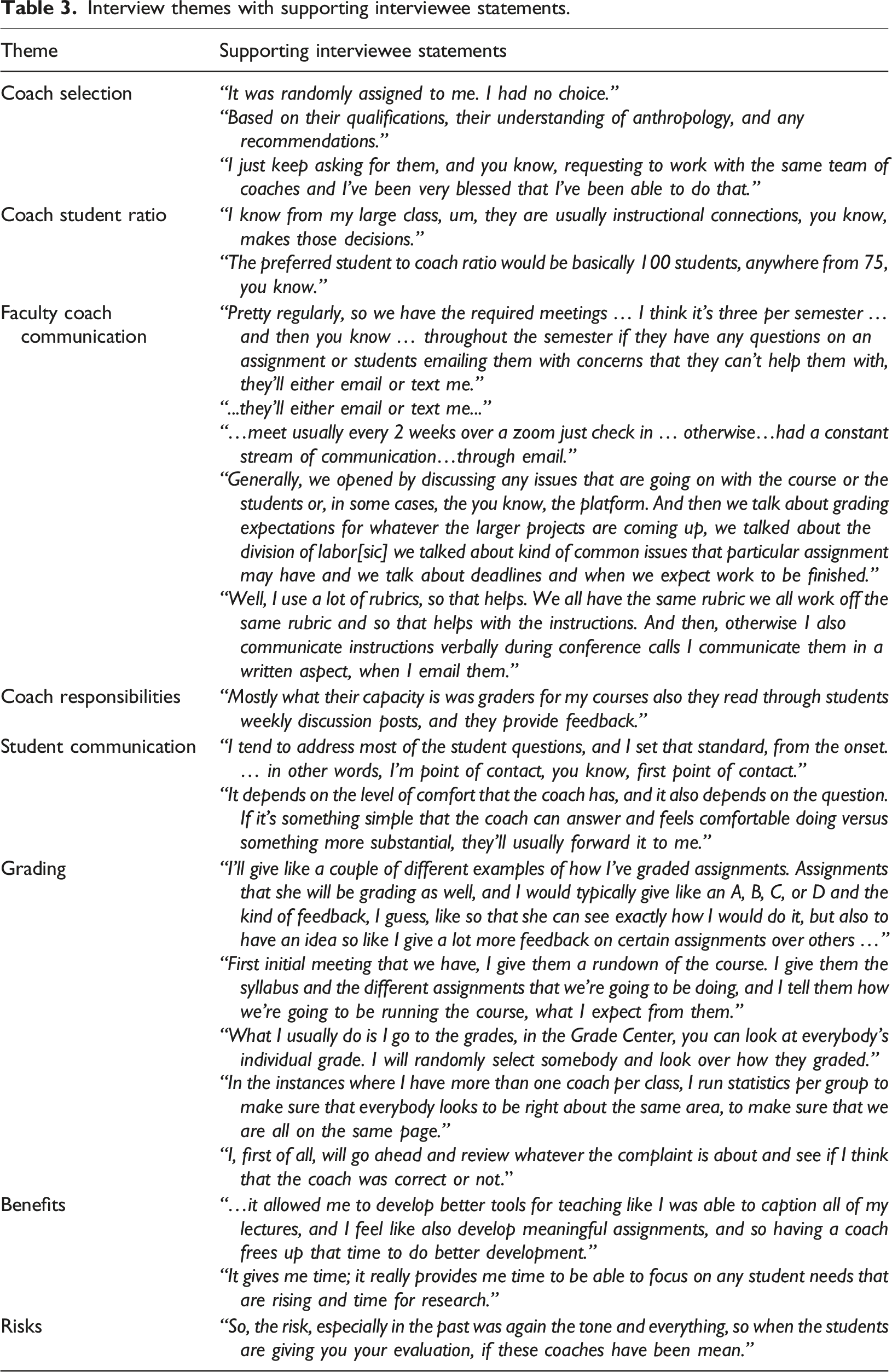
Interview themes with supporting interviewee statements.
Theme 1: Coach selection
The first theme was how faculty selected coaches. The interviewees reported various ways in which they selected coaches to provide support in their online courses. The faculty reported that using coaches with subject matter expertise relevant to the course was very important. Faculty also stated that having a previous working relationship with the coach is helpful when selecting an academic coach. Lack of participation in the selection process was considered unhelpful.
Theme 2: Coach-student ratio
All the interviewed faculty reported that course enrollment directly impacted the amount of instructional support needed; however, there was no consensus about a specific coach-to-student ratio. Participants said the number of coaches required depended on enrollment and the type and level of course. The experience level of the academic coach was another consideration for faculty when determining a specific coach-to-student ratio.
Theme 3: Communication between coaches and faculty
The interviewees discussed how the frequency and type of communication with academic coaches were crucial for successful teamwork. These faculty members reported meetings with academic coaches before the course, sometimes weekly, sometimes monthly, and sometimes more. All faculty felt that, at minimum, faculty should meet with academic coaches before the course begins and again at the mid-point of the course. The pre-course meeting was vital for relaying important information about the course flow and academic coach responsibilities. Additionally, these faculty stressed the importance of faculty and academic coaches working out a means of communication that is amenable and convenient for all involved. Various communication platforms were used, including phone, Zoom, and email with frequent check-ins recommended.
Theme 4: Responsibilities of coaches
Theme four is related to the responsibilities assigned to coaches by the course faculty. The primary responsibility reported was grading and providing feedback. Instructors must clearly communicate the which assessments academic coaches will grade and how they will be graded. Additional considerations were instructions regarding grading turnaround time.
Theme 5: Student communication
The fifth theme that emerged from the analysis involved student communication. Comments indicated that faculty using academic coaches must be clear about the approach and expectations regarding how and who would address student communication. Some faculty felt they needed to handle all student queries, while others felt student communication could be vetted by academic coaches and forwarded to faculty as necessary. Others reported a need for transparent communication and requested that students copy the academic coach and the faculty on all communication.
Theme 6: Grading
The sixth theme was related to grading. Related comments surrounded effective strategies to provide clear instructions to the academic coaches about how the instructor wanted them to grade. Giving the academic coaches detailed instructions and grading rubrics was essential for transparent grading. Faculty participants also spoke of how they ensured the reliability of grading done by coaches and how they handled student complaints about grading completed by coaches. Some participants said they completed random spot checks of grading done by coaches; others conducted statistical comparisons to ensure accuracy. Complaints about grading completed by coaches were typically handled by the course instructor, involving the academic coach when necessary.
Theme 7: Benefits of using a coach
The overwhelming majority of the faculty interviewed reported that more free time was the most significant benefit of using an academic coach for instructional support. More time to spend helping individuals or groups of students, improving the course through adding or updating content, and conducting research activities were beneficial to faculty.
Theme 8: Risks of using a coach
The last theme from the qualitative data analysis was the risks of using an academic coach. The faculty interviewed noted two risks to using an academic coach for instructional support: the potential impact on faculty evaluation scores and increased responsibility. The faculty reported how end-of-course student evaluations did not allow for differentiation between instructors and coaches. Therefore, a student who had an issue with an academic coach might use the faculty evaluation to report dissatisfaction with the result of the instructor of record being potentially negatively impacted. Other comments on risk discussed increased faculty responsibility when an academic coach is part of the instructional support team. A faculty member often agrees to a larger course enrollment when an academic coach is provided to help. This additional number of students increases the number of overall faculty responsibilities including academic coach guidance.
Phase 2 quantitative results
Survey data.

Perceived Benefits and Risks of Utilizing Coaches based upon a 5-point Likert Scale (5 = Definitely yes; 1 = Definitely not).

Discussion
The data analysis suggests defined themes and practices related to faculty best practices for using an academic coach as a member of the instructional support team.
Coach selection and ratio
Choosing an academic coach and determining the coach-to-student ratio were identified as essential faculty considerations. Study participants selected instructional coaches based on their prior interactions or by examining resumes and selecting those with subject matter or related professional experience. Surprisingly, in this study’s qualitative and survey phases, some instructors reported that academic coaches were assigned without their input. In a few cases, faculty were assigned the course late, and department personnel had already requested academic coaches to meet deadlines. It was important for faculty to have input into choosing academic coaches that had subject matter expertise or with whom they had previously worked. Past research has shown that online teaching takes more time than is often acknowledged in teaching workloads, and appropriate instructional support measures should be in place (Gulinna et al., 2022; Puksa & Janzen, 2020).
Faculty-coach-student communication
Communication was an identified trend significant throughout the instructional support team deployment steps. Participants reported that clear and consistent communication between faculty and academic coaches was also essential. Faculty should provide academic coaches with stated expectations before a course begins and establish a regular communication pattern and method. At a minimum, instructors should schedule a pre-course, a mid-course, and an end-of-course meeting, along with making themselves available when needed to address questions. Many participants in this study reported meeting with academic coaches much more frequently – sometimes weekly. These meetings took place in various formats including email, webinars, or phone/text messages. Building the mentor-mentee relationship, even virtually, is essential to relay course objectives, content, associated tasks, and grading responsibilities (Hendon and Bledsoe, 2022). An open line of communication should create an environment where academic coaches feel supported and comfortable sharing ideas and feedback. A strong instructor-teaching assistant relationship is thought to provide a solid foundation for an online course (Harrington et al., 2022).
Established clear communication is also vital between the instructional team and students. In an online course, where a team approach to instruction is being used, students need to understand with whom they should communicate when a problem or concern arises. Participants in this study sometimes asked students to contact the course faculty for help, while others asked students to contact coaches. Others used a hybrid approach and asked students to include the course faculty and the academic coach in any communication for complete transparency. Whether the instructor or the acaademic coach was the main point of contact was up to the instructor’s discretion. Overall, active communication was key in faculty-coach-student relationships. Faculty-coach-student relationships connect students, improve engagement, and increase course rigor, creating a caring culture in the online environment (Pacansky-Brock et al., 2020). Active contact with students is a key element of embracing kindness in teaching (Lesoki, 2022). Regardless of the student communication approach, laying the groundwork for an environment where students feel enhanced teacher presence has been found to improve student engagement and satisfaction in the online course (Ng, 2019).
Grading responsibilities and accuracy
Grading responsibilities and how to oversee accuracy were essential themes identified by both the interviewees and survey respondents. Faculty must clarify the academic coaches’ expectations on grading assessments and the appropriate evaluation measures. The need for clear grading rubrics for every assessment was identified as a necessary best practice. Academic coaches should also be informed about the assessments they will be grading and how they fit into the course. In both phases of this study, most respondents utilized academic coaches to participate in and grade discussion board assignments. Formal papers, group projects, and examinations were other assessments academic coaches were tasked to provide grading support. Much literature has been published about the use of teaching assistants in undergraduate face-to-face courses; however, similar instructional support within the online course has been minimally described (Parker et al., 2015). The role of the academic coach in the online course has yet to be clearly defined.
The results for both research phases indicated faculty asked academic coaches to grade all types of assessments, including those considered high stake assignments. In the survey phase, 36% of the respondents reported that academic coaches graded all types of assignments, while 32% responded that academic coaches only graded low-stakes assignments. High-stakes assignments require more student time and effort, thus typically carrying more weight toward the final grade. Low-stakes assignments require less student time and effort and do not heavily impact a student’s final grade (Bain, 2004).
In addition to the types of assessments academic coaches are asked to grade, the online faculty member must carefully contemplate the amount of grading requested of academic coaches. The faculty participants in this study graded along with their academic coaches and reported they graded between 50–74% of the total number of assessments. Conversely, 26% of our respondents stated that the academic coaches graded between 90-99% of the assessments. Online course faculty should also consider how many hours an academic coach spends grading per week. In other words, realistic expectations of the academic coach must be established in terms of the amount of grading to be completed by academic coaches and the required turnaround time for posting grades. As one interviewee stated, “Don’t ask a coach to do anything you wouldn’t do.” Grading responsibilities – like other obligations such as fielding emails or supporting discussions – have been determined to be a best practice when an online instructor seeks to define a teaching assistant’s role (Harrington et al., 2022).
A determination of the grading accuracy completed by academic coaches was identified as a necessity by the participants in this study. Survey questions were specifically designed to explore how faculty determined academic coach grading accuracy based on the information learned from the qualitative semi-structured interviews. Survey participants were asked how they verified accuracy if more than one academic coach worked within a course and how they ensured grading consistency among coaches. Over half of the survey participants reported they completed routine spot checks of work graded by coaches to verify accuracy. Some of the survey participants (n = 4) indicated they graded a specific number or a percentage of the assignments to verify grading accuracy. In online courses where teaching assistants have grading responsibilities, the course instructor needs to provide targeted coaching and feedback specifically for the grading process (Harrington et al., 2022).
Lastly, faculty must consider how to manage any possible grading issues. For example, if a student complains about a grade issued by an academic coach, the online faculty member must have a process to handle the complaints. Of the survey participants, 44% stated that if a student complained about a grade, the faculty reviewed the work, updated the grade as necessary, and notified the coach and student. However, 36% of the survey respondents requested that the coach review and update the grade and then inform the student. Schacter (2021) pointed out that student frustration about grading often stems from a misunderstanding. Approaching students with empathy can build trust and the opportunity to come to a mutually agreeable conclusion regarding grading that still prioritizes student learning.
Benefits
In the qualitative phase of this study, interviewees reported the primary benefit of using an academic coach was increased free time. Faculty reported utilizing this extra time to interact with students, improve course design, and conducting research. Survey results supported the qualitative findings in that 80% of the participants reported that “definitely yes” there was a benefit to faculty when they used academic coaches for instructional support within their online courses. Historically, online instructional design theory has promoted the need for an interactive and collaborative online adult learning community framework (Snyder, 2009). Faculty satisfaction with teaching online has been related to support and collaboration with other faculty (Badia et al., 2019; Brown & Thomas, 2020). The assistance provided by academic coaches should result in increased faculty satisfaction, improved course design and rigor, and overall productivity.
Risks
The interviewees within the qualitative phase of this study felt the primary risk for the faculty who used academic coaches for instructional support in the online course was twofold. First was the potential impact on faculty evaluation scores, which could impact the annual institutional process of teaching evaluation. Secondly, interviewees felt that deploying an instructional team approach using an academic coach increased faculty responsibility in terms of oversight. It is important to note that during this question, interviewees spoke in hypotheticals. Example quotes include “the only problems would be if they...” and “The risks, I would say would be that you might have a coach that maybe kind of doesn’t see eye to eye.” In the survey results, 54% of respondents felt there was no risk in using an academic coach for instructional support, and 26% felt there were potential risks. No data were collected from participants about the amount or nature of professional development in online teaching strategies in this study. It is unknown if the less experienced online faculty perceived a higher level of risk to the use of academic coaches when compared to experienced online faculty. The collection of additional data for further investigation of the relationship between perceived risk to using instructional support is warranted.
Limitations and ethical considerations
This study about how academic coaches can be effectively utilized for instructional support within online courses involved many variables, some of which were difficult to measure. Additionally, the generalizability of this research is limited due to the data being gathered at one institution. However, to improve generalizability, the trustworthiness of the qualitative data was promoted through independent and collective coding of the data. With respect to the quantitative data analysis process, the number of respondents for the survey was limited and found to be suitable only for descriptive analysis. Institutional Review Board approval was obtained for all research processes.
Implications for practice and future research
The results of this mixed methods study have laid the groundwork for a better understanding of the best practices related to the utilization of instructional support services provided by academic coaches within online courses. Information gleaned from these results should provide the foundation for creating a guide that faculty could use to self-evaluate their use of academic coaches for online instructional support. Such self-evaluation would provide a much-needed best-practice resource. In general, faculty members who use academic coaches might need to be made aware of the myriad of ways in which they can be employed. These results also provide a foundation for the future creation of a valid and reliable instrument to evaluate the application and use of academic coaches for online instructional support. Further research is needed to gain academic coaches’ perceptions of effective practices.
Conclusion
This study presented qualitative and quantitative research results seeking to examine the attributes, behaviors, preferences, feelings, attitudes, opinions, and knowledge reported by online faculty who use academic coaches as members of an instructional support team. The research identified effective strategies related to the successful integration of an academic coach within an online course. Findings from this study warrant more rigorous research on the effective implementation and comparisons of various ways to deploy academic coaches within the online course. As online enrollment surges, faculty members face the challenge of balancing student success with the implementation of a rigorous curriculum in an environment that fosters diverse perspectives and the pursuit of higher learning.
Footnotes
Declaration of conflicting interests
The author(s) declared no potential conflicts of interest with respect to the research, authorship, and/or publication of this article.
Funding
The author(s) disclosed receipt of the following financial support for the research, authorship, and/or publication of this article: This study is supported by Instructional Connections Small Research Grant Program IC_IC (IC_Project_34000482).
