



Abstract
This paper shares an account of our wonderings, happenings, and learnings emerging from encounters between children, iPads, digital microscopes and found natural materials (and bugs!) in a series of workshops at a children’s museum. Our intention is to build on and disrupt established theories about children’s museums by thinking differently and creatively about new ways of seeing, knowing, and understanding children’s literate practices in these spaces. We have written before about children’s interactions as social practices where material (human and non-human), discursive, and spatial resources come together through physical and virtual interactions. Building on that work, we consider the complex interplay between the emerging identity of the place, the children’s engagement with the experiences, and the connections the children made through their play. The playgroups at this children’s museum have offered us new perspectives on and learnings about young children’s literate practices through digital experiences and the unique opportunities for playing, learning and connecting with technologies.
Introduction
The places and spaces within which children interact will shape their learning, not only about themselves and others, but also about the ways things are, how they work and how they can engage as active participants. Increasingly, these interactions are shaped by digital technologies characterised by children’s active engagement with digital content. Children are curious about technology. In turn, digital technologies can spark children’s curiosities about, and connection with, aspects of their worlds. Indeed, researchers including Kervin and Verenikina (2017) and Kyrönlampi et al. (2021) note that the ubiquity of technology in home and community settings means children can observe how others value its capacities and roles within their lives, the literacy practices required and potentially perceive their own interests and potential for its use. In this paper, we explore how a digital technology play-space as part of a children’s museum can enable this transformative potential of technology through playing, learning and opportunities for talk.
In our research, digital technologies are not considered “tools” for getting things done. Rather, our views align with Cathy Burnett’s (2011) positioning of digital technologies as a series of social practices situated within rich experiences. It’s through these experiences that Fenwick and Landri (2012) and Kervin et al. (2019) propose that human and non-human materials, and spatial and discursive resources come together through physical and virtual interactions. Opportunities for exploring, taking up and sharing ways of using literacy are embedded within these socially constructed experiences (Bartlett, 2007), developing multimodal literate repertoires (Burnett et al., 2014; Comber, 2015) that support engagement within and beyond immediate settings. The concept of literate practices captures a breadth of ways using words, action, interactions, and texts for successful participation not only in immediate settings, but in their transferability to new ones. And so, this research is also underpinned by concepts of literacy as a social practice developed through active interactions that are not only related to an immediate purpose but also the cultural significance they represent (Bartlett, 2007; Gee, 2007; Street, 1984).
These theoretical perspectives press our research team to ensure uniqueness of each experience, that is, the ways this space at this time and with these resources support play, learning, interactions, literacy practices, and a sense of purpose. With this perspective comes accountability and responsibility for the types and ways digital technologies are incorporated, positioned and offered in the space.
Opened in 2022, the UOW Children’s Technology Play Space (referred to herein as CTPS) is an initiative of the Australian Research Council’s Centre of Excellence for the Digital Child, the world’s first research centre dedicated to creating positive digital childhoods for all Australian children (https://www.digitalchild.org.au/). The Centre for the Digital Child’s research agenda examines the nature of growing up with digital technology and seeks to support the development of healthy, connected, and educated children. As such, it encourages children’s active use of digital technology and uses its technology spaces (of which the CTPS is one) to offer experiences that empower children in their digital childhoods. The CTPS takes up digital technology in ways that can support play as opposed to being the play. Technology is acknowledged as transformative to the experience yet seamless in use and in connection with children’s intentions and decisions and capacities. And so, the child controls the technology and its place in the play.
The CTPS operates as a living lab where children and their families come for play-based experiences supported by digital technologies. In a previous publication, we explored the rationale and process for initial set-up of the CTPS (Kervin et al., 2023). We detailed how participants in the space are aware of and consent to their participation in the research, and there are regular visitors who attend for the opportunity to be part of the evolving research focus on the group. The CTPS engages children in quite particular places and spaces; it is located within a university campus (main campus of UOW) in a building hosting an early childhood focussed research institute (Early Start) and is a research space adjacent a children’s museum (Discovery Space). The CTPS also builds on the UOW Early Start enterprise, including the Discovery Space by considering the role of digital technologies in the lives of children in their first decade of life. Physically, the CTPS sits adjacent to the Discovery Space. Double doors enable internal access from the Discovery Space (making it another experience) and external access through the foyer (enabling targeted recruitment for research). The physicality of the space alongside its intention and purpose enables a certain set of opportunities that prioritise the agency and capacity of children to take control of their lives, their learning, and their capacity to develop deep understandings about the world.
Our intrigue was captured by the opportunities offered by the CTPS to bring together unique assemblages that are dynamic and responsive to the events taking place (Burnett, 2011; Fenwick and Landri, 2012), the types of technologies with which it makes sense for children to engage (Kervin and Verenikina, 2017) and the rich practices that enable meaning making and quality interactions between children, their adults and the digital technologies (Hackett et al., 2020; Kervin et al., 2019; Kumpulainen et al., 2019). And so, in this paper we look to the transformative opportunities that are, and could be, facilitated for using digital technologies in playful ways that support curiosity, encourage exploration, and extend thinking (Kyrönlampi et al., 2021) and promote sharing of understandings.
Before exploring a particular encounter with digital microscopes here, we note that we look to the child as the experiencing body in the CTPS. That is, our examination of the ways children encounter the space (Kumpulainen et al., 2019) and persist with the resources supports us to understand their movements, their learning, and embodied experiences. This focus on embodiment enables us to begin to understand how children understand and take up the facilitated experiences through their movement around the space and their interactions with materials. The CTPS can facilitate children’s learning and so we were driven to consider how to interpret children’s literate practices in the space and how and why the space itself might hold different meaning and significance for different children (Kyrönlampi et al., 2021; MacRae et al., 2017; Pahl and Rowsell, 2010). The ways children’s bodies respond to the actual space and the (im)material aspects of the play through dynamic and ongoing encounters enables us to examine our expectations within the experience and take notice of the different roles children (and their adults) assume in relation to use of digital technology.
In this way, each experience offers multiple tacit and emplaced possibilities for knowing. It is understood that the ways museums feel meaningful for children and the opportunities they offer for tacit and emplaced knowing are important areas for further investigation (Hackett et al., 2020). For us, understanding what matters to children through what they decide to do with other children, adults, and non-/digital things, and the ways they both share and take up new knowledge leads to new ways of thinking about children’s meaning making and embodied pedagogies (Kervin et al., 2019). The consideration of non-human aspects and qualities alongside the entanglements between human bodies and place, matter, and time build practical expertise alongside theoretical knowledge. The interlacing of practice and theory is explored in the subsequent section to provide context for introducing a specific case whereby children, iPads, digital microscopes, leaves, ants, adults and ‘live’ screenings came together to afford looking closely, setting the context for talk. The true affordances of this encounter, however, extend well beyond the time-space of the event itself, offering us as authors and researchers the opportunity to apply an illumination lens that encourages us to take notice of the practices – the happenings and learnings, the wonderings and sharings, we experience with children and their families. It is a lens that provokes us to look more closely and talk about what it is that we see and sense about children’s experiences in the CTPS.
Experiences and research approach
Overview of play experiences at the Children’s Technology Play Space, 2022–2024.
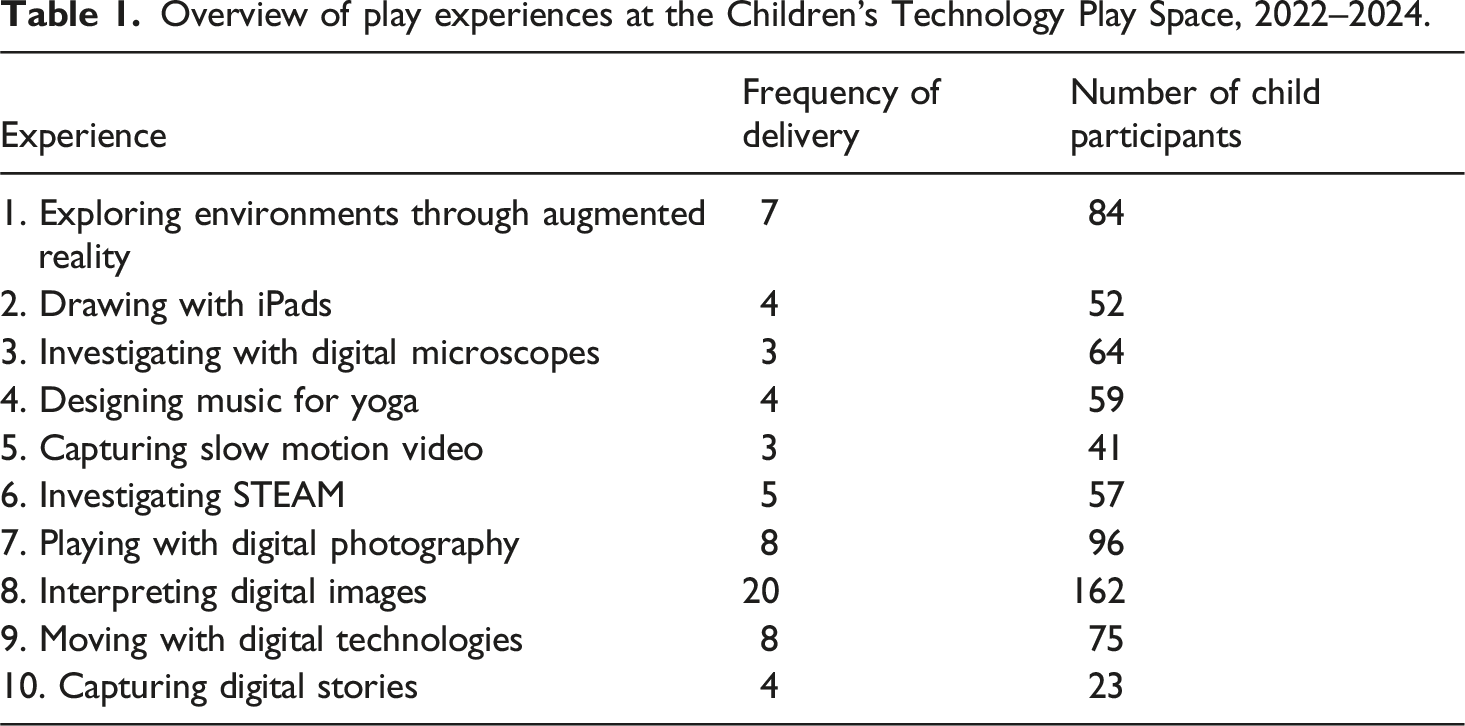
Across these facilitated experiences, we work from a shared definition of digital technology: tools, systems, and devices that can generate, create, store or process data. This definition acknowledges that digital technology usually has some type of processor/microprocessor/microchip and that even the simplest digital technologies store some data. Digital technologies include personal computers and tablets, tools such as cameras and digital toys, systems such as software and apps, and less tangible technological resources such as the internet. The researchers planned, developed and facilitated experiences that included digital technologies while also taking into consideration the social and literate practices on offer: • Processes for engagement - how will the CTPS be organised to enable movement, access to resources, interactions, and choice with response to experiences? • Opportunities for connection - how might we support children and adults to share and build on existing language, field knowledge and digital literacies? • Roles and responsibilities of researchers, children and adults – How can children engage with digital technologies as competent co-creators or investigators? How might adults support child-led digital play experiences?
The researchers implemented procedures for data collection that enabled and complemented interactions with children. Adults – parents and carers - had an opportunity to speak with one of the researchers about the purposes of the play experiences and provide their consent for theirs and their child’s participation in the research. Consent was also sought for video recording the play sessions and for sharing blurred images in research publications. Ethical approval was obtained by the Social Sciences Human Research Ethics Committee, University of Wollongong (2022/107) on 31/05/2022. The research team invited each child and their adult to play and engage with the experience and followed the child’s interest. During these play experiences, the researchers worked as a team to ensure children and adult dyads had a play partner while at the same time enabling data capture (i.e., a researcher used an iPad to capture the evolving play). The role of each researcher was not exclusively set, meaning each could respond as a play partner to any child and their adults at any point. A 360-camera also captured the movement of children and families within the Children’s Technology Play Space during the session. The number of researchers in each experience varied in response to the number of children in the CTPS to ensure children always constituted the higher ratio.
Data from each playgroup were selected as we encountered and responded to experiences that resonated with us. MacRae et al. (2017: 508) describe data as being ‘sticky’ causing us ‘to pause, to scratch our heads’ and as such, we recognised that encounters from the investigations with digital microscopes had stuck with us, having had ‘an effect on us’. And so, we acknowledged the ways this data had generated an affective ‘pull’, inviting us as researchers to take notice (MacRae et al., 2017; MacLure, 2013). In this way, rather than only thinking about what the data generated from these activities might mean in ways that seek reductionist ‘answers’ and explanations, our analysis sought to consider what happened (happenings), what ways of knowing are provoked (learnings), and what questions are raised (wonderings).
Case study: Children’s engagement with an experience – Digital microscopes
Exploring nature using digital technologies – during outdoor or indirect experiences such as museum visits – can support children’s creativity, wellbeing, sense of place, multi-species interactions, and learning about the environment (Bates, 2018; Peach et al., 2025). While we have used digital microscopes in different play sessions in the context of nature investigation and STEAM sessions (Mantei and Kervin, 2025), in this paper we particularly focus on their use for investigation of natural objects to illustrate the entanglements between place, matter, and time. In doing so, we ask the questions: • How do children engage and investigate with digital microscopes within the CTPS? • What opportunities exist for children to connect with the experience itself, with the digital microscopes, with their adults, and with their knowledge? • What can we learn from children’s play, sense-making, literate practices, and navigation of digital technologies from this experience offered within the CTPS?
External to the Children’s Technology Play Space is a natural area with many established trees, a flowing creek, native plants, birdlife, and animals and their tracks. We noticed many children stopped to look at, talk about, and share their wonderings about found objects in these spaces as they entered the building. To connect physical and digital we incorporated found objects from this natural environment into digital investigations. Careful not to disrupt those environments, we collected branches, leaves, flowers, rocks, moss, seed pods and so on that were easy to borrow and return.
The found objects were arranged at a long, low table. Also on the table were five iPads each with a digital microscope clipped over the iPad camera. More iPads and digital microscopes were available, and the bank increased as needed. The length of the table and the spacing of found objects accommodated multiple users. Children made choices about what they wanted to explore and investigate. Sometimes they moved around the table, other times they remained in a single location and drew the materials towards them.
During interactions with the children, the researchers used discipline specific vocabulary (e.g., insect; seed pod; microscope), academic language of investigation (e.g., discover, examine), and in-time support and operational language (e.g., image capture; focus; close-up) for use of the iPad and digital microscope as needed. Children led the experience, and adults were encouraged to follow those leads across the three ninety-minute sessions for 64 children and their adults. Our analysis of the video data collected during this time revealed four patterns of interaction that emerged from the affordances of the technology within the experience: fostering children’s curiosity about the natural environment; time and opportunity to look closely; motivation to investigate more found items; and discovering connections.
Fostering children’s curiosity about natural environment
The children were enticed to enter and then stay in the CTPS upon seeing the array of natural objects. The various textures and materialities of the found items, including spikey seed heads, crisp dried bark, and smooth shiny leaves invited children to touch and pursue their curiosities. The energic movement of bodies reaching across and moving around the table, as well as the rising volume of conversations conveyed the increasing excitement in the space, as the children and their adults selected different materials for microscopic examination. As the digital microscopes and natural materials touched, plants working themselves between the plastic and lens as if growing into the camera (see Figure 1), aspects of the materials became illuminated that otherwise would not be easy - or possible - to observe with human eyes. Using the iPad’s camera function, children and their adults captured still images and video footage of the different items, moving the microscope to view another object, and then another. Through this process they became creators of text. Technology afforded flexible understandings through observation and reflection. Four photos of plant materials taken using the microscope.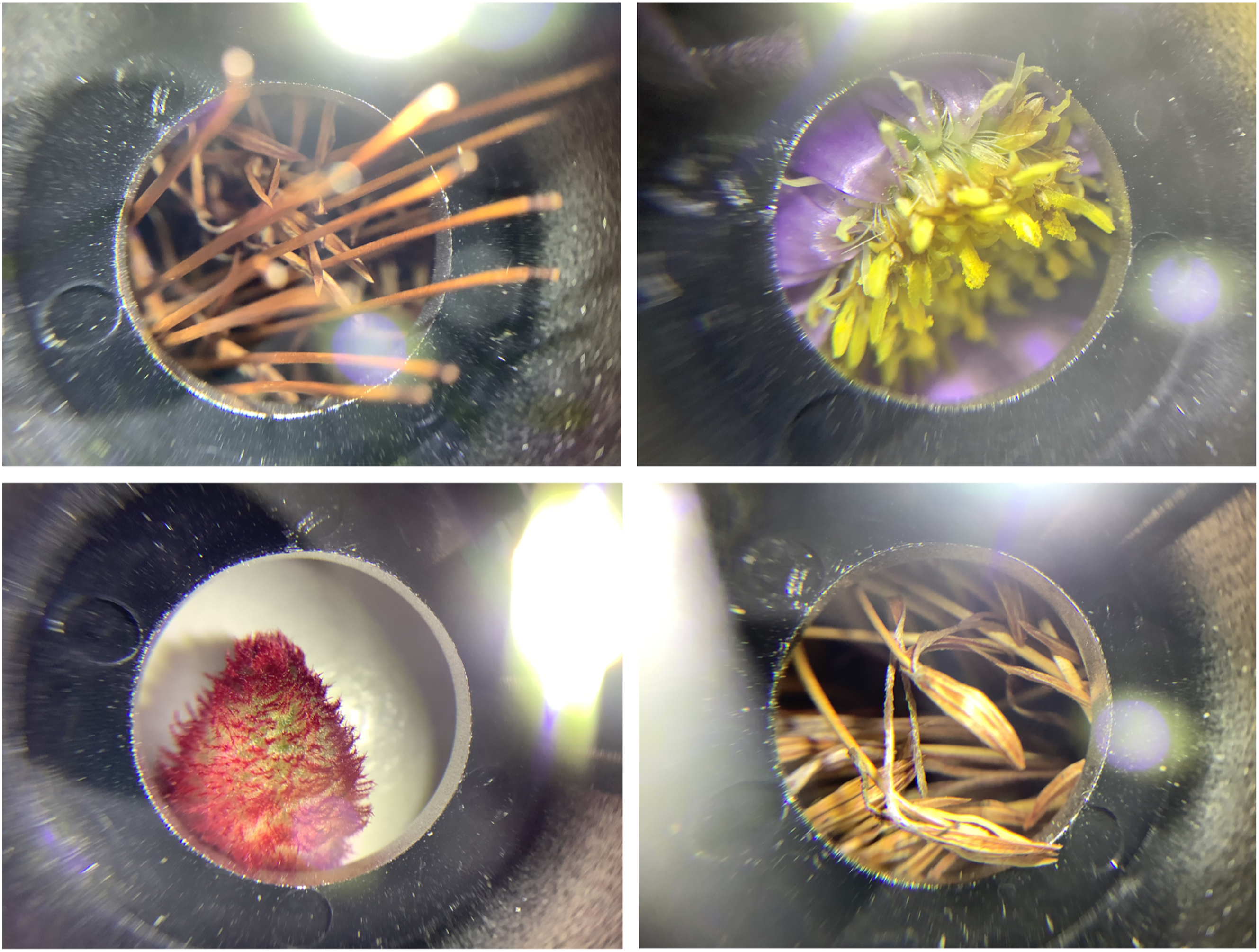
The children and adults, mostly unknown to each other, shared their captured images. ‘Look at this one!’ and ‘I can see the seeds!’ prompted sharing and subsequent explorations among the children and their adults as they took new perspectives on familiar items previously experienced in the outdoor environment. Individual and shared observations prompted language interactions between and among the children, their adults, and the researchers. Figure 1 shows close-up photographs captured by the children of different flowers and blossoms that were used to build knowledge and vocabulary about the sorts of materials naturally occurring in their local spaces. As these pictures were taken, the children and their adults drew upon and developed field vocabulary as they discussed the specimen; they looked carefully at the “petal”, “flower head”, and “stamen” as they talked about broader ideas such as “pollen” and “native plant”. These interactions sparked interest and built field knowledge and discipline specific vocabulary about plants and insects (e.g., petal, stalk/stem, stamen, seed, lichen, antennae/feelers) that afforded more precise observations and deeper understandings.
Time and opportunity to look closely
Digital microscopes clipped to the camera of the iPad afforded opportunities for close examination and analysis of the natural materials on offer. While using the iPad was not uncommon for most children, the microscopes and digital camera together offered the opportunity to examine and capture elements of the natural environment in new ways. The simplicity of the technology empowered children to take control. And it fostered openness and creativity that contrasted common app designs that constrain rather than enable exploration (Kervin and Mantei, 2017). As a new experience, there was some perceptual adjustment required for understanding the ways the digital devices worked. For example, the images from the microscope were visible on the large screen of the iPad but captured from the much smaller lens of the camera in the top left-hand corner, requiring the user to look differently to focus on and then view an item. And further, the functionality of the microscope required its lens to be extremely close and even touching the item of interest to achieve a sharp focus. Once these operational skills were taken up, children and their adults (often equally fascinated about the opportunity to look closely!) were active users of the technology, exploring the features of the found objects and inviting others to spend time examining the evidence captured. Figure 2 shows children exploring the natural materials through the microscopes independently and with support. In these instances, the children were heard discussing the range of natural items available as they sorted through what they wanted to examine more closely. Upon making selections (in both these examples on leaves), the children with the support of their adults examined the shape and colour of the leaves and noticing the pattern of veins on an individual leaf. The perceptual adjustments requiring careful placement of microscope and plant matter, as well as the closer, more detailed imagery afforded by the digital technology, encouraged children to take time, pause, talk, notice, capture, and reflect. Technology afforded a closer look at found materials. Children using the iPad to look closely at leaves.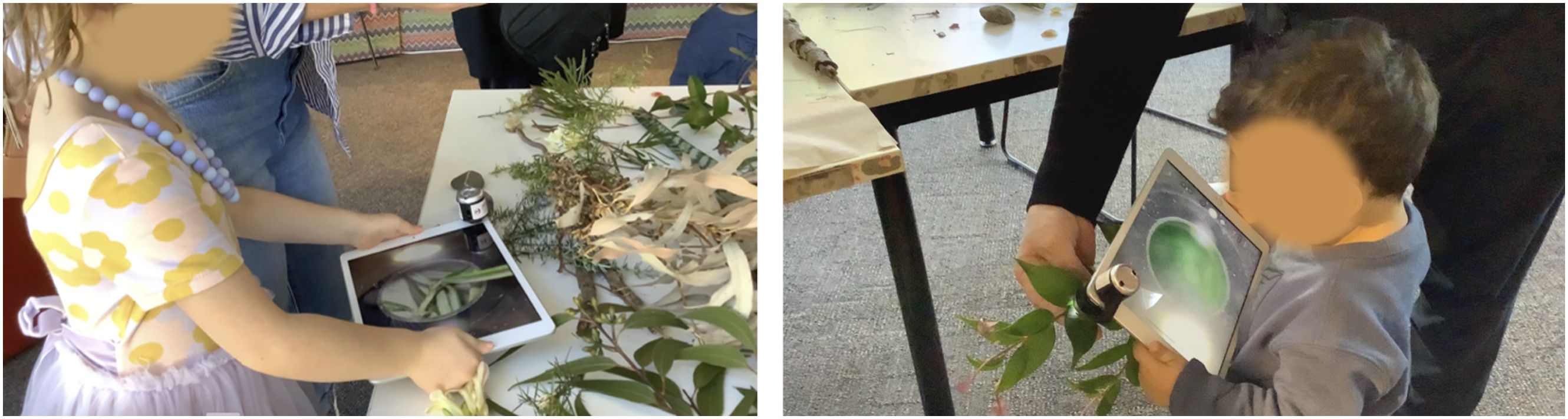
Motivation to investigate more found items
As creators of text, children and adults could use their still and moving images to check back, reflect, compare and contrast, and confirm understandings. Playing and replaying captured content not only led to new understandings but also motivated subsequent explorations of the items on the table and into the broader play space. The use of the technologies encouraged conversations between children and adults that invited further investigation – ‘I wonder…’; ‘What if…?’ ‘Can you find…?’ ‘What else…?’ were common phrases. For example, a shared interest in an image of a small bug found rolled up in a seed pod led to a broader exploration of and discussion about the appearance and physical features of living creatures. This new line of inquiry generated movement in the space between the natural materials introduced from the outside environment to x ray images of small creatures and a kit of insects set in resin. Using their microscopes and the camera to capture images, children and their adults pursued this interest across their new set of materials. These scientifically presented resources afforded new views of the items of interest, affording discussions about the internal and external parts of the body (e.g., skeleton, vertebrae, skull), and comparisons about similarities and differences of the resin suspended bugs (e.g., length of feelers, number of limbs). Figure 3 shows images captured across the assemblage of materials collected to enable this closer investigation. As the children investigated the features encapsulated within the resin they also made some predictions about how that creature may have engaged with the natural items they had also investigated. For example, where might you find a crawling caterpillar compared to a flying insect? On a piece of bark? Or in a flower? Expanding a line of inquiry to investigate body structure. Left: looking through microscope at an insect. Centre: Child using iPad microscope with help from adult. Right: iPad microscope being used to investigate insects in resin.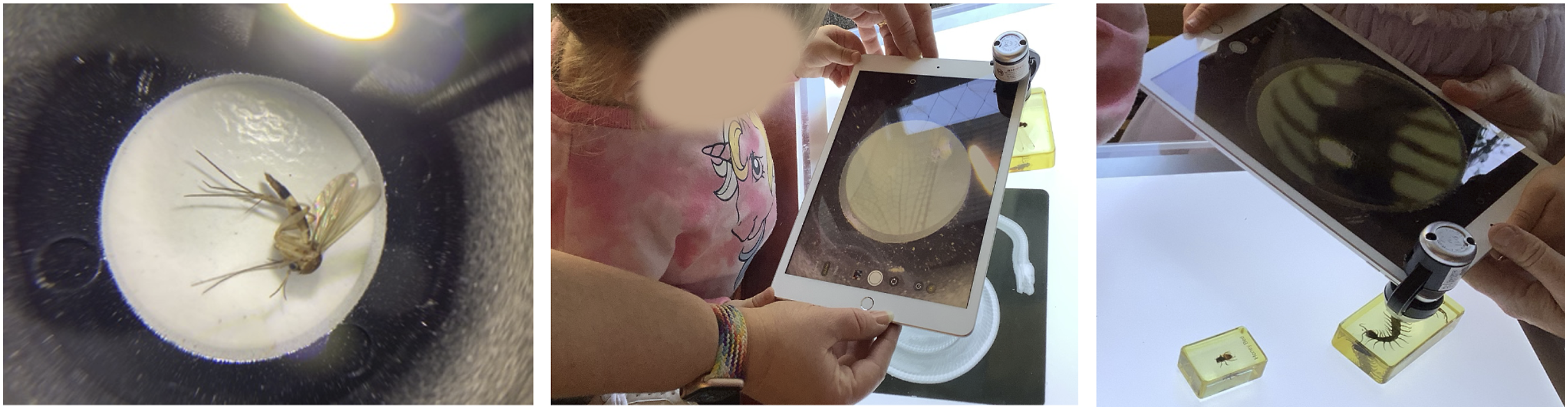
Excitement and discovery through connections
The adults (researchers and children’s accompanying adults) were observed encouraging children to connect the found materials on the table with familiar places, spaces and events beyond the Children’s Technology Play Space. And while these mainly adult-led prompts and connections were valuable, they were quite overt in their pedagogic intent. For example, one parent’s observation - ‘Oh this one is just like the flowers we have at home in our front yard.’ followed by an interrogative question – ‘Do you remember those?’ provoked minimal observable response by the child. However, a child’s discovery of a living creature, such as an ant or ‘bug’, sparked children’s talk, interactions, and sharing of their own stories about bugs they’d seen/experienced in other places. From the children’s reactions and subsequent extended engagement with these personal experiences, the children’s own discoveries appeared more significant and perhaps even urgent for sharing about other places and spaces where they had encountered them.
The discovery of a living creature was of interest to those beyond the person holding the microscope. In one instance, children paused their own investigations in favour of watching the ant – an unexpected visitor - that had been found by others. Some gathered closely around the physical object on the table (see Figure 4), however, the mirroring of the iPad onto the Play Space wall afforded everyone a clear view of the finding. The capacity of the technology to transform an individual finding of the ant in the microscope to a large, shared text allowed everyone to view, discuss, develop knowledge and language about the nature of this discovery. The ant, previously hidden in the materials, became a big presence in the space – both physically and figuratively - magnified by the microscope and by the mirroring of the iPad to the projector. Investigating something new. Left: Adult pointing to direct children’s attention to the image from the iPad projected on the wall. Right: Projected image, microscope view of ant.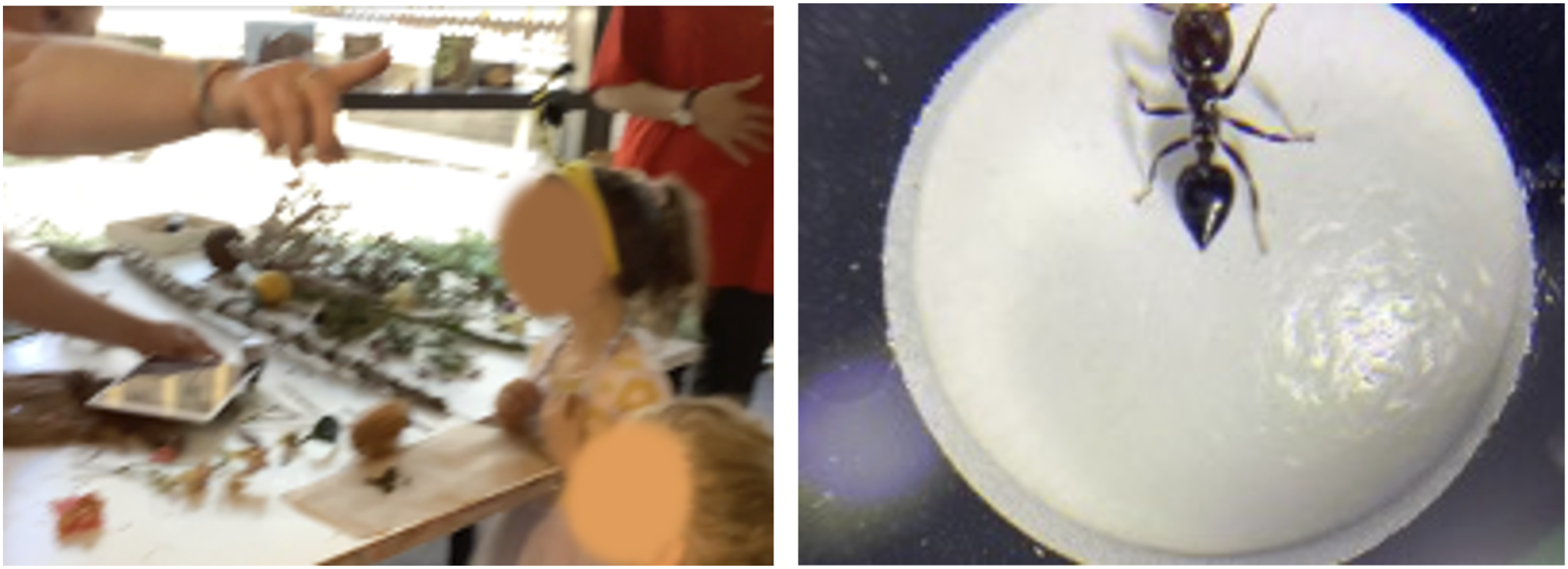
In the example shown in Figure 4, the discovery of an ant prompted stories as the children connected with and extended on their own experiences with living creatures. (Children turn to the sharing wall where the ant can be seen running around under the microscope)
The sharing of personal experiences in this example appears to have connected the CTPS with the children’s familiar home spaces, the materials on offer in the CTPS with those in other familiar spaces, and with their own experiences beyond the CTPS. The encounter also provoked sensory memories, whereby children’s embodied interaction with this ant resonated with similar experiences of insects crawling upon them. These responses seemed to offer opportunities for tacit knowing across spaces and times, whilst similarly encouraging collective meaning-making in this space, at this time. The interaction drew the children into a community with things in common inspiring dialogue and story.
Reflections and next steps
In this paper, we have considered children’s encounters in the CTPS beyond what they might mean by taking up a ‘materially focused framing’ (Hackett et al., 2020: 2). Looking more closely at children and adults’ encounters with the digital microscopes has illuminated the important connections between literacy practices and spaces, resources, interactions, and time (Burnett et al., 2014). Emerging from the data is the importance of fostering curiosity, giving children time and space for emergent investigation, thinking and talk, and being responsive to the connections they want to explore with others – other people, materials, technologies, and spaces. The multiple opportunities for conversation, connection, and co-investigation arising from encounters with the digital microscopes challenges the often-assumed notion that digital technologies shut down children’s interactions and narrow play experiences - such as during play with certain apps. Instead, children’s relationships with other humans, animals (ants or ‘bugs’), and materials (technological and natural) provided open-ended possibilities for children’s co-play and collaborative learning through observations, the naming of processes and things, and extension of knowledge.
In the CTPS, embodied learning challenged taken-for-granted relations between human and non-human, objects and materials. Allowing for interactions between human and non-human placed value on the ‘ambiguity and openness of experience’, and emphasised children as not only learning bodies, but experiencing, sensing bodies in museum spaces (Birch, 2018: 516). For instance, the unexpected encounter with the ant, and its respectful re-homing in the natural environment, provided opportunities for children to share in tacit and embodied remembering and meaning making whilst playing, learning and connecting with technologies. The investigation and projection of the ant through the technologies available and the subsequent conversations showed both children and ants may risk making themselves vulnerable to one another (e.g., by being crawled on, moved, and disturbed by the other). As Taylor and Pacini-Ketchabaw (2015: 514) suggest whilst reflecting on their own research experiences involving young children, ants, and worms, these interactions ‘required us, as well as the children, to become more attuned to ways in which human and nonhuman alike affect and are affected by each other.’ Although not necessarily the focus of this activity, this resonates with the potential offered by children’s museums for cultivating social and ecological awareness (Bates, 2018; Shaffer, 2023), and for embodied, affective, multi-species encounters to provide environmental education that acknowledges shared experiences and vulnerabilities (Peach et al., 2025; Taylor and Pacini-Ketchabaw, 2015). Like children’s museums more broadly, the activities within the CTPS afforded a multiplicity of pedagogic possibility.
Whilst we are interested in how children’s interactions with digital technologies encourage co-play, develop literacies, and ultimately enable learning about their worlds, our reflections below focus more upon what we can learn from what happened (happenings), what lessons can be drawn upon in the future (learnings), and what further lines of inquiry are generated (wonderings).
Happenings
In the microscope activity, children were curious about the digital technologies and the natural/animal materials they encountered, and the opportunities they generated. Digital technologies were used to investigate the materials, and the materials enabled explorative and flexible interactions with the digital microscope and then with others. For instance, through looking closely and photographing details that are otherwise not possible to see, children and their adults produced visual text and engaged in conversations about familiar items but in ways that encouraged new ways of using language and finding deeper understandings about natural materials. Children became increasingly proficient at exploring and talking about the specificities of natural and digital things in ways that fostered connections between children, adults, technologies, found materials, and memories - the ‘threads and traces of other times and places’ (Burnett et al., 2014: 92). Their co-inquiry encouraged relationships across all participants and nonhuman actors, echoing what Wallis and Noble (2023: 696–697) describe as the ‘shared intimacy’ that can occur during activities in museums where visitors are encouraged to ‘look and linger’. These conversations and connections generated pedagogical opportunities that were diverse, emergent, and investigative, opportunities for the development of complex literate practices (Comber, 2015).
Whilst we curated the experience with hope for certain engagements and outcomes, what we could not account for were the surprising and spontaneous events arising with and from the encounter. And while the materials themselves were not responsible for “making” the children literate (Bartlett, 2007: 64), the ant crawling out from a folded leaf was an invitation for further exploration, clarification through interactions and talk, and experimentation with the other natural materials, the digital microscopes and materials in other forms such as the ‘bugs’ suspended in resin. We could not, even if we had tried, engineered such an occurrence, nor the influence it had. The emergence of the ant, the other children and their adults wanting to see the ant, mirroring the iPad and projecting it onto the wall, the conversations, the memories, and the further inquiries with the resin bug were all unexpected, all flowing from and with each other. In contrast, moments that took up an explicitly directed pedagogic intention seemed to shift the relationship from one where children and adults were co-inquirers toward adult-directed activity designed for a specific outcome. Interestingly, the involvement of the ant in the activity was a ‘shared experience of not knowing’ (Wallis and Noble, 2023: 709). All of us, researchers and participants alike, encountered the moment and felt provoked to embrace the unexpected directions and ‘special’ unfoldings that had occurred during these children’s interactions in museum spaces (Hackett et al., 2020: 5). These happenings remind us that whilst accounting for risk and uncertainty are important, we must be malleable in our approaches to facilitating activities in children’s museum spaces ‘by welcoming the unexpected, and letting it influence our work in the moment and in our planning’ (Clayton and Shuttleworth, 2018: 539).
Learnings
Museums are spaces characterised by the attention they give to objects and the ways they are valued in their spaces. Through our analysis, encounters with iPads and natural materials highlighted the importance of taking account of the ways children and adults interact with nonhuman things – digital and non-digital, living and not. In this way, we take up MacRae et al.’s (2017: 509) suggestion that ‘accounts of children in museums could pay more attention to non-human aspects of the experience, and the way in which these are entangled with (and inseparable from) what children do in museums.’ The digital technologies – including microscopes, iPads, and mirrored projections - afforded rich socio-material experiences whereby different materials, bodies, and ways of seeing and knowing in the real/virtual spaces came together to enable different possibilities (Fenwick and Landri, 2012; Kervin et al., 2019).
Our analysis has also drawn our attention to the ways of knowing in the CTPS – through our research practices and within the activities themselves – that are not simply a matter determined by us as adult humans. Taking account of the nonhuman things and the ways that knowing emerged from intricate encounters between adult-child-digital-material troubles the notions that humans can gain mastery and control over knowledge-making through binaries and the fixing of ‘truth’ (Golding, 2014; Greenhill, 1992), particularly about the natural world, notions deeply interconnected with museum practices. For instance, observational practices such as looking closely at animal species through microscopes are inevitably caught up in (continued) histories where humans have sought, slain, and displayed animal and plant species with the intention of advancing knowledge. Thinking with these knotty practices, the microscope activity became significant for the ways hierarchies and boundaries between magnification (close looking) and projection (enlarging), living (ant) and non-living (bug in resin), child and adult, social and literacy practices, remembering, and digital and natural, were negotiated and reworked. Found materials, ants, bugs suspended in resin, and digital technologies were not passive, nor were they simply instruments for children’s learning. Together with children and adults, these materials and technologies generated possibilities for rich encounters such that the CTPS might become not just a place for learning but also ‘an experiential place that fosters relationships between and across people and things’ (Birch, 2018: 523). This reminds us that the ways we design, deliver and document (research) activities in the CTPS needs to stay committed to practices that appreciate what emerges between human participants, things, and technologies. These insights encourage us, as researchers and facilitators, to take notice of the specificities, histories, and un/intentional hierarchies our activities reinforce or revise, with the hope this goes some way to contend with the non-neutrality of museum spaces and practices (VerCetty, 2022).
Wonderings
Our analysis suggests that in children’s museum activities, and museum spaces more generally, we must continue to ask how this space at this time and with these resources might support unique experiences of (digital) play, literacy learning and investigative interactions. As adult facilitators working with an array of things and people, we have a responsibility for the ways digital technologies are incorporated and perceived. Whilst not wishing to overstate our ‘control’, we ask how we might be more responsive to the potential opportunities, affects and connections digital technologies afford? How might we continue to investigate (with) digital technologies? How can we create more possibilities for sharing in ‘not knowing’ (Wallis and Noble, 2023: 709)? And, ultimately, how can we continue to support joyful moments of collaborative, emergent curiosity?
Footnotes
Acknowledgements
The authors would like to thank children and families that participated in research activities at the Children’s Technology Play Space, a living lab for the Australian Research Council Centre of Excellence for the Digital Child (CE200100022).

Ethical considerations
This study was approved by the Social Sciences Human Research Ethics Committee, University of Wollongong (2022/107) on 31/05/2022.
Consent to participate
Written informed consent for participation in the research and publication was provided by participant(s) or a legally authorised representative.
Funding
The authors disclosed receipt of the following financial support for the research, authorship, and/or publication of this article: This work was supported by the Australian Research Council Centre for Excellence for the Digital Child (CE200100022).
Declaration of conflicting interests
The authors declared no potential conflicts of interest with respect to the research, authorship, and/or publication of this article.