




Abstract
The purpose of this study is to investigate digital storytelling based on the technology acceptance model. For this aim, the study was conducted as a case study with the participation of 52 pre-service mathematics teachers. The findings firstly showed that most of the pre-service teachers’ perceived ease of use was high as they consider digital storytelling contributed to the learning environment and their professional development. It was additionally observed in participant responses that their usefulness perceptions are high. Consequently, most pre-service teachers intend to use digital storytelling in their future teaching practices. It was finally revealed that some of the pre-service teachers stated their intention of their students’ participation in the digital storytelling process, while others expressed their intention of bringing their own digital stories to the classroom as educational material.
Introduction
In a knowledge society, individuals are required to possess various skills. Education is being updated in a way to improve these skills. These skills are also named as 21th-century skills and draw the attention of many education researchers (Binkley et al., 2012). Teachers have a significant role to teach these skills to individuals. Teachers also need certain knowledge and skills to improve students’ skills (Shulman, 1987). Given the fact that technology has an impact on every aspect of life, teachers require a good level of knowledge on their subject area, technology, and pedagogy (Mishra and Koehler, 2006). The framework named ‘Technological Pedagogical Content Knowledge’ (TPACK) plays a key role for teachers in the 21st century (Joo et al., 2018).
Researchers are working on innovative methods and techniques to increase teachers’ TPACK levels. One of these techniques is the digital storytelling method which enables learners to actively participate and create their products with the help of technology (Condy et al., 2012; Robin, 2008; Yang and Wu, 2012). Digital storytelling is enriching the stories that are told by people with media components (Yüksel, 2011). In other words, Digital storytelling is a method that has become easier to be implemented with advanced technological tools. The literature shows that digital storytelling contributes to the development of different variables in learners such as motivation, engagement, and academic achievement (Hung et al., 2012; Nam, 2017; Sadik, 2008). In addition to the contributions of digital storytelling in terms of learners, it also has a positive impact on teachers’ and pre-service teachers’ TPACK levels (Sancar-Tokmak et al., 2014; Sancar-Tokmak and Yanpar-Yelken, 2015). However, an increase in teachers’ TPACK levels does not necessarily indicate that teachers will use these skills in the classroom environment. To integrate technology in the classroom environment, teachers should consider the affective perspective in addition to the cognitive perspective (Joo et al., 2018).
Technology in mathematics education
In the literature, it is seen that the studies on the TPACK levels of pre-service mathematics teachers are limited (Yigit, 2014). Accordingly, more research is needed to increase pre-service teachers’ technology integration skills, or in other words, TPACK levels (Niess, 2006). In addition, pre-service teachers need to be acquainted with related technologies (Sinclair et al., 2009) and be able to design a course that can integrate technology in order to successfully integrate technology in educational environments (Bray and Tangney, 2017). It is known that the successful integration of technology into educational environments affects success positively (Cheung and Slavin, 2013). For this reason, it is important for pre-service teachers to experience that they can integrate technology into educational environments during their teaching education (Tondeur et al., 2012) in terms of teaching mathematics. However, the success of technology integration into educational environments is related to teachers’ belief in technology (Donnelly, McGarr, and O’Reilly, 2011; Ertmer and Ottenbreit-Leftwich, 2010). In particular, teachers’ or prospective teachers’ belief that technology is beneficial is one of the most important predictors of integrating technology into educational environments (Ndlovu et al., 2020).
Digital storytelling in pre-service teacher education
Digital storytelling is one of the methods that teacher candidates can use to integrate technology into their educational environments. While digital storytelling enables learners to be active in the learning environment, it also allows them to create their own products (Author, Date). It can be beneficial for prospective teachers to experience digital storytelling in two ways; (1) They can take a digital story that they have prepared themselves for the class as a media. In this way, they can attract the attention of the students about the subject and use the video in the presentation of the content. (2) They can use digital storytelling as a method and enable students to create digital stories. In this way, students can both be active in the learning environment and enable them to structure their own learning. In both cases, it can be said that the integration of technology in the learning environment will take place.
When the digital storytelling studies with teacher candidates in the literature are examined; It is seen that the digital storytelling process has an effect on different variables related to teacher candidates. Sancar-Tokmak and Yanpar-Yelken (2015) revealed in their study that the digital story creation process had a positive effect on teacher candidates’ TPACK self-confidence. Pre-service teachers stated that their TPACK levels improved after the digital story creation process (Sancar-Tokmak et al., 2014). In the study conducted by Kilic and Sancar-Tokmak (2017) with prospective classroom teachers, they stated that they intend to use digital storytelling in the future to attract learners’ attention and support learning in their classrooms. In addition, digital storytelling increases pre-service teachers’ technological competencies and their belief that technology can change educational environments (Heo, 2009).
Technology acceptance model
One of the most important models that demonstrate the behavioral intentions of individuals to use technology is the Technology Acceptance Model. The model that was defined by Davis (1989) has been updated within the following years - TAM-2 (Venkatesh and Davis, 2000), TAM-3 (Venkatesh and Bala, 2008)- and took its final form. The model emphasizes that individuals should perceive technology as useful, should find it practical, and accordingly should have intentions to use it to perform a certain behavior. Individuals need to learn how to use a particular technology to perceive it as useful and easy. However, the concept of digital storytelling is still not well-known by many pre-service teachers (Author, Date). In fact, many teachers still deliver their courses by using classical methods (Ursavas et al., 2014).
Significance and purpose of the study
There are different models in the literature regarding the integration of technology in educational environments. (Mishra and Koehler, 2006; Tondeur et al., 2012). In these models, it is revealed that teachers and pre-service teachers should have certain skills. With the developing technologies, different methods and digital tools are used in this integration process. Digital storytelling is seen as one of these methods. However, it is not enough to have the skills or to know which method to use for the integration of technology in educational environments. Different variables affect integrating technology into educational environments. (Joo et al., 2018). When the digital storytelling literature is examined, it is seen that some researches are about the perceptions of teachers or pre-service teachers on digital storytelling (Condy et al., 2012; Karataş et al., 2018; Kilic and Sancar-Tokmak, 2017; Kocaman-Karoglu, 2014; Yuksekyalcin et al., 2016); some researches are about the effect of digital storytelling on different variables like motivation, achievement, etc. (Hung et al., 2012; Nam, 2017; Yang and Wu, 2012); some researches are about the effect of digital storytelling on TPACK skills (Sancar-Tokmak et al., 2014; Sancar-Tokmak and Yanpar-Yelken, 2015). However, research studies are needed to demonstrate pre-service teachers’ intentions to integrate this technology into their future classrooms.
In this direction, the purpose of the study is to evaluate digital storytelling in terms of the technology integration process. In that respect, answers were sought for the following research question; • How do pre-service teachers assess the Digital Storytelling process within the framework of the Technology Acceptance Model?
Method
Within this framework, the research was carried out using case study, one of the qualitative research methods. The purpose of the case studies is to deeply investigate a case (Simsek and Yıldırım, 2011).
Participants
The participants of the study were selected through Convenience Sampling Method which is a non-random sampling method (McMillian and Schumacher, 2010). The study was carried out with 52 pre-service mathematics teachers who studied in a faculty of education and registered to the course titled special teaching methods-II. Teacher education in Turkey is carried out in the framework of a four-year training program within the education faculties. In the first 2 years, basic courses, field courses, and introductory courses in pedagogy (introduction to educational science, learning psychology, etc.) are included, and in the 3rd and 4th years there are courses for specific teaching practice (such as special teaching methods). Although the only technology-related courses of the pre-service teachers are the “information technologies in education” course they take in the first year; This course focuses on developing basic ICT skills apart from technology integration. In this respect, it can be said that pre-service teachers did not take a course on how to integrate technology into their educational environments.
44 of the participants were females (%84.6) and eight of them (%15.4) were males. Both the qualitative and quantitative data are collected from all participants.
Data collection tool
A structured interview form that was developed by the researcher to identify pre-service teachers’ opinions on the implementations was used in the study. The interview form consisted of three open-ended questions. These questions were used to identify pre-service teachers’ opinions on ease of use of digital storytelling, usefulness, and their future intention to use. • What are your opinions about the ease of use regarding the digital storytelling creation process? Why? • Do you think that the digital storytelling creation process is appropriate for mathematics teaching? • Will you consider using the digital storytelling creation process in your classrooms in the future?
Procedure
The implementation was carried out in the scope of the course titled special teaching methods-II which was compulsory for pre-service teachers who study in the faculty of education. The course was delivered in a conventional classroom environment, and pre-service teachers used their computers and smartphones to develop digital stories. The implementation process was launched by pre-service teachers who were given information about digital stories. The definition of digital stories was made and their types, development processes, and advantages were highlighted. In the following week, Web 2.0 tools like Vyond, WeVideo, Plotagon that pre-service teachers can develop their digital stories were introduced and the strong aspects, different features, and using instructions were explained. Pre-service teachers were free to choose the environment that they will develop their stories. While the environments that pre-service teachers can develop their digital stories were presented, the process of digital story creating was also launched. The first step of digital story creation was producing ideas, and in this step pre-service teachers were asked to find a common misconception in the field of algebra learning. Afterward, the pre-service teachers conducted a literature review to identify the misconceptions. After pre-service teachers specified the misconceptions that they decided to work on, the scriptwriting process was started. Figure 1 shows the document example of a pre-service teacher created in the idea producing stage which states the idea for the story. The pre-service teacher passed to the next stage after the required feedback from the instructor. Story example created by pre-service teachers in the idea producing stage.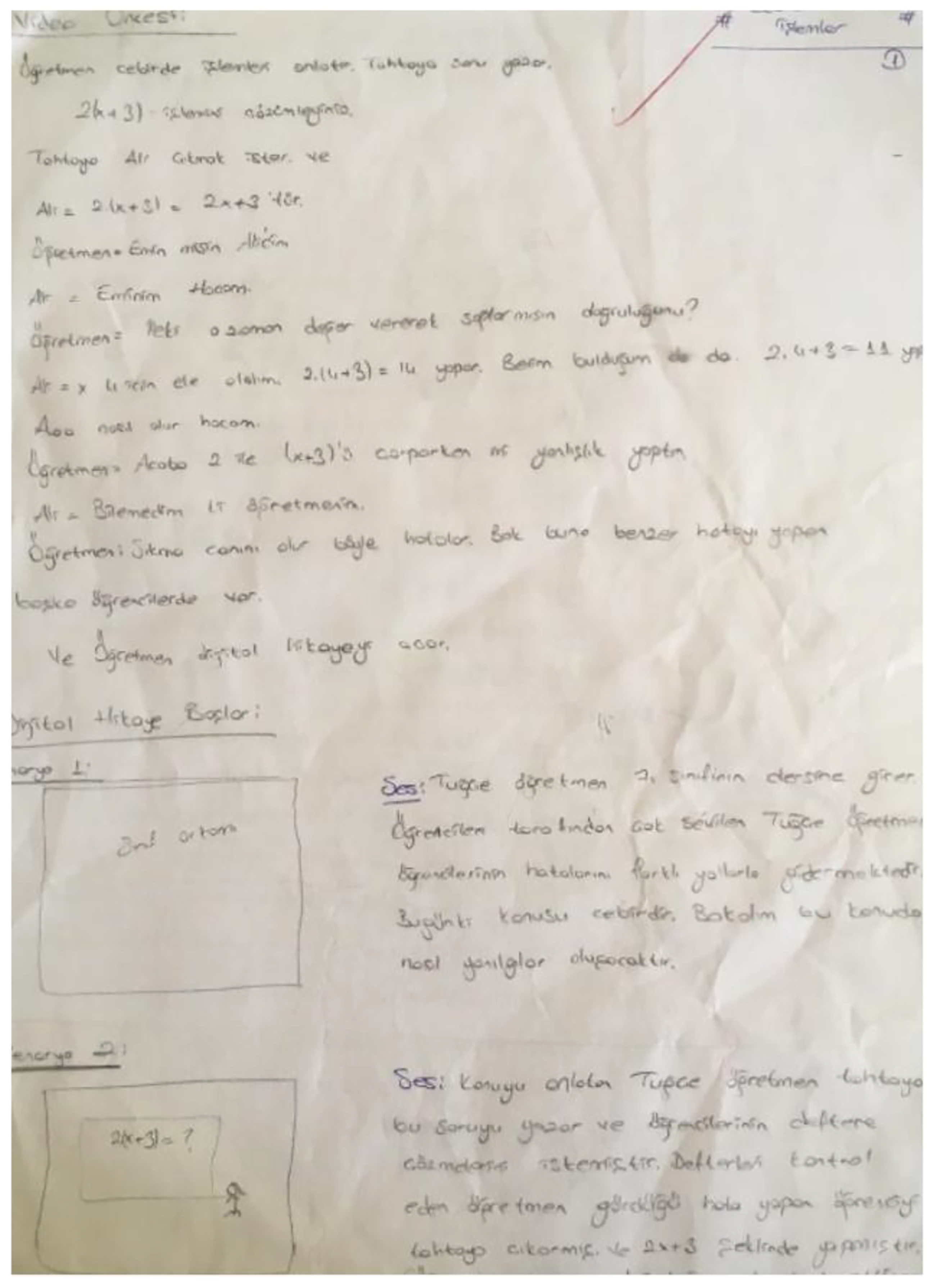
Later on, pre-service teachers were asked to find media that could be related to the idea they had or to design it if they want to create their media. In the next step, they were asked to create storyboards and the instructor of the course examined the boards created by the students and gave feedback. Figure 2 shows an example storyboard developed by pre-service teachers. Story board example developed by pre-service teachers.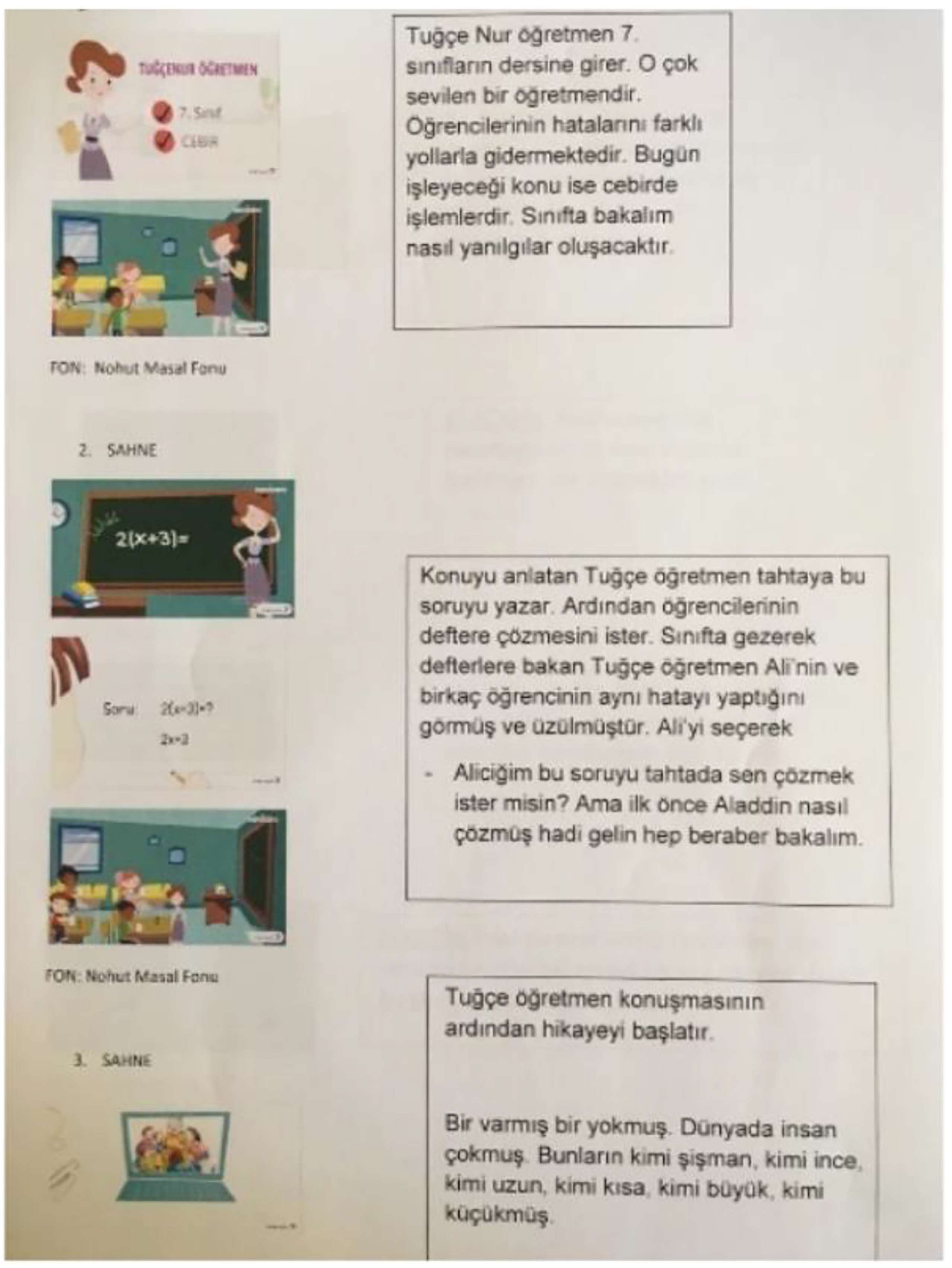
After the feedbacks given for the storyboards, digital stories were started to be created in the digital environment. During the process, feedbacks were given to the pre-service teacher on their stories. After the completion of the stories, the qualitative data was collected. The whole process was completed in 8 weeks.
Data analysis
The data were analyzed in three phases including (1) organization of the data, (2) coding and reducing data (3) representing data with tables and discussion (Creswell, 2007). In the first phase, the data were transformed into digital text files. In the second phase, the data is separated into sections using the constant comparative method (Glaser, 1965). To name the data sections, the Technology Acceptance Model was used as a base and the categories were created according to this model. The themes were specified as a result of the content analysis. The analyses were carried out by both researchers to ensure the reliability of the data, and the final version was created by reaching a consensus proposed by Lincoln and Guba (1985). The reliability of the qualitative data was calculated by the formula (
Findings
Perceived ease of use
Pre-service teachers’ evaluation on digital storytelling according to the perceived ease of use.
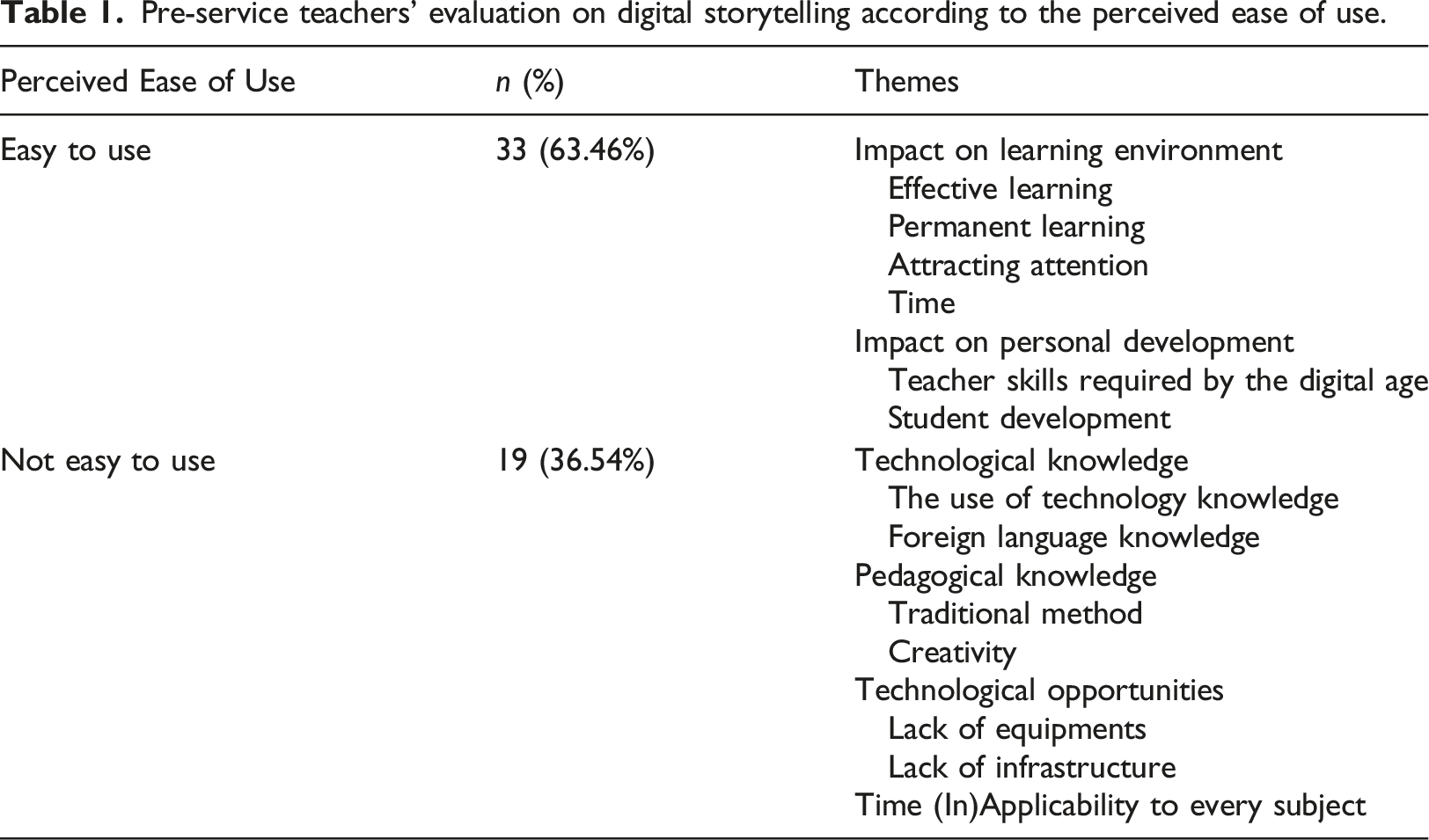
The pre-service teachers who found digital storytelling easy to use emphasized the pedagogical impacts of digital storytelling, self-development of teachers, and time. On the other hand, the pre-service teachers who did not find digital storytelling easily pointed out technological knowledge, pedagogical knowledge, technological opportunities, time, and (in)applicability to every subject. The fact that the ‘time’ factor is included in both sections can be interpreted as pre-service teachers who found digital storytelling easy to use can get prepared in a shorter time while the ones who did not find it easy had difficulties being prepared.
Most of the pre-service teachers think that digital storytelling may contribute to more permanent and effective learning. This situation was stated by some of the pre-service teachers as; “…creating a story might be a very effective method to ensure permanent learning and eliminate children’s mistakes.” “A student can learn the subjects that include visuality more permanently by seeing”
Another pre-service teacher expressed that a learning environment that is enriched by digital storytelling will be more effective to draw students’ attention by saying; “ I think it is quite useful and productive to draw students’ attention and to facilitate their understanding”
The pre-service teachers think that the time for teaching subject learning environments can be shortened with digital stories. One of the pre-service teachers explained this situation as; “We can teach a complicated subject to children more permanently in a shorter time with digital stories.” “It will shorten the delivery of the subject”
Another reason that pre-service teachers found digital storytelling easy is the contribution of the implementation to their personal development and student development. A pre-service teacher expressed that teachers should be equipped with the skills required for the digital age as; “Mathematics teachers should keep up with the digital age and do their best for the development of students.”
The given situation shows that the pre-service teachers believed that the development of a teacher will have an impact on the development of students as well. In parallel with this, another pre-service teacher emphasized the importance of digital storytelling as; “Although the process seems difficult, the outcome of it can be useful Teachers can speed up after a few tries. I think that teachers who want to improve themselves can learn about this process and implement it for the sake of their students.”
The examination of pre-service teachers’ reasons to find digital stories ‘not’ easy to use showed that the highlighted the deficiencies that emerge/might emerge in terms of the use of technology. The pre-service teachers did not evaluate the ease of use only from their perspective, but from their colleagues’ perspective as well and indicated that older teachers might have difficulties using this technology. The given situation was expressed by a pre-service teacher as follows; “I don’t think that a 50 years old teacher who has no ideas about technology can prepare a digital story.” “Teachers who don’t like computers would find it difficult. For example, I spent 5 days on that.”
Some of the pre-service teachers mentioned the lack of foreign language knowledge since the mediums for developing digital stories only provide service in a foreign language; “Preparing a digital story wouldn’t be easy if the language of the program will be English.”
Another dimension that pre-service teachers did not find easy in terms of the use of digital storytelling is the pedagogical knowledge dimension. The fact that teachers try to proceed in the framework of a curriculum causes pre-service teachers to consider such kinds of implementations time-consuming, and the curriculum can be followed by using traditional methods. This situation was expressed by the pre-service teachers as; “Teachers do not have time for creating such kind of stories, they generally use the direct instruction technique.” “There is no time for this application when a teacher delivers a course according to the curriculum.” “It can be used by a teacher who is pedagogically equipped.” “It is not easy to use because our education system is based on a teacher-centered understanding. A teacher is seen as an instructor who teaches the subject and gives some example questions. This will be the same for the next generations.”
Some of the pre-service teachers believed that the use of digital stories was not easy given that it is an activity that requires creativity. The given situation was explained by one of the pre-service teachers as follows; “Personally, I had difficulties. I don’t know if I could manage without help from my friend. You need creativity.”
One of the most important factors that caused pre-service teachers to think that the use of digital stories is not easy is the lack of confidence in the opportunities of schools that they will work in the future. Based on the assumption that they will work at village schools, pre-service teachers believed that the schools will lack the infrastructure and accordingly the technological equipment and opportunities. This situation was expressed as; “The school which we will work at might not have facilities to use digital stories.” “We might not have computers or we might have problems finding tools to present the digital stories we prepare.” “It is difficult to use such kind of technology in village schools.” “Infrastructure is not adequate in most of our schools.”
Some of the pre-service teachers who did not find the use of digital stories easily base their opinions on the time needed for developing these stories. Another negative opinion reflected that digital stories are not appropriate for teaching every subject. They stated these negativities as follows; “It might be difficult to adapt all subjects into digital stories.” “It takes too much time. Creating a 5 min video took days.” “It is inconvenient and takes too much time.”
Perceived usefulness
Pre-service teachers’ evaluation on digital storytelling according to the perceived usefulness.
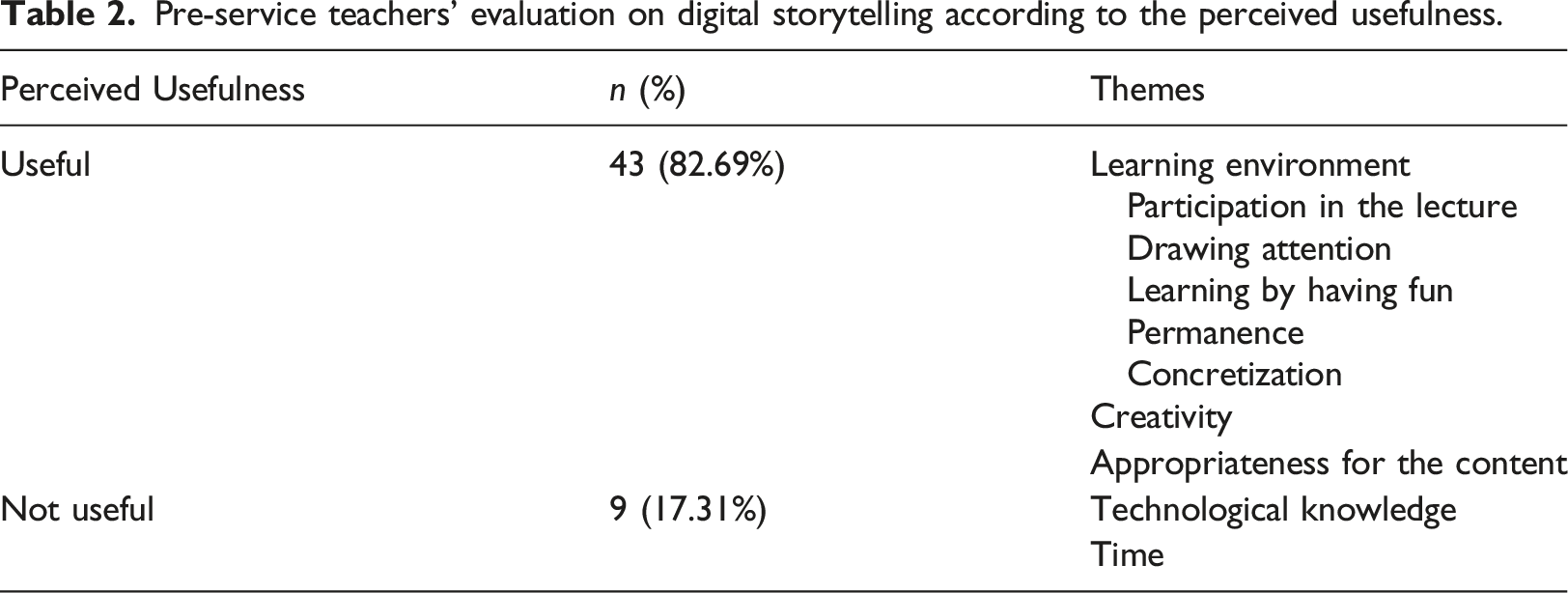
The pre-service teachers who found digital storytelling useful indicated that its contribution to the learning environment was an important factor. The pre-service teachers who thought that student’s participation in lectures would increase expressed their opinions as; “Given that the new generation of students are more interested in technology, participation in lectures can be increased by using such technologies”
Drawing attention stood out as the benefit that pre-service teachers mentioned most frequently in terms of the perceived usefulness of digital storytelling. They highlighted that components of digital storytelling and digital stories enrich the learning environment and draw students’ attention.
The given situation was expressed by some of the pre-service teachers as; “Mathematics is an abstract subject and students are having difficulties understanding it. I think that the reason for a mistake or a subject can be understood better by drawing students’ attention”. “Mathematics is a subject that requires an effort and it is a subject that we focus on devotedly. We need to provide sufficient information to students about the concepts in 40-minute lecture time and digital stories are very appropriate for this. It can also help to save time, and it is quite appropriate for us with its attention drawing aspect.” “It draws the attention of students and a student comprehends a mistake by considering himself or herself as the student or the hero of a story, and learns it permanently in an appropriate manner.”
Pre-service teachers believed that students can experience a more permanent and entertaining learning process by having fun in lectures through digital storytelling. This situation was explained by some pre-service teachers as follows; “It is a method that enables students to learn by having fun and that’s why it has higher permanency.” “Mathematics is taught in an entertaining manner. We can make students love mathematics in this way.” “Mathematics is not a beloved course and everybody approaches it with prejudgment. Students can both have fun and learn through digital storytelling.” “Actually, in the beginning, I made such a mistake.” I thought that it was a more appropriate method for other lectures. But it surprised me. I believe that it will be a permanent and entertaining process to eliminate misconceptions in mathematics teaching.”
Pre-service teachers found digital storytelling as they believed that it could prevent perceiving mathematics courses as an abstract subject and that could turn this abstractness into concreteness. The given situation was expressed by the pre-service teachers as follows; “Given that mathematics is an abstract course, I think that it is difficult to teach certain stuff without eliminating this abstractness. Making it concrete as much as we can (both visual and auditory) will also help students to understand it easier. One of the ways of eliminating this would be using digital stories.” “Mathematics is an abstract course and we need to teach it to students by concreting it as much as we can. Digital stories will help in this matter.” “Given that mathematics is an abstract and difficult course to understand, it is a course which is not liked by the students and makes them afraid. Using them in such kind of a lecture is definitely appropriate and useful. Maybe the materials could be less than the materials that can be used for other courses but they are appropriate to enable students to realize students their mistakes and the difficulty of learning.”
The pre-service teachers did not find digital storytelling useful as they did not find it appropriate for the content. Particularly question solving-based delivery of the mathematics course and the belief that the question-solving process cannot be taught by stories lead to pre-service teachers’ negative opinions about the usefulness of digital stories. “It is difficult to express solutions to the answers by visualizing with stories. Instead of that, I can bring materials to the class to fill this gap.” “Difficult questions that require complicated operations require knowing the key point and a student may not be capable to associate it with a story.”
Some of the pre-service teachers did not find digital stories useful as they thought that students’ technological knowledge is not sufficient for creating a digital story. A pre-service teacher expressed this situation as; “… It is difficult for students to use digital stories as their technological readiness (computer usage) is not sufficient until secondary school.”
The most important factor for not finding digital storytelling useful was the time. This conclusion is made given that the process of creating digital stories can be time-consuming. Pre-service teachers expressed this situation as follows; “It is a time-consuming activity. I can only use it for misconceptions.” “I think that I can get a more positive response if I will use the time for students one-to-one instead of creating digital stories. In addition to that, a student may not be able to learn from a digital story as well.” “I don’t think that the use of a digital story, which is a time-consuming effort, is not appropriate for teaching in terms of time while we barely complete the curriculum in 1 year in the school environment.”
Intention to use
Pre-service teachers’ evaluation on digital storytelling according to intention to use.

The results showed that some of the pre-service teachers might bring the videos that prepare on their own to the classroom, and some of them might ask their students to prepare them. Pre-service teachers who were intended to create digital stories expressed the reason for it and ways implementation as follows; “I will definitely use it… We also did that and I think it was very useful for me even we found it difficult. Being a teacher is not all about providing the knowledge and doing nothing else, I think that it is also about knowing the best way of teaching it, and I found it very useful for teaching mathematics.” “…It might not be very effective if I teach the course, but I can draw a student’s attention by making him or her listen to it from a peer.” “I ask my students to prepare it by informing them to use digital stories. I would like to help them to improve their creativity and contribute to their technological knowledge.” “I would ask them to prepare it if there is a classroom in the school. If the school does not have computers I would ask them to write a script about the situations that might create misconceptions.” “I will use it because it is a multi-directional teaching technique. I will not make them prepare it individually but in groups.”
The results showed that there were pre-service teachers who were intended to bring digital stories that they prepare to the classroom instead of asking their students to prepare them. They have different reasons to think in this way. The most common reasons were explained by pre-service teachers as follows; “Yes, I like it. I will definitely do it, I need to make students like mathematics by entertaining them because most of them find it boring. But I will do it by myself. It is not appropriate for their level.” “I would not ask them to do it. It is a process that requires effort and time. It might be difficult for them. I would prepare them when I have time and make them watch it.” “I will not ask my students to prepare it because not all of them have the opportunities and they have different cognitive levels. Children may not have the same skills in the development period.” “I will present the products I created, in other words, my digital stories, in the classroom instead of the creation period. Because I believe that creating them in the classroom won’t draw the attention of all students and they won’t be interested.
Pre-service teachers who were not intended to use digital stories in the future expressed their opinions as follows; “I will not ask them to prepare it because it is a difficult method. I think it does not worth the effort. If there are previously prepared ones they can bring, otherwise, I wouldn’t ask for it.” “I don’t plan to implement this. Instead of this, I can make different implementations during the lecture.” “I don’t think about implementing it as it is a very difficult process. I found it difficult.” “In general, I don’t think that I will use it…I definitely don’t think that it is economical.” “…I do not prefer to use it. I will teach the subjects on my own without the help of technology.” “No. I will have a lot of free time, be bored, and find nothing else to do, then I can use them.”
Discussion
The findings on the perceived usefulness of digital storytelling in the context of the technology acceptance model showed that pre-service teachers generally assumed that digital stories as a convenient technology to use. Particularly, the impacts such as effective and permanent learning, drawing students’ attention and time played a role in perceiving digital storytelling as an easy method. The pre-service teachers who did not perceive the use of digital storytelling as easily made their assessment in an integrative way. Particularly, the teachers with low technological literacy who are already teaching highly believed that they cannot adapt to this technology. Moreover, they believed that the schools which they will be appointed to for the first time will not have the necessary technology. Accordingly, the difference between regions may worry about future teachers using technology. In order to prevent this situation, policymakers need to increase their awareness of technology integration. As a result of such an integrative assessment, they did not consider digital storytelling implementation as easy.
The findings on pre-service teachers’ opinions on the usefulness of digital storytelling showed that they found it useful at a high level. Particularly, its contribution to the learning environment had an important role in their assessment. The given situation was consistent with the studies found in the literature (Islim et al., 2018; Karataş et al., 2018; Kilic and Sancar-Tokmak, 2017). Particularly mathematics pre-service teachers’ belief in concreting the course to change the attitude towards mathematics showed similarities with the study conducted by Kilic and Sancar-Tokmak (2017). In the relevant study, pre-service teachers believed that the attitude towards mathematics can be changed with digital storytelling. The teachers who did not find digital storytelling useful generally thought that it is not appropriate for every subject. However, this situation might stem from the fact that they do not have sufficient knowledge of the relevant literature. In the literature, various studies showed that digital storytelling can be used for teaching different subjects (Karataş et al., 2018); Kilic and Sancar-Tokmak (2017); Robin (2008); Sancar-Tokmak et al. (2014); Sancar-Tokmak and Yanpar-Yelken (2015); Yuksekyalcin et al. (2016). In addition, digital storytelling is not required for all content. The important thing is to select the appropriate subject by the teachers and design teaching accordingly.
The findings on pre-service teachers’ intentions to use digital storytelling implementation in their future classrooms showed that they were intended to use it at a high level. This situation was consistent with the studies in the literature (Islim et al., 2018; Karataş et al., 2018; Kilic and Sancar-Tokmak, 2017). Although some of the pre-service teachers mentioned that they can ask their students to prepare digital stories, some of them highlighted that they can use the stories which they will prepare on their own. The given finding also shows similarities with the study conducted by Kilic and Sancar-Tokmak (2017). It may be more valuable for teachers to make their students active in the learning environment and develop their own stories in the digital storytelling process. Thus, they will have implemented a method that will contribute to students’ 21st-century skills in the classroom. Otherwise, it will not go beyond enriching the learning environment with the media. The study results revealed that pre-service teachers had a common belief that students are not capable of creating digital stories.
Conclusion
When the research findings are examined, it is seen that pre-service teachers generally find digital storytelling effective and useful, but they have some question marks in their minds such as time and technologies to be used. In order to eliminate these types of question marks, researches that will enable pre-service teachers to apply in real classrooms can be planned. In order to eliminate these question marks, it is important for pre-service teachers to have authentic experiences with which they can integrate technology. For this, frameworks such as TPACK and SQD are available in the literature to improve the technology integration skills of pre-service teachers. Especially in the SQD model, for the successful technology integration of pre-service teachers, firstly, instructors who can be role models for them are needed (Tondeur et al., 2012). Therefore, in future studies, it can be investigated how much of the teacher training staff can be role models for pre-service teachers in technology integration.
In addition, the fear of pre-service teachers not using digital storytelling in every content or feel obliged to use digital storytelling in every content actually shows that they may have a lack of knowledge about instructional design principles. From this point of view, adding instructional design courses to pre-service teachers’ curriculum will make it easier for them to integrate technology into educational environments (Tondeur et al., 2012).
Footnotes
Declaration of conflicting interests
The author(s) declared no potential conflicts of interest with respect to the research, authorship, and/or publication of this article.
Funding
The author(s) received no financial support for the research, authorship, and/or publication of this article.
