




Abstract
Pre-class work assumes a central role in flipped learning, which has recently enjoyed immense popularity across various disciplines. This qualitative case study investigates the factors associated with learners’ doing/failing to do the pre-class tasks in flipped learning. It also compares teacher-created interactive videos and YouTube videos in terms of how they fit into flipped learning as instructional materials that can be used to motivate learners to do pre-class tasks. The learners in an English language teaching methodology course were asked to take turns each week to watch either teacher-created videos enriched (via PlayPosit) with quizzes and discussion questions or YouTube videos. The qualitative data were collected using semi-structured interviews with six participants recruited using criterion sampling. The participants’ reflective journals and the lecturer’s diary triangulated the data. The results indicated that the learners found the YouTube videos more enjoyable and teacher-created interactive videos more instructive, due to the embedded interactions they had rather than the teacher’s presence. However, the task completion levels in the pre-class work were low in both teacher-created and YouTube videos. Pedagogically considered, effective and enjoyable delivery rather than teacher presence in videos seems more critical for learners. Therefore, using high-quality ready-made videos and enriching them with interactive elements could be a viable option in flipped learning.
Introduction
Flipped learning has witnessed an upsurge in popularity and has apparently led to an instructional paradigm shift. In this model, learners watch videos to learn the content outside the class and do interactive learning activities at school under the guidance of the teacher (Bergmann and Sams, 2012). It is customary in flipped learning to assign video-based homework or reading assignments, and students’ completing them is critical. For instance, Alghasab’s (2020) study indicated that doing homework assignments helped not only boost the learners’ participation and interaction but also increase their enjoyment. Failure to complete them, on the other hand, could lead to serious consequences, as flipped approaches “wager the success of in-class activities on the likelihood of students’ completing their pre-class assigned work” (Abeysekera and Dawson, 2015: p. 2).
Unfortunately, it is usually challenging to get students to cover the audio, video or text-based content at home. This has been empirically supported as some researchers reported a limited number of students doing the pre-class work. For instance, only 11.7% of the students in Watanabe’s (2014) study said that they regularly watched the videos. Similarly, Patanwala et al. (2017) found the percentage of the students with adequate viewing time gradually decreased from the first session (75%) to the fourth (36%).
Moreover, poor monitoring of students’ homework performance remains to be one of the burning issues in flipped learning (Mehring, 2016; Yang, 2014). Teachers usually do not have adequate mechanisms for monitoring task completion and engagement. Being aware of this, a limited number of teachers and researchers have used their own methods to ensure that students watch the assigned videos. For instance, Bergmann and Sams (2012) asked the students to take down notes and share them on a weblog. Other methods included the submission of a written log with questions and responses that confirm the completion of the assignments (Alghasab, 2020), online pre-class quizzes (Patanwala et al., 2017), gamified quizzes (Zainuddin, 2018), in-class quizzes before the activities (Chuang et al., 2018; Shyr and Chen, 2018) and video click statistics (via Screencast-o-matic and Edpuzzle) (Chen, 2018). There are also other issues besides the monitoring problem. For example, a legitimate criticism is that video watching is a passive activity (Kolås, 2015) because videos are a tool for information transfer rather than something that could activate learners. Another critical point is whether the videos were created by the teacher or borrowed from video platforms. A great majority of researchers (and teachers) used online videos (e.g. Al-Harbi and Alshumaimeri, 2016), while some created their own videos or used a combination of teacher-prepared and ready-made ones (e.g. Alghasab, 2020).
Interactive videos (also called “hypervideos”) offer various dynamic components that could help resolve the issues regarding passive viewing and the lack of tools for monitoring. Despite their potentials for enriching instructional videos and providing tools for monitoring, research into the use of interactive videos is scarce, particularly in L2. Similarly, interactive videos have been used in very few studies investigating flipped learning (e.g. Chen, 2018; Zou and Xie, 2019). For instance, a recent systematic review of studies on learner engagement in flipped learning in various domains (Bond, 2020) indicated that EdPuzzle, a popular interactive video tool, appeared in only three out of 107 studies. Moreover, the use of teacher-created versus ready-made videos is an underresearched area.
To take a global look at the issues mentioned above, we used an instructional design in which the participants were asked to take their turns to watch teacher-prepared interactive videos and YouTube videos. In this sense, the purpose of the investigation was two-fold: (1) the factors associated with doing out-of-class tasks using videos created by the class teacher (the second author) and enriched using PlayPosit versus YouTube videos, with a special emphasis on exploring the reasons of lower completion of out-of-class tasks and (2) to explore how instructor-created interactive videos and YouTube videos could fit in a flipped English language methodology class as learning materials to be used outside the classroom.
Background to the study
In flipped learning, the pre-class work entails lower-end cognitive skills (e.g. watching videos/reading chapters and remembering what is stated in them), whereas the in-class work is composed of active learning activities that necessitate the use of higher-end cognitive skills (Bergmann and Sams, 2012; as cited in Alsowat, 2016). However, research indicates that the success of the in-class work is closely connected with if the students do the pre-class work (e.g. Chen Hsieh et al., 2017; Lee and Choi, 2019).
Various studies reported poor pre-class performance (lower assignment completion levels) (e.g. Kırmızı and Kömeç, 2019; Patanwala et al., 2017; Watanabe, 2014). Admiraal et al. (2017) conducted a study in which 49 pre-service teachers practiced flipped learning with a group of students. Some of the teacher candidates reported that most of their students failed to watch the videos. The same problem was observed by Aghaei et al. (2019), who found that there were always students failing to watch the videos and the class teacher had had difficulty in dealing with them throughout the semester. On the other hand, the students complained that the assignments were rather demanding. The same problem persisted in Heron and Thompson’s (2019) study, in which many learners watched the videos just before examinations rather than as pre-class work. In De Araujo, Otten and Birisci’s (2017) study, the two participant teachers acknowledged poor pre-class performance as a significant challenge. Similarly, in a study carried out by Kırmızı and Kömeç (2019) with Turkish-L1 learners of English, some of the participants were unwilling to watch the videos before the class. The researchers attributed this lack of motivation to the learners’ over-dependence on the teacher and their poor learner autonomy.
Various reasons could account for lower levels of task completion in the pre-class work, such as heavy schedule that learners have (Al-Harbi and Alshumaimeri, 2016) and issues of Internet access (Bakla, 2018). Furthermore, flipped learning might mean the end of good old days for students when they could just sit and watch (Restad, 2014), or changes might be a threat for their comfort zones. Teacher presence, which could help alleviate some of these problems, is the topic discussed in the next section.
Teacher presence
Although learners are at the centre of all classroom activities, the role of a good teacher cannot be underestimated because it is a must to build a good learning environment (The Flipped Learning Network, 2014). The guidance and presence of such a teacher are essential, not only during the classes but also during pre-class work. Teachers might be concerned about the loss of face-to-face lectures due to lack of social presence. However, social presence is also a part of online environments where there is interaction. The concept of “teacher presence” is one of the aspects of social presence in online learning as proposed by the Community of Inquiry Framework (Garrison et al., 2000). It is directly related to the interaction between the teacher and students. It is critical because being present in online platforms where students are required to spend a significant portion of their learning time is positively perceived by students. Teacher-created videos and their interactive versions could be influential in increasing the presence of the teacher.
Interactive videos
Interactive videos offer various elements that could make it possible for learners to interact, not only with the content but also with their teacher and peers. These dynamic components include but are not limited to different types of questions, links to external websites, voiceover, embedded pictures, notes/annotations, reflective pauses, an interactive table of contents for easy navigation and so forth. Interactive videos also give teachers full control over learners’ watching behaviour by limiting or allowing rewinding/forwarding, adjusting speed or by placing reflective pauses at certain points (for an overview see Bakla, 2017). Research into embedded interactions in interactive videos indicated that embedded quiz questions boost learning (e.g. Tweissi, 2016; Vural, 2013). Also, students’ responses and their watching behaviour are recorded for monitoring purposes. The interactivity and opportunities for monitoring could make interactive videos a highly useful tool for pre-class work in flipped classes. Moreover, interactive videos offer more advanced features that could promote individualisation. Being aware of their affordances, particularly for pre-class work, Mehring (2016) suggests using free interactive video software (Playposit, EdPuzzle etc.) as a tool for collecting learner data in flipped classes.
Despite their potential, interactive videos have been addressed in very few research studies that investigated flipped learning. Chen (2018) used an interactive video program to insert audio explanations to the videos and to monitor the number of views for each video. The focus of this study was to compare grammar, vocabulary and text explanation videos. Similarly, Zou and Xie (2019) assigned the learners interactive videos created using EdPuzzle in the experimental group. The authors concluded that just-in-time teaching supported by EdPuzzle helped the learners get higher scores in report writing. Building upon the background information provided above, the following section elaborates on how the study was carried out.
Method
This case study aimed to understand English teacher trainees’ experience of flipped learning in which they watched teacher-created videos enriched using PlayPosit and YouTube videos. A case study is a research procedure in which the researcher explores one or several instances of a phenomenon in detail (Given, 2008). It is carried out to gain a complete understanding of the phenomenon under investigation (Creswell, 2002). This research design matched our goals because we wanted to explore the participants’ opinions of teacher-prepared interactive videos used as a pre-class task in a flipped methodology class. We also aimed to unearth the potential factors that influenced the participants’ doing the pre-class tasks (i.e. watching the videos). Finally, we aimed to explore learners’ perspectives of instructional materials that could motivate learners to do the pre-class work. In line with the emergent nature of qualitative research, we set out to explore the nature of poor pre-class performance, which was probable at least for a subset of our learners (based on earlier research findings and raw data from interactive videos, Socrative test scores and informal talks with the participants). The study lasted for five weeks, during which the learners were taught five language teaching methods and were tested using a student response system (Socrative) at the beginning of each session. This study aimed to seek answers to the following research questions. Q1. What are the perceived factors that influenced the participants’ doing the pre-class tasks? Q2. What do the participants think about teacher-created interactive videos and ready-made (YouTube) videos as out-of-class learning materials in a flipped class? Q3. What are the perceived characteristics of motivating instructional materials for pre-class tasks?
Participants
This study was carried out in an English language teacher training program, and a group of sophomores (N=29) (19 females and 10 males) in a language teaching methodology course volunteered to participate in the study. The participants had previously taken courses that aimed to improve their language skills and during their second year, they began to take several methodology courses, including “approaches and methods in language teaching” and “instructional methods in ELT”.
Procedure
The topics addressed and learning materials used in the study.
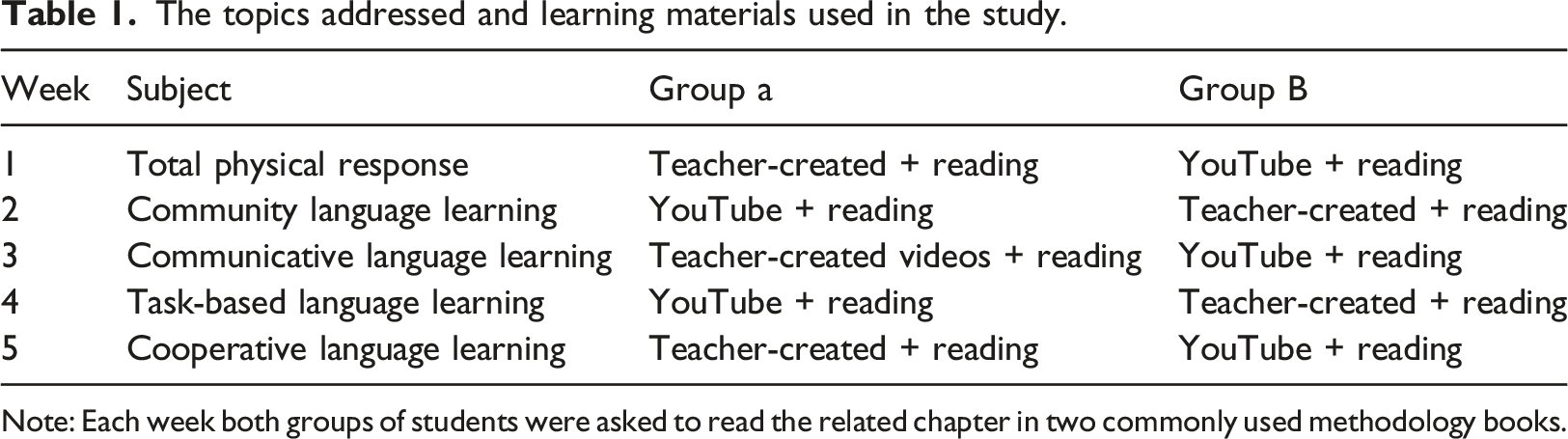
Note: Each week both groups of students were asked to read the related chapter in two commonly used methodology books.
Instructional videos
Two short videos for each topic were created by the teacher. The teacher-created videos were augmented using pre-watching questions, factual questions, which were intended to facilitate the understanding of the major features of the method and discussion questions for exchanging opinions (see the Appendix 1). On the other hand, YouTube videos were not augmented; only their links were provided. They were selected based on several criteria: a. Their contents were the same as those of the interactive videos. For instance, the topic in the first week was the total physical response method. Both interactive and YouTube videos included mini lectures about it. b. Their durations were approximately the same with those of the interactive videos. c. They were of acceptable video quality.
Data collection tools
Digital literacy scale
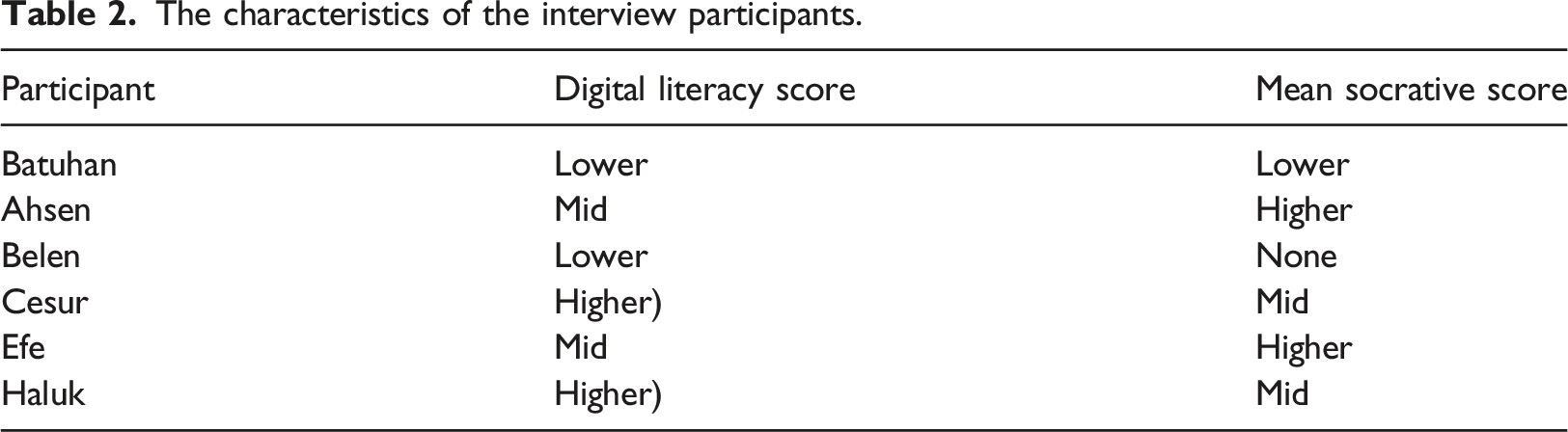
As the instructional design used in the present study included technology-enhanced components, the researchers used a digital literacy scale to recruit interview participants with lower and higher digital literacy levels to add richness to the qualitative data. A digital literacy scale, developed by Ng (2012) and adapted into Turkish by Üstündağ et al. (2017), was used to identify the participants’ levels of digital literacy. A literacy score out of 50 was calculated for each learner. This score was used to recruit the interview participants (lower, average and higher scores).
Semi-structured interviews
Following the instruction, semi-structured interviews were carried out with six participants (four males and two females). We used semi-structured interviews because we needed flexibility to adjust the flow of the interview based on the participants’ responses. On the other hand, the interview protocol functioned as a guide that helped keep track of what to focus on during the interview. The interview addressed issues related to (a) their experience of watching interactive videos enriched with questions and forum discussions, (b) how the participants perceived teacher-created and YouTube videos and to what extent these videos helped motivate them, (c) the teacher’s presence in the videos, (d) the level of participation in out-of-class video watching activities, (e) the learners’ perspectives of formative tests given in each session and (f) their views of the interactive videos, challenges and suggestions for improvement. The semi-structured interview protocol included 12 questions intended to explore the participants’ experiences, but the interviewer also asked some probing questions whenever applicable. The participants were encouraged to express themselves freely without limitations of time, but they usually provided short responses (See Appendix 1 for the interview protocol). The interviews were carried out by the first author in Turkish, and each of them lasted approximately half an hour. They were audio-recorded, and the recordings were transcribed verbatim.
Reflective journals (RJ)
The participants were asked to respond to reflective journal (RJ) prompts. 29 students (including the six interview participants) kept reflective journals in English. All the participants were requested to respond to the following guiding questions each week. Q1. What have you experienced this week? Describe briefly what kind of activities you have observed/been involved in and whether you have been satisfied with it, indicating the reasons. Q2. What have you learnt from this experience you think that can be applied in your teaching procedure? Knowledge/skills/strategies? Q3. Try to reflect on your feelings this week. You may include some memorable moments you valued. Then indicate your own interpretation or comments on them. Finally, explain why it was significant for you.
Lecturer’s diary
The second researcher (the class teacher) kept a weekly diary, in which she recorded information about the procedures followed, her impressions about the activities and the students, challenges and how the students were doing.
Validation
The characteristics of the interview participants.
Data analysis
The interview recordings were transcribed and analysed using Nvivo v1.3. The authors used no predetermined codes; the data were analysed using inductive content analysis, in which they (a) got familiar with the data at the beginning, (b) did initial coding (mostly descriptive), (c) searched for themes based on initial coding, (d) reviewed the codes by further reading and coding and (e) defined the themes and labelled them. They considered not only frequency but also prevalence of the ideas, but the latter was considered more important. The relationships between ideas were explored and tested against the data from the interviews, reflective journals and lecturer’s diary. The codes and themes were revised using data from negative cases. Annotations and memos helped the researchers to facilitate, support and enrich the analysis. The analysis and the resulting codes and themes were fine-tuned through iterative cycles of reading and coding. The exemplar codes were selected based on their representativeness and from different participants to ensure multivocality. They were then translated into English by the first author and were checked by the second.
Findings
Theme 1. Poor pre-class performance is a multi-dimensional phenomenon.
This theme pooled participants' views on a variety of negative factors that affected their pre-class performance. The pre-class performance was poor, but there was considerable variability among the students. That is, while some students failed to watch the videos and read the assigned chapters, there were also others who worked diligently (e.g. Efe and Ahsen). An earlier analysis indicated that the students failed to complete the assignments, due to lack of motivation. However, deeper analyses indicated that the issue was much more complex than initially thought. That is, poor pre-class performance was influenced by various interconnected problems that were clustered into instructional-side and learner-side issues (Figure 1). The multi-dimensional causes of poor performance in the pre-class work.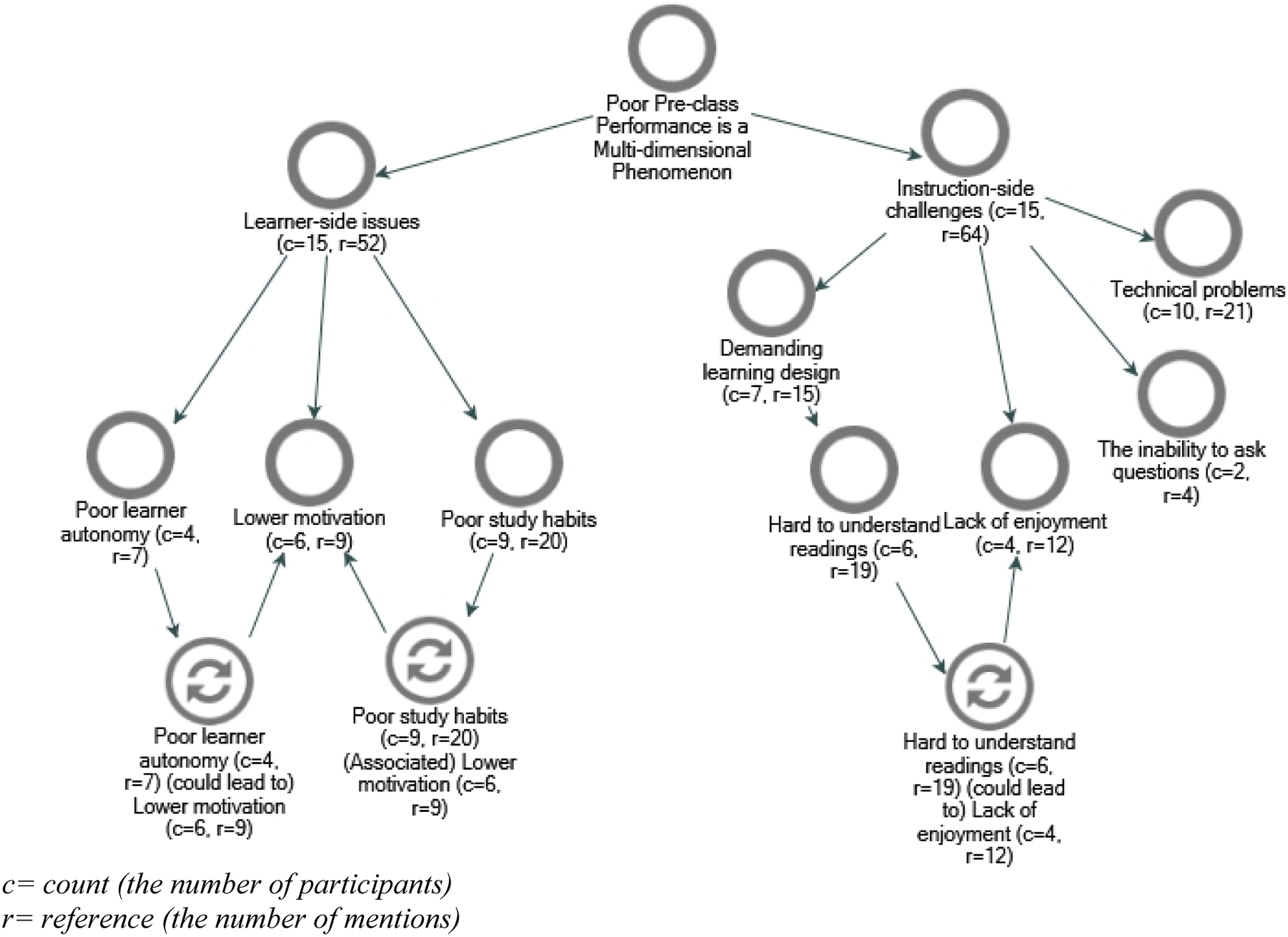
Instruction-side challenges
This category was composed of issues related to the nature of flipped learning itself and the instructional materials.
Demanding learning design
The learning design was described as ‘demanding’ by most of the participants. First, having to spare time for the lesson, not only at school but also at home, was tiring for them. “Reading the chapters and watching the videos at home were time consuming. Obviously, doing something both at school and at home was tiring for us” (Ahsen, interview). Cesur complained about how hard the lesson was: “… Our friends had a hard time concentrating on the subject because it is a difficult lesson, in terms of both language and content” (Cesur, interview). The content was considered theoretical, and this seemed to have decreased their motivation. “... I have never done theoretical stuff with pleasure, I’m not interested in it” (Batuhan, interview). Second, although the researchers did not set out to explore the participants’ perspectives of the assigned readings, it later became clear in the interview and reflective journal data that the language of the readings was a significant challenge, and this made the learning design even more demanding. All the six interview participants unanimously reported that the language of the readings was difficult to understand. “Almost everyone agrees that reading only once is not enough to comprehend it” (Belen, interview). “The language of the book was not comprehensible; reading it once would not suffice” (Haluk, interview). This issue was also brought up in the reflective journals.
Technical problems
The participants also reported that they had experienced some technical difficulties. These difficulties included accessing the interactive videos, problems with the interface of the interactive video tool and internet access. Several students reported that they initially could not see the comments made by others in the discussions. Some participants, including one with a higher digital literacy score found the interface of the interactive video tool a little bit confusing: “The interface of PlayPosit may seem a little bit complicated to some students” (Haluk, interview). The data from the lecturer’s diary verified this: “Some students had some technical problems in the registration phase” (Lecturer’s diary, week-1). The technical problems seemed to have demotivated the students in undertaking further work.
Lack of enjoyment
There were participants who reported that they frequently found themselves gaining no enjoyment from some of the tasks. “The book was boring to me. I didn’t want to read it” (Haluk, interview). Even Efe, one of the most exceptional students (as he did much more than requested) stated that he got bored at times (Efe, RJ, Week-4). Although a few students reported boredom while watching the videos, the students frequently used the words “boredom” and “difficult readings” together in the same context, which suggested that difficult readings led to boredom.
The inability to ask questions
Two of the interview participants noted that they were unable to ask the teacher questions while studying at home, yet this issue was not mentioned in the reflective journals. Ahsen said: “On the one hand, we can understand the subject better because we work at home. On the other hand, there is nobody at home where we can get help about the points we don’t understand” (interview). Cesur voiced similar opinions: “Not having a teacher in front of us while studying at home was a bit of a challenge because we could not have direct contact with our teacher when we did not understand… We can directly ask the teacher questions at school” (interview).
Learner-side issues
This category was mainly composed of problems related to the characteristics of the participants or how they behaved.
Lower motivation
The participants attributed poor performance to lower motivation and other perceived factors that added to this problem (lower learner autonomy and weaker sense of responsibility). “Generally considered, there was also reluctance in the classroom” (Belen, interview). Lower motivation seemed to have persisted throughout the instruction. “I noticed that I am not motivated enough this week” (Sude, RJ, week-4). “I feel really unwilling this week. I didn’t want to prepare for this lesson” (Sinan, RJ, Week 2).
Lower motivation was linked with poor learner autonomy and weaker sense of responsibility. The lower performers seemed to hold the belief that “the lecturer is the source of knowledge and she has got the responsibility to transfer her knowledge to students” (Lecturer’s diary, Week 5). This also was one of the perceived reasons that led to poor participation in out-of-class activities. Besides this, the participants criticized themselves or peers. Efe, a diligent student, clearly considered “sense of responsibility” as a necessary condition. The lecturer’s diary further supported this. Theme 2. Enriched (interactive) videos with effective delivery could work well.
The students found teacher-created interactive videos more effective. They liked the way interactive components worked and found them highly effective (count [c]=10, r [reference]=19). Two interview participants and four reflective journal writers reported that the interactive videos were easy to understand (c=6, r=8). “This week I was in the interactive video group. Comparing interactive to traditional videos, I can say interactive ones were more effective in explaining the topic and making it more memorable” (Selim, RJ, W2). Efe said, “When in the traditional group, I couldn’t get a clear idea of the topic… just watching traditional videos wouldn’t be that helpful. It would be boring and ineffective. As questions appear while watching the interactive videos, we are guided back to the book” (interview). Efe also noted that he did better in Socrative tests when he watched interactive videos.
Another aspect of interactive videos discussed by two of the participants was immediate feedback. In the reflective journal, Cesur wrote: “It is very fruitful to be in the interactive group because we can immediately learn the correct answers, and it makes things clear” (Cesur, RJ, week-5). What he said in the interview further supported this: “… interactive videos tested our understanding while we were watching them. That’s why they were so much better and more efficient” (Cesur, interview). However, as one negative case highlighted, seeing immediate feedback could prove discouraging, especially when the student answers are not correct.
The interactive videos also included discussion questions which theoretically had the power to facilitate interaction among the students and between the teacher and students. However, as the data from the interactive video logs indicated, the participants mostly responded to the embedded discussion questions and less frequently interacted with peers. Unlike an overwhelming majority of the participants, Efe, the student with the highest participation rate in the discussions, was aware of the value of discussions: “First of all, we have access to resources we can use while writing. We can perfect our sentences as we write. … We have time to think. We can delete what we write or rewrite or edit it” (interview). Theme 3. Videos, particularly teacher-created videos, were a shortcut to understanding the content; YouTube videos were more enjoyable for the participants.
The students found the videos more enjoyable and less time-consuming than the reading assignments. “I enjoyed watching videos rather than reading texts because reading the whole content takes much more time. By watching them, I saved time” (Haluk, RJ, Week-1). Ahsen, for example, commented, “It was better to learn by watching the videos than to learn by reading; it was more motivating.” (interview). The students found both groups of videos equally comprehensible enough. However, they found YouTube videos more enjoyable and livelier. For example, Cesur said, “As I said, I was able to concentrate on the [YouTube] videos because they were more interesting and livelier in terms of visuals and animations” (interview). However, not every student found YouTube videos enjoyable. For instance, Ece said, “I studied at home. First, I read the book and later watched the videos. I studied in the traditional video group, but I think the videos are a little boring” (Ece, RJ, week-2). Similarly, Haluk commented: “The traditional [videos] did not motivate me much, frankly” (interview).
On the one hand, the students thought that teacher-created videos were a little “serious” and “monotonous,” “As I said, they [the teacher-created videos] seemed a bit serious and lifeless to me. I think they should be better in terms of visuals and delivery” (Cesur, int). On the other hand, they appreciated the teacher’s effort: “Understandably, our teacher is not a professional in this [preparing videos]. Her job is teaching… I also told her that I respected her effort. She spared time for such things and prepared something for us. Now, when you appreciate her effort, you concentrate on the work even more” (Efe, int). The lecturer’s diary verified what these participants said. Another participant used more positive expressions that highlighted how teacher-created videos motivated him. “Our teacher’s videos sounded familiar to our ears as we are familiar with her. And because she is our teacher, I was also curious” (Batuhan, interview). Globally considered, the learners found teacher videos easy to understand but monotonous. However, due to the interactive components they included, these videos were considered instructive enough. Theme 4. Socrative functioned as a self-regulation tool.
The lecturer gave the participants Socrative quizzes. They liked not only taking Socrative tests but also preparing their own quizzes and assessing their peers’ knowledge. “I liked Socrative activity because it is beneficial for revising what we learned from the book” (Pelin, RJ, week-2). “I really liked the activity of two groups preparing questions for each other and answering them” (Zeki, RJ, week-3). The students also thought that weekly Socrative quizzes motivated them to do the out-of-class work (count=5, reference=8). “I think I read the chapter more carefully, as I expected a test in the beginning of the class. I watched the videos a little more carefully” (Ahsen, interview). Moreover, further enriched with post-test explanations from the teacher, Socrative was considered as a source of feedback. “Socrative tests followed by the teacher’s explanation made the topic easier and clearer to understand” (Cesur, RJ, week-2).
With such uses, Socrative functioned as a self-regulation tool that helped the learners to be aware of what they must do next (Figure 2). It helped them to see how well they were doing: “The questions in Socrative pushed me to think about what I had learned” (Cemre, RJ, week-2). Borrowing the words of Belen, this category can be neatly encapsulated: “For example, to correctly answer the questions in Socrative, it was essential that we read the chapter. Therefore, we did the out-of-class activities. People read the chapter to be able to do better in Socrative” (interview). However, being a negative case, Haluk noted that Socrative quizzes were not a source of motivation: “I thought I could easily answer the Socrative questions [without reading the chapter] … I don’t think anyone cared that much, even though our teacher could see our responses” Similarly, Batuhan noted that they were boring. These two students sometimes failed to do the assignments, suggesting that in-class quizzes might be considered useful for more hardworking students. A representation of the learner response system (Socrative) used as an in-class activity.
Discussion
Q1. What are the perceived factors that influenced the participants’ doing the pre-class tasks?
The data indicated that nearly half of the students worked diligently to do the pre-class work. The rest reported being less willing to do it. Lower task completion levels for these participants were obvious from the interactive video monitoring data, student interviews, student reflections and the lecturer’s diary. However, the videos were found to be more useful and enjoyable than the assigned readings. The learners thought that the videos were a shortcut to learning; some noted that reading the chapter took much more time than watching the videos, and the reading passages were considered highly difficult to understand. Therefore, they mostly depended on the videos to learn the content.
One of the most significant findings of the present study was that lower pre-class performance was a multi-dimensional phenomenon shaped and influenced by various factors, related not only with the learners but also with the instructional design. On the one hand, learner characteristics and behaviour had a significant share in lower pre-class performance. Lower motivation, for example, was an issue that had a negative impact on pre-class performance. Poor motivation was also the result of feeling overwhelmed as they had tasks in other classes. Bad study habits seemed to be a significant student-side challenge in flipped learning.
Another major finding was that the evidence we found points to lower learner autonomy as a major learner-side reason why the students performed poorly. As found by Kırmızı and Kömeç (2019), overdependence on the teacher and poor learner autonomy could lead to poor motivation. Previous studies found that flipped learning improved learner autonomy (e.g. Han, 2015). However, a major finding from the present study is that a certain level of autonomy is essential (as a precondition) for successful implementation of flipped learning, which could help develop it further. As Cockrum (2014) proposed, teachers and learners are to get out of their comfort zones and be active both inside and outside the classroom to ensure successful implementation of flipped learning. Stepping out of their comfort zone could mean being active both inside and outside the classroom. Doing research and choosing relevant information, according to Ryan (2013), forces learners to leave their comfort zones and to assume the responsibility for their own learning. As voiced by some of the participants in Moraros, Islam, Yu, Banow and Schindelka’s study (2015), two of our participants complained about the lack of opportunities to ask the teacher questions at home, but they did not report seeking practical solutions to this problem, such as doing research or contacting the lecturer. As the lecturer mentioned in her reflective journal, the students maintained the belief that the lecturer is the source of knowledge and he or she has got the responsibility to transfer their knowledge to students. Except for a few, the participants did not say that they did research. Moreover, they could have interacted with the teacher via the discussion questions to eliminate the problem of being unable to ask the teacher questions, but interactive video logs indicated that they preferred to respond to the teacher’s question rather than interact with her and their peers.
The data also indicated that lower pre-class performance can be attributed to instruction-side issues. A major theme was that the learners experienced some technical difficulties, which was also identified in a metasynthesis carried out by Turan and Akdağ - Ç imen (2020). Some of the participants complained about poor internet connection. This finding lent support to other studies (Aghaei et al., 2019; Correa, 2015), in which inadequate system infrastructure was considered as a major obstacle. 2015) in which inadequate system infrastructure was considered as a major obstacle in the path of successful implementation. To address the internet connection problems researchers or teachers provided the videos in CDs to eliminate possible Internet access problems (Mohammadi et al., 2019). This could be a viable option particularly if a limited number of students experience this problem. Another major source of technical problems was the interactive video tool itself. Students almost unanimously reported that they had difficulty in accessing the interactive videos and seeing the comments made by others during the first week, yet it was soon resolved when the participants got used to the tool. Besides technological problems experienced, some of the participants found the learning design demanding. This finding supported that of a systematic review carried out by Turan and Akdağ - Ç imen (2020), which revealed that flipped learning increased the workload of both teachers and learners.
Another significant problem was the difficult language of the readings. The results of the present study indicated that all the interview participants, along with some reflective journal writers, in the present study found the assigned chapters difficult to understand. However, their study skills and level of learner autonomy were apparently not enough to deal with such a learning design. Therefore, harder readings decreased their motivation to read the chapters. Probably due to this perceived challenge and inadequate coping strategies, most of them did not read the chapters and preferred to watch the videos. This is in good agreement with Kurt’s (2017) study, in which ELT students found videos more enjoyable than assigned readings.
Q2. What do the participants think about teacher-created interactive videos and ready-made (YouTube) videos as out-of-class learning materials in a flipped class?
One of the most remarkable results to emerge from the data is that the participants were interested in the quality of the videos, rather than who created them. Although they appreciated the effort put by the teacher, they also found the teacher-created videos a little boring, which supported Herreid and Schiller’s (2013) claim that teacher-created videos could be marginal in quality. In fact, although teacher-created videos could be valuable for increasing familiarity and teacher presence, this potential value is bound to be overshadowed if delivery is poor and speech is monotonous. This is highly likely as most teachers could lack the expertise needed for good video creation. As was the case in other studies (Alghasab, 2020), some of our participants reported they were not very happy with the quality of the videos. Similarly, boring lessons that fail to engage learners was considered among concerns that Correa (2015) mentioned. One participant’s words described the features of potentially more useful videos. He earnestly suggested selecting the videos from YouTube and enriching them with interactive elements. On the other hand, the participants found interactive elements highly effective.
what are the perceived characteristics of motivating instructional materials for pre-class tasks?
The creator of the videos was not deemed very significant, the participants attached more importance to quality (enjoyableness and delivery) than to their teacher’s presence. The results of the present study indicated that interactive videos could be used to monitor learners’ out of class work, and texts of video discussions could be “food for thought” in in-class activities. Discussion questions could be a tool for learners to clarify unclear points and could be a step towards eliminating the complaint that it is not possible for learners to ask questions for clarification, as voiced by the participants in Kırmızı and Kömeç’s (2019) study. The participants in the present study liked testing their peers by using the questions they prepared (in Socrative). This activity included an element of gamification, which, as Zainuddin (2018) found, helped some of the learners get motivated. In this sense, it could be better to use a combination of instructional tools (e.g. interactive videos and gamified in-class quizzes), interesting and enjoyable content and elements of external motivation. For an external element of motivation, teacher-administered quizzes can be used to motivate learners to watch the assigned videos.
A major theme that emerged from the study was that the perceived challenge in understanding the language of the assigned chapters caused the learners to fail to do the reading assignments. Therefore, adopting the principle of “easier materials” as commonly applied in extensive reading, teachers could assign reading texts that are a little below their linguistic level in terms of difficulty. The comparative data (teacher-created interactive videos versus YouTube videos) provided basic characteristics of pedagogically more appropriate videos (Figure 3). The participants’ perspective of the features of potentially useful videos.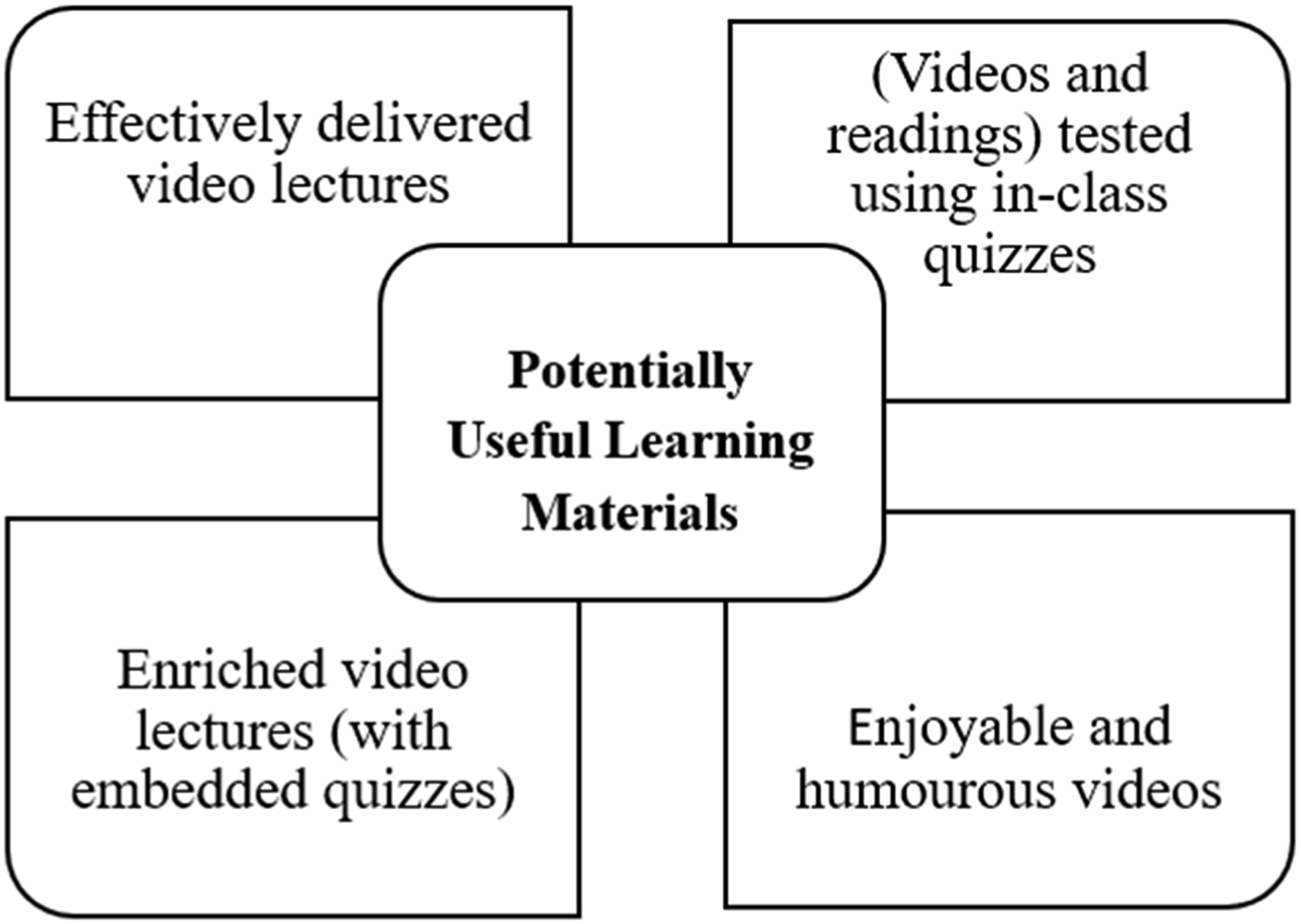
Pedagogical implications
As the results of the present study and earlier ones (e.g. Admiraal et al., 2017; Aghaei et al., 2019; De Araujo et al., 2017; Patanwala et al., 2017; Watanabe, 2014) indicated, getting students to do the assignments at home is one of the persistent problems in flipped classrooms. When learners fail to gain some background knowledge by reading or watching videos, the class teacher usually has a hard time introducing active learning strategies. Based on the findings of the present study, and in line with Zainuddin’s (2018) suggestion, educators must trial new strategies that could motivate learners in pre-class work.
As some researchers note, boring videos/materials could be a serious problem (e.g. Correa, 2015). Therefore, teachers are to create or find well-prepared, fun and lively videos. Based on the data from our study, we could suggest turning such well-prepared videos into hypervideos by adding interactive components to further add to their value because the participants found interactive components in videos highly instructive. It should be noted that they attached more importance to video quality (pedagogical value), than who created it; in other words, their teacher presence was considered less significant than the nature of the video. Therefore, teachers could use professionally created online videos and turn them into interactive videos. In this way, they could save time and provide their students with higher quality materials. Moreover, as the data from the present study indicated, regardless of who creates them, videos should not be purely theoretical. If a teacher is to create his/her own videos, he/she should make sure that the delivery is fun and lively. Wherever possible, it is wise to provide practical information and show demonstrations and give examples.
Although the videos in this study were not lengthy (five to 10 min), the learners had to watch the videos twice (see Materials Section), so that a different set of embedded questions could be posed. Lower levels of video watching in the present study indicated that asking the students to watch the videos twice might not be a good idea. Teachers are to strike a balance between control and flexibility in designing interactive videos in terms of density of interactions and how many times learners are asked to watch them. Although none of the participants voiced a complaint about having to watch the interactive videos twice, this might have had an impact upon their willingness to watch the videos. Rather than adopting a one-for-all approach, decisions could be based on features of the topic presented in the videos.
Besides providing learners with pedagogically high-quality materials, considering learners’ workload into consideration while identifying the amount of pre-class work is critical because as the data from the present study indicated, (as found in Turan and Akdağ-Çimen, 2020) learners’ perceived workload could have a significant impact on their pre-class performance. Therefore, prudence in decision-making as regards how much homework to assign is essential. Nicolosi (2012) claims that if students are assigned manageable assignments, it is likely that they will do it. Therefore, assignments that are beyond the capacity of the students should be avoided. Nicolosi (2012) also recommends teaching learners how to manage their time well rather than just telling them that they must study harder. Moreover, doing homework assignments seems to be a matter of habits. Those who are not accustomed to doing homework could pose a significant challenge for flipped classes. Therefore, teachers are to take into consideration to what extent students tend to do homework assignments. Globally considered, we urge prudence in assigning reading and watching tasks as pre-class work. It is not possible to tell how demanding a task is without reference to the targeted learners. Teachers have to consider the characteristics of their students and the learning context while deciding what and how much to assign as homework. Flipped instruction may not be a good option for a class with students with poor study habits or with less autonomous learners. Learner autonomy is so significant for flipped learning that teachers could seek ways to train learners to gain a certain level of autonomy before flipping their classes.
As the data from the study indicated, completion of the pre-class work by all students seems unlikely, so effective solutions to this problem should be sought. The flipped learning supported by interactive videos and Socrative could be good for more hardworking students, but less motivated students are to be considered as well. The teacher, upon monitoring their pre-class performance, could provide short in-class lectures whenever necessary, making the whole instructional design a semi-flipped one. Yet, this could lead to a predicament as was the case in Admiraal et al.’s (2017) study, in which the teacher candidates reported that they were faced in a serious dilemma over whether to provide short in-class lectures for unprepared students. Therefore, alternative methods could be used. For instance, as suggested by Nicolosi (2012), unprepared students could be requested to observe group discussion and take down notes, rather than directly take part in the discussions. Bergmann and Sams (2012) asked the students who failed to view the videos at home to watch them in the class using a computer reserved for this. It is claimed that such a practice helped learners to recognize the importance of the teacher’s guidance in the classroom (Bergmann and Sams, 2012). This practice was also adopted by some other researchers (Chi-Jen and Gwo-Jen, 2018; Lin and Hwang, 2018).
Flipped learning does not necessitate an all-or-none approach; that is, as Filiz and Kurt (2015) simply put it, you can use flipped learning to teach a single subject in a course or implement it for one semester or throughout the academic year. Depending on the learning environment, characteristics of learners, and the nature of the subject, questions regarding what, when and how much to flip should be answered (Sales, 2013). A teacher might want to flip a certain portion of the course for a limited time because that portion yields itself for flipped learning (Stannard, 2015). Similarly, flipped instruction may not be a good option for a class with students with poor study habits or with less autonomous learners. Therefore, teachers could seek ways to improve learners’ study habits and autonomy before flipping their classes.
Limitations and further research
One of the limitations of the present study was that we implemented flipped learning for a short time. Learners’ getting accustomed to the nature of flipped learning over time could have provided different data. Therefore, further research could be carried out for longer periods. We tried to increase teacher presence by adding interactive components (embedded questions and discussion) to teacher-created videos; we did not use them separately. To see the genuine impact of interactive components on students’ task completion, motivation and content recall in flipped learning, future researchers could empirically test the impact of traditional and interactive versions of teacher-created and ready-made videos on students’ motivation, their pre-class task completion levels and in-class quiz scores.
The data from the present study indicated that interactive videos could be useful, so prospective researchers could investigate what interactive elements might better increase learner motivation and achievement. Different methods of increasing teacher presence (except for using teacher-created videos and the teacher’s participating in online discussions) were beyond the scope of this study, so further research could investigate the impact of increased teacher presence on students’ pre-class task performance. Another worthwhile topic of future research could be seeking best methods for dealing with unprepared students in the classroom. Our approach took advantage of Socrative as an in-class quizzing and gamification tool as suggested by Zainuddin (2018), but we did not use gamification outside the class. Therefore, future researchers can investigate gamification in pre-class work.
Footnotes
Declaration of conflicting interests
The author(s) declared no potential conflicts of interest with respect to the research, authorship, and/or publication of this article.
Funding
The author(s) received no financial support for the research, authorship, and/or publication of this article.