




Abstract
During the first months of the COVID-19 pandemic, most schools worldwide were closed and online teaching replaced face-to-face teaching. This study reports the results of a survey among 845 teachers of primary and secondary education in Greece who taught their students fully remotely during the pandemic lockdown. These Greek teachers expressed the difficulties that they faced as well as the opportunities that they gained during this emergency distance teaching (EDT). Through qualitative content analysis this study found that everyone (students, teachers, and state) involved in EDT faced various difficulties due to digital infrastructure’s inadequacy, limited support by the state, limited digital educational material, as well as low digital literacy of students, parents, and even some teachers. On the other hand, there were many opportunities for teachers to experiment and apply their prior training knowledge on distance education to EDT. More concretely, teachers managed not only to improve their teaching and digital skills, to enrich and organise their educational material with more interesting online educational resources, but also to collaborate with colleagues, and to maintain effective communication with students. Similarly, students had opportunities to improve their digital and soft skills and receive personalized teaching. However, some teachers believed that their workload and their available free time increased while other teachers believed the opposite. Also, some teachers believed that students’ participation and engagement increased while other teachers believed the opposite. Finally, the study suggests actions to be taken to support the teachers in EDT such as improvements in digital infrastructure, digital educational material, teachers’ training, as well as support and clear guidelines by the educational authorities.
Keywords
Introduction
About 1.6 billion students and 63 million primary and secondary education teachers in almost all countries of the world have been affected by the COVID-19 pandemic (United Nations (UN), 2020; UNESCO, 2020a). Due to health directives about social distancing, schools were closed shifting teaching from face-to-face to fully online teaching. This sudden disruption of the education systems has affected 94% of the world’s student population during spring 2020. Online platforms, television or radio were employed by almost all countries to deliver teaching. Specifically, 60% of countries offered an online learning platform developed by their ministry of education (UNESCO, 2020a). Note that in 2018 (Ikeda, 2020), only half of 15 years old students in OECD countries were studying at schools with an effective online learning platform. According to the United Nations’ latest report (UN, 2020) about three-quarters of teachers were required to teach using online learning platforms, often without sufficient guidance, training, or resources. Furthermore, about three-quarters of teachers were required to continue teaching supported by television or radio. Finally, about half of teachers were required to continue teaching using mobile phones. The teachers had to quickly adapt their teaching material and pedagogical practices to emergency distance teaching (EDT). However, not all students and teachers were equipped with the necessary devices and skills to participate in online teaching and learning. In some European countries, most students and teachers had little experience of teaching and learning online (European Commission, 2020). Actually, 67% of EU teachers had no previous online teaching experience, 25% had some experience, and only 6% had extensive experience with the online teaching (School Education Gateway, 2020). In order for the online teaching and learning to be effective, students and teachers should be equipped with appropriate Internet connectivity and devices, as well as with at least basic digital skills. Furthermore, teachers should be able to use digital technologies and various pedagogical methods for online teaching ensuring that all students participate in the teaching and learning process (European Commission, 2020; School Education Gateway, 2020).
According to European Commission (2020), the most important requirement of digital education is teachers’ development of educator-specific digital competences, followed by leadership, as well as by appropriate digital educational resources and infrastructure. Regarding the level of teachers’ digital skills before the COVID-19 pandemic, more than one-third of students in OECD countries were taught by teachers who were not equipped with skills and resources to integrate digital technologies in teaching (Ikeda, 2020).
It is obvious that distance teaching brings several particularities that should be seriously considered during the design of distance courses especially in the context of EDT during pandemic lockdown. This study seeks to investigate the teachers’ perceived difficulties and opportunities in EDT during the pandemic lockdown. Based on the discussion above, this study aims at answering the following research questions:
More concretely, this study examines the above research questions exploiting the results of a survey that was conducted among 845 Greek teachers in primary and secondary education. These 845 teachers had successfully completed a National Teachers’ Training Programme on integration of digital technologies in teaching during the first months of the COVID-19 pandemic. Due to the Greek schools’ lockdown, all teachers had to deliver their courses via distance education methods. Just after completing the Training Programme these teachers answered our questionnaire. The teachers’ responses were analysed using content analysis (Hsieh and Shannon, 2005; Neuendorf and Kumar, 2016). The main contribution of this study is to shed light on the teachers’ perceived difficulties and opportunities in distance teaching during pandemic lockdown. The results of this study can be used by researchers, educational authorities, educational institutions, and educators towards the design of effective educational policies, guidelines, actions, and teaching methods in distance education. Furthermore, the findings of this study might also be useful for preparing for emergency distance teaching as well as responding to crises that necessitate measures for emergency distance education.
Previous studies on teachers’ difficulties in emergency distance teaching
During the COVID-19 pandemic and the forced quarantine, teachers had to teach and work online from their home while their students had to attend their classes online from their own home, possibly with the help of their parents. However, teachers faced a plethora of difficulties originated by themselves, their students and their parents, as well as by the school and the state.
According to a recent European study (School Education Gateway, 2020) half of EU teachers considered that their students’ access to technology (computers, software, stable Internet connection, etc.) was the main challenge in their online distance teaching courses. More than 40% of teachers stated that their main online distance teaching challenges were the increased workload and stress working from home, as well as keeping students motivated and engaged. Furthermore, more than one-third of teachers said that both their own access to technology and involving pupils from socially disadvantaged homes were their biggest challenges in online distance teaching.
During emergency distance teaching, a teacher had to overcome difficulties originated from three sources: (i) the teacher him/herself, (ii) the students and their parents, and (iii) the school and the state. More specifically, a teacher or/and a student may be facing the following personal difficulties: • Inefficient personal digital infrastructure: Lack of effective Internet connection, wi-fi, laptop, desktop computer, mobile phone, software (e.g., videoconferencing, collaboration tools, security tools, etc.), electricity, etc. (e.g., Di Pietro et al., 2020; European Commission, 2020; Ferri et al., 2020; Klapproth et al., 2020; Korkmaz and Toraman, 2020; Mseleku, 2020; Ikeda, 2020; Radu et al., 2020; School Education Gateway, 2020); • Inefficient digital educational material & resources for online teaching and learning (e.g., European Commission, 2020; Mseleku, 2020; Ikeda, 2020; School Education Gateway, 2020); • Low digital skills (e.g., Di Pietro et al., 2020; Ikeda, 2020; School Education Gateway, 2020; UN, 2020); • Low soft skills such as communication, collaboration, self-regulation, self-organization, self-discipline, time management, adaptability/flexibility skills (e.g., European Commission, 2020; Korkmaz and Toraman, 2020; School Education Gateway, 2020); • Communication & collaboration difficulties (e.g., School Education Gateway, 2020); • Lack of personal contact, human touch & feel, gestures, multimodal communication (e.g., European Commission, 2020; Ferri et al., 2020; Radu et al., 2020; UNESCO, 2020c); • Lack of social contact, social presence, sense of community and belonging in a specific class (e.g., European Commission, 2020; Ferri et al., 2020); • Low interest, engagement, concentration, motivation, and enthusiasm towards online teaching and learning (e.g., Ferri et al., 2020; Klapproth et al., 2020; Radu et al., 2020; School Education Gateway); • Technology-originated health problems, e.g., too many hours in front of a computer screen may cause eyestrain, musculoskeletal and joint problems, headaches, insomnia (e.g., Radu et al., 2020); • Negative psychological and emotional factors, e.g., stress, anxiety, fear, isolation/loneliness, depression, confusion, burnout, nervousness, anger, boredom (e.g., INEE, 2020; ITFTE, 2020; Klapproth et al., 2020; Mseleku et al., 2020; Oducado et al., 2020; School Education Gateway; UNESCO, 2020c; UNESCO, 2020b); • Work overload: Increased workload and fatigue (e.g., European Commission, 2020; Hawani and Chikha, 2020; Kaden, 2020; Klapproth et al., 2020; School Education Gateway, 2020); • Information overload and cognitive fatigue (e.g., European Commission, 2020); • Technology overload and cognitive fatigue (e.g., Estrada-Muñoz et al., 2020); • Lack of privacy, e.g., lack of private space at home without noise and other disturbances (e.g., Ferri et al., 2020; Ikeda, 2020); • Digital safety risks, e.g., bullying, harassment, threat, hate speech (e.g., UNESCO, 2020c); • Disinformation, false information, hoaxes, fake news (e.g., European Commission, 2020);
In addition, a teacher may be facing the following teacher-specific difficulties: • Inefficient online teaching skills (Ikeda, 2020): Lack of teacher’s digital pedagogy skills, online instructional design skills, open educational resources (OERs) and open educational practices (OEPs) skills, online assessment skills (e.g., Ferri et al., 2020; Korkmaz and Toraman, 2020; School Education Gateway); • Time consuming to design online course (e.g., Stephens and Coryell, 2020); • Time consuming to interact, communicate, advise, feedback every single student (e.g., Stephens and Coryell, 2020); • Difficulties to teach students facing their own difficulties such as lack of personal digital infrastructure, lack of digital skills, lack of interest, negative psychology and emotions, fatigue, etc. (e.g., School Education Gateway); • Difficulties to maintain students’ interest, engagement, concentration, motivation, etc. (e.g., Korkmaz and Toraman, 2020; School Education Gateway, 2020); • Difficulties to continuously check students’ involvement and engagement (e.g., School Education Gateway, 2020); • Difficulties to remotely assess and evaluate students (e.g., School Education Gateway, 2020); • Difficulties to achieve fair, integrous, objective, and reliable assessments/exams, i.e., no cheating, plagiarism, copying, exposure (e.g., Radu et al., 2020); • Difficulties to support students’ technically, psychologically and pedagogically from a distance (e.g., Korkmaz and Toraman, 2020); • Difficulties to manage and teach a high variety of students who have large differences among themselves with respect to socio-economic environment, family & home environment, digital infrastructure and skills, etc. (e.g., Di Pietro et al., 2020; School Education Gateway, 2020; UNESCO, 2020c); • Students’ parents lacking general education and skills, e.g., cognitive, emotional, social, communication, collaboration, openness, as well digital skills (e.g., Di Pietro et al., 2020; Ferri et al., 2020; School Education Gateway, 2020).
Furthermore, teachers were facing the following difficulties originated by the state and their school: • Inefficient Digital Infrastructure by state & school: Lack of effective bandwidth in every computer network (wide area, metropolitan area, and local area networks), servers, uplink and downlink bandwidth of learning management systems and platforms, online services and functionalities of learning management systems and platforms, software (e.g., videoconferencing, collaboration tools, multimedia authoring, quizzes tools, plagiarism detection tools, security tools), online and virtual laboratories, etc. (e.g., European Commission, 2020; Ikeda, 2020; Promethean World, 2020); • Limited Digital Educational Material & Resources, e.g., OERs and/or Massive Open Online Courses (MOOCs) for all subjects, all educational levels, and all proficiency levels, etc. (e.g., European Commission, 2020); • Digital Educational Policies: Limited support to teachers, students & parents, teachers’ training, non-discrimination (inclusion) policies and digital divide consideration, flexible online teaching delivery scheduling, alternatives to physical laboratories and real experiments, online assessment policies, privacy protection policies, imposed/dictated instructional methods, etc. (e.g., European Commission, 2020; UN, 2020; UNESCO, 2020a; UNESCO, 2020b; School Education Gateway, 2020).
Apart from the difficulties, obstacles, and challenges that teachers faced in their online remote teaching experiences during the pandemic lockdown, there were also a number of opportunities, benefits, and gains that have emerged in this context and need to be mentioned.
Previous studies on teachers’ opportunities in emergency distance teaching
According to a recent study that was mentioned before (School Education Gateway, 2020) 40% of EU teachers stated that the most pleasant surprise in online remote teaching was their freedom to experiment innovative teaching scenarios, methods and strategies.
During emergency distance teaching and learning, both teachers and students may have the following opportunities and benefits in comparison to the face-to-face teaching: • Flexibility in teaching from anywhere (e.g., Di Pietro et al., 2020); • Comfort and safety in teaching and learning from any convenient place and personalized digital environment (e.g., Di Pietro et al., 2020); • Improved knowledge, skills, experience, and confidence on using digital technologies and tools (e.g., Stephens and Coryell, 2020); • Easier group formation, management, and collaborative work (e.g., Bozkurt et al., 2020);
In addition, teachers may have the following extra opportunities: • Increased teaching autonomy and agency (e.g., School Education Gateway, 2020); • Improved knowledge, skills, experience, and confidence on online teaching and learning (e.g., Stephens and Coryell, 2020); • Innovation and experimentation with various online teaching methods (e.g., School Education Gateway, 2020); • Teaching improvement with a variety of multimedia educational material (e.g., School Education Gateway, 2020); • New collaborations with fellow colleagues (e.g., Bozkurt et al., 2020).
Concluding this section, we need to underline that besides the big number of difficulties that teachers and students experienced in their online remote teaching/learning, many more positive surprises for education have emerged that need to be further explored in the near future. But how this new educational situation affected Greek teachers?
Context and participants
According to Cedefop (2020), on March, 10, 2020, the Greek government, in cooperation with the Greek National Public Health Organisation, decided to close all levels of school and higher education and to shift to online teaching and learning. The schools of primary and secondary education reopened hesitantly for some weeks during May 2020. During this pandemic period, students and teachers participated in synchronous and asynchronous distance teaching and learning. More specifically, the Greek Ministry of Education selected the Webex Meetings video conferencing service by Cisco to be used for synchronous distance teaching and practically more than one hundred thousand (100.000) primary and secondary education teachers have live-streamed their lessons to over one million learner views. There were recorded over 40 thousand (40.000) online courses per day and almost 10 million learners participated in these live classes. Furthermore, the national educational television (http://www.edutv.gr/) was broadcasting daily supplementary learning audio-visual material mainly for primary school pupils. Furthermore, primary and secondary education teachers and students had access to national digital learning platforms (i.e, dschool, e-me, e-class), OERs repositories (i.e, Photodentro, ebooks, Aesop), and educational portals.
Between March and June 2020, more than 5800 primary and secondary education teachers participated in a National training programme “Advanced Training for the Utilization and Application of ICT in the teaching practice”. All these teachers attended a 60-h blended training course that included online synchronous and asynchronous teaching and learning. They were supported by an asynchronous distance education, e-learning management, and “training material distribution” system which provided the following: (i) Ability to develop and publish "classic" e-courses (moodle platform); (ii) Ability to develop and publish MOOCs (edX platform); (iii) Ability to create and maintain trainees’ e-portfolios (mahara system); (iv) Ability to utilize Virtual Machines for specific subjects (e.g., internet security); (v) Tools for creating educational material and activities; vi) Digital material library/repository tools (Photodentro); (vii) Communication tools to enhance discussions and collaborative work between trainers - trainees (forum, chat); (viii) Evaluation and feedback tools. In addition, they were supported by a synchronous distance education system which provided the following: (i) Virtual classroom management and operation tools such as video conferencing, application sharing, whiteboard, presentation, chat, voting, session saving, etc. (e.g., BlackBoard Collaborate, Big Blue Button); (ii) Tools for virtual worlds’ development and utilization (opensim platform). Finally, there was a central information portal, a help desk, educational material repositories, qualifications certification and much more.
Methodology
The authors conducted a survey among these 5800 primary and secondary education teachers who were trained in utilizing digital technologies in their teaching practice from March to June 2020. This particular teacher population was selected mainly because it provided a convenient size due to the teachers’ high participation in the programme. Also, the authors could easily access this population compared to the generic teachers’ population due to the General Data Protection Regulation (GDPR). After the end of the training, a questionnaire in Greek language was sent via email to these 5800 teachers. The questionnaire was created using the online software QuestionPro and required respondents’ consensus for their volunteer and anonymous participation. All data was collected according to the ethical standards. No personal identification of data was collected. In addition to demographic questions, the questionnaire included two open-ended questions regarding the difficulties and obstacles that they faced as well as the opportunities, benefits, and gains derived within the context of EDT. Specifically, the teachers voluntarily and anonymously answered the following open-ended questions: “What was the biggest difficulty (problem, barrier) that you faced during the “COVID-19 emerged distance teaching” and how did you overcome it?” and “What was the biggest opportunity (advantage, benefit) that you encountered during the “COVID-19 emerged distance teaching” and how did you take advantage of it?”.
A total of 845 teachers successfully answered the questionnaire, 631 were female and 214 were male, with an average age of 41–50 years old. More than one-quarter of them were primary education teachers while the rest were secondary education teachers. About half of them hold a M.Sc. degree, 6% hold a Ph.D. degree, and the rest hold a B.Sc. degree. Regarding teaching experience using digital technologies, 24.5% had less than 5 years of experience, while 37.5% had 5–10 years, 22% had 11–15 years, 11% had 15–20 years, and the rest over 20 years of experience.
The teachers’ responses were investigated through content analysis (Hsieh and Shannon, 2005; Neuendorf and Kumar, 2016). According to Hsieh and Shannon (2005), content analysis is a popular qualitative research method. Its main analytical approaches regard the extraction of codes, coding categories or keywords from textual data to interpret the meaning from the content. In this study we followed the conventional content analysis approach which is based on the direct extraction of codes and themes (coding categories) from the text data which is one of the main three content analysis approaches (Hsien & Shannon, 2005).
Taking into consideration the findings of the literature review (described in the previous sections), three researchers in the field of Technology Enhanced Learning agreed on investigating the difficulties in EDT faced by (1) the teachers, (2) the students and (3) the state based on the teachers’ responses to the questionnaire. In the next steps, each researcher independently and repeatedly read the teachers’ responses. In the first readings, each researcher tried to immerse into the teachers’ views, gain insights, and obtain a sense of the whole. Next, each researcher read carefully the teachers’ responses word-by-word to derive initial themes that correspond to key difficulties of teachers, students, and the state taking also into consideration the literature review. Then the three researchers met, discussed the followed procedure and their initial findings, and came to a consensus regarding the final themes. Next, each researcher highlighted the instances for each theme with different color in his/her own copy of the text. The researchers met again and came to a consensus regarding these instances and their allocation to themes. Eventually, there was one common copy of the teachers’ responses highlighted with different colors for each theme. Finally, one researcher counted the instances for each theme (different color). The same procedure was followed for the teachers’ responses regarding the opportunities. The next section describes and discusses the research results.
Results and discussion
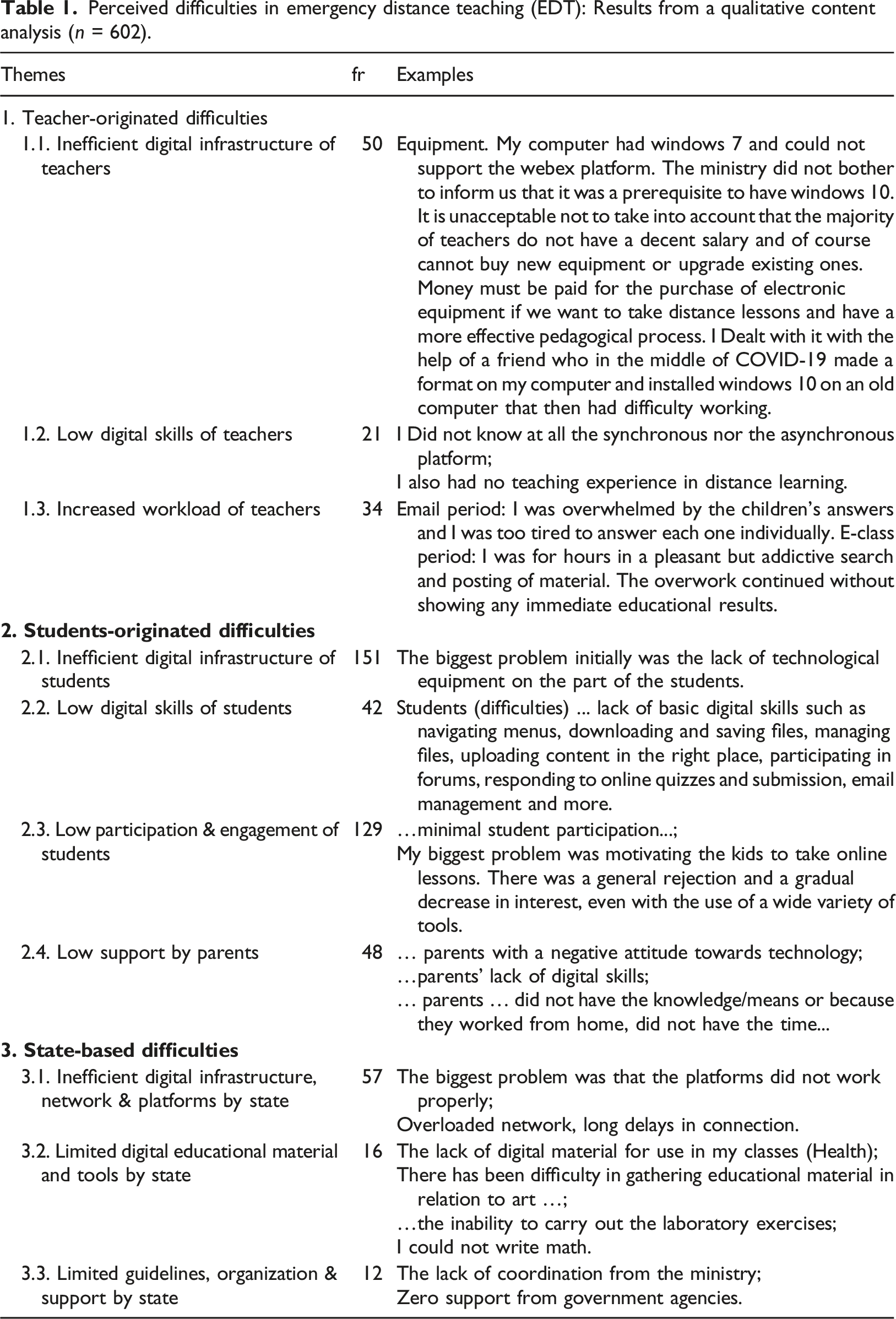
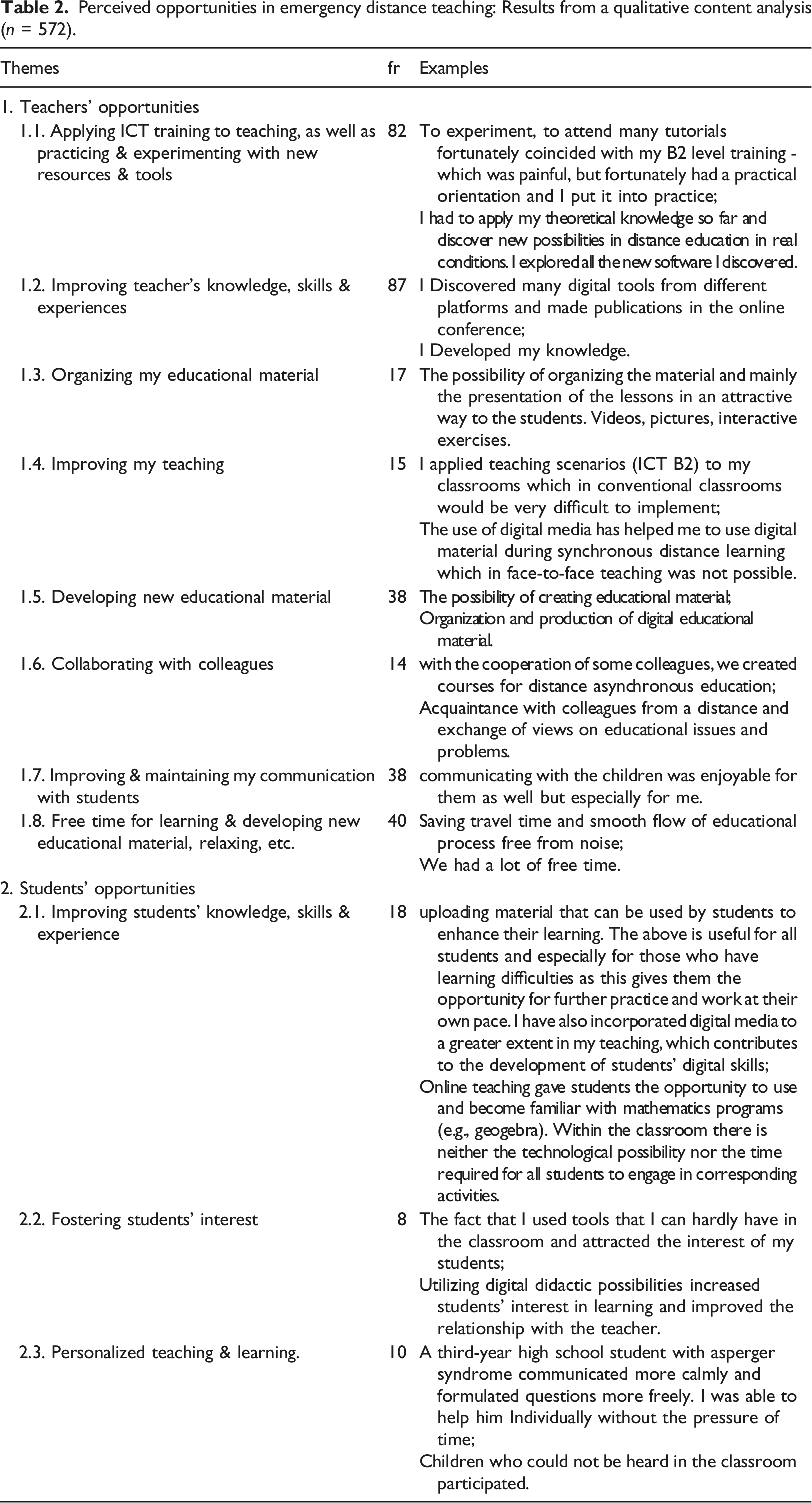
The survey’s participants provided 602 individual text responses regarding the difficulties they experienced in EDT, and 574 responses regarding the perceived opportunities in EDT.
Teachers’ perceived difficulties in EDT
Perceived difficulties in emergency distance teaching (EDT): Results from a qualitative content analysis (n = 602).
Perceived opportunities in emergency distance teaching: Results from a qualitative content analysis (n = 572).
The identified difficulties that teachers experienced in EDT covered a broad range including teachers-originated, students-originated, and state-originated difficulties. Many of the identified themes are in agreement with the ones mentioned in the literature review. In addition, teachers mentioned some extra difficulties. A total of 602 respondents (456 female, 146 male) provided text-based feedback about their perceived difficulties.
The most frequent difficulty was related to the students’ digital infrastructure (e.g., low or no Internet connection, no computers) followed by the low students’ participation that was due to their limited digital infrastructure at their homes, their low digital skills, the lack of ability of their parents to support them, and the non-mandatory teaching attendance. Especially, primary education teachers had serious problems because the children did not know how to utilize digital technologies and could not attend long duration online classes. There were also many problems with both teachers’ and the state’s digital infrastructures. Moreover, teachers pointed out that their workload increased. Several teachers reported that they did not have the necessary digital skills and digital educational material and tools for EDT. Although these teachers attended an ICT training program, some of them did not manage to gain high digital skills. Furthermore, they did not have the time to self-reflect and practice the new knowledge since they had to abruptly use EDT. As far as specific subjects (e.g., health, math, laboratories, physics, gymnastics) are concerned, teachers faced serious problems in delivering their online lessons due to the lack of alternative educational resources (e.g., virtual labs, aerobics video free from advertisements). Furthermore, some teachers reported that they did not receive adequate support and clear guidelines from the state officials. Few teachers also mentioned their increased stress and anxiety as well as the negative attitude of some colleagues against online teaching. All these results are in accordance with previous studies presented in section 2. Finally, few teachers reported some unusual difficulties such as addiction for searching and posting material.
In addition, the following difficulties were identified in individual responses: • Difficulties learning the use of new digital technologies and tools (e.g., videoconferencing, learning management systems, collaboration tools, etc.) in a very short time; • Difficulties adapting new daily routines, schedules, and teaching methods; • Difficulties organizing and scheduling multiple digital tools, classes, educational materials, assignments, etc.; • Multitasking & concurrent operations and activities; • Difficulties adapting teaching, communication, support, feedback, assignments, assessment to each individual student; • Difficulties triggering and providing frequently feedback to every individual student; • Difficulties adapting the teaching pace to students’ comprehension of the educational material since there were not any signs of students’ comprehension; • Students attending an interrupted sequence of lessons, i.e., some students missed some lessons and had to catch up the class in subsequent lessons; • Difficulties maintaining students’ discipline; • Limited opportunity for unavailability (right to disconnect), i.e., teacher is expected to be always available online or on-phone; • Teachers who are also parents of children being students; • Difficulties following State’s strict policies and directives, e.g., exclusive use of specific platforms, resources and tools; strict scheduling and duration of lessons, teaching methods, etc.
Teachers overcome these difficulties with self-study on the Internet, receiving ICT training from the state as well as support and help from digitally expert colleagues, relatives, and friends. Moreover, they borrowed computers and software from relatives and friends or they spent their own money to buy new ones. In addition, they used their mobile phones a lot to communicate continuously with students and parents. Consequently, they put in a lot of effort and they spent their free time solving problems. They also adapted their teaching to the new situations. For example, a language teacher, who was teaching pronunciation while wearing a mask, used reusable masks that have transparency in the mouth. Finally, they dealt with such difficulties with patience and humour, lowering at the same time their expectations. However, some teachers quitted their efforts as they were disappointed by constantly trying to support students (e.g., students’ participation and engagement) without any positive outcomes.
Teachers’ perceived opportunities in EDT
Teachers reported a broad range of teachers’ and students’ opportunities and benefits in EDT. Many of the identified themes are in agreement with the ones mentioned in the literature review. A total of 572 respondents (425 female, 147 male) provided text-based feedback about their perceived opportunities.
The most popular opportunity was the improvement of teachers’ own knowledge, skills, and experiences, followed by the opportunity of applying the knowledge and skills acquired in ICT training seminars to teaching and experimenting with new resources and tools. Next, teachers addressed the opportunity of having free time for learning and developing new educational material or even relaxing and sleeping. However, as it was described in the previous section, some other teachers faced increased workload and were overwhelmed. These differences may be due to different teachers’ subjects, schools or educational levels. Several teachers emphasized the opportunity to develop new educational material as well as to maintain and improve their communication with their students during the lockdown. Some teachers outlined the opportunity of organizing their educational material and improving their teaching. Several teachers addressed the improvement of students’ knowledge, skills and experiences and the collaboration with their colleagues. Moreover, teachers reported an increase of student’s interest and personalized teaching and learning. However, as it was described in the previous section, some teachers faced students’ disinterest. These findings show that teachers’ positive or negative experiences in EDT varied. Few teachers also mentioned the improved communication with parents, the opportunity to work at their home’s comfort, safety, and quietness, as well as the costs’ saving from transportation. All these results are in accordance with previous studies presented in section 2. Finally, few teachers mentioned some unexpected opportunities such as the open access to digital books offered generously by private publishers.
It is interesting that most of the teachers (602) described the difficulties that they faced while fewer teachers (574) reported the opportunities that they had. Furthermore, there was a group of 24 teachers that they did not find any benefits in EDT.
In addition, the following opportunities were identified in individual responses: • Time saving from travelling to school, formal dressing, personal grooming, etc.; • Easier participation of both teachers and students in teaching and learning; • Easier and faster dissemination, sharing, and anytime access to course announcements, educational material, assignments, feedback, grades, etc.; • Current and updated educational material; • Large variety of options for educational material and resources; • Improved soft skills, e.g., communication, collaboration, time management, leadership, problem solving, etc.; • Improved knowledge, skills, experience, and confidence on online communication and collaboration; • Improved knowledge, skills, experience, and confidence on using digital educational material, • Improved knowledge, skills, experience, and confidence on managing online assessment;
Actions to support teachers
Based on the survey’s results, it becomes clear that teachers faced various difficulties. It is important that the State’s government support the teachers as well as improve the digital infrastructure, the digital educational material and resources, and the educational policies. More specifically, the State government can implement the following actions:
Support directly the teachers:
• Upgrade teachers’ personal infrastructure, e.g., laptop, desktop computer, Internet connection, software, tools; • Train teachers on digital skills, OERs, OEPs, online teaching, learning, and assessment (e.g., Huang et al., 2020; ITFTE, 2020; School Education Gateway, 2020; UNESCO, 2020d); • Train teachers on socio-emotional skills (e.g., ITFTE, 2020; UNESCO, 2020d); • Train teachers on 21
st
century skills, e.g., communication, collaboration, creativity, adaptability, critical thinking, problem solving, etc.; • Allow flexibility in teaching and assessment regarding times, schedules, methods (e.g., ITFTE, 2020); • Involve teachers in the educational material design and development; • Empower teachers to organize, manage and adjust the curricula, teaching, assessment, etc. (e.g., ITFTE, 2020); • Empower teachers to ensure equity and inclusion, to support vulnerable and special needs students (e.g., School Education Gateway, 2020); • Equip teachers with innovative educational resources and tools, e.g., learning analytics tools, secured assessment environments; • Create and manage teachers’ collaborative communities; • Protect teachers’ privacy, security, and safety (e.g., ITFTE, 2020); • Protect assessment validity, avoid plagiarism, dishonesty, copying in exams; • Promote teachers’ role models and best practices, as well as award successful teachers; • Provide mentoring to teachers with respect to online teaching and assessment; • Provide psychological and social-emotional support to teachers (e.g., ITFTE, 2020; UNESCO, 2020d); • Provide clear and effective guidelines for fair, integrous, objective, and reliable online assessments, qualifications certification & accreditation, etc.; • Secure teachers’ safe working environment; • Provide incentives to motivate teachers;
Enhance the digital infrastructure:
• Provide various distance teaching delivery methods, e.g., online platforms, videoconferencing, TV broadcasting (e.g., Di Pietro et al., 2020; School Education Gateway, 2020; Yao et al., 2020); • Networks with high bandwidth everywhere, e.g., remote villages or islands (e.g., Di Pietro et al., 2020; European Commission, 2020); • Learning Management Systems and platforms (e.g., Di Pietro et al., 2020; European Commission, 2020); • Security; • Openness; • Flexible digital infrastructure, i.e., various options for the required Internet connections, devices, operating systems, applications software, digital skills of teachers and students, etc. (e.g., UNESCO, 2020e); • Inclusive learning platforms, tools, educational material and resources for all (e.g., Di Pietro et al., 2020).
Enhance the digital educational material & resources:
• Provide a variety of appropriate digital educational material, resources and tools (e.g., OERs, open-source apps) for online teaching, learning, and assessment at all subjects and educational levels (e.g., European Commission, 2020); • Curate and share appropriate OERs for online teaching, learning, and assessment (e.g., Huang et al., 2020); • Develop new OERs tailored to online teaching, learning, and assessment (e.g., Huang et al., 2020); • Develop inclusive OERs adapted to individual needs, e.g., for special need students; • Develop innovative educational tools and apps, e.g., learning analytics, serious games, remote and virtual labs, based on artificial intelligence, virtual/augmented/mixed reality; • Plan for increased use of collaborative tools in teaching and learning.
Develop clear educational policies & guidelines to support:
• Communication and collaboration among national and international educational authorities; • Digital infrastructure (e.g., European Commission, 2020); • Digital educational material & resources (e.g., European Commission, 2020); • Online teaching and schools’ operation (e.g., UNESCO, 2020e); • Teachers’ training (e.g., Reimers and Schleicher, 2020); • Online assessment, qualifications certification & accreditation, etc.; • Equity, inclusion and non-discrimination (e.g., Di Pietro et al., 2020); • Digital privacy, safety, and security (e.g., UNESCO, 2020e); • Parents with children at school (e.g., European Commission, 2020; UN, 2020; UNESCO, 2020a; UNESCO, 2020b; School Education Gateway, 2020).
It is important to develop synergies, alliances and partnerships among state government (i.e, ministries of education, economics, employment, justice, digital infrastructure, etc.), local governments’ authorities, and schools’ principals, individual teachers and students, organisations of teachers, students and parents, including digital technology providers (Internet, mobile communication, computers, software, apps, etc.), educational content providers, and anyone else involved in education. All involved stakeholders need to frequently, clearly, and effectively communicate and collaborate exchanging knowledge and experiences. Then, the state government will coordinate and orchestrate the crisis response strategies giving teachers enough autonomy to adapt to daily specific situations. Furthermore, continuous feedback, evaluation of the outcomes, and adaptation of the strategies should be also applied. Finally, collaboration among international organizations and governments would also facilitate the sharing of experiences and the exchange of good practices.
Conclusions and future research
This study investigates the difficulties and opportunities that 845 Greek teachers encountered in emergency distance teaching (EDT) during the COVID-19 pandemic. Through qualitative content analysis this study identified the following themes of difficulties that teachers faced: (i) teacher-originated (digital infrastructure, digital skills, workload), (ii) students-originated (digital infrastructure, digital skills, participation & engagement, parents support), and (iii) state-originated (digital infrastructure, educational material & tools, guidelines & support) difficulties. The most frequent difficulty was related to the students’ digital infrastructure (e.g., low or no Internet connection, no computers) followed by the low students’ participation that was mainly due to their limited digital infrastructure at their homes, their low digital skills, the inability of their parents to support them, and the non-mandatory teaching attendance. Such difficulties are confirmed by previous studies (e.g., Ferri et al., 2020; Radu et al., 2020).
Furthermore, this study identified the following themes of opportunities for i) teachers (application of ICT training to teaching, experimentation, skills improvement, teaching improvement, educational material organization, new educational material development, collaboration with colleagues, improved communication with students, free time) and ii) students (skills improvement, interest improvement, personalized teaching & learning). The most frequent opportunity was the improvement of the teacher’s own knowledge, skills, and experiences, followed by the opportunity of applying the knowledge and skills acquired in ICT training seminars for teaching and experimenting with new resources and tools. Similarly, School Education Gateway (2020) reported that teachers mentioned innovation (i.e., freedom to experiment with teaching practice) as the most pleasant surprise of EDT.
However, although previous studies pointed out that teachers were overloaded and had no free time in EDT (e.g., School Education Gateway, 2020), this study found that indeed some teachers agreed that they were highly overloaded working for many hours while some other teachers reported that they had a lot of free time. It is possible that this difference of teachers’ perceptions with regards to having or not free time may depend on the educational authorities’ guidelines and instructions regarding teachers’ responsibilities and classes’ organization. Teachers in different subjects, schools, and educational levels may have different guidelines and responsibilities. Although previous studies pointed out that students had low interest, engagement, and motivation in EDT (e.g., School Education Gateway, 2020), this study revealed that most students were not interested and engaged in EDT according to some teachers’ feedback while other teachers reported exactly the opposite This difference of teachers’ opinions may depend on a multiplicity of factors such as their students’ age and characteristics, the class subject, or even the teacher’s teaching skills.
Finally, the study calls state authorities to support the teachers (e.g., through training, communities, resources and tools) as well as improve the digital infrastructure, the digital educational material and resources, and the educational policies.
This study makes the following contributions: • A new taxonomy of difficulties and opportunities in EDT in primary and secondary education; • A set of ranked difficulties and opportunities in EDT based on the frequency of teachers mentioning them. Many of these difficulties and opportunities have not been recognized by previous studies. For example, to the best of our knowledge, the following opportunities appear first time in our study: ‘Applying ICT Training to teaching’; ‘Organizing my educational material’; ‘Developing new educational material’; ‘Improving & maintaining my communication with students’; ‘Free time for learning & developing new educational material, relaxing, etc.’; ‘Fostering students’ interest’; ‘Personalized teaching & learning’. • A set of actions taken by the teachers to overcome difficulties in EDT; • A taxonomy of actions to be taken by state authorities in order to support the teachers.
The main limitation of this study regards the generalizability of the findings. The results depend on the place and time of the survey implementation. The survey was conducted on a set of Greek teachers who had received training on the integration of digital technologies in teaching during the beginning of the pandemic lockdown. Since that time, it is expected that many teachers have been receiving such training in most countries. For this, future research could be conducted on different teacher populations, or compare the findings between teachers who participated in teacher training programmes and those who have not. Furthermore, local and cultural factors have possibly affected the results. Different countries fight differently the COVID-19 crisis with respect not only to educational directives, but also to the general population directives. Furthermore, different countries have different infrastructure, skills of population and teachers, socio-economics, cultures, and more. Future research would compare teachers’ difficulties and opportunities with respect to their countries, their disciplines (subjects) and their previous online teaching experiences.
Another limitation of this study that could be addressed in future research is the limited amount of feedback received on the second part of the first open-ended question, asking the way that teachers overcome the stated difficulties. For this, future research could emphasize more on this dimension by providing richer insights and providing evidence on the teachers’ applied solutions to overcome the emerged difficulties.
Finally, the mixed teachers’ perceptions regarding their workload and their available free time as well as their students’ participation and engagement in EDT needs further investigation. Future research would investigate the factors that affect these teachers’ perceptions as well as teachers’ attitude towards the use of EDT.
Footnotes
Acknowledgements
The authors would like to thank the anonymous reviewers and the following colleagues for their valuable help: Chatziplis P., Dagdilelis B., Egarchou D., Georgiadou E., Lambrinos Y., Leventis A., Triantafyllou V., Vouzaxakis G. and Zagouras C.
Declaration of conflicting interests
The author(s) declared no potential conflicts of interest with respect to the research, authorship, and/or publication of this article.
Funding
The author(s) received no financial support for the research, authorship, and/or publication of this article.
Author biographies
 ). She holds a Master degree in ICT and Foreign Language education from Ca' Foscari, University of Venice, (IT) and a Ph.D. from the University of Athens, (GR), in the field of Applied Linguistics. She is the author of over 80 articles that have been published in peer-reviewed journals, conferences, and books. She has coordinated and collaborated with many European research institutions on more than 35 EU projects. Her research interests include CALL, TEL, MOOCs, OERs, Teachers Training.
) lab at UoM. He holds a M.Sc. and a Ph.D. degree in Computer Engineering, University of Southern California, Los Angeles. His research interests include online teaching, learning and assessment; personalised & collaborative learning & assessment; digital skills; user experience & acceptance of smart systems & service. He has received over 7500 citations, h-index = 44, i10- index = 132.