




Abstract
Although blended learning (BL) has emerged as one of the most dominant delivery modes in higher education in the 21st century, there are notable barriers and drawbacks in using BL for English language teaching and learning in Vietnamese universities. This study reports on research into the use of BL, conducted through semi-structured interviews with 30 English as a Foreign Language (EFL) lecturers from 10 different universities across the two major cities of Vietnam. The findings revealed that EFL lecturers identified eight groups of barriers and four groups of drawbacks to the successful implementation of BL. The most significant barriers included: lack of infrastructure and technology, institutional policies and support; lack of knowledge, experience and investment in using BL; lack of technological competence and information technology (IT) skills and lack of teaching time to employ web-based technologies and online resources in classrooms. Meanwhile, the most crucial drawbacks were: lecturers’ workload, ineffective use of BL, time consumption and demotivation. The authors point to the underlying factors contributing to these barriers and drawbacks and make implications for how some of these can be effectively addressed through constructive changes to policy and practice.
Keywords
Introduction
The explosion of web-based technologies along with their numerous applications and functions has led to innovative changes in teaching and learning in higher education (Basal, 2015; Bukhari and Basaffar, 2019; Oweis, 2018; Tawil, 2018). The application of web-based technology in universities has contributed to the emergence of many delivery modes such as web-facilitated learning, technology-enhanced learning, hybrid learning and online learning (Allen and Seaman, 2011). Of those modes, blended learning (BL), a combination of face-to-face and online learning, has become most widely used and predominant in higher education in many countries (Bowyer and Chambers, 2017; Gaol and Hutagalung, 2020). It is claimed that BL can optimise the advantages of both face-to-face and online learning, and concurrently it minimises the shortcomings of each of these two delivery modes (Al-Alwani, 2014; Eldeeb, 2019). While the use of BL brings many benefits in higher education, it also presents many difficulties and barriers for stakeholders (Al Bataineh et al., 2019; Cuesta Medina, 2018; Rasheed et al., 2020). This paper explores these barriers and drawbacks in universities in a developing country, Vietnam, where BL has been implemented to enhance the teaching and learning of English as a foreign language.
In light of the rapid growth of technological advances, the Ministry of Education and Training (MOET) of Vietnam has recognised the potential benefits of BL, so it has issued policies that require the application of information and communication technologies (ICTs), especially web-based technology, in the tertiary education system (Hoang, 2015; Nguyen, 2017). Consequently, BL has been increasingly adopted by Vietnamese universities to address stated shortcomings of traditional face-to-face pedagogies (Hoang, 2015). Currently, English language has been mandated by MOET as a compulsory course of study for all students in Vietnamese universities, either in a major, full-time learning mode or in a minor mode, where English is only a part of their university study. In response to this exponential growth of English language teaching in Vietnamese universities, and increasing standardisation of teaching courses, universities have reduced the number of face-to-face teaching hours in English courses in accordance with MOET’s policies and implemented the rapid growth of Web 2.0 and ICTs. However, EFL students are still required to achieve the same outcomes; classrooms remain teacher-centred; lecturers explain knowledge orally and students listen to lectures passively and students do not self-teach and self-study because they are dependent on lecturers (Hoang, 2015). Nevertheless, Hoang argued that BL is the optimal delivery mode that will help Vietnamese universities to solve these current problems. At the same time, Hoang stressed that combinations of online learning and face-to-face learning in English language education have been challenging, and many barriers and drawbacks have become apparent during its implementation. This study aimed to investigate Vietnamese EFL lecturers’ perspectives of barriers and drawbacks that they themselves said that they had encountered while implementing BL in English language education at Vietnamese universities. The study aimed to address the following research question:
What are Vietnamese EFL lecturer’s perspectives of barriers and drawbacks that they have encountered during the implementation of BL in English language education at their universities?
Literature review
Blended learning in English as a foreign language higher education
The term blended learning (BL) has been increasingly and widely used in higher education in the 21st century (Mozelius and Rydell, 2017). However, ‘there is no consensus among researchers on what exactly BL refers to’ (Radia, 2019: p. 2). In EFL in higher education, BL is defined differently according to three major perspectives of scholars. First, many researchers have viewed BL from the perspective of a learning process. For example, Zaim and Mudra (2019) gave the clearest and most general definition of BL: it is a mix of face-to-face learning and online learning. In a similar vein, Sari (2019) considered BL as ‘a combination (or combinations) of face-to-face learning processes using the online English learning applications’ (p. 259). Second, other researchers have viewed BL from the perspective of a teaching process. Here, BL is identified as ‘a combination of traditional face-to-face teaching and online teaching’ (Wright, 2017: p. 64). Others agree that BL is ‘a combination of face-to-face and online instruction to produce effective, efficient, and flexible learning’ (Zhang and Zou, 2020: p. 41). Third, BL has been viewed from the perspective of the flipped learning approach, which requires students to conduct independent learning of knowledge at home prior to class, and to spend in-class time on interactions, presentations and discussions. Sulaiman (2018) explained a flipped classroom design as one where students need to read texts and watch videos before class and then they use class time for thoughtful discussions and presentations. According to Banditvilai (2016) and Bakeer (2018), flipped learning is a form of BL as it combines student self-study outside classrooms and face-to-face interaction with a teacher inside classrooms.
For the purposes of this paper, and in Vietnamese higher education contexts, BL can be defined as the use of web-based technologies and online resources to support face-to-face EFL teaching and learning. This definition is a synthesis of explanations from authors who focused on using modern educational technologies (Zhang and Zou, 2020), the Internet and digital technologies (Eldeeb, 2019), online applications and resources (Ghazizadeh and Fatemipour, 2017; Sari, 2019) and an online language learning management system (Sun and Qiu, 2017) to support traditional English language education in reaching educational goals.
Barriers and drawbacks faced by EFL lecturers during the implementation of BL in English language education.
In this study, a barrier is defined as a problem that prevents lecturers and/or students from using BL successfully. On the other hand, a drawback is a disadvantage that makes the use of BL difficult or imperfect when its application is mainly positive. Impossibility permeates the idea of a barrier; imperfections are drawbacks.
Previous studies have investigated barriers and drawbacks that EFL lecturers encounter while teaching English using BL in tertiary contexts. First, many researchers described the barriers that prevent the use of BL in English language education as either internal or external. Some barriers are caused by internal factors, or by EFL lecturers themselves. For example, some authors considered lecturers’ lack of awareness, skills and experience in using BL as a major barrier (Alotebi, 2016; Ghazizadeh and Fatemipour, 2017; Mathew et al., 2019). In particular, Mathew et al. (2019) explained that ‘the lack of awareness of a compatible teaching methodology for the virtual classroom might lead to a failure in fulfilling the intended learning outcome’ (p. 113). Moreover, the lack of technological knowledge and IT skills was considered as another internal barrier for the use of BL in English education (Rahim, 2019; Wright, 2017). This might be because EFL lecturers had not been well trained in using educational technology but mainly in English teaching methodology (Hoang, 2015). Thus, EFL lecturers needed training in two areas: ‘using the internet, social networks or different kinds of software to familiarise the teachers with the benefits of adopting a blended method to learning English’ (Ghazizadeh and Fatemipour, 2017: p. 612); and ‘designing of BL courses and activities to teach foreign languages to the students’ (Rivera, 2019: p. 132). Another internal barrier identified was the significant influence of Vietnamese traditional teacher-centred pedagogy which was mainly influenced by Confucian philosophy (Hoang, 2015). As evidence of this barrier, Zaim and Mudra (2019) explained in detail that EFL lecturers find it hard to ‘introduce a new delivery method which employs technology’ (p. 214) because students preferred face-to-face learning in classrooms. Similarly, Mathew et al. (2019) added that EFL lecturers often prefer to ‘rely on syllabi to plan their teaching sessions’ (p. 113) and ‘rely on prescribed course textbooks to deliver their classroom lectures’ (p. 111).
In addition, previous research has also described barriers caused by external factors for BL use in English language education. One of these barriers was the lack of well-developed institutional policies to guide EFL lecturers to combine face-to-face learning and online learning effectively (Tshabalala et al., 2014), which explains why lecturers are confused about using this delivery mode in English teaching. Another crucial barrier was the lack of infrastructure to facilitate the implementation of BL (Mudra, 2018; Zaim and Mudra, 2019). For example, several authors (Mudra, 2018; Yağci et al., 2016) emphasised slow Internet connectivity that makes lecturers unable to deliver BL-based teaching as planned or to respond to students’ emails as soon as expected. Moreover, Riel et al. (2016) indicated the emergence of problems related to technologies which broke down or did not work well; and the usability of web-based technologies to do learning activities. Another study revealed that there was not enough technical support for EFL lecturers to implement BL well (Sari and Wahyudin, 2019).
Moving to drawbacks, several researchers have described a number of these that EFL lecturers encounter during the implementation of BL in their English teaching. For example, Izzah and Amalia (2016) asserted that lecturers are unable to pay the same attention to all students when delivering teaching content in three various learning stations: in classrooms, online and in computer laboratories. The main drawback identified in a study by Mathew et al. (2019) was that lecturers could not provide exact evaluations of students’ online performance. They stated that ‘depending solely on e-platform to evaluate students’ performance and grading them based on the uploaded assignments or discussion threads may not provide accurate results of students’ contribution to an assigned task’ (p. 112). Similarly, EFL lecturers were believed to be unable to manage students’ activities outside classrooms (Rahim, 2019; Riel et al., 2016). Rahim (2019) confirmed that BL makes it difficult for educators ‘to control the learners’ participation in out-class activities’ (p. 1167). Another drawback was that BL was time-consuming (Rahim, 2019), and it increased workload for EFL lecturers (Koşar, 2016). Rahim (2019) and Riel et al. (2016) pointed to another drawback for EFL lecturers implementing BL in English teaching: students’ lack of self-management. This drawback indicates that the EFL lecturers find it difficult to keep students concentrating on their tasks. Riel et al. (2016) also found other drawbacks; for example, the EFL lecturers found it hard to establish learning goals and objectives that students could achieve as planned; they were unable to deliver lectures within the specified time; they could not organise work schedules and establish a time frame to finish work; and they found it difficult to deal with technological problems arising during their implementation of BL.
Methodology
The aim of this qualitative study was to investigate, in depth, what Vietnamese EFL lecturers said, in their own words, about the barriers and drawbacks they had experienced when implementing BL in English language education in their universities. Gaining these rich personal perspectives required a methodology of semi-structured, in-depth interviews (Trainor, 2013). The participants were drawn from 10 Vietnamese universities across the two largest cities in Vietnam; these universities differed in terms of working cultures, facilities, training policies and training scope, allowing a fine-grained, rich set of data to be collected. With ethics approval from Edith Cowan University’s Human Research Ethics Committee, the approval of the respective Deans of Faculties or Departments of English Language, and informed consent from the EFL lecturer participants, in-depth, semi-structured interviews with 30 EFL lecturers were conducted between January and March 2019. The selection of participants involved a purposive sample; each Dean supplied a list of potential candidates. Each lecturer was then personally contacted with an information letter and consent form. At least two participants came from each of the 10 universities, and no lecturer who agreed to participate was declined. The participants were aged from 25 to 55 with most between 30 and 50. They were all full-time lecturers with at least either a bachelor’s degree or a master’s degree in English language teaching. Importantly, they had used BL in their English language teaching for at least 2 years, although others had done so for more than 10 years. The sampling strategy (Trainor, 2013) produced a suitably large sample within the practicalities of interview research; they were not self-selecting; and they were appropriate participants for this study due to their relevant experience in terms of English language teaching with the use of BL.
Interviews with each lecturer took place at a time and place determined by the participants. Each lasted between 30 and 45 minutes and the participants’ responses were recorded with a digital recording pen. Subsequently, the lead author transcribed those interviews, translated them into English language, and then analysed them using NVivo 12™ software. Data were analysed using three phases of data analysis – data condensation, that is coding, data display and drawing conclusions (Miles et al., 2014). Initial levels of codes (child nodes in NVivo 12™) were subsequently further analysed into themes and categories within the NVivo 12™ framework, in the form of higher order nodes. Running queries and using graphical representations of data in NVivo 12™ facilitated the findings that are revealed in detail in the subsequent section of the paper.
Findings
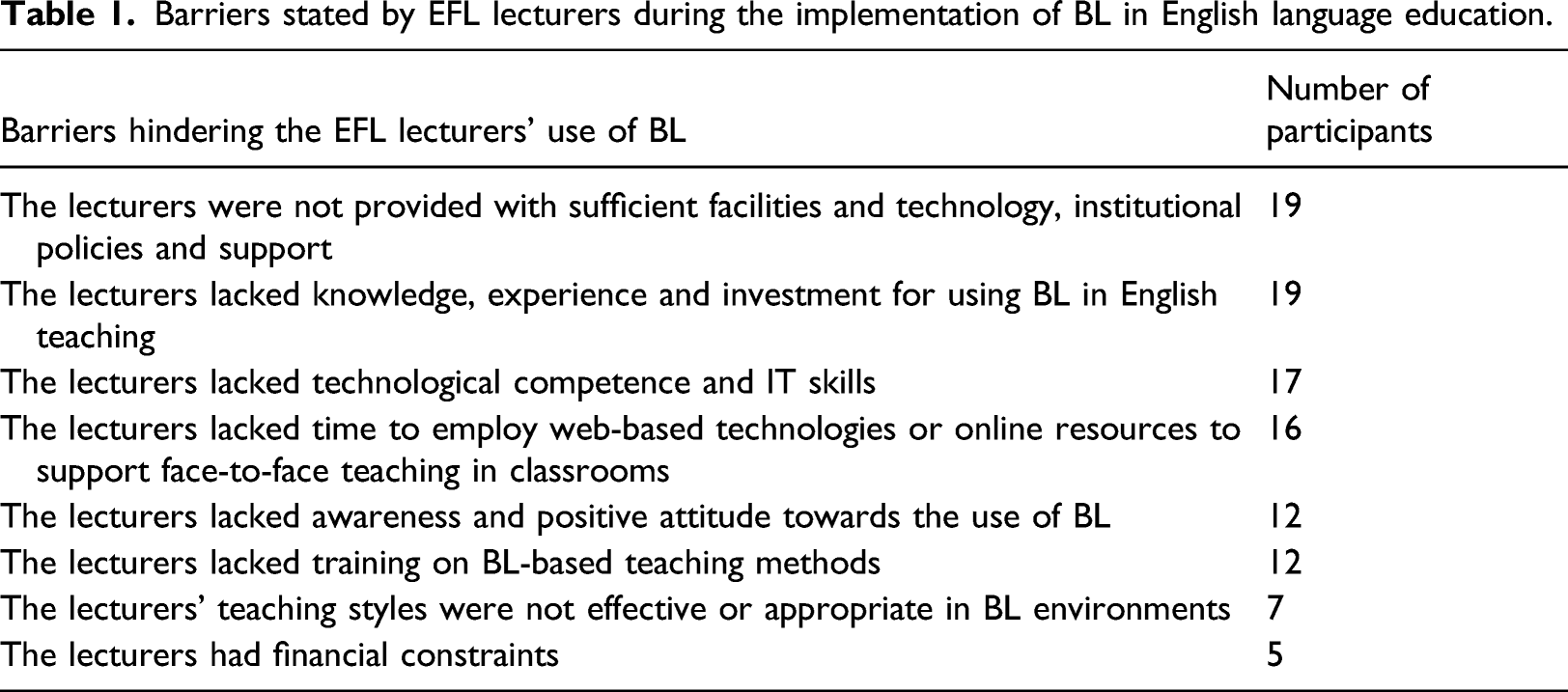
Barriers stated by EFL lecturers during the implementation of BL in English language education.
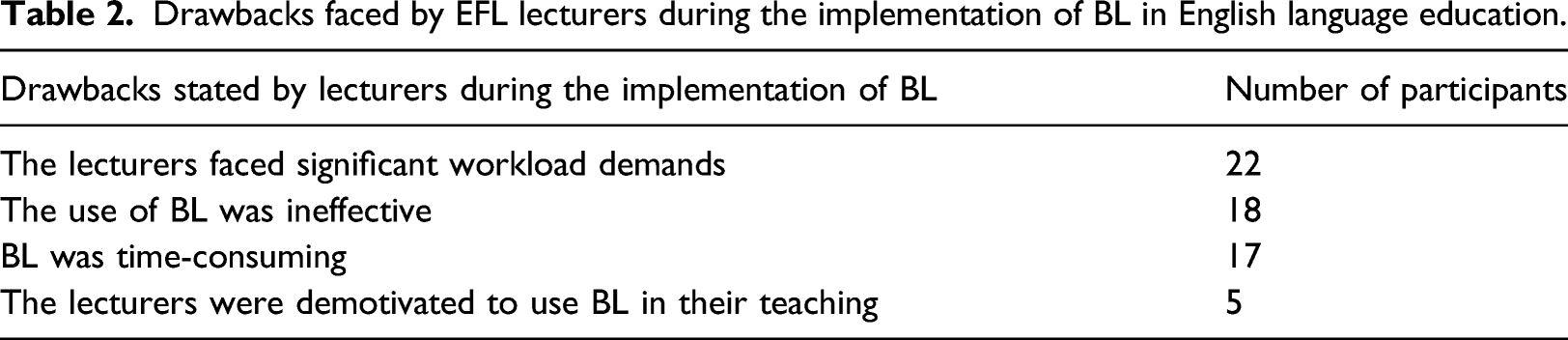
Drawbacks faced by EFL lecturers during the implementation of BL in English language education.
Stated barriers
Eight sets of barriers were identified by the EFL lecturers in their responses to the questions about implementing BL in their courses and classes. These are itemised in Table 1, before commentary on each of the themes that follows.
The most important barrier, stated by two-thirds of the participants, was that the EFL lecturers were not provided with sufficient facilities and technology on campus to implement BL in their teaching. This external barrier was related to the limited features of the LMSs; slow Internet connection; or textbook-based websites that were not interactive and communicative. For example, two participants stated:
I cannot upload files many times because the Internet connection doesn’t work consistently and being unable to upload files is very annoying (Lecturer 6).
The software, Sanako, was only good during the early days when my university started using it. After that, the software didn’t work well …now headphones cannot be used … The computer laboratory is almost inactive, so lecturers mainly ask students to go there to do online exercises for practice. It is impossible for students to practise English speaking skills, and listening practice depends on hearing aids that sometimes work and sometimes don’t work (Lecturer 10).
Of equal importance to EFL lecturers’ use of BL was the internal barrier of their own lack of knowledge, experience, and investment for using BL in English language teaching; this was also stated by 19 participants. Examples of their comments include:
There was a training class on e-Learning within a few days for EFL lecturers, and several lecturers participated in the class. However, lecturers were very busy with their teaching schedules, and they also found that they were not sure how to use BL after that. Even if they now use BL, they cannot gain any benefits, so they are not motivated to use it (Lecturer 8).
I myself have not really understood and mastered how to teach an English lesson with blended learning effectively (Lecturer 29).
The next predominant barrier was lecturers’ lack of technological competence and IT skills, admitted by 17 participants. This barrier significantly affected lecturers’ use of BL in their English teaching because they had to design lectures, activities and exercises to deliver online teaching as well as monitoring and managing the whole learning process. For example, Lecturer 19 stated that “I am very afraid of using technology. … if I must apply it, I find it very difficult to manage students’ learning with it.”
The fourth major barrier identified was that the duration of English courses was too short, so the lecturers lacked time to employ web-based technologies or online resources to support face-to-face teaching in classrooms. Mentioned by 16 participants, two stated that:
The class contact time must be used to transmit the content that the Department of English Language stipulates. Thus, lecturers cannot have sufficient contact time to supplement [learning with] more practice activities in class (Lecturer 1).
In teaching English reading skills, I don't have enough time to use more technology with only 45 periods [45 min/period] as outlined in the syllabus (Lecturer 9).
Slightly less than half the participants commented that one barrier EFL lecturers faced lay in them not being fully aware of the benefits of BL; and their lack of awareness and resultant negative attitudes impacted on their use of BL in their teaching. Noting that they projected these barriers onto others, two participants explained that: This is due to their psychology and attitude toward the use of BL. They do not see benefits of teaching and learning with the online system. Many lecturers believe that when transferring from traditional teaching to online teaching, they will lose their jobs as their pay is based on their face-to-face teaching hours in physical classrooms (Lecturer 3). There are some lecturers who have expressed their dissatisfaction with the use of BL. However, I do not know why the Dean keeps saying this delivery mode is good. In fact, it is terrible (Lecturer 22).
Moreover, other participants revealed their negative attitude toward the use of BL due to their workload, inappropriate policies and ineffective infrastructure during their teaching. An insightful statement came from Lecturer 3 who said that ‘Lecturers have to do more work when using blended learning, but they are not paid more, so no one wants to apply blended learning’.
Another barrier was the lack of training on BL-based teaching methods, admitted to by 12 participants. They stated that they were trained on how to use web-based technologies, but not on more specific BL-based pedagogies; therefore, each of them had to explore their own teaching methods with BL, or they did not know how to implement BL in English teaching, especially within the Vietnamese context. For example, they responded that: Lecturers must have official and professional training on how to implement this mode of delivery [BL]. In reality, there isn’t this type of training in Vietnam (Lecturer 9). There is not a system of BL-based teaching methods although we know it is an approved trend worldwide. However, nowadays, there aren’t any guidelines on how blended learning is being used, how it is defined and what are specific steps to apply it in delivering English lessons. In general, blended learning is implemented differently in Vietnamese universities in accordance with their own discretion and preference (Lecturer 23).
There were two barriers perceived by a small number of participants. One barrier, stated by only seven participants, was that EFL lecturers were familiar with face-to-face teaching styles based on Confucian teaching traditions, so the lecturers were not in favour of using BL. Two participants explained that: That is because of the teaching culture. The ‘old’ teaching culture along with the traditional methods has existed too long in lecturers’ subconscious, so they do not want, or they do not feel confident to use a new mode of delivery like blended learning (Lecturer 13). Previous traditional teaching methods are deeply rooted in lecturers’ subconscious, which leads them to teach their students in the old-fashioned ways they have learned before (Lecturer 30).
The last barrier hindering the implementation of BL was lecturers’ financial constraints, which was identified by the smallest number of participants, five. For example, Lecturer 15 stated that: Perhaps finance is the first factor that can hinder lecturers from using technology. For example, there is some free software that helps converse files, but when converting the files, it only converts 50% and then it stops. Thus, I have to buy the software. I cannot ask for the funding from my university, so I have to pay for it with my own money (Lecturer 15).
Stated drawbacks.
The findings revealed that EFL lecturers stated four drawbacks emerging during the implementation of BL in English language education. Three of these emerged most often across the participants as presented in Table 2.
The most important drawback that the EFL lecturers faced was the significant workload demands when teaching English with the use of BL; this was identified by more than two-thirds of the participants. Many of them stated that they were busier than before because they had to take responsibility for online teaching besides face-to-face teaching. For example, one participant explained that: Currently, lecturers’ workload is increasing because normally lecturers only deliver teaching in classrooms; but they now have to be in charge of online learning as an additional part. They cannot reduce face-to-face contact hours in classrooms; they still attend classes, and they still work more online (Lecturer 18).
Lecturer 18’s comments about not reducing face-to-face contact hours refers to the university’s policy that lecturers are still mandated to teach a set number of hours face-to-face; as a result, time for online learning was an additional load but physically limited. Furthermore, many of the lecturers admitted that they had to meet many requirements when using BL; they had to know how to “use different technologies to prevent the repetition of the same games, which makes students bored” (Lecturer 5) and they had to update many contemporary digital applications to enhance their teaching than they did before. In addition, Lecturer 28 also added that “it is challenging for lecturers to prepare online content that can be combined seamlessly with the unfinished parts of content taught in class.”
The second drawback, as perceived by 18 participants, was that lecturers’ use of BL was not as effective as the lecturers had expected. They referred to the lecturers being unable to manage students’ online learning effectively; they could not promote students’ online interactions and communication; they found it difficult to deal with students’ plagiarism; and they were not sure about students’ outcomes in BL environments. For example, Lecturer 5 asserted that ‘I find it hard to interact with my students when working online’ while Lecturer 2 added that ‘It is difficult to accurately check whether a student has done [online] homework on his own or have asked someone else to do it for him’.
The next drawback, stated by 17 participants, was that the use of BL was overly time-consuming. They explained that they had to accomplish many teaching tasks in BL environments such as designing online activities, lectures, assessments and videos as well as dealing with technical problems. However, there was no reduction in face-to-face teaching hours, so the application of online learning was additional or cumulative, not complementary. For example, many of the lecturers explained why the use of BL caused time consumption by stating that: ‘Technical problems often take them [lecturers] lots of time to solve’ (Lecturer 1); ‘It takes me time to design and upload lectures to the LMS’ (Lecturer 4); ‘Lecturers need lots of time to get familiar with using the LMS’ (Lecturer 8) and ‘I have to spend a lot of time searching updated technologies’ (Lecturer 30).
The last drawback emerging from the data was that, after a period of implementing BL, the EFL lecturers felt demotivated to continue using it. This drawback was identified by only five participants. The participants explained why their motivation had decreased, given their preference for face-to-face, traditional teaching that was strongly influenced by Confucian philosophy. One powerful example was found in Lecturer 6, who was in charge of BL facilitation at her university; despite this responsibility she expressed her sense of demotivation: If I’m allowed to have enough teaching time in classrooms, I will still choose face-to-face teaching. Teaching is an art that cannot be delivered online… When meeting students face-to-face, I can see students’ physical expressions as well as expressing my body language, thus I still choose the traditional teaching method. Therefore, I can best deliver my lectures. (Lecturer 6)
Discussion
There are four meta-themes that can be drawn from the findings of this study. The first is that the Vietnamese EFL lecturers appeared to be shackled by the traditional teaching culture, which concurs with those of a previous study, in one university in Vietnam, conducted by Hoang (2015). Implementing BL, especially the online dimensions, goes against the proudly held Confucian teaching traditions of Vietnamese lecturers that are inherent in Vietnamese culture. The influence of traditional teaching cultures as a constraint on implementing BL has been found in other, recent research (Mathew et al., 2019; Zaim and Mudra, 2019). As a result of the impact of tradition, the teaching styles of the EFL lecturers in this study were not effective or appropriate in BL environments. These lecturers have been strongly influenced by Confucian teaching traditions; thus, they felt confident and familiar with an ‘authority style’, which has been ingrained in their minds and teaching habits. This authority style conflicts with approaches to online teaching in BL environments. Refusing to shed this style caused the EFL lecturers many problems. They found it difficult and frustrating to track students’ academic progress and outcomes; they found it impossible to deal with students’ plagiarism online; they were unable to promote students’ online interactions and communication; they lacked problem-solving skills with students’ online learning; and they could not make most use of all available technologies. Added to this constraint was that the lecturers lacked knowledge of, experience in, and investment for the use of BL in their English teaching; in particular, they lacked technological knowledge and IT skills. This means that there were aspects or traits of the lecturers themselves that contributed to the problems. The findings that the EFL lecturers lacked awareness, understanding and experience in using BL in their English teaching supports previous research (Alotebi, 2016; Ghazizadeh and Fatemipour, 2017; Mathew et al., 2019). That the lecturers lacked technological knowledge and IT competence is consistent with studies conducted by Koşar (2016), Rahim (2019), and Wright (2017).
The second broad theme indicated that, despite the use of BL being a top-down policy decision, the Vietnamese EFL lecturers were not provided with sufficient infrastructure and technologies to implement BL in their teaching effectively. As a result, they encountered many technological problems during implementing BL in their English teaching. These were essentially infrastructural and technical problems that added to the problems of implementing BL, but the responsibility for these lay with the universities rather than the individual lecturers. In developing countries, not all universities are fully well-equipped with infrastructure and technology (Eldeeb, 2019; Mudra, 2018; Radia, 2019), which contributes to the problems of implementing BL. These findings connect to previous studies; for example, Mudra (2018) and Zaim and Mudra (2019) found that EFL lecturers in Indonesia were not provided with sufficient infrastructure and technologies to implement BL in their teaching. In addition, the finding that the EFL lecturers encountered many technological problems is in consistent with the finding of Riel et al. (2016). However, this study revealed that the lecturers did not receive enough institutional support in terms of professional development and technical support, which reflects previous research conducted by Sari and Wahyudin (2019). Moreover, while the teaching of EFL lecturers has been strongly dependent on institutional guiding policies (Tshabalala et al., 2014), another finding of the study indicated that the lecturers lacked well-developed pedagogies for implementing BL in English language education.
Third, the theme revealed that lecturers found it difficult to manage students’ online learning outside class, which implies that Vietnamese EFL lecturers were still wedded to principles of traditional, face-to-face modes of delivery in classrooms where they can monitor and manage students’ learning confidently and easily. While this finding is in line with some previous studies (Rahim, 2019; Riel et al., 2016), it contrasts with the findings of others, like King (2016) and Matukhin and Zhitkova (2015), who stated that lecturers could effectively monitor and manage their students’ performance and learning progress thanks to the LMSs. In addition, the finding that the Vietnamese EFL lecturers blamed BL for reducing their teaching creativity is not consistent with previous research findings that lecturers can create dynamic and flexible learning situations thanks to the use of web-based technologies (Blessinger and Wankel, 2013) or that lecturers must be creative to design informative, interesting and diversified lectures in BL environments (Sun and Qiu, 2017). Creativity in BL, however, relies on the practitioners being accustomed to, and confident with the technology that underpins it (Mehlenbacher, 2010).
Finally, the theme indicated that the use of BL was time-consuming and caused increased workload for the Vietnamese EFL lecturers. Their experiences of using BL contradicted the claimed advantages for this delivery mode. They had assumed that BL would save them teaching time and reduce their workload; instead, for these lecturers, due to inappropriate and unsuccessful use of BL, these advantageous features became unexpected drawbacks. These findings align with previous studies (Koşar, 2016; Rahim, 2019); however, they are contrary to those of other researchers (Basal, 2015; Kudryashova et al., 2016; Tawil, 2018) who found that BL helped lecturers save teaching time in classrooms.
It can be clearly seen that the findings of this study are closely interrelated. The drawbacks emerging during the EFL lecturers’ implementation of BL were related to, and resulted from, the barriers they faced. For example, that the lecturers experienced much pressure and workload while implementing BL (a drawback) was partly caused by their lack of technological competence and IT skills, and insufficient provision of facilities and technology on campus (barriers). That the lecturers’ use of BL was not effective (a drawback) resulted from their lack of training in BL-based teaching methods; inappropriate teaching strategies; lack of teaching time; lack of knowledge and experience in using BL; and lack of technological competence and IT skills (barriers). Furthermore, the EFL lecturers were demotivated with the use of BL (a drawback) because they were still wedded to the Confucian approach to teaching that mitigated their willingness to do so (a barrier).
Conclusion
Although BL has been a widely used mode of delivery in higher education globally, it is still relatively new in Vietnamese educational contexts. As a result, the implementation of BL is varied and unsystematic across many Vietnamese universities. While it is inevitable that barriers and drawbacks will emerge during any implementation of BL, this paper has outlined those specific to the EFL lecturers in Vietnamese universities. Of all stakeholders involved in the implementation of BL, the EFL lecturers are the main ones who directly implement this mode of delivery; thus, their perspectives of the implementation process are significant. These barriers and drawbacks that the EFL lecturers themselves encountered concerned eight major groups. Some of the most important related to universities, including: inadequate facilities and technology; confused and confusing policies; lack of institutional support and insufficient course duration. Other important barriers related to the EFL lecturers; these were: the lecturers’ own lack of knowledge, experience and investment for using BL; and their lack of technological knowledge and IT skills. Meanwhile, the four perceived drawbacks consisted of: the lecturers’ ineffective use of BL along with other resultant outcomes: lecturers’ workload demands; their demotivation; and the amount of time consumed by implementing BL. Realising and understanding these barriers and drawbacks will help EFL lecturers themselves have effective solutions to deal with them, which helps lecturers take advantage of BL as well as improving the quality of English language education in Vietnamese universities. The implications are discussed in the section below.
Implications
Most of the major barriers that the EFL lectures identified, and the major drawbacks that they spoke about, all related to what their respective universities failed to provide. Therefore, the first set of implied solutions relate to institutional responses.
The Vietnamese universities may wish to review and improve their policies and procedures for the implementation of BL in EFL education as they respond to the top-down policies by the Ministry of Education and Training. This means that the faculties or departments of English Language, in conjunction with the university’s leadership, develop detailed, systematic implementation plans for the application of BL, and follow up with careful evaluations. Institutional responses, at the least, demand providing technologies that facilitate integrated, seamless, online activities both in class and off campus. These include well-provisioned classrooms with consistent Internet access for staff and students; screens, speakers, projectors, or even interactive whiteboards; and quality software. Many lecturers relied on computer laboratories for their teaching, and these need to be equally well resourced. The EFL lecturers expected to use BL require, at a minimum: greater access to professional development and professional learning; technical support; syllabuses that provide detailed BL activities; and well-developed interface design of the LMSs. Furthermore, the universities have to recognise that staff engaged in online teaching and learning have to be paid for such work. This is an essential requirement, but universities could also provide other incentives such as encouragement and rewards to EFL lecturers who have implemented BL enthusiastically and successfully in their English teaching.
With these institutional facilities and incentives in place, the EFL lecturers can afford to, and must, enhance their knowledge of BL practices and learn more about effective implementation of BL in English language education. First, many need to improve their foundational technological competence and IT skills by: attending training sessions on the use of computers, web-based technologies and online educational resources; learning technological and IT skills from colleagues and students; updating technological knowledge and latest educational technologies; and maximising the use of existing and improved facilities and technologies provided by universities. Moving beyond this essential professional development in their universities, they can learn by: reading books, articles, websites and documents; attending voluntary academic seminars, workshops and conferences; organising professional learning communities among EFL lecturers to discuss the use of BL and share experience. Professional learning may be further enhanced by updating teaching qualifications; conducting experimental teaching with the use of BL in different English classes; and writing articles and making presentations about using BL in English teaching for different learners. Engaging in such professional development and learning would enhance their mindsets, motivation and attitudes towards the use of BL.
Limitations and further research
This study was conducted solely through semi-structured interviews with 30 EFL lecturer participants. This means that generalisations may be difficult to justify, despite a relatively large sample and the range of contexts from which the participants were drawn. While arguing for internal validity (Maxwell, 2013) in this study, nevertheless, to generalise the findings of this study to all Vietnamese universities, requires a greater range of research approaches and instruments used to collect data across larger samples, to examine the external validity and reliability of the findings in this study. It may also be important to involve EFL students in future studies to generate more comprehensive understandings of barriers and drawbacks from their perspectives. Based on the findings from this study, a large-scale quantitative survey could be developed to explore the evidence of these challenges more widely in the Vietnamese higher education context.
Footnotes
Acknowledgments
The first author would like to express her sincere gratitude to the 30 EFL lecturers at Vietnamese universities who willingly shared their teaching experience through interviews.
Declaration of conflicting interests
The author(s) declared no potential conflicts of interest with respect to the research, authorship, and/or publication of this article.
Funding
The author(s) received no financial support for the research, authorship, and/or publication of this article.

Author Biographies
Thi Nguyet Le has been working as a senior lecturer of English language at the University of People’s Security, Vietnam for 17 years. She is currently a PhD candidate at School of Education, Edith Cowan University, Australia. She has a strong passion for research in the fields of TESOL methodology and blended learning.
Bill Allen is a senior lecturer in Education at Edith Cowan University.
Nicola F Johnson is an associate professor of digital technologies in education and the Associate Dean (Research) in the School of Education at Edith Cowan University.