




Abstract
There is a paucity of opportunities for Vietnamese EFL students to use and practise English speaking skills both inside and outside the classroom, attributing to students’ lack of interest and motivation in improving their speaking skills. Given that learning can be distributed across a multitude of formal and informal settings, the social and informal features of Facebook serve as potentially ubiquitous support for students to productively practise and use the target language. To date, however, much of the discussion of the promising incorporations of Facebook into EFL teaching and learning repertoire remains largely in writing and intercultural communicative effectiveness, with an evident scarcity of empirical research on students’ speaking practice. This qualitative study was conducted with 10 Vietnamese EFL learners, aiming to examine whether the Facebook-based learning community articulated any educational potentials for EFL speaking practice. The findings revealed that there were three features of the Facebook-based learning community, including flexible access, shared visions and values and collaborative relationships, which were beneficial for the members to maintain learning motivation, be more engaged in peer collaboration and co-construct essential knowledge for speaking practice. The findings suggested that the Facebook-based learning community could serve as a means for promoting more speaking practice among Vietnamese EFL learners.
Keywords
Introduction
Despite sustained efforts to highlight speaking skills as a core element in English as a Foreign Language (EFL) curriculum, escalating speaking skills has not been adequately addressed in practice and has hitherto been considered a daunting task for Vietnamese language learners of English. The picture emerging from the existing research on EFL teaching and learning in Vietnam is that speaking and listening skills are lagging behind, whereas primary focus still lies in teaching reading, writing, grammar and vocabulary inputs (Vu and Shah, 2016). At some Vietnamese universities, the EFL education is also characterized by teacher-centred instructional strategies, placing less emphasis on how EFL learners’ needs can be identified and fulfilled. Resultantly, Vietnamese EFL students may become shy and lack confidence to develop English-speaking competence as expected, even though they are not really passive learners (Truong, 2017).
In addition, like the other non-Anglophone countries, there is a paucity of opportunities for Vietnamese EFL students to use and practice English speaking skills both inside and outside the classroom, attributing to students’ lack of interest and motivation in improving their speaking skills (Hao, 2017; Vo et al., 2018). In this sense, students encounter those challenges including expressing their ideas verbally and carrying on conversations effectively, as well as mastering their knowledge regarding pronunciation, speech function, grammar and vocabulary. Since they only obtain relevant language knowledge in a decontextualized way, this hinders their speaking abilities, decreases learning motivation and causes a greater level of anxiety for engaging in real communication.
Consequently, ‘when leaving universities, many graduates could not communicate in English in some simple situations, they could not understand general news in English either’ (Tran, 2013: 143). Another example comes from a doomed fate where only a few graduates among 11,000 Vietnamese graduates in finance and banking were offered jobs in banks because of their low level of English communicative competence (Hoan cited in Tran, 2016). The annual ranking of 100 countries and regions by their English language skills published in 2020 has recently reported that Vietnam was still placed as low proficiency for 2 years in a row, after being categorized as moderate proficiency level from 2015 to 2018 (Education First English Proficiency Index, 2020).
Acknowledging that the classroom itself is not simply a four-wall space, and learning can be distributed across a multitude of formal and informal settings, learning with an extension of the sociocultural reality can be complemented by the emergence of social media platforms, such as WhatsApp, Twitter, Facebook and Instagram (Stone and Logan, 2018). The learning experience through the social networking sites might offer learners opportunities to become reflective learners, which means that they can recognize what they have acquired so far, how they have mastered it and what they still need to strive for further development (Dewey, 1933). Also, the incorporation of social media as teaching and learning tools has captured the attention of teachers and institutions that wish to harness students’ activeness in learning. For example, learning in such communities with a broad array of resources displays a positively intertwined relationship with language gains, and language learners are found to be actively engaged in opportunities offered by informal learning outside of classrooms (Cole and Vanderplank, 2016; Lai et al., 2018). Among the social media platforms, the twenty-first-century digital-native students have a level of global immersion with Facebook and embrace this ecology of information for different purposes in educational contexts (Willems and Bateman, 2013). Unlike instructional practices taking place in schools or classrooms, student engagement in Facebook practices is articulated to be more self-directed, indicating that students adopt various approaches to broaden language learning experiences. Technically, the social and informal features of Facebook serve as potentially ubiquitous support for students to productively practice and use the target language by encouraging them to take part in peer collaboration (e.g. Chugh and Ruhi, 2018; Naghdipour and Eldrdige, 2016).
To date, however, much of the discussion of the promising incorporations of Facebook into EFL teaching and learning repertoire remains largely in writing and intercultural communicative effectiveness, with an evident scarcity of empirical research on students’ speaking practice. For example, Barrot (2018) undertakes a critical analysis of the published literature in the period 2010–2017 on Scopus database, exploring the integration of Facebook into language teaching and learning. Unsurprisingly, of the 16 studies investigating Facebook as a platform for developing productive skills (i.e. writing and speaking, respectively), the complementary contribution of Facebook on speaking skills has so far been under-explored with only one empirical study (i.e. Sun and Yang, 2015). Having reviewed relevant literature, Jassim and Dzakiria (2019) suggest that Facebook is a potential learning platform for students to improve their communication skills as they overcome fear and anxiety of speaking English when much more interaction is facilitated. To the best of our knowledge, another glance at the literature reveals that there have been four other empirical research (i.e. Akbari et al., 2016; Aydin, 2017; AlSaleem, 2018; Yen et al., 2015) devoting attention to Facebook and speaking skills. Facebook can be used as part of EFL blended learning settings, combining both weekly in-class instructions and out-of-class speaking activities (Sun and Yang, 2015; Yen et al., 2015). In the research conducted by Aydin (2017), even though Turkish students perceive that Facebook fosters their speaking skills, no pedagogical intervention was administered. Akbari et al. (2016) incorporate an online intervention with an experimental group of Persian students; nonetheless, the online teaching sessions took place on Twitter while Facebook was merely used for task assignments and completions. By comparing two groups – one with Facebook-related activities and one with the traditional teaching method – the findings reported by AlSaleem (2018) support the use of Facebook to improve students’ oral communication skills – making enquiries for clarification, articulating ideas clearly or carrying out conversations without preparation.
Prior research available in the scant literature on the integration of Facebook in EFL speaking skills has also evidently advocated that Facebook promotes students’ self-construction of knowledge as they not only demonstrate their activeness in the learning community but also become more motivated and autonomous in their own language learning process (Akbari et al., 2016; Aydin, 2017; Sun and Yang, 2015; Yen et al., 2015). For non-Anglophone countries where English is not regularly spoken in public, Facebook carries out its meaningfulness as an affordable and authentic learning venue to practise the target language beyond the traditional classrooms. For example, EFL learners are found to develop their public speaking-related skills, including how to develop confidence; brainstorm ideas and organize content and sharpen the use of pronunciation, grammar and vocabulary (Sun and Yang, 2015). In line with the potentials from learners’ perspectives, there is also a shift in EFL teachers’ role from being knowledge providers or authority figures to facilitators. EFL teachers, by integrating Facebook to surpass the gap between the teacher-based classroom and personal learning context, stimulate both virtually cooperative teacher–student and student–student interactions, thereby minimizing the limitations of the physical environments of the classroom and offering more opportunities for speaking practice (Sirivedin et al., 2018).
A successful integration of Facebook for educational purposes, however, is argued to heavily depend on ‘a complex interaction between a number of factors including the timing of content delivery, the integration of social media content with course assessment and the students’ own perspective on using social media for academic purposes’ (Dyson et al., 2015: 303). Without any physical connection, students might be more likely to experience a sense of frustration and a loss of immediacy when communication is established, leading to their unsatisfactory learning outcomes (Sung and Mayer, 2012). Additionally, creating a Facebook group for a class shows a level of consistency with students’ appreciation for course content (Akcaoglu and Bowman, 2016). This raises the question as follows: if the out-of-class learning environment is entirely offered on Facebook and is not in relation to in-class learning, how will Vietnamese EFL learners make use of this learning community in light of maintaining motivation, being engaged in peer collaboration and constructing essential knowledge for speaking practice?
This article, despite aiming to better articulate the educational potentials of Facebook-based learning community for EFL speaking practice, sets itself apart from the aforementioned previous research. The learning community in this study was separate from the existence of any EFL programme and totally free from the influences and concerns of exams or scores, whereas Facebook was part of EFL blended learning in previous studies (e.g. Sun and Yang, 2015; Yen et al., 2015). Rather than focusing on utilizing Facebook as a supplement to in-class instructions and measuring EFL learners’ speaking performance, our overarching aim was to understand students’ learning experiences of how a Facebook-based learning community can be harnessed for EFL speaking practice. This article hopes to contribute the teaching and learning speaking skills in the Vietnamese EFL context where students still feel reluctant to practice their speaking skills outside the classrooms and devote more time on merely passing the compulsory EFL courses at the university or achieving the English language proficiency certificates for graduation purpose.
The notion of a learning community under the auspices of Facebook
A community, conventionally, is underpinned as a group of people sharing homogeneous interests and establishing a sense of personal identity by the roles they are performing and the relationships they are maintaining within the whole group’s activities (Riel and Polin, 2004). Accordingly, a community embraces its own culture and communication methods, indicating a continued existence despite any amendments concerning participation. Moving beyond its omnipresence in every aspect of life, the discourse of community in learning has various definitions and is sometimes perceived as confusing. A learning community might be a collective process of learning within a whole school or a classroom. While Strike (2004: 217) argues that ‘the idea of community may be like democracy: everyone approves of it, but not everyone means the same thing by it. Beneath the superficial agreement is a vast substratum of disagreement and confusion’, Davies et al. (2005) assert that a subgroup of students striving for a common educational purpose by supporting and collaborating with each other can be narrowly considered as a learning community. In line with the technological advancements, the notion of community can be extended into online communities of inquiry (Garrison et al., 2010), online communities of practice (Wenger, 2010) and online knowledge-building communities (Zhang et al., 2009). To avoid the obfuscation surrounding the concept of the online learning community, students’ experiences of Facebook-based learning community for EFL speaking practice, in this study, are drawn from the following features – flexible access, shared visions and values and collaborative relationships (Figure 1). The defining elements of Facebook-based learning community for speaking practice.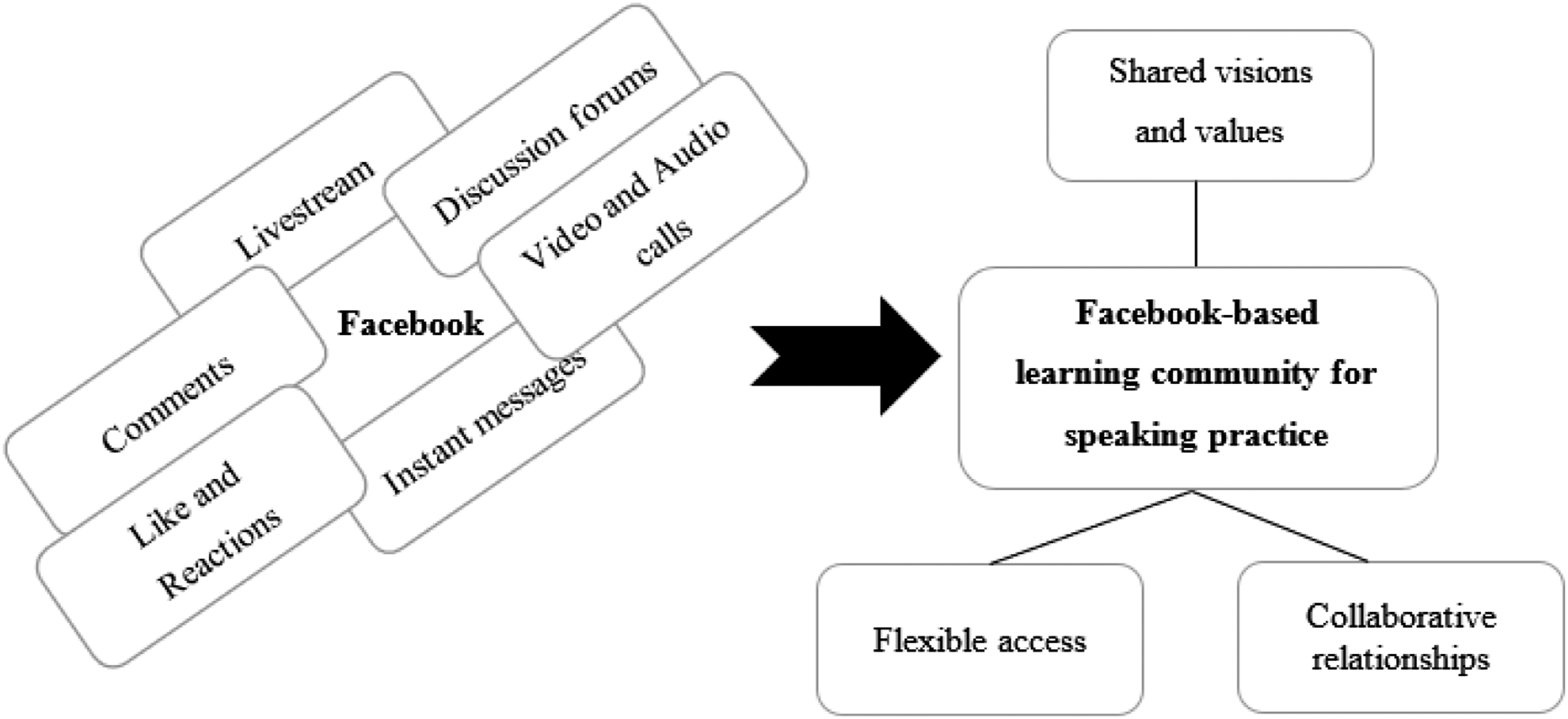
Regarding access, a learning community is traditionally defined as a group of people who attend the same geographical school or classroom simultaneously. In simplest terms, learning is generally enabled by being situated in a commonplace (West and Williams, 2017). The proliferation of Facebook for educational purposes, however, has formed blurred lines for the meaning of geographic community or presence. Regardless of the constraints of time and space, when Facebook is integrated into the learning process as an additional part for out-of-class contexts or online learning material, it curtails the limitations by amplifying potentially unlimited audiences and crossing boundaries between social situations. It comes as no surprise that students show great enthusiasm and enjoyment about the prominence of Facebook (Irwin et al., 2012) as they already have a Facebook account and are often on the site, thereby possessing technological multitasking capabilities and familiarizing themselves with fundamental knowledge related to Facebook’s social functions and features (Menzies et al., 2017). This lends credence to the notion that incorporating Facebook is not time-consuming but really feasible for students’ smooth transitions from social to educational purposes. As a popular communication method, Facebook provides students free and flexible access to like, share and comment on a specific content posted by their peers or teacher. Rather than passively waiting for physical access to one particular learning context (e.g. face-to-face setting), Facebook enables students’ level of involvement, which increases the likelihood of them taking initiatives for fully exploring a language with greater confidence and greater enthusiasm. This is also posited to foster students’ motivation and activeness in learning (Naghdipour and Eldridge, 2016).
Another boundary conceptualizing the Facebook-based learning community focuses on shared visions and values, indicating that members of the community should share the same goals and missions (West and Williams, 2017). It is of the utmost importance that shared visions and values are promoted because students can not only be assimilated into the sociocultural practices enhanced by the learning community, but also believe that in the progress, they are all working to achieve the final goals. Students, by reaching a consensus over their shared visions, can shift their identities from being peripheral to being full members (Hughes, 2010). Put another way, this aligns with Elbers’ (2003) opinions that ‘students began to view themselves in different roles and speak about themselves in different ways. They talked about their new identities and responsibilities as members of a community of inquiry’ (p. 81). Nevertheless, ‘to be a member of a community usually entails subjugation to its score values and norms of behaviour, and to deviate from these in resistant assimilation is to run the risk of becoming marginalised in order that the integrity of the community is preserved’ (Hodgson and Reynolds, 2005: 16). This poses a challenge that the Facebook-based learning community might potentially be exclusive for many types of learners, particularly those feeling isolated and disconnected with their peers and instructors regarding work obligations or academic expectations (Phirangee and Malec, 2017). With the absence of shared visions and values, identity incongruence causes a loss of sense of community with their peers.
In an explicit recognition of the focal role that shared visions and values play in the Facebook-based learning community, efforts must be devoted to clarifying the specifically joint visions and values that students need to conjure up. In this study, the goals of developing and practising speaking skills that each member of the community wishes to manifest must be the driving force. By doing so, students will avoid experiencing feelings of otherness and finding the unfitness between their own identity and that of the whole group, and fruitfully, all make efforts to contribute the mutual success. For instance, EFL learners are desperately anxious about the pronunciation errors they commit, which significantly leads to fears of being humiliated by their peers (MacIntyre, 2017). With the presence of Facebook-based learning community where ‘groups of people … through this process develop a sense of belonging and mutual commitment’ (Booth, 2012: 8), learners’ fears and anxiety can possibly be resolved because the shared visions and values evoke the feelings of being respected and being safe. They can also overcome the speaking hurdles and importantly experience less pressure for discussions compared to face-to-face learning settings. In other words, members of the community are more likely to be highly committed to having their meticulous attention and sheer persistence for the goal setting.
While creating shared visions and values acts as a compass for the learning community, a further yet pivotal requirement that must be imposed is to establish collaborative relationships among members of the community, including both teacher and peers. Closeness and connectedness facilitate more communication which, in turn, may develop students’ openness towards being wrong or accepting new ideas. Hung and Yuen (2010) and Irwin et al. (2012) are of a similar opinion and suggest that collaborative social relations help students to become clearly discernible to place emotional trust and make close connections with each other. Members, due to the duties and obligations they comply with in the learning community, both need and feel needed by their peers. They take advantage of this learning platform to have thought-provoking discussions and fruitful collaborations, thereby co-developing their profound understandings of what they are taught, and even co-constructing new knowledge (Berger and Hänze, 2015; Zheng and Warschauer, 2015).
Defined as ‘anything that might strengthen the students’ capacity to self-regulate their own performance’ (Nicol and Macfarlane-Dick, 2006: 205), feedback belongs to a myriad of advantages that establishing collaborative relationships on Facebook results in. More specifically, members of the Facebook-based learning community, including both the instructors and students, can take advantage of various Facebook functions (e.g. liking and reacting, commenting or audio/video calling) for the purpose of interactively exchanging constructive feedback. Teacher and peer feedback can be facilitated through both dialogic feedback and feedback-comment type, without any barriers related to time and space constraints like the provision of in-class feedback. Having students get engaged in providing and receiving feedback improves their learning process since feedback providers and receivers become more motivated and encouraged to make connections between their knowledge and themselves (Gielen and De Wever, 2015).
Methodology
Participants
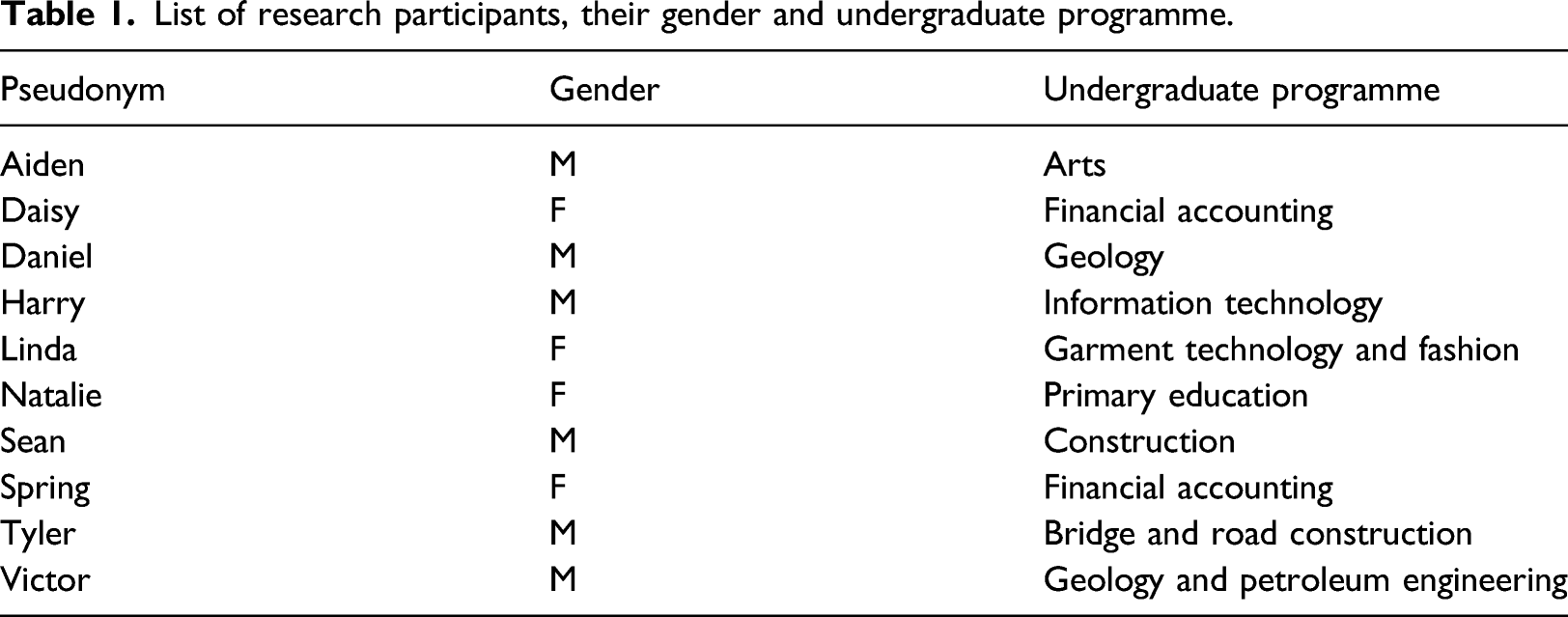
List of research participants, their gender and undergraduate programme.
Design and procedure
A closed Facebook group was created, and all the 10 participants were added into the group by the first author, who was in the role of an instructor. The project lasted 4 weeks. Given that Facebook enables live stream video broadcasting with patterns of interactions between the instructor and the members of the learning community, there was one live stream video broadcasting for each week. The live stream was aimed at facilitating open discussions between the instructor and the members of the Facebook-based learning community on the topic, including grammatical structures and essential vocabulary, discourse management, pronunciation and ideas. In the live stream, English was mostly used while Vietnamese would only be used to clarify any points that the members could not understand thoroughly. All the members of the Facebook-based learning community were required to use English when they would like to share their ideas and raise concerns regarding the weekly topic, by typing their comments. At the end of the session, the video became a permanent post in the group; therefore, those who could not join the live stream were able to watch the video and catch up with the materials.
After that, the participants were divided into two small groups of three and one small group of four to have further discussions on the weekly assigned topic and practise speaking skills. This activity was designed to help students consolidate the knowledge they gained in the live stream and applied into practice. The groups were changed every week so that the participants were offered opportunities to connect with the other members in the learning community. For the small group discussions, they were asked to make audio/video call to practise speaking skills about at least 20 min, but all the participants reached a consensus on making a video call. Given that the whole group instruction provided students fundamental knowledge about essential grammar and vocabulary, discourse management, pronunciation and ideas, students were given opportunities to review those points in the small groups. After that, they would work collaboratively to brainstorm and exchange ideas about the guiding question, for example, ‘Is beauty the same for every person?’ or ‘Should children be given challenges?’. In the next step, students would practise their speaking skills and then give each other feedback on how their peers used grammar and vocabulary, discourse management and pronunciation in their talk. In each whole group session, the instructor reminded the participants of what they would be expected to demonstrate in the small-group sessions, which was aimed to guide them to be more focused on the tasks. Since students were asked to provide feedback on their peers’ speaking performance after each small-group session, they needed to remain engaged in the instructions and practise their speaking skills as much as possible.
In the first 2 weeks, the first author joined each group’s discussion, which was aimed to instruct them how to use English for group discussions and give feedback to each other. This is important because instructor’s presence in the beginning stages of organizing learning activities on Facebook will help students’ online discussions move in the right direction (Whittaker et al., 2014). In the remaining 2 weeks, the participants practised speaking skills without the instructor’s presence. Given that the participation in this project was entirely voluntary and students were eager to practise their speaking skills, the instructor decided not to join any small-group session. This would give students opportunities to be autonomous in their learning – taking responsibilities for practising English during the sessions and managing the process of exchanging peer feedback.
The next activity required each member of the Facebook-based learning community to make an individual recording based on the guiding questions about the topic they had been involved in on the live stream and small-group discussions. The individual recordings were first exchanged in each small group and then sent to the instructor. Within each small group, the group members were asked to provide peer feedback to each other, covering grammar and vocabulary, discourse management and pronunciation. Each member of the learning community also received feedback from the instructor with the same criteria. Through receiving both instructor and peer feedback, each participant was able to reflect upon their strengths and weaknesses in each recording, thereby tracking their own learning progress. The details are presented in Figure 2. The design of the Facebook-based learning community for speaking practice.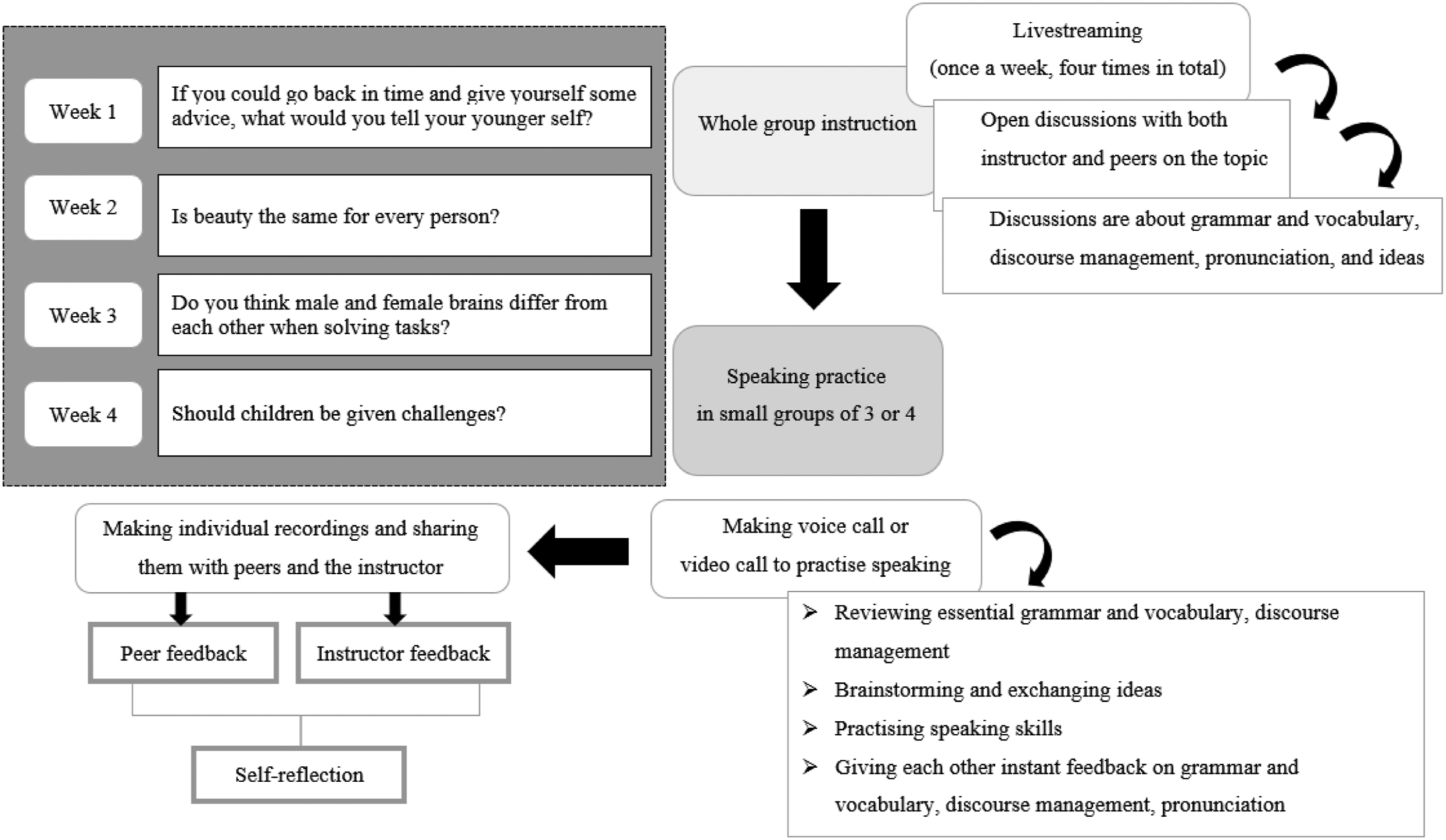
Data collection and analysis
The data presented in this article came from semi-structured interviews with the 10 participants after they had finished the 4-week speaking practice in the Facebook-based learning community. Taking a semi-structured format, these interviews, lasting from 15 to 30 min, were aimed at gaining in-depth information about the participants’ perspectives and experiences when they were engaged in the learning community. In accordance with the participants’ wishes to be interviewed in their first language, all the interviews were conducted in Vietnamese because they felt more comfortable to fully express their learning experiences and have smooth conversations. The interviews were conducted by the first author who got intensive research training in qualitative research when she was pursuing her postgraduate study at a UK university. The interview protocol was designed with open-ended questions and planned follow-up probes to unpack as much about the participants’ experiences in the Facebook-based learning community, for example, ‘What is your experience of interacting with other peers to practise your speaking skills using Facebook?’, ‘How did you and your peers manage the video call?’, ‘Can you tell me more about …?’ and ‘Can you share one example to specify what you have just mentioned?’ During the interviews, the first author was an active listener and also used spontaneous follow-up questions to encourage further elaboration from the interviewees if needed, such as, ‘You have just mentioned that you could understand each other well, so what was your approach to achieving that understanding?’
The interviews were audio-recorded and transcribed verbatim in the original interview language by the first author. Data were translated into English by the first author, which was then double-checked for accuracy by an English teacher in Vietnam that has experience in translating documents. Thematic analysis (Braun and Clarke, 2006) was applied to analyse the interview data. This process involved the first and second authors separately and extensively reading the transcripts several times in order to familiarize themselves with the data and then sharing their ideas about the codes and themes. The final decisions about the salient themes including flexible access, shared visions and missions and collaborative relationships were made when both authors reached a full agreement after having online meetings to thoroughly discuss the initial coding, axial coding and themes. This is in line with Braun and Clark’s (2019: 594) suggestion when they state that ‘If more than one researcher is involved in the analytic process, the coding approach is collaborative and reflexive, designed to develop a richer more nuanced reading of the data, rather than seeking a consensus on meaning’.
Findings
Theme 1: Flexible access
This theme describes students’ experiences of flexible access when the Facebook-based learning community was established for speaking practice. The students interviewed for this project were generally quite positive about the interweaving relationships between the popularity of Facebook and its convenience for accessing as a learning community. For example, Harry remarked that ‘Almost everyone uses Facebook, so the use of Facebook is quite friendly. We could easily use Facebook as well as easily share, read and evaluate the information in our learning process’. A similar view was shared by Tyler, who affirmed that his friends and him accessed Facebook every day so that they were able to regularly update any information posted on Facebook: ‘Facebook is a social networking site which is known and used by a lot of people. I and other students log on to Facebook every day to check the news and other general information’.
Due to the popular presence of Facebook for social and educational purposes, the members of the learning community found that they could be immediately notified of any updates related to the learning materials or announcements for the speaking practice. This view was mentioned by most of the participants: ‘When the Facebook Group was created to study, we could easily update new information which was notified’ (Tyler); and ‘I could easily get access to the learning content anywhere and anytime I wanted’ (Daniel).
With regard to the learning materials, including videos, announcements, instructor and peer feedback and individual recordings, many students expressed similar sentiments, focusing on the advantages of storing and accessing data unlimitedly. Compared with traditional classroom settings, the discussions still existed in the Facebook group; therefore, the participants were able to re-visit the contents they could not understand thoroughly. For instance, Sean mentioned that ‘Facebook does not restrict the sharing of any kind of resources or materials. We just had to share them on Facebook and when we wanted to study, we logged on to Facebook and downloaded them’.
The participants shared the positive views and praised the benefits of the Facebook-based learning community on avoiding missing information. In traditional classes, students certainly miss important information related to one specific lesson if they are absent on that day. Even though they could get some materials from the instructor, it is impossible for them to follow what exactly happened during the lesson, such as group discussions, teacher’s instructions and interactions between the instructor and students. However, with the functions on the Facebook-based learning community, the members were able to catch up with their peers and the instructor anytime and anywhere, even if they could not arrange a time to attend the live stream. In this sense, Sean indicated that ‘When we share anything on Facebook group, it will be kept there forever, and we will not lose them’.
In spite of demonstrating positive views towards the features of Facebook-based learning community on updating the teaching and learning contents, a few students mentioned the flow-away of information in the group. Natalie, for example, explained that ‘When I could not interact with the Facebook group and wanted to check all the information later, I would possibly miss some information and not be able to catch up with my friends because the information was flown away [...] needed to spend time finding all the previous information’. The flown-away of information sometimes could be problematic if the Facebook-based learning community included a lot of information, comments or messages for group discussions. However, Sean argued that ‘[...] the flow-away of the information did not really affect the learning, only we had to spend some time finding the previous information’. This means that if the participants adopted positive attitudes towards the flexible access of the Facebook-based learning community, they did not mind spending time finding the information on the previous days.
Theme 2: Shared visions and missions
The purpose of this Facebook-based learning community was not about testing and assessment. Instead, the participants were encouraged to escape from their shyness and anxiety while using English to communicate with the others, thereby establishing the shared visions and missions. These concepts are important foundations for facilitating proactiveness in learning because the shared visions and missions provide precise directions and clear focus for learning. In turn, the members of the Facebook-based learning community will realize what they should do and what they can learn by devoting their efforts and commitments.
At the beginning of the project, the participants were informed to use English as much as possible, particularly when they were making the video/audio call to practise speaking skills. When each individual member of the Facebook-based learning community fully complied with this requirement, the first vision of establishing an English-speaking community of learning could be promoted. Otherwise, the other members of the learning community could feel demotivated if they were making efforts to practise English, but their peers did not share the same vision.
The interview data revealed that all the participants were motivated to use English while they were engaged in different activities in the Facebook-based learning community, such as making comments, sending messages to their peers and making audio/video calls to fulfil the weekly assigned task. For example, this view was mentioned by most of the participants: ‘I found it more interesting using English sentences in the conversations’ (Daniel); ‘I could use English more often to write comments, post status or talk with others’ (Sean); ‘I could use Messenger on Facebook to send messages, make calls and speak in English’ (Daisy); and ‘Facebook could assist with the communication in English, helped me enhance my vocabulary and communication skills’ (Tyler).
Noticeably, as mentioned above, the purpose of the Facebook-based learning community was not related to testing and assessment. Therefore, the participants could temporarily escape considerable pressure for whether they were making any grammatical mistakes, which was considered as barriers for Vietnamese EFL learners’ hesitations in speaking practice. This was another shared vision that each member of the learning community was expected to develop. For example, Harry reported that ‘Learning English on Facebook helped remove the worries about making mistakes when using English on it. [...] Thanks to the substantial amount of regular interaction (on Facebook), I could improve my confidence in communicating in English’.
In a similar vein, Tyler mentioned that ‘I did not need to think about a grammatical structure to use because when I had much exposure to the communication, I could speak in a correct way without thinking too much in my head’. This means that the participants prioritized the practice of speaking skills in terms of having smooth communications and succinctly expressing ideas, rather than being heavily influenced and even controlled by their worries over whether they were using grammar correctly.
Even though students did focus on the fluency and expressions of ideas, they were still aware of the importance of improving their weaknesses based on the peer feedback and self-reflection. Aiden explained that ‘We normally interact with Facebook so it’s necessary that we have broad knowledge of English. We cannot know everything, so we have to actively learn new things and find out information about the things we do not know to learn more new words’. This shows that the Facebook-based learning community not only removed the psychological barriers (e.g. anxiety, shyness and worries over grammar use) but also encouraged the members to be more active and autonomous. The participants were also found to move beyond the assigned topics and share more learning materials to practise speaking with each other. Daisy asserted that ‘I could also share the materials for the English practice. We could not only talk about the learning materials but also about other topics in life. Therefore, we could understand each other more’.
Concerning the shared visions and missions of the Facebook-based learning community, it is vital to avoid the feelings of being isolated and disconnected from peers and the instructor among members of the community. As long as any member of the community feels a sense of community, they will share the same directions with the other members. The findings showed that the participants highly valued the sense of community when they were practising their speaking skills in the Facebook-based learning community. Natalie commented that ‘Facebook carries a sense of social community. Therefore, when I wanted to inform others of some information, I just had to post that information on Facebook group so that my friends could see it and follow the flow of information. A lot of people could see that information at the same time. [...] Lots of people could interact with each other through the comments too’. The sense of community that the Facebook group brought to the participants was not only related to the assigned tasks, but they also established long-term peer relationships for the purpose of having regular speaking practice either online or offline. This view was positively shown by Linda: ‘In the early days, we might need teacher’s instructions to get to know each other. After getting on familiar terms with each other, if we have an interest in English, we can chat with each other and become friends. We can also have face-to-face meetings together’.
Theme 3: Collaborative relationships
The instructor–student relationship was precisely discussed by the participants while they were talking about collaborative relationships in the Facebook-based learning community. Several participants commented that they did not feel any boundaries between the instructor and students by informally learning and practising English on Facebook; therefore, the relationships became closer with smooth communications. Daniel narrated that ‘Using Facebook for informal learning is more effective because Facebook can facilitate the interaction and it does not have the boundary between teacher and students’. Similarly, Harry delivered his opinion that ‘The activities on Facebook helped create good communication and close relationship. The closer we could get to the teacher, the friendlier we could be, and we could also learn better’.
Through the activities when the instructor live-streamed, gave feedback to the individual recordings and joined the discussions in either small groups or whole groups, some participants observed the potential learning motivation for speaking practice generated from the friendliness and closeness of the instructor–student relationships. For example, Victor claimed that ‘The closeness with the teacher on Facebook created a motivation for us to know each other better, so I could feel more comfortable when asking the teacher something’. In support of this view, Natalie also reported that ‘When we sent messages or called the teacher through Facebook, we felt more comfortable and closer to the teacher’. Compared with the traditional classrooms, Daniel expressed that ‘I did not feel much nervous like when I was in a classroom. I could ask the teacher things about my learning anywhere and anytime’. This confirmed that the instructor–student relationship became closer and more collaborative, thereby helping the participants overcome the traditionally cultural barriers causing shyness and unwillingness for inquiries.
Even though most of the participants were positive about the instructor–student collaborative relationship, Aiden asserted that ‘Our study depends on ourselves. The teacher could only encourage and support us somehow, but I did not really appreciate the value of interaction with the teacher through Facebook’. The reason why Aiden did not feel much about the value of instructor–student collaborative relationships on Facebook might be congruent with Daniel’s view when he stated that ‘I could feel the closeness to the teacher, but the connection was neutral. It did not bring a sense of friendliness like when we meet face-to-face’.
In terms of the student–student collaborative relationship, positive opinions were given by most of the participants. Daniel, for example, indicated that ‘I could make more new friends and talk to them easily. Sometimes when I communicate with others face-to-face, my emotions are not stable, and I could feel shy. However, Facebook helped me overcome my shyness’. This proved that giving peer feedback or having face-to-face discussions for the purpose of practising and improving speaking skills could be considerably influenced by some psychological features (e.g. shyness, anxiety and face concept). Therefore, with the potential benefits from the Facebook-based learning community where the members had the shared visions and missions, the learning would become more effective. Together with Daniel’s opinion, Natalie illustrated that ‘[...] Learning on Facebook was more comfortable. Facebook is suitable for the comfortable and friendly learning between friends’.
Moreover, for the speaking practice within small groups of three or four, the participants were required to change their group weekly. This was aimed at providing each member of the Facebook-based learning community the opportunity to challenge themselves in working collaboratively with other members. The findings revealed positive comments from the participants when they highly valued the opportunities to widen their group work with different peers, rather than merely sticking with one group like in-class discussions. Victor, for instance, added that ‘I could easily communicate with the people I had not known before. I could have more relationships to others. I could also make friends with the people who were far away. In comparison with the study on other websites such as YouTube, etc., Facebook could help me interact with more friends. Other websites provided me more interaction with the teacher but less interaction with other learners’.
The group discussions and peer feedback activities also encouraged the participants to learn from each other. More specifically, the participants found that the constructive feedback they received from those who had better English proficiency was useful because those students could identify their strengths and weaknesses related to grammar and vocabulary, discourse management and pronunciation. The feedback could be given in different formats such as dialogic feedback during the discussions or written feedback. To illustrate this view, Daniel mentioned that ‘When I talked to friends by video call, if my friends were better in English, they would help me correct my mistakes. I could also communicate in written forms comfortably. If I made any mistakes, my friends would help me correct’.
Discussions and conclusions
The results from the interview data highlight that the Facebook-based learning community, with the three key boundaries including flexible access, shared visions and missions and collaborative relationships, provided valuable opportunities for the participants to practise their speaking skills. The findings are broadly consistent with the previous studies on the integration of Facebook in EFL speaking (i.e. Akbari et al., 2016; Aydin, 2017; Sun and Yang, 2015; Yen et al., 2015), advocating that the Facebook-based learning community promotes students’ self-construction of knowledge and activeness in language learning. Facebook constituting an ‘ideal environment for communication and interaction among students’ (Aydin, 2012: 1103) also generates learning motivation and autonomous learning, thanks to the support of useful functions such as commenting, liking and reacting, and audio/video calling. Moreover, the flexible access to the contents in the Facebook-based learning community (e.g. learning materials, group discussions, videos and comments) enables speaking corpora in which students can reactivate and consolidate knowledge anytime and anywhere. This, according to Goh (2016), can be considered as a catalyst that promotes students’ metacognition for speaking improvements.
Within the context of Vietnamese EFL education where learners may lack opportunities and an authentic learning environment to practise speaking skills, the Facebook-based learning community provides an affordable and authentic learning venue to improve learners’ use of the target language in communication. Through the activities of joining live stream, having interactive lessons with the instructor in live stream, joining group discussions, making individual recordings and reflecting upon feedback, each member of the community not only develops their confidence and escapes from shyness, but also sharpens their knowledge in pronouncing, using vocabulary and grammar and using discourse management to connect their ideas.
Even though the presence of the instructor in the Facebook-based learning community is important, there is a shift in the instructor’s role from directly giving instructions and providing knowledge towards facilitating discussions and giving assistance if needed. This, in turn, encourages each member of the learning community to take more responsibilities in their speaking practice. The findings corroborate the ideas of previous studies (e.g. Gielen and De Wever, 2015; Hung et al., 2016), in which peer feedback exerts positive impacts on student engagement in learning and practising their speaking skills. Moreover, the shared visions and collaborative relationships enhance active student engagement in provoking lively discussions in which they will learn from each other. By giving feedback to their peers, feedback providers are able to develop thinking skills because they need to devote meticulous attention to their peers’ audio recordings. Their feedback, therefore, would be more constructive and critical. For feedback receivers, reflecting upon the peer feedback would also develop their reflective thinking and critical thinking as they need to analyse whether the comments or suggestions are sensical.
Despite the benefits of the Facebook-based learning community on students’ practice of speaking, the findings revealed that this community would be more effective if it is designed for informal learning. For example, Victor narrated that “Facebook will be an effective learning environment if we know to use it properly. It could be an effective environment for formal learning if we know to exploit it. However, using Facebook for informal learning will be more effective. If we use Facebook for formal learning, it will be the same like the traditional learning, and it will be more difficult’. Linda also added that ‘Facebook can be effectively used for learning. However, in order to communicate directly, we need to have some meetings outside. Facebook is a supportive learning tool, but it cannot be everything. [...] Informal learning on Facebook is more effective. In my opinion, we need to have face-to-face meetings if the learning is important. After that we can have fewer face-to-face meetings and use Facebook as a supportive tool’. These opinions imply that the Facebook-based learning community will be beneficial for creating more learning opportunities in which students know what their shared visions and missions are and learn how they can work collaboratively with their peers and the instructor. However, if the learning community is related to formal learning, students might be suffering from pressure to achieve good results, rather than devoting efforts to improve their speaking skills. This would be a challenge when the Facebook-based learning community is established in Vietnam where the exam-oriented culture still exists, and students are still extrinsically motivated to learn English (e.g. learning English for certification and learning to pass EFL courses at universities). In order to overcome this challenge, any member of the Facebook-based learning community must be given essential information about its visions and values by the time they agree to be part of the community. Specific training and more practice should be given; therefore, they will be aware of the benefits they reap in terms of exchanging feedback, establishing collaborative relationships and co-constructing knowledge.
Alongside the benefits of creating a Facebook-based learning community for instructional practice and speaking practice, there would be some concerns about privacy because students perceive this social networking site for social purposes rather than for educational purposes (Lee et al., 2016; Miron and Ravid, 2015). As an attempt to address the concerns about privacy, the group was set as ‘close’, and the first author as the administrator of the group was responsible for managing the content accuracy (Whittaker et al., 2014). In addition, most of the participants reported that they portrayed themselves as ‘reluctant Facebook users,’ which means that they mainly used Facebook for searching and updating information and were engaged in ‘low-identity building activities,’ such as viewing the content on Facebook and reacting to the posts on their news feed (Dennen and Burner, 2017: 187). As a result, this way of using Facebook is considered to both connect with other peers for practising speaking skills and preserve their privacy. Participants were also encouraged to make use of privacy settings offered by Facebook – ‘altering the visibility of their profiles’ and ‘regulating access to personal information’ (Young and Quan-Haase, 2013: 492). In this study, participants expressed their high level of engagement in the Facebook-based learning community in which they gained flexible access, developed shared visions and established collaborative relationships for improving speaking skills, but they did not raise any concerns about privacy. Future research can focus on examining how Vietnamese EFL students perceive the privacy while practising their language skills in the Facebook-based learning community.
In this article, the focus was on unpacking how Vietnamese EFL students experienced their speaking practice in the Facebook-based learning community, rather putting an emphasis on their speaking performance. However, the individual recordings showed that students were able to apply what they had been instructed in the whole group session into their speaking practice, for example, using ‘regret doing/not doing something’, ‘used to’, ‘spend time doing something’, ‘should/shouldn’t’ and imperative form to tell others their past stories and give advice to their younger self in Week 1. Even though they were provided a list of essential vocabulary and grammar structures in each whole group session, the instructor reminded the students of the learning objectives – creating a learning community and practising English speaking skills as much as possible. This reassured students that they did not need to be ‘perfect’ in the way they used English to communicate with their peers in the small-group sessions or to make the weekly recordings. As long as they made sustained efforts to be engaged in the discussions with their peers and reflect upon the feedback they received, they should not worry too much in case of making mistakes. Future research on the Facebook-based learning community – either in Vietnam or in other contexts – could investigate how students develop their speaking competencies by testing their performance in different time points – both quantitatively and qualitatively.
Although this study was conducted before the outbreak of the COVID-19 pandemic, its findings can provide some practical suggestions for teaching and learning EFL speaking skills when remote teaching has been implemented. During the first stage of the pandemic when in-person teaching and learning were suspended, various workshops were already organized to help the teaching staff at the Vietnamese higher education institutions familiarize themselves with several online education platforms such as Teams and Google Classrooms (Pham and Ho, 2020). Regarding EFL teaching and learning during the pandemic or even in the post-pandemic, Vietnamese teachers can use Facebook to create a learning community in which students are encouraged to spend more time outside classroom working collaboratively with each other and practising their speaking skills.
Limitations for the current study include the sample size with only 10 participants and the length of the speaking practice in the Facebook-based learning community. Future research on the integration of the Facebook-based learning community should consider recruiting more participants and running the course for more than 4 weeks. This helps to show more signs of improvement among participants when they narrate about their learning experiences in using Facebook to improve their speaking skills.
Footnotes
Declaration of conflicting interests
The author(s) declared no potential conflicts of interest with respect to the research, authorship, and/or publication of this article.
Funding
The author(s) received no financial support for the research, authorship, and/or publication of this article.
