




Abstract
Education literature has advocated the adoption of Exploratory Practice, a form of practitioner research developed for teachers and students to work on local puzzles (what puzzles them in their teaching and learning) for understanding. Despite the popularity of Exploratory Practice in different contexts, there has been little exploration of how Web 2.0 can be employed in Exploratory Practice to enhance language learning and teaching, considering the reality of a digital world for both language teachers and learners. This article bridges this gap by introducing Exploratory Practice with Web 2.0 to a Chinese high school English class, prompted by a teacher's puzzle regarding her students’ English-speaking difficulties. Normal classroom activities were used as data-collection tools. This innovation was found effective in boosting students’ confidence and comfort in speaking English in class and in enhancing teaching and learning experiences. The innovation, therefore, affirms Exploratory Practice as a viable research proposal for practitioners and the value of integrating Web 2.0 with Exploratory Practice to explore issues in language classrooms.
Introduction
In 2017, the Ministry of Education (MOE) of the People's Republic of China issued the Curriculum Standards for High School English Education and started a new round of curriculum reform. The Curriculum Standards aim to cultivate each student as a whole person with four core competencies, including language ability, cultural awareness, thinking capacity and learning ability. Language ability is interpreted as the ability to understand and express meaning in social contexts by way of listening, speaking, reading, viewing and writing (MOE, 2017). English-speaking ability, as we can see, is required by the Curriculum Standards.
The Curriculum Standards also highlight the employment of modern information technology to enrich English learning resources, emphasizing the deep integration of information technology into classroom teaching. This article defines Web 2.0 as the web development and design, and the various web technologies, by which information is not only created but also shared (Halim and Hashim, 2019).
In line with the requirements of the Curriculum Standards, this article describes how Exploratory Practice (EP) with Web 2.0 was adopted by a Chinese high school English teacher (second author of this article) to explore the issue of her students’ English-speaking difficulties in class. The innovation affirms EP with Web 2.0 as a practical research proposal for schoolteachers to work on their what puzzles them in their teaching (Hanks, 2017), particularly the issues regarding their students’ learning, for a better understanding and a higher quality of classroom life.
The Teaching Context
The innovation took place in a class with 50 first-year students in a key high school located in the center of a small town in southeastern China. Most of the students in this innovation were from rural areas and their chance of encountering native English speakers was extremely rare. Nevertheless, the learners had reached the Common European Framework of Reference for Languages (CEFR) A2 level after three years of middle school English education. Theoretically, students with such a level of English are believed to be capable of socializing with English speakers (Zhuo and Huang, 2024). Additionally, the students, born and raised in the digital era, were accustomed to employing Web 2.0 for their daily activities including learning and socializing purposes.
The teacher of this innovation was enthusiastic about doing research meaningful to her students and herself for years. When the innovation occurred, the teacher was engaged in a teacher development project led by a teacher-research mentor (first author of this article). This project aimed to support high school teachers to research their classrooms, without adding an extra burden to their already busy schedule. This was why the project adopted EP (Allwright, 2003, 2015; Allwright and Hanks, 2009; Hanks, 2017), a form of research emphasizing the integration of research into teaching. EP proposes the following seven principles (Allwright and Hanks, 2009: 260):
Focus on quality of life as the fundamental issue. Work to understand it, before thinking about solving problems. Involve everybody as practitioners in developing their own understandings. Work to bring people together in a common enterprise. Work cooperatively for mutual development. Make it a continuous enterprise. Minimize the burden by integrating the work for understanding into normal pedagogic practice.
The teacher was introduced to EP in this project. She found that the above EP principles echoed her teaching philosophy and the aspiration to conduct meaningful research. This point will be further elaborated in the next section.
Reasons for the Innovation
As mentioned above, students’ English level indicated their capability to communicate in English in class. However, the teacher observed that her students either turned silent or failed to communicate effectively when they were supposed to talk in English in class. This issue perplexed the teacher and prompted her to investigate it.
Meanwhile, with further engagement in the aforementioned project, the teacher identified two connections between EP and her teaching context. This convinced her of the necessity of conducting EP to explore her students’ English-speaking difficulties.
Quality of Classroom Life (QoCRL)
A classroom is not only a place where learning happens but also a place where teachers and students live every day (Allwright, 2003). QoCRL is considered ‘the most important matter, both for the long-term mental health of humanity (and the mental health of the language teacher!), and for the sake of encouraging people to be lifelong learners’ (Allwright, 2006: 14–15). However, in practice, all too often ‘life has become subordinated to teaching and learning, instead of learning being part of life’ (Gieve and Miller, 2006: 40). EP enables teachers to explore and understand their students in class and thus ‘become more aware of the quality of life in their settings’ (Miller et al., 2021: 448).
In China, quality of classroom teaching, instead of QoCRL, was the theme of the past two rounds of educational reform (MOE, 1993, 2003). QoCRL has long been ignored. However, language teaching and learning happen through the social interaction between teachers and students, who are social beings with emotional needs. Therefore, their life in the classroom requires addressing, just as EP suggests. Such a humanistic approach of EP to language in language classrooms accords with the aim of the Curriculum Standards (MOE, 2017) to cultivate each student as a whole person. The teacher was convinced that QoCRL should be practiced to restore the nature of language teaching and learning.
Co-Constructed Understanding
Among the seven principles, the word ‘understand(ing)’ is repeated several times. By recognizing both students and teachers as ‘legitimate investigators’ (Hanks, 2015: 630) of their language classroom context, co-constructed understandings as opposed to measurable improvement are a key characteristic of EP (Allwright and Hanks, 2009).
To develop students’ core competencies required by the Curriculum Standards (MOE, 2017), particularly their thinking capacity and learning ability, it is imperative to fuel a deeper level of understanding within the students. The teacher considered that EP's emphasis on co-constructed understanding could assist her students to achieve this goal.
Description of the Innovation
EP has been acknowledged as a form of teacher-friendly research, featuring in using ‘potentially exploitable pedagogical activities (PEPAs)’ (Hanks, 2021: 467) as data collecting tools. To gather information for suitable PEPAs, the teacher organized an in-class discussion with her students concerning their English-speaking difficulties in class. Three major factors, including low confidence in English-speaking ability, lack of English-speaking practice and doubt about the value of their contributions, were mentioned by the students. Therefore, the teacher decided that adequate preparation time and consistent speaking practices would be an essential part of the PEPAs. Additionally, considering students’ familiarity and comfort with modern technology, the teacher decided to employ Web 2.0 in this EP as well.
Regarding the normal teaching agenda, every three weeks the teacher had a unit on a new topic to teach. Each unit started with a reading text of a certain discourse type. There were four main types of written discourse in the current high school textbooks, including description, narration (autobiographies), narration (short stories) and argumentation. The limited classroom time only allowed the teacher to analyze the text. The teacher felt the need to consolidate students’ learning of the text and deepen their understanding of the topic and the specific discourse type. Therefore, she designed four corresponding tasks as her students’ speaking activities: drawing, interviewing, readers’ theatre (Martinez et al., 1998) and debating.
Considering all these aspects, the teacher devised the following steps (PEPAs) to explore her puzzle of why her students had English-speaking difficulties in class. Figure 1 illustrates the flow of the whole process and the detailed responsibilities of the teacher and her students.
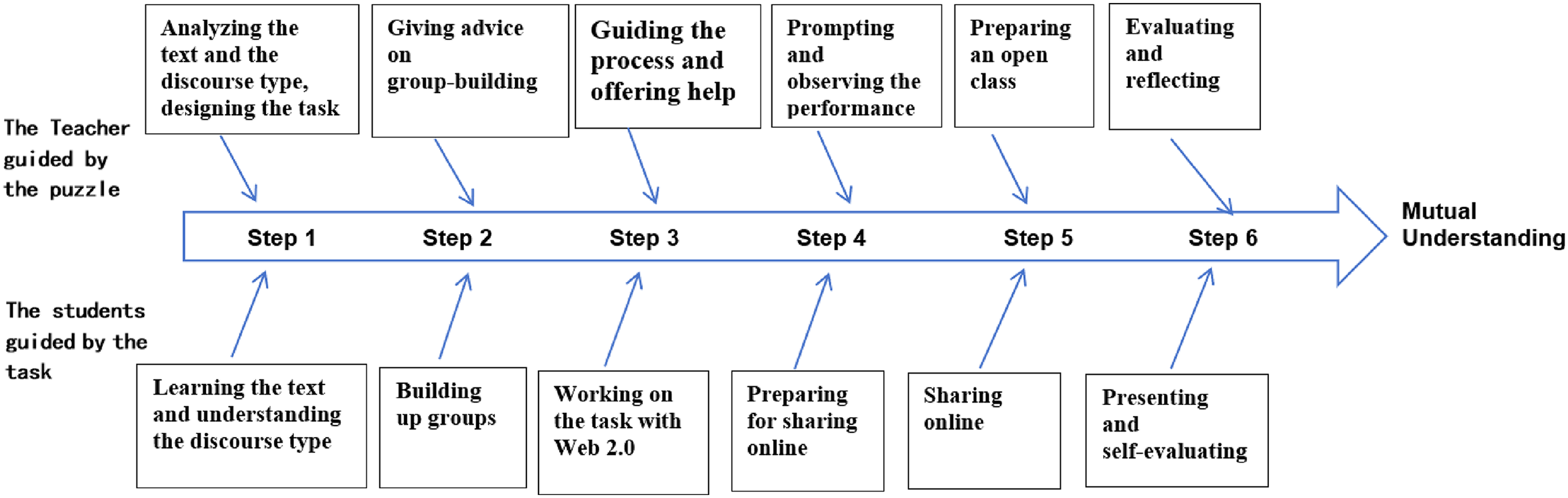
Exploratory Practice on students’ English-speaking difficulties in class.
The following example of this EP was the teaching of a description on Art and the reading text described some famous paintings.
Step 1: Learning the Text and Understanding the Discourse Type (in Class, Week 1)
First, the teacher guided her students to learn the text and accumulated some key vocabulary for describing a painting. Then, she also posed the following questions for students to have a better understanding of the discourse type of description:
What is the name of the painting?
When, where, and why did the painter create the work?
What objects did the painter paint in the work?
What is special about the painting?
How do you feel when appreciating the work?
Can you give your comments on the work?
After these questions were addressed together in class, the students were required to complete a task of drawing in three weeks, specifically working as a group to produce a painting with a description using what they learned in class.
Step 2: Building up Groups (in Class, Week 1)
The students had the freedom to form their group (5 in one group and 10 groups in total) based on their willingness and English proficiency level. Each group selected a leader to overview their task. To make full use of Web 2.0 and time outside the classroom, students also created a WeChat group (Chinese social platform, equivalent to WhatsApp) as their social media platform to keep the group discussion going after class. The teacher also formed a WeChat group with the 10 leaders to provide guidance during the process.
Step 3: Working on the Task with Web 2.0 (After Class, Weeks 1–2)
Students were advised first to decide on a list of steps for this project and work accordingly. A deadline was set. All group members surfed the internet to learn more information about famous paintings, particularly about how they were described and presented on social media. Then the whole group synthesized the collected information and decided on one idea to work on further. The work was distributed among the group members based on their strengths. For example, those with better artistic talent drew the picture, those with better English skills wrote the description and those with better technology skills presented the group work online.
Step 4: Preparing for Sharing Online (After Class, Weeks 1–2)
At this stage, the teacher had a meeting with the 10 group leaders. To make full use of Web 2.0 and to diversify students’ dissemination, the teacher prompted students’ critical thinking and creativity by asking the following three questions:
How can you present your work elegantly and concisely?
How can you stimulate viewers’ interest in your work?
How can you employ Web 2.0 for the above two purposes?
The group leaders then went back to their groups to discuss the three questions with their group members. Through discussion, each group fixed an online sharing plan.
Step 5: Sharing Online (After Class, Week 2)
The students collaborated in groups to disseminate their work. Some groups wrote articles with their painting, some groups shot videos to describe the painting, some added background music to provide an atmosphere for the painting and some used photos to illustrate how this final painting came into being. Despite these varied means, each group publicized their work with open access online. See Figure 2 for an example of online sharing in the form of an article.
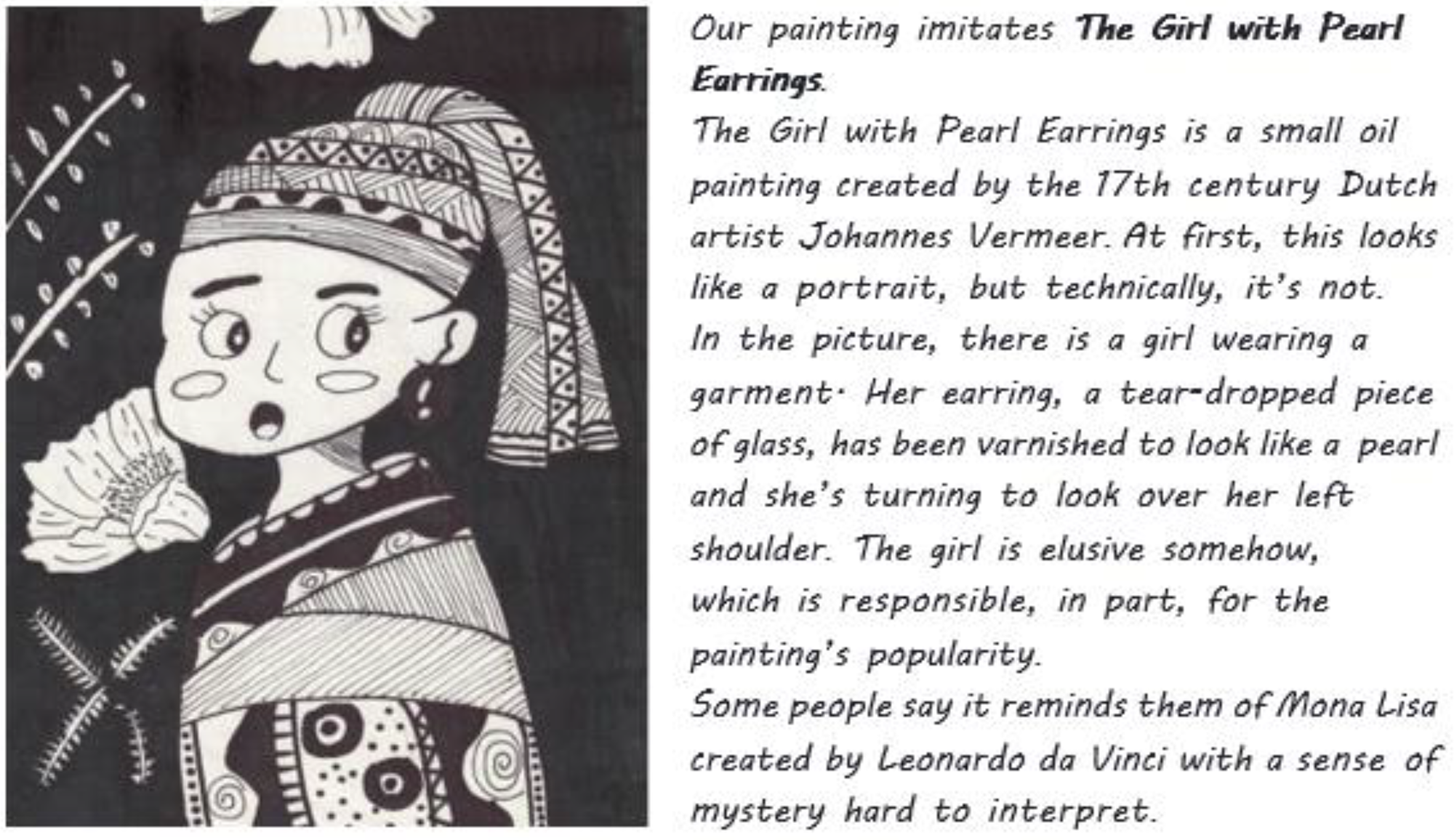
An example of students’ Exploratory Practice sharing online.
Stage 6. Presenting and Self-Evaluating (in Class, Week 3)
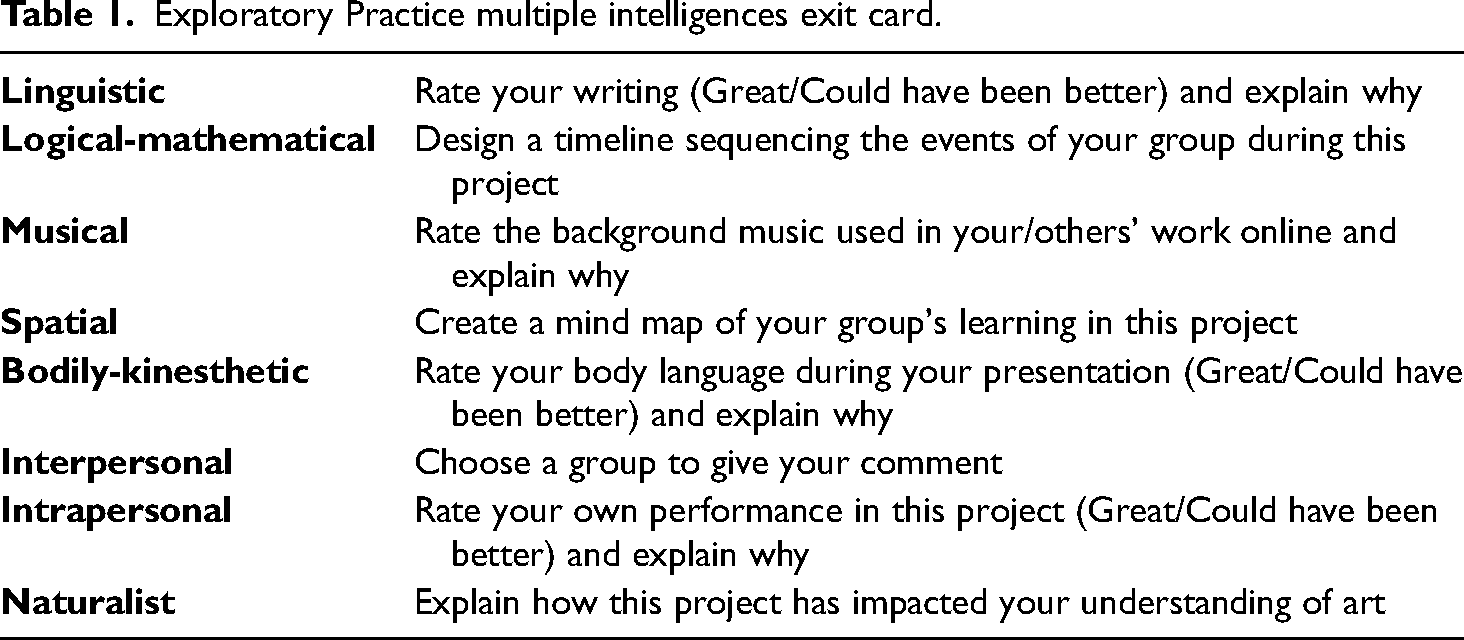
To facilitate students’ reflection, the teacher organized an open class, where each group gave a 3-minute presentation in English about their artwork. The teacher was impressed by her students’ oral presentation, both in terms of fluency and the depth of their sharing. Finally, each group received a Multiple Intelligences (MI) (Makkonen et al., 2022) Exit Card (Table 1) to self-evaluate and consolidate their learning. First, students worked independently to address all the seven tasks on the card. Then they shared and compared their learning by referring to their answers on the card within the group. Through this, students visualized their strengths and weaknesses in completing the group project while deepening their understanding of art.
Exploratory Practice multiple intelligences exit card.
Reflections
This EP solved the teacher's puzzle regarding her students’ English-speaking difficulties in class and deepened her understanding of her students’ capabilities. Students’ performances in the open class fully demonstrated that they have made great progress in speaking English and developing their language skills as well as gaining deeper insights into the topic of Art and the discourse type.
An interview was conducted again to explore students’ views on their improved English-speaking ability. The students unanimously attributed their improvements to two factors. First, the engagement in authentic learning activities enabled them to focus on using English for communication, instead of doubting their English ability. Second, the employment of Web 2.0 enabled them to gather information to generate insightful views concerning the topic, boosting their confidence in sharing with others in English.
The teacher concluded with the following three key takeaways from this EP.
EP Empowers Students’ Learning by Creating Authentic Inquiry Needs
EP enables teachers to puzzle over the issue of her students' English-speaking difficulty, think up and design activities that encourage students’ active learning by conducting authentic inquiries. In an exam-oriented educational system, students will primarily rely on memorization of content, rather than seeking a greater understanding of knowledge holistically (Ho, 2022). In this EP study, the teacher's puzzle about her students’ English-speaking difficulty has prompted her students to conduct authentic inquiry with Web 2.0. Not only did students have a better understanding of the reading topic and of themselves, but also gained valuable experience of working in a team environment.
EP Contributes to the Well-Being of Both Teachers and Students by Enhancing QoCRL
EP encourages teachers to pause and explore, instead of jumping to a hasty conclusion regarding their students’ learning issues. This transformed mindset of teachers could reduce friction in the classroom resulting from a lack of understanding. Additionally, teachers are more likely to practice a student-centered approach when they recognize that ‘learners are interesting’ (Allwright, 2015: 26). Both points lead to a higher QoCRL, contributing to the well-being of both teachers and students, as exemplified in this EP study.
EP with Web 2.0 Accommodates Students’ Learning Preferences and Boosts Their English-Speaking Confidence
Born in a digital age, students nowadays are accustomed to using Web 2.0 for socializing, learning and sharing. The integration of Web 2.0 with EP caters to the unique learning preferences of these students, as exemplified in this EP study. By gathering information online and synthesizing the findings as a group, the students gained confidence in the value of their sharing and thus their confidence in English-speaking.
Future Pedagogical Directions
This innovation adopted EP with Web 2.0 as the pedagogical approach. From puzzling to understanding, this innovation deepens the teacher's understanding of her students’ English-speaking difficulties in class without disruption to her normal teaching agenda. Despite this triumph, there are some caveats that future researchers should consider.
First, the employment of Web 2.0 could be a double-edged sword, although various benefits have been validated in different studies (Hursen, 2021). There is a danger that students may copy and paste information. Therefore, teacher guidance on information discernment and synthesis should be in place before students start to gather information.
Second, the sustainability of EP in an exam-oriented education system could be a challenge. For one thing, this transformative way of active learning may not appeal to educational stakeholders who believe in passive learning and drilling for higher scores in exams. For another, to implement EP, teachers still need to do extra work to design, gather and analyze data, and offer guidance even after school, although EP emphasizes minimizing teachers’ workload by integrating research into the normal teaching agenda (Hanks, 2021). Therefore, future studies could explore how EP can be sustained in such a context.
Nevertheless, this innovation of employing EP with Web 2.0 to address Chinese high school students’ English-speaking difficulties in class acts as a prelude to all the possible positive transformations in language classrooms, particularly in an educational system characterized by high-stakes testing.
Footnotes
Funding
The authors received no financial support for the research, authorship, and/or publication of this article.
Statement
The participants provided their written informed consent to participate in this study and gave permission for the authors to use their data for this research.
