




Abstract
This is a cross-sectional study that was conducted to explore readiness with regard to the sudden shift towards emergency remote teaching and its correlation with perceived effectiveness, satisfaction, anxiety and attitudes among instructors in Princess Nourah bint Abdulrahman University (PNU) in response to the COVID-19 pandemic lockdown. Data were gathered using an online questionnaire on readiness and perceptions of effectiveness, attitudes and satisfaction relating to the emergency remote teaching, as well as the anxiety resulting from it. Pearson’s test was performed to assess the correlations between different parameters. The results of the study showed that readiness in terms of emergency remote teaching was high, at 44.9% among instructors, while 64.8% of them scored moderately regarding their perception of the emergency remote teaching’s effectiveness. A positive attitude towards emergency remote teaching was reported by 18.5% of the instructors, although a high level of satisfaction was observed in 79.6% of the cases, and 38.7% showed no anxiety. A positive and significant correlation was obtained between a readiness to shift to emergency remote teaching and perceived effectiveness, attitudes and satisfaction (r = 0.2 and p < 0.01); however, anxiety showed a significant moderate negative correlation with perceived effectiveness (r = −0.35) p < 0.01, attitudes (r = −0.33) p < 0.01 and satisfaction (r = −0.44), p < 0.01. In conclusion, instructors at PNU were ready to provide emergency remote teaching, which led to high perceived effectiveness and levels of satisfaction, while the high level of anxiety could be attributed to stressful circumstances related to the COVID-19 pandemic.
Keywords
Introduction
Novel coronavirus disease (COVID-19) is an infectious disease caused by a new coronavirus discovered in December 2019 (WHO, 2020). The sudden outbreak of COVID-19 was declared to be a public health emergency of international concern by the World Health Organisation (WHO), due to the unexpected and alarming continuously rising numbers of confirmed cases worldwide (WHO, 2020). In fact, 4 months after the outbreak declaration (by the 4th of April 2020), the total confirmed cases exceeded 1 million globally. Along with the rest of the world’s countries, Saudi Arabia was affected by this outbreak, albeit at a lesser magnitude at that time, as its confirmed number of infections was only 2039 on the 4th of April 2020 (MOH, 2020). Despite this, anticipatory preventive and precautionary measures had already been taken by the Saudi Government a month earlier to maximise population safety while dealing with COVID-19. Thus, a lockdown was imposed, social distancing was practised, events and gatherings were cancelled and public places were closed. In line with these preventive measures, an emergency plan was adopted by the Ministry of Education, instructing an immediate and urgent shift to remote teaching to ensure a continuous delivering of education to students under these current circumstances (MOE, 2020). As per its definition, emergency remote teaching is “a temporary shift of instructional delivery to an alternate delivery mode due to crisis circumstances” (Hodges et al., 2020). Emergency remote teaching was introduced by Hodges and colleagues to distinguish the nature of remote learning that is imposed during crises from other remote learning methods, such as distance learning, blended learning, e-learning and mobile learning. In this case, emergency remote teaching represents the only solution that ensures both social distancing and continuous teaching as long as the lockdown period persists. However, for the purpose of this research and within its specific context, where e-learning was used as an alternative method during the COVID-19 lockdown, literature concerned with e-learning will be used to further understand and explain emergency remote teaching.
The shift to emergency remote teaching during the lockdown imposed as a result of the COVID-19 pandemic had a global impact on educational systems as well as on the psychological health of students and faculty members (Ahmady et al., 2020; Odriozola-González et al., 2020; Sahu, 2020). Saudi Arabian universities, in particular, made a noteworthy effort in terms of emergency remote teaching, with a smooth shift to e-learning using different pre-existing learning management systems platforms (Yamin, 2020). This smooth shift could be attributed to the e-learning infrastructure found in the Saudi Arabian higher education system, through which e-learning has been integrated into Saudi universities since the year 2002 (Al-Asmari and Khan, 2014); since then, almost all Saudi universities have created an e-learning unit or department supported by the Saudi National Centre for E-learning (Al-Shehri, 2010).
Princess Nourah bint Abdulrahman University (PNU) is the largest women’s university in the world with more than 38,000 students and 2000 instructors. Since 2013, PNU has adopted Blackboard as its learning management system, which is a web-based technology that enables instructors to plan, assess and deliver course materials online (Almarashdeh, 2016). It is a very well-known and common tool adopted by higher education institutes to enhance distance learning. As such, several colleges in PNU gradually achieved the basic level required for Blackboard activation. This includes the uploading of teaching and reading materials and the activation of discussion boards with the students, in addition to the uploading of assignments by students and plagiarism testing and the giving of virtual classes. Although the senior administration team at PNU strongly encouraged, supported and requested the achievement of the basic activation level of Blackboard, instructors did not always comply with Blackboard activation due to several reasons, such as a lack of skills and practice, time constraints, difficulty in dealing with technology and preferences for traditional education (Al-Busaidi and Al-Shihi, 2010; Asiri, 2012). Thus, the predominant teaching mode used by staff members has always been traditional face-to-face teaching in classrooms. This was the most common teaching mode as per habits and comfort. When the lockdown was imposed, instructors were mandated to shift completely to remote teaching by utilising the learning management system provided by the university, which was mainly based on Blackboard with later support from Microsoft Teams. Thus, the complete shift to remote teaching imposed in PNU was unexpected and urgent. The reality was that this shift was sudden, and no aspects related to teaching, such as the course nature, instructor’s experience in e-learning or college speciality (medical, humanities or scientific), were taken into account. The priority was to keep both PNU students and staff safe from COVID-19.
Regardless of the existence of infrastructure and a learning management system, this completely unplanned, sudden shift may have had an effect on the educational experience. Literature indicated the importance of advanced proper planning to provide properly structured, effective e-learning, which achieves its intended outcomes whether as a complete distance-learning course or blended learning (where virtual learning is combined with face-to-face interaction, as is the current case in PNU) (Rice and McKendree, 2014). Moreover, several empirical studies considered poor planning and a lack of staff training as barriers to a successful e-learning experience (Algahtani, 2011; Edwards and McKinnell, 2007). In 2005, the University of York developed a framework for planning and delivering blended learning (Rice and McKendree, 2014). It consists of four stages, which are design, socialising the learners and instructors, supporting participation online and maintaining activity and, finally, summing up the learning outcomes for the course. By following this process, learners’ and instructors’ readiness is expected to increase by preparing them on both technical and psychological levels and by giving them a sense of relevance with regard to the value of virtual learning. Consequently, it is helpful to anticipate any decreases in the confidence levels and increases in anxiety of both learners and instructors.
As for instructors’ anxiety, it may arise from the perception that e-learning is more demanding compared to a traditional teaching approach (Hasan and Bao, 2020). Moreover, as e-learning implies a complete use of technology, Johnson et al. (2012) illustrated that technology anxiety is the most challenging barrier to overcome in teaching an online course. Besides anxiety due to teaching an online course, instructors might face additional anxiety resulting from the unusual lockdown situation due to the COVID-19 pandemic (Casagrande et al., 2020). In fact, several studies have indicated high anxiety levels among academics and teachers during the pandemic around the world (Kim and Asbury, 2020; Talidong and Toquero, 2020). Kim and Asbury (2020) revealed that while usually workload is a main stressor for instructors, during the pandemic it was a marginal issue, and uncertainty and worrying about the vulnerable had a stronger effect.
As mentioned earlier, literature anticipated that emergency remote teaching during the COVID-19 pandemic could affect learning outcomes (Ahmady et al., 2020; Yamin, 2020). Yet, of importance, the ability of an educational system to achieve its intended outcome within a short time frame is referred to as effectiveness, which is one of the crucial aspects of ensuring the requested quality of teaching (Reeves and Hedberg, 2003). Nevertheless, the issue of evaluating the effectiveness of e-learning has been a controversial and much disputed subject (Algahtani, 2011). Khan (2005) recommended a comprehensive evaluation for e-learning, which includes students, instructors and the context of learning and covers the input, process, output and people. A review of literature evaluating the effectiveness of e-learning was conducted by Noesgaard and Ørngreen (2015) and included a total of 61 empirical studies. It found that e-learning was considered effective in the majority of the studies (N = 41), partially effective by 6 studies and ineffective in only 6 studies. However, the evaluation of effectiveness used a wide range of methods and parameters, including, but not limited to, the learning outcome, attitudes, satisfaction and perceived learning. Consequently, the authors recommended that when measuring effectiveness, researchers should specify what variables are being tested and why in order to increase the usability of the results and properly inform decision makers in teaching processes.
More recently, literature has emerged that offers contradictory findings about the value of students’ evaluations of the effectiveness of learning. Lawrence (2018) considered students’ evaluations of teaching as a poor measurement for the effectiveness of learning and as providing invalid data. Additionally, a meta-analysis of the relationship between students’ evaluations of teaching and learning indicated that there is no significant correlation (Uttl et al., 2017). On the other hand, the perspective of instructors with regard to the usefulness of e-learning, satisfaction levels and acceptance has been found to be useful in bringing appropriate elements together for successful planning in order to achieve effective e-learning (Sørebø and Sørebø, 2008). Hence, this research will cautiously examine the effectiveness of e-learning, considering the process of emergency remote teaching by exploring PNU instructors’ perceptions of effectiveness.
Mishra and Panda (2007) highlighted the importance of decision makers understanding instructors’ attitudes towards e-learning. This is particularly important when new technology arises or when a new experience takes place. This understanding allows them to plan effectively in a manner that is acceptable to the end users. This is particularly true when instructors are considered a key stakeholder by being involved in planning and playing a role in choosing the appropriate features that meet their teaching needs (Sørebø and Sørebø, 2008).
Likewise, literature has indicated that achieving instructors’ satisfaction is crucial to maintaining the continuity of e-learning and commitment to using learning management system platforms (Al-Busaidi and Al-Shihi, 2012; Al-Samarraie et al., 2018). In addition, instructors’ satisfaction was considered to be an essential factor in terms of influencing their ability to use learning management systems and the quality of their performance (Yengin et al., 2011).
Conceptual framework
As the literature shows, in ordinary situations, instructors can influence e-learning in a number of ways. First, readiness, which can be measured in terms of having a proper e-learning infrastructure in place and being trained to use learning management systems, can increase the chance of having a successful e-learning experience. Second, instructors’ satisfaction with the e-learning experience can increase the chance of them using and continuing with high-quality e-learning. In addition, understanding instructors’ attitudes towards e-learning and their perceptions regarding its effectiveness can be helpful in planning and advancing the experience. Lastly, as the study was not conducted in an ordinary situation and took place during a pandemic lockdown, the psychological status of the instructors was a main concern. Hence, to guide this research, a conceptual framework (Figure 1) was developed by the researchers, including the five elements which are; readiness, perceptions of effectiveness, attitudes, satisfaction and anxiety to explain the experience of emergency remote teaching among PNU instructors.
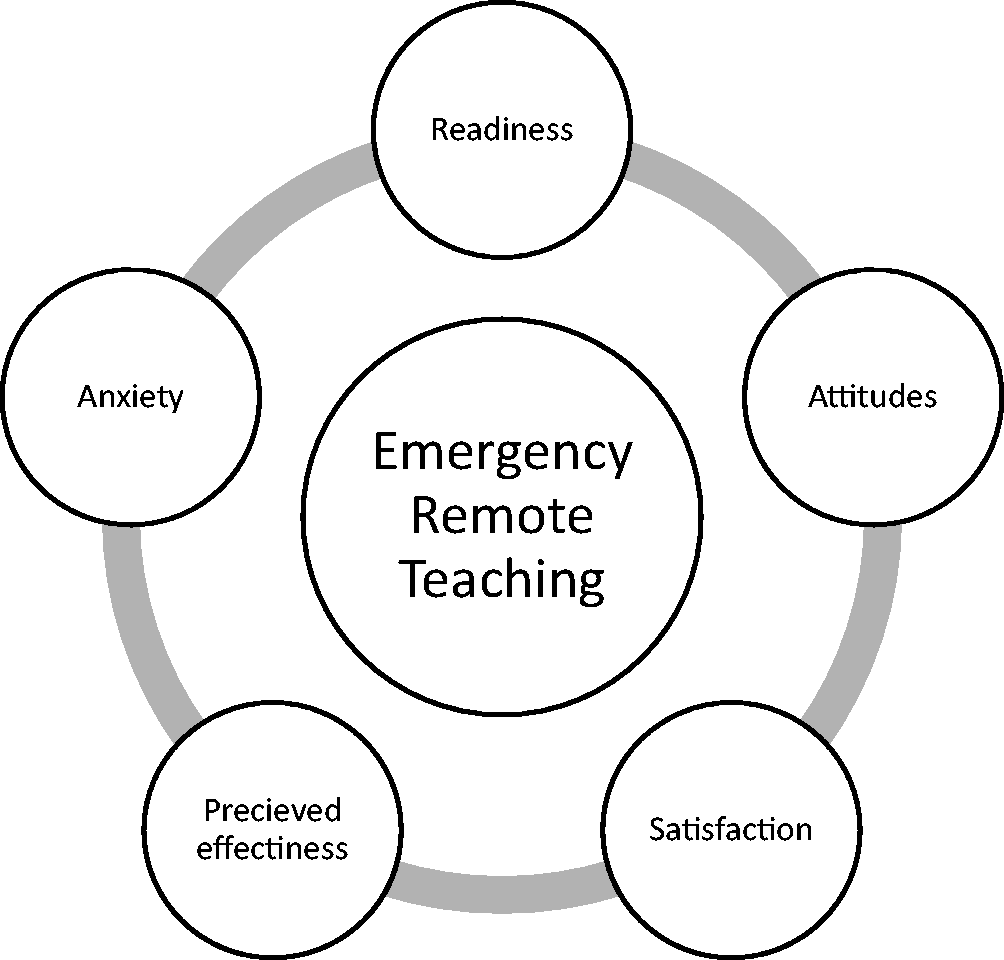
Conceptual framework of elements of emergency remote teaching.
In light of the literature and considering the case of the PNU emergency shift to e-learning, where no process was followed to plan appropriate virtual learning courses, this research study aims to explore the readiness and perceived effectiveness, satisfaction, anxiety and attitudes regarding emergency remote teaching among PNU instructors during the sudden shift to virtual learning in response to the COVID-19 pandemic lockdown. The hypothesis statement is that the readier the course instructors are to implement e-learning/remote learning, the better their perceptions in terms of effectiveness, satisfaction and attitudes and the lower their levels of anxiety during the emergency shift to remote emergency teaching will be.
As per projections with regard to achieving the complete containment of the COVID-19 pandemic, it might take several months to create a vaccine (Chen et al., 2020), and hence, the lockdown might concern at least the first term of the 2020–2021 academic year. Thus, it is crucial to evaluate this current emergency remote teaching experience in PNU from the instructors’ perspectives to help in designing specific recommendations to improve the overall quality and effectiveness of e-teaching in general and, specifically, during times of emergencies. The objectives of this research were as follows: 1 – to explore readiness regarding the sudden shift towards emergency remote teaching among instructors in PNU in response to the COVID-19 pandemic lockdown and 2 – to assess the correlation between the readiness and perceived effectiveness, satisfaction, anxiety and attitudes of instructors in terms of emergency remote teaching.
Methodology
Research design and subjects
This was a cross-sectional descriptive study. It was conducted among faculty members at PNU during the month of May 2020. The recruitment of participants was performed using a non-probability convenient sampling technique. In order to collect data, a questionnaire was shared online and distributed through the official mailing lists of the university to reach out to all faculty members of PNU. Moreover, the survey questionnaire link was disseminated by the researchers through social media applications, mainly WhatsApp. The study inclusion criterion was being a faculty member at PNU, regardless of academic ranking or the college to which they belonged. However, faculty members who were not engaged in teaching in March 2020, when the emergency switch to remote learning happened, were excluded from the study.
Ethical approval from the institutional review board (IRB) committee at Princess Nourah Bint Abdulrahman University was obtained prior to conducting the study (IRB Log Number 20–0162). Informed consent was displayed on the first page of the questionnaire, which informed about the objectives of the study. Participants were provided with information indicating that taking part in this study was voluntary and that anonymity would be maintained throughout all stages of the research. Participants were assured about the confidentiality of their data and that they would only be used for research purposes. Participants were informed that by answering the questionnaire they gave their consent to participate in the study.
The required study sample was estimated to be a minimum of 360 instructors from a total study population of 2161 faculty members. These numbers were estimated to have a confidence level of 95% that the real value is within ± 5% with a p = 0.5, after adding an additional 10% to overcome any incomplete data. A total of 401 respondents completed the questionnaire.
Research instrument
Data were collected using an online questionnaire (see the appendix), which was developed by the researchers based on five elements of the conceptual framework explained earlier. The questions were adopted from previous literature (Ghenghesh et al., 2018; Uziak et al., 2018) with modifications to meet the objectives of the study. The questionnaire consisted of six sections as follows:
Section 1
This explored study sample characteristics, such as college affiliation (health colleges, scientific colleges, humanitarian colleges or other such institutes), academic ranking, language of teaching (English or Arabic), years of experience (ranging from 0 to up to more than 10 years) and the number of courses taught by each instructor (ranging from 1 to more than 5 courses).
Section 2
This aimed to assess the level of readiness of the course instructors related to emergency remote teaching. It consisted of five questions related to their experience with different e-learning platforms. It included the online applications used to support their teaching (Microsoft Teams, Zoom, Telegram, WhatsApp and Blackboard), the different features of the official PNU learning platform (virtual classes, discussion board, quizzes/exams, uploading course materials, submitting assignments) and the methods used to communicate with students (office hours, email, Blackboard, Telegram, WhatsApp, during lectures only), prior to shifting to complete remote e-learning. The last two questions enquired about the existence of good network connections and devices to provide remote teaching. For each answer reflecting the use of Blackboard and related features one score was given and for each answer reflecting the use of other learning platforms or the existence of supporting environment was also given a score of 1. The minimum score for readiness was 0, while the maximum score was 9. A readiness score was interpreted as being low if the score was between 0 and 3, moderate if the score was between 4 and 6 or high if the score was between 7 and 9.
Section 3
This measured perceptions of effectiveness regarding emergency remote teaching among PNU instructors during the sudden shift to virtual learning in response to the COVID-19 pandemic lockdown. This section was assessed using a Likert scale with five degrees of agreement, ranging from 1 to 5 (Likert, 1932). The highest score of 5 was for “strongly agree”, and the lowest score of 1 was for “strongly disagree”. Eleven questions assessed the instructors’ perceptions of the effectiveness of the shift to emergency remote teaching. These questions covered different dimensions, including the quality of teaching, supporting independent learning, achieving learning outcomes, improving student-instructor communication, time management and being organised. The total scoring ranged from a minimum of 11 to a maximum of 55. The scores obtained were categorised as follows: low (11–25.6), moderate (25.7–40.2) or high (40.3–55).
Section 4
This focused on evaluating measured attitudes of the instructors at PNU towards the emergency remote teaching. As for perceived effectiveness, this parameter was assessed using a Likert scale with five degrees of agreement, ranging from 1 to 5 (Likert, 1932). The highest score of 5 was for “strongly agree”, and the lowest score of 1 was for “strongly disagree”. Attitude was measured using six questions covering the motivation to use different teaching styles, delivering the subject material well and all course learning outcomes, in addition to whether emergency remote teaching was more enjoyable than the face-to-face approach and the preferred way of teaching for delivering more courses and, finally, whether emergency remote teaching had changed perceptions about teaching styles and assessment methods. The minimum total score was 6, and the maximum one was 30. The total scores obtained were then organised into the three following categories: a negative attitude (6–14), a neutral attitude (15–22) or a positive attitude (23–30).
Section 5
This assessed the satisfaction of PNU instructors with the emergency remote teaching. This section was also assessed using a Likert scale with five degrees of agreement, ranging from 1 to 5 (Likert, 1932). The highest score 5 was for “strongly agree” and the lowest score 1 for “strongly disagree”. The satisfaction parameter was evaluated by five questions covering the overall experience and its clarity, accessibility, easiness and support. The scale ranged from “highly satisfied” to “not at all satisfied”. The highest score of 5 was for the former, and the lowest score of 1 was for the latter. The maximum possible score for this section was 25, and the obtained scores were classified as low (5–11.6), moderate (11.7–17.2) or high (17.3–25).
In sections 3, 4 and 5, total scores were used for each item, as recommended by Warmbrod (2014), because total scores have been reported to provide congruent interpretations of obtained results, and they also provide the opportunity to assess the correlation between the different studied parameters.
Section 6
This focused on the assessment of anxiety using a self-administered anxiety assessment tool, namely the General Anxiety Disorder-7 (GAD-7) tool (Spitzer et al., 2006). It consisted of seven questions to assess how often a person worries about life events, and in the case of this study, the event is the emergency remote teaching in response to the COVID-19 pandemic lockdown. The highest score of 3 was given to “nearly every day”, and the lowest one of 0 was given to “not at all”. The maximum total score was 21, and the scores obtained were interpreted as follows: no anxiety when a score is between 0 and 4, a low level of anxiety for a score between 5 and 9, a moderate level of anxiety for a score between 10 and 14 and a severe level of anxiety for a score between 15 and 21. To suit the purpose of this study, a minor modification was made as instead of assessing the last two weeks, it was used to assess the period of the shift to emergency remote learning.
Validity and reliability of the study instrument
Before making the questionnaire available online, it was translated from English to Arabic using a forward-backward technique. Necessary changes were made to ensure its correct translation. In addition, the validity of this questionnaire was established as the survey questions were checked by a panel of three experts in education and three university academics. The reviewers confirmed that the questions were clear, readable, comprehensive and suitable for their intended purpose. Internal consistency was assessed using Cronbach’s α test, which yielded good results. The obtained values of α were equal to 0.84, 0.81 and 0.83 for the perception of effectiveness, attitudes and satisfaction, respectively. The GAD-7 is a reliable tool that showed excellent internal consistency and good test reliability in previous studies, as reported by Spitzer et al. (2006) and Sawaya et al. (2016). For the data set of this research, Cronbach’s α test was 0.92. To assess the feasibility, the instrument was piloted with 10% of the sample, and minor modifications were needed.
Statistical analysis
Data analysis was performed using SPSS software (version 22). Results were presented in terms of frequency and percentages. Descriptive statistics (means and standard deviations) were used to represent the results related to different parameters. Pearson’s correlation coefficients were used to assess the correlation between readiness and perceived effectiveness, satisfaction, anxiety and attitudes regarding emergency remote teaching among PNU instructors during the sudden shift to virtual learning in response to the COVID-19 pandemic lockdown. Results were considered statistically significant at a p-value of ≤ 0.05.
Results
General characteristics of the study population
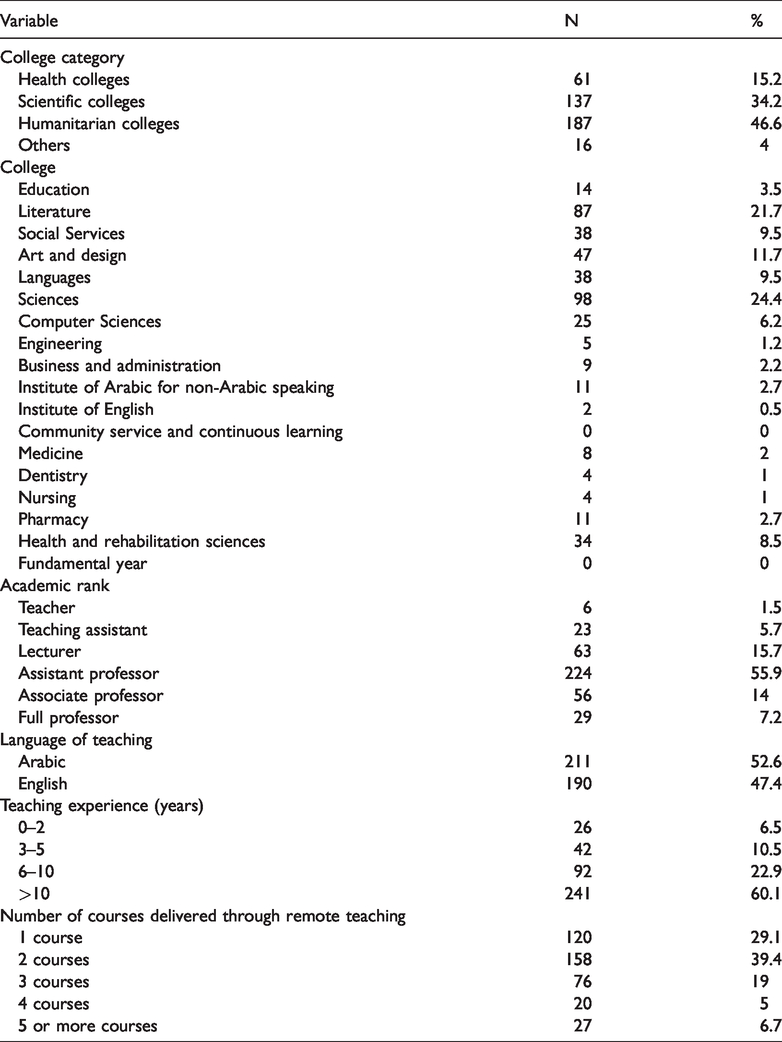
A total of 401 instructors from PNU filled in the online questionnaire. As indicated in Table 1, 15.2% of participants belonged to health colleges, 34.2% belonged to scientific colleges and 46.6% belonged to humanitarian colleges. More than half of the participants were from the College of Sciences (24.4%) the College of Literature (21.7%) or the College of Art and Design (11.7%). Most of the respondents had more than 10 years of experience (60%), followed by 6 to less than 10 years of experience (22.9%). PhD holders accounted for 77% of the sample, and 47.4% used English as their language of teaching (Table 1).
General characteristics of the study population (N = 401).
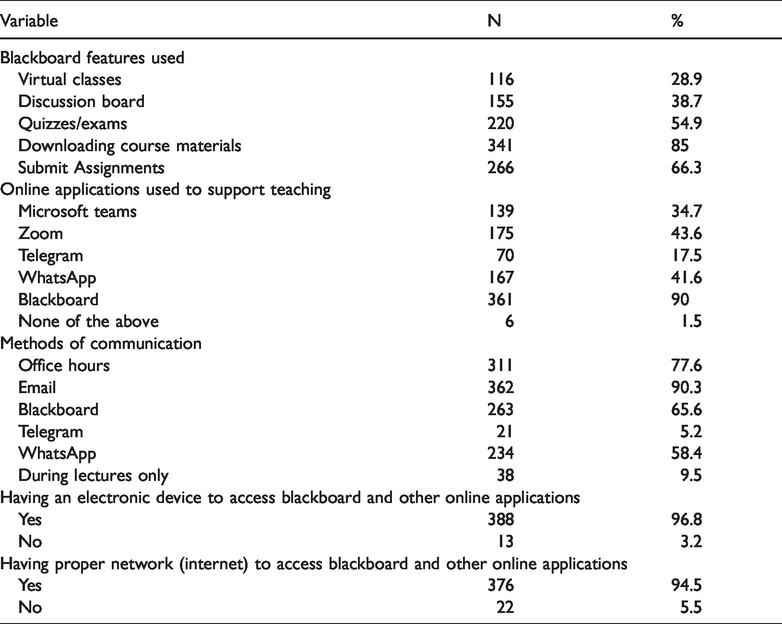
Readiness of PNU instructors prior to shifting to emergency remote teaching
In terms of readiness to shift to emergency remote teaching, the results demonstrate that 90% of the subjects used Blackboard prior to the emergency remote teaching, indicating that Blackboard was the most used platform by PNU instructors, followed by Zoom (43.6%) and WhatsApp (41.6%); however, slightly more than one third of the respondents were familiar with the Microsoft Teams application (34.7%). In terms of the features of Blackboard, 85% used it to upload course materials, while 66.3% and 54.9% used it for submitting assignments and performing quizzes/exams, respectively. However, delivering virtual classes was the least used feature, with only 28.9% of instructors employing it. On the other hand, 96.8% had electronic devices for accessing Blackboard and other online applications, and 94.5% had proper networks (internet) for this purpose (Table 2).
Readiness level prior to shifting to ERT (N = 401).
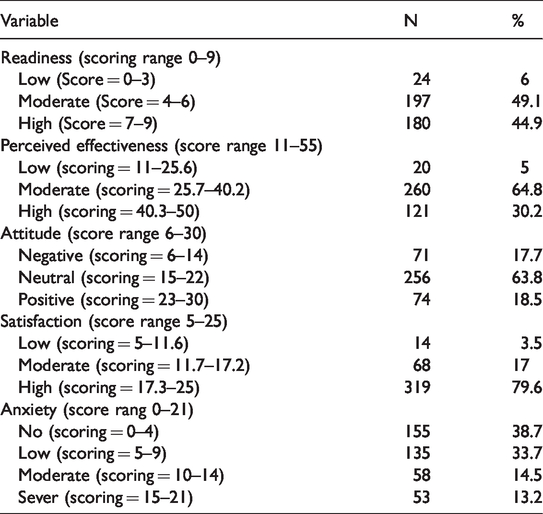
Levels of readiness and perceived effectiveness, attitudes, satisfaction and anxiety among instructors during the shift to emergency remote teaching
The results in Table 3 indicate that the instructors’ readiness to shift to emergency remote teaching was high among 44.9% of the sample, and a moderate level of readiness was reported in 49.1%, while the perceived effectiveness was high for 30.2% of the study participants, as they scored more than 40.3 and moderate for 64.8% of them, who obtained scores between 25.7 and 40.2. Almost two thirds of the study participants scored moderately in terms of their perceptions of the effectiveness of emergency remote teaching (64.8%). Participants’ attitudes towards emergency remote teaching were positive in 18.5%, neutral in 63.8% and negative in 17.7% of the subjects. A high level of satisfaction (79.6%) was reported among the subjects of this study, while the anxiety results revealed that 13.2% had severe anxiety versus 38.7% that had no anxiety (Table 3).
Percentages of different levels of readiness, perceived effectiveness, attitude, satisfaction and anxiety among instructors during the shift to ERT (N = 401).
Correlation among readiness and perceived effectiveness, attitudes, satisfaction and anxiety for instructors at PNU during the shift to emergency remote teaching
In Table 4, the correlations between the studied parameters of readiness and perceived effectiveness, attitudes, satisfaction and anxiety related to emergency remote teaching are summarised. Pearson’s r correlation revealed a significant weak positive correlation of readiness with the total scores of perceived effectiveness (r = 0.20, p < 0.001), attitudes (r = 0.22, p < 0.001) and satisfaction (r = 0.21, p < 0.001), while no correlation was obtained with stress. Moreover, there was a significant positive strong correlation between perceived effectiveness and attitudes (r = 0.78, p < 0.001) and a moderate positive correlation between effectiveness and satisfaction (r = .058, p < 0.001). There was a significant positive moderate correlation between attitudes and satisfaction (r = 0.52, p < 0.001). However, a significant moderate negative correlation was obtained between anxiety and perceived effectiveness (r = −0.35, p < 0.001), attitudes (r = −0.33, p < 0.001) and satisfaction (r = −0.44, p < 0.001) (Table 4).
Correlation (r) among readiness, perceived effectiveness, attitudes, satisfaction and Anxiety for instructors in PNU during shift to ERT (N = 401).
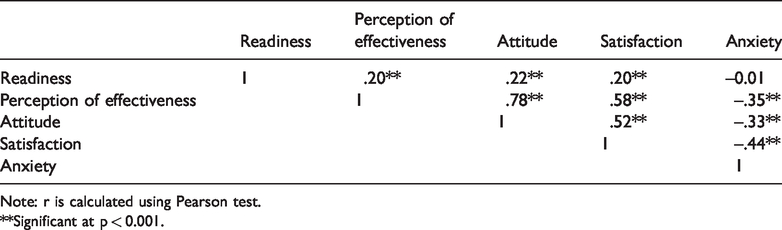
Note: r is calculated using Pearson test.
**Significant at p < 0.001.
Discussion
This study explored the readiness and perception of effectiveness, attitudes, satisfaction and anxiety during the shift to emergency remote teaching among faculty members at PNU amid the COVID-19 pandemic lockdown. To our knowledge, this is the first study that focuses on evaluating this unique experience of instructors at PNU. As such, it is worth recalling that PNU is the largest women’s university in the world, with more than 38,000 students enrolled in various specialities in its 18 different colleges and institutes. Besides, the total number of instructors exceeds 2000, reflecting a very important input and exchange in terms of teaching experience. Undergoing a sudden shift to emergency remote teaching could be considered as a golden opportunity to assess PNU’s potential in terms of taking a formal step forward in adopting e-learning as one more available teaching strategy. In fact, the results obtained in this study showed that the majority of instructors at PNU were actually ready to shift to emergency remote teaching. This was indicated by 94% of the sample demonstrating moderate to high readiness before the shift. Furthermore, about 90% of PNU instructors showed moderate to high perceptions of the effectiveness of emergency remote teaching. This finding is supported by the results related to attitudes, where positive attitudes were observed to be slightly higher than negative attitudes, and most of the subjects demonstrated neutral attitudes (63.8%) towards emergency remote teaching. In terms of satisfaction, PNU instructors were satisfied with the experience of a sudden shift to e-learning as 79.6% demonstrated high satisfaction, while more than a third of the instructors had no anxiety, and only 13.2% and 14.5% reported severe and moderate anxiety, respectively, as measured by the GAD-7. The r values obtained for the correlations between the studied parameters revealed that the hypothesis statement set of our research was only correct for perceived effectiveness, satisfaction and attitudes as the higher the readiness the better these parameters were, despite the correlation being weak, while the hypothesis was not correct for the level of anxiety as r = −0.01.
One important finding of this study was that the readiness level was moderate to high among the instructors at PNU. This high level of preparedness could be explained as an expected result of the services provided by the university to faculty members. These services include, but are not limited to, providing a personal laptop; free internet access on the whole campus, including in faculty housing accommodation; and very efficient and rapid IT technical support. Additionally, an e-learning unit was established in each of the 18 colleges and institutes of PNU. By doing so, the university has reinforced the use of Blackboard and provides regular training to all its faculty members in order to increase the tool’s activation levels and to maximise the potential of e-learning. Despite the emergency remote teaching not being planned in advanced, this e-learning infrastructure provided a good base for the shift, which, as literature has suggested, is an important factor for the success of e-learning (Nasiri et al., 2014); this is supported by Aljaber (2018) who reported a growth in e-learning readiness among universities in Saudi Arabia. Naveed et al. (2017) investigated factors that contribute to the successful implementation of e-learning in Saudi universities. Their study found that institutional support and infrastructure readiness were considered to be factors that lead to success in implementing e-learning. In the current study, participants’ levels of satisfaction were assessed based on the support provided and PNU’s infrastructure. Hence, a high level of satisfaction (79.6%) was found among the study sample, which is an expected result of the support provided to staff by the university during the shift to emergency remote teaching. This was evident from the positive correlation between readiness and satisfaction (r = 0.21, p < 0.001).
Another relevant finding of the study is that the majority of the participants (90%) perceived their teaching to be effective during the lockdown. Accordingly, the perception of instructors regarding the effectiveness of e-learning as a result of the sudden shift was aligned with the body of literature discussing the success of e-learning as a mode for teaching and achieving students’ learning outcomes. Rajab (2018) compared the face-to-face mode of teaching and the emergency shift to e-learning imposed as a result of the war in the southern region of Saudi Arabia. The results indicted a high level of satisfaction with the effectiveness of learning among faculty members and reported no difference in students’ performance in face-to-face education and the emergency e-learning situation. Additionally, in literature concerned with e-learning, no difference was reported between face-to-face and remote learning in terms of the achievement of learning outcomes (Cavanaugh and Jacquemin, 2015; Page and Cherry, 2018). Thus, despite the earlier dispute about the effectiveness of e-learning (Algahtani, 2011), more recent literature has supported the claim that there is no significant difference between e-learning and face-to-face learning. In addition to the current finding of this study where, even with the lack of proper planning during a time of emergency, instructors perceived their teaching to be effective due to the high level of preparedness and a strong e-learning infrastructure, the growing evidence supporting the effectiveness of e-learning in Saudi universities should encourage more utilisation of e-learning or blended modes of teaching in higher education. This will overcome the challenges faced by higher education in Saudi Arabia to accommodate the increasing number of high school graduates and the high workload of instructors (Aljaber, 2018). As the literature shows, having a positive attitude towards e-learning increases its level of acceptability for instructors (Mishra and Panda, 2007). However, in the present study, a minority (18.5%) of the instructors had a positive attitude, and a slightly lower percentage (17.7%) had a negative attitude, while the majority of the participants (63.8%) had neutral attitudes. These results contradict a number of studies in Saudi Arabia where a positive attitude towards e-learning was found among the majority of faculty members (Akbarilakeh et al., 2019; Alkhalaf et al., 2012; Hussein, 2011). However, a plausible explanation for this difference in attitudes could be based on the fact that the previously mentioned studies assessed attitudes towards structured e-learning in regular situations. In contrast, the current study assessed attitudes of the emergency shift during the global pandemic without prior planning or consideration of technical and psychological readiness. The university could improve the instructors’ attitudes and increase their acceptance of learning by involving them in decision making and improving the teaching system based on their feedback, as recommended by Sørebø and Sørebø (2008). Celik and Yesilyurt (2013) investigated the relationship between anxiety resulting from e-teaching and attitudes in faculty members. Their results demonstrated that instructors’ attitudes towards e-learning were a main predictor of their anxiety. In this study, a possible explanation is that the negative attitudes might result from the anxiety level of the instructors as 27.6% reported moderate to severe anxiety, as measured by the GAD-7. In fact, several stressors may explain the level of anxiety reported by PNU instructors. Technological anxiety that arose from designing an online course may be a factor that contributed to high anxiety among the study participants, as reported by Johnson et al. (2012). In this study, instructors were mandated to shift completely to remote learning without prior planning. Yet, it should be mentioned at this point that the shift did not concern the teaching alone, but also the assessment of students and maintaining regular interaction with them, as well as keeping up-to-date with any new instructions from the university. Additionally, literature shows that academics have higher levels of job stressors leading to the higher manifestation of stress. In addition to teaching duties, instructors usually perform daily administrative tasks and are requested to maintain a minimum level of scientific research activity and community services (Iqbal and Kokash, 2011; Soliman, 2014). In accordance with this finding, Mohamed and Mohamed (2016) confirmed the existence of a moderate level of stress among faculty members at Hafr al-Batin University. Moreover, female instructors, specifically those who work in middle-level positions, reported the most work-related stress (Sliskovic and Sersic, 2011). It is worth noting that all the PNU instructors who participated in this study were females, which could explain to a certain extent the severe anxiety level reported in the study.
It was previously demonstrated that stress in the workplace may result in undesirable outcomes that impact performance and satisfaction (Hashemi et al., 2015). Therefore, understanding factors influencing stress levels in academic institutions is essential to formulating strategies to improve instructors’ performance and satisfaction. Interestingly, role isolation, which is manifested in not being included in decision making, was found to be the main stressor faced by faculty in public universities (Nazneen and Bhalla, 2014). This could be amplified by the sudden decisions imposed during the emergency shift to e-learning. Although anxiety existed among the participants during the period of shifting to emergency remote teaching, this might be affected by many factors including the anxiety imposed by the COVID-19 pandemic during the total lockdown period. A number of studies around the world have indicated that the COVID-19 pandemic is affecting people’s psychological health. Chan et al. (2020), for example, investigated the psychological impact of COVID-19 on the general population in China and reported that 28.8% reported moderate to severe anxiety. Additionally, a recent study conducted on the general population in Saudi Arabia demonstrated moderate to severe anxiety and depression in nearly 42% of the study sample in response to COVID-19 (Joseph et al., 2020). The current study showed lower rates of moderate to severe anxiety (27.6%) in comparison to the results of Joseph et al. (2020). Yet, these are concerning results that should be taken seriously and dealt with in a professional way (Sawaya et al., 2016; Spitzer et al., 2006). In response to these findings, it would be appropriate if the university could develop and provide a mental health programme composed of educational and professional psychological support to help instructors to cope with anxiety during pandemics.
Strengths and limitations
With regard to the strengths of the study, the questionnaire used in this study showed a very good internal consistency, and hence, the data collected can be considered to have high reliability. In addition, the survey was carried out in real time during the COVID-19 pandemic, while emergency remote teaching took place, which could provide an accurate insight from PNU instructors in relation to emergency remote teaching. Finally, to our knowledge, this is the first study focusing on emergency remote teaching in PNU, the largest women’s university in the world. Evaluating this experience will be extremely useful as an evidence base for decision-making processes at the university in terms of adjusting and improving e-learning within a long-term perspective. However, the study used a non-probability sampling technique, which, as a consequence, may affect the generalisability of the results and could be the main limitation of the present study. Nevertheless, the results of the study could provide an insight for other universities that are experiencing similar circumstances.
Conclusion
Readiness and perceived effectiveness, satisfaction, attitudes and anxiety among instructors were assessed during the sudden shift to remote learning at PNU. The results indicate that they were ready to shift to emergency remote teaching as they demonstrated high perceived effectiveness and high levels of satisfaction regarding it. This could be explained by the long-term PNU investment in infrastructure and instructor training prior to the emergency remote teaching. However, the higher level of anxiety observed may result from several factors related to job demands and the COVID-19 pandemic.
Recommendations
Based on the results of the current study, it is recommended to explore readiness by measuring scales specific to e-learning and by assessing in-depth factors influencing emergency remote teaching, such as training with regard to the use of Blackboard, technical support and infrastructure components and the university’s response to the specific needs of instructors. Furthermore, the impact of emergency remote teaching on achieving learning outcomes related to theoretical, practical and clinical aspects should be assessed. As severe anxiety was reported, it would be of interest to consider delivering educational and psychological support to instructors to limit the negative effects of such teaching resulting from the COVID-19 pandemic.
The high level of readiness and strong infrastructure, along with the capacity of the e-learning mode of teaching to achieve student learning outcomes, support the utilisation of e-learning as a mode of teaching. Therefore, it is time for PNU and the other Saudi higher institutions to consider rethinking the opportunity to expand the percentage of courses offered online. Undertaking such a strategic decision could be a potential solution to increasing the admission of high school graduates from all over the Kingdom of Saudi Arabia. Besides, it could also help in overcoming the high workload imposed on instructors. There is no doubt that, as per this unique experience resulting from the COVID-19 lockdown, PNU seems to have enough expertise to allow it to work on strategies to improve attitudes and the acceptance of new technology in the teaching process. As such, a participatory approach by involving instructors as key stakeholders in decision making regarding the e-learning planning process would be beneficial in terms of enhancing the quality of the teaching and the achievement of the students’ intended learning outcomes, as literature supports the influence of involvement in decision making on improving attitudes.
Supplemental Material
sj-pdf-1-ldm-10.1177_2042753020981651 - Supplemental material for Readiness towards emergency shifting to remote learning during COVID-19 pandemic among university instructors
Supplemental material, sj-pdf-1-ldm-10.1177_2042753020981651 for Readiness towards emergency shifting to remote learning during COVID-19 pandemic among university instructors by Samiah Alqabbani, Afrah Almuwais Nada BenajibaFatmah Almoayad in E-Learning and Digital Media
Footnotes
Acknowledgments
The authors would like to express their gratitude to the PNU instructors who participated in this study.
Authors' contributions
All the authors (Samiah F. Alqabbani, Afrah Almuwais, Nada Benajibab, Fatmah Almoayad): Made a substantial contribution to the design of the work and acquisition and statistical analysis of data. Contributed significantly interpretation of data and drafting the article. Contributed in collating supportive literature, adding and improving scientific merit of the study and revised manuscript for English language grammar, syntax and flow as well as formatting. Revised and approved the version to be published, Participated sufficiently in the work to take public responsibility for appropriate portions of the content.
Availability of data and material
Authors declare availability of material (questionnaire) used in their study.
Consent to participate
It was displayed on the first page of the online questionnaire containing the objectives of the study. Participants were recruited voluntarily, and anonymity was maintained through all stages of the research. Participants were assured about the confidentiality of their data and that it will only be used for research purposes. Participants were informed that by answering the questionnaire they gave their consent to participate in the study.
Declaration of Conflicting Interests
The author(s) declared no potential conflicts of interest with respect to the research, authorship, and/or publication of this article.
Ethics approval
The ethical approval from the institutional review board/ethics committee in Princess Nourah Bint Abdulrahman University was obtained prior to conducting the study (IRB Log Number 20–0162).
Funding
The author(s) disclosed receipt of the following financial support for the research, authorship, and/or publication of this article: This research was funded by the Deanship of Scientific Research at Princess Nourah bint Abdulrahman University through the Fast-Track Research Funding Programme.

Supplemental Material
Supplementary material for this article is available online.
Author Biographies
References
Supplementary Material
Please find the following supplemental material available below.
For Open Access articles published under a Creative Commons License, all supplemental material carries the same license as the article it is associated with.
For non-Open Access articles published, all supplemental material carries a non-exclusive license, and permission requests for re-use of supplemental material or any part of supplemental material shall be sent directly to the copyright owner as specified in the copyright notice associated with the article.
