




Abstract
This article explores why certain types of conversations are effective to develop disciplinary knowledge during video game play while others are not. In particular, we analyze conversations among students playing an educational video game that focuses on the process of viral replication. To do so, we use an emergent qualitative coding strategy. In this process, we identify three different types of conversational patterns: general, content and situated conversations. General conversations are not related to biology or other class topic. Content conversations are related to class content, but they do not involve the different sources of information available for students. Situated conversations delve into disciplinary knowledge by connecting gameplay with the information available in the educational materials. Situated conversations support the development of disciplinary knowledge by presenting the symbolic devices of the domain and bringing expert knowledge to the learning situation.
Keywords
In gaming contexts, conversations emerge spontaneously because they support core aspects of gameplay, such as coordinating actions and building shared identities (Corredor, 2018; Corredor and Gaydos, 2014; Steinkuehler and Williams, 2006). In educational video games, additionally, scientific content relates to gameplay (Adams and Clark, 2014), which generates connections between conversations and disciplinary content. These connections facilitate the learning of subject matter by making scientific phenomena part of everyday conversation (Eberbach and Crowley, 2009; Escallón et al., 2019; Fienberg and Leinhardt, 2002; Orcasita-Pineda et al., 2018). This study presents a qualitative analysis of situated conversations in the context of a game-based educational intervention in biology. In particular, the article describes how an educational video game focused on the process of viral replication fosters conditions that allow the emergence of situated conversations and favor the understanding of the mechanisms underlying viral infections. More generally, this article portrays game-based conversational dynamics that can support scientific literacy in core topics of cell biology, which is important not only for the pursuit of careers in Science, Technology, Engineering and Math (STEM), but for the compliance with public health measures such as vaccination, handwashing and, in extreme circumstances, social distancing and self-quarantining.
Prior research shows quantitatively that domain-specific learning with video games is mediated by situated conversations, that is, by conversations in which participants connect interactively the game and the supporting educational materials (Corredor, 2018). Interestingly, this research finds also non-significant learning results of conversations focused on class content that do not involve the coordination of educational materials in gaming situations. These results require further exploration of the discourse dynamics fostered by educational videogames, since it is not clear which the specific advantage of situated conversation is. To fill this gap, qualitative analyses in this study describe the characteristics of situated conversation that make them productive in terms of learning. Additionally, the study shows using an emergent qualitative methodology that the distinction between general, content and situated conversations is a robust one. In the following section, we review the literature explaining why games are natural places for informal conversation.
Video games as third places for conversation
Third places are defined as spaces for informal social interaction different from home and work, which have certain characteristics that facilitate establishing new interpersonal networks (Oldenburg, 1991 Steinkuehler and Williams, 2006). These characteristics include being a neutral leveling ground, which is easily accessible, with regular participants that engage in conversational playful interactions. Qualitative evidence shows that different types of video games, including Real-Time Strategy and Massive Multiplayer Online Role-Playing Games, function as third places for informal interaction (Ducheneaut et al., 2007; Steinkuehler and Williams, 2006). In these settings, gamers engage in conversations and playful activities that foster complex forms of comprehension about gameplay. Ethnography in gaming settings suggests, for example, that gamers can autonomously develop new forms of mathematical understanding when interacting about game content in third places (Steinkuehler and Williams, 2006). Qualitative research indicates additionally that content related to gameplay is a legitimate conversation topic in educational video games (Gaydos and Squire, 2012; Squire and Durga, 2009; Steinkuehler and Duncan, 2008). For example, gamers engage in both virtual and face-to-face conversations to model the micro-world of games and to discuss optimal solutions to strategic choices related to gaming situations (Squire and Durga, 2009; Steinkuehler and Duncan, 2008). Furthermore, when students are placed in a game environment that provides affordances for collaborative reasoning (e.g., a grid to organize information), they display higher learning results than students working individually (Sung and Hwang, 2013).
There is also evidence that educational video games foster situated conversations that involve the simultaneous use of games and learning materials in the social space (Corredor, 2018). Situated conversations are the result of video games’ social characteristics that create third places and the dynamics of gameplay that direct conversation towards action and activity, which in the case of educational video games is highly related to subject matter. These characteristics are inherent to educational video games but not necessarily to other educational or social spaces. Many online or physical environments act as third places but not direct conversation towards disciplinary content. For example, social media platforms display many characteristics of third places (Corredor, Pinzon and Guerrero, 2011). They are conversational in nature, not mandatory, playful, and easily accessible (Oldenburg, 1991). They constitute a neutral ground and level participants because no evident hierarchy organizes interactions. These spaces, however, do not create situated conversation related to subject matter because their focus is essentially social. Other activities, including many educational ones, focus on content and problem solving, but do not necessarily foster spontaneous conversation (Silseth, 2017). Conversations produced by educational video games get the best of these two scenarios.
Conversation, dialogue and discourse
Conversation, broadly defined, has been highlighted as an essential element in human development, knowledge production and learning by researchers in philosophy, psychology and the learning sciences (Dunbar, 2000; Habermas, 1984; Lehrer and Schauble, 2000; Rorty, 1979; Shor and Freire, 1987; Soares et al., 2020; Vygotsky, 1986; Wickman, 2004). Conversation fosters collaborative interaction among motivated actors that exchange information, coordinate perspectives and combine problem-solving capabilities in order to forge new forms of comprehension. Gee (2014) has extended the definition of conversation to include text in diverse formats, action and interaction with others. The core of this definition is that conversations are essentially turn-taking dynamics in which different or similar goals are shared and negotiated among actors through cycles of goal-directed activity.
The beneficial effects of conversation in classroom practice have been broadly documented (Mitchell et al., 2016). Spontaneous conversations not mediated by an expert facilitator have a positive effect in learning in informal contexts. In museums, for example, conversations among visitors generate explanation regarding museum objects and favor, in this way, the understanding of disciplinary concepts (Fienberg and Leinhardt, 2002). Likewise, spontaneous conversations among children with similar levels of ability have positive effects on literacy, second language learning, and social development (Aukrust and Rydland, 2011; Corredor and Gaydos, 2014; Neuman and Roskos, 1991; Peterson, 2010; Siegel, 1997). Talk among children has positives effects because it happens in the zone of proximal development fostering collaborative reasoning among peers, even when a more knowledgeable participant, such as teacher, is not present.
Similarly, research on the tutor-tutee effect shows that this type of interaction can increase knowledge levels of tutor and tutee, even when no teacher or expert participant is present (Roscoe and Chi, 2007). Research shows that tutoring is particularly effective when it implies knowledge elaboration (e.g., making inferences) and active engagement with subject matter (Fuchs et al., 1994; Okita et al., 2013; Roscoe and Chi, 2007, 2008). Additionally, research shows that tutors learn more when they have access to feedback coming from tutees or teachable agents (Okita et al., 2013; Roscoe and Chi, 2007). In this sense, it is feasible that by fostering conversation about subject matter, educational video games promote students’ understanding of scientific phenomena.
Literature presents, however, certain nuances regarding the conditions under which action and conversation become productive. From a pure Piagetian point of view, the emergence of necessary knowledge can be explained by the interaction between experience and individual cognitive dispositions, which permits the reorganization of knowledge structures during activity (Johnson, 2003). In this theory, the interaction between experience and the cognitive disposition of children are enough to explain development, with no social interaction being necessary. A different point of view is raised by philosophers studying the concept of communicative rationality (Han, 2002). Communicative rationality states that, under certain ideal constraints, argumentation can produce normatively adequate answers, even without experience or evidence. That is, argumentation among equals can work as an adequate knowledge elaboration procedure even without clear external referential verification. In Vygotskian and situated perspectives, on the contrary, the incorporation of external discursive practices in social interaction are fundamental to the development of knowledge. This is so because in these perspectives, socialization provides individuals with linguistic and cultural tools to interpret the world (Greeno et al., 1996). In this context, disciplinary discourse can be thought as a tool to be acquired and simultaneously constructed through social practice. We consider that this framework is the most adequate to interpret the effects of situated conversation, particularly, their potential to connect game action and the discourse of scientific communities embodied in educational materials. The potential of video games to create situated conversation is explored in the following section.
Situated meaning, social interaction and conversation in games
Learning in video games is situated (Gee, 2008). Actions, content and available resources are used in the solution of ill-defined tasks within the game. The separation between content and use, learning and practice that traditionally has dominated schools disappears in game-based learning (Barab et al., 2007). Games require continuous problem solving in context. In the educational game used in this study, for example, players do not learn about cell biology first and then practice its application to problem solving. Content is used contingently to solve game situations, such as directing signals to the ribosome or getting close to the mitochondria to get energy. This provision of content “on demand” modifies substantively the gamers’ relationship with content (Gee, 2005). Content is put at the service of gaming goals, connected with gamers’ identities, and embedded in the social context, which is important because social cues determine critical elements of motivated cognition and metacognition (Gaviria, 2019). The effects of this transformation on conversation are paramount. While traditional school talk is unidirectional and separated from its constitutive referents, video game talk is grounded in the tool and situated in the physical and social space.
This is so because video game activity is itself a form of conversation, in which individuals or groups cyclically form goals, act, probe solutions and get responses from the game. (Gee, 2014). Critical to this process are the use of tools, the awareness of the deep characteristics of the game, and the understanding of the game as a system. Much as scientists do, video gamers need to go beyond superficial details and establish what game elements are relevant for the goals of the problem-solving situation. Furthermore, when conversing with the game, players learn to see the game as a system, strive to understand how this system work, develop the skill to describe what they have learned in a given language, and share knowledge with others in ways that fosters public discussion of claims and cumulative knowledge. In this process, gamers search, identify and use tools that can guide them in the discovery of the deep features of the game.
These characteristics are not exclusive of video game talk; other educational activities can foster situated conversations (e.g., biology lab activities). Video games, however, provide an ideal medium to promote this type of conversations in activities with little teachers’ intervention. For example, in a lab activity that requires observing microorganisms using a microscope, teachers have to provide more guidance to students than in an educational video game. Teachers could, of course, provide just the microscope’s manual and a biology book, but it is not likely this will create a structured sequence of actions leading students to build a coherent representation of the microorganisms’ interaction. Thus, in order for the activity to be successful, teachers would have to intervene in the learning activity by providing a detailed guide of the steps of the research process, or by interacting constantly with students. Educational video games, on the other hand, create situated conversations with little teacher intervention because, by its own nature, activity in video games is situated. Video games provide legitimacy to disciplinary conversations because they make the application of those ideas necessary to solve the problems posted by the game (Barab et al., 2010). Video games, additionally, have short and constant cycles of feedback produced by the well-defined tasks they embed within ill-defined tasks or narratives. They also have representational advantages that facilitate the comprehension of scientific phenomena (Corredor, Gaydos and Squire, 2014; Moreno and Mayer, 2000).
Conversations about game play push gaming communities to weave diverse meanings around and to coordinate several cultural artifacts. Research shows in fact that gaming communities base their game play on several cultural artifacts and objects, including Internet documents, such as online discussion boards, and self-made products such as excel charts (Martin and Steinkuehler, 2010; Steinkuehler et al., 2010). For this reason, conversations in video games are situated: Gamers need to interpret the supporting materials to improve their position in the game. This is so, in part, because game play aligns goals in the game with goals in the educational materials. This has been observed, for example, in the context of second language learning in which video games connect students’ game actions and the use of other resources available for game play (Corredor and Gaydos, 2014; Peterson, 2010; Piirainen-Marsh and Tainio, 2009; Rankin et al., 2008).
Learning mechanisms and educational functions of situated conversations
Situated conversations are characterized by the fact that players spontaneously talk about the learning materials in the context of the problem-solving situations provided by the game (Corredor, 2018). Their effects can be explained, in part, by players’ engagement in the active integration of knowledge sources, which has shown to be an explanatory factor of the positive learning effects of both self-explanation and tutor-tutee talk (Butcher, 2006; Roy and Chi, 2005). During situated conversation, the use of information coming from sources encourages deeper understandings by requiring the active integration of different sources (Ainsworth, 1999). Additionally, situated conversations provide feedback to players about their explanations. For example, when suggesting a given action within the game, players can evaluate the results of their suggestions through their effects in the game. Furthermore, situated conversations increase knowledge elaboration (e.g., making inferences) because they push players to connect different elements in the game with the information presented in the supporting materials. For instance, in sequences of actions that depend on the conceptual knowledge provided by the supporting educational materials, players bring together game actions and disciplinary knowledge.
Situated conversations, additionally, have important functions in supporting complex learning in video games environments. Research in multimedia learning points out that cognitive load must be avoided to facilitate learning (Moreno and Mayer, 2005). However, action and learning in many video games are characterized by exposing players to complexity, and, therefore, by pushing them to the limits of cognitive load. Although games have mechanisms that keep demand within the limits of the zone of proximal development (e.g., ratings systems), they also create learning situations in which cognitive overload is present (e.g., when you lose a game level by definition the game requirements are exceeding your cognitive resources). So, how is it possible for people to learn when using educational video games?
Learning in video games is possible, in part, because situated conversations provide the social and material scaffolding that allows gamers to deal with the complexity and the cognitive load of gaming situations. Situated conversations, when put at the service of disciplinary content help students to develop adequate mental models of scientific phenomena (Corredor, 2018). Then, it must not be surprising that in games, despite cognitive load, students engage in information seeking behavior, argumentative interaction, and collaborative problem solving, which contributes to the development of varied types of literacy and scientific habits of mind, such as modeling and systemic thinking (Martin and Steinkuehler, 2010; Steinkuehler, 2008; Steinkuehler and Duncan, 2008). It is in the context of situated conversations that video games become a core element to support the development of argumentative skills and the comprehension of domain-specific theories (Gaydos and Squire, 2012; Squire and Durga, 2009).
This study provides a qualitative description of situated conversations. It shows that conversation among players help them to coordinate different sources and to discover the relationships between the video game and the learning materials. We also compare situated conversations with other types of conversations showing their importance for game-based learning. The research design of this study is presented in the following section. We present the game in the context of an enriched instructional situation that included play-time, conversation and use of educational materials delivering disciplinary content.
Method
This study analyzes the conversation of a group of 5th grade students while they play an educational video game that depicts the process of viral replication. Conversations were recorded and analyzed using an emergent qualitative strategy. The following pages describe the game, the characteristics of the game-based pedagogical intervention, and the process of data collection and analysis.
Participants
88 students participated in this study. The sample included 50 boys and 38 girls, corresponding to the gender distribution of the two classes, observed in this study. Students were enrolled in two different primary schools in a large city of Colombia. Prior to the study, schools were contacted and invited to participate in the study. Once both the principal and the teachers agreed to participate, parents were asked for informed consent with the option to participate in the study or keep their children in regular school activities. Students whose parents provided consent were organized in 44 dyads and their conversations were audio recorded and analyzed.
Game and educational activities
The educational activities lasted three weeks. Half of the students (22 dyads) participated in a game-based intervention. The other 22 dyads participated in traditional educational activities that required them to read several educational materials and build collaboratively a representation of the viral replication process. Students were assigned randomly to dyads and groups. In the first session, students were given a brief introduction to the concept of viral replication. They also learned about the mechanics of the educational video game or the educational activities, depending on which group they were in. They were told also that they will be provided with educational materials that could be used to support their activities during the intervention. In the traditional education group, students work in pairs in several tasks that require active engagement and representation, such as building an image of the viral replication process or answering several inferential questions regarding this process. In the video game group, they played the game for the next two sessions. The game (“Virulent”) is a strategy game that requires players to control the reproduction of a virus. In the process, players observe and interact with the mechanisms underlying both viral replication and cell defenses (Figure 1). These mechanisms included the production of virions, the role of antibodies, the interaction between viruses and cell membranes, the functions of ribosomes and mitochondria, and the process through which viruses create copies of themselves using cell structures. This game was designed by the Games and Learning Society Research Center at the University of Wisconsin-Madison and presents accurate expert knowledge of cell biology. Students worked in pairs, were instructed to discuss their strategy and switch the direct control of the game several times during the class. The use of these two conditions was incidental to a quantitative comparison being conducted and favored by space limitation in the computer labs of the schools participating in this study. This fact forced us to use a phase-in randomization strategy (Duflo et al., 2007) in which a random sample of half of the population played the game first while the other stayed in their regular classroom activities. After the study, the order was reversed and students in the traditional activities group were taken to the computer room and vice versa. Conversation produced in the second part of the intervention were not audio recorded, given that students in both groups had been previously exposed to instruction in cell biology and the observations might be contaminated by this experience. The two conditions allowed us to maximize the variability of conversational patterns.
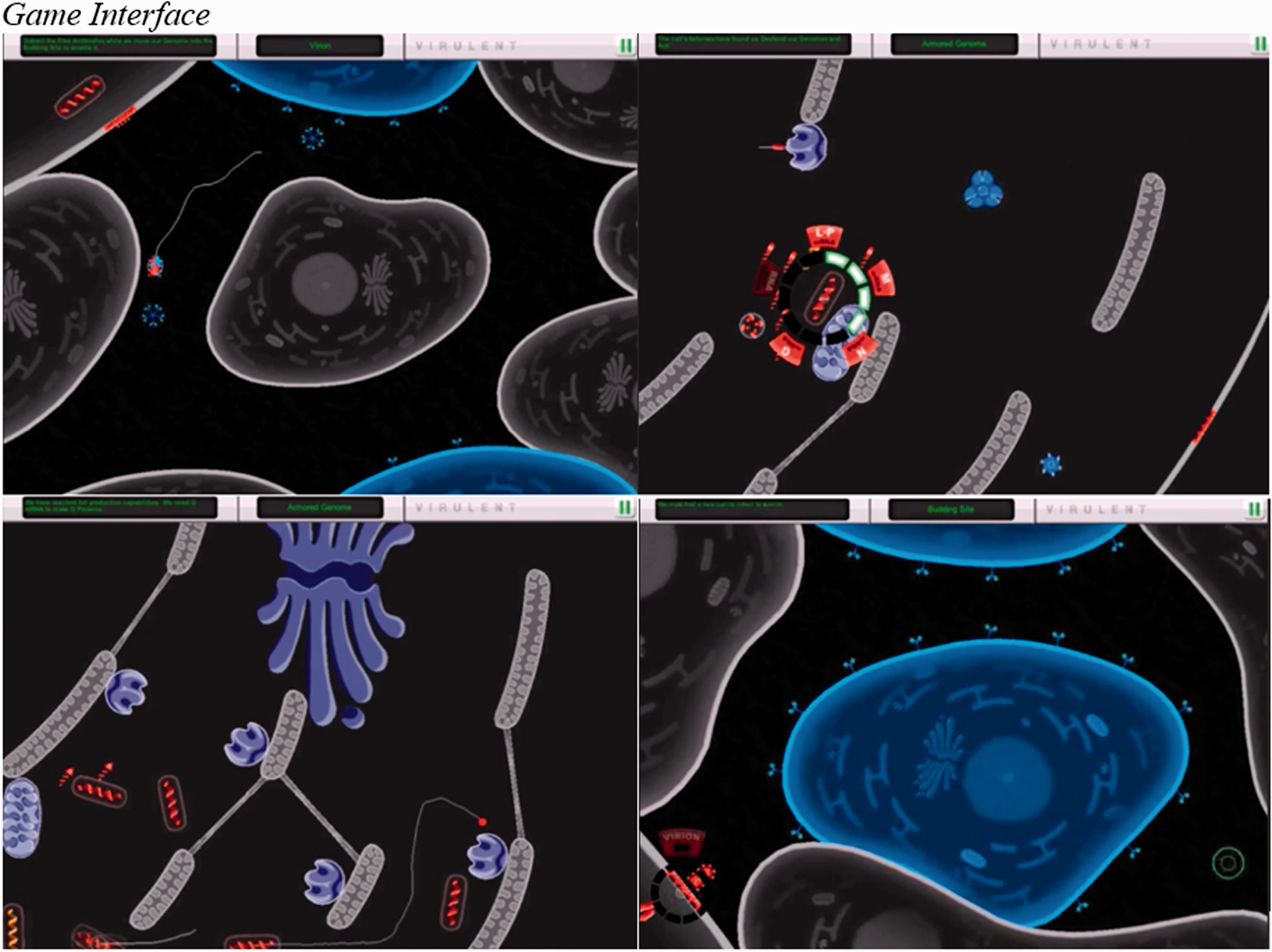
Game interface.
Data analysis
Students’ conversations were audio-recorded and segmented in 30 seconds excerpts. Initially, we identified excerpts that included conversation instances and then coded them using an emergent qualitative coding strategy (Hesse-Biber and Leavy, 2010). In the process, we used grounded theory and ethnographic approaches that focused on thick description (Bringer et al., 2006). Initially, we used open coding to isolate conversations’ features that might be relevant in an educational situation. The identified features included the elements to which dyads referred in the conversation (e.g., the game, the educational materials), the elaboration of inferences, the use of symbolic devices of the discipline (e.g., mitochondria) as opposed to the use of everyday expressions (e.g., blue cylinder), and the presence or absence of turn-taking in the conversation. After that, we produced a thick description of three types of conversations: general conversations, content conversations, and situated conversations. To do so, we identified elements that frequently emerged together and analyzed their use, functions and meanings within the educational game-based situation. Finally, we conducted axial coding to compare the descriptions of the three types of conversation and elaborate a theoretical framework from which to interpret the different effects and roles of situated conversations. Both triangulation and saturation were evaluated during this process, as recommended by prior research (Sanabria and Gers, 2019). In each step, triangulation between two groups of coders was obtained, finding that the distinction between general, content and situated conversations was consistent for both coding teams. Similarly, saturation was achieved when the three types of conversations arose in each of the weekly sessions in both fifth-grade classes observed in this study.
Results
In the following section, three types of conversations are described and analyzed in order to explain why situated conversations produce better learning result than general and content conversations (Corredor, 2018). Our results indicate that, when compared to other types of interaction, situated conversations have a special status as mediators of cultural knowledge during game-based learning. This status is created by the characteristics of situated conversations. To better comprehend this effect, it is necessary examining from a qualitative standpoint the structure of conversations occurring during the intervention. Here, we analyze fragments of different types of conversations and isolate elements that might explain the privileged role of situated conversations.
General conversation: Learning to make small talk
This category is defined as a conversation in which students talk back and forth without commenting on class content. Often, we observed that students involved in traditional educational activities talked about issues related to their everyday experiences and interests, to their emotional worlds, and to pragmatic aspects of their activities, not related to class. This observation, which is not a common topic of analysis in the educational literature, points to the basic, although often ignored, fact that students do not go to school just to learn content. School is an experience of social discovery, of building personal connections, shared identities, through, among others, the art of small talk. By communicating their daily concerns, students share meaning and develop basic skills for adult life, such is being able to maintain viable warm social relationships. In fact, everyday conversation is a basic mechanism for the development of emotional and social understanding (De Rosnay et al., 2014; Melzi and Fernández, 2004).
General conversation, however, does not relate, at least at the grain size of this study, to learning of subject-matter. For this reason, it does not produce major learning of disciplinary content. Table 1 presents three examples of this type of conversations produced by three different dyads. In example 1, students talk about their class schedule. In example 2, they talk about dog breeds. In example 3, they talk about going to a party. These three examples show how, under low motivation conditions, students’ conversation focus often on aspects external to the class. Furthermore, they exemplify how traditional educational experiences separate learning from everyday life and how, when choosing a topic of conversation, students in this type of settings do not have disciplinary content as their first choice. As we will see in the following section, video games steer conversations towards class topics in ways that are more productive for the learning of subject matter.
General conversation examples.
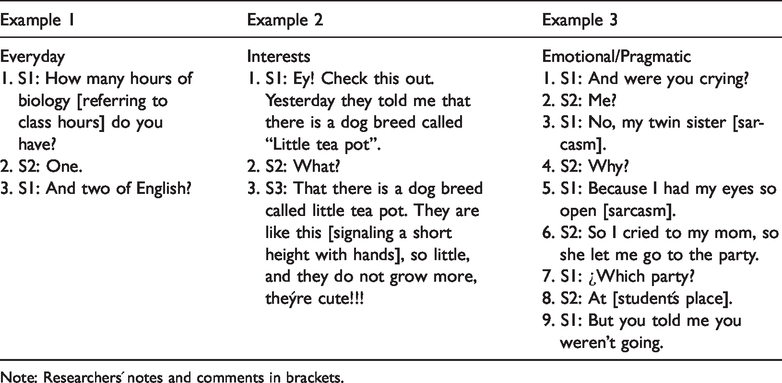
Note: Researchers´ notes and comments in brackets.
Content conversation: Unsupported exploration of class content
Content conversation was coded when students discussed the class topic. In this type of conversation, they exchange information and discuss their actions and outcomes in the game and other class activities. In Example 4 (Table 2), students are trying to define the correct way to use a new type of signal, an mRNA (mRNA-mp) that creates a new type of protein (m-proteins). At this point of the game, they know how to use the n-proteins, and the mRNA’s (mRNA-np) that signal the ribosomes to produce those proteins, but they do not know how to use the m-proteins and the mRNA-mp´s, responsible for the synthesis of this second type of protein. They are in a complex situation because they are trying to protect the virus from the incoming cell defenses (slicer enzymes and proteasomes), while trying, at the same time, to interfere with the cell signal system (by sending m-proteins to ribosomes) and to coopt the cell structures, particularly, the ribosome to reproduce their own genetic material and to synthesize the proteins necessary to make copies of virus (by sending different types of mRNÁs to the ribosomes). In this particular situation, they should use mRNA-np signals to stop the slicers (which they have done before), and m-proteins to block the ribosome and the proteasomes (which are new activities). They are trying to map equivalent elements across past levels of the game to find out whether the functions they discovered in those levels are applicable to the problem-solving situation being faced in the current level. All these cognitive activities are engaging and challenging, but, somehow, they do not produce learning of subject matter. This is so, because, during this conversation, students do not name adequately the elements of the viral replication process (Table 2). Instead, they use the geometric forms to refer the game elements. In that sense, their cognitive efforts are focused on the comprehension of the game, but students do not delve into the scientific model of the viral replication process. In the absence of support, talk about the game do not connect student activity with the symbolic devices of the domain, which are defined by social practices, and therefore cannot be achieved by the works of communicative rationality alone. Students need to connect their discussion in the classroom with knowledge developed by experts and with the conventions of scientific domains, in order to make the most of it in terms of learning.
Content conversation example.
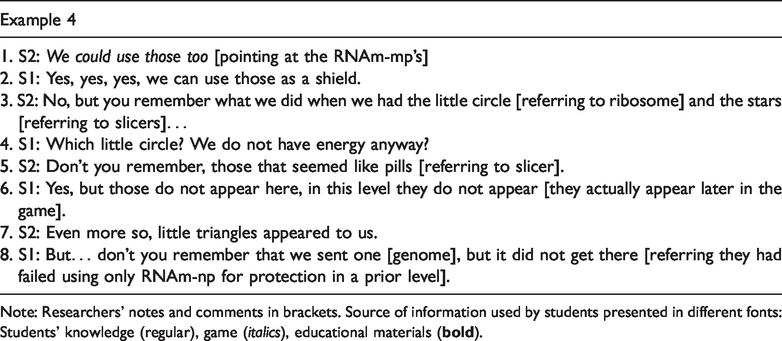
Note: Researchers’ notes and comments in brackets. Source of information used by students presented in different fonts: Students’ knowledge (regular), game (italics), educational materials (
As shown in Table 2, content conversation gravitates around disciplinary elements. The question then is why this type of interaction does not produce learning of subject matter (Corredor, 2018). A possible answer for this question is that content conversation is, when compared with situated conversation, a self-contained type of talk. Self-contained, in this context, means that the ideas in the conversation are redundant or derived directly from elements presented before in it. Content conversation lacks mediational value because expert knowledge is outside of the interaction. Content conversation does not mediate between students and subject matter because disciplinary content in biology is provided by the educational materials, and it is in connection with those materials that domain-specific knowledge increases. When we compare examples of content conversation with examples of situated conversation, it is possible to see how during situated conversation students make deliberate efforts to coordinate different sources and to enlarge their knowledge bases using the available sources. In content conversation (Example 4), students reflect on the game situation and they try to find the best strategy to respond by mapping some elements (m-proteins) on others (n-proteins). However, they advance in the understanding of the game, but not in disciplinary comprehension, because they do not use resources that can bring disciplinary knowledge to the table (e.g., educational materials). At the end, they do not connect the elements they are using in the game (e.g., little triangles) with disciplinary relevant categories.
Situated conversations: Connecting with expert knowledge
Situated conversations were coded when students talked about class content, while examining other educational resources available in the classroom. More specifically, in situated conversations, external materials helped students to connect game elements with disciplinary content. As a way to make this difference visible in the following examples, the sources of students comments were color coded: Utterances that come from students prior knowledge or reasoning skills are presented in white as standard text; those utterances coming from or related directly with game actions are colored in light gray with a black border; finally, utterances coming from the supporting materials or directly related to them are in dark gray. Example 4 presents an instance of content conversation (Table 3). In this example 4, students initiate the conversation by referring directly to game elements (Line 1), but soon they start using only information, questions and answers coming from their own knowledge base or skills (Table 2). They do not recur to the available resources to resolve their query, which reduces their possibilities of advance in their comprehension of the viral replication process. A different situation is visible in Example 5, a typical example of situated conversation is presented (Table 3). In this example, students are in the same level and situation than students in Example 4. They are trying to establish the best strategy to protect the genome from proteasomes and slicers that act as the cell´s defenses. In the decision-making process, they explore the materials that support the use of the game. In particular, they are reading the educational materials that presents an explanation of the disciplinary meaning of the elements included in the game. This interaction with the materials transforms a query about the game, in a query about genetics. They give specific names to interactions that otherwise will be interpreted as mechanical interactions between geometrical figures without scientific meaning.
Situated conversation example.
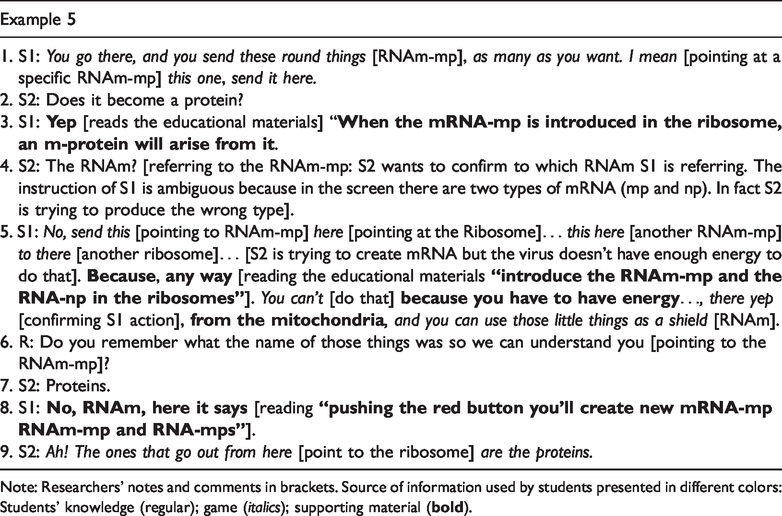
Note: Researchers’ notes and comments in brackets. Source of information used by students presented in different colors: Students’ knowledge (regular); game (italics); supporting material (
In Example 5, S1 is reading the educational material and S2 is controlling the virus. S1 suggest a possible action (Line 1), and S2 asks about the disciplinary meaning of that action (Line 2 and 4). Then S1 use information coming from the educational materials to orientate the gaming strategy connecting, in the process, game action to subject matter (Lines 3, 5 and 8). When the researcher asks about the scientific meaning of a certain element (Line 6), S2 uses prior knowledge to answer wrongly the question (Line 7). Then, S1 uses the educational materials to find the correct answer (Line 8), to which S2 agrees. Line 5 shows a very interesting pattern, common in situated conversation. In this pattern, students weave in a single line several sources of information. In this line S2 is helping S1 to decide the correct actions on different types of RNAm’s, by basically pointing to elements in the screen (e.g., send this). At the same time, this student is reading the educational materials to understand the disciplinary constraints of the possible decisions (e.g., having energy). S2 does not finish his sentences but he talks simultaneously about the game and the information available in the educational materials. Situated conversation is situated because the information coming from the educational materials is understood in an organic relationship with the game itself.
Content conversation, as defined in this text, includes a varied number of patterns that require students to talk about subject matter. However, in this type of interaction, students do not coordinate disciplinary ideas and content automatically. On the contrary, introduction of concepts is made via situated conversation. Materials outside the conversation enrich the discourse and the game acts as a pivotal point through which disciplinary principles and terms are introduced. Typically, in situated conversation, students move back and forth from queries produced by game situations, conjectures obtained from the supporting materials and feedback obtained from the actual actions in the game. In Example 6, students are trying to find out the disciplinary meaning of a game object, in order to define its function within the problem-solving situation (Table 4). In Lines 1, 2 and 3, they specify the query. That is, they discuss which object in the screen they are talking about. In Line 4, S1 makes a conjecture about the function of the object and then reads the educational materials to confirm it. In Lines 5 and 6, they rephrase the information obtained from the materials, and, in Lines 7 and 8, they try to apply what they have learned to the gaming situation. In Example 7, students comment about their game results in the game (Lines 1, 2 and 3, Table 4). In Line 4, S2 reads the educational materials in order to find a way to improve their gaming performance, and in Lines 5, 6 and 7 they rephrase the information and try inferring the actual use of that information within the game situation.
Additional examples of situated conversations.
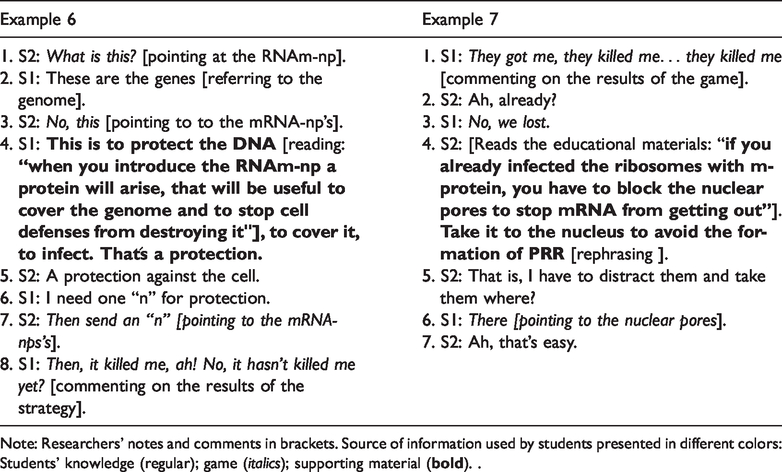
Note: Researchers’ notes and comments in brackets. Source of information used by students presented in different colors: Students’ knowledge (regular); game (italics); supporting material (
These are common examples of how game and educational materials interact to produce learning in this study. In situated conversations, students become active agents of the learning process; they combine queries coming from the game with information coming from the readings. This coordination is possible because, as mentioned before, video games align goals in the game and goals in the materials. Students playing virulent have a reason to look for certain types of information, and every piece of information has a use within the gaming situation. Conversation is situated in the social space but also distributed in the social and physical space of the game and the educational materials. Interactions like those described in this section are not possible in a vacuum. Games create the opportunity to bring together different sources information and motivate students to find links among those sources. The power of video games as learning tools comes to some extend from their power to create situated conversations. In situated conversations, it is possible to see how video games foster the conditions for learning of subject-matter that cannot be produced solely on the basis of argumentation among truthful peers, as suggested by communicative rationality (Han, 2002). In other words, situated conversations extend communicative rationality because domain-specific understanding, at least in empirical disciplines, is developed in the discourse scientific communities over years, sometimes centuries, and, therefore it cannot be developed independently by students. Of course, this knowledge needs to be reconstructed actively by students in the classroom. Nonetheless, the articulation of disciplinary knowledge and game-based learning through situated conversations seems to be central to the development of a sophisticated understanding of subject-matter.
Conclusions
Our analyses showed that, in situated conversation, students go back and forth between the game and the educational materials to improve and orientate their performance. In the process, they gain access to domain-specific ideas, in this case, knowledge about cell biology and genetics. This result helps to explain why situated conversations have positive learning effects (Corredor, 2018). As shown in the qualitative examples, situated conversations require complex cognitive and social processes that allow students to connect game activity with disciplinary content. In particular, situated conversations allow participants to align goals in the game with pieces of domain-specific information. That is, situated conversations help students to identify, which game goals connect to the information contained in the supporting learning materials. In this way, this type of conversation helps students to learn content knowledge, despite the fact that there is not an expert facilitator in the interaction. In this sense, our results confirm the idea that video games are conversations with the world, that involve cycles of goal-settings, action, social interaction and feedback (Gee, 2014). Our results also extend this idea to include the fact that, when the game’s microworld represents disciplinary knowledge, students learn subject matter.
Our results, additionally, connect with the question of how knowledge is developed by students during game-based educational activities: by experience, by isolated argumentation, or by informed conversation. Although theories of communicative rationality in philosophy (Habermas, 1984; Han, 2002) and some instances of constructivism (Johnson, 2003; Smith, 2017) assume that argumentation and experience are enough to produce normatively accurate knowledge), our result suggests that in the context of game learning, rationality is useful as long as it connects with meaningful materials that mediate social knowledge. In this sense, the qualitative study of situated conversations in video games highlight the importance of supporting adequately game-based educational activities, particularly, those ones related to empirical disciplines.
In this regard, video games’ potential to promote situated conversations can be used to transform educational environments in ways that do not require the direct intervention of either teachers to promote conversation or experts to provide accurate disciplinary knowledge. As shown by our analysis, expert knowledge is introduced in the interaction via situated conversation. Students playing Virulent had similar levels of knowledge, but they explored the materials that contain information about cell biology and discuss their implications for game play. In this process, they increased their levels of disciplinary understanding. Situated conversations among peers’ support learning, even when no expert is present in the classroom. The mechanisms underlying this process are related both to the reorganization of knowledge produced by collective explanation (Fuchs et al., 1994; Okita et al., 2013; Roscoe and Chi, 2007, 2008) and also by the social affordances of video games as third places (Ducheneaut et al., 2007; Steinkuehler and Williams, 2006).
The main educational implications of this study relate to the role of teachers and the uses of educational materials in game-based learning. As observed in this study, situated conversations are the most productive activity in terms of learning. However, not all students engage in this type of conversation, which prevents them from using the supporting materials to develop an understanding of subject matter. That is why, even in the student-centered learning experience produced by video games, teachers still have a role. They can act as facilitators in the learning process; as guides that promote, probably through questions, an adequate experience of collective reasoning. In this endeavor, teachers have at least two functions. First, they can promote the articulation of game and learning materials by highlighting their uses in the problem-solving situation. Second, they can encourage the exploration of symbolic devices of the discipline as a means to express conclusions about the game. For designers, the challenge lies in finding suitable ways of producing, presenting and orchestrating supporting materials that are both rigorous in its approach to disciplinary content, and attractive and ease of use for teachers and students. Digital technologies today allow multiple orchestrating strategies, including hypertext, audio explanation and scaffolding through online forums.
This study has several limitations. First, the intervention does not include the participation of a teacher. This design decision was taken in order to observe natural interactions among students without providing external inputs. This situation is, however, not authentic in most learning settings, in which teachers are active participants. In this sense, the search for control led us to sacrifice ecological validity. The observations were collected also in a short time period, so it is hard to know how interactions will evolve in a longer timeframe. Will students get bored with the game? Will situated conversation decrease? On a different level, the intervention depicted in this study requires computer and internet availability in regular classrooms. This assumption does not reflect the situation of most classroom in schools around the world. The use of physical board games or alternative non-digital technologies need to be considered. Finally, the qualitative nature of this study allows us to conjecture and observe how situated conversations coordinate different resources in the classroom. It is not possible, however, to have a quantitative account of these dynamics. Future studies need to address these issues.
As shown by the disregard of basic health guidelines in the context of the Covid-19 pandemic, there seems to be a world-wide problem with the understanding of infection and immune response. Many people confound virus and bacteria (let alone prions). They ignore social distancing and masks use as a matter of personal or aesthetic choice. They reject vaccination but believe in magical cures, with no basic biological logic. This global tragedy is in itself a failure of science education, affecting, not only the academic realm, but decision-making in everyday life. A new approach to this educational challenge, part of which has to involve digital media and video games, is an urgent matter. Today, more than ever.
Footnotes
Declaration of Conflicting Interests
The author(s) declared no potential conflicts of interest with respect to the research, authorship, and/or publication of this article.
Funding
The author(s) received no financial support for the research, authorship, and/or publication of this article.
