




Abstract
The present study aimed at exploring the effects of integrating social media (instant messaging through Line App and Facebook) and design thinking into a vocational education course on corporate identity design in Taiwan. Corporate identity helps organizations achieve competitive advantage. This benefit is even more pronounced in Taiwan, where visual communication is esteemed. The present study recruited two groups of 11th graders (N = 60) from a vocational high school in the northern part of Taiwan as its participants. One group was designated as the experimental group and the other as the control group. The experimental group received creative instruction through the use of Facebook and Line App with design thinking integrated into the pedagogy, whereas the control group did not. Both qualitative and quantitative approaches were used to obtain feedback on the teaching and learning process. The results of the analyses indicated that students who were allocated to the experimental group demonstrated better quality design products than their counterparts in the control group.
Introduction
Background of the study
Taiwan’s Ministry of Education has long been dedicated to training vocational learners in creativity, especially for design majors. Such instruction emphasizes the inculcation of problem-solving and creative thinking abilities in students (Chen, 1984). Corporate identity design is a compulsory subject in Taiwan in fields related to visual communication design as this is aimed at enhancing the capabilities of students to promote corporate brand stories. This subject incorporates a thorough acquisition of awareness about corporate culture, the basics of corporate systems, and the application of professional knowledge (Wong, 2011). The present study utilized class observations and questionnaires among vocational high school students to determine the creative thinking training and application of the learning environment. The educators were more attentive to visual aesthetics than to organized creative thinking courses. As Yang et al. (2005) have indicated, there exists a noticeable gap between what design students learn in class and what is expected of them after they graduate.
The learning environment of design education has been influenced by progressive technological changes which has gradually yielded control to students (Lin et al., 2017; Wang and Huang, 2001; Wiklund and Andersson, 2018). Deng (2017) confirms that the digital age is characterized by sharing and adapting, implying that collaboration is the key word in today’s world. Creativity from digitization is suitable for student-centered education, which provides room for individual differences. Diverse, flexible, and increasingly creative pedagogic means must be adopted to cater for the needs of different students (Li and Lian, 2014; Liu, 2007). To enhance the attainment of learning objectives, teachers should not only teach creatively but also aim to promote their student’s creativity (Jeffrey and Craft, 2004). This intention is even more pivotal for students enrolled in the corporate identity design course.
Technology-integrated teaching programs can enhance the information technology (IT) competence of students, increase interactions between students and teachers, and upgrade teaching quality and learning effectiveness (Wang, 2015). Specifically, the utilization of social media platforms and Instant Messaging ones like Line App to enhance interactions between teachers and learners has been documented in literature as being instrumental to the attainment of learning goals and objectives (Bosch, 2009; Shih et al., 2015; Wang, et al., 2012; Yusoff et al., 2017). Learners can freely interact and share content with classmates through social media platforms, such as Facebook. They can also collaborate and devise imaginative ways of accomplishing their assignments (Aydin, 2012; Chen and Chen, 2017; Gikas and Grant, 2013; Harris, 2008; Madge et al., 2009). As a result, learners exchange valuable educational information in a sociable and relaxed manner.
A pedagogy that integrates design thinking fosters an environment of collaboration among learners and provides students the freedom to accomplish their classroom-related work (Kimbell, 2011). The 21st century requires design students who are creative and innovative and who learn with the end-user in mind. This objective can be achieved effectively through design thinking methods of instruction (Wrigley and Straker, 2017). This methodology is especially useful for students taking corporate identity courses because they must comprehend the uniqueness of the corporate identity needs of organizations in Taiwan (Schmitt, 1995) and because the competences they acquire from their curriculum will determine the success of their future clientele.
The current study aimed at exploring the effects of social media-integrated teaching and design thinking on students taking a vocational education corporate identity design course in Taiwan. The specific research objectives for this study were to:
Explore the effects of social media-integrated teaching on the learning obtained by students taking the corporate identity design course; and Evaluate the effectiveness of a teaching program that integrated design thinking vis-à-vis knowledge acquired by students and their work-related application of the obtained learning.
Literature review
Corporate identity
Corporate identity focuses on the promotion of core organizational spirit and culture through the design of communication. Gardner and Fishel (2013) regard corporate identity as a brand’s personality established within the customer’s mind. A corporate identity encompasses three interrelated aspects: mental character, distinctive behavior, and visual uniqueness. According to Balmer (2001: 257), the creation of a corporate identity attempts to answer the question “Who am I?” and considers institutional aspects, such as business structure and ethos, market, performance, history, reputations, and the organization’s relationship to other identities. Since corporate identity is the image of the organization as perceived by the outsiders, the foregoing arguments suggest that students undertaking corporate identity need to help their clients to stand out by creating inimitable products for them. Even then, the students’ thinking must necessarily be innovative and creative in order to achieve this aim.
Business enterprises can achieve a competitive advantage in their markets if they can establish the right corporate identity. Melewar et al. (2005) assert that corporate identity is a composite of numerous elements, such as what it stands for, its mission and vision, as well as its visual elements. Thus, the manner in which these components are combined is vital to the achievement of an organization’s strategic competitive advantage. Foroudi et al. (2014) also claim that the organizational logo and color are key elements of a firm’s visual corporate identity. Color, they argued, communicates the positioning of the firm (in relation to its competitors) and should hence be carefully and strategically chosen. Hence, the ability of a corporate identity design student to ingenuously mix the different elements of corporate design (for example the colors) in order to come up with unique products, is an advantage. Further, organizations can easily leverage on their well-set corporate identity for a strategic competitive advantage.
Like its East Asian counterparts, the Taiwanese corporate world attaches greater meaning to visual communication and corporate identity in general (Schmitt, 1995). For example, white color symbolizes death and mourning in South East Asian countries lie Taiwan, while blue (the corporate identity color in the US) is perceived as ‘cold and evil’ (Aslam, 2006: 20). This cultural consideration necessitates a consideration by both student and instructors of corporate identity visual communication courses. Significant attention must be paid to corporate identity design courses because such programs help to create professionals who can produce innovative and creative final products that can aid firms in the construction of effective corporate identities that will help them gain a strategic competitive advantage in their markets.
Since corporate identity is pivotal to an organization’s success, students of corporate identity design must necessarily think out of the box to meet their clients’ needs. Kimbell (2011) states that design students should be able to see the end product from the client’s perspective and must be creative in the production of ideas. Only innovative designers are able to visualize the expectations of their clients without duplicating products. Therefore, design courses at any level should inculcate creative, innovative, collaborative, and other-related skills in their students according to market requirements (Wrigley and Straker, 2017). Corporate identity design teachers therefore need to put emphasis on the creativity aspect in their classes, as well as design classroom activities in ways that will promote this useful component among learners. While some learners may naturally be predisposed to creativity, majority of them will need to be trained to be creative.
Social media-integrated teaching
A pedagogy that integrates social media and mobile apps is now commonplace. More effective teaching and learning are fostered through the use of IT, particularly social media as a tool when it is combined with other teaching materials (Stewart, 2015). The core of social media-integrated teaching rests in student-centered classrooms where students can learn more autonomously and can help teachers achieve innovation in teaching methods with IT, for example, incorporating the use of platforms such as Facebook and Line App (Bosch, 2009; Hsieh et al., 2017; Wang, 2010). Facebook also encourages collaboration among learners through the sharing of resources and through engagement in collaborative discussions (Aydin, 2012; Gikas and Grant, 2013; Harris, 2008). Studies have demonstrated that social media platforms can enhance the attainment of learning objectives when they are strategically used (Alabdulkareem, 2015; Bosch, 2009).
Some studies have also been carried out on learners’ use of instant messaging platforms like Line App. It is important to first note that Line App’s use in Taiwan is more common among smartphone users, and is more popular than Facebook, YouTube, WeChat and Instagram (Chen and Chen, 2017). This suggests the need to focus more attention on how this App is being used for educational purposes, especially among learners. Shih et al. (2015) in their study which examined ESL students’ use of Line App in the English classes realized that the App helped the learners improve their spelling, grammar and consequently boosted their confidence. Students using Line App in Hsieh’s et al. (2017) study had mixed observations: while some liked the App for its convenience in learning, others found it more relevant for socialization than for learning. The line App has thus had extensive use in educational circles globally.
The pedagogic use of social media platforms does present some challenges, however. Some students may not be willing to participate in such activity, other students may become distracted, while others students may fear the exposure of substantive personal information (Baran, 2010; Wiklund and Andersson, 2018). However, the use of social media in instruction is credited with the ability to enhance interactions, both among students and between students and their instructors. Such engagement results in enriched learning (Bosch, 2009; Madge et al., 2009). The use of Facebook in instruction can benefit educators by extending the students’ learning time and by evoking real-time contributions from learners, resulting in the greater attainment of learning objectives (Ezziane, 2007; Harris, 2008). Similarly, teaching can become more innovative and varied if social media can help students cultivate their cognitive, critical thinking, creative, and problem-solving skills (Wang and Huang, 2001).
The integration of social media and instant messaging platforms in the teaching methodology can help students taking corporate identity design courses to enhance their interactions. Augmented communication is useful for learning. Design students benefit particularly from collaboration, both with their peers and with their instructors (Daer, 2010). Thus, social media can be a useful tool in this aspect. Also, the teaching of design-related courses is a challenging task (Dym et al., 2005): teachers must be creative and innovative in their instruction methods. Alabdulkareem (2015) contends that the use of social media enhances the educational experience of learners. In Taiwan, like other countries, there’s utilization of multiple social media platforms for teaching and learning. The current study however, focusses on Facebook and Line App.
Design thinking
According to Pande and Bharathi (2020), design thinking has been applied across various fields such as business, law, science and others, and in education, has extensively been utilized from basic to higher levels. Johansson-Sköldberg et al. (2013) noted that design thinking is applicable in theory and practice, and distinguish between ‘designerly thinking’ and ‘design thinking’. While the former is rooted in the field of design and links theory to practice, the latter is focused on ‘the discourse where design practice and competence are used beyond the design context’ (Johansson-Sköldberg et al., 2013: 123). While exact definition of ‘design thinking’ is elusive, one characteristic it has been associated with is innovation (Liedtka, 2015).
According to Kimbell (2011), design thinking incorporates what an individual designer knows, how such a person makes sense of the assigned work, and how that work is actually accomplished. Design thinking generates a well-organized plan that focuses on creativity and problem-solving (Lande et al., 2012). Both these characteristics involve the application of a strategic mindset, problem-solving, target orientation, and decision-making, and all these attributes improve proficiency and flexibility.
Design thinking focuses mainly on the designer’s mental processes. These intellectual
practices are formed by design behavior and are different from the actual design (Cross, 1999; Wrigley and Straker, 2017). According to Leverenz (2014: 2):
Design thinking refers specifically to a creative process engaged in by designers, which has been researched, theorized, and in some cases codified into an approach to problem-solving applied to everything from designing a child’s tooth brush to improving how nurses handle the changing of shifts.
The foregoing arguments suggest that creativity is the hallmark of design thinkers, and is reflected in the novel approach to problems at hand. Deign thinking allows individuals to envision the end product and to consequently devise an innovative yet practical solution to the posed challenge.
Design thinking-integrated teaching
Design thinking, is instrumental in teaching, especially when it overlaps with other constructivists theories (Pande and Bharathi, 2020). Design thinking advances through three methods: brainstorming, lateral thinking, and critical judgment. Brainstorming integrates public perspectives and thought processes (Chang et al., 2015), and this activity is believed to enhance creativity by 65% to 93% in comparison to solo reasoning (Lawson, 2006). Lateral thinking is a diffused (or long-winded) way of reflection and helps generate unrelated ideas through discrete experiences to evoke an entirely novel perspective. Vertical or convergent thinking, on the other hand, recalls previous experiences or references (Chang et al., 2015) in contemplating the contexts of problems. This type of deliberation requires a clear objective that allows a person to delve into a problem to unearth solutions that may not be immediately obvious. Convergent or vertical thinking is a skill that is often utilized for daily decisions; it can help the discovery of answers, aid in the application of acquired knowledge, and be useful in the thorough analysis of problems (Lawson, 2006).
Examining the complex process of the reasoning undertaken by design students, Orthel and Day (2016: 15) indicate the need for instruction methods that incorporate design thinking: If design educators value design thinking as an active, definitional approach to what designers do, then they must press their students to learn and use an intentional design thinking approach that includes ideation through re-representation, iteration, and concept-based and solution-based problem exploration.
Methods and materials
The present quasi-experimental design study aimed to evaluate the integration of social media and design thinking into a corporate identity design course at a vocational high school in Taiwan. According to White and Sabarwal (2014), quasi-experimental designs test causal hypothesis and involves the creation of a comparison group. Further, Shadish et al. (2002) observed that the purpose of quasi-experiments is to test descriptive causal hypotheses about manipulable causes, and includes control groups and pretest measures. In the current study, the researchers designed, conducted, and analyzed a comprehensive lesson apt for students in the department of advertisement, which they then taught using design-integrated approach( See Appendix). Students used social media (Facebook and Line App) to respond to their teachers as well as interact with colleagues. The Facebook IP addresses of the students were kept recorded to prevent multiple logging.
Purposive sampling was adopted for the present study. According to Etikan et al. (2016), in purposive sampling, the researcher deliberately chooses participants based on the qualities they have. In the current study, a total of 60 corporate identity design students taught by one of the researchers, were purposively recruited from two classes of 30 students each. The participating learners were required to attend the course for 2 hours every week. Ethical approval was obtained from their institution before they were engaged in the study. Students receiving the usual teaching methodology were designated as the control group, whereas those receiving the pedagogy that integrated social media and design thinking were designated as the experimental group.
The subsequently accomplished comparison mainly assessed the works produced by students through the interventions provided by the different teaching styles. A quantitative method was used, and four teachers were recruited as the graders to assess the work presented by each student on the basis of five parameters: topic selection, logo structure, logotype, color application, and symbol pattern. Each of the five factors was graded on a scale of 1 (poor) to 5 (excellent) points. The quantitative data were then coded and analyzed using SPSS. Both descriptive and inferential statistics were used to ascertain the differences in the overall performances recorded by the two groups.
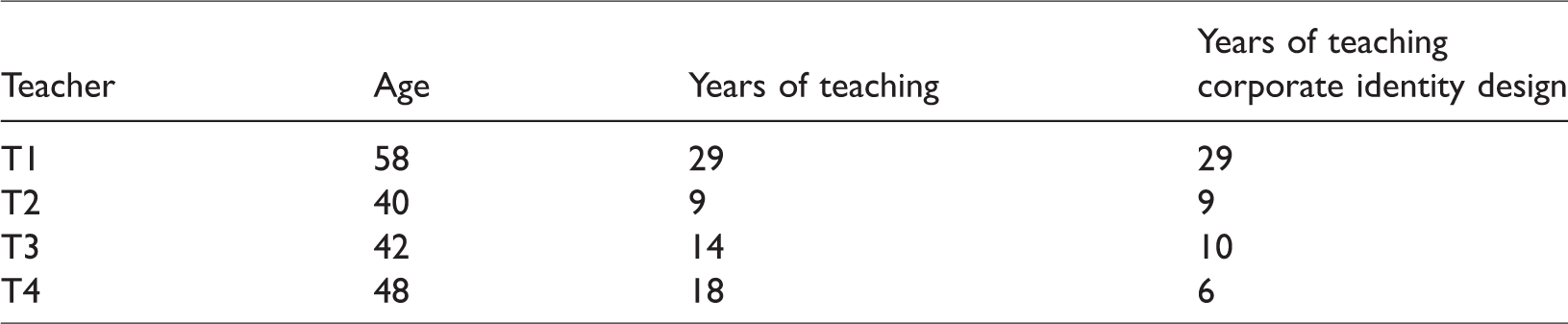
During the conduction of the study, three design experts were invited to offer suggestions on the course. Further, as mentioned above, four qualified and experienced teachers of the department of advertisement at the vocational high school were invited to assess the work of the students on the basis of five themes. Qualitative responses were also sought through interviews with the four teachers and with three design experts and through open-ended questionnaires for students. The demographic descriptions of the four teachers are presented in Table 1. They were referred to as T1, T2, T3, and T4.
Demographic descriptions of the four teachers.
Results
Social media-integrated teaching
The students all agreed that the introduction of social media to the course methodology was beneficial to both teaching and learning. They considered social media convenient because of its fast delivery via mobile devices and the prevalence of the Internet. Numerous students noted that handing in and reviewing their homework were more convenient through social media than the traditional way because they could submit their homework at any place and time, and they did not have to print their homework. Paper use was also reduced as a result. It was also easier to remember homework deadlines because social media settings could be set to remind them of the due dates and times for assignments.
Any problems faced by students could immediately be resolved by teachers through instant feedback opportunities offered by social media platforms. Some students thought that it was easier to get the latest news related to their work through social media. They could thus learn autonomously after school, refer to information offered by teachers, observe the works uploaded by their classmates, and learn on their own through reference and study on the Internet.
However, some disadvantages of the use of social media platforms were also noted. Students reported that they could not absorb all the information from Facebook, which could cause them to miss some important messages. They were unable to update information, contact others, and hand in their homework on time through social media without the availability of the Internet and a functional hardware device. As Facebook and Line App contained a lot of reference data and allows students to see the work done by their classmates, some indicated that they tended to rely too much on the social media platform, which limited their own innovation and imagination. Some students also admitted to feeling stressed when they saw the reminder notifications. It was also apparent that some students would chat extensively with their classmates while researching information via the Internet and were thus distracted from their task. Finally, a few students claimed that their over-reliance on social media turned them into “phubbers,” or mobile phone addicts.
Teachers reported the advantage of being able to respond instantly with instructions, elucidations, and answers when students faced problems. Some instructors lauded the benefit of “paperless” instruction provided both by Line App and Facebook. Uploading homework through the Internet could potentially decrease erroneous output and material waste. Students could hand in their homework through social media according to their progress. Two teachers also thought that students could have more time to prepare for homework. Both students and teachers could review the learning progress, which was encouraging. Teachers were easily able to monitor the learning accomplished by their students and could assist them when necessary.
The three experts expressed a positive view of the integration of social media and design thinking into the corporate identity design course. They thought it was a creative and pragmatic means of enhancing interactions with students and increasing their understanding of the design course curriculum.
Effectiveness of design thinking-integrated teaching
Results obtained from descriptive statistics
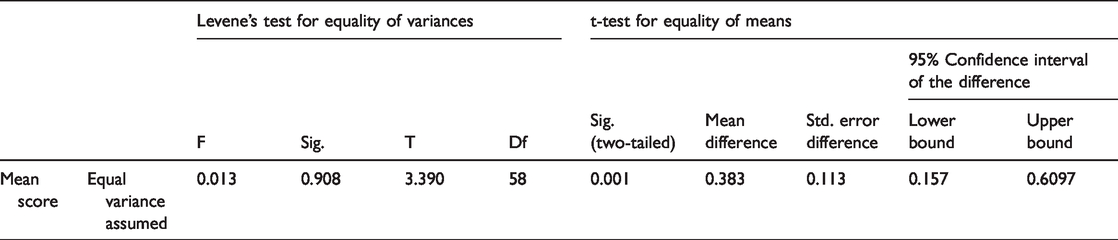
As can be seen from Table 2, the experimental group who received creative teaching that involved design thinking registered a higher mean score (3.75). In addition, the minimum and the maximum marks scored by this group are clearly higher than those scored by the control group who were taught through the usual methodology. However, the standard deviation is quite high (0.4382): the extreme numbers yield unstable effects. The mean and standard deviation of the control group are 3.667 and 0.4375, respectively.
Descriptive statistics of the effectiveness of teaching.

Results obtained from independent t-test analysis
Levene’s Test for Equality of Variances was conducted to decide whether to use equal variance. A result of P = 0.908 > 0.05 signifies under 95% confidence interval of the difference, and equal variance should be used to analyze the results of the t-test. The outcome of the t-test reveals P = 0.001 < 0.05 (Table 3), which means under 95% confidence interval of the difference; the mean scores demonstrate significant differences between courses taught for the past 2 years with or without creative pedagogy.
Independent t-test.
Descriptive statistics of each graded item and results of the independent sample t-test
Results obtained from descriptive statistics
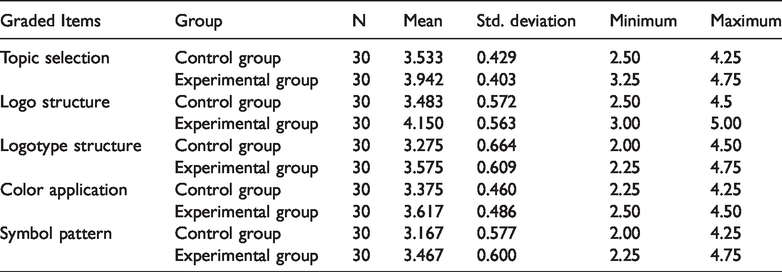
Table 4 elucidates that the mean of each of the graded factors was higher for the experimental group than for the control group. Logo structure evinced the greatest difference in the means, whereas color application demonstrated the smallest difference in the means. Three items, topic selection, logo structure, and logotype structure, showed smaller standard deviations than the control group. Logotype structure exhibited the largest standard deviation, whereas logo structure demonstrated the smallest. On the other hand, the standard deviations pertaining to the color supplications and symbol patterns were larger in the experimental group than in the control group.
Descriptive statistics of each graded item.
Results obtained from the independent t-test
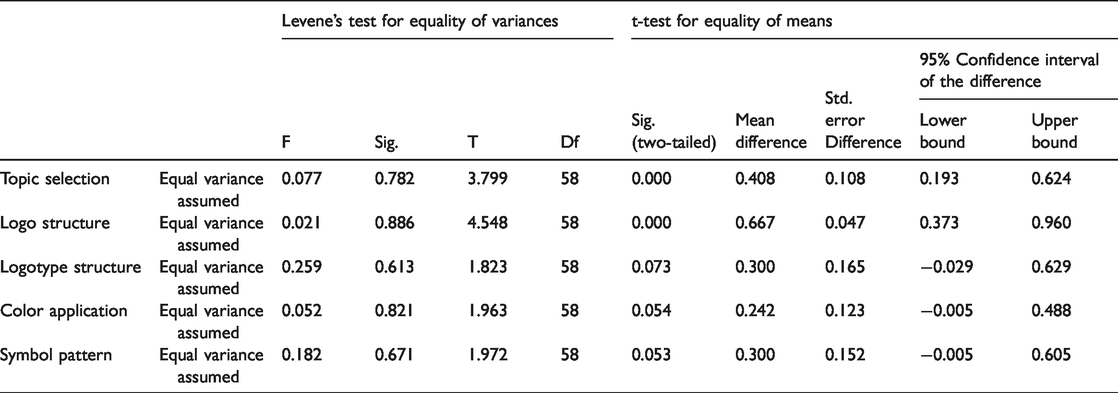
From the results in Table 5, the significance of each graded item tested in Levene’s Variance Equivalence Test was greater than 0.05 (topic selection, P = 0.782; logo structure, P = 0.886; logotype structure, P = 0.613; color application, P = 0.821; symbol pattern, P = 0.671), indicating under 95% confidence interval; the equal variance should be used to analyze the results of t-test of each graded item. In the t-test result under the 95% confidence interval, only the topic selection and the logo structure are smaller than the significant level of 0.05 (topic selection, P = 0.000; logo structure, P = 0.000), showing that the mean scores of the two items in the 2-year teaching assessment are significantly different. The significance of the other three items is above the significant level of 0.05 (logotype structure, P = 0.073; color application, P = 0.054; symbol pattern, P = 0.053), indicating the mean scores of the three items do not have significant differences.
Independent t-test of each graded item.
The scores were compiled to create a line chart to evince teaching effectiveness and to easily display and compare the relationships between the five graded items over 2 years. The overall teaching effectiveness was higher for the experimental group than for the control group. The logo structure exhibited the largest difference among the five items over the span of two years.
Qualitative responses
The qualitative responses received from the teachers and the design specialists also supported the study’s quantitative findings. For example, Experts A and B underlined the importance of design thinking: ‘The relationship between design and thinking is like the tip of the iceberg: a vast thinking system may be manifested solely through styles and colors as expressed in logos and logotypes. (Expert A) ‘Design thinking is aimed at solving the problems encountered by a brand; therefore, design thinking must address the manner in which the impact exerted by problems can be minimized and how difficulties in branding can be resolved.’ (Expert B)
‘ … the process of design thinking encompasses two main steps: understanding the problems one is facing and solving and thinking (empathetically) from the user’s perspective … the entire context of the design of corporate identity should follow a logical structure, and students must possess the ability to create designs that can really and practically capture the essence of the problem to effect its resolution.’
Their logo structure designs were varied, simple, and aesthetic. (T3) They displayed a combination of corporate culture and spirit in their work. (T1)
For the control group who did not receive creative instruction, the teachers noted many areas that needed improvement and intervention:
‘The topic selection for these students was simplistic, and they did not build stronger links between their work and the corporates for whom they were designing’ (T2).
Their logo structures exhibited less flexibility and were unable to demonstrate the required corporate images. Also, the logotype structures of their works lacked adequate word arrangements and font clarity. Their color decisions also required improvement.’ (T3)
Discussion
The effects of social media-integrated teaching on learning
It was evident from the feedback received from the teachers, the experts, and the learners in the experimental group that the social media and design thinking-integrated pedagogy was helpful to both the teaching and learning processes. In congruence with the views of researchers such as Alabdulkareem (2015), Bosch (2009), Chen and Chen (2017), Shih et al. (2015) and Madge et al. (2009), Facebook and Line App provided learners of corporate identity design with an avenue through which they could increase their interactions with their classmates and their instructors. Such opportunities enriched the classroom experience of both the students and their instructors.
Similarly, both teachers and learners lauded these platforms for their immediacy and flexibility because teachers could respond as soon as the learners uploaded their work. Both teachers and learners could deliver their work to each other from diverse locations (Ezziane, 2007; Harris, 2008; Wang, 2010). These benefits helped to enhance the creativity and thinking capabilities of the corporate design students in the experimental group as was reflected in the work they produced for the course, which was significantly superior to the products presented by the learner group that was not privy to the creative pedagogy.
Nonetheless, certain challenges of using Facebook and Line App were made evident in the study. Among others, these included information overload, problems occurring from the lack of Internet access, and distraction from learning. Baran (2010) observed that social media can be another public networking platform for many learners, which can potentially work against the attainment of learning objectives. Aydin (2012) similarly concluded that learners use social media platforms such as Facebook to interact with their peers, friends, and families. With Line App, Hsieh et al. (2017) realized that some students associated it more with socialization than education. Thus, students using social media platforms for learning purposes may be overwhelmed by the social aspects of the media and may become too preoccupied as was reported by some students in this study. The potential addiction to gadgets (phones) and social media is another difficulty mentioned by students in the present investigation, and this problem may be dangerous. This outcome aligns with the views of some participants in Gikas and Grant’s (2013) study, who reported similar obsessions with their devices even though the same devices had increased their opportunities for learning.
In 2006, Yeh deemed interactions between teachers and students to be instrumental for the effective teaching of creativity. The imagery, prior knowledge, and skills required for creativity enable superior output from students (Jeffrey and Craft, 2004). If students are equipped with the aforesaid elements, teachers are considered to command personal efficacy in instruction, which is crucial for the teaching of design thinking. The teachers engaged in the present study acknowledged that they could monitor the progress of the students and offer solutions as required through social media. Such admissions indicate that the teaching efficiency of the instructors was enhanced by the availability of social media as a pedagogic tool (Dexter et al., 1999; Dias, 1999; Kind and Evans, 2015).
Design thinking teaching
The findings of this study reveal that students in the experimental group generally performed far better than those in the control group. Design thinking-integrated teaching allowed the students to be creative and to focus on possible solutions to their problems (Kimbell, 2011; Leverenz, 2014). Both the quantitative and the qualitative results obtained from this comparative study indicated that the overall performance of students in the experimental group was better than that of those in the control group. Topic selection and logo structure particularly exhibited significant differences in comparison to those in the control group. It is probable that interactions and discussions on social media among the students aided their choice of creative themes for their work. As social media extends classroom discussions (Bosch, 2009; Harris, 2008), the learners were probably able to deliberate on their class content from diverse perspectives. Similarly, design thinking would have prompted students to think outside the box and devise innovative solutions to the problems presented to them.
The evident lack of creativity and innovation by students in the control group further evidences the merits of pedagogy that incorporates design thinking. According to Wrigley and Straker (2017), design thinking inculcates 21st century skills, such as creativity, collaboration, innovation, and problem-solving, in learners. The control group clearly lacked these skills, and if they did exhibit them, the abilities were uncoordinated. Of course, teachers and teaching styles play a role in the attainment these skills or lack thereof (Simplicio, 2000). For example, Jeffrey and Craft (2004) argued that unlike pedagogy in which teachers use innovative ways to present their content, teaching for creativity is aimed at promoting creative thinking or behavior among the learners. They contend that teaching for creativity involves, among other things, an awareness of creativity, an element of curiosity, and the extension of practical opportunities for learners to be creative. These components were inculcated into the teaching methodology utilized for the experimental group, but not for the control group.
The arguments presented above and the results of the experiment evidence the increase in interaction between teachers and students through the use of design thinking, brainstorming, lateral thinking, and vertical reasoning. In addition to the teacher–student communication, the enhanced interactions among students could also aid in the creation of a better classroom climate and provide teachers with a sense of achievement. Most students reported in the questionnaire that design thinking was beneficial to them because it made them think faster and more directly. It must be remembered that problem-solving forms the core of design thinking (Leverenz, 2014). This aspect was evident in the finished products presented by the students in the experimental group. In congruence with Bowkett’s (2005) observations, the implementation of creative pedagogy was effective in three respects: for the school (course planning), for the teachers (teaching design), and for the students (learning effectiveness).
Conclusion, implications for corporate identity design
This study investigated the effectiveness of the introduction of social media and design thinking to a vocational education corporate identity design course. The careful lesson planning and class guidance applied in the course allowed students to learn and create open-mindedly. The module involved support from instructors on how to design logos, constant revisions of the students’ sketches, and discussions and feedback among students and between the students and instructors through the use of social media platform. In the process, the students employed the brainstorming method to capture the essence of the course. When necessary, they made use of lateral and vertical thinking. The course helped students gain an interest in learning and the significance of life in a short time. These attributes were directly reflected in their works.
As argued earlier, corporate identity is an instrumental organizational area; thus, students enrolled in a corporate identity design course must be provided thorough practical preparation. Further, Schmitt (1995: 34) has observed that: East Asians differ from westerners in significant ways. Due to the visual nature of the writing system, East Asians are attuned to visual information processing and pay close attention to the writing of a name. Due to cultural traditions, colors may carry different associations. Therefore, in positioning corporations and marketing products in East Asia, it is necessary to adjust a global identity to local tastes.
The current study confirms that the incorporation of social media and design thinking into the instruction methodology for the course of corporate identity can truly improve the creativity of students and enhance their interest in, and ameliorate their final work output. As an implication of this investigation, practitioners may consider the potential of social media interactions among students and between students and their teachers as opportunities for enhancing the attainment of the learning objectives of the course. Specifically, Facebook and Line Apps are two useful avenues that can be explored in enhancing collaborative and creativity skills among learners.
The results of the present study also suggest that teachers should be prepared to embrace social media or design thinking in their classroom pedagogy. The integration of these two approaches in instruction requires teachers to go out of their way to help students, to respond to numerous questions and comments from students on social media, and to model what is expected from students during the creative design thinking course. As the teachers engaged in the current study stated, the use of social media needs close monitoring of students and mandates the provision of instantaneous feedback. Planning for the design thinking classes and projects is also time-consuming as much diligence is required on the part of the instructors.
Limitations and areas for further study
One limitation in this study regards the methodological approach used in this study. According to McKenney and Reeves (2012)design-based methods have more advantages to all students compared to quasi-experimental approaches, like the Jasper approach which benefited even the control students. Basically, future approaches should consider more design-based methodologies.
The present study also involved only 60 students from one institution. Further, the sample was divided into an experimental group (30 students) and a control group (30 students). Future studies could consider increasing the number and locations of the participants. Students in settings that differ in the involvement of an increased number of participants and teachers could aid in the test of the generalization of the results obtained by the current investigation. Such an extension of the present experiment will aid in the betterment of scholarly comprehension of creative teaching methodologies and design thinking.
It would require a longer time to clearly establish the effectiveness of design thinking and innovative teaching approaches and to ensure their more intensive application in courses. Future studies could be longitudinal in nature and should be conducted through prolonged research duration. The extended period will allow students to adjust to the pedagogy and to absorb knowledge over an adequate time. Also, the present investigation pertained only to one course of corporate identity design for a single semester in which the curriculum was focused on the logo, logotypes, symbol patterns, and basic color application systems. The feedback received from the participating students indicates that the introduction of design thinking into the course made the material more interesting and easier to grasp. Yet, some segments of the syllabus still required further elaboration. Therefore, future studies should consider the reflections of students and should test their knowledge after the teachers have designed the general course curriculum .
Supplemental Material
sj-pdf-1-ldm-10.1177_2042753020950879 - Supplemental material for Effects of social media and design thinking on corporate identity design course in Taiwan
Supplemental material, sj-pdf-1-ldm-10.1177_2042753020950879 for Effects of social media and design thinking on corporate identity design course in Taiwan by Guan-Chen Liu and Chih-Hsiang Ko in E-Learning and Digital Media
Footnotes
Declaration of Conflicting Interests
The author(s) declared no potential conflicts of interest with respect to the research, authorship, and/or publication of this article.
Funding
The author(s) received no financial support for the research, authorship, and/or publication of this article.

Author Biographies
Supplemental Material
Supplemental material for this article is available online.
References
Supplementary Material
Please find the following supplemental material available below.
For Open Access articles published under a Creative Commons License, all supplemental material carries the same license as the article it is associated with.
For non-Open Access articles published, all supplemental material carries a non-exclusive license, and permission requests for re-use of supplemental material or any part of supplemental material shall be sent directly to the copyright owner as specified in the copyright notice associated with the article.
