




Abstract
This research analyses tweets, interviews and observations to grasp power relations between oppressive education and liberative technology in Arab contexts. It ascertains that liberative technology may limit oppressive education and unveils that oppressive education may restrict liberative technology or exploit technology as instruments for further oppression. It discloses that oppressive education may apply liberative technology to oppress itself or may tolerate liberative technology to gain vested interests. It reasons that students may use technology to counter-oppress oppressive education, meaning that education and students undertake repressive ‘battles’, turning oppression into a lifestyle. It proclaims that students may, online, incite the public against education. It indicates that, in societies where the crowd is more powerful than authorities, oppressed students can, virtually, unite against oppressive education, meaning that ‘the oppressed’ (students) becomes more powerful than ‘the oppressor’ (education). The take-home message is that, despite the growing philosophisation of technology as oppressive tools, individuals are, as found by this article, not powerless, as they can turn technologies into liberative tools and develop emancipation out of oppression. A further proposition to be drawn from the findings is that students are not apolitically decent, as they can encounter downward oppression with even crueller upward oppression.
Introduction and theoretical framework
Education of oppression
Civilisation is an act of placing humans into systems, for example, economic, political and education systems (Parsons, 1951). Such systems necessarily require a certain degree of control (and, therefore, a certain degree of oppression) over their members in order to function (Luhmann, 1995). Put simply, oppression is a necessity for civilisation (Forrester, 1971). The complete absence of social systems occurs only hypothetically, in what Hobbes (1983) calls ‘the State of Nature’. The total nonexistence of social systems means the existence of ‘uncontrolled’ full human freedom and emancipation that leads to all-encompassing social messiness and ‘a battle of all against all’ (Hobbes, 1983: 82). Humans have, throughout history, accepted the concept of ‘civilisation’ (and, consequently, control and oppression) as a compromise in exchange for overall social order and the sake of a liveable, organised social life (Rousseau, 1968). Although oppression is a prerequisite for (or, a result of) civilisation, its quantity varies from one social context to another. At times, oppression is kept to a minimum, and at other times, it is applied extensively. The current article concentrates on the oppressive features of one particular system – the education system.
The term ‘education’ is used throughout the current article to refer to the ‘education system’. One reason for concentrating on education is that the globally mainstream social view of education as a liberative tool (cf. Lambeir, 2005) has encouraged humans to overlook the potential of education to act otherwise, i.e. to oppress. So, this article counter-balances this mainstream view of education by examining the potential of education to act as an oppressive vehicle. A close look at the term ‘education’ shows this term to sometimes convey an implicitly political and oppressive sense and have a clearly ‘interventive’ intention of ‘educating’ and, accordingly, civilising human animals, taming their ‘wildness’ and gelding their ‘destructive, insensitive and cruel side’ (Galligani, 2013: 75). As synonyms of ‘educate’, Thesaurus.com suggests ‘brainwash’, ‘drill’, ‘drum into’, ‘put through the grind’, ‘show the ropes’ and ‘condition’; synonyms that sound oppressive. The seeming implication is that the more educated one is, the more ‘disciplined’, controlled and oppressed one becomes, thus, the more oppressive experiences one encounters. Education has used oppression as a fundamental tool to upgrade humans from ‘wild animals’ to civilised individuals (Bruner, 1996). In this case, oppression has been justified as a means to good ends (i.e. the end of having civilised creatures). Since means are shaped to serve particular interests, education as a means can be shaped (and has been shaped) to serve oppressive interests. Activists, educationalists and researchers have undertaken and cultivated academic and non-academic (physical and virtual) campaigns against the oppressive features of education (Joseph, 1994; Ngo and Kumashiro, 2007). Nonetheless, despite these regular campaigns, as well as constant criticisms, the education system has survived, as it is robust and resistive. This robust and resistive reaction on the part of the education system makes such a system look even more oppressive.
Arguably, education is, by its very nature, oppressive. This element of oppression occurs regardless of broader social, cultural and political cultures and contexts – yet the degree of oppression varies from one context to another. Pioneers in oppression and education include Paulo Freire (1993), Henry Giroux (2011), Gloria Jean Watkins (2003) and Jonathan Kozol (2005). For example, Freire (1993) depicts education as a structural practice of domination, decontextualisation and objectification of humans. Kumashiro (2000), likewise, calls for a theory of anti-oppressive education. Similarly, Joseph (1994) and Watkins (2003) promote activist approaches to educational curricula, seeking to problematise such oppressive conceptions as sexism, ‘ableism’ (discrimination in favour of able-bodied individuals), classism, ‘ageism’ (discrimination on the grounds of age), racism, ‘speciesism’ (discrimination in support of one species, usually homo sapiens sapiens), economic injustice, colonialism, ‘ethnocentrism’ (the belief in the inherent superiority of one’s own ethnic group or culture) and other forms of internalised and institutionalised oppressive concepts. Hence, education could, at times, be described as a ‘kyriarchy’ (Schüssler Fiorenza, 2001): a social system structured oppressively around domination, oppression and submission (McLaren, 2015).
Technology of liberation
Politicians initially applied capitalism (and its powerful tools such as technology) as a tactical strategy for boosting economies (Pestre, 2000). Given the perceived various successes which capitalism had achieved in the domain of economics, powerful politicians, around the 1980s, vigorously transformed capitalism into a generic reformistic ‘ideology’ and have taken it far beyond the domain of economics (Cooper, 2011). They have applied capitalism as an inclusive solution to almost everything and used it to shape nearly every component of life, including educational institutions (Singh, 2018). As yet, educational institutions are theoretically and essentially to prioritise human values and promote a sense of humanisation whereas capitalisation tends to treat individuals in the primitive form of behavioural data and psychological objects through the dehumanising acts of data extraction and analysis (Shugurova, 2019; Zuboff, 2015). Because influential figures have well sponsored the scheme of capitalisation, it has managed to have a ‘hidden hand’ (Wilkins and Olmedo, 2018: 1) over education and has shaped educational policies, structures, processes and pedagogies in its favour, using its various formidable tools (e.g. technology) to turn education from a humanistic method to a non-humanistic one (Aguirre, 2005; Stevenson, 2018). Capitalism has, for instance, encouraged education to integrate technology into its activities to help with the contemporary capitalism-oriented missions of ‘producing’ so-called human resources, constructing employable and profitable individuals and, accordingly, objectifying humans while overlooking their needs and interests as humans (Apple, 2000; Donoghue, 2018). In this case, technology has been applied by capitalistic advocates to initiate top-down interventions to turn education into oppressive humanitarian means, thereby normalising oppression (Naidoo and Williams, 2015).
That said, some may argue that technology, like other tools, has the potential to liberate and the potential to oppress (Mackay, 1996). As reported by Graça (2010) and Kast and Rosenzweig (1979), in the field of science and technology, some analysts believe that technology develops autonomously and separately from any form of biases, whether social, cultural, economic or political. In other words, technology-driven changes are, as Feenberg (2003) reports, believed to serve efficiency and rationality gains alone, following a linear internal logic, leading or even pushing society toward progress (and progress only). Technological changes control social events and force social adaptations, ‘constraining the trajectories of history’ (Sismondo, 2010: 96). These perspectives denote the inherently useful effect of technology, treating technologies ‘as being political reforms in themselves’ (Al Lily, 2013: 45). Technology enters (at times by invitation but, most times, by invasion) oppressive educational contexts and challenges this oppression and enables liberation (Al-Saggaf, 2006). Notwithstanding, some oppressive educational contexts can be as powerful as liberating technologies, which likely results in an unpleasant clash between context and technology (Al-Tawil, 2001). The victims from such a clash usually are citizens (e.g. students). That is, whereas education may seek to oppress students and push them in a specific direction, technology may attempt to liberate them and, consequently, push them in the opposite direction. In this case, the two entities of education and technology can be enemies, even though they are commonly written about as essentially ‘friends’ that work together for a better world and an ‘easier’ life (Friedman et al., 2011; Riedijk, 1986).
Methodology
The previous section has established a conceptual framework regarding oppressive education and emancipative technology. This section shows how this conceptual framework has been applied in practice. The extent of oppression and liberation differs from one societal setting to another. For this reason, this study has chosen one particular setting, the Saudi educational setting. A variety of assumptions about this setting have encouraged this choice. The first is its high orientation. This setting is largely directed and highly regulated, being more likely to engage in some form of control (cf. Al Lily, 2018). The second relates to power dynamics. Power relations in this setting are well established and, as a consequence, are more likely to oppress to a greater degree (Al-Adesani, 2010). The third concerns collectivity. The collective nature of broader society may have left restricted space for individuals and, in this way, constrained their individualistic freedom. The fourth assumption regards tribalism. The strong influence of tribal configurations over education is a source of concern, as tribes tend to exert a large degree of command over members and expect a considerable degree of obedience from individuals. The fifth relates to faith and relates to how local ideologies encourage people to show discipline and follow detailed instructions. The sixth assumption concerns capitalism and how many aspects of society are gradually being influenced by capitalistic principles – principles that facilitate a high degree of societal direction. The seventh is about online social dissatisfaction, namely, how social media and events witness a flux of complaints against the unpleasant nature of educational management. The eighth assumption, centralisation, relates to how educational policies, regulations and contents are centralised, limiting micro-level expressive practices. The ninth relates to attitudes. In the selected setting, liberation is perceived as a negative matter; however, control, discipline and the like are regarded positively (Ramiyan, 2009). These assumptions constitute the conditions under which the study was carried out. The educational sector in Saudi Arabia is witnessing a fundamental reform (seen through its ambitious Vision 2030); hence, highlighting spots of oppressive education is hoped to assist this vision with the development of improved and emancipatory education.
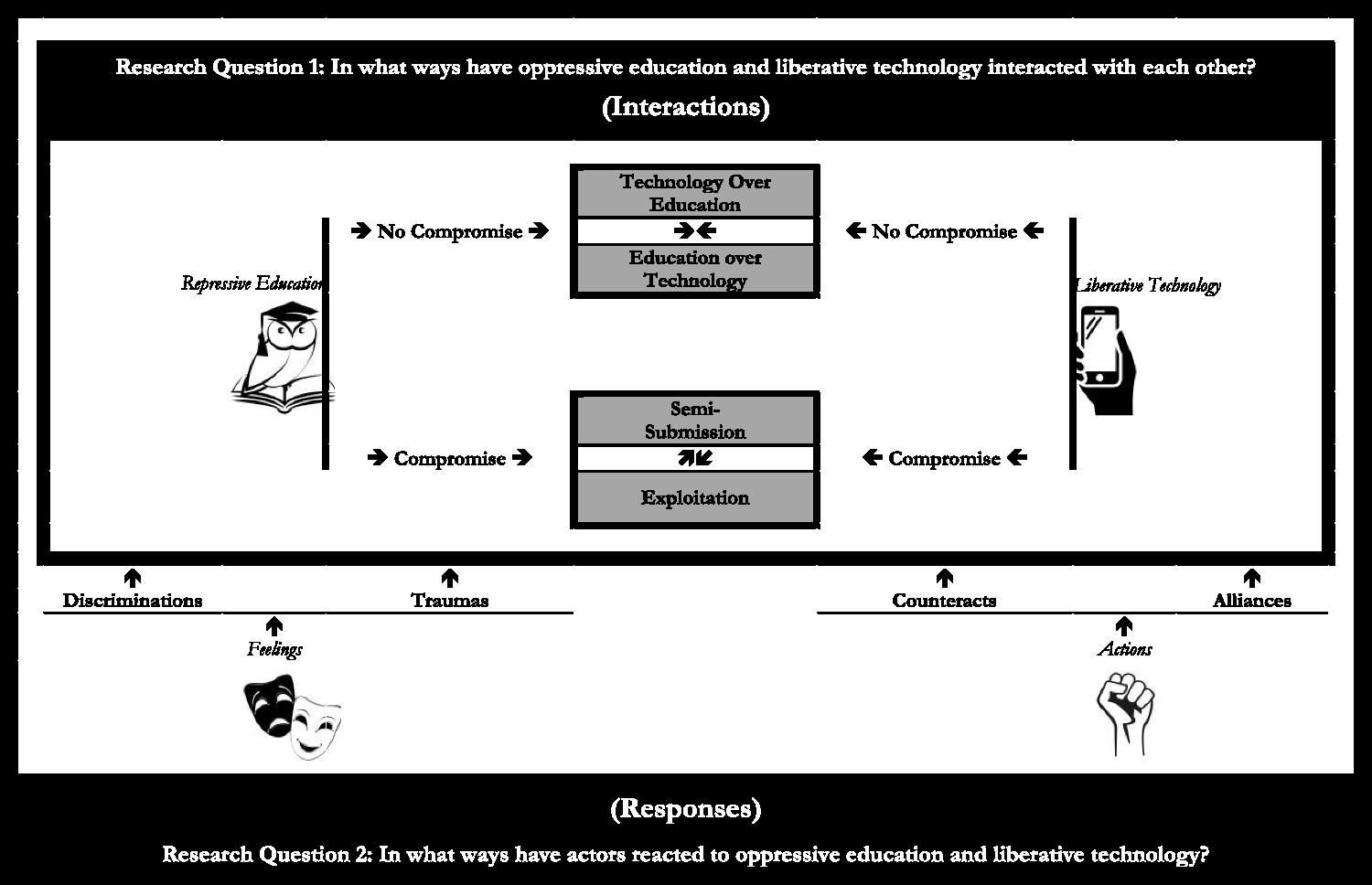
Assumptions about the oppressive authority of education and the liberating power of technology are strong and, consequently, more likely to clash with one another or engage in forms of negotiation. This led to the first research question: In what ways have oppressive education and liberative technology interacted with each other? (Research Question 1). Bearing in mind that humans are politically proactive creatures who react to what they encounter in various ways, the second research question is: In what ways have actors reacted to oppressive education and liberative technology? (Research Question 2). These two research questions are addressed by carefully analysing the main hashtags originating in five Saudi universities by collecting 1831 tweets wherein students demonstrate a sense of oppression as caused by their education. This was done by visiting the hashtag of each Saudi university for an entire month. Tweets of the same content were considered one tweet. The researchers acted as non-participant observers, that is, they did not tweet universities’ hashtags so as not to influence the data being collected. The authors, moreover, undertook a participant observation of the day-to-day activities at two Saudi higher education institutions for one semester. These activities included observing 28 classes, engaging in 32 extracurricular activities, attending 11 managerial and administrative meetings, and examining policies and regulations. Because of gender separation, the authors could observe male-only campuses. That said, the authors employed two women, who acted as informants on the female-only campus. These informants worked for a few days only and were then fired as the authors realised that this experience of having cross-gender informants was culturally sensitive.
Another data collection method was unstructured interviews with 113 students, 22 support staff and 18 academics in the higher education public sector. In this sample, most of the students were unmarried whereas the majority of employees were married. Additionally, the interviewees derived from various Arab countries, but were predominantly from Saudi Arabia, Egypt, Jordan and Sudan. Most of the students were undergraduates. Most of the support staff had bachelor’s degrees or less. Most of the interviewees were men. Women were interviewed either through a mediator or via the phone, as face-to-face meeting across gender lines would be culturally sensitive and, hence, would make many women uncomfortable. Interviewees signed informed consent sheets. Notes were taken from each interview and were sent by WhatsApp or email to the interviewee to check the accuracy of the transcripts. Each interview was 10 minutes long. The data were analysed thematically in line with the research questions. That is, the data from tweets, observations and interviews were mixed and coded. Codes of similar meanings combined to produce concepts. Then, concepts of the same kind were assembled to generate categories. After that, alike categories eventually led to themes. This analytical process is illustrated in Figure 1. In the next section, findings are linked to codes and to the type of data collection methods from which they originate. Data collection methods are referred to as
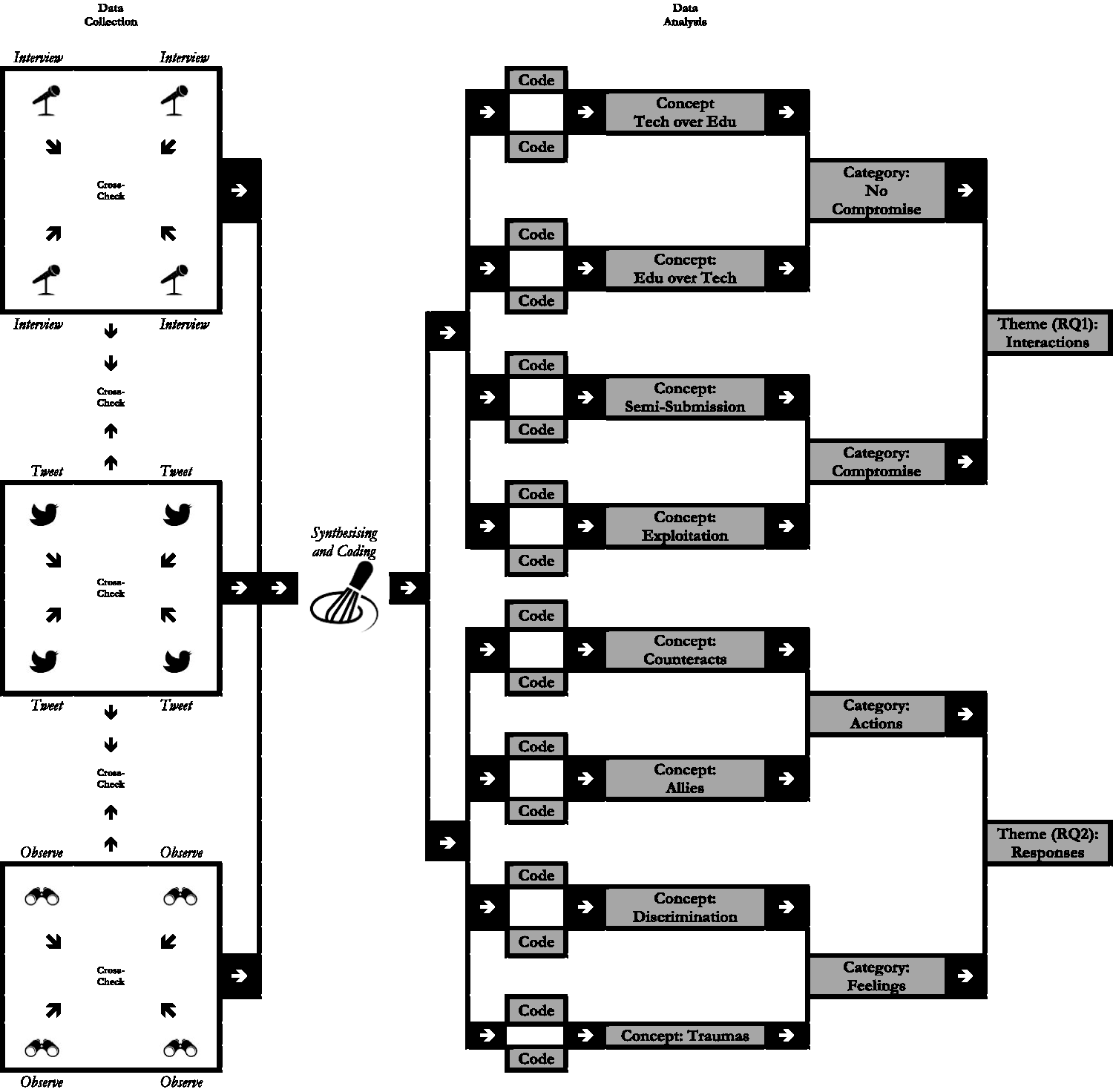
Data collection and analysis.
Findings and discussions
The current article first builds a conceptual framework that, theoretically, shows oppressive education and emancipative technology. It then explains how qualitative research has been conducted at Saudi universities to put this conceptual framework into practice. We now move on to show how this research has helped answer the two research questions (see Figure 2).
Figure 2, How the findings feed and are fed by the research questions.
Theme (RQ 1): Interactions
Category (no compromise)
Concept: Technology over education
Raw data analysis reveals that, from time to time, technological liberation has won against educational oppression. The two entities of education and technology have been incorporated, to a high degree, into the social life of students. Nevertheless, each of these entities has sometimes been found to have a totally different agenda to the other and to, therewith, push students in different directions. That is, whereas education has pushed for oppression, technology has pushed back for liberation and expression. Consequently, students’ mental health and psychological state have been found to have been fragmented and disrupted by these two forces (O14, O77, I50, T40: psychology). Occasionally, the technology of liberation succeeds, enabling students to escape from various forms of oppression exercised by education. As an exemplification, education has oppressed students by preventing them from accessing certain materials, e.g. making only carefully chosen publications available at the library, thus, controlling what students can and cannot read. Technology has, however, liberated these students by enabling them to use the Internet to access other materials (O263, I64, T473: access). Nonetheless, education has acted defensively against this liberation by establishing a filtering-out system that controls the materials that students can and cannot access in online settings (O320, I98, T744, T653: filtering-out). Notwithstanding, technology has exerted even further liberation, releasing students from this oppressive, educational filtering-out system by enabling them to use virtual private networks (a.k.a. VPNs) to go beyond any form of local filtering-out action (I357, I370, I738: proxy). In this case, education and technology have engaged in a politically persistent interaction to shape students, and technology has eventually won.
Data analysis further shows that, at times, oppressive education has used liberative technology against its own oppressive agendas. As a consequence of various factors (e.g. global competition), education in Saudi Arabia has had to integrate technology into its various activities, even if this integration means that technology will go against the political agendas of education. This means that education has used technology against itself, causing self-damage. Students have used social networks not only to discuss their homework but to assemble and promote trends that fight any educational attempt to oppress them (T348, T490, T621, T626: campaign). Whereas education has long oppressed students by exercising top-down power (i.e. power based on authority), technology has come to enable students to assemble and, accordingly, constitute bottom-up power (i.e. power based on collectiveness and unification). Having integrated technology into education, students have started using digital technologies (e.g. social networks) to openly criticise education (including higher authorities, such as the minister of education) (T13, T152, T453: criticism). This represents a historic change in the long-unbalanced power relationship between education and students. In this case, education’s act of integrating technology has gone against itself, with education ‘making a bad political move and having dug a hole for itself’ (interviewee). Education may be well aware that it is not in its best interests to integrate technology into its activity, but it has to embrace technology due to various economic and political forces, such as global pressure on governments and education authorities.
Concept: Education over technology
At times, however, the data suggest that educational oppression and technological liberation have been found to have battled, and educational oppression has won. That is, educational oppression has, from time to time, managed to oppress the potential of technology to set students free. A case in point is how the education sector has oppressed students by offering them limited entertainment on campus (O275, I217, I507: fun). Nevertheless, technology has addressed this oppression; for example, some students have connected their laptop to the projector in a classroom and watched a movie during class breaks. Given that the concept of cinema is a culturally sensitive issue, these students were investigated by a committee called the ‘Disciplining Committee’ (O10, O500, I540: anti-fun). Based on this investigation, the Committee found these students guilty of ‘gross misconduct’ (interviewee) and asked them to sign a form stating that they would not do it again (O36, I105: misconduct). In this case, education has ‘won’ by oppressing not only students but, moreover, the potential of technology to liberate them.
Oppressive education has been found to exploit liberative technology to exert further oppression. Technology is actually an ‘obedient’ tool that neutrally responds to the needs of whoever wants to shape it. Although it sometimes responds to ‘the oppressed’ to overcome oppression, at other times, it responds to the interests of ‘the oppressor’ in exerting further oppression (I82, I179, I323: further oppression). Hence, education has not simply oppressed technology but also exploited it as an oppressive instrument for further control. To illustrate the point, educational institutions have established departments called the ‘Department of Instructional Technologies’. The use of the term ‘instructional’ here implies that education intends to ‘instructionalise’ education, i.e. analyse what academics and students do, break their work down into a series of job descriptions consisting of separate tasks, and examine what components can be automated, standardised and outsourced, achieving technological automation and the ‘instructionalisation’ of teaching and learning. Likewise, the incorporation of e-marking systems and learning management systems can also be interpreted as signs of this instructionalisation (O249, I70, T422: systemisation). The larger the automation of teaching and learning, the less flexible these two components can be, with automated teaching and learning going ‘above’ the will of students and teachers.
Category (Compromise)
Concept: Semi-submission
At times, oppressive education has submitted to liberative technology but only partially (i.e. based on specific terms and conditions). The following is an illustrative example. Education has oppressed students by emphasising spatiality and temporality (on the values of space and time). On the flip side, technology has set students free from temporal and spatial constraints. That is, Saudi universities, conventionally, see knowledge and learning as restricted according to temporal factors (class-time) and spatial factors (taking place on campus) – they ‘force students into attending classes’ (tweeter) (I374, T505, T512: classroom). Moreover, universities place long concrete fences around their campuses with gates protected by security, stressing their spatial values (O1, I261, II337: campus). That said, technology has helped students discard such restrictions, enabling online education and e-learning, thereby undermining temporality and physicality. However, education authorities initially rejected these digital forms of education, not recognising them and not incorporating them into their institutions (I51, I144, I464: recognition). It is only recently that education authorities have started to tolerate these technological forms of education (O265, O330, I46: tolerance). Nevertheless, this tolerance is only partial because education authorities accept only those online education certificates obtained from national universities while not recognising online education certificates obtained from international universities (O24, I9, I392: partial tolerance). This shows that oppressive education may battle with liberative technology, and the former may eventually acquiesce to the latter, albeit merely partially.
Education has oppressed intentionally and unintentionally. At times, oppression has been found to have been made essential, with new technological regulations, policies and facilities being structured around oppression and being designed to ensure oppression (O133, I60, I130: intentionality). At other times, in contrast, oppression has been found to have existed only as a ‘side-effect’, in the sense that new technological regulations, policies and facilities have been designed with no aim at oppression, but as these regulations, policies and facilities are being implemented and developing, oppression then starts emerging (O237, I220, T457: unintentionality). Some students have reported being annoyed by the poorly designed university digital facilities (e.g. registration systems), with these facilities constantly crashing, being difficult to navigate or being too slow (I26, I54, I240: crashing; difficulty; slowness). Additionally, others have complained, ‘chairs in the classrooms are uncomfortable’ (tweeter), and ‘speakers in classrooms are noisy because they are of bad quality’ (tweeter) (T218, T270, T275: discomfort; noisiness). All these cases suggest that education has incorporated both badly designed digital technologies (e.g. registration systems and speakers) and non-digital technologies (e.g. chairs), and this poor design has resulted in the unintentional oppression of students, causing them discomfort and increasing their suffering.
Concept: Exploitation
At times, education has welcomed technological liberation only to achieve political gains. Education has oppressed students by not allowing them to have any representatives on university committees (O120, I218, I322: representation). It has also oppressed them by not enabling them to unite and by banning the formation of any assemblies (e.g. students’ unions and teachers’ union) (O288, O407, I21: non-unification). Technology has helped release them from these forms of oppression by empowering them to unite, assemble and collectively protest against certain oppressive features of education (O85, O134, O205: non-unification). To illustrate the point, students and teachers have established web-based forums and discussion boards and gathered through social networks to address the ways in which education has oppressed them. At first, students established informal and illegal online forums (O149, O160, I531: illegal forum). The management of universities saw these forums as problematic because the management had no control over them, given that students founded them. Management overcame this problem by alternatively founding a formal and legal forum, over which they could have full control and, hence, impose specific terms and conditions regarding registration and participation in the forum (I692, II714, I722: legal forum).
In this case, education has played a game, welcoming technological liberation merely to obtain particular vested interests. To cite another example, Saudi education has welcomed the ability of technology to unfetter education by founding online education degrees, thereby opening up and liberating education and enabling the public to engage in life-long learning. This has not necessarily been done because education is interested in liberation, but rather because education has realised that this kind of degree can be a generous source of income for universities. They have allowed thousands of students to register for these degrees, and there are thousands of students registered for one single course (interviewee).
In this case, oppressive education has enabled liberative technology, not because education is interested in the emancipative features of technology but rather because technology can work to buttress education’s vested interests (e.g. obtaining fees and money) (I342, I362, I770: capital). One interviewee remarked that ‘to maximise their financial income from online education, the Saudi education system has resorted to monopoly, recognising only online education certificates obtained in Saudi universities while not recognising any online education certificates obtained abroad’.
Education can oppress not because it is interested in oppression itself, but rather because it wants to achieve economic gains (e.g. efficiency). To illustrate the point, education has implemented specific machines for marking examinations, which has resulted in various forms of oppression (O800, I364, T300: automatisation). Even before the existence of technologies, multiple-choice examinations had been a common (oppressive) practice, reducing the critical and intellectual capacities of students by limiting them to choosing among predetermined items. Now, with the existence of technologies, a new machine has been constructed to mark multiple-choice examinations in a faster than ever manner. Given the technological ability to speed up the marking process of multiple-choice examinations, Saudi universities have fewer teachers and classes that could consist of thousands of students (O807, O814, T311: efficiency). This means that, whereas in the past, teachers had the option as to whether or not to conduct multiple-choice examinations, now, with the integration of technologies (and, by doing so, the increase in the number of students), teachers have no option but to conduct multiple-choice examinations. In this case, education has used technology for oppression over not only students but also teachers for the sake of efficiency gains (i.e. more students, fewer teachers and quicker processing).
Theme (RQ2): Responses
Category (Actions)
Concept: Counteracts
Some students have used technology as a means of counter-oppressing education. This means that education and students have become engaged in a battle of who oppresses whom. Accordingly, students have shifted from being ‘the oppressed’ to being an oppressor. In this respect, the two entities (students and education) have become two sides of the same coin – both acting as oppressors. These two entities may, in the long run, become accustomed to being oppressive, ending up being ‘partners in repression’ (interviewee). Since education has the power to oppress and counter-oppress, and likewise students can now access a (technology-cultivated) power to oppress and counter-oppress as well, the two entities may engage in an endless circle wherein they keep oppressing each other in a non-stop manner. Education ‘has long oppressed students, which has resulted in accumulated oppression on the part of students’ (interviewee) (I126, I262, I285: accumulation). This accumulated oppression will, sooner or later, ‘explode’ (interviewee), as technology increasingly enables students to freely express and get rid of what has extensively oppressed them. Once accumulated oppression explodes, it may become out of control and turn into revenge (I244, I644, I775: revenge). The counter-oppression (exercised by students) seems to be more aggressive than the (original) oppression (exercised by education), partly because a spirit of revenge cultivates this counter-oppression and because ‘students have never even dreamt of having such power, and yet suddenly so much power has been put in their hands by technology without the necessary skills in how to handle power’ (interviewee) (O403, I157, T606: aggression). On the other hand, the constant counter-oppression exercised by students over education has also resulted in accumulated oppression on the part of education authorities. This accumulated oppression has already exploded, with a former minister of education ‘directing a surprisingly rude, foul public letter to a web-based constant critic of education authorities. The use of such rude, foul language by the minister shows that education authorities have reached a critical point and have already exploded’ (interviewee).
As the battle surrounding who oppresses whom between students and education authorities has intensified, this battle has consequently ‘hindered the development of academia, taking students away from knowledge, keeping them occupied with stupid politics’ (interviewee) (O585, I546, T801: institutional politics). This battle can essentially hold back the progress of academia, since such a conflict is oppression-oriented and, on this ground, unhealthy. A look at Twitter shows the campaigns and, most times, ‘fights’ (interviewee) that some students initiate against education (I138, I382, T29: fight). Technology-based liberation has been ‘misused by some teenagers to cause messiness, upset social order and spread immorality’ (interviewee) (I73, I560, I598: messiness). This is perhaps one reason why liberation and empowerment are socially perceived negatively among many nationals (T72, T100, T135, T164: negativity). As education and students keep oppressing and counter-oppressing one another, oppression increasingly becomes ‘a social norm that is passed on from one generation to another and becomes an integral part of the social fabric, culture and heritage’ (interviewee) (I744, I757, I776: normality). Once oppression becomes a norm, it is treated by subsequent generations as a source of pride and granted a positive nuance that hides its negativity (cf. Giroux, 1983). To illustrate, oppressive phrases such as ‘controlling the class’ and ‘correcting behaviour’ are commonly used in Arabic academic publications, conferences and workshops (O257, O281, O331: class control; behaviour correction). They are an integral part of Arabs’ academic discourse, culture and heritage. There are books and seminars about how to better ‘control’ classes and ‘correct’ behaviour; even though the terms ‘controlling’ and ‘correcting’ convey a very high degree of control (and, subsequently, oppression). At some Arab universities, committees in charge of the administration of examinations are called ‘the Control’, conveying a sense of authoritarianism and oppression (O523: language).
Concept: Alliances
Some students have used technology as an instrument for ‘inciting’ (interviewee) the public to join their revenge against education (O463, I363, T651: incitation). Because the crowd has now become more powerful than authorities, the fact that oppressed students have united via social media and collectively acted against oppressive education means that ‘the oppressed’ is turning out to be more powerful than ‘the oppressor’ (cf. Freire, 1985). Nowadays, given the strengthening role of human-rights activism and social collectiveness, the power of technology-based unification (here, done by students through social media) is increasingly becoming more influential than the power of authority (here, exercised by education authorities). This means that the counter-oppression exercised by students has become more powerful than the oppression exercised by education (I90, I132, I429: reverse power). This could imply that ‘the oppressed’ has become politically more powerful than ‘the oppressor’. Such an occurrence would suggest a historic transformation in the long-established power relationship between citizens and education authorities in Saudi Arabia. The public has employed the expressive power of technology to articulate particular demands against education authorities (T587, T608, T654: articulation). This articulation may not be effective, given that historically oppressed students internalise the image of historically oppressing education and hence are not only unaccustomed to the concept of empowerment but moreover ‘fearful of freedom’ (Freire, 1993: 31). Therefore, students cannot be expected to simply end up using the expressive and emancipative potential of technology to free themselves since they do not know what freedom means and are not used to empowerment. Instead, they more likely use (or, to be more accurate, ‘misuse’) the expressive and liberative potential of technology to merely seek revenge for the sake of revenge with no consideration of eventually achieving any form of essential change, freedom or reform (O411, I563, I580: no reform). Some students have used emotional wording, twisted officials’ statements and played ‘dirty games’ (interviewee) to attract sympathy from the public and make the public join their revenge against education (T18, T37, T392, T810: manipulation). In online settings, they encounter educational oppression by using harsh wording, mocking policies and making fun of educational practices.
Category (Feelings)
Concept: Discriminations
Education has represented teachers as ‘holy figures’ (tweeter), to the extent that there is, as reported by one interviewee, a widely common saying: ‘Stand up for the teacher and show him reverence since the teacher is almost a prophet’ (O387, I425, T85: high value). In short, teachers and professors are, socially and culturally, presented as ‘being always right!’ (tweeter). This social ‘sanctification’ (interviewee) of the teacher has made some teachers ‘tyrannical’ (tweeter), ‘despots’ (tweeter), ‘stubborn’ (tweeter), ‘bossy’ (tweeter), ‘non-understanding’ (tweeter) and as ‘seeing themselves as being above the law and regulations’ (tweeter) (T121, T156, T446, T461: power). Conventionally, education has oppressed students by forcing them into showing a considerable quantity of submission to teachers (O437, I94, I296: submission). This social sanctification of the teacher has, despite all, come to an end owing to the existence of social networks wherein ‘teachers are put on trial and questioned all the time’ (interviewee) (I484, I540, I701: destabilised power). Many students use digital social networks such as Twitter to anonymously and freely say anything they please against teachers, to ‘grill’ (interviewee) them and to subject them to harsh criticisms using impolite wording (O183, I99, T76: facing). Technology has unshackled these students by enabling them to go online and act ‘naughty’ (interviewee) by showing ‘rudeness’ (interviewee), ‘no respect’ (interviewee) and ‘no submission’ (interviewee) to teachers (I92, I166, I222, I436: devaluing). Some teachers have seen such non-submission as lacking respect for teachers and undermining their professional reputation (I517, T447, T660: defence). Hence, some teachers have promoted virtual campaigns (e.g. in Twitter) recalling the traditional passive submission to teachers (T23, T52, T83: protection). In this case, education has oppressed students, who have used technology to counter-oppress teachers, who have used technology to ‘counter-counter-oppress’ students (T421, T777, T783, T809: ping-pong defence). In this case, education has become the oppressed, and students have become the oppressor, presenting a fundamental change in the power relationship between education and students, which was traditionally imbalanced and biased towards education (I286, I556: power relation).
Education has oppressed students by exposing them to various discriminative experiences. Technology has, regardless, enabled them to question any form of discrimination against them, seen when one tweeter complained about ‘the persecution of female students under the name of religion’ (I284, T47, T430: religion). Female students, unlike male students, ‘cannot leave the campus before 11:00 am, so the female student is locked up and imprisoned, which is annoying’ (tweeter). At other universities, female students are supposed to ‘stay until 02:00 pm, although she may have finished all her lectures – isn’t it her basic right to manage her time in any way she wants?’ (tweeter). Students have used technology to complain about such forms of discrimination, underline their existence and urge authorities for immediate actions (T129, T242, T318: reaction). Students nowadays ‘go online and anonymously call for quality and equal treatments that overcome any form of discrimination – something that they would not dare say in their offline lives because these students are scared of punishment’ (interviewee).
Education authorities have not exposed teachers to surveillance, which has encouraged teachers to oppress students given this lack of observation (O305, I276, T293: surveillance). That said, digital technology has liberated these students who now use digital technology as a means of surveillance, e.g. they can currently use various recording and video applications on their smartphone to capture any form of oppression and misconduct excised by teachers over them (I57, T45, T394: recording). Some professors have seen such behaviour on the part of students as a new form of ‘social gaze into the classroom’ (interviewee). Education has oppressed students to the extent that there is, as reported by one interviewee, a saying that ‘once a teacher closes the door of the classroom, he can do whatever he wants to do with students’. This is no longer the case owing to the existence of technology, as students can now use their smartphone to ‘sneakily record or even video any misconduct by teachers and put it online’ (interviewee).
Concept: Traumas
Education ‘has caused students a life-long trauma of oppression, from which they suffer even after they graduate, grow old, advance their career, become elderly and have grandchildren’ (interviewee). Another interviewee added: ‘Whenever education is mentioned, those who are long graduated will automatically recall the oppression they encountered as part of their educational experience’. Although some informants graduated from the university and finished their degree many years before, the oppressive experience with the university remains at the forefront of their mind, and these students ‘will be happy to take revenge against the university whenever they are able to’ (interviewee). This suggests that these students’ experience is better described as a trauma inscribed in their mentality (I489, I547, I597: trauma). One of the socially uncomfortable forms of action and behaviour that those educationally oppressed and yet technologically liberated humans have is revenge (I244, I644, I775: revenge). As is the case, it is common that, whenever a university says anything about its achievements, tweeters harshly criticise, question and attack these achievements. Whenever a university talks about its policies, tweeters harshly criticise, question and attack these policies. So, universities are having their day of reckoning, and students have a score to settle with universities (interviewee).
Concluding remarks
The message that can be drawn from the current research and can be of relevance to international audiences is that, although technology can be inserted into students’ academic life as an oppressive tool, these students can re-shape technology as a tool for liberation and expression. The political proposition is that students (and the like) are not powerless individuals unable to do anything other than submit to oppressive forces. A similar assumption is that students can instead engage in bottom‐up interventions whereby they drive liberation out of top-down oppression. Notwithstanding the increasing theorisation of technology as an oppressive tool, there remain ‘spaces of hope’ (McLaren, 2018: 2) whereby students may re-shape oppressive tools for their liberation and the chance to speak on behalf of themselves and to recognise their value, voice and perspectives within structural and institutional contexts of oppressiveness. This article has argued for the hoped status of becoming digitally emancipated despite being educationally oppressed. That being said, this status could be seen as a fake form of emancipation and freedom, whereby students can virtually (and therefore merely theoretically) hold a discourse with this freedom, speak to this emancipation and feel their ‘other self’ that comes to existence merely through technology (cf. Al Lily, 2016). In such a manner, technological emancipation may trick one into thinking of oneself as someone who is not who one really is. Students may not be able to bridge the gap between the emancipation of digital life and the oppression of physical life. If one experiences emancipation merely in online settings, emancipation may mean something utopian to them. Although the introduction of digital emancipation to physically non-emancipated individuals might initially appear as a positive change, it may bring about negativity, such as making them feel more conscious of physical oppression and, thus, feel even more oppressed. Going online may provide students with the ‘taste’ of emancipation, whereas they are, in reality, not allowed tangible emancipation. They observe freedom online despite the inability to reach it in physical life. They may see digital emancipation as sufficient to satisfy them and their curiosity, not seeking emancipation in non-digital settings. Because students do not have emancipation in offline settings, they may misuse emancipation in online settings, or they may be defamed and fall prey to cybercrime and may not know where one’s own emancipation is supposed to stop (namely, it is supposed to stop when it harms others’ freedom). Educationally oppressed, technologically emancipated students may not understand the essential value of emancipation. For some of them, emancipation arises when attacking oppression and accomplishing revenge against the oppressor (cf. Luke and Gore, 2014). In this regard, emancipation does not go beyond this aggression to the achievement of fundamental changes and reforms. Closer examination at what students tweet about indicates that students tend to complain about merely trivial matters, instead of fundamental issues. This is perhaps because they are so oppressed (and brain-washed) to the extent that they cannot think of fundamental matters.
Footnotes
Declaration of Conflicting Interests
The author(s) declared no potential conflicts of interest with respect to the research, authorship, and/or publication of this article.
Funding
The author(s) received no financial support for the research, authorship, and/or publication of this article.
Author Biographies
