




Abstract
This study explores how educators (n = 23) in a graduate-level “teaching with technology” course used the affordances of digital composing, and sonic composition in particular, to “sound out” reflection. Using the twin-lenses of sociocultural theory and social semiotics, findings suggest that sound operated as a: rhetorical tool for illustrating affect/argument; complementary mode to syncretic meaning; and a diegetic structural feature/locating mechanism. Examining how multimodality became a technology and communicative resource for teachers to remix reflection, this study highlights the frictions and freedoms of using sound to synthesize learning in the online teacher education classroom. As such, this article proposes novel ways to think with sound in e-learning and (re)educates the senses to hear practitioner-inquiry in new ways.
Introduction and overview
Despite the large body of scholarship examining the task of teacher education in promoting a vision of technology that advances education (McKnight et al., 2016; Ottenbreit-Leftwich, et al., 2012; Polly et al., 2010; Russell et al., 2003; Webb, 2013), few studies consider the role digital technologies have in “sounding out” practitioner-inquiry. In other words, while the affordances of digital tools are seen as a resource to promote student learning writ large, there is a paucity of research that listens to what this type of instruction “sounds” like on the ground. Similarly, while recent work has attuned us toward sound design in multimodal expression and reflection (see, for example, Phillips and Smith, 2012; Smith, 2018; Wargo, 2018), few studies attend to how teachers leverage the resources of sonic composition to hear their practice in new ways.
Investigating the sounds of practitioner-inquiry through digital composition, this article explores 23 teacher-produced artifacts, or “multimodal ensembles” (Jewitt, 2008), to demonstrate how sound (conceptually and theoretically) synthesized the enactment of a remediated instructional unit. Examining how multimodality became a technology and communicative resource for teachers to remix reflection—moving away from print-based ways of documenting the inquiry process and toward more expressive ways of knowing and being—this study highlights the frictions and freedoms of using sound and sonic composition to tune in to practitioner reflection.
Purpose of study and research questions
The primary purpose of this study was to explore how in-service teachers in a graduate-level “teaching with technology” course used the affordances of digital applications and tools (e.g. Audacity, VoiceThread) to “sound out” their reflections on remediating focal units through educational technology. As such, three research questions guided our inquiry:
How do 23 in-service educators in a graduate-level teaching with technology course remix reflection through digital media, and sonic composition in particular? What role does sound play in shaping the audible contours of reflection and practitioner-inquiry? How, when analyzed through a critical content lens, does sound function as a design resource? What are the possibilities and/or restraints?
Literature review
Multimodality, as a technology, has enabled a significant expansion of the range of media by which teachers and students communicate. As a communicative resource, multimodality presupposes that meaning is created and interpreted through a variety of representational modes (Jewitt, 2009; Kress and van Leeuwen, 2001). With the hype of social networking sites (i.e. Twitter), digital applications (i.e. Popplet), and tech-tools (i.e. SMART Boards, Chromebooks), multimodality is the communicative register of contemporary e-learning and educational technology. Notwithstanding its capacity for knowing, being, and being known differently, multimodality has also contributed to what Kress (2003) has called “the new dominance of the image” (p. 1). Taking heed of this warning, and given this article’s focus on sonic composition, in this section, I zero in on sound’s status in digital learning and review its role in re-educating the senses to teaching and instructional design.
New conceptualizations of sound in spaces of teaching and learning
Sound is traditionally perceived as an ear-centric mode. Compared to print, speech, and/or image, sound has served as a peripheral resource in design. Recent scholarship in teaching and learning, however, has moved beyond such a restricted view of sound and has privileged it as a powerful tool with promising affordances. Sound and sonic composition invites educators to both enliven the senses and leverage the acoustic ecologies of classroom learning to inform new understandings of space and classroom design (see, for example, Ahern, 2018 and Ceraso, 2014).
Trained to hear in Eurocentric culturally-coded ways, some argue that students need new ways of noticing sound. Ceraso (2014), for instance, argues that sound is a multisensory act. It can be seen, heard, and felt through what she calls “multimodal listening,” an activity where listeners immerse themselves in the context and are attentive to not only the sensory and embodied features of sound, but also to the material and environmental aspects that comprise and shape one’s embodied experience. This ecological perspective characterizes sound as a situated, full-body act, one that is dynamically related with/in surroundings. Sonic composition, in this sense, is the vibrational interaction of sound and body within a complex environmental system that engages audiences in powerful and holistic ways (Hocks and Comstock, 2017).
Apart from its ecological framing, sound can also be interpreted as an intersubjective state. As van Leeuwen (1999) contends, “Sound is a mode that centres and situates us, forming and shaping our cultures and our identities in the process” (p. 32). Sound, as a signifier, works to evoke particular cultural referents, stories, attitudes, and meanings. As a sign, it functions as a mental unit which is processed for something other than itself. These units are socially situated and contextually diverse. However, as van Leeuwen further argues, sound is not a completely subjective experience. It is “also objective in a way, used to create more general if not universal feelings of joy, suspense or fear, as in the case of movie soundtracks” (van Leeuwen, 1999: 32). Therefore, as Chion (2016) declares, our listening practices and interpretations of sound are a state of “intersubjective objectivity,” an objectivity where universal meanings are shared across cultural communities.
Conventional multimodal practices in e-learning silence sound’s impact. They [multimodal practices] “have the unintended side effect of constructing hierarchies where word and image are made more important than sound” (Ahern, 2013: 75). However, sound itself can be read as text. Schafer (1994) describes this heard ambient composition as the soundscape. He describes the soundscape as … an acoustic field of study. We may speak of a musical composition as a soundscape, or a radio program as a soundscape or an acoustic environment as a soundscape. We can isolate an acoustic environment as a field of study just as we can study the characteristics of a given landscape … A soundscape consists of events heard not objects seen. (pp. 7–8)
This paper acknowledges the paucity of literature examining sound in e-learning. It aims to examine it as a mode and design resource through the lens of social semiotics. Reading sound through a sociocultural frame, this article explores how students leveraged the affordances of sound to remix reflection. Sound, configured here, was a modal collaborator. Highlighting the audible contours of a practitioner-inquiry project examining how technology enhanced remediated instructional units, I put my ear to the floor to hear the frictions and freedoms of engaging with educational technology and sonic composition in a graduate teacher education course.
Theoretical framework
Theoretically, this study utilized the twin lenses of sociocultural theory (Vygotsky, 1978; Wertsch, 1991) and social semiotics (Hodge and Kress, 1988; Kress, 2003). More specifically, it used an “activity-based multimodal theory of composing” (Shipka, 2006) to examine what Wysocki (2004) called creating “more room for play” (p. 15) in practitioner-inquiry. As a framework, activity-based multimodality highlights the rhetorical capacity and metamodal awareness of participants’ authoring. This perspective on communication and representation assumes that sign-makers have an array of modes available to them for meaning-making. Each mode, whether alphabetic print, speech, gesture, image, or sound, has its own set of semiotic resources, organizing principles, and affordances (Bezemer and Kress, 2016). Indeed, through promoting the activity of synthesis through multimodal production, the study was interested in examining the material functioning of student-produced texts. It explored how each mode, when separated or taken together, contained particular potentials for delivering a specific message.
A key tenet of activity-based multimodal theory is understanding how modes are shaped by activities and how these activities later influence their uptake in communication. This perspective on multimodality “focuses on processes of making meaning through situated practices and interpretations, the design (selection, adaptation, transformation) of multiple modes, and the representational features available by social actors in the environments of their daily lives (Jewitt and Kress, 2010: 342). This means that communicative meaning and message will fall flat if the relation between the perceptual object, for example, the sounds of a school bell, is unknown to the recipients/listeners. In short, meaning making is a process of design where mode matters.
With an emphasis on sound, an activity-based multimodal theory of composing was used to view how specific modes served as the mediational means for the activity of reflection. It explored how participants’ used sound to shape how their artifact and/or argument was “heard.” Sound, thus, highlighted two co-constitutive relationships: the relationship between listener and object and the relationship between teacher/participant and experience/reflection. As standalone texts, participants’ multimodal artifacts provided a variety of interpretations for possible and probable audiences, each asking the listener/reader to interpret it themselves as and how they heard it. Sound provided a relational conduit between listener and composer.
As a theoretical framework, activity-based multimodal theory highlighted how multiple modes mediated the meaning-making process of reflection. It also amplified the goals and purposes of participants’ larger composition (i.e. as a personal reflective piece, as an assignment for a professor). Hence, the kind of work promoted by an activity-based theory for multimodality is not defined by the production of a particular kind of text that is pre-determined (i.e. print-based reflections) but rather opens up opportunities for students to demonstrate rhetorical awareness and communicative flexibility to accomplish a synthesis that may not be afforded through other design choices.
Methods and modes of inquiry
This article draws on data from a larger practitioner research study investigating how in-service educators in a teaching with technology course used the affordances of digital technologies to enhance their instruction. Practitioner/teacher research involves “systematic and intentional inquiry” (Cochran-Smith and Lytle, 1993: 5) and contends that those in a particular context are in a unique position to study it. With a specific aim to understand how participants leveraged the resources of multimodal composition in synthesizing their summative experience, this exploratory study investigates a snapshot of the larger inquiry to examine how sound was used as a tool and resource to remix reflection. In this section, the specific context and participants are detailed as well as the larger processes of data generation and analysis.
Context of the course, participants, and remix/remediate assignment
This study was conducted at a large midwestern research university in the United States in Spring 2015. The focal graduate-level class “Teaching with Technology,” is a required course for in-service educators pursuing a MA in curriculum and instruction. With diverse backgrounds in secondary mathematics, elementary education, and humanities-oriented electives (i.e. music, art), students enrolled in the course held a variety of instructional roles (see Table 1).
Participants by grade level, subject/problem of practice, duration of artifact, and primary mode of composition.

VO: voice-over; ELA: english language arts.
As the culminating project of the course, the purpose of the larger assignment was to use the affordances of multimodal composition, with a special emphasis on sound and sonic composition, to illustrate and develop rhetorical awareness of the practices and processes of practitioner-inquiry. Starting with a problem-of-practice, students engaged with using technology to remix and/or remediate an existing instructional unit, project, and/or assessment.
Data generation
In order to understand participants’ goals and purposes in multimodal design, numerous sources of data were generated.
Computer-captured screen recording of group interview
As an online class, participants regularly attended synchronous sessions using Blackboard Collaborate or Adobe Connect. Participants featured in this article participated in a 60-minute semi-structured “design interview” (Dalton et al., 2015) after the completion of their “sounding out synthesis” product. This interview attempted to unearth decision-making as it pertained to sound and sonic composition. Audio of this interview was transcribed and then analyzed alongside other data sources.
Multimodal composition/sounding out synthesis project
The primary sources of data for this project were the resulting multimodal artifacts. These artifacts were the culminating product of the course. Encouraging participants to “sound out” their synthesis using the affordances of digital technologies, artifacts were first de-identified and then transcribed using a multimodal transcription technique (Norris, 2004).
Class artifacts and reflective papers
Along with final digital compositions, I collected course materials and assignments related to the larger project and process (e.g. focal instructional units that were remediated using technology, course reflections, and notes). I also collected participants’ reflection papers which they completed and submitted with the final project.
Data analysis
Data analysis was an iterative and recursive process. Based on my previous work examining prospective teachers’ sonic cartography (see Brownell and Wargo, 2017) and given the size of the corpus, I recruited a graduate student to assist in analysis. Since the focus of the larger study was to examine and understand how graduate students enrolled in a teaching with technology course used the resources of sound to “sound out” synthesis through digital production, we took a “layered literacies” (Abrams and Russo, 2015) approach to analyzing the multimodal artifacts.
In analyzing participants’ compositions, we first created a transcription scheme. Examining modal density across each of participant’s final assignment, we listened for patterns across the larger corpus. In doing so, we analyzed and discussed how each participant, perhaps implicitly, created a hierarchy of modal expression through digital composing. Placing the artifact’s dominant mode at the top of the scheme and working our way down (in terms of modal density), we then created unique transcription schemes for individual participants. While the hierarchy of modes was unique for each student, we decided to break frames into three-second intervals for consistency.
After creating unique schemes, we transcribed each participants’ final multimodal artifact. Noting both the ambient audio participants included and voiceover that was scripted and recorded, we examined natural sound and speech; noting what Barthes (1985) called the “grain of voice.” Reducing natural sound to alphabetic print, we described what was heard (e.g. door slamming, bubbles popping, etc.). After, with the audio turned off, we moved to transcribe and record other modes present (i.e. video). With artifacts transcribed, we then employed a “grounded theory” (Strauss and Corbin, 1998) approach to coding and analysis. Open coding the specific sonic practices students used, we noted how many times across the entire corpus these distinct practices, as we came to hear them, occurred (see Table 2).
Categories and open codes with frequency across final course artifacts.
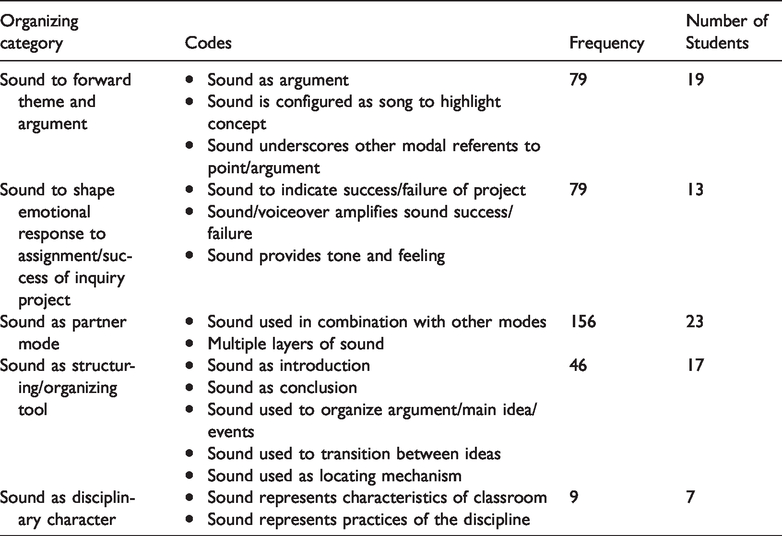
Based upon these broad organizing categories, we used a form of critical content analysis to further examine how sound was used as a descriptive and interpretive tool to synthesize participant’s remediated instructional units. Critical content analysis, like other qualitative traditions, is a term encompassing an array of research methods used to describe and interpret textual artifacts. Critical here, was a “stance of locating power in social practice in order to challenge conditions of inequity” (Short, 2017: 1). As a tool, in critical content analysis “the researcher uses specific critical lens as the frame from which to develop the research questions and to select and analyze the texts” (Short, 2017: 5). Reading across these multimodal artifacts, three frames guided our inquiry: focalization (sound tells what story), social characteristics/traits of characters (how does sound shape the story), and closure (in what ways does sound structure the story). We further developed our coding scheme based on this heuristic and conducted axial coding (Strauss and Corbin, 1998). In this phase, we connected participants’ perspectives and personal rationale to their multimodal designs. This process revealed new information concerning initial categories and frames. As a final phase of analysis, we wrote theoretical memos for each frame and provided a grounded description of where in the artifacts these were most prominent, noting of course that examples were global across the corpus. We strengthened the trustworthiness of findings by performing participant member checks following the completion of analysis.
Findings
Reading across the entire corpus of data, sound was integral to all 23 multimodal artifacts. Participants layered and combined modes for a variety of rhetorical effects. Outside of sound, speech/voiceover was used in 20 of the artifacts and image/video was used in 6. On average, artifacts were 240 seconds in length and ranged from 60–620 seconds. Further analyses suggested that sonic composition, as a feature for reporting practitioner-inquiry, served a variety of roles in remixing reflection.
Although I present descriptive data of the entire corpus here, the sheer number of sonic moves students used to sound out their synthesis mitigates any comprehensive understanding or documentation of the distinct logics and affordances used to remix reflection. A holistic content analysis, thus, is not my purpose. Rather, findings are detailed thematically wherein focal students’ artifacts are used as representative of the larger data corpus. These themes include using sound as: (1) a rhetorical tool for illustrating affect/argument, (2) a complementary mode to syncretic meaning, and as (3) a diegetic structural feature/locating mechanism.
Affective illustrations: Sonic actions and “Sound” arguments
Among students’ multimodal reflections, sound was largely employed for its illustrative capacity. It, as a mode and sign, expressed mood (affect) and amplified the logics of participants’ arguments. Sound rendered reality. Anna (all names are pseudonyms), for example, an eighth grade mathematics teacher, identified that her students had difficulty interpreting the functional relationship between independent and dependent variables on a line graph. Taking this up as her problem of practice for the teaching with technology course, she used the affordances of instructional technologies (e.g. motion detectors) and infused these tools in to her teaching. When Anna described how motor detectors brought positive changes to her students’ learning (e.g. students designed real-life action projects to create their own line graphs to understand relationships), music with rising intonation and volume amplified connotative feelings of excitement. In this instance, Anna’s mood of exaltation was conveyed to the listener vividly through sound. After, she narrated her reflection with voiceover. “So,” Anna said, “I took my original lesson plans centered on lectures and worksheets and tossed them into trash.” Layered below her narration, the ambient sounds of paper being crumpled up and tossed played. Anna used sound here, to support her argument for abandoning the “traditional” lecture-style lesson. Sound signaled a willingness to try a new instructional design focused on learner inquiry and student agency. It also rendered a semiotic event, helping listeners visualize Anna’s actions. As listeners, we heard how, quite literally, Anna crumpled up her old lesson plans and tossed them into the trash. Sound, thus, was an amplifying effect to detail the success or failure of the problems of practice solution.
Sound, as a design feature and modal resource to underscore argument, was varied across participants’ artifacts. For Cassie, a fifth grade teacher, sound provided a backdrop to the content of her problem of practice. Asking students to perform online research about Indigenous peoples in Michigan (students were charged with the task to collect information on a specific tribe online), Cassie introduced her project using music as a soundtrack to voiceover. Using the keywords “Indigenous Michigan” to search for sounds on FreeSound.org, Cassie used music as a resonant resource for her unit of inquiry. When talking about tensions of implementing her solution (using iPads in her classroom to create more collaborative opportunities for student research), Cassie used orchestrated sounds of heavy rain. Sound, as it was deployed here, amplified the emotional struggle. Thunderous claps of “Boom! Boom!” and other sonorous stories representing inclement weather were used to figuratively illustrate Cassie’s anxiety toward the iPad shortage. In contrast to Cassie, Amy used the sounds of children shouting “Yay!” and hand clapping to express the positive changes brought on by her remix project. She also reframed the popular Charlie Brown teacher sounds of “Woh Woh Woa-Woa” to indicate her concerns. Taken together, sound captured teacher emotion (e.g. anxiety, happiness) as well as the perceived success/failure of the instructional solution and remix project.
Sound, however, was more than mere emotion and sonic backdrop. It was also used by participants to compliment the summation of their instructional solution. John, a Kindergarten teacher, adopted sound as a call-and-response resource. While he narrated his mental activity of brainstorming a problem of practice, he inserted a series of fabricated sounds to express his argument and thinking moving forward (see Figure 1).
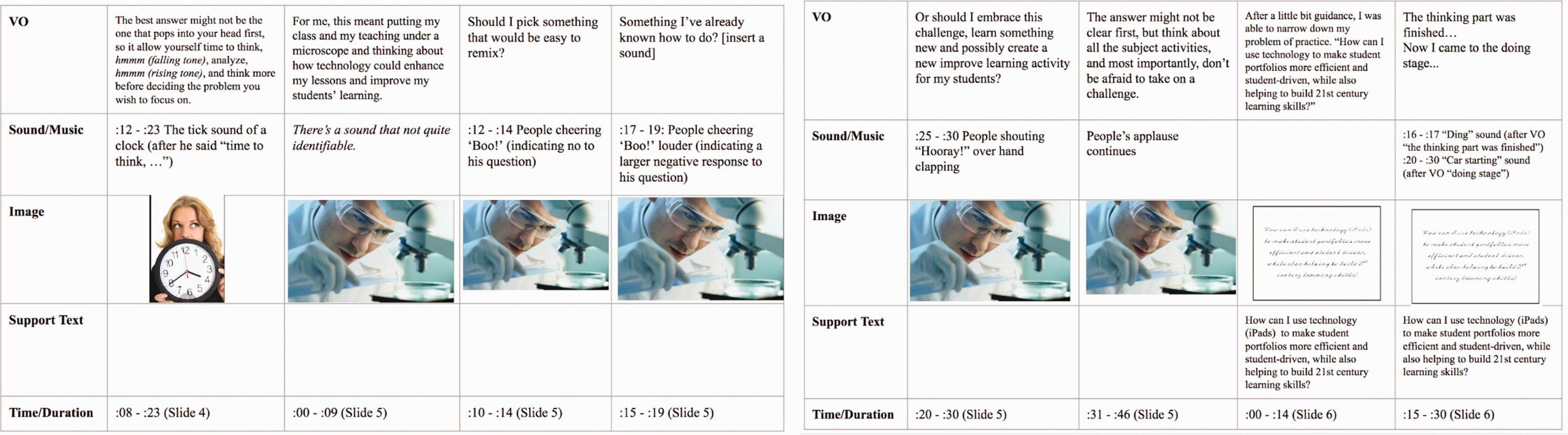
Sample of John’s multimodal transcript.
In analyzing the transcript, I found that John’s central argument was, “as teachers, we should be confident and courageous to choose more challenging, unfamiliar problems to solve because it may afford us more meaningful learning experiences and produce surprisingly positive effects on our students.” To amplify his point, John adopted a sequence of questions that were followed by a series of orchestrated sounds. Each sound served as an interactive response to the aforementioned question. A group catcalling and shouting “Boo!” for example, highlighted how John should not pick “something that would be easy to remix” or “something I [John] have already known how to do.” Comparatively, applause and cheer indicated that John should “embrace this challenge” and “learn something new.” The striking contrast between sounds (“Boo!” shouts vs. wild applause) implied completely different answers to the aforementioned sequence of questions. Sound, perhaps used here to be heard by peers and professors, suggested a challenging problem of practice.
Detailing the semiotic systems of remixing reflection: Sound as a syncretic partner mode
Remixing reflection, as it turned out, had a multi-dimensional semiotic code. In the larger analysis, I found that sound was always used in combination with other modes. Synchresis—the forging between what one sees and hears—was a central design feature for participants. There was no single artifact solely adopting sound to synthesize the solution to their problem of practice. In this section, thus, we detail sound’s function as a syncretic partner in participants’ multimodal artifacts.
The majority of students (n = 20) used voiceover as the foundational sonic mode to remix their reflection. Without contributing substantial new information, participants matched modes (i.e. image, text, and sound) to echo the content of their speech and/or to add complimentary visual details to their final assignment. This form of modal matching represented an intersemiotic relationship where modes “went with” each other (Dalton et al., 2015) at a repetitive level to create a cohesive message. Jamie, an elementary social studies teacher interested in mobilizing technology in early economics education, detailed that her core problem was revolved around the perception that social studies was “commonly seen as the boring subject in school” (see Figure 2).
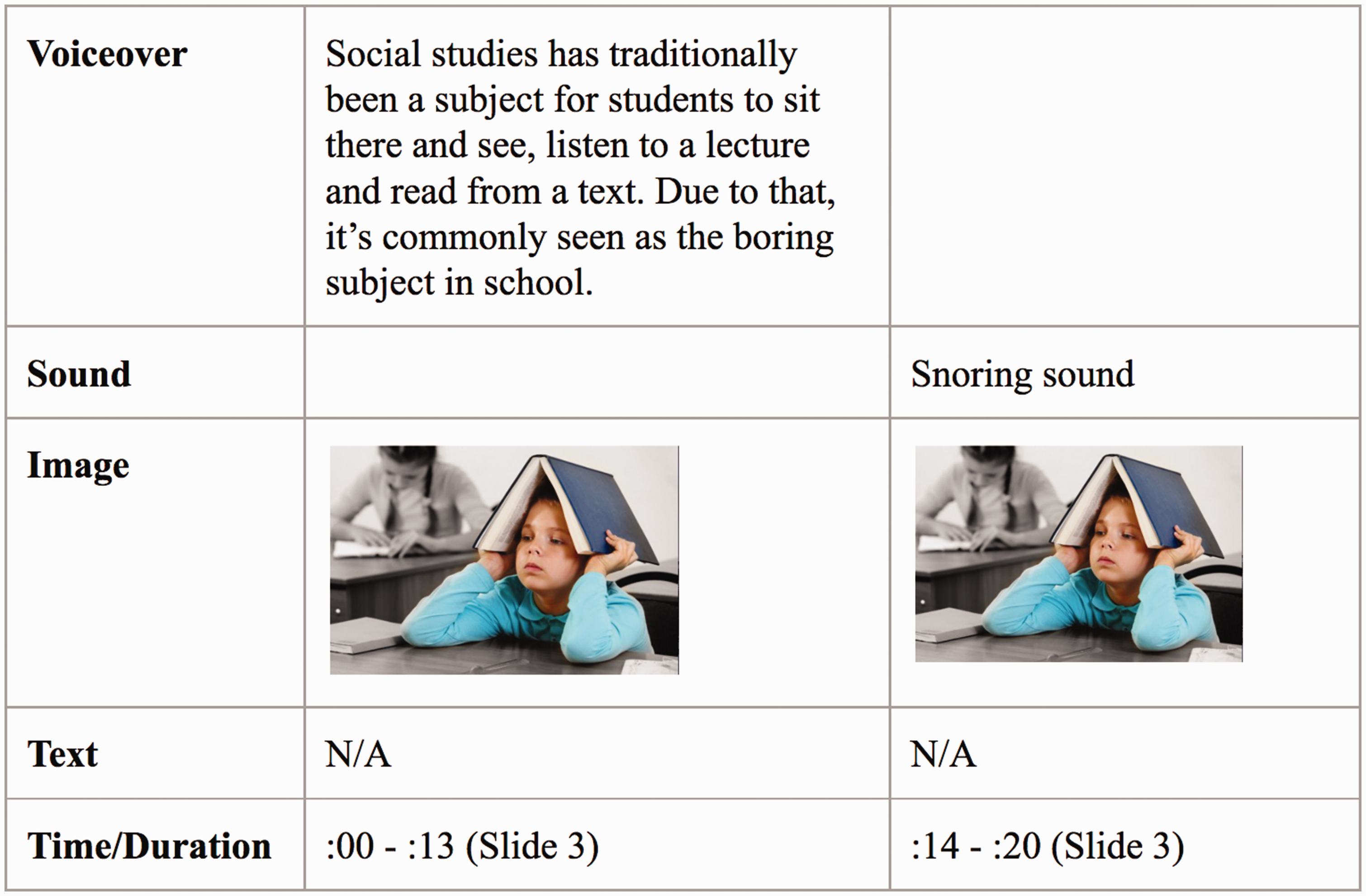
Jamie’s modal matching transcript.
Highlighted in the multimodal transcript, Jamie’s voiceover served as the foundational communicate layer of her message. The partner image (a “sleepy” child with a book over their head) visually replicated what was described in the narration (social studies as the boring subject). Jamie complemented this modal dyad found sound A “snoring sound” (her words, not my own) was added to provide sonorous details (but not new information) and to reinforce the misconception of social studies as a “boring” discipline. Taken together, these modes achieved a level of content complementarity and syncretic cohesion to give the audience a more holistic picture of the problem.
In contrast to Jamie, some participants adopted alphabetic text (i.e. print) as the foundational mode to communicate content (n = 3). In Amy’s remix project, for example, she documented how she worked to increase student engagement through infusing technology in writer’s workshop. More specifically, she used text to label the progression of her story and signpost the main idea of her synthesis. Sound, movement, and image were integrated as secondary partner modes to bring a multifaceted effect to the primacy of text. When Amy introduced her project, for instance, she used a sequence of rolling text similar to the Star Wars™ franchise opening credits. Set against a black backdrop, “Not long ago in a classroom not too far away … ,” was foregrounded in yellow print. Using animation effects from Microsoft PowerPoint, the words zoomed in and out. The booming music from Star Wars™ backdropped the scene. Together, modes partnered and cohered to form a multimodal mosaic. Adding dramatic design effects and intertextual sounds to her argument, Amy used the audible echoes of pop culture to simultaneously both invite the listener in to a familiar world while underscoring the severity of her problem of practice.
Sound, as a secondary partner mode, was pervasively deployed in participants’ digital compositions. It achieved modal cohesion with other design elements and worked to amplify certain “heard” authorial effects. The inclusion of sound as a partner mode, however, did not necessarily contribute new information. Rather, as a mode, it was deployed by participants to support the communicative power of more foundational modes (i.e. voiceover or text). In latter analyses of the larger corpus, I created modal density maps for each artifact. Maps located sound as a subordinate mode to meaning making. Here, I use a modal density map to demonstrate the layering of modes in Denise’s artifact (see Figure 3).
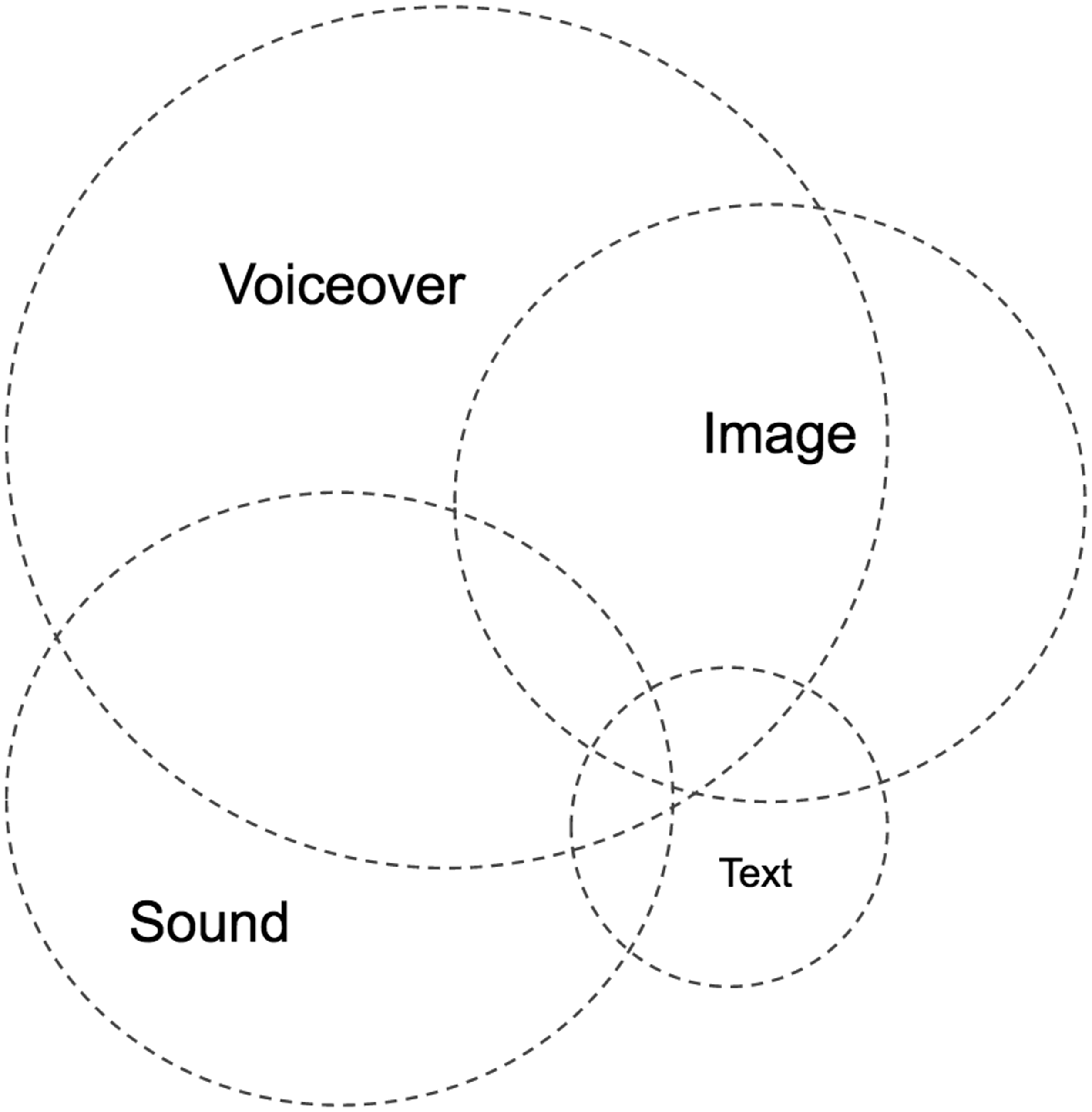
Modal density map.
As the map detailed, there was an unequal modal hierarchy in Denise’s digital composition. Sound was a secondary, rather than equal, partner. Whereas voiceover and alphabetic text functioned as primary communicative means for message delivery, sound was a silenced expressive resource. In the end, as illustrated throughout the larger corpus, sound was an unequal partner to more dense modes of design (e.g. alphabetic text, image, voiceover, etc.).
Diegetic designs: Sound as structural feature and locating mechanism
Outside of illustrating students’ primary arguments (i.e. the success or failure of the remediated unit) and/or serving as a partner mode to multimodal production, sound was also deployed as a diegetic design feature for participants. Structurally, sound notated the commencement and termination of the digital artifact. Denise, for example, used the familiar sounds of a school bell to open her three-minute sonic ensemble. Sound functioned, here, as a mechanism to segment parts of her audio reflection. The ambient sounds of footsteps over crushed leaves marked a transition to her description of what the practitioner-inquiry journey would entail. “This part,” Denise wrote in her final response paper, “was to tell people about my journey. They [listeners] could hear me walking it.” Denise closed her sonic artifact similarly. Layered on top of one another, she used orchestrated sounds of children cheering with a whispered voiceover request for a “silent cheer.” Denise’s digital composition, comparatively, was an outlier. The bulk of participants used sound as a transitional feature between elongated voiceover. Beatrice, for instance, used five seven-second musical transitions to detail her personal inquiry, the success of the project, and future steps as a primary grades educator. Sound, for Beatrice, was not a means to amplify her synthesis but rather an additive that simply was stitched into her reflection and meet the criterion of the larger assignment.
Sound also functioned as an immersive locating mechanism. It created an acoustic blueprint for building place in participants’ artifacts. From the high school laboratory to the early elementary classroom, in-service teachers used sound to concurrently build the environs of their classrooms, practices, and workspaces. As noted earlier, Denise, an early elementary educator, used recorded claps, cheers, and voices of young children to highlight both the reception and action of her classroom problem of practice. In an interview some weeks after her submission, I (Wargo) asked Denise for her rationale.
Adjacent to using sound as a structural feature of reflection, or as an affordance of attuning listeners to the environs of a workplace, participants also used it to illustrate particular practices and functions of technology. Denise, for example, used the sounds of bubbles popping to detail the function of the Popplet application. A digital tool used to plan, organize, and structure her first grade classroom’s writing unit, the bubble noise provided listeners with an ear toward remixing her unit as they signaled children’s “generation of ideas” (Denise, Reflection). In comparison, Jamie highlighted the reverb of educational technology used in her fourth grade classroom with the sounds of an audio logo. The ubiquitous Microsoft “ding,” layered on top of sounds of ripping paper (a tool and technology once used to plan and organize her economics unit and advertisement project), sound provided a sense of sonic symbiosis. The listening experience was cemented through meaning and aesthetics.
Discussion and implications
This study examined how 23 in-service teachers used the affordances of multimodality—as a technology—to “sound out” reflection. Through their use of sonic composition, the nuances and audible contours of practitioner-inquiry were heard. Qualitative content analysis revealed that sound served three primary roles in remixing reflection. For the majority of participants, sound operated as a rhetorical tool to persuasively illustrate action and argument. Sound also functioned as a subordinate partner mode, working complementarily to achieve synchresis. In support of these two roles, sound was deployed by participants as a structural feature and diegetic resource. In this section, I talk across these larger findings and chart both theoretical and pedagogical implications for thinking with sound as a digital resource in the online teacher education classroom.
Sound, as a modal resource for design, allowed participants to voice the frictions and freedoms of remediating instruction with educational technology. Content analysis revealed that, as Smith (2017) argued, engaging in digital composition was “a unique blend of sociocultural, affective, content-related, and personal dimensions” (p. 27). With a particular emphasis on sound, however, findings extended my own imaginary regarding the purpose of reflection in the online teacher education classroom. Participants used the digital resources of sound to engage and attune listeners toward the processes and practices of personal inquiry. For instance, individual experiences and environs of classrooms were voiced in ways that are sometimes silenced in the e-learning classroom. Sound, here, functioned as a cultural referent and local artifact. Drawing listeners in to engage in new ways, sound functioned as a signifier. A dimension of activity that sometimes fell flat through other forms of reflection, sound indexed listeners to the lived realities and histories of participation of teaching and learning.
Sound, for students, mobilized a freedom and fluency of audible expression. Through modal matching, participants created an expressive mosaic to talk across personal tensions of using educational technology to advance their teaching. Leveraging the digital technologies of the teacher education classroom (e.g. Audacity, VoiceThread), participants used sound to comment and critique instructional approaches, to categorize and curate possible solutions and technologies, as well as to amplify the successes or perceived failures of their projects. As John detailed in his closing reflection, sound, and multimodal composition more broadly, allowed classmates to “hear the happenings” of classroom instruction.
Sound, however, was also a friction for participants. Despite students demonstrating metamodal awareness of how modes could be synergistically combined to convey a cohesive message, voiceover still dominated artifacts. Natural sound rendered minor complimentary details, whereas speech (orchestrated sound) and text (alphabetic print) functioned as semiotic foundations for delivery. Perhaps, this presupposition of “seeing” sound as secondary was a condition of the activity. In re-evaluating the corpus of artifacts, I found that participants used the confines and criteria of the assignment to ensure they were “performing” sound the right way. In fact, when submitting the assignment on Blackboard (our learning management system), the comment, “I hope this sounds OK” was used by 15 of 23 participants. Thus, the confines of the assignment, as well as the parameters of submitting the final synthesis project (i.e. a weblink), could have resulted in a flattened sonic experience.
Participants’ frictions and freedoms in sonic design help to chart future directions for using sound as a resource in the online teacher education classroom. Sound encouraged teachers, theoretically, to re-learn to listen. Participants heard their practice in new ways. From recording the ambient noise of their hallway to searching for artificial sound on FreeSound.org, participants became invested in sound’s phonic economy. They yearned for peers, professors, and colleagues to listen across the symbolic and expressive. As teacher educators, we should capitalize on this investment and work with our students to consider how sound operates as both an embodied and aural experience.
Conditioned to hear, respond, and silence certain sounds and voices, this re-education and sonic un-learning takes work. As the person who set the parameters for the assignment, I now see some of the missed opportunities in both the design and enactment of the “sounding out” synthesis activity. In reflection, I would first invite students to examine a series of found sounds and orchestrated sonic artifacts. Together, as a group, we would then work to develop a meta-language for sonic composition. In developing this meta-language, we would interrogate rhetorical purpose and examine how, if at all, digital technologies advance multiliterate expression. Examining how sound operated as an equal partner mode for achieving modal equivalence, for instance, we would give sound its due, pedagogically.
Conclusion
The task of sounding out synthesis offered students a wide array of communicative possibilities as well as the semiotic space to hear reflection in new ways. As Yancey (1998) disclosed over 20 years ago, “reflection makes possible a new kind of learning as well as a new kind of teaching” (p. 8). Hence, and as the findings suggest, it may be worthwhile to re-center sound in the e-learning environment. In conclusion, I want to foreground three areas for future study. First, research forwarding sound as a resource to remix reflection should advance our understanding of the sonic as an embodied event. Sound is not solely a semiotic signifier. What may it mean, for example, to experience sound as a vibrational material and technology? How do we, as listeners, participate in the felt experience of reflection without relying on the reality of observation? Second, I think it is imperative to continue to investigate how deaf and/or hearing-impaired students use the technologies of closed captioning (see, for example, Zdenek, 2015) as a means to document what it may mean to read and experience sound. While no participants self-identified as deaf or hard of hearing in this study, I acknowledge that the understanding and presentation of sound in this article is limited. Finally, we would do well to remind ourselves that the classroom space itself (whether digital or analog) is a sonic technology well worth exploring. As a teacher educator with a vested interest in sonic technologies, my hope is that we might also include examinations of the productive interplay between sound and the infrastructures of teaching and learning.
Footnotes
Acknowledgements
The author would like to thank Zhongfeng Tian (Boston College) for his assistance in transcription and early data analysis.
Declaration of Conflicting Interests
The author(s) declared no potential conflicts of interest with respect to the research, authorship, and/or publication of this article.
Funding
The author(s) received no financial support for the research, authorship, and/or publication of this article.
