




Abstract
Understanding learner participation is essential to any learning environment to enhance teaching and learning, especially in large scale digital spaces, such as massive open online courses. However, there is a lack of research to fully capture the dynamic nature of massive open online courses and the different ways learners participate in these emerging massive e-learning ecologies. To fill in the research gap, this paper attempted to investigate the relationship between how learners choose to participate in a massive open online course, their initial motivation for learning, and the barriers they faced throughout the course. This was achieved through a combination of data-driven clustering approaches—to identify patterns of learner participation—and qualitative analysis of survey data—to better understand the learners’ motivation and the barriers they faced during the course. Through this study we show how, within the context of a Coursera massive open online course offered by the University of Illinois, learners with varied patterns of participation (Advanced, Balanced, Early, Limited, and Delayed Participation) reported similar motivations and barriers, but described differences in how their participation was impacted by those factors. These findings are significant to gain insights about learners’ needs which in turn serve as the basis to innovate more adaptive and personalized learning experiences and thus advance learning in these large scale environments.
Introduction
With the advent of technological advancements in a global digital connected world, the structure of learning is undergoing a paradigm shift. Learning is no longer restricted to a traditional hall, specific time frame or one-to-many relationship (Kalantzis and Cope, 2012). Technology affordances have offered the tools to expand learning beyond these boundaries of physical spaces and limited student–teacher relationships. Learning is becoming more innovative, ubiquitous, open, and massive (Burbules, 2011; Haniya and Rusch, 2017). Especially, massive open online course (MOOCs) have disrupted the landscape of higher education by providing an alternative way of knowledge acquisition and lifelong learning delivered online and at no cost to any participant in the world as long as they have the appropriate internet connection and technology device. Consequently, MOOC learners are more heterogeneous than other formal learning contexts, such as the traditional classrooms (Engle et al., 2015). They come from different backgrounds, employment status, age, educational level, different lifestyles, and their interest in these courses is motivated by different factors. According to Bloom (1968), diverse learners require different learning paths to master their learning and progress in the course according to their capabilities; however, this is not well explored in MOOCs.
Despite the widespread popularity of MOOCs and their potential for higher education, their capability to differentiate learning and accommodate diverse learners’ needs is still questionable (Davis et al., 2017; Kizilcec and Halawa, 2015). By virtue of open access, MOOCs provide anytime and anywhere learning, yet the format of these courses remains mostly uniform—releasing videos and assignments on a fixed weekly schedule—regardless of learner differences and course topic. This is particularly the case for the “one-size-fits-all” teaching strategy to teach for the average students, which assumes sameness and homogeneity of learners. This approach has been argued for many years to provide a high quality learning experience (Dewey, 1986; Freire, 1972; Lave and Wenger, 1991). Educational researchers are now calling for a new reform to advance and adapt learning by designing equitable educational environments that account for learners’ motivations and interests (Haniya and Roberts-Lieb, 2017; Kalantzis and Cope, 2016; Tomlinson and McTighe, 2006). To accommodate the different needs of an increasingly diverse student population, the goal of MOOCs should not only be to provide educational content to millions of people, but it also needs to be directed toward optimizing their learning in order to provide high quality educational experiences.
As a step toward supporting the development of rich differentiated learning experiences in the context of MOOCs, we studied the relationship between learner participation in a MOOC, their initial motivation for registering for the course, and the barriers they faced throughout the course. Our goal was to better understand how and why learners participate in these massive scale learning environments in order to provide insights to better support the design of differentiated learning experiences in these massive scale learning environments. To this end, we investigated patterns of participations in a Coursera MOOC offered by the University of Illinois by combining a data-driven clustering approach—to identify the learners’ main participation patterns—and a qualitative analysis of the learners’ responses to pre- and post-course surveys. The results provide us with insights regarding why learners engaged with the course content with varying level of participations.
Related work
Different researchers have taken various ways to the study of understanding learners’ behaviors and participation in MOOCs. For example, Cisel (2014), Hone and El Said (2016), and Morris et al. (2015) looked at the potential factors that might impact learners’ participation and performance in MOOCs. Yet, identifying factors alone is not enough to understand the dynamic nature of learning in MOOCs. Other researchers aimed to developing predictors to study participation and predict learners’ performance in these courses. In one work, Sinha et al. (2014) developed a predictive model of student completion derived only from the video lecture clickstream data in order to determine which behavioral action (i.e. fast watching, slow watching, re-watching, skipping) was associated to course dropouts. They found students who like to re-watch the videos are most likely to continue in the course. In another work, Crossley et al. (2016) went another step forward to have better predictive understandings of MOOCs’ success and engagement by combining the clickstream data and natural language processing of the forum posts. They found that viewing the lectures and submitting assignments on time are the most predictable variables of MOOCs’ completion with a notable relation to the writing quality of the forum posts. Despite these efforts in studying learners’ behaviors and predicting factors of leveraging participation in MOOCs, what is needed is an understanding of the distinct ways learners engage and participate in these learning environments.
One of the several studies that have focused on finding the different participation patterns in MOOCs is the study of Milligan et al. (2013). The researchers conducted semi-structured interviews and identified three distinct patterns of participation: active, lurker, and passive learners in a connectivist MOOC. However, this study has only relied on 29 participants from a total of 2300 registered learners. Another study used data mining techniques to explore patterns of engagement in three computer science MOOCs by mining learners’ behaviors in video watching and assessment submissions of each student (Kizilcec et al., 2013). The researchers found four patterns of engagement and participation as follows: completing, auditing, disengaging, and sampling. Completing pattern includes learners who completed majority of assessments. Auditing pattern characterizes those learners who watched most of the videos but completed assessments infrequently. Disengaging learners completed assessments early in the course but discounted engagement afterwards. Finally, sampling learners merely explored some course videos. Similarly, Anderson et al. (2014) used clustering analysis techniques on MOOCs’ lecture viewing and assignment submission, and found five patterns of students’ engagement. These patterns are the viewers, solvers, all-rounders, collectors, and bystanders. To illustrate, viewers' pattern describes learners who primarily watched course lectures. Solvers' pattern are those learners who primarily solved the assignments for a grade. All-rounders' pattern includes those learners who are in the middle of doing both activities of watching lectures and solving assignments. Collectors' pattern resembles those learners who downloaded the videos but not necessarily watched them. Lastly, bystanders' pattern displays those learners with a low activity profile. While these studies mined some of the students’ activities in video lectures and weekly assessments, they did not include learners’ interaction in weekly discussion forums, an important aspect of learning as it resembles learners-to-learners interaction. Also, they did not connect between learning patterns and other factors of motivations and barriers. This leaves a gap in current research to conceive an inclusive picture of learners’ participation in MOOCs across the main activities in the course and thus using supplemental methods to understand why learners engage in one way but not in the other.
The research context
In this study, we investigated participation in a Coursera MOOC offered by the University of Illinois at Urbana-Champaign in 2014. The course attracted a total of 10,818 learners from 165 countries, 41% of which were from emerging economies. The purpose of the course was to develop a better understanding of marketplaces in different areas of the world. It engaged learners in thinking of the global challenges of poverty and in designing solutions for such problems to envision a better world. The course was structured in an eight-week time frame and the registration was open until the end of the course. However, we have controlled our participants to those who have shown at least a learning behavior in the first week of the course. Each week in this course, 4–6 video lectures discussing a new topic were released. Learners were expected to watch these lectures and complete 2–3 quizzes, with a maximum of three attempts for them to achieve the highest score. Learners were also expected to participate in the assigned weekly discussion forum; however, this activity was optional and did not count toward their final grade.
Methods
The study utilized a combination of a clustering approach—providing data-driven discovery of the learners’ participation patterns—and qualitative methods—to develop a deep understanding of why learners follow a certain pattern. For this purpose, two types of data were collected from the course: clickstream data logs (Video Watching, Forum Participation, and Quiz Submission) and the open-ended questions relevant to learning motivation and barriers in the pre- and post-course survey.
Prior to the clustering analysis, the clickstream data went through several steps of curation and rearrangement to make it into a workable format using SPSS software. First, as we were interested in studying learner behavior, we removed all data that were considered irrelevant for that purpose, such as IP addresses, scores, content of learners’ forum posts, etc. Then, we aggregated data into a weekly basis to capture weekly units of learner behavior, when new content is made available. We aggregated all behavior that took place after the end of a class in a special week (week 9). Weekly participation was measured using three variables: Video Watching, the total number of videos a learner clicked in a week; Quiz Submission, the total number of attempts the learner has made to submit a quiz in a week; and Forum Participation, the number of times the learner posted in a forum and/or made a comment in a week. We filtered out data by removing learners who did not show any behavior across the three identifiable variables across the full period. The new filtered document included data from a total of 4583 learners.
Once the data curation process was complete, we applied the k-means clustering algorithm to the curated data using RapidMiner software, to identify groups of weekly participation behaviors based on the three selected variables (Video Watching, Quiz Submission, and Forum Participation). A combination of visual inspection and silhouette score was used to determine the number of clusters for this analysis. Silhouette analysis offers a method to evaluate the quality and appropriateness of the resulting clusters by measuring the mean distance between one data point in a particular cluster and all other data points in the same cluster. In other words, it measures how similar an object is to its own cluster compared to other clusters. It ranges from −1 to 1, where the highest value indicates a strong structure in a cluster, while a lower value indicates a weak structure (Kaufman and Rousseeuw, 2009).
Following the identification of clusters of weekly learner participation, we conducted a second clustering analysis, using the k-means algorithm, to identify prototypical participation patterns for the whole course. This was achieved by using the results of the first clustering analysis as input for the second analysis. More specifically, the weekly participation behaviors of each learner were arranged in a sequence (starting in week 1–week 9) and clustering was conducted across those sequences to identify course long participation patterns. The number of clusters for this analysis was determined using visual inspection of the resulting clusters and silhouette score. The whole process of data curation and clustering took almost two months to be completed.
Along with the previous clustering method which almost took two months, the study utilized a qualitative approach to explore the common themes that could motivate or limit learners’ participation across the different participation patterns (Creswell, 2014). To provide rich data and discover more information about learners, we relied on the open-ended questions relevant to motivation and barriers. The open-ended questions allow learners to freely express their opinions, while closed-ended questions have limited choices that cannot provide interpretation. First, we analyzed data from the open-ended question in the pre-course survey: What are your reasons for taking this course and what do you hope to get out of it? Then we investigated the limiting factors of learners’ participation using data of the post-course survey question: What were the factors that limited the extent to which you took advantage of this Coursera opportunity? The data were analyzed using content analysis techniques (Creswell, 2014). Each response was matched to the participation pattern of the corresponding learner. Initially, we read through the data to obtain a general sense of the information it provided and reflected on its overall meaning. Then, we established the coding process by creating a thematic codebook using open-ended approach in ATLAS.ti software. The coding process of the themes occurred by two people independently. It included one of the authors in this paper and another graduate student from a similar field of study. All codes were compared and analyzed for differences. All the differences were resolved between coders. Almost each response was tagged to a single code that best represents it, with the exception of four responses that have shown multiple codes. We quantified the occurrence of each emerging theme across different groups, and presented the findings in numerical and textual forms.
Results
How learners learn?
By applying the first clustering model, data analysis revealed three different clusters (silhouette score of 0.86) to describe the overall participation of each learner in a particular week based on the three identifiable variables of videos, forums, and quizzes. We included the mean score of each variable in Table 1 and identified the clusters based on the frequency of participation behaviors as follows: (1) Highly Active, (2) Moderately Active, and (3) Less Active. As it appears in Table 1 and Figure 1, Highly Active learners participated the most in relation to posting to forums, submitting more quizzes, and watching the expected number of video lectures. Moderately Active learners have primarily watched lectures more than the other two clusters, yet they submitted fewer quizzes and occasionally participated in the forums. Their video watching behavior was exceptionally higher than the other clusters with an average of 37 recorded actions in a week that has 4–6 lectures. As a matter of fact, MOOC learners can watch and re-watch the videos multiple times, thus we set the cut off of this variable to 150 times. Finally, the Less Active learners undertook very few activities compared with the other two clusters. They watched fewer video lectures, submitted a limited number of quizzes, and rarely participated in the discussion forums.
Means of learners’ participation in a week across videos, forums, and quizzes.

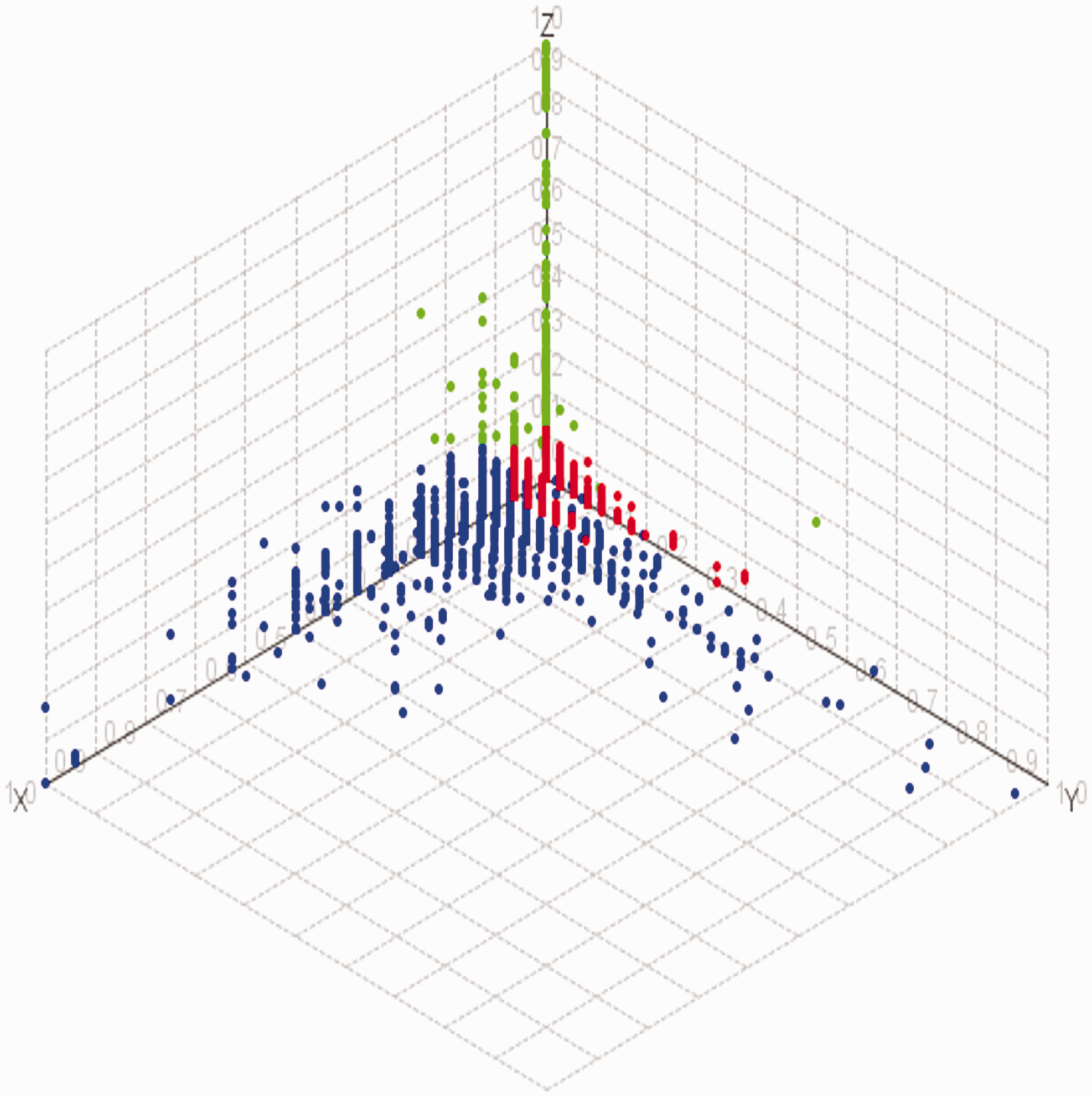
Clustering learning behaviors in a week (x = Quiz Submission, y = Forum Participation, and z = Video Watching). HA = blue plot, MA = green, LA = red.
We used these resulting clusters to determine the prototypical learner participation patterns during the course by arranging weekly participation behaviors of each learner as a sequence and applying the k-means algorithm. To apply the k-means algorithm, which requires numerical variables, we assigned a numerical value for each of weekly participation clusters: the highly active cluster had the highest value of “3,” the moderately active cluster was assigned the value of “2,” and the less active cluster was assigned the value of “1.”
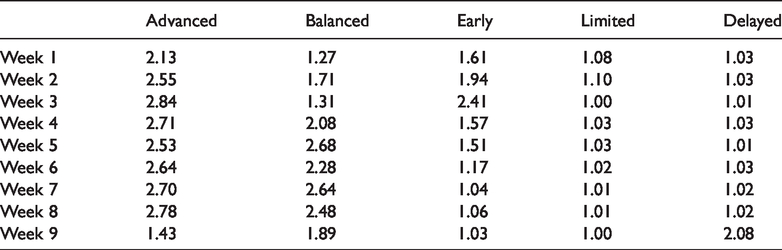
Applying k-means to this sequence of nine values (week 1–week 9) revealed five distinct prototypical participation patterns (silhouette score of 0.60). These clusters are labeled as “Advanced,” “Balanced,” “Early,” “Limited,” and “Delayed” participation and are presented in Table 2 and visualized in Figure 2. We chose these labels to broadly represent the observed level of participation under each cluster. Table 1 shows the mean values of the participation levels for each cluster across the whole eight weeks of the course and week 9 (participation after the course ended).
Participation patterns across weeks.
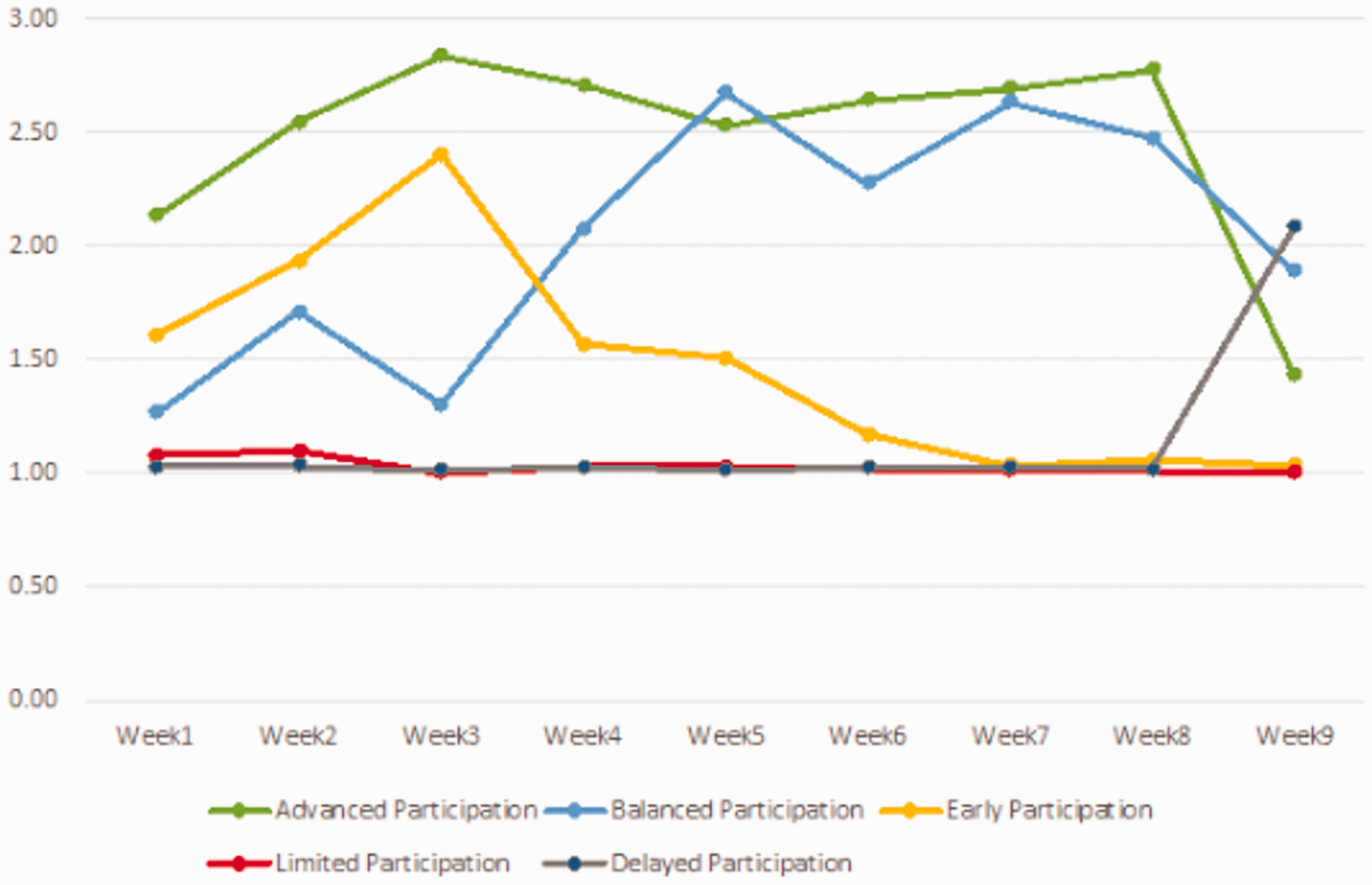
Visualization of participation patterns across the different weeks of the course.
Advanced Participation
Presented by the green line in Figure 2, this cluster characterizes learners who were highly active across the eight weeks of the course. They are the most committed toward the observed course activities including accessing video lectures, submitting quizzes, and participating in the discussion forums throughout the course. Notably, their level of participation is nearly stable across the different weeks with a slight decrease around week 1 and a high drop in activity after the class ended (week 9), both of which are expected. Indeed, week 1 marks the beginning of the course and usually in any course learners spend a considerable time for the first few days to orient themselves with the syllabus and the course content before committing to the assignments. On the other side, week 9 marks any observed activities after the course is over and since learners in this cluster participated throughout the eight weeks of the course they did not need to participate once the course was over. In general, participation in this cluster resembles that of most learners in traditional university classes, where learners follow the predetermined objective set by the instructor. It composes 5.4% out of all learners included in our analysis.
Balanced Participation
This cluster, shown in blue line in Figure 2, represents an unexpected participation pattern that emerged from data analysis. Interestingly, the overall level of participation in this cluster increases and decreases in a systematic way almost every other week. Learners in this cluster seem to balance their learning behavior across time. In particular, they started with a low participation level in week 1 and then their participation rate increased in week 2. As learners moved to week 3, their participation level dropped again and then it started to rise sharply in week 4 and week 5. Similarly, in week 6 the level of participation went down and then it went up again in week 7. Toward the end of the course, there is a slight decrease in week 8 and then a larger one in week 9 after the course is over. Although the participation level in this cluster increases and decreases almost every week, the range of participation in the first three weeks of the course was considerably lower than the range of participation in the other weeks. This cluster is the smallest one as it only represents 4.4% of all learners included in our analysis.
Early Participation
This cluster, the yellow line in Figure 2, includes learners whose overall level of participation was high early in the course, but gradually decreased as the course progressed. Learners in this cluster seemed to be committed to the course activities more than the learners in the Balanced Participation cluster at the beginning of the course and reached their highest peak of participation around week 3. However, their participation dropped sharply around week 4 and continued decreasing until it reached the lowest level in week 7. This cluster contains 7.4% of all learners included in our analysis.
Limited Participation
Presented by the red line in Figure 2, this cluster includes learners who are less active in the observed course activities in contrast with the other clusters. Those learners have limited participations in terms of accessing video lectures, submitting quizzes, and participating in the forums across the whole eight weeks of the course and after the course is over. Participation in the first two weeks of the class is slightly higher than for the remaining weeks; however, it is lower than most other clusters. The majority (76.81%) of learners included in our analysis are associated with this cluster.
Delayed Participation
In this last cluster, learners highly participate in the course after it is finished (see the gray line in Figure 2). For the eight weeks of the course, learners have similar learning behavior as others in the “Limited” participation cluster with low activity. However, their participation sharply goes up after the course is over (i.e. in week 9). The type of observed activities in week 9 for this cluster is mainly focused on accessing many videos lectures; probably, for later use. This cluster constitutes 6% of all learners included in our analysis.
Why learners follow a certain pattern of behavior?
In order to better understand not only how, but also why learners participate in the course following different patterns, we investigated different factors of motivations and barriers found in the open-ended questions in pre- and post-course surveys.
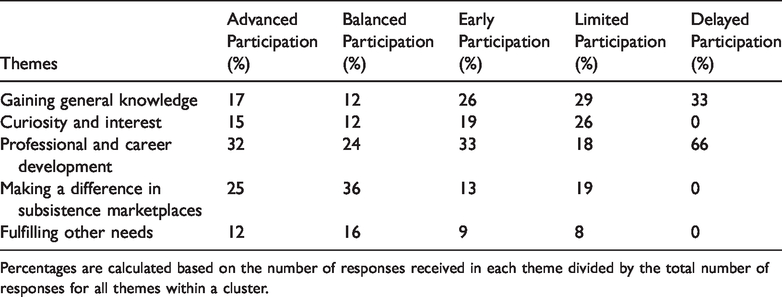
In the pre-course survey, we had a total of 358 responses to the open-ended question “what are your reasons for taking this course and what do you hope to get out of it?”. Out of those responses, 60 were clustered in the “Advanced Participation,” 25 in the “Balanced Participation,” 64 in the “Early Participation,” 206 in the “Limited Participation,” and 3 in the “Delayed Participation” pattern. Responses related to the learners’ motivation were coded qualitatively across five common emerging themes (see Table 3).
Percentages of motivations across the different patterns of participation.
Percentages are calculated based on the number of responses received in each theme divided by the total number of responses for all themes within a cluster.
Due to the attrition of participation in the course (Kizilcec and Halawa, 2015) a lower number of learners completed the post-test survey, with only 85 responses to the post-course survey question “what were the factors that limited the extent to which you took advantage of this Coursera opportunity?”. Among these responses, 43 were in the “Advanced Participation,” 19 in the “Balanced Participation,” 9 in the “Early Participation,” and 14 in the “Overview Participation” clusters. No responses were in the “Delayed Participation” cluster relevant to learning barriers and, as such, it was excluded from the data analysis. The limiting factors emerging from this question were qualitatively coded across eight themes (see Table 4).
Percentages of limiting factors across the different patterns of participation.
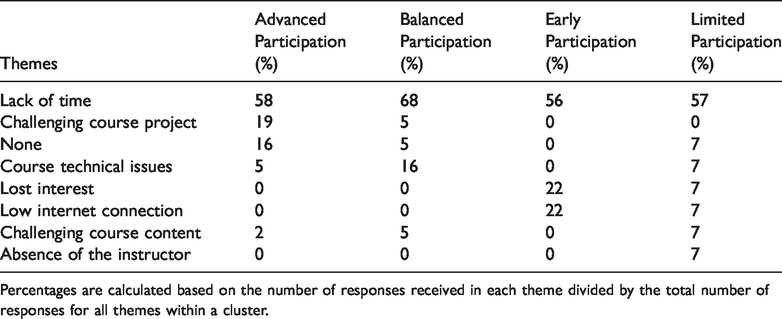
Percentages are calculated based on the number of responses received in each theme divided by the total number of responses for all themes within a cluster.
Motivations
While we observe an overlap between the different motivating factors among the different clusters, participants in the advanced and balanced clusters were mainly motivated by clear learning goals (see Tables 3 and 4). Their most common motivating factors were related to work, either to enhance current profession skills or prepare for future career. In addition, learners in those clusters intended to make wise use of the course content, by applying it to a larger context to make a difference in subsistence marketplaces nationally and globally. For example, a survey respondent stated: I want to understand this subsistence marketplace … [The] majority of people where I live in India are poor and they will qualify for this marketplace, and as a professional in the field of marketing, I would like to understand this market through different perspective to help them. This course can help me to address the challenges and opportunities available in this market.
Advanced learners were also less often motivated to participate in the course just to gain general knowledge and for curiosity purposes. On the other hand, those factors were more often provided by learners in the Limited Participation cluster. Almost one-third (29%) of the learners in this cluster were coded as mentioning an extrinsic motivating factor to gain general knowledge of the course. One of the respondents said: “Some basic understanding. Not much hopes.” Curiosity and interest was their second most common motivating factor, more than one-fourth (26%) of the learners reported that they were curious toward learning about the subject. For instance, one student stated: “I hope it is fun and interesting, or else I won’t finish it.” Those more general motivations might explain why these learners were more likely to follow a limited learning path.
In the Early Participation cluster, we observed a mix of common motivating factors that included both concrete and more general motivating factors. Almost 33% of learners in this cluster were motivated to engage in the course for career and professional development purposes, followed by gaining general knowledge (26%) and then curiosity goals (19%). Little is known about learners’ motivating factors in the delayed cluster because of the low response rate found in the data collection. Only three responses were reported, two of them appeared under the professional and career development category, while the last one appeared in the gaining general knowledge theme.
Although these were the most common themes for motivation, learners mentioned other factors to fulfill other needs, such as experiencing online education and MOOCs, improving English language, exploring learning in a high-ranking university, and earning a certificate.
Barriers
Findings show that there are numerous factors that affect learner’s engagement and participation in the courses; however, the most common theme among all the clusters was lack of time. The highest percentage of time concern was found in the balanced cluster as 68% of learners were challenged to participate in the course due to that barrier. The rest of the other clusters were influenced with time concern at similar rates: 58% for the Advanced Participation cluster, 57% percent for Limited Participation, and 56% percent for Early Participation. Although the appearance of this limiting factor was common among all clusters, students described their time concern differently across the different clusters. In the advanced level of participation, learners provided more detailed responses as to how time affected their participation, while less active participants were not clear enough in their responses. Advanced learners referred to time concern as not being able to take full advantage of the course and contribute to the optional activities, rather than the required ones. More specifically, they meant not being active in the forums and/or completing the final project, as both were optional. In this regard, one of the survey respondents stated: “because of my other overlapping work duties and obligations, I couldn’t fully take advantage of forum assignments and participate in discussion forums.” Another one added “since it was optional and only for extra credit, I stopped engaging with the forums.” Others chose to skip the final project because of lack of time: I did not have enough spare time to dedicate to the course. For this reason, I was able to watch all the videos, to read the readings and to take all the quizzes but I did not have time to do the projects for extra-credit.
In addition to the lack of time, there were other factors that limited student’s participation in the course, such as the course project and content being challenging, technical issues, losing interest, and low internet connection. Interestingly, losing interest and low internet connection themes were widely prevalent in the Early Participation cluster. Almost 20% of learners in this cluster indicated these limiting factors as equally likely to affect their participation in the course. Commenting on losing interest, this participant stated, “After the simulation on Spent.org I became really excited about the course, but then all the assignments were not interesting.” In regard to slow connection, one learner said “I find myself in Malawi (a genuine 3rd world country). Everyone here is a subsistence farmer … Internet here is much too slow to watch videos. So, I stopped participating in this class.” These findings could help us understand as to why these learners were highly motivated early in the course, and then their participation dropped out throughout the weeks.
Discussion
Learning beyond the norm
Our study was designed under the assumption that different learners require different scaffolding to master their learning needs. Real change in education happens with the recognition of learners’ differences, especially in massive scale learning environments where students come from different backgrounds in relation to work commitment, language, academic and intellectual level, and other related differences. As expected, we found that MOOC learners do not follow only one path of learning, which is how the courses have been structured in a linear traditional model designed for average learners (Clark, 2016; Ubell, 2017). Instead, MOOCs operate in a unique and distinguished way of varied levels of participation which is not explicitly reflected in the course structure or the platform design. We found that learning in this MOOC has followed five different patterns of participation associated with learners’ educational needs and time availability beyond the averaged learning. Only one of these patterns may fit within the archetype of regular courses at traditional settings that are taught for average learners, which is the Advanced Participation pattern. Learners in this cluster progress in the course according to the course goals set by the instructor in the syllabus.
Beyond that, four other clusters emerged in the data analysis representing new ways of learning at scale. One of the most interesting learning paths we found was the “Balanced” participation cluster, where learners balance their learning in a two-week period. These learners have shown clear goals to engage in the course, but appear to be juggling between other responsibilities; this requires a need for developing instructional accommodations and adaptive features to deepening their learning. One method is to design a differentiated learning module by allowing more time to do the required activities, instead of limiting students to week-by-week time frame. Another interesting pattern found in the data analysis is the Delayed Participation cluster, where learners do the work after the course is over. Little is known about this cluster, as they were less likely to answer the pre and post surveys; however, it raises a question for further investigations about how to reach out to these students early on, how to help them make the best out of their learning experience. The Early Participation cluster constitutes a third way for learners to engage in a large scale environment that may require an attention. As seen earlier, in this cluster, learners’ participation level drops down gradually throughout the course. However, the qualitative analysis of the study has shown this learning behavior could be due to personal limiting factors, such as time availability, loss of interests, and poor internet connection. Since some of these learners indicated their intention for gaining general knowledge, a new intervention could be integrated in the system to allow for multiple learning paths, for example, by offering a different set of material for students who would like to simply acquire a surface level understanding of the topic compared to students with more advanced learning goals that would be completing a more standard set of activities. This proposed intervention can target learners across the different levels of participation to help them achieve their intended learning goals.
These findings of having multiple learning behaviors align with Kizilcec et al.’s (2013) study. Their study reported four different patterns of participation that are similar to the ones found in this dissertation, but not the learning behavior found in Balanced Participation cluster. These variations should be acknowledged in the MOOC design to offer flexibility to support different learners. This study aims to expand learning beyond the average dominator and create several other options and multiple learning paths to accommodate differences. In particular, pedagogy at scale needs to be reshaped to tackle these differences in the learning process and course design to be reflexive and adaptable.
Learning with time limitations
Often times, different learners have different goals and learn at a different pace that fit within their time frame. Time is a crucial element for active engagement in any educational context and most importantly in online settings where there is a limited face-to-face communication. In this study, we found that lack of time is the most influential factor to limit learners’ participation across the different participation patterns. The findings came as no surprise for learners in the “Limited” cluster as they did not accomplish much of the required work for the course and their goal was simply to gain general knowledge.
However, it was surprising to observe how time was still considered the most common limiting factor for learners in the “Advanced” and “Balanced” participation clusters. Although they reported time constraints as frequently as others in different clusters, they differed in their interpretations along those dimensions. Most of these learners provided explicit answers of how time influenced their participation in the surveys. They spoke about their obligations and responsibilities toward family, work, studies, and other priorities in their life that caused their time limitations. One of the learners said: “I am working and studying at the same time. This course was additional activity and I wasn’t able to devote high amount of time working on it.” Another one added: “Deadlines were a little bit tight for me. I was ill for 2 weeks and couldn’t catch up, … I wasn’t able to participate much in the forums and gain extra credits because I didn’t have enough time.” Thus, they stayed active in the course by choosing to do the required activities and skipping some of the optional ones, such as forum participation and final projects.
In contrast, learners in the “Early Participation” and the “Limited Participation” clusters did not provide much information on how time affected their participation; their answers were short and more general. It appears that they were not ready for the time demands of taking this course. Perhaps this is why some learners started very active and then slowed down, why others did not participate as much and why others only participated toward the end.
The prevalence of time concern confirms the findings of other studies. For instance, Kizilcec and Halawa (2015) found that “the primary obstacle for most learners was finding a time” (57) to participate in the course. Similarly, Shapiro et al. (2017) indicated that MOOC learners are restricted with their time availability due to family and work commitments. However, none of these found a variations of time concern factor among different learners in different groups as we found in our study. Thus, time needs to be taken into consideration when planning for future MOOCs. A new design of MOOCs should reflect on these concerns and develop different engagement levels at a different pace and tailored to the preferences and interests of various learners, as well as instruction that is paced to a student’s unique needs. One suggestion, similar to one proposed earlier, would be to integrate multiple learning tracks each offering a variety of learning goals and requiring different time commitment to complete the course in order to match the learners’ availability and needs. For instance, the course could be designed to have three levels of participation as follows: Advanced, Intermediate, and Basic track with a wide range of required activities and time demands.
Participation for the public good
What was really important to highlight is the fact that most of the survey respondents indicated hopes to learn how to succeed in the workforce and most importantly how to contribute to the production of the public good. Qualitative data analysis from the survey has shown those learners were not necessarily motivated in pursuit of formal credentials or to gain a certificate although there were three of them who had. Instead, the majority of learners participated in this MOOC because they sought experiences and insights that would help them in their professional lives and making a positive change in the subsistence marketplaces nationally and globally. This was mainly observed in the “Advanced” and “Balanced” participation clusters which had the most active learners. Learners who were less active in the course as seen in the “Limited Participation” cluster were mostly motivated to have an overview of the course content and satisfy their curiosity and interests. These hopes were in line with the course’s focus to improve business practices in underserved areas.
Indeed, the content of this course was one of its kinds as it dealt with strategies and techniques in how to improve the dynamics of subsistence markets in poor areas and cope with related challenging issues. The instructor presented some case studies from India to show successful examples of how subsistence markets work regardless of the complexity of people’s life. This drew an attention to thousands of learners who seek knowledge of social improvement to apply it in their current career or future plans of starting NGO organizations and small enterprises to reduce poverty. Poverty is one of the big problems of the global world especially in underdeveloped countries and bringing this subject through MOOCs is very well-positioned to encourage motivated learners to enhance the global market. For instance, one of the learners was interested to produce a subsistence market for prison inmates and homeless people who live in the street looking for any opportunity. He said: “I am interested in the subsistence markets of prison inmates, homeless people and street people in the U.S.” Another learner from Malaysia had a passion to help poor people in his area to have a better life through business, where people couldn’t even afford to have the minimum life needs of electricity, running water, and a decent sanitation. He commented: It has always been one of my passion to work with people who live in the rural areas of my country, who couldn’t even afford to get electricity and running water, or decent sanitation. I believe that this course will be able to provide me with the knowledge and insight I could not get from classes or textbooks, and equip me better to serve the people of my country.
While planning for additional courses in this area, we should take into consideration the learning barriers of learners in developing countries such as the low internet connection. Perhaps we could adapt the course’s design to be more flexible and accessible in terms of the learning materials, such as adding handouts, video transcript files, PPTs, etc.
Conclusion
By clustering learners’ participation in quizzes, forums, and video lectures using educational data mining techniques and analyzing the qualitative data of the surveys, our study reported significant insights about learners’ participation at massive scale. It revealed five unique patterns of participation as follows: Advanced, Balanced, Early, Limited, and Delayed clusters. Across the five different clusters, learners reported similar factors of motivations and barriers, but these factors vary in terms of its impact on different learners. For instance, the factor of time concern seems to be the most frequent barrier to affect learner participation, how these effects vary between those who are in the advanced clusters (Advanced and Balanced) and those in the less-advanced cluster (Limited and Early).
It is important to mention that the study has some limitations. One of these limitations is the inclusion of only one course, within a specific field that was taught in Coursera platform. It was also limited by the small number of respondents to the open-ended questions in the pre- and post-course surveys. Despite these limitations, our study makes a significant contribution to the MOOC literature by providing insights of how and why learners learn in MOOCs. It suggests rethinking the MOOC design from the differentiated learning approach and employing multiple paths of learning to accommodate learners’ needs and time availability. Future research will further contribute to the field of online education by investigating engagement patterns in different MOOC platforms and using the insights obtained through this work to guide the development of interventions to promote success for all learners in massive scale learning environments. In particular, we are interested in expanding the research presented in this paper by replicating our work with additional MOOC courses across different disciplines. Doing so will provide us with more information about whether the patterns identified within our study can be generalized across MOOCs. We are also interested in doing a comparative study between learners’ participation in Coursera and other MOOC platforms, such as EdX. This will help us to understand how different platforms support learners’ needs.
Footnotes
Declaration of Conflicting Interests
The author(s) declared no potential conflicts of interest with respect to the research, authorship, and/or publication of this article.
Funding
The author(s) received no financial support for the research, authorship, and/or publication of this article.
