



Abstract
Imperatives to connect the worlds of home and school, evident in global policies of family engagement and partnership initiatives between teachers and parents to support children’s education are viewed as key dimensions of academic success. However, developing ways to meaningfully connect and engage teachers, parents and students in learning ecologies remains elusive, contested and increasingly complex in the digital age. Teachers are encouraged to draw on their students’ digital ‘funds of knowledge’ to create innovative learning opportunities and develop capacities for creativity and critical thinking. Despite significant research into creativity pedagogies and the inclusion of parents in policy documents urging for increased innovation in schooling, which often implies the use of digital technologies, parents are largely invisible in research into creative pedagogies. The data explored in this article are drawn from a larger project which adopted a teacher-as-inquirer approach to investigate teacher, student and parent experiences and understandings of innovative teaching designed to integrate creative and critical thinking with digital literacy practices. The analysis mobilises the key features of creative and innovative learning environments identified in the research literature to explore teachers’ initiatives to develop reflexive and innovative pedagogies and foregrounds the ways in which incorporation of digital media impacted on parental engagement in their children’s learning. Findings highlight significant challenges for schools and teachers to meaningfully and sustainably connect home and school learning which positions children, teachers and parents as agentic and creative.
Keywords
Introduction: Parents and schooling in the digital age
Imperatives to connect the worlds of home and school, evident in global policies of family engagement and partnership initiatives between teachers and parents to support children’s education are viewed as key dimensions of academic success (Bocconi et al., 2012; Cachia et al., 2010). Yet, the movement from parental involvement in schooling to the engagement of families in learning has been identified as one of the major challenges for the teaching profession (Daniel et al., 2016; Goodall and Montgomery, 2014; MetLife Survey of the American Teacher, 2012). Developing ways to meaningfully connect and engage teachers, parents and students in learning ecologies (Barron, 2006) remains elusive, contested and increasingly complex in the digital age. Central to this challenge is the development of shared understandings of the multiple purposes and modes of communication between teachers, parents and students, encompassing the support and enhancement of learning, feedback on learning and assessment and exchanging information about school and family ways of knowing. Teachers are encouraged to draw on their students’ digital ‘funds of knowledge’ to create innovative learning opportunities and develop capacities for creativity and critical thinking (Coiro et al., 2008; González et al., 2005; Thurlings et al., 2015; Walsh, 2011). However, the nature of initiatives to connect home and school knowledges is the focus of extensive research and critique (Blackmore and Hutchison, 2010; Castro et al., 2015; Fox and Olsen, 2014; Povey et al., 2016; Sefton-Green and Erstad, 2017; Selwyn et al., 2018).
Access to and engagement with technologies across diverse home and school settings is situated, shaped by ever changing social, cultural, economic and political contingencies (Selwyn et al., 2018). Digital technologies may be perceived simultaneously as solution to and source of enduring educational challenges, capable of promoting innovative multimodal literacy practices and personalising learning (Pandya, 2018) and engendering endless digital distractions through social media and ubiquitous screens (Kuznekoff et al., 2015). In school communities, parent and teacher perceptions of the role of digital technologies in schooling are contested, with some advocating for more sophisticated understandings and creative engagements and others concerned by the potential for distraction, overuse and exposure to danger and risk (Barry et al., 2017; Gillis, 2006; Livingston and Sefton Green, 2016). Teachers express ambivalence about the place of ICTs in education, experiencing teaching and administrative work with technology as ‘… both liberating and exploitative, democratizing and disempowering’ (Selwyn et al., 2017: 403), and contributing to the intensification of the labour of teaching. The intensification of teachers’ work and effects of performativity on teaching have been well documented (Ball, 2003; Gerrard and Farrell, 2014; Jeffrey, 2006; Selwyn et al., 2017; Singh, 2015; Troman et al., 2007). Australian teachers, for example, describe increasing administrative demands to meet compliance standards, with digital technologies generating additional tasks for teachers, such as continuous, repetitive and superficial reporting to parents which fails to engage with deep learning (McGrath-Champ et al., 2018).
Educational policies and curriculum documents foreground the development of 21st century skills, such as critical and creative thinking, capacities for collaboration, communication and innovation with information and communications technologies (Australian Curriculum Assessment and Reporting Authority (ACARA), 2012). Despite significant research into creativity pedagogies (Craft, 2011, 2012; Craft et al., 2014; Hall and Thomson, 2017; Thomson and Sefton-Green, 2010) and the inclusion of parents in policy documents urging for increased innovation in schooling (Cachia et al., 2010) which often implies the use of digital technologies, parents are largely invisible in research into creative pedagogies. The relatively small number of empirical studies into the ‘relatively “soft” and hard to define area of creativity and education’ identified in a systematic review of research into creative learning environments (Davies et al., 2013: 89) demonstrates a need for further research in the area, particularly participatory studies in which the voices of teachers, students and parents are present. While the establishing of home–school links is identified as enhancing the conditions of possibility within which innovative teaching might occur, there is little research into the ways in which teachers, parents and children view and participate in innovative teaching and learning opportunities.
Research into innovative teaching points to the complexities of teachers’ efforts to innovate within cultures and policies of performativity, such as high stakes testing, international achievement rankings and increasingly contractual employment (Craft et al., 2014; Jeffrey, 2006; Troman et al., 2007). Teachers may experience discontinuities between the emphasis on creativity, innovation and critical thinking in curriculum frameworks and the demands of standardised, competitive assessment practices (Kostogriz and Doecke, 2011). Factors inhibiting creative pedagogies identified in the research literature include the pressures of performativity, limited time, constant curriculum reform and assessment and access to meaningful and sustained professional learning (Craft et al., 2014; Davies, 2006). Teachers’ preconceptions about the nature of creativity and doubts about their own capacity to teach creatively have also been noted as barriers to creative pedagogies (Cremin et al., 2006) with this perception more evident in older teachers, who were perceived to be less willing to experiment than their early career colleagues (Harris and de Bruin, 2018). Lack of time for collaboration to exchange ideas and plan deep approaches to the cultivation of creative and critical classroom learning activities and scepticism on the part of parents and students about the value of critical and creative thinking in terms of academic success have been identified as barriers to teaching for creative and critical thinking in secondary schools (Harris and de Bruin, 2018).
If innovative teaching and learning are to occur, it is essential that teachers are clear on what creativity means to them and also which teaching practices encourage and support creativity (Cheung, 2012). Studies of creative teaching and learning have consistently identified a range of key characteristics of creative and innovative learning environments:
Flexibility and plurality: provision of a wide range of resources and spaces with possibilities to work beyond the classroom, access to and experimentation with new media or technologies; provision of relevant pedagogies; open ended, iterative planning (Addison et al., 2010; Craft, 2011, 2012; Craft et al., 2014; Davies, 2011; Davies et al., 2013; Jeffrey, 2006; Sharp et al., 2008; Troman and Jeffrey, 2010). Foregrounding agency: authentic tasks, children given control and supported to take risks; teachers balancing structure and freedom; challenge based or open-ended learning, mutually respectful and supportive relationships with teachers; regular dialogue with teachers, peers, parents (Craft, 2012; Cremin et al., 2006; Davies et al., 2013; Hall, 2010). Collaboration: involvement of parents in planning and resourcing; low adult to child ratio collaborative learning with peers; high teacher expectations, co-construction between and with children; adaptation to individual learning needs (Davies et al., 2013; Gandini et al., 2005).
These characteristics of creative learning environments emerge from a range of studies, with digital media implicit as 21st century resource. However, not all studies reviewed included explicit discussion of new technologies or their contribution to creative and innovative teaching. In Table 1, the alignment between the characteristics of creative and innovative learning environments identified in the literature with the seven e-learning affordances of digital media and their corresponding reflexive pedagogical features are represented. These ‘e-learning ecologies’ or ‘7 affordances’ are ‘ubiquitous learning, active knowledge production, multimodal knowledge representations (multimodal meaning making), recursive feedback, collaborative intelligence, differentiated learning, metacognitive reflection (metacognition), and differentiated learning’ (Cope and Kalantzis, 2017: 13–14).
Creative and innovative learning environments, e-learning affordances and reflexive pedagogies.
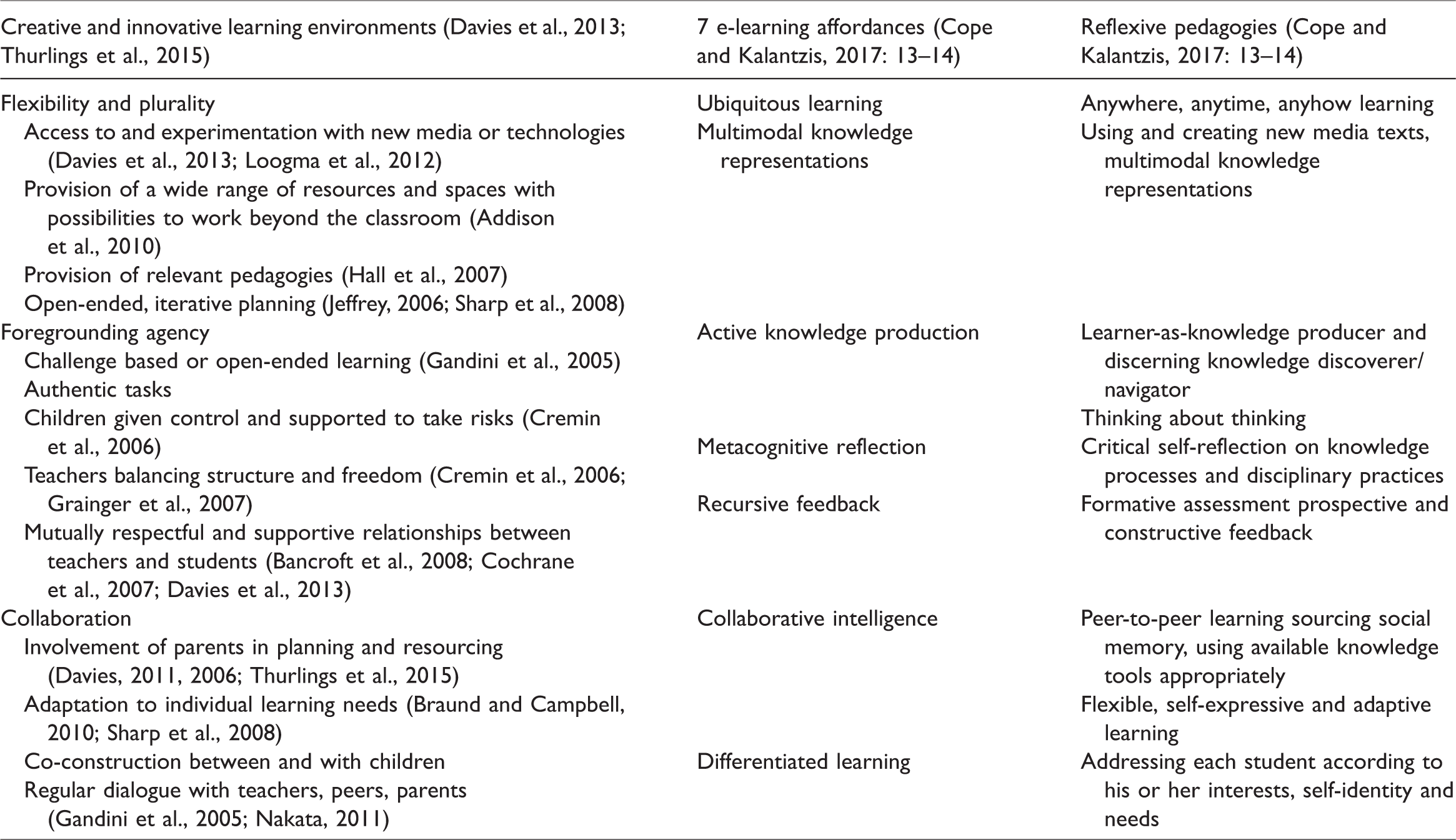
The analysis in this article mobilises the combined lenses of the key features of creative and innovative learning environments identified in the research literature synthesised above and the 7 e-learning affordances to explore teachers’ initiatives to develop reflexive and innovative pedagogies. Additionally, the pedagogies were designed to also promote parental engagement in their children’s learning within digital environments. Through analysis of teachers’ pedagogies and practices intended to foster creative technology infused learning, we identify barriers to and enablers of meaningful engagement of parents encountered by teachers and parents during the course of these explorations.
Research context, design and methodology
The data explored in this article are drawn from a larger project which explored research undertaken by teams of school-based teachers and university researchers in response to challenges within the Australian Curriculum to plan, implement and assess learning experiences for students at the intersection of the learning area English; the general capabilities of Literacy, Information and Communication Technologies (ICT), and Critical and Creative Thinking; and connecting home and school learning. The research project, located within a professional learning programme supported by Catholic Education Melbourne (CEM) staff, adopted a teacher-as-inquirer approach (Cochran-Smith and Lytle, 2009) to investigate teacher, student and parent experiences and understandings of innovative teaching designed to integrate creative and critical thinking with digital literacy practices. The study included an investigation into ways of involving parents in their children’s learning within digital environments. Teams of middle years teachers from nine schools participated in professional learning, school visits from the researchers to support action research projects and a teacher research showcase. School teams collaboratively developed research questions addressing a school-based literacy-related issue or interest area and undertook cycles of participatory action research addressing the selected issue or interest area. The professional learning was supported by opportunities for ongoing reflection, documentation and reporting on project implementation with colleagues within and across schools.
Case studies were conducted in three schools, using elements of classroom ethnography and practitioner research in literacy, with participant observations by the researchers over two years, following literacy research methods developed in Australian and international studies of digital and home–school literacy practices (Cochran-Smith and Lytle, 2009; Comber and Kamler, 2005; Heath and Street, 2008; Rowsell, 2013). The case studies included perspectives from three teachers, their principals and literacy leaders, together with six students from each literacy/English class and the parents of these students. Over the course of the data collection period, the researchers observed teachers during classroom teaching, working in their school teams in professional learning and planning environments, took visual and written field notes and engaged in a series of audio recorded and transcribed interviews with teachers, principals, literacy leaders, students and parents.
This article reports on investigation of the following research question: ‘How might literacy learning that integrates creativity, critical thinking and ICT be enabled across home and school?’.
In the two classroom case studies that follow, drawing on observations and interview data, we highlight the barriers and enablers experienced by teachers aiming to integrate creativity, critical thinking with digital literacy practices which meaningfully involve parents. We focus on the ways in which teachers redesigned their teaching practices to integrate creative and critical thinking with digital technologies and foster parental engagement in their children’s literacy learning. We explore the perceptions of teachers, parents and children as they respond to the demands of the redesigned tasks. Our analysis foregrounds the ways in which the incorporation of digital media impacted on the engagement of parents in their children’s learning.
Case study 1: Blogging with parents
Jacqui (Pseudonym) is an experienced teacher at a small primary school in an outer urban suburb of Melbourne, attended by children predominantly from socio-economically advantaged Anglo-Celtic families. Aware that the year 5/6 students were adept at using technologies to socialise, Jacqui and her colleagues were eager to develop opportunities for students and parents to collaborate in online environments to enhance learning. Using inquiry pedagogy, Jacqui developed a sequence of units designed to develop students’ research capacities through individual projects and requiring them to represent their understandings through creating a range of multimodal texts: models of processes involved in causing natural disasters, filmed advertisements for innovative products to be sold at the school fair and plays which were filmed and acted as part of a Parent Showcase. Since many of her 11- and 12-year-old students were enthusiastic users of social media, Jacqui and her teaching team introduced class blogs as a forum for teachers, students and parents to share, reflect on and assess the children’s learning. Jacqui was interested to explore how various forms of online collaboration might enhance student and teacher learning in and beyond the classroom, and facilitate communication between children, parents and teachers. Students were introduced to protocols for critiquing their classmates’ work on the blog, with teachers modelling how to offer constructive feedback and students practicing how to provide their peers with useful online critique.
However, online collaboration between children and parents proved to be more challenging than anticipated. Teachers assumed parental knowledge about the new literacy practice of blogging, which most parents had no experience of. They expressed a desire for instruction on how to communicate appropriately on the class blog: ‘It’s challenging for us, because we’re the ones that need to change our approach. It’s a new skill, trying to learn to blog as a way of communicating’ (Michelle, Parent).
Parents appreciated this ability to connect with their children’s learning and extend their digital literacies, but were sensitive to the children’s desire for autonomy and agency: Being connected to the learning is really important, not being in control or it because they’re [children) in control and the teachers are guiding them, but connected to it, so you can then engage with it however you want to. (Rebecca, Parent)
Some parents expressed ambivalence about their participation on the blog and were reluctant to assume teacher-like roles, such as commenting critically on students’ ideas or offering formative feedback on work. They were at times unclear about the intended purposes of the blog, with purposes and expectations not clearly articulated by teachers and children. Parents were conscious that the digital environment required them to interact in new ways with their children’s learning: There’s so many possible purposes for the blogs and we’re not really clear yet on what they are. Like there’s sharing work, but there’s sharing work with peers and with parents, and they’re two different purposes. Then there’s reminding and asking for information or things, reflecting on how they went or how they could do it better; and then critiquing other people, and at the moment it’s all kind of blending in. (Annie, Parent) I have three different sections of the house calling out “Mum, Mum, Mum” and I … … . She’s got heaps of work to do. Mum’s looking after my younger brother all the time, and doing all the washing and all that so yeah, mum does all the housework. She’s too busy and by the end of the day, she’s too tired to talk and she just wants to get dinner finished and sit down and get us to bed so she can have some quiet time. (Tom, 11 years old)
Case study 2: Connecting parents through Instagram
Georgia (Pseudonym) was a graduate teacher at a small Melbourne primary school in the inner north, with a culturally diverse population of Anglo-Celtic, Italian and Greek socio-economically advantaged families. The school environment was characterised by bright, spacious classrooms and offered a range of specialist subjects including Performing Arts, Italian and Visual Arts. Georgia was a member of the year 5/6 team of experienced teachers, who engaged in inquiry-based teaching and learning. Influenced by a range of assessment information into students’ oral and written language, the team identified the need to develop students’ oracy and literacy through multimodal engagements, drawing on parents as resources for learning. They designed an inquiry into ‘The Senses’ which focused on experiential learning through music, art and the creation of music video; a novel response with themes identified and represented multimodally using Photostory; and a comparative analysis of a graphic novel and a film exploring the interplay between linguistic, visual and audio modes and the representation of gender roles across the two texts. Parents were invited to collaborate with and resource their children’s learning, throughout the inquiry cycles.
The first task involved parents and children in selecting and listening to instrumental music with the aim of generating descriptive vocabulary to articulate the emotional qualities it evoked. Using digital platforms, they searched for music and watched YouTube clips together to locate favourite music that interested both parents and children, sometimes movie soundtracks or television commercials. Students brought the music to school via a link, USB or CD and wrote about their experience of it, building on the expressive vocabulary they shared in the conversation at home. Parents were largely positive about this task, and enjoyed the opportunity to introduce their children to music they loved. Parents observed that although this kind of homework was not typical, it led to interesting conversations that were unlike routine homework tasks: I haven’t had the opportunity to talk to my children that much about my experience of learning an instrument. I played the violin in an orchestra, so, it was an interesting opportunity for me to talk to my daughter about something that was important to me, that she didn’t really know about. Homework is a chore that sometimes I see the point of it, sometimes I don’t (laughs). Anything that gets kids to talk to their parents about what they’re doing in the crazy, busy age …… asking them, ‘What do you think about that?’ is quite a nice homework task. (Frances, Parent) I need to have time available because most of it’s [homework] talking about things driving to and from the gym in the car. So we talk a lot, but I actively have to make that time now …. perhaps while we’re driving, or while I’m making dinner.
This regular, informal image sharing was viewed as a catalyst for conversations between parents, children and teachers, rather than a demand for prescribed parental involvement in homework. Instagram also provided a window into other teachers’ classrooms, stimulating informal sharing of ideas and professional learning. Many teachers followed other classes enthusiastically: ‘I find it amazing. I look at it regularly, so I can see what’s going on in all classes’ (Literacy Leader).
Other staff expressed fear of this new mode of sharing information with colleagues and parents and the potential risks of social media: ‘I’m just petrified. I’ll end up communicating with someone I shouldn’t be and I’ll be in trouble’ (Senior Teacher).
The rapid integration of this social media platform into teachers’ daily practices prompted discussion within the school about the purposes for school wide use of Instagram and the development of protocols for protecting privacy and determining the age limits and degree of children’s independent use of Instagram. Diverse views of the purpose and impact of Instagram were expressed within the community, with many parents enthusiastic about the easy access to the life of the classroom: I’ve found Instagram really helpful … . I’ll just check in while I’m having lunch and teachers will post things that children have drawn or created on the interactive white board. Then at dinner, I’ll say: ‘So how was your day today?’ ‘Alright’. ‘What did you do?’ ‘Not much.’ ‘Really? So did you do anything in maths?’ ‘Sort of.’ ‘Like what?’ ….
Some parents viewed Instagram as ‘just another thing I have to learn’, while others dismissed scepticism about its purpose: There’s been criticism like, ‘Oh shouldn’t they be focussing on teaching the kids instead of taking photos of them?’ I’ve had to say ‘Actually, there is value in it’. Many of the photos are not of the children, but of the work, to show what they’ve done. The kids are engaged and happy, they’re laughing, it’s really important that you can see whatever it is that they’re doing, they’re enjoying it. It [ICT] has enhanced the way we communicate with parents as well. Like with Instagram and everything, that’s just a new way that we couldn’t do without ICT, so it creates more opportunities to have the home school connections … . (Georgia, Teacher)
Engaging parents in children’s learning: Multimodality and creativity
The case studies reveal how, together with their colleagues, Jacqui and Georgia redesigned their teaching practices to integrate creative and critical thinking, ICT and foster parental engagement in their children’s literacy learning. The physical environments at both schools included flexible learning spaces and digital resources and offered opportunities for children to experiment with new technologies and engage in ubiquitous learning within and beyond the classroom. Parents of Jacqui’s students were initially intentionally involved as resources for learning, in planning and collaborating with their children both through conversation and on the class blog, demonstrating the potential for collaborative intelligence that may be facilitated via new technologies. Although parents expressed a need for further clarity around their role in supporting their children’s learning and requested further training in the new media skill of blogging, they developed insights into their children’s learning through this more intensive form of engagement.
This case study also highlights some of the barriers to engaging parents in digital learning environments, when this requires learning new skills or relies on sets of digital capital that are not equally accessible to parents, teachers and children. Teachers were unaware of parental levels of familiarity with blogging and in retrospect identified a need for parent workshops on digital literacies and online protocols. The sustainability of parental engagement in their children’s learning at home which requires explicit instruction by teachers and the co-operation of children appears unlikely. In this example ubiquitous learning, while evident in the inquiry-based pedagogies, was more enthusiastically experienced in the affinity spaces of Minecraft and YouTube, where children were engaged in using, creating and sharing their multimodal knowledge with their peers.
Georgia and her colleagues similarly drew on family funds of knowledge (González et al., 2005), in inviting parents to resource and participate in expanding their children’s capacities for creative expression. The reported discussions between parents and children of favourite music and class novels were experienced as pleasurable by parents, and represented an opportunity for children to engage in ubiquitous learning beyond the classroom which informed their multimedia responses. Teachers reported that children’s responses included more sophisticated vocabulary and reflected deeper engagement with the themes of the literature circles. Georgia’s introduction of Instagram as a mode of communication with parents and colleagues was enthusiastically embraced and expanded into a form of professional e-learning, as other teachers also began sharing their classroom practices with colleagues via Instagram. This highlights the potential for early career teachers to lead innovative uses of technology and engage in ubiquitous learning through professional learning within and between schools and informal sharing of teaching ideas via social media. Georgia’s use of Instagram encouraged collaborative intelligence with parents informally invited into their children’s school lives through image sharing. For Georgia, teaching creatively involved multiple forms of learning or praxis: ‘Creative teaching is learning on the go, learning through conversations and … observing different teachers as well. I learn through trial and error … .I just have an idea and I give it a go’.
Pedagogies were developed collaboratively with colleagues in an environment of continual learning in action, supported by the professional learning programme which encouraged reflection and co-construction of new understandings about creative pedagogies. The pedagogical approaches adopted by Jacqui and Georgia reflect key elements of creative learning environments (Davies et al., 2013) and the affordances of e-learning (Cope and Kalantzis, 2017), in foregrounding exploratory inquiry, with children engaged in dialogue and collaborative, ubiquitous learning with teachers, peers and parents, in classrooms, online and at home.
Collectively these experiences reveal the challenges and contradictions involved in engaging parents as learning resources in digital environments. While parents were politely enthusiastic about their increased involvement in their children’s learning, the sustainability of their participation was uncertain. Parents welcomed information about the curriculum, topics being studied and their children’s progress, but were reluctant to act as tutors or teachers. Parents’ unfamiliarity with new forms of digital media used at schools was experienced as a barrier to their involvement in homework and engagement with school-based learning; some parents actively resisted and critiqued the increasing emphasis on ICT in their children’s education. Despite a widely held view of homework as an important communication channel between home and school, designing relevant, purposeful homework tasks requiring specific forms of parental involvement was impossible to sustain. This was due to multiple factors: busy family schedules, challenges for teachers in clearly communicating the roles of parents and children in completing home tasks and student resistance to parental involvement. Most students were conscious of their parents’ numerous competing demands on their time and many expressed a preference for completing tasks independently. The popularity of the use of social media to offer accessible visual accounts of learning via Instagram to parents suggests that incorporating everyday digital media as a tool for connecting home and school experiences may offer pleasurable insights into their children’s school lives, rather than dutiful co-operation with school agendas.
Conclusion
This study confirms a range of characteristics and pedagogical principles shaping creative learning environments previously identified in systemic reviews of research literature: access to a plurality of digital resources and pedagogies; teacher and student agency in open-ended, dialogic environments; collaborative learning with teachers, parents and peers supported by high teacher expectations (Davies et al., 2013; Thurlings et al., 2015). Our analysis of teachers’ pedagogies and practices designed to foster parental engagement with their children’s learning within digital environments has identified a range of enablers and barriers to innovation and parental connection. Enablers included clear communication and collaboration between children, teachers and parents within accessible physical and online environments. Flexible physical spaces, groupings and timetabling increased the frequency and depth of learning at school, according to both teachers and students; children at one primary commented that the ‘Collaboration Room’, where groups came together across three classes, was one of their favourite places in the school. Discussion of school tasks between parents and children was jointly experienced as valuable and pleasurable when it involved co-creation and sharing ideas around topics of mutual interest. Simply using parents as fact sources or tutors was not seen as contributing to enriched understandings or creativity. While some parents enjoyed the opportunity to discuss and investigate new media literacies with their children, others questioned the role of technology in enhancing learning, particularly in relation to their children’s access and engagement with screens across home and school. Our findings in this study also suggest that parental engagement with school life continues to be gendered, with mothers the central parental presence in homework and communication with schools.
Key barriers to parental engagement with their children’s learning within digital environments were underpinned by unclear and unexpressed teacher expectations regarding the role of parents in schooling, purposes for home–school communication and the place of technologies in learning. Parents were reluctant to act as their children’s tutors and expressed a preference for home tasks that could be completed independently. Likewise teachers set homework specifically to develop students’ independent learning skills and struggled to find an authentic and meaningful way to involve parents in school directed learning at home. Further, most children preferred to maintain separation between their home and school lives and actively obstructed or limited parental participation in school learning, finding peers more helpful than parents. This was due to children’s perceptions of their parents’ lack of knowledge about the various digital literacies and platforms being drawn on for school tasks and tight family schedules which left little dedicated time for homework. Parents expected schools to provide regular information about their child’s academic progress and social and emotional wellbeing, whether through email, personal contact or via online learning management systems.
Collectively these case studies highlight the significant challenges for schools and teachers to meaningfully and sustainably connect home and school learning which positions children, teachers and parents as agentic and creative. It is demanding and stimulating for teachers to infuse their teaching with the curriculum and policy agendas of creative and critical thinking, deploying new technologies and evolving pedagogies. The research context encouraged risk taking in a collaborative professional learning community and underlines the value of practitioner research and school–university partnerships to sustain collaborative professional learning. Further analysis of the impact of the redesigned pedagogies on student learning and their creative engagement with digital literacies across primary and secondary contexts will continue the complex work involved in reshaping home, school and university connections in a digital age.
Footnotes
Acknowledgements
The authors acknowledge the support of CEM in funding the data collection, analysis and reporting phases of this research project and the generosity of the participating students, teachers and schools in agreeing to be involved in this research.
Declaration of Conflicting Interests
The author(s) declared no potential conflicts of interest with respect to the research, authorship, and/or publication of this article.
Funding
The author(s) disclosed receipt of the following financial support for the research, authorship, and/or publication of this article: This work was supported by funding from CEM.
