




Abstract
The analysis of case studies is an important constructivist instructional strategy that shows potential for engaging students in asynchronous online discussions. However, little is known about the use of audio-based discussions to promote this type of analysis. Twenty-nine students from two sections enrolled in an online instructional design course participated in the study. Students from both sections had the opportunity to experience different learning activities including online case-based discussion forums using text-based (Moodle) and audio-based (VoiceThread) formats. Data from a course evaluation survey were collected and analyzed based on the diffusion of innovation theory. Results revealed that students considered the case-based discussion as the most relevant learning activity. Additionally, students preferred the text-based format over the audio-based for the discussion of case studies. Reasons for their preferences and implications for research and practice are discussed.
Keywords
Introduction
Case-based instructional approach is an important constructivist strategy that helps students to have more engaging learning experiences and to apply their emerging knowledge to study instructional design (ID) problems in authentic situations (Jonassen, 1999, 2011; Jonassen and Hernandez-Serrano, 2002; Stepich and Ertmer, 2010; Woolf and Quinn, 2009). Literature has shown that this instructional approach has been used effectively to teach medicine, business, law, psychology, and teacher preparation (Lee et al., 2009; Pena-Shaff and Altman, 2009; Saleewong et al., 2012). Carr-Chellman (1999) described that this strategy is relevant to the teaching of ID because this field focuses primarily on solving ill-structured problems. With the current popularity of online education in higher education (Seaman et al., 2018), it is imperative to study how to implement case-based instruction in online asynchronous environments and the different technologies that could support case-based discussions.
Asynchronous learning environments refer to computer-mediated communication systems that allow communication anytime via the Internet (Hiltz et al., 2007). Due to the difficulties of being connected at the same time because of work, family, and other commitments, asynchronous computer-mediated activities are great alternatives to promote communication among students (Hrastinski, 2008; Simonson et al., 2012). Among the different asynchronous activities, online discussions are identified as critical activities for interactive learning environments (De Wever et al., 2006; Ertmer et al., 2007; Swan, 2001). Almost all asynchronous online discussion environments are currently text based that require typing skills (Girasoli and Hannafin, 2008). Such an environment, however, may not work well for some participants. For example, students with weak reading and writing skills are deficient typist (Hall, 2012). One alternative that some researchers and educators have begun to explore is the use of audio-based asynchronous discussions. However, the number of studies about the use of audio-based asynchronous online discussion in educational settings is limited (Hew and Cheung, 2012, 2013).
New technologies have been emerging to assist educators who design learning spaces supported by digital technologies (Gros, 2016; Romero-Hall and Rocha-Vicentini, 2017). However, designing high-quality technology-supported environments is challenging for educators as it entails ID principles and knowledge of how people learn in online environments (Lee and McLoughlin, 2010). Besides the learning management systems (LMS) used to implement online education, it is relevant to consider the use of Web 2.0 technologies to design activities that promote students’ learning through collaboration (Hill, 2013; Hsu, Ching, and Grabowski, 2014). As stated by Marra (2013), Online learning lacks the opportunities for both nonverbal and synchronous communication that can take place in face-to-face settings. Thus the tools that support conversations – both synchronous and asynchronous – are critical to participant interactions and ultimately student learning in online courses. (p. 275)
With the focus on learning more about the integration of online case-based discussions in ID education and the use of audio-based communication to offer a different alternative to students, the purpose of this study was twofold. The first was to know the relevance of creating and reviewing multimedia presentations on case studies in ID in students’ overall learning experience. The second was to explore the perceptions of students about the use of asynchronous audio-based discussions on case studies when compared to text-based discussions. Thus, the two research questions that guided this exploratory study were: In an online learning environment,
To what degree, students perceive VoiceThread presentations on case studies as a valuable activity to their overall learning experience? What are the students’ opinions of asynchronous audio-based discussions of case studies when compared to text-based discussions?
Text versus audio-based discussions
Although studies are suggesting the benefits of asynchronous audio discussions, they are mainly limited to improve the oral and listening skills, and only a few focused on advantages and disadvantages of asynchronous audio versus text discussions (Hew and Cheung, 2012). After a search on different academic databases using keywords such as “asynchronous voice” or “asynchronous audio,” Hew and Cheung (2013) found just two empirical papers about the asynchronous audio-based discussion. In the first one, McIntosh et al. (2003) studied an asynchronous voice-based discussion tool called Wimba in two English courses for different activities such as an introductory exercise, small group debates, class discussions, and note-taking assignment. Using a survey at the end of the class, results indicated that using the medium was a positive experience for the majority of the students. In the second study, Chang (2010) examined the use of mobile devices to record audio clips to participate in asynchronous online discussion forums in two classes of information management. Using a technology acceptance survey, the author compared audio-based with text-based discussions. Results showed that students’ acceptance of audio-based input was not significantly higher than text-based input on a mobile device for an asynchronous online discussion. Finally, based on the limited research regarding the use of audio- versus text-based asynchronous online discussions, Hew and Cheung (2013) developed a study to understand graduate students’ preferences. Based on the data collected for this study, authors found six perceived advantages of audio-based discussions when compared to text-based ones: Useful for students with poor typing skills or audio learners, better tool to assess how speech is delivered, spontaneity ensures originality of ideas, able to confirm identity of student, more realistic, encourages participation, and more expressive, able to detect emotions, understand someone better. However, regardless of these advantages, more than half of the students reported that they would prefer to use text over the audio during the discussions if they were given a choice.
A similar search using “asynchronous audio” or “asynchronous voice” and “online discussions” in the Academic Search Premier (EBSCO) and the Education Resource Reference Information Centre (ERIC) was performed. Besides the papers reviewed by Hew and Cheung (2013), four more research-based papers were found. Yaneske and Oates (2010) evaluated the use of a Wimba Voice Board to support audio discussion within a module for language learning with 11 students. Results showed that the users felt that the voice board had many advantages such as improving personalization, motivation, and the opportunity to practice speaking and listening skills. However, some students felt uncomfortable posting audio comments. Also, using the Wimba Voice Board, Hew and Cheung (2012) compared text-based and audio-based asynchronous discussion with two groups of undergraduate students. Analysis of the discussion showed that there was no significant difference between the students’ degree of participation. Analysis of students’ reflections showed that asynchronous voice discussion enabled a better understanding of messages, promoted original ideas, allowed for easier participation from students who prefer speaking to writing, removed participation barriers for students who are not English proficient, and fostered a sense of online community. Pang and Hew (2014) also examined the use of Wimba Voice Board and text-based online discussion in supporting students’ critical thinking. Results showed a significant relationship between the quality levels of critical thinking and the type of asynchronous online discussions. The authors found that more students in the asynchronous audio discussion produced higher than expected critical-thinking levels. Finally, Ching and Hsu (2015) analyzed data from 36 graduate students who participated in an audio/video discussion activity via VoiceThread. Focused on gender preferences, researchers found that overall, audio/video discussion is likely to be more effective for and perceived more positively by female students than male students. In summary, the literature shows the potential advantages of using audio-based discussions, but there is a need for additional research that empirically examines students’ perceptions about the use of audio-based versus text-based asynchronous online discussions.
Theoretical framework
The theoretical framework guiding this study was drawn from the diffusion of innovation (DOI) theory. Developed by EM Rogers, this theory is a widely used framework in the area of technology diffusion and adoption (Sahin, 2006). Rogers (2003) defined diffusion as “the process in which an innovation is communicated through certain channels over time among the members of a social system. It is a special type of communication, in that the messages are concerned with new ideas.” (p. 5). He also defined innovation as “an idea, practice, or object that is perceived as new by an individual or other unit of adoption.” (p. 12). Thus, in this study, we view the use of audio in asynchronous discussions on ID cases as an innovation.
Roger’s DOI theory described five factors that influence the adoption of an innovation: relative advantage, how the new idea is better than the existing practice; compatibility, the extent to which the innovation is consistent with values, experiences, and needs of potential adopters; complexity, related to the perception that the new idea is difficult to understand and use; trialability, how an innovation is generally adopted more rapidly when it is experimented on a limited basis. Finally, observability is defined as “the degree to which the results of an innovation are visible to others” (Rogers, 2003, p. 16). These elements from the DOI theory were considered as a framework to discuss the implementation of audio-based discussions.
Methodology
Context and participants
This study was conducted at a metropolitan research university located in the Pacific Northwest of the United States. Using a convenience sample strategy (Creswell, 2015), participants in this study were 34 adult students over the age of 21 years pursuing a master’s degree in educational technology. The three-credit ID course is required for all students as part of their plan of study. Based on the video introductions at the beginning of the course, students had a broad range of backgrounds, knowledge, and experiences in the field of educational technology. For example, from the Fall course, 5 of the participants were technology coordinators or coaches for different schools, 13 were currently teachers (elementary and secondary), and 1 worked for a consulting firm as an instructional designer. From a total of 40 students (21 males and 19 females) enrolled in the courses (19 from Fall and 21 from Spring), 34 of them answered the evaluation survey at the end of the course (19 from Fall and 15 from Spring).
Settings
Two textbooks were required in the course. Streamlined ID (Larson and Lockee, 2014) was the one that the class followed to discuss introductory concepts in the field. The second textbook was The ID casebook (Ertmer et al., 2014) where cases and initial prompts were taken for different discussions. The textbook contains cases from three different settings: K-12, postsecondary, and corporate or manufacturing environments. Cases are 4 to 7 pages long including text and pictorial material, and each one of them contains questions for preliminary analysis and implications for ID practice that could help instructors to organize their case-based instruction and discussion. As defined by the authors, The cases in this book are designed to be dilemma oriented: each case ends before the solution is clear. Students are expected to evaluate available evidence, to make reasonable assumptions as necessary, to judge alternative interpretations and actions, and, in doing so, to experience the uncertainty that commonly accompanies design decisions. (Ertmer et al., 2014, p. xiv)
Introductions
Because asking online students to work in groups when they did not know each other could be uncomfortable for some students (Vonderwell, 2003), an introductory activity using VoiceThread was developed. Students were asked to post a video to introduce themselves as a social icebreaker so students could get to know each other academically, professionally, and personally. Additionally, students were required to post a message to at least three classmates with whom they found some similarities. These asynchronous communications via video deliver verbal and nonverbal cues relevant to developing social presence (Griffiths and Graham, 2009; Rovai, 2007). To reduce the degree of uncertainty perceived with this communication methodology (Rogers, 2003; Sahin, 2006), the activity also helped students to familiarize themselves with VoiceThread before the case-based presentations and discussions.
Small-group presentations
Students were grouped at the beginning of the semester to create a VoiceThread presentation where they had to analyze three case studies in ID. Recommendations provided by Ertmer et al. (2009, 2014) on how ID experts solve ill-structured problems were shared with the small groups to help them in the analysis process. According to Ertmer et al. (2009), this “guidance encouraged novices to synthesize rather than summarize information, focus on principles rather than on surface features, identify relationships among identified issues, and make assumptions (i.e., to be reflective) based on what was stated in the case” (p. 121). These presentations were watched by the rest of the class before the case-based discussions. This activity offers to students a good opportunity to promote learning (Trespalacios, 2017). In addition, members of the group helped lead one of the asynchronous discussion forums scheduled during the semester where they offered comments and questions to their classmates. This peer moderation/feedback is a relevant strategy to emphasizing student–student interactions and foster understanding during online discussions (Ertmer et al., 2007; Rovai, 2007; Xie et al., 2014).
Whole-group discussion
Several week-long asynchronous discussions were scheduled during the semester. They were opened on Monday, and students had until Thursday to participate by answering the initial two prompts related to the cases that they were required to analyze (see Appendix 1 for prompt examples). By Sunday, they were required to make at least two follow-up posts: one answering the leading group’s comments and questions and a second on a classmate’s thread to provide different points of view and encourage reflection. To avoid bias for using one technology more frequently than the other, during the fall semester, five asynchronous online case-based discussions were scheduled during the semester. The first four were text-based discussions using the forums provided by Moodle, and the final one was developed in VoiceThread using its threaded commenting feature. For the following spring semester, four asynchronous online case-based discussions were scheduled. The initial three discussions were developed using VoiceThread and the final one was organized in the Moodle discussion forum.
ID project
Students were asked to develop an ID project. This project was divided into three parts based on the iterative ADDIE (Analysis, Design, Development, Implementation, and Evaluation) framework. The first report was based on the analysis phase, the second contained the design and development phases, and the third and final report had the updated versions of the first two reports and the evaluation phase. For the first two reports, a peer-review activity was designed where student provide feedback to one of their classmate’s projects. A form was provided to the students to help them to focus the feedback on the most relevant aspect of each phase.
Data collection and analysis
Data were collected in an anonymous course evaluation survey administered at the end of each semester. Multiple choice and open-ended questions were analyzed to answer the research questions of this study. Initially, two multiple-choice questions (5 = Strongly agree to 1 = Strongly disagree) asked students their opinions about creating and using a multimedia presentation on case scenarios on ID. The questions were as follows: (1) Creating a VoiceThread presentation with my group improved my understanding of the cases assigned and (2) Watching VoiceThread presentations supported my understanding of the cases assigned each week. Additionally, the following two open-ended questions were included to explore students’ perceptions of the online case-based discussions in general and their preferences on audio- and text-based discussions in particular: (1) Which aspects of this course were most valuable to your overall learning experience? and (2) How was your experience discussing with your classmates an ID case in VoiceThread? Based on this experience, do you prefer VoiceThread or Moodle forums to discuss ID case scenarios?
Frequencies and descriptive statistics were generated from students’ answers to the multiple-choice questions. Additionally, considering each student’s answer to the open-ended questions as the unit of analysis, a content analysis was conducted to know their preferences and understand the reasons why they preferred text- or audio-based online discussions. For the first question, a directed content analysis (Hsieh and Shannon, 2005) was used based on the multiple activities from the class. If a response included two or more different preferences, each one of them was counted separately. For the second open-ended question, a conventional content analysis (Hsieh and Shannon, 2005) was used to describe the communication preferences of participants during the case-based discussions. The two authors analyzed the qualitative data independently, and themes were shared and discussed to reach a consensus. Examples of themes are shown in the following section.
Results
To answer the first research question about how students perceived the activities related to case studies for their overall learning experience, most of the students tended to agree that creating and watching VoiceThread analysis of case studies in ID promoted understanding of them (see Table 1). In contrast, students from the spring course tended to be neutral about the relevance of watching the leading groups’ presentation before the online case-based discussions.
Students’ opinions about the activities related to case studies in instructional design.
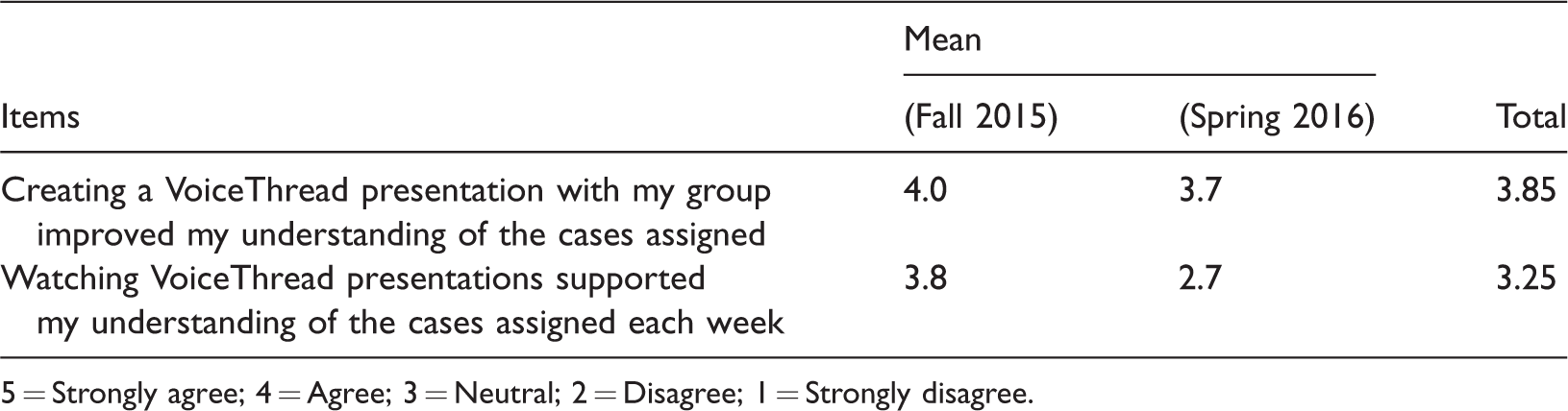
5 = Strongly agree; 4 = Agree; 3 = Neutral; 2 = Disagree; 1 = Strongly disagree.
Additionally, a content analysis was conducted on students’ responses to the following question from the course evaluation survey: Which aspects of this course were most valuable to your overall learning experience? From the 28 students who responded to this question, 38 instances were found in the data (see Table 2). The following aspects were described by the students: Case studies, ID project, Content, Peer-review, readings, and VoiceThread.
Students’ opinions about which aspects of this course were most valuable to your overall learning experience.
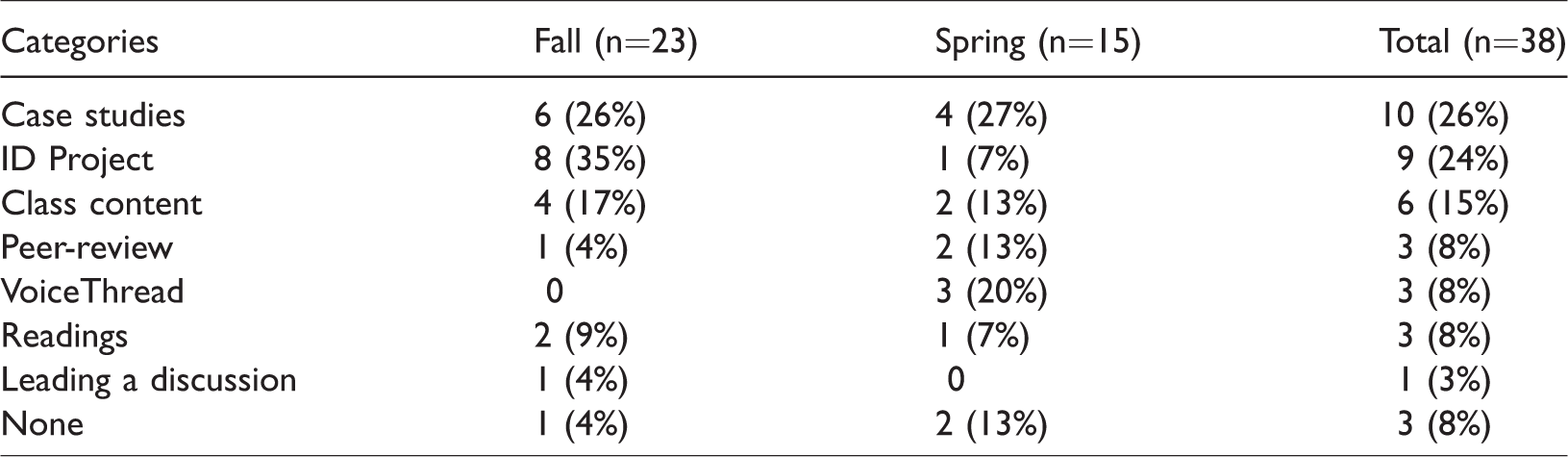
The aspect that students considered most valuable for their learning experience was the analysis of ID case studies. When participants indicated case study analysis as one of the most valuable aspects of the course, two main reasons were identified: discussions and learning/application. Discussions were associated with comments that refer to how the case study analysis was integrated into the course. Students valued the use of asynchronous forums to discuss the cases in ID. Some comments in this area are: “I liked to see what other people were thinking from the case studies” and “The discussions fostered deep analysis of the case studies in relation to our main text book's concepts.” It was also identified that students valued the opportunity to apply the content and learn from that experience. Students valued the fact that the case analysis helps them to see real situations they may encounter as instructional designers. Some of the comments identified in this category are: “the case studies and reading Streamlined ID helped me understand the job of an instructional designer.” and “it really makes you think of real-world issues and how you would react to them.”
Identified nine times, the second most valuable aspect for students was the ID project (24%). For example, one student stated, I feel like the creation of the Instructional Design project was great. It was awful to do, but I thought that the way it was broken into chunks and exemplary examples were provided made it manageable, and even though it was grueling, I thought it was a really great way to learn how to do ID.
To answer the second research question about students’ opinions of asynchronous audio-based discussions of case studies when compared to text-based discussions, a content analysis was also conducted on the 29 students’ responses (16 from Fall and 13 from Spring) from the first open-ended question (How was your experience discussing with your classmates an ID case in VoiceThread? Based on this experience, do you prefer VoiceThread or Moodle forums to discuss ID case scenarios?). Results showed that more than half of the participants preferred text-based discussions over the audio-based discussions. Specifically, 52% of the students described that they preferred online case-based discussions using the text-based forum provided by the LMS, 31% preferred the audio-based discussions using VoiceThread, 14% of the students did not express any preference, and one (3%) participant did not like either of them (Table 3).
Students’ preferences about online case-based discussions.

Among the 15 participants who preferred text-based discussions,
Eight participants (53%) described that discussions in the Moodle forums made it easier and faster for them to scan comments in the discussion boards looking for interesting and main points. For instance, one participant wrote, “VoiceThread was good, but I read much faster than people talk, and it can be difficult to go back and reference something a person said. I can skim through words and find information much easier.” Three participants (20%) mentioned that text-based discussion was better for learning. For example, one participant stated, “I liked the moodle forums better because I learn better through reading vs. listening”. Four participants (27%) did not describe why they preferred text-based discussions. Six participants (67%) described that VoiceThread allowed better communication among them. For example, one participant stated, “Discussions with classmates in VoiceThread were true, asynchronous class discussions …” Another participant stated, “I liked the VT [VoiceThread] better, since it felt more natural and I was able to see how people thought in a more free-form approach.” Two participants (22%) mentioned that they preferred audio-based discussion because VoiceThread was easy to use. One participant (11%) did not express any opinion about why he/she preferred audio-based discussions.
Among the reasons why the nine students preferred audio-based discussions,
Finally, from the four students who expressed no preference, one indicated: “I like having to voice my opinion, but find it harder to reply and keep track of other people's thoughts on VoiceThread. With Moodle, I can easily reference my original post and the thread attached to it.” Another student stated, “I honestly believe that both methods are valuable…. Moodle was a little easier and time efficient, VoiceThread forced me to type up a coherent response which would have been longer than a forum response.”
Discussion
Case studies in ID
Multiple authors have indicated the relevance of cases in ID education (Choi and Lee, 2008; Jonassen, 1999, 2011; Jonassen and Hernandez-Serrano, 2002; Woolf and Quinn, 2009). In this study, where participants took part in several educational activities such as peer-reviews, discussions, small group presentations, or instructional projects, results indicate that case studies analysis was perceived by the participants as the most valuable learning experience in the course. Participants described that the basis for this preference was the discussion of cases promoted learning and the showed application of the ID concepts. These opinions are aligned with what the literature said about the relevance of case studies analysis in ID education and aligns clearly with the goal of the ID CaseBook, in each of these examples, students were asked to apply their emerging knowledge of ID within the context of ‘real-world’ situations, with their inherent messiness left intact. This allowed students to develop their technical skills while working on realistic, complex problems. (Ertmer et al., 2014, p. xiii)
Audio-based versus text-based asynchronous online case-based discussion
Looking specifically to the online case-based discussions and the two formats offered for communication, more than half of participants involved in the discussions preferred text over audio to publish their initial and follow-up posts. These results are aligned with previous research related to students’ preferences on audio- and text-based discussions (Hew and Cheung, 2012). Half of the students who preferred online text-based discussions described that the text-based discussions in Moodle made it easier and faster for them to scan comments in the discussion forums looking for interesting and main points. Since students are required to reply to a couple of their classmates’ responses, the audio-based discussion does not provide a relative advantage in this activity when compared with text-based discussions (Rogers, 2003). However, as indicated in the results, the main reason for those students who preferred audio-based discussions was that VoiceThread allowed better communication among them. The clues provided by audio provided a relative advantage when it is compared with a medium with fewer communication clues and it also provided compatibility with how they could have a discussion. Additionally, these justifications to prefer one or the other can be related to the characteristics that each format provides or what Ramirez and Burgoon (2004) defined as modality richness. For instance, Ramirez and Burgoon (2004) described that text-based computer-based communication is the leanest form of communication. It provides the least information as it relies on typed text in comparison with audioconferencing that adds aural information. Moreover, as stated by Romero-Hall and Rocha-Vicentini (2017), “asynchronous audio dialogue and feedback can allow for more engagement in discussions, as it affords users to better understand the feedback being given through cues present in spoken comments, as opposed to text comments …” (p. 88).
Although half of the participants expressed a preference for text-based discussions, it is important to mention that almost one-third of the participants preferred audio-based discussions. Based on the experiences during the discussions and some participants testimonials, a few recommendations are provided. The first recommendation would be organized students in small groups while having the case-based discussion to help save time. With fewer posts, the task of reviewing responses, analyzing them, and then contribute their own thoughtful post would be less intimidating and time-consuming. The second and third recommendations are related to time limits. Two participants who preferred text-based discussions stated, “I would much rather read a forum post than have to sit there and listen to someone go on and on. Maybe if there was a 30 second time limit to each response?” The second one stated, auditory learning is my weakest form of learning. Some students talked way to[o] long for me to stick with them. I like variety. I think the VoiceThreads would be better if they had to be short and concise which would require practice and carefully selecting the words to use.
Conclusions and limitations
Case-based instruction is an important strategy that has been used widely in areas such as business and medicine, and, because of its success, it has been adopted in other areas such as ID (Ertmer and Koehler, 2014). Implementing asynchronous online case-based discussions is a relevant method of learning to motivate students’ critical thinking and problem-solving skills in addition to improving communication and collaboration skills. As discussed in the literature, asynchronous discussions are considered the cornerstone of online courses (Ertmer et al., 2011), and authors advocate for designing asynchronous audio/visual environments to promote student learning (Girasoli and Hannafin, 2008). This study successfully explored the design of asynchronous online discussions to analyze cases in ID.
Results of this study also confirmed previous research where the majority of students preferred text-based discussions over audio-based discussions (Hew and Cheung, 2012, 2013). Specifically, for online instructors using a case-based approach, this research contributes to the literature showing an example of how asynchronous case-based discussion could be implemented using educational web tools like VoiceThread. Based on the results of this study and the advantages of audio-based communication based on Roger’s DOI theory, it is relevant to keep researching the implementation of asynchronous audio-based discussions. As technology advances, instructional-based technologies that support multimodal asynchronous online discussions allow online learners to enjoy discussions in different formats (text, audio, and video) (Romero-Hall and Rocha-Vicentini, 2017).
Due to the exploratory nature of the current study completely based on self-reported data, the findings should not be generalized beyond the described learning context and additional research would be required using another type of settings to back up the results presented in this study. For instance, participants of this study were graduate students enrolled in a master’s program in educational technology. It is possible that students with different background and technical expertise might express different opinions regarding their preferences and reasons for them.
Footnotes
Declaration of conflicting interests
The author(s) declared no potential conflicts of interest with respect to the research, authorship, and/or publication of this article.
Funding
The author(s) received no financial support for the research, authorship, and/or publication of this article.