




Abstract
We examined asynchronous online discussion boards, specifically those that are unmediated by teacher figures, to identify characteristics of these spaces that support or constrain students as they seek help in mathematics. We analyzed 86 questions and 114 associated responses posted to two Khan Academy discussion boards centered around two related trigonometry lessons. The platform created a space where students could ask a variety of questions ranging from those requesting math definitions and explanations of math procedures to justifications for why formulas are true. However, crowdsourced replies to questions were delayed, sometimes taking more than one year for a reply to be posted; content of student replies did not always match the content of the questions posed; and the quality of the replies varied considerably, some replies were helpful or resourceful while others were incorrect or vague. These challenges seemed connected to the unmediated nature of this type of asynchronous online discussion board. We argue that this online learning environment demands additional self-regulated learning strategies such as awareness of one’s needs and the timeframe in which they must be met. We also discuss implications for research and practice.
Social cognitive perspectives of self-regulation have guided investigations of online learning and of autonomous learners (Lynch and Dembo, 2004). There are behavioral, cognitive, motivational, and environmental facets of self-regulation that a learner needs to manipulate in order to be successful (Pintrich, 2000) and self-regulated learners are active in pursuing and achieving their learning goals (Zimmerman, 1989). One effective self-regulated learning strategy is seeking help. Help-seeking, in general, has been recognized as a challenging self-regulation endeavor as it requires several steps (Aleven et al., 2006; Newman, 2008; Puustinen et al., 2015). A student must recognize that she has a problem, determine whether external help is necessary, decide to seek that help, find the correct type of help as well as the appropriate helper, ask for the needed help, receive the help, and then finally process the help to solve the original problem (Puustinen et al., 2015). With the help of technology, the options for where help can be sought have expanded, as the Internet provides access to resources that are available at any time. However, understanding the different kinds of help that is available lags behind the number of sites that are created to offer help. In this study we examine one form of help that comes from the utilization of unmediated, asynchronous online discussion boards (uAODs), and we investigate their usage in gaining mathematics knowledge and help.
Benefits of seeking help online
When it comes to seeking academic help online, there are some obvious benefits that come with the widespread access to the Internet. In addition to the previously mentioned ease of access to instructors, peers, and unknown experts, the cost of help is also low or often free. As long as one has access to the Internet, help can come from anywhere and what seems to be, any time. For example, the math help website examined by van de Sande (2011) shared that people from every continent had utilized the site. Psychological benefits have been identified as well. Seeking help in a traditional classroom can be difficult due to lack of self-confidence, and this is less of an obstacle for seeking help when students can search and ask questions anonymously (Karabenick, 2003; Ryan and Shin, 2011).
When learners seek help online, they may turn to a number of online help-seeking tools like a search engine, an online tutoring platform, or a question and answer forum. These online help-seeking platforms can be categorized along a number of dimensions. Firstly, an online help-seeking platform can be characterized in terms of its adaptiveness to the needs of the learner (Puustinen and Rouet, 2009). For example, a search engine that calls up text based on a learner’s query does not adapt to the learner, whereas a human expert who attends to the intricacies of a learners’ question has excellent adaptation to the learner, and somewhere in between these two extremes, a help system that provides help based on a learner’s performance on an online quiz has moderate adaptation to the learner. Secondly, help-seeking platforms can be characterized by the type of help-seeking behaviors that they accommodate (Cheng and Tsai, 2011; Hao et al., 2016). Cheng and Tsai (2011) identified three online help-seeking behaviors: (a) formal help-seeking (e.g., asking an instructor or class assistant for help online), (b) informal help-seeking (e.g., asking a peer for help online), and (c) information searching (e.g., using a search engine to seek help). Given these dimensions of online help-seeking platforms (adaptiveness and help-seeking behavior accommodated), uAODs (e.g., Khan Academy, Yahoo! Answers) are adaptive platforms for formal or informal help-seeking.
It is important to highlight that, although all AODs may seem adaptive, there are characteristic differences among them. One type is as a supplement to class instruction. This is the most common way students interact with an AOD and much research has been focused on AODs within learning management systems (LMS; for a review, see Loncar et al., 2014). Within LMS settings, students have clearly identified instructors and peers from whom to seek help. This reduces one of the challenges of seeking help in general, which is finding an appropriate helper. In an LMS environment, the student can expect their instructor to provide help as well. Previous research emphasizes the importance of teachers providing online help. In efforts to make recommendations for teacher education programs Bawane and Spector (2009) compiled a list of competencies previous researchers identified as being part of an online instructor’s role. Developing appropriate learning resources, facilitating participation among students, monitoring individual and group progress, assessing individual and group performance, and providing guidance based on student needs are some of the identified competencies. It is clear that there is emphasis on teachers being aware of when students might need help and providing the best help possible.
In addition to seeking academic help online through a class AOD, the Internet allows for access to information and help beyond the classroom and LMS in a form of crowdsourcing help. Crowdsourcing refers to outsourcing work to unknown people 1 (Howe, 2008). Open online forum rely on crowdsourcing help and some scholars have begun to examine them to better understand how students are utilizing them for learning. Puustinen et al. (2015) examined how French middle school students interacted with voluntary math teachers online in order to get help on a math tutoring website. Students communicated their own homework progress and interacted with unknown tutors in accordance to offline, in-person communication rules. In another study, van de Sande (2011) examined exchanges on a calculus homework help website and identified four distinct ways that students behaved: coasting, slacking, sustaining, and ramping. These referred to different ways students responded to the help they received, such as sustaining engagement while interacting to receive help or responding to help with further engagement toward finding a solution to the problem they posted. These open and free sites were developed with the intention of providing those who want help with help. Like students who utilize LMS discussion boards, those who utilize these tutoring site discussion boards can expect a reply. However, in addition to these kinds of AODs with committed volunteers who take the role of a content expert, there are sites that have discussion board features that seem to rely on crowdsourcing input and discussion entirely, such as Reddit and Yahoo! Answers. There is even less known about the utilization of these open, online forums.
Seeking trigonometry help online in the United States
We chose to investigate this topic of online help-seeking within the domain of mathematics, particularly the topic of trigonometry. Trigonometry is one of the more complex topics covered in advanced high school algebra in the United States. It requires learners to synthesize and apply geometric, algebraic, and graphical reasoning in abstract and novel situations. Trigonometry is also important in students’ pursuit of STEM majors and careers. Advanced algebra is a high school requirement in 30 states (Zinth, 2012) and is considered a gatekeeper for both high school graduation and college success in the United States, particularly for students of color and low-income students (Attewell et al., 2006; Stoelinga and Lynn, 2013; Tyson et al., 2007). U.S. students who pass advanced algebra are more likely to graduate both high school and college (Hanford, 2016). Trigonometric thinking requires learners to have an integrated understanding of geometry and algebra topics, and furthermore has applications in physics, architecture, surveying, and engineering. Given the importance of learning and being successful in trigonometry courses, free and accessible help for trigonometry can have great implications for student learning and therefore characteristics of learning resources are important to understand.
The current study
With widespread access to the Internet, students can get help from various sources. Unlike the growing body of research on how to best utilize LMS features and train teachers to be effective instructors online, we have little understanding of how vastly different open, online forums can function as resources, particularly ones without an identified teacher/expert. Therefore, our study was guided by the following research questions: What characteristics of an unmediated, asynchronous, online discussion board create challenges to math help-seeking? What additional affordances, if any, do unmediated, asynchronous, online discussion boards provide to math help-seeking?
Method
Data collection and analysis
Data were comprised of questions and replies posted on two mathematics discussion boards housed on khanacademy.org. Khan Academy is an extremely popular site providing students with academic instruction in the form of videos explaining content. Each video has a discussion board associated with it and the discussion boards crowdsource help. The reach of Khan Academy has exploded over the years since its creation, with the website recording nearly 12 million users every month and over 60 million registered users in the 2017 report (Khan Academy, 2017). This can be compared to the 8 million learners per month and 50 million registered users in 2016 (Khan Academy, 2017). As the number of video viewers continue to grow, so will the users of the discussion boards, making it important to understand the opportunities uAODs afford and the challenges they pose.
The Khan Academy discussion board is adaptive to learners comments and questions and happens in an formal/informal online environment (Cheng and Tsai, 2011; Puustinen and Rouet, 2009). What distinguishes the Khan Academy discussion board from other adaptive, formal/informal online platforms is that it relies on crowdsourcing to provide students with help that is specific to their questions. Despite the popularity of crowdsourcing platforms like Wikipedia or the Khan Academy discussion board, there are concerns regarding the quality of the information presented in them. Researchers have raised concerns regarding the accuracy, coverage, sources, and volatility of information as well as the uncertain motives and expertise of the users that post new information to crowdsourced websites like Wikipedia (Denning et al., 2005). Furthermore, Marsden (2009) found that 90% of crowdsourced information is of mixed quality. It is critical then, that platforms such as these are looked at carefully to infer the kinds of repercussions they may have for help-seekers.
The top 100 posts from two online discussion boards were collected during the spring of 2017. The first discussion board was connected to the unit titled, “Transforming sinusoidal graphs: Vertical stretch & horizontal reflection.” The top 100 posts from the first discussion board included 37 questions; some questions gained more than one reply while a greater number of questions gained only a single reply. The second question posted in the first discussion board had the most math-related replies (seven replies), with additional replies not related to answering the question. Most questions posted had one reply (52.3%), with three questions posted on this board had no replies. The second discussion board was connected to the unit titled, “Transforming sinusoidal graphs: Vertical & horizontal stretches.” The second discussion board included 49 questions. Nine questions posted on this second board had no replies.
We chose to analyze comments from discussion boards focused on the topic of trigonometry graphs because this topic tends to be one of the more challenging topics that students encounter in advanced algebra courses and may be a stumbling point for students as they move on to higher education (Attewell et al., 2006; Stoelinga and Lynn, 2013; Tyson et al., 2007). The two discussion boards that we chose to analyze were associated with consecutive lessons that built upon one another. Consecutive lessons were chosen to minimize the variance in the characteristics of the sample population between the two.
Data analyses happened in an iterative manner. Our initial unit of analysis was the question–reply pair and expanded to the entire thread whenever relevant. We first independently open coded the data separately to better understand how students were using the online discussion forums and what characteristics the replies had (Saldaña, 2010). Through discussion of the open codes, we collaboratively compared and consolidated codes, exemplifying the move from open coding to axial coding (Corbin and Strauss, 2008; Saldaña, 2010). Using these emerging themes (Corbin and Strauss, 2008; Creswell, 2007), we separately coded again and arrived at some proportion of agreement between our ratings for relevance of the question (approximately 70% agreement), narrowness of the question (approximately 60% agreement), open-endedness of the question (approximately 70% agreement), and procedural/conceptual nature of the question (approximately 60% agreement). In further coding and comparing with the higher level themes we determined that the questions and responses had characteristics that could be categorized by content (even/odd functions, reflection, translation, amplitude, period, and holistic graphing questions) and purpose of the questions and responses using three categories: provision of definitions, processes, and justification.
We watched the accompanying videos and considered this information when examining the relevance of the questions and replies. However, the content of the videos were not examined beyond being used to understand and contextualize the questions posted on the discussion boards. We also collected the number of votes and the upload date displayed for each question and response at the time of analysis, as these are characteristics associated with AODs. With regard to the time of posting, the website automatically reduced the accuracy of the dates as more time had elapsed (e.g., time was posted in units of days until one month had passed, then would display time in units of months until a year had passed, then displayed time in units of years). This information was used to fully understand the challenges when utilizing uAODs for learning.
Researcher bias
We reflected on our identities and past identifications in order to disclose areas for biases. The first author received her secondary education overseas, in a culture where teacher authority had the final say and self-pacing was not a typical option. Her understanding of online learning came first from having been an instructor for online courses at the post-secondary level. The second author was previously employed as a high school mathematics teacher. His understanding of student difficulties in trigonometry stems from his experience as a pre-calculus instructor in secondary institutions. Together, the authors comprise a team with some expertise in online learning environments and disciplinary and pedagogical knowledge of trigonometry. We acknowledge that even though these experiences inform some insights into student thinking enabled by online discussion boards, they also constrain our perspective to preconditioned ways of framing student thinking in trigonometry, and/or online.
Results
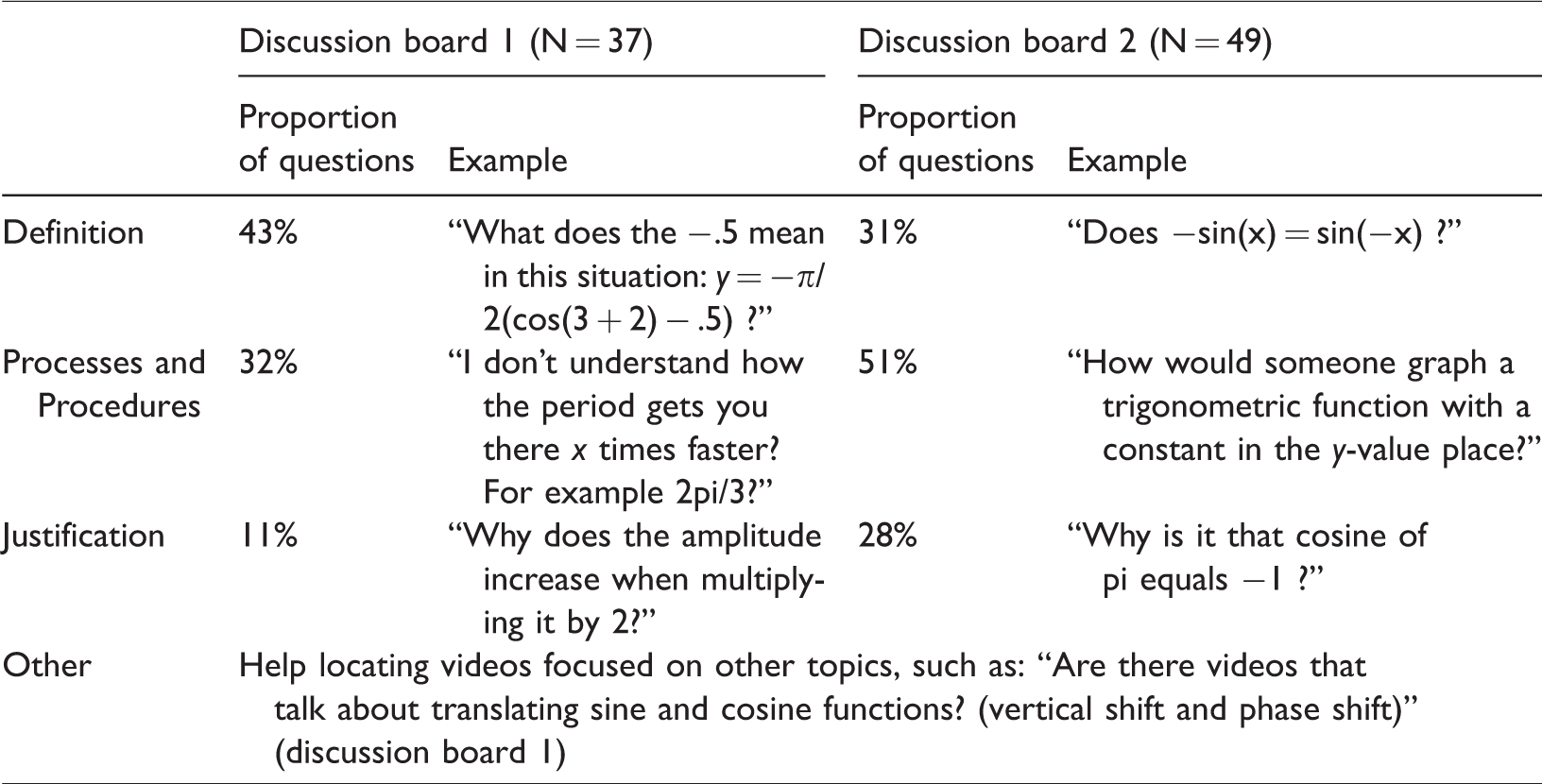
Question posters sought three types of information: mathematical definitions, mathematical processes and procedures, and justifications (see Table 1). The format of the question posts were open-ended questions or closed, and yes or no. Some posts included several questions embedded in a single post and could include both open-ended and closed, yes or no questions.
Types of information sought by help-seekers in question posts.
Across the two boards, the 86 questions posted covered a number of topics and sometimes touched upon more than one topic in a single post (see Table 2). With regard to the up or down voting mechanism, in discussion board 1, only the top six questions and replies received more than five votes. This was similarly found in discussion board 2 with only the top five questions and replies posted in discussion board 2 receiving more than five votes. The majority of the remaining posts had one to two votes.
Content of questions posed on each discussion board.
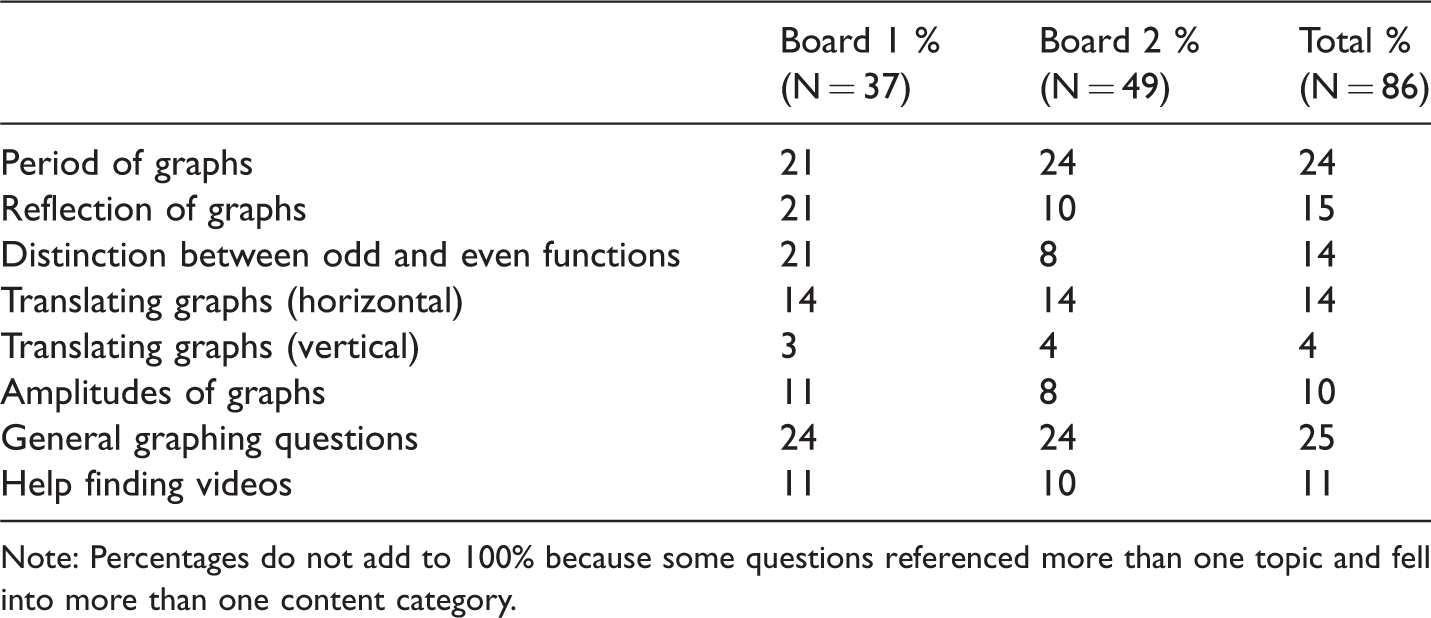
Note: Percentages do not add to 100% because some questions referenced more than one topic and fell into more than one content category.
Below we report the characteristics of the discussion board posts, in order to answer the research question: what characteristics does an unmediated, asynchronous, online discussion board have that provide affordances and create challenges to math help-seeking? The results are organized in relation to the platform’s characteristics of being an unmediated, asynchronous, online discussion board. In efforts to protect the anonymity of the users, all screen names were replaced with pseudonym screen names and posts have been paraphrased.
Unmediated and asynchronous
The asynchronous nature of the discussion board was clearly visible in that the time between questions posted and replies posted did not show any identifiable pattern. The time between questions and replies ranged anywhere between 16 days after a question was posted to 3 years and 10 months after. It should be mentioned that replies may have been posted more promptly than 16 days, but the time signatures for posts become less precise over time (e.g., there is no way to know the time that passed between a question that was allegedly posted “4 years ago” and a reply that was also posted “4 years ago”). With this said, 20 replies were posted within one month after the question was posted, whereas 44 replies were posted within one year, 12 replies were posted within one month and one year, and 9 replies posted after one year. There were even 11 replies posted between two and four years after the question. Simply put, 81% of the replies posted at least a month after the question was posted. This was different from the back and forth discussion interactions that were close in time, some even minutes apart described by van de Sande (2011). The time gaps of over 16 weeks would not happen in an AOD that was part of a college course since that would be extending beyond an academic semester, unless the course was a unique course that went on for an entire academic year.
We found one clear example of a user who lacked understanding of the asynchronous aspect of the board. One user expressed urgency in their post, “…could someone please direct me toward [an instructional video]?… I have my final tomorrow and I am still baffled!” The user seemed to be attempting to elicit sympathy for a more timely reply. This user posted their question “3 years ago” and received a reply that was also marked as being posted “3 years ago,” but the delay between entries must have been significant given that the response began with “Sorry we missed your final… .”
Unmediated and online
A number of users took advantage of the discussion board being an online resource by incorporating technology. Several users connected question-posters with additional resources, namely a graphing calculator website, desmos.com and provided links to other Khan Academy and YouTube videos. Below UserA asked why the period of a trig function is found using the expression “2pi/coefficient.” Although UserB did not explain why the period is “2pi/coefficient,” UserB provided a link to an interactive graph that can be used to show how the period of sine changes depending on integer values of that coefficient.
Question: seriously, I don’t understand why 2pi/coefficient = period 10 months ago. UserA Reply: https://www.desmos.com/calculator/vkodibwt9s 10 months ago. UserB
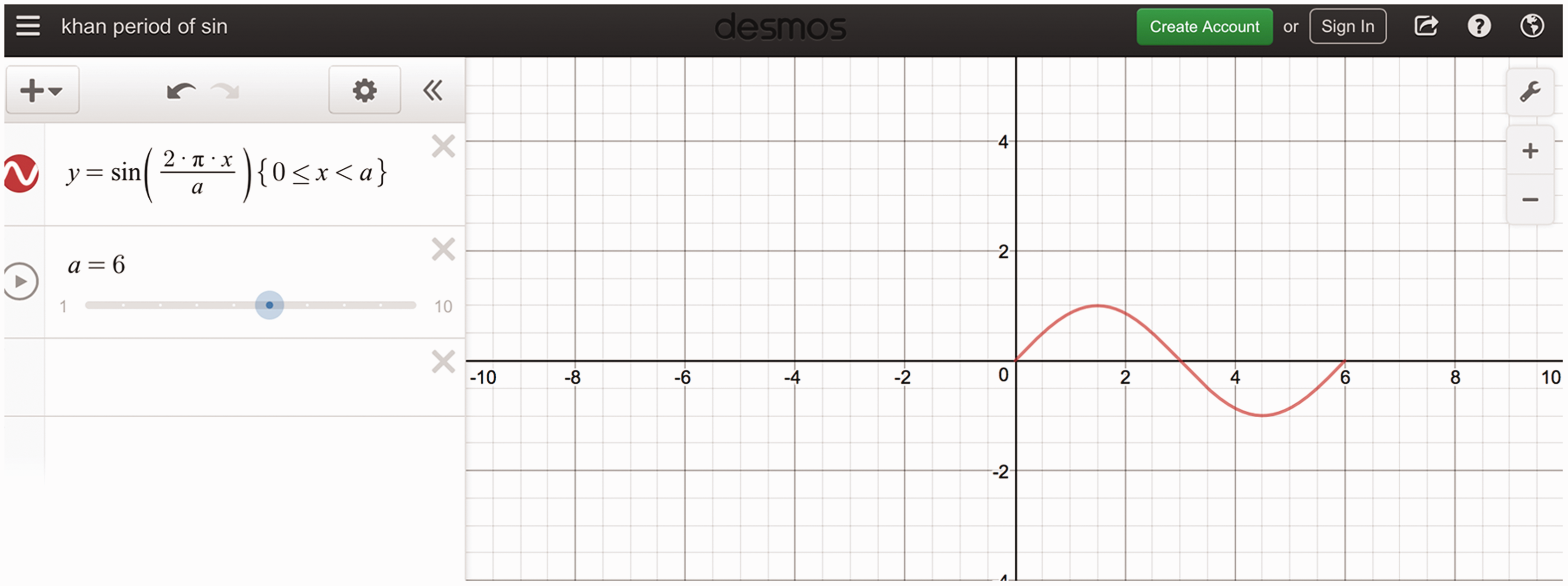
Graphing calculator found online (desmos.com).
Unmediated discussion board
Although most of the posted questions on the two discussion boards received replies, there were few discussions happening. Interactions among question poster and reply posters were limited. We found only a small number returned for additional help, behavior identified by van de Sande (2011), or to express whether the help received was satisfactory or not, behavior identified by Puustinen et al. (2015). Among the questions that had multiple replies, only three threads had users who acknowledged previously posted answers (two of them being simple “thank you” statements) and one thread had conflicting replies and no acknowledgement of the conflict.
In addition to the limited discussion, the quality of the content in the replies varied. This has been previously identified as a characteristic of crowdsourcing information in other domains. Some of the replies were detailed and helpful.
Question: I don’t get the amplitude equation at all. Can somebody please help me?: D 2 years ago. User345 Reply: Intuitively you can think of the amplitude as how high and how low the curve goes when compared to the midline. Given sin(x) or cos(x), the highest point will be 1 and the lowest point will be −1. To calculate the amplitude you have to subtract them and divide by 2: 1 − (−1) = 1 + 1 = 2 divide this by 2 and you get 1. A function with a highest point of 2 and lowest point of −2 has a difference of 2 − (−2) = 2 + 2 = 4 which divided by 2 is 2. You get a function like that if you multiply a trig function by a number: for example, 2cos(x) or 2sin(x). The amplitude is just half the distance between the highest and lowest point. If you have a number multiplying a trig function, like: k*sin(x) or k*cos(x), the amplitude will be the absolute value of k. (you take the absolute value because it is a distance). For instance, the amplitude of 3sin(x) is the absolute value of 3 which is |3| = 3. Similarly, the amplitude of −3sin(x) is the absolute value of −3 which is |−3| = 3, so the amplitude is also 3. 2 years ago. User001
User001 started with a conceptual definition of amplitude (“intuitively you can think of…”) and then two examples to illustrate the definition. The first example illustrated how to determine amplitude of a simpler case—the parent functions sin(x) and cos(x)—by taking half of the vertical distance between peaks. The second example illustrated how to find the amplitude in a slightly more difficult situation—2cos(x) or 2sin(x)—and again elaborated on why this procedure works. Then, User001 applied the established definition of amplitude in two more complicated and general examples. The first example generalized the amplitude procedure using the constant k as multiplied to the parent function. The user explained that the amplitude can be found by determining the absolute value of this constant, and provided justification for why this is true (i.e., that it represents a distance). To illustrate how this more generalized mathematical description of amplitude works, User001 substituted values in for k (3 and −3), explaining that they have the same amplitude. Therefore, in this reply, User001 provided a definition and the procedure to find the amplitude when given a trigonometric function, providing justifications along the way. In sum, despite User345’s unspecific question, User001 provided a response with a range of important and accurate definitions, procedures, and justifications organized in a way to be easily interpreted by the help-seeker.
In contrast, there were also replies that provided incorrect or incomplete information.
Question: How are −2sin(x) and 2sin(−x) different? 4 years ago. UserKay Reply: The two negatives cancel each other out, and thus they are the same. 3 years ago. UserEm
Finally, in addition to correct and incorrect replies, there were replies that fell into a gray area that were not incorrect mathematically but were irrelevant to the topic of the overall unit and discussion board. There were only a small number of these kinds of replies but are presented to demonstrate another challenge to learning that needs to be associated with uAODs. Because the discussion board is open, anyone can post a reply, and getting an accurate reply is another burden that falls on the help-seeker.
Question: I should probably know this by now, but is f(−x) same as −f(x)? 4 years ago. User909 Reply: no, here is an example to show that this is false for f(x) = x^2 f(−x)=(−x)^2=(−1)^2*x^2=x^2=f(x) 3 years ago. User212
Discussion
In this study, we investigated how individuals were utilizing adaptive uAODs to obtain crowdsourced help in mathematics. This uAOD was different from other online help forums because the help-seekers had to rely on crowdsourcing—the division of work between many users who are likely unfamiliar with each other to achieve a cumulative result—to construct and self-correct the help posted on the forum. By examining the content and characteristics of the questions and responses posted, we identified several challenges with utilizing this kind of online resource. One clear challenge was that help was delayed, sometimes the lapse between question post and reply post was over a year. Even if students are returning to check if anyone replied to their questions, given that in the U.S. students in secondary school are in one grade for one year, that help is no longer useful to the student who was looking for that help. Because this was an expected challenge we were surprised to find one user who was looking for immediate help, suggesting that the time delay was not obvious for all users.
Another challenge was that the quality of the help varied. The posted replies ranged from providing step-by-step procedures with several examples to outright incorrect information to some that were irrelevant to the topic. Although one might consider this as an expected outcome of crowdsourcing, we argue that this broad range of possible help makes the utilization of this resource particularly challenging for users who are not proficient or have not mastered the content. In essence, they do not have the tools to differentiate useful help from poor quality help. Through findings from interviewing students’ perceptions of informal learning through YouTube, Tan (2013) highlighted how, although the availability and accessibility of resources were increasing, students still (if not more) relied on teachers to assist in deciphering academically sound and valid materials. Greater access to resources brings its own set of challenges. This burden of filtering through and identifying useful help made utilizing this type of online resource challenging and may explain why Hao et al. (2016) also found that computer science students preferred to ask peers for help over searching for information online. Furthermore, slow and inaccurate responses pose challenges for help-seekers in content areas other than mathematics and in other crowdsourced online platforms. For example, Khan Academy offers online courses in other STEM disciplines such as economics, as well as courses in Arts and Humanities such as U.S. History, all of which have active discussion boards. Help-seekers frequenting these sites, and other uAODs such as Yahoo! Answers, are likely to come against the same barriers for obtaining online help as those in mathematics: slow and occasionally inaccurate or vague responses.
There were two unexpected characteristics of crowdsourcing uAODs that would benefit from further investigation. The first one was that the name, “discussion board,” is misleading. Different from the sites examined by van de Sande (2011) and Puustinen et al. (2011, 2015), there was little to no back-and-forth discussion happening. We did not find any explicit instruction informing users to treat the boards as a place where complete answers and explanations are posted. So it seems users perceived the board as not a place for back-and-forth discussion. This may be why many of the posted replies tended to elaborate beyond a mere yes or no, even if the question was asked in a yes or no question format. Some replies included justifications or procedures to better illustrate the definitions, even when only definitions were asked for. Having access to elaborated-upon help can be useful for students who can follow and understand the justifications and procedures provided in previous posts. Whereas, students who have limited understanding of the content may have harder time utilizing the replies as a resource. Research is needed to examine how students of different learning proficiencies learn from this form of crowdsourced, online help.
Another unexpected characteristic was that many of the posted questions were similar in content. This indicated that many students were not reading the discussion posts carefully before asking a question. When considering the unpredictable time delay between questions being posted and replies being posted, students need to strategize how they will scan online discussion boards for help rather than solely relying on users to respond to their questions in a timely manner. This may include thinking about how many threads they will read to determine whether the particular board is the appropriate place to seek help. Also if a student can identify a question that is similar enough to a previously posted question they may be able to find help in the replies, rather than posting their own question and hoping for a reply. The challenge would be that the student would need to have enough prior knowledge and understanding of what they know and do not know to be able to identify questions that are similar to their own. Further research on teaching students how to filter and process replies that are not helpful are needed.
Implications
There are several implications of our study. We considered the uAOD of Khan Academy as a representative of other websites that host crowdsourcing uAODs. We encourage administrators of such sites to facilitate a community where disagreement is welcomed. Although there have been some recommendations for teachers and other mediators to pay closer attention to the posts happening on online discussion boards (Loncar et al., 2014), this seems impossible for unmediated discussion boards like the one we reviewed. Rather, encouraging the community to give feedback on posted replies and in the long run be able to self-correct would be ideal. As critical thinking and communication of disagreement are skills identified as necessary to be successful in the 21st century (Binkley et al., 2012; P21: Partnership for 21st Century Learning, 2015), teachers need to teach students how to express critical feedback and disagreement in a respectful and courteous manner on a discussion board thread.
Given the varied quality of help, the findings from our study suggest the importance of students being able to communicate what they know and do not know. Posting a question that delineates between what is known and unknown can better their chances of getting a reply that addresses what they actually do not know. However, until students can do so, developing skills and awareness becomes an additional challenge when utilizing this potential resource. Therefore, teachers need to help students develop the self-awareness as well as a critical eye for consuming the information they find on the Internet. Providing scaffolds for how to self-reflect as well as be critical about the characteristics of the online discussion board is one area that students could benefit from receiving help and training (Fisher and Baird, 2005).
In addition to the previously discussed implications for teachers in general, there are implications for math teachers specifically. Mathematical argumentation is an important skill and discussion boards can serve as an archive of those arguments. Previously posted replies can be utilized as examples of how to communicate a mathematical argument. Math instructors can also teach students strategies for evaluating the validity of mathematical arguments posed in online discussion posts.
With regard to research, Song and Hill (2007) proposed a conceptual model for understanding self-directed learning in online environments, in which they built on previous self-directed learning models. In their proposed model, Song and Hill include a contextual dimension that presumed the existence of instructors and peers in the form of instructor feedback and peer collaboration. In our paper, we highlight an online environment where the so-called instructors and peers vaguely exist but cannot be relied on to provide help in an interactive way. Future research is needed to examine how students may utilize other contextual cues to develop self-directed learning skills.
Limitations
There are several limitations that are important to note. Due to the nature of the data and the exploratory nature of the study, we cannot make claims regarding any learning outcomes of the students who utilized the videos or the discussion boards. Future research is needed to investigate how students use such uAODs and process the help they receive from online sources. All of the users were anonymous and therefore there was no way to determine whether those who actively post on the discussion board are characteristically different from those who only read discussion boards. One area for future research would be to investigate the learning outcome differences between active and passive utilization of discussion boards.
Our sample was also limited in that we focused our data collection and analyses on only two discussion boards. Future studies might consider taking a larger sample of data from a wider variety of discussion board topics. Future research might take a longitudinal approach to observe shifts in student question asking and responding behavior over time and/or across multiple discussion boards.
Lastly, one aspect of these unmediated discussion boards we did not expect when we started our investigations was the lack of disagreement or pushback from the community of users when wrong or wrong-ish posts were made. Comments of disagreement or questioning were not made and the down voting feature was not actively used. No post had a down vote. In the absence of any critiques, the burden of determining whether a reply is correct or incorrect fell on the students and the only mechanism to protect against learning wrong answers, the up/down voting system,did not accurately reflect correct versus incorrect content. Another telling example of how poorly the up/down voting feature functioned is that, at the time of manuscript preparation, a thread of math puns (“I guess that’s a good sine” and “I like your amplitude”) we found in discussion board 1 had the most up votes and was therefore at the top of the discussion board thread. This clearly shows how the up and down voting feature is not enough to help students to decipher what is helpful or not on the discussion board.
Conclusion
Currently research on the utilization of online resources and the Internet has not moved beyond identifying that students are going beyond their class/school resources and looking on the Internet to find information and help. Our study begins to lay out how these unmediated spaces can be generally useful but at the same time trickier to navigate for students who have limited self-regulated learning skills. It is important to recognize that Khan Academy and other websites like it have limitations, and without appropriate guidance and skills students will not be able to gain from them what they utilized the websites to gain.
Footnotes
Declaration of Conflicting Interests
The author(s) declared no potential conflicts of interest with respect to the research, authorship, and/or publication of this article.
Funding
The author(s) received no financial support for the research, authorship, and/or publication of this article.