



Abstract
Social network sites in general, and Facebook in particular, allow users with common interests to meet, share ideas, and collaborate, creating new forms of informal learning. In order to understand and eventually take advantage of the many benefits that Facebook can bring to the academic world, we need to study its adoption process. The objective of this article is to identify the factors that may motivate university students to adopt and use Facebook as an educational tool. We aim to contribute to the existing literature by adding a unique approach to examine this question, incorporating theories and constructs from the well-developed technology acceptance theory. According to our results, Performance Expectancy of Students is the most important factor on predicting the Behavioral Intention to Use Facebook for academic purposes, followed by Appropriateness for Academic Setting and Compatibility With Academic Work.
Introduction
Social media is not a fad, but it is here to stay. It is not something that is going away anytime soon, but it will continue to evolve. Social media has revolutionized our lifestyle, and it has a significant on influence every part of our lives: our personal relationships, our entertainment choices, and our work place and/or school.
According to Boyd and Ellison (2007), social network sites (SNSs) can be defined as web-based services that allow individuals to (1) construct a public or semi-public profile within a bounded system, (2) articulate a list of other users with whom they share a connection, and (3) view and traverse their list of connections and those made by others within the system.
If we focus on the way we communicate with the outside world, the impact of SNSs seems to be undeniable. Not only SNSs have reconfigured social interactions, but they have also allowed users to customize the news they receive, making the experience much more participatory. However, it was also found that the Facebook’s News Feed ranking algorithm prioritizes stories posted by a user’s friends to make them more relevant and it could make users feel isolated in a “filter bubble” (Eslami et al., 2015; Pariser, 2011).
The academic world, aware of the tremendous potential of SNSs to improve the learning experience, has begun to formally bring these tools into their classes in various ways (e.g., as supplemental help; for class discussion boards; to provide course-related information, and encourage student interaction; Hurt et al., 2012; Irwin et al., 2012).
Among the different SNSs, Facebook stands out as the leader; it was the first social network to surpass 1 billion registered accounts and, according to Statista (2017), it had 1.97 billion monthly active users on April 2017 (www.statista.com). Facebook has come a long way since it was created in 2004 and it has big plans for the future. As Mark Zuckerberg states on his Facebook page: For the past decade, Facebook has focused on connecting friends and families. With that foundation, our next focus will be developing the social infrastructure for community—for supporting us, for keeping us safe, for informing us, for civic engagement, and for inclusion of all.
While some of these models are based on individuals’ internal decision-making processes (Ajzen, 1991; Davis, 1989; Venkatesh and Davis, 2000), other ones underline the relevance of innovative factors when analyzing the adoption and diffusion processes (Corrocher, 2011; Lai and Chen, 2011; Moore and Benbasat, 1991; Rogers, 2003).
After a careful analysis of the theories and models that have been used to explain the adoption, diffusion, and use of technological innovations, including the Technology Acceptance Model (TAM; Davis et al., 1989), the Unified Theory of Acceptance and Use of Technology (UTAUT; Venkatesh et al., 2003), and the Innovation Diffusion Theory (IDT; Rogers, 2003), we borrow and adapt to the educational context four measures from the UTAUT model: (1) “Performance Expectancy,” (2) “Effort Expectancy,” (3) “Social Influence,” and (4) “Facilitating Conditions.” In addition, we include (5) “Perceived Ease of Use,” from the TAM, and (6) “Compatibility With Academic Work and Behavioral Intention,” from the IDT. And finally, to account for the unique context of integrating Facebook into university coursework, we included the factor “Appropriateness for Academic Setting,” developed by Sheldon (2015) to measure students’ comfort level with using Facebook with their instructors.
The remainder of this article is structured as follows: the next section provides a literature review on the previous research on the educational use of Facebook and on the main models and theories that have been historically used to explain the diffusion, acceptance, and adoption of technological innovations. The following section details the structural model and the methodology used in this study. We then present and discuss the results of our analysis. In the final section, we identify the limitations of our study as well as the future directions of this research.
Literature review
The last decade has witnessed a surge in the number of studies that analyses the potential uses of Facebook as a tool that, when properly used, can enhance the teaching-learning process. Even though a large number of these studies conclude that undergraduate students generally consider Facebook as a social tool, they also recognize that it can ultimately help them transition into university life (Cheung et al., 2011; Greenhow et al., 2009; Madge et al., 2009; Selwyn, 2009). Along these lines, Barczyk and Duncan (2013, 2016) found that students in the upper level courses were favorably disposed toward the educational use of Facebook because of its potential to enhance students’ sense of classroom community, and its ability to foster the development of communities of practice in terms of knowledge sharing, collaboration, and learner-centered activities.
These findings are aligned with those of Beaudoin (2012), Hurt et al. (2012), Kabilan et al., (2010), and Moeller and Nagy (2013), who state that Facebook can promote the development of connections among fellow students and the creation of a stronger sense of community. Another reason why Facebook may have a positive impact in a learning environment is its capacity to promote discussion among students (DiVall and Kirwin, 2012; Hurt et al., 2012; Schroeder and Greenbowe, 2009; Shaltry et al., 2013) and communication between students and instructors outside the classroom (Bosch, 2009; Selwyn, 2009; VanDoorn and Eklund, 2013). In addition, there is some evidence that students adopt Facebook more actively when they are provided with autonomy and can take the initiative (De Villiers and Pretorius, 2013; Hurt et al., 2012) and when the instructor is less involved or is a passive participant (Hurt et al., 2012; Teclehaimanot and Hickman, 2011).
However, despite Facebook’s potential to promote academic engagement and expand the boundaries of the traditional classroom (Tower et al., 2014), the research on the effectiveness of using Facebook for academic purposes has provided inconclusive results (Irwin et al., 2012; Schroeder and Greenbowe, 2009). The contradictory nature of these studies prove that we cannot conclude that all young students are equipped with sophisticated technological skills and have learning preferences for which the current education system is not prepared (Bennett et al., 2008; Jones and Shao, 2011). In this sense, Taylor et al. (2012) conclude, after performing an exploratory study on business students’ use of Web 2.0 technology in academic work, that these university students did not support the use of Facebook as a formal academic tool due to its limited pedagogical utility. Similarly, Omer (2012) found that, even though the students from the University of Gaziantep (Turkey) who participated in his research study expressed very positive views toward Facebook use as a supplement to instruction, they still prefer traditional coursework. Along the same lines, Dennen and Burner (2017) found that some of the students who participated in their research did not favor the use of Facebook in a formal school context; many of them wanted to avoid context collapse between their social identities and their classroom identities; they were also concerned about privacy issues. Chromey et al. (2016) reached a similar conclusion when they showed that students are willing to accept social media use for class purposes as long as they do not need to provide personal information. In addition, surveillance issues can be pointed out as another reason why international students would not use Facebook for learning (Bamman et al., 2012). Solving surveillance issues is particularly necessary when dealing with international students. Faculty are even less enthusiastic about using Facebook than are their students (Ajjan and Hartshorne, 2008; Cloete et al., 2009; Manca and Ranieri, 2016; Roblyer et al., 2010). Rogers-Estable (2014) concluded that the main barriers to faculty to use more social media tools in education were extrinsic factors (e.g. time, training, support), rather than intrinsic factors (e.g. beliefs, motivation, confidence). Also, Veletsianos and Kimmons (2013) reported that tensions exist between online social networks adoption for teaching and faculty identity as well as between personal connections and professional responsibility.
When we turn to the literature on the reasons that may motivate university students to adopt Facebook for academic purposes, we find a well-developed, theoretically grounded and extensively validated literature that analyses the factors that impact the acceptance of Facebook as an educational tool. While some of these models are focused on individuals’ internal decision-making processes (Ajzen, 1991; Davis, 1989; Venkatesh and Davis, 2000), other ones stress the importance of innovative factors when analyzing the adoption and diffusion processes (Corrocher, 2011; Lai and Chen, 2011; Moore and Benbasat, 1991; Rogers, 2003).
In this article, we borrow and adapt to the educational context from the UTAUT model: (1) “Performance Expectancy,” (2) “Effort Expectancy,” (3) “Social Influence,” and (4) “Facilitating Conditions.” In addition, we include (5) “Perceived Ease of Use,” from the TAM, and (6) “Compatibility With Academic Work and Behavioral Intention,” from the IDT. And finally, to account for the unique context of integrating Facebook into university coursework, we included the factor “Appropriateness for Academic Setting,” developed by Sheldon (2015) to measure students’ comfort level with using Facebook with their instructors.
Research model and hypothesis
Several models, such as the TAM (Davis, 1989), the IDT (Rogers, 2003), and the UTAUT (Venkatesh et al., 2003) have been traditionally used to explain the acceptance, diffusion, and use of technological innovations.
After a thorough review of the literature on how these models have been applied to various contexts, we propose a model (Figure 1) that includes eight possible antecedents of behavioral intention (BI) toward the academic use of Facebook: (1) Performance Expectancy of Teacher (PET), (2) Performance Expectancy of Student (PES), (3) Effort Expectancy (EE), (4) Social Influence (SI), (5) Facilitating Conditions (FC), (6) Appropriateness for Academic Setting (AT), (7) Perceived Ease of Use (PEOU), and (8) Compatibility With Academic Work (C). The variables and hypotheses are explained below.
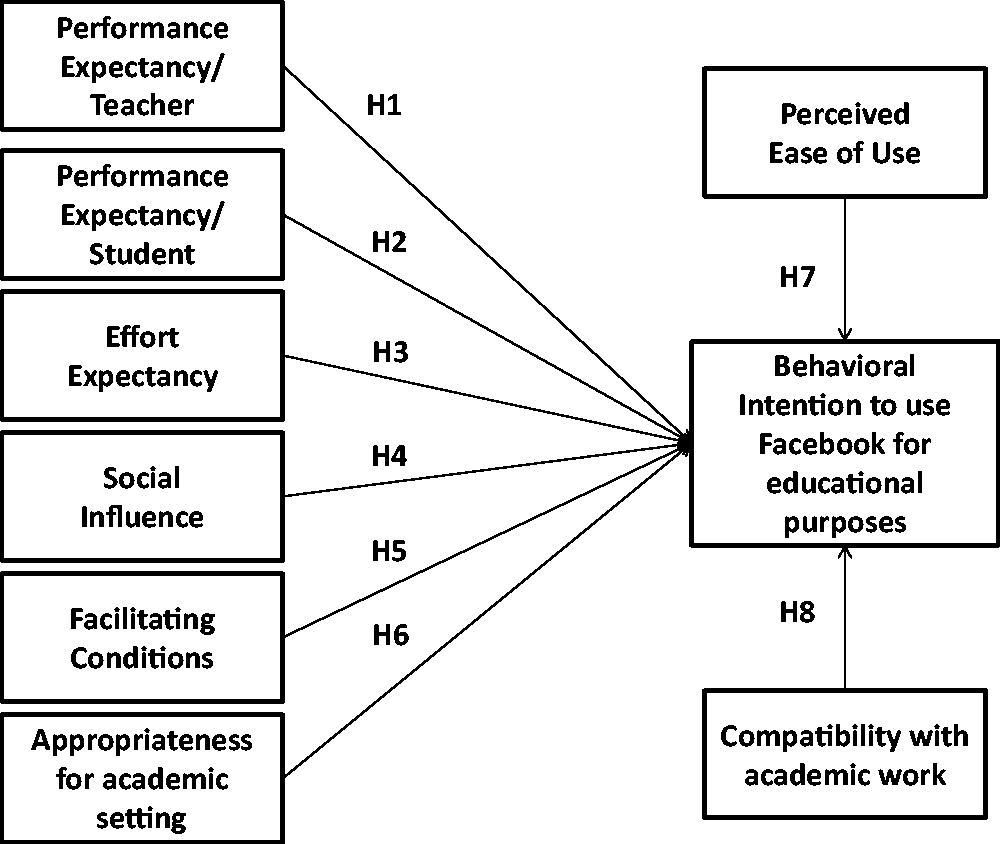
Research model.
Performance Expectancy, Effort Expectancy, Social Influence, and Facilitating Conditions
The UTAUT model establishes Performance Expectancy, Effort Expectancy, Social Influence, and Facilitating Conditions as four core constructs that can be used to predict users’ BIs to adopt information technologies for work-related purposes (Venkatesh et al., 2003).
Venkatesh et al. (2003) define Performance Expectancy “as the degree to which an individual believes that using the system will help him or her to attain gains in job performance,” and Effort Expectancy as “the degree of ease associated with the use of the system.” Facilitating Conditions are defined as “the degree to which an individual believes that an organizational and technical infrastructure exists to support the use of the system” while Social Influence is “the degree to which an individual perceives that important others believe he or she should use the new system.”
The UTAUT has been widely used in different contexts (such as near-field communication and mobile-based payment technology): acceptance in the restaurant industry (Khalilzadeh et al., 2017), e-Banking adoption (Oliveira et al., 2014), and acceptance of Enterprise Resource Planning software (Chauhan and Jaiswal, 2016). In the educational context, this theory has been used to study the role that computer anxiety can play on female university students’ perceptions toward Web 2.0 applications for learning (Yoo et al., 2012). This theory has also been used to analyze why and how scholars are using social media for communication and information dissemination, (Gruzd et al., 2012) to study the use and acceptance of social media among health educators (Hanson et al., 2011) and to study how non-profit organizations use social media for public relations (Curtis et al., 2010).
Several researchers have confirmed the relationship between Performance Expectancy, Effort Expectancy, Social Influence, Facilitating Conditions, and Behavioral Intentions to Use. For instance, Magsamen-Conrad et al. (2015) found that Effort Expectancy and Facilitating Conditions were determinants that positively predicted tablet use intentions. Bennani and Oumlil (2014) discovered that Performance Expectancy positively influences the perceived advantages of social media platforms during the teaching/learning process, and it significantly affects students’ adoption entrepreneurship. Finally, Tosuntas et al. (2015), Lakhal et al. (2013), and Nistor et al. (2013) demonstrated the impact of Effort Expectancy on Behavioral Intention to Use a technology.
Social Influence is correlated to BI in many studies about social media users such as employee recruitment and selection (El Ouirdi et al., 2016), recruitment and selection process of library professionals and faculty members (Yuvaraj, 2016), scholars (Gruzd et al., 2012), students (Ismail, 2010; Sánchez et al., 2014), and health educators (Hanson et al., 2011).
Finally, the relationship between Facilitating Conditions and Behavioral Intention and Use behavior is supported in recruitment and selection processes (El Ouirdi et al., 2016; Yuvaraj, 2016), in academia (Gruzd et al., 2012; Ismail, 2010), and in tablet use intentions (Magsamen-Conrad et al., 2015)
Therefore, this study hypothesizes that:
Appropriateness for Academic Setting
Sheldon (2015) developed a new measure—Appropriateness for Academic Setting—to account for the unique context of using Facebook for academic purposes. Her paper examined students’ reasons and gender differences in adding faculty as Facebook friends and concluded that there is a neutral belief about the appropriateness of having a professor as a Facebook friend. Moreover, her results showed no gender difference in appropriateness. We adapt and include this new variable in our model expecting that it will be a factor that affects the intention to use Facebook for educational purposes. In our context, Appropriateness for Academic Setting measures students’ comfort/discomfort in using Facebook with their instructors. Therefore, this study hypothesizes that:
Perceived Ease of use
The TAM has extensively studied the individual acceptance and usage of new technologies (Davis et al., 1989). According to this model, the two main factors that determine intention are as follows: Perceived Usefulness and Perceived Ease of Use (Davis et al., 1989; Davis and Wiedenbeck, 2001). Our research model includes “Perceived Ease of Use” as a potential determinant of Behavioral Intention to Use Facebook for educational purposes because many empirical studies have shown that this variable has a significant impact on the BI to adopt technological innovations (Sin et al., 2012; Tsu Wei et al., 2009). In our study, Perceived Ease of Use is defined as “the degree to which the individual considers that the usage of Facebook for educational purposes would not entail extra effort.”
Therefore, this study hypothesizes that:
Compatibility With Academic Work and Behavioral Intention
The IDT has been used to analyze the diffusion process of a wide variety of innovations (Rogers, 2003). Moore and Benbasat (1991) established the factors that could be used to analyze individual information technology acceptance. These factors are relative advantage, compatibility, complexity, trialability, and visibility. Relative advantage and compatibility have proved to be the factors that have a more significant impact on consumer intention to adapt new technologies (Agag and El-Masry, 2016; Lu et al., 2011).
Compatibility is defined as “the degree to which an innovation is perceived as being consistent with the existing values, needs, and past experiences of potential adopters” (Moore and Benbasat, 1991). Our research model includes Compatibility With Academic Work, expecting it to be a significant determinant of Behavioral Intention to Use Facebook for educational purposes. BI is concerned with the factors behind an individual’s intention to carry out a behavior (Ajzen, 1991). Oliveira et al. (2016) point out that consumers with a higher intention to adopt a new technology are more likely to become adopters (Leong et al., 2013) and to recommend the technology to others (Miltgen et al., 2013). In our study, Compatibility With Academic Work is defined as the degree to which Facebook is perceived as being consistent with the existing values, needs, and past experiences of students in order to improve their learning.
Therefore, this study hypothesizes that:
Research methodology
Participants and procedure
This study focuses on young adults studying at a public university in Spain. Students enrolled in undergraduate business programs at the University of Huelva (Spain) were invited to participate in an online survey. Specifically, the URL to the survey was e-mailed to students, inviting them to participate in the study. Students were not given any extrinsic reward for participating in the survey, and it was made clear that participation was strictly voluntary and anonymous. Consistent with earlier studies in the area, a non-random sampling technique was used for collecting data (Sharma et al., 2016; Wang and Wu, 2008). When the survey was sent, some students were using Facebook to follow courses such as business information systems. Those students who had never used Facebook in class answered the questions thinking how they would feel if they had used it.
Our results (Table 1) show the predominance of female Facebook users (55.6%) over male users (43.6%) and their age ranged from 18 to 44 years (M = 22.79, standard deviation (SD) = 3.66). Most Facebook users are enrolled in the third (n = 92) and fourth (n = 50) course levels. The majority of these students go online from several times a day (36%) to all the time (15%). When asked about the number of Facebook friends they have, the responses were extremely different; some participants reported having 28 friends while others had 982 friends (M = 268.11, SD = 175.32).
Demographic profiles and descriptive statistics of respondents.
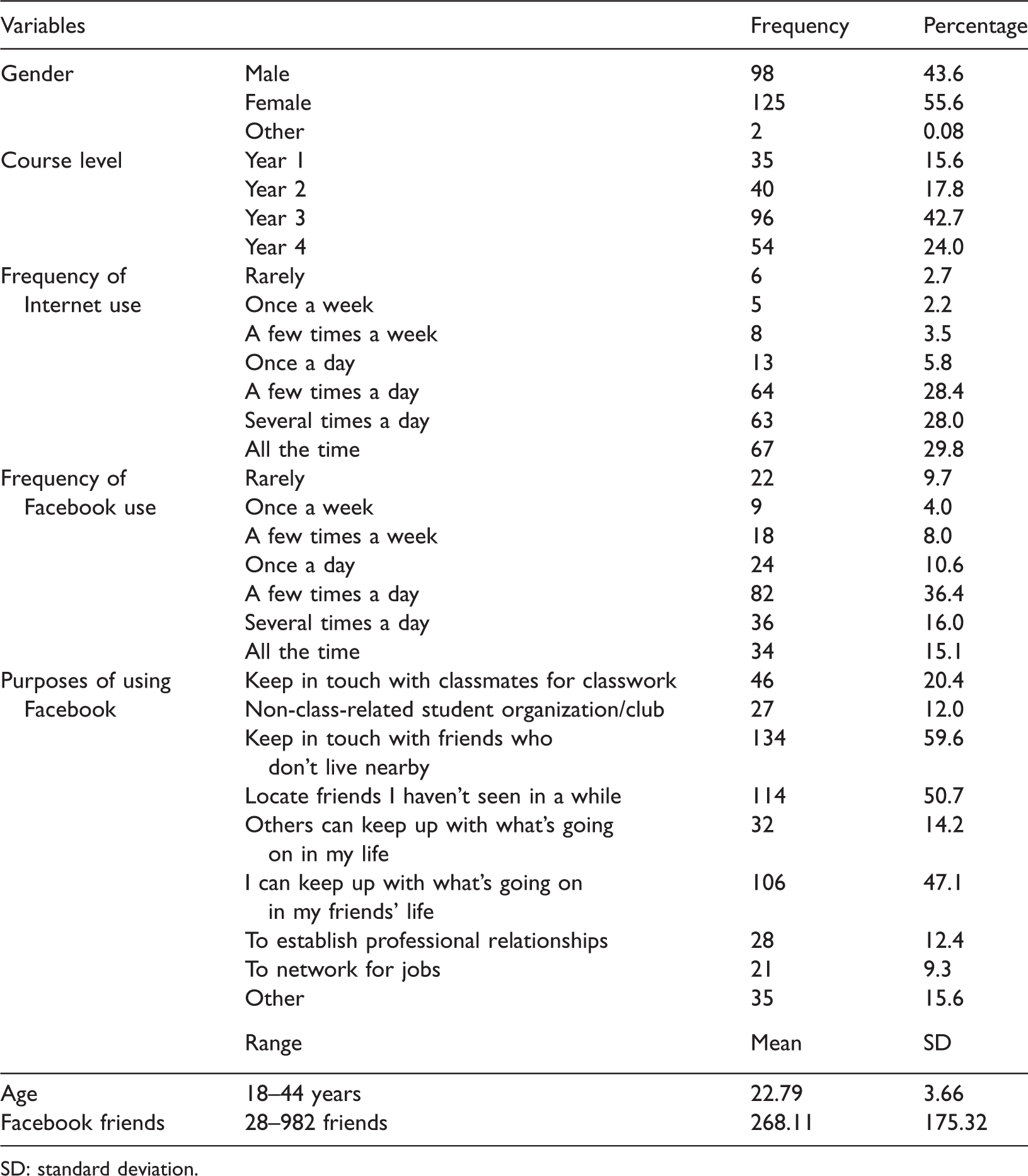
SD: standard deviation.
Most survey respondents use Facebook to stay in touch with friends who do not live nearby (60%), to locate friends they have not seen for a while (51%), and to keep up with what is going on in their friends’ lives (47%). On the other hand, only 20% reported that they use Facebook to keep in touch with classmates for classwork, while 12% use it to establish professional relationships, and 9.3% to network for a job. According to these results, we can conclude that Facebook is mainly used as a tool to locate and keep in touch with friends who do not live nearby.
Measurement
The scales for each variable in our model (Figure 1) were adopted from previous studies. We borrowed and adapted to the educational context from the UTAUT model: (1) “Performance Expectancy,” (2) “Effort Expectancy,” (3) “Social Influence,” and (4) “Facilitating Conditions.” In addition, we included (5) “Perceived Ease of Use,” from the TAM, and (6) “Compatibility With Academic Work and Behavioral Intention,” from the IDT. And finally, to account for the unique context of integrating Facebook into university coursework, we included the factor “Appropriateness for Academic Setting,” developed by Sheldon (2015) to measure students’ comfort level when using Facebook with their instructors. All items were measured using a seven-point Likert-type scale, with the anchors being 1 = strongly disagree to 7 = strongly agree. Gender was coded on a nominal scale where 1 represented woman, 2 represented man, and 3 represented other. Age was measured in years. Respondents’ use of Internet and Facebook was measured by asking about the frequency of usage, which was ranked on a seven-point interval scale (1 = rarely to 7 = all the time).
The initial questionnaire used to collect data from students was created in English. The questionnaire was divided into two parts. The first part of the survey consisted of questions on the main variables of this study, e.g. students’ perceptions of social media usage in higher education (see Appendix 1). The second part of the survey consisted of questions on key demographic variables and the frequency of Internet and Facebook usage, the purposes of using Facebook in general, and the purposes of using Facebook for teaching. The final questionnaire was administered in Spanish, so the English questionnaire was translated into Spanish and then back into English to ensure translation equivalence (Brislin, 1970).
Results
Assessment of measures
Exploratory factor analysis (EFA) and confirmatory factor analysis (CFA) were conducted to assess the convergent and discriminant validity, reliability, and unidimensionality of factor structures of the UTAUT constructs. We used SPSS 22.0 for the EFA. Structural equation modeling (AMOS 22.0) was employed for the CFA and to test the proposed research hypotheses.
To assess the validity of measures, a single measurement model was estimated. The chi-square (χ2) statistic for the model is significant (χ2/(df) = 1.887), as might be expected due to the large sample. The other fit indices indicate a good fit (Comparative Fit Index = .941; Tucker–Lewis Index = 0.934; root mean square error of approximation = .053). All items load significantly on their respective constructs, and factor loadings range from 0.71 to 0.95. This meets the threshold of 0.50 set by Hair et al. (2006) and demonstrates convergent validity at the item level. In addition, at the construct level, the reliability coefficients (Cronbach’s alpha) and composite reliability for all constructs were well above the threshold level of 0.70 (Nunnally and Bernstein, 1994), and the average variance extracted (AVE) exceeds 0.50 (Fornell and Larcker, 1981), all of which provide evidence for convergent validity at the construct level (see Table 2). Evidence of discriminant validity is provided by the fact that the AVE for each construct is greater than the squared correlation between that construct and any other construct in the model (Fornell and Larcker, 1981). Table 2 also presents the correlation matrix.
Reliability and validity of constructs.
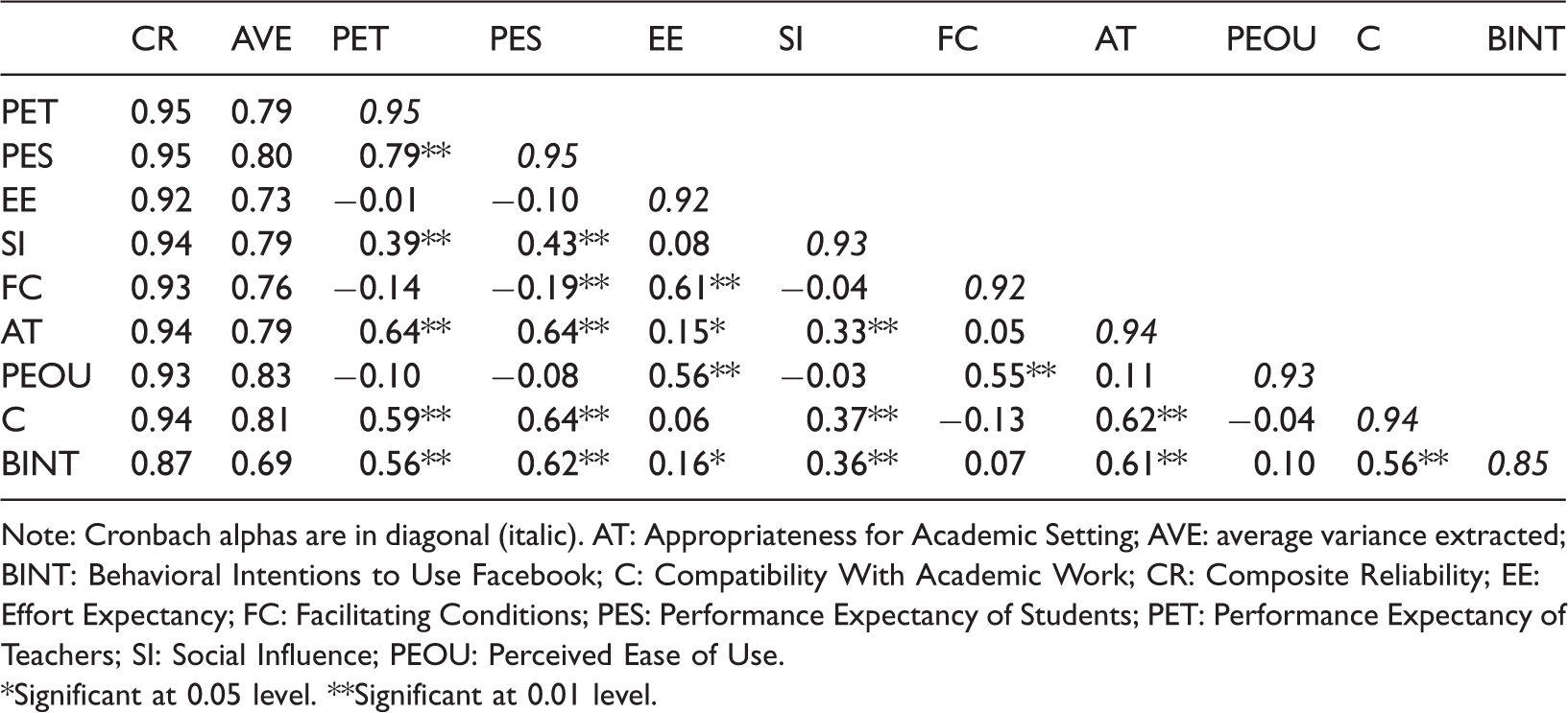
Note: Cronbach alphas are in diagonal (italic). AT: Appropriateness for Academic Setting; AVE: average variance extracted; BINT: Behavioral Intentions to Use Facebook; C: Compatibility With Academic Work; CR: Composite Reliability; EE: Effort Expectancy; FC: Facilitating Conditions; PES: Performance Expectancy of Students; PET: Performance Expectancy of Teachers; SI: Social Influence; PEOU: Perceived Ease of Use.
*Significant at 0.05 level. **Significant at 0.01 level.
Structural model results
Table 3 shows the results obtained from the structural model for testing the proposed hypotheses. These results showed that “Performance Expectancy of Students,” “Appropriateness for Academic Setting,” and “Compatibility With Academic Work” influence the “Behavioral Intentions to Use Facebook for academic purposes.” Performance Expectancy of Students (β = 0.40, p < 0.01) was the most influencing determinant of Behavioral intentions to Use Facebook for academic purposes, followed by Appropriateness for Academic Setting (β = 0.38, p < 0.01), and Compatibility With Academic Work (β = 0.34, p < 0.01).
Results of structural equation modeling.
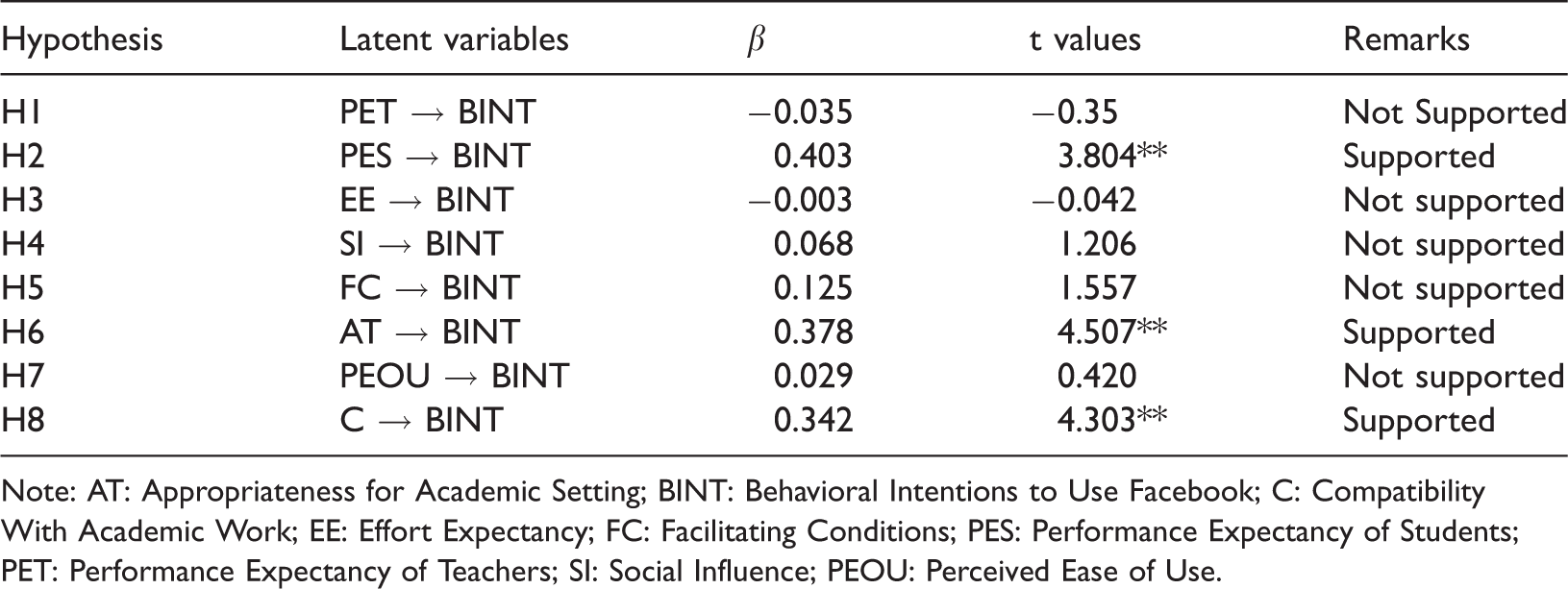
Note: AT: Appropriateness for Academic Setting; BINT: Behavioral Intentions to Use Facebook; C: Compatibility With Academic Work; EE: Effort Expectancy; FC: Facilitating Conditions; PES: Performance Expectancy of Students; PET: Performance Expectancy of Teachers; SI: Social Influence; PEOU: Perceived Ease of Use.
Findings and discussion
The results of this research reveal that “Performance Expectancy of Students,” “Appropriateness for Academic Setting,” and “Compatibility With Academic Work” are the main factors that influence the “Behavioral Intentions to Use Facebook for academic purposes.” The positive influence of “Performance Expectancy of Students” toward Behavioral Intentions to Use Facebook for academic purposes (H1) is consistent with the belief that university students feel that using this tool will increase their productivity and will allow them to accomplish their tasks more quickly. These results are aligned with findings from previous studies conducted by Nawi et al. (2017), McKeown and Anderson (2016), Escobar-Rodriguez et al. (2014), and Venkatesh et al. (2003).
“Compatibility With Academic Work” also has a positive and significant effect on Behavioral Intentions to Use Facebook for academic purposes (H8). Therefore, students who feel that Facebook fits their lifestyles and needs may be more inclined to use it for educational purposes. As our results show (67.5% of the students in our sample check their Facebook from few times to all the time during the day), the use of Facebook is consistent with their existing values, needs, and past university experiences. Along the same lines, Cao et al. (2013) showed that task-technology compatibility between teaching and social media applications has a positive effect on the use of social media for academic purposes. However, and contrary to these findings, Manca and Ranieri (2016) did not conclude that task-technology compatibility has a positive effect on the educational use of social media.
In addition, “Appropriateness for Academic Setting” is the second most important factor influencing Behavioral Intentions to Use Facebook for academic purposes. This means that students who feel comfortable when they interact with their lecturers on Facebook and believe Facebook is an appropriate platform for lecturers to use with their students will have the intention to use Facebook for academic purposes. This result confirms the conclusions reached by Sheldon (2015) and Baran (2010). Baran (2010) conducted a study in Turkey that showed that students believed it was quite appropriate for instructors and students to socialize through Facebook. However, these conclusions were contradicted by Malesky and Peters (2012) who pointed out that nearly 40% of students and 30% of the faculty believed that it is inappropriate for lecturers to even have an account on SNSs. Students viewed the lecturers’ actions as being more appropriate only when they are trying to assist their students.
In our study, the factors “Performance Expectancy of Teachers,” “Effort Expectancy,” “Social Influence,” “Facilitating Conditions,” and “Perceived Ease of Use” have no significant influence on the intention to use Facebook for academic purposes. Contrary to our findings, previous studies have supported these relationships. For instance, Sharma et al. (2016) showed that Social Influence is a determinant variable that influences the decision to use Facebook in higher education. Moreover, in other context, Yuvaraj (2016) discovered that Performance Expectancy, Effort Expectancy, Social Influence, as well as Facilitating Conditions triggered the BI of recruiters to adopt social media. Our results could be interpreted as Effort Expectancy, Social Influence, Facilitating Conditions, and Perceived Ease of Use being variables that are considered more oriented to the use of Facebook for general purposes and not in an academic setting. More specifically, as we mentioned before, the effect of “Performance Expectancy of Teachers” is not a significant factor (H1). The reason for this result could be that students do not fully understand the potential of Facebook for teaching purposes; they do not believe that Facebook can actually help lecturers improve their teaching strategies. This may happen because students are not aware of the potential of Facebook for lecturers teaching, and they are not really sure if Facebook increase lecturers‘ productivity, or help them to teach in a more efficient way.
Conclusions, limitations, and future research
The expansion of digital, social, and mobile technologies has created a culture of content sharing that has transformed not only the way in which we communicate and interact with each other, but it has also reshaped the learning process. The online resources provided by SNSs allow users with common interests to meet, share ideas, and collaborate, creating new forms of informal learning (Brown and Adler, 2008; Maloney, 2007). As Phillips et al. (2013) point out, some students spend more time using these informal learning platforms to interact with their classmates, organize class projects, and receive comments than they do with their teachers in the traditional classroom.
However, the research on the effectiveness of using Facebook for academic purposes is mixed (Irwin et al., 2012; Schroeder and Greenbowe, 2009). Many authors determined that students view Facebook primarily as a social tool and generally are not enthusiastic about the idea of formally introducing it into university classes (Baran, 2010; Madge et al., 2009; Selwyn, 2009), though this finding isn’t universal (Roblyer et al., 2010; Smith and Caruso, 2010). Despite all its well-hyped potential, faculty are typically even less enthusiastic about using Facebook than are their students (Ajjan and Hartshorne, 2008; Cloete et al., 2009; Roblyer et al., 2010; Sharma et al., 2016).
But the reality is that, despite the ambivalence of faculty and students, and the inconclusive results about its effectiveness, Facebook is being used in higher education for formal learning. In order to understand and eventually take advantage of the many benefits that Facebook can bring to the academic world, we need to study its adoption process. Once we understand the reasons that may motivate students to adopt Facebook as an educational tool, we will be in a better position to translate these insights into actionable strategies and programs.
Therefore, the objective of this article is to identify the factors that may motivate university students to adopt and use Facebook as an educational tool. We aim to contribute to the existing literature by adding a unique approach to examine this question, incorporating theories and constructs from the well-developed technology acceptance theory, and adapting and adding to that work to fit the unique context of integrating Facebook into university coursework.
To reach this goal, we build a model based on the previous models that have been historically used to explain the diffusion, acceptance, and adoption of technological innovations. We borrow and adapt to the educational context four measures from the UTAUT model: (1) “Performance Expectancy,” (2) “Effort Expectancy,” (3) “Social Influence,” and (4) “Facilitating Conditions.” In addition, we include (5) “Perceived Ease of Use,” from the TAM, and (6) “Compatibility With Academic Work and Behavioral Intention,” from the IDT. And finally, to account for the unique context of integrating Facebook into university coursework, we included the factor “Appropriateness for Academic Setting,” developed by Sheldon (2015) to measure students’ comfort level with using Facebook with their instructors.
According to our results, Performance Expectancy of Students is the most important factor on predicting the Behavioral Intention to Use Facebook for academic purpose, followed by Appropriateness for Academic Setting and Compatibility with Academic Work. Therefore, we can conclude that students who feel that Facebook enable them to accomplish their academic work faster or allow them to increase their performance will have a positive intention to use Facebook for academic purposes. In addition, students who feel that Facebook suits their lifestyles and it is an appropriate educational platform will have a positive intention to use Facebook for academic purposes.
The findings of this research show that students are well aware of the positive impact that Facebook may have on their academic performance. Therefore, we recommend educational institutions to teach their instructors how to use Facebook in the most effective way. The proper incorporation of Facebook and other social media tools in the education system requires proper planning and coherence with the rest of the didactic resources. Moreover, lecturers need to spend time and effort to create a good course dynamic to engage students by the incorporation of more participatory practices. We also suggest investing in technical infrastructure and support to innovate teaching practices and educational services in order to help lecturers incorporate social media into their courses properly (Buchanan et al., 2013; Manca and Ranieri, 2016). The benefits of having a more connected and motivated student body can easily outweigh the costs of its proper implementation.
Although our research indicates that Facebook is an effective tool in teaching and learning processes, we must remember that educators should be highly sensitive to the negative effects of this tool, such as inappropriate behaviors, abuse, and cyberbullying (Aydin, 2012). Thus, the ethics of Facebook use should be examined and regulated on global, national, and educational-based scales, as results show that users require more definitive guidelines when participating in online social networks (Birky and Collins, 2011).
The limitations of this research can be grouped into three different categories. The first one is related to the sample. All the students who participated in this study come from a business school located in the South of Spain. It would be interesting to expand the scope of this research and compare results from different populations of students. Future studies could analyze whether there are significant differences in students’ perceptions depending on the degree they are studying or their country of origin. The second limitation would be the fact that we focused our research on a specific SNS. Even though Facebook stands out as the leader (www.statista.com), it would be worthwhile to explore additional academic studies about students’ perceptions of other tools such as wikis, blogs, social bookmarking, or twitter. The third limitation is related to the inclusion of additional variables that might affect university students to adopt and use Facebook as an educational tool, which could be pedagogical appropriateness, technological affordances of the platform among others.
To conclude, we must remember that, even though Facebook has the potential to improve the teaching-learning process and students spend many hours connected to this SNS, Information and Communication Technologies should never replace great teaching. Virtual learning environments allow instructors to expand the boundaries of the traditional classroom, but they should be used only as a supplement of good teaching practices.
Footnotes
Declaration of Conflicting Interests
The author(s) declared no potential conflicts of interest with respect to the research, authorship, and/or publication of this article.
Funding
The author(s) received no financial support for the research, authorship, and/or publication of this article.