




Abstract
As an instant messaging application accessed through smartphones, WhatsApp is currently used by millions of people across the world to share information in various formats such as audio, photos, videos and text. The higher education is one of the sectors where the hype of WhatsApp has been acknowledged and consequently, students and lecturers continue to embrace this technology. Using the decomposed theory of planned behaviour model, the study investigated the use of WhatsApp technology by information and communication technology students and land management students at Mzuzu University in Malawi. In order to collect both, qualitative and quantitative data, researchers used a questionnaire with predominantly closed ended questions and semi structured interviews. Findings showed that 51 (92.7%) students own smartphones and the majority use WhatsApp to accomplish various academic activities including sharing academic information, communicating with fellow students and lecturers, and conducting collaborative learning activities. According to the study, the benefits associated with WhatsApp use by students included instant sharing of information, academic collaboration, and ability to learn beyond classroom hours. Challenges include costs of ICT gadgets, frequent electricity outages and unreliable Internet connection from mobile network service providers. The study recommends that Mzuzu University should improve Internet bandwidths and install more Wi-Fi access points across the campus. The study recommends further that mobile network service providers in Malawi should offer special or competitive smartphones prices to students in addition to improving their network signal.
Keywords
Introduction
According to the International Telecommunication Union (2017: 9), the number of mobile phone subscriptions has grown exponentially over the years, from 738 million in 2000, to over seven billion in 2015, with most of this growth taking place in the developing world. Technologies such as mobile devices have permeated our daily lives and provide inexhaustible access to communication and information. While it is a known fact that many fields are exploiting the power of mobile phones alongside their applications, the higher education has not been spared from the lure of mobile phones alongside their applications. Studies about the use of emerging technologies and mobile learning to improve student learning are becoming more prolific in higher education (Bozalek et al., 2015; Pimmer and Pachler, 2014; Veletsianos, 2010). Some researchers have specifically reported about the benefits and purposes that mobile phones alongside their applications bring to higher education. Madeira et al. (2009) report that emerging technologies afford students the opportunity to visualize and interact with learning content by using multimedia, rich graphics, animation, simulation, and virtual environments. Educators in higher education institutions (HEIs) are ‘tech-savvies’ (Willemse, 2015: 1). Ludlow and Duff (2009) report that Internet technologies have had a more dramatic influence on education than any previous technological innovation because Internet technologies allow individuals of all ages to access education and training programs with less effort and cost. Internet technologies permit users to access resources and communicate using the World Wide Web. Moreover, advancements in information and communication technology (ICT) have profoundly revolutionised higher education especially with regard to the delivery and presentation of lectures (Chawinga and Zinn, 2015). Educators and students use mobile technologies in diverse contexts for a variety of teaching and learning purposes, for example discussion forums, creation and distribution of content, increased individual support and personal development (Conejar and Kim, 2014: 193).
ICT experts coined the term Web 2.0 in 2005 (see O’Reilly, 2005) as one way of giving users an opportunity to contribute content to the world wide web. The term Web 2.0 is defined by Kaplan and Haenlein (2010: 61) and Barczyk and Duncan (2011: 267) and Chawinga (2017) as applications that support user generated content. ICT applications that enable users generate their own content courtesy of Web 2.0 are called social media (Barczyk and Duncan, 2011: 267). Since 2005, many social media applications have been introduced and some of the most popular ones include: blogs, wikis, Real Simple Syndication (RSS) feeds, YouTube, Flickr, Facebook, Twitter, Skype and WhatsApp (Armstrong and Franklin, 2008; Chawinga, 2017; Hough and Neuland, 2012). Some of these social media technologies have proved useful in teaching and learning in higher education. For instance, researchers have studied importance and use of WhatsApp in teaching and learning in higher education (Pimmer et al., 2018; So, 2016).
Social media and the higher education: Some brief facts
As already stated, social media networks have made some significant penetration into the higher education (Nassar, 2016: 1). Some empirical studies have demonstrated the value of social media in teaching and learning in higher education. Among other benefits, social media tools encourage students to participate in online classroom where students use them to communicate with their lecturers, colleagues, share news, course resources and ideas (Chawinga, 2017). More importantly, social media has proven to enhance active learning and search activities of students thereby affording them an opportunity to develop collaboration and communicating skills, and creating a learning environment to be self-directed learners (Chawinga and Zinn, 2016; Nassar, 2016). On the part of instructors, social media offers them a convenient way of sharing ideas with students and providing feedback to students about their work (Chawinga, 2017; Nassar, 2016). This study focuses on the use of WhatsApp in teaching and learning at a university in a developing country.
The WhatsApp messenger: Its background, features and use
WhatsApp is one of the world’s most popular communication applications in the 21st century (Ahad and Lim, 2014). The potential for using WhatsApp as an instant messaging tool is particularly pertinent in resource-poor contexts, because it is currently one of the most commonly used applications on mobile phones, additionally it is a free service (Rosenfeld et al., 2018; Yeboah and Ewur, 2014: 157). To access WhatsApp, users are expected to be connected to the Internet through mobile data or Wi-Fi.
There are plenty of features that make use of WhatsApp in HEIs more attractive as outlined by Kadam and Mhatre (2016), Boyinbode et al. (2017) and Bouhnik and Deshen (2014). One of the features is that WhatsApp has a capability of being customised to operate in various smartphone operating systems such as Android and can be accessed through most other smartphones regardless of the operating system or the type of the smartphone. The common use of WhatsApp includes sending and receiving in real-time to individuals or groups of text messages, pictures, videos, voice messages and user’s location and contacts. WhatsApp application affords users to easily share anything created using this application with other web-based information sharing applications such as, Facebook, Twitter, Emails just to mention some of the most notable ones.
WhatsApp also acts as an information archiving application because users can back up or store their important conversations or information that can be retrieved later. WhatsApp also allows users use a phone short text message facility, an email, Facebook and Twitter to invite colleagues to join WhatsApp. Finally, even if the user is offline, WhatsApp saves messages until they are retrieved during the next application use (Rosenfeld et al., 2018; WhatsApp, 2017). It is therefore a compendium of all the features and functionality that make WhatsApp more attractive to be used in HEIs.
Brief literature review
Several studies have set out to establish awareness, familiarity and the frequency of social media usage among students in higher learning institutions. Findings by Tuurosong and Faisal (2014), Naidoo and Kopung (2016), Tawiah et al. (2014) and Willemse (2015) have all revealed that WhatsApp is the most frequently used social media amongst students followed by other social networks such as Facebook, Twitter, Skype and YouTube. Students usually use WhatsApp to chat with friends and relations and for academic purposes. Sobaih et al. (2016) investigated the importance and use of social media in higher education in developing countries as effective teaching and learning tool. The results revealed extensive acceptance of social media use by students for academic purposes. As claimed by Sobaih and Moustafa (2016) and Tassiopoulos (2010) in relation to teaching and learning in higher education, social media have excessive prospective to be used as a communication podium for educational related activities and can bridge the digital gap between developed and developing countries.
A study in Hong Kong by So (2016) assessed the use of mobile instant messaging tools to support teaching and learning in higher education. Sixty-one undergraduate students who had smartphones with WhatsApp were assigned into experimental and control groups. Results revealed that members in the experimental group did well than members in the control group. WhatsApp intervention improved learning achievement of members in the experimental group. So (2016) further report that members in the experimental group showed affirmative perception and acceptance of incorporating WhatsApp in teaching and learning.
A study involving nursing students from five schools in Oyo State, Nigeria which was part of a multinational research project on the use of mobile social media in health professions education in developing countries, studied the use of WhatsApp by students during placements. Findings suggest that students used WhatsApp for their communication with their fellow students and nurses. WhatsApp use was associated with students' upheld social capital with fellow students and reduced feelings of isolation. Perceived ease of use and perceived usefulness influenced WhatsApp use during placements (Pimmer et al., 2018).
Benefits associated with the use of WhatsApp in teaching and learning
Literature reveals a number of benefits associated with the use of WhatsApp in teaching and learning. A study by Amry (2014) revealed that students used WhatsApp because the technology made learning easy and flexible, allowed collaborative learning and knowledge sharing. Other researchers have also indicated that using technologies such as WhatsApp creates an affective learning and teaching environment between students and instructors (Zengin et al., 2011). In his study at a Saudi Arabia University, Barhoumi (2015) found that students felt that social networking tools based on mobile learning activities helped with learning and knowledge sharing and the acquisition, dissemination, and analysis of information and knowledge. Based on several studies (Naidoo and Kopung, 2016; So, 2016; Trenkov, 2014; Willemse, 2015), some key advantages have emerged: reduced time needed for face-to-face meetings, building a deeper trust between students and instructor, provision of a larger scope of feedback, help motivate students better due to continued integration with instructors beyond working hours, offers minute-by-minute level feedback (with little no lag time), continued interactions even after the course is completed, provision of a secure learning environment, and assist students in improving their academic performance.
Amry (2014) argues that WhatsApp instant messaging is very easy to use and this characteristic encourages the majority of university students to use this mobile system for academic and other purposes.
Challenges associated with the use of WhatsApp in teaching and learning
Despite enormous benefits of using WhatsApp, some researchers have reported about the challenges of using WhatsApp in academic activities. Johnston (2013) reported that some lecturers and students have scepticism when intending to use social networks such as WhatsApp in a classroom because they regard such technologies as distractors to school work. Kuppuswamy and Narayan (2010) explained that the social networks grab the total attention and concentration of the students and diverts it towards non-educational and inappropriate actions such as time killing by random searching and not doing their jobs. Such claims were explored and discussed by Yeboah and Ewur (2014) who found that students at a Ghanaian university used WhatsApp for chatting with friends on different issues rather than for academic work and described WhatsApp as a necessary evil for students in tertiary institutions in Ghana.
Research problem
The research problem of this study originates from two key sources. First, both researchers who work at Mzuzu University have observed that Mzuzu University has made tremendous strides in improving ICT infrastructure. For example, the University offers free computer and Internet services through the library to students and lecturers. The University has other three computer laboratories and wireless access points which are accessible by all students on the University campus. More so, most students whom we teach have smartphones which are the mostly used mobile devices for accessing various social networks including WhatsApp. Likewise, most lecturers at Mzuzu University have smartphones and other advanced mobile devices such iPads and Tablets. Previous studies done at Mzuzu University by Chawinga (2017) looked at the combined role of blogs and Twitter in teaching and learning, Chawinga (2016) looked at the role of Twitter in a university classroom and Chawinga and Zinn (2015) investigated the use of various Web 2.0 technologies in teaching and learning. More so, despite prior studies conducted in other countries revealing the power of WhatsApp in teaching and learning (see Naidoo and Kopung, 2016; So, 2016; Trenkov, 2014; Tuurosong and Faisal, 2014; Willemse, 2015), it seems no such a study has been conducted in Malawi being a developing country. In view of the seeming gap, the present study investigates how WhatsApp is being used by students at Mzuzu University. In light of the research gap, the study is guided by four research questions as follows:
What is the current awareness of and familiarity with WhatsApp amongst ICT and land management students? For what educational purpose do ICT and land management students use WhatsApp? What do ICT and land management students perceive as benefits of using WhatsApp? What are the factors that influence ICT and land management students to adopt WhatsApp?
Theoretical framework: Decomposed theory of planned behaviour
Several models and theories have been developed to explain and predict behavioural intention to accept an information technology (IT) (Sahli and Legohérel, 2014). Among these models are the Technology Acceptance Model (TAM) by Davis (1989), the theory of planned behaviour (TPB) by Ajzen (1991), the decomposed theory of planned behaviour (DTPB) Model by Taylor and Todd (1995) and the theory of innovation diffusion by Rogers (1962) (Sahli and Legohérel, 2014). This study is informed by the decomposed theory of planned behaviour.
Taylor and Todd (1995) developed the DTPB as an extension of the TPB. This model aims to explain the behaviour of users based on the relationship between beliefs, attitudes, intention, and behaviour. According to Taylor and Todd (1995), attitudes, subjective norms, and perceived behavioural control are the elements that help to understand the reasons or factors that influence individual intentions to adopt an innovation (Crespo and Rodriguez Del Bosque, 2008; Rogers, 1995). The theory has been adopted in this study because some researchers (Baharun et al., 2014; Chawinga and Zinn, 2015; Hastuti et al., 2014; Shih and Fang, 2004) have endeavoured to shed more light on how the DTPB explain the acceptance and rejection of ICTs in HEIs.
There are three factors under the construct of attitude and they include perceived usefulness, ease of use and compatibility. Perceived usefulness is defined as the degree to which an individual believes that a technology can improve their job performance (Davis, 1989: 320). In this case, students are likely to accept a technology if they have a perception that this technology can add value to their learning activities. Ease of use represents how simple an innovation is to understand and operate (Rogers, 2003: 70). The implication is therefore that if students perceive a technology as user friendly, they are likely to accept and incorporate them in their educational activities. Compatibility refers to the extent to which a technology fits with the potential existing values and experiences (Rogers, 2003: 72) implying that students will accept and use technology if they marry well with their existing learning practices. Subjective norms refer to the social pressures that make an individual perform a particular behaviour (Ajzen, 1991: 202). For example, students can be influenced by fellow students, and their lecturers to start using a technology in their academic activities.
Perceived behaviour control consists of three aspects: self-efficacy, resource facilitating condition and technology facilitation condition. Taylor and Todd (1995: 156) point out that individuals are likely to accept and use the technology if they are themselves comfortable using it (self-efficacy). In terms of resource facilitating condition and technology facilitation condition, students are likely to accept new technologies if there are favourable conditions or facilitating conditions. Examples of facilitating conditions in this case may include time and money (resource facilitating condition), mobile technologies and strong Internet bandwidths (technology facilitating condition).
Subjective norm of the DTPB has two factors which include peer influence and superior’s influence (Taylor and Todd, 1995). Peer influence explains that if students can be influenced by their colleagues to use or not to use an innovation. In the context of WhatsApp, students can adopt this technology for academic purposes if their colleagues are using it for similar purposes. Superiors in this case are lectures likely that students will be encouraged to use WhatsApp in accomplishing their academic activities if their lecturers are using this technology. Figure 1 depicts the DTPB model.
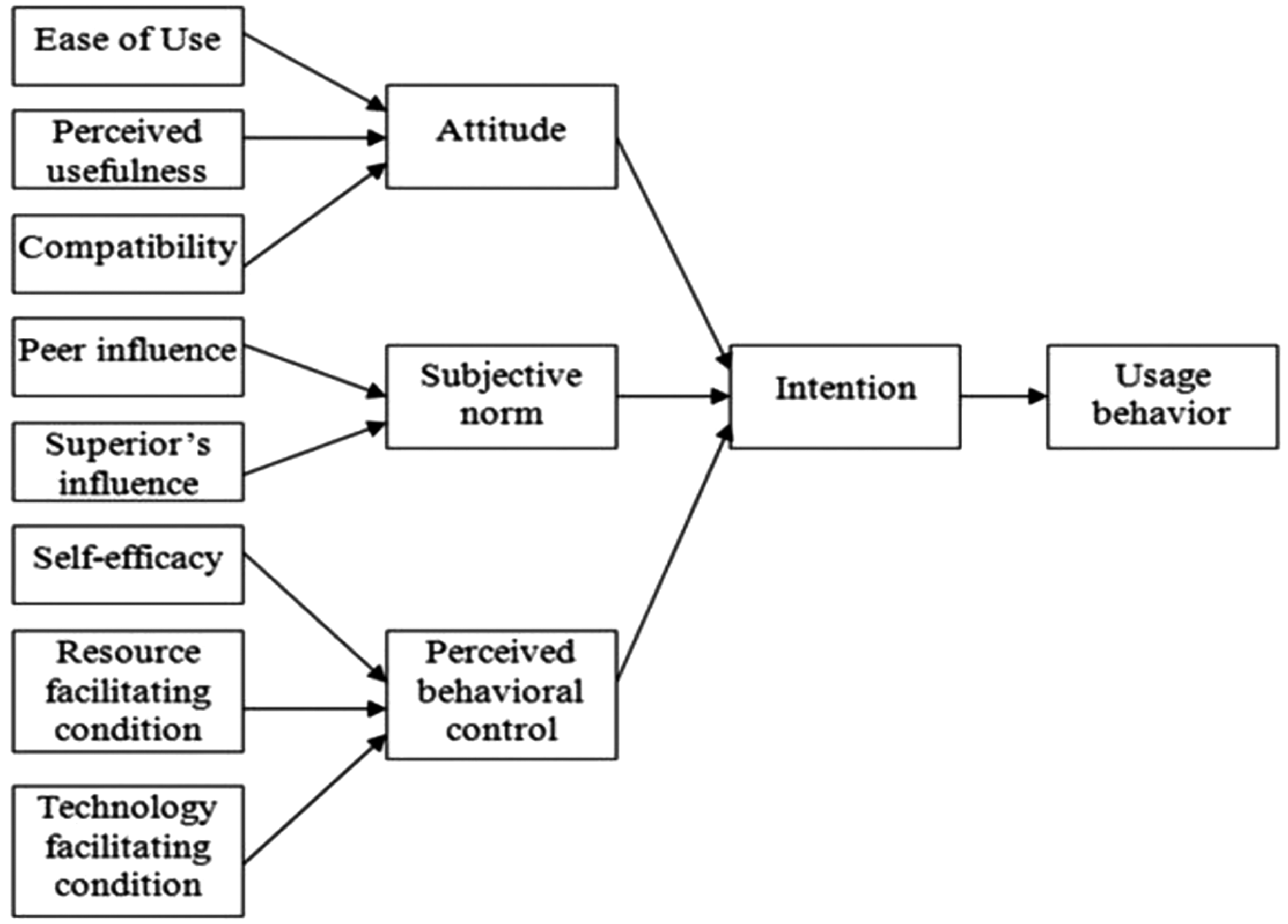
The decomposed theory of planned behaviour (Taylor and Todd, 1995: 163).
Contextual setting
Mzuzu University was officially opened in 1999 as the second public University in Malawi after its establishment by the Act of Parliament in 1997. It is located along the Mzuzu-Karonga Main road and is about few kilometres away north of Mzuzu City in the Northern Region of Malawi (Mzuzu University Annual Report, 2015). The university has six faculties and six centres. It started with the faculty of Education in 1999, and the following additional faculties were later introduced: Environmental Sciences; Tourism and Hospitality Management; Humanities and Social Sciences; Science, Technology and Innovation; and Health Sciences. Centres include Centre for Open and Distance Learning; Centre for Security Studies; Centre for Inclusive Education; Testing Centre for Renewable Energy Technologies; Water and Sanitation; and Centre for Environmental Management.
Methodology
In this study researchers used a quantitative survey and semi structured interviews. The study gathered quantitative data using a questionnaire that contained closed-ended questions and qualitative data were collected through semi structured interviews.
We self-administered questionnaires to 60 students. The questionnaire was divided into the following five sections: general information or background information, awareness and familiarity with WhatsApp, purpose for using WhatsApp, benefits of using WhatsApp in academic activities and factors for use and non-use of WhatsApp. The questionnaire had 12 questions spread across the four sections. The general information section was tailored to explore age, gender, year of study and programme of study. Awareness and familiarity with WhatsApp section was meant to find out student’s experience (years) in using WhatsApp, devices they use in accessing WhatsApp and level of competency. The purposes students use WhatsApp for section was tailored to explore personal use of WhatsApp and activities they perform with WhatsApp. Lastly, factors for use and non-use of WhatsApp section was tailored to find out from students factors which influence students to use or not use WhatsApp.
The qualitative part of the study was collected by conducting semi structured interviews with six respondents that were purposively selected. The researchers purposively selected ICT level 2, level 3 and level 4 class presidents and land management level 2, level 3 and level 4 class presidents to participate in the interviews because the researchers were informally informed by the Heads of Departments of the programs that each class had a WhatsApp group and class representatives were WhatsApp group administrators. Each interviewee was interviewed separately by the researchers to solicit information on each specific objective. Questions were framed to explain factors of perceived usefulness, ease of use and compatibility using DTPB. Data collected through interviews were primarily meant for further explanation on some concepts that emerged in data collected through the questionnaire. Quantitative data from the questionnaires were analysed using the Statistical Package for the Social Sciences (SPSS) and Microsoft Excel and qualitative data which were analysed thematically to validate each other.
Research participants
In this study, data were collected from undergraduate students studying ICT and land management programmes at Mzuzu University in Malawi. The study was conducted between August and September 2017. ICT is a programme offered under the Faculty of Information Science and Communications while land management programme is offered under the Faculty of Environmental Science. The study targeted students who were in level 2, level 3 and level 4. The study targeted students studying ICT and land management because both programmes are science related and in both programmes, students study a compulsory course of End User Computing (BICT 1101) at level 1. It is assumed that End User Computing course is an eye opener to students in terms of ICT. Researchers expect that ICT students should be more aware and competent in using WhatsApp technology considering that they are better grounded in ICT than their counterparts.
Research ethics in this study were followed in two phases. First, before the commencement of the study, we sought and granted permission by the Office of the Research Director to conduct this study at Mzuzu University. Finally, each questionnaire was accompanied by a cover letter which sought consent from participants to answer the questionnaire. The cover letter informed students that participation in the study was voluntary had freedom not to participate if they wished so, and if even they voluntarily accepted, they were informed that they were at liberty to withdraw from the study at any stage without giving any reason or explanation. The cover letter further assured participants that the information provided was going to remain confidential and meant for coming up with a research article to be published in a peer reviewed journal. Upon finishing reading the cover letter or consent letter, participants were required to sign a consent form to confirm that they had understood the content and were not forced to participate in the study.
Data presentation and discussion of findings
In this section, we present and discuss the findings based on the data we collected through questionnaires and interviews. We present and discuss the findings according to the themes underpinning this study as follows: awareness of and familiarity with WhatsApp technology amongst ICT and land management students, educational purpose ICT and land management students use WhatsApp technology for, benefits of using WhatsApp technology in academic activities and factors that influence ICT and land management students to adopt WhatsApp technology. We distributed a questionnaire to 60 students of which 55 (91.6%) responded. Of the 55 (91.6%), 28 (46.6%) were land management whereas 27 (45%) respondents were ICT students.
Demographic and general information
As depicted in Figure 2, there were more males 32 (58.1%) compared to 23 (41.1%) females. The study established further that 51 (92.7%) students own smartphones and 14 (25.5%) own laptops. Worth mentioning is that according to the findings, many students own smartphones than laptops thereby giving credence to claims made by researchers in the research problem section that most students are seen in possession of smartphones at Mzuzu University.
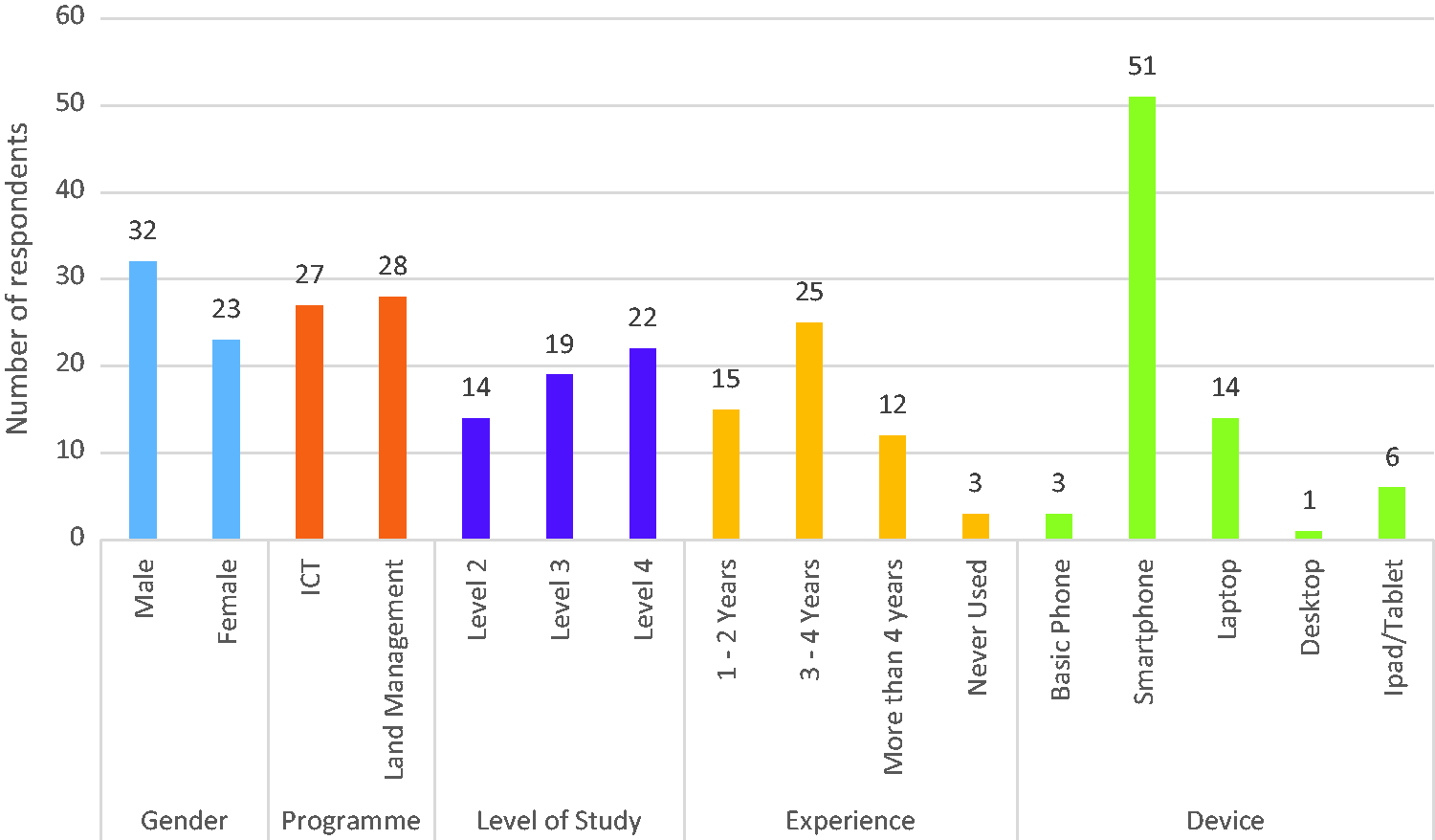
Background information of respondents (n = 55).
Students’ awareness of and familiarity with WhatsApp technology
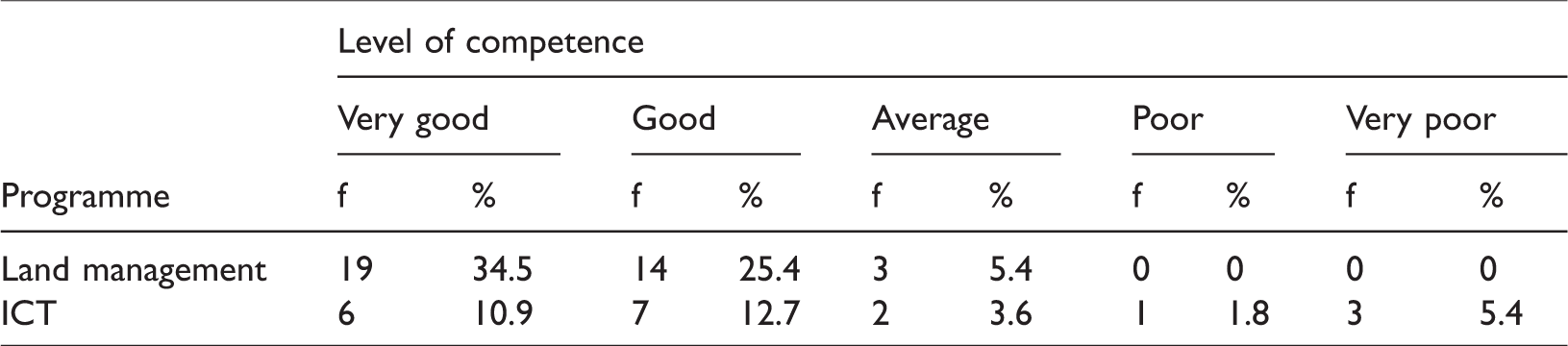
This section of the questionnaire attempted to establish students’ level of awareness of WhatsApp and their competencies in using this social media technology. Overall, according to the findings, 51 (93%) students are aware and competent in using WhatsApp technology. In terms of their competencies, findings presented in Table 1 reveal that land management students are more competent in using WhatsApp as compared to ICT students with scores of 28 (51%) and 23 (42%) respectively. The findings are in contrast with what researchers expected. Our expectation was that considering that ICT students have their courses predominantly ICT, they could be more competent in using WhatsApp than their land management counterparts who only do one introductory ICT based course in level one.
Students’ competence in using WhatsApp (n = 55).
The reason for this disparity was given during interviews where most ICT students mentioned that they focus more on technical aspects of ICT such as programming, networking and software development/engineering just to mention some and pay less attention to social media technologies. The following verbatim from some ICT students repent many other similar comments made by other ICT students: “Usually, our courses are based on the technical aspect of ICT and we rarely concentrate on using social media” and another who agreed said “our courses are very tough because they are technical in nature and we find little time to exploring the features of social media such as Facebook and WhatsApp”. Generally, the results suggest that students are aware and competent in using WhatsApp. During interviews, it was revealed that most students learnt how to use WhatsApp through the WhatsApp help feature, an online feature which provides predefined topics and frequently asked questions to users. Interviews with students showed they find using WhatsApp easy because of this help feature or facility.
These findings can be well explained by the DTPB Model which is informing this study. The model through the element of ease of use suggests that people are likely to use a technology if they find it easy to use. In this context, since students have indicated that they were able to use help feature to learn on their own how to use WhatsApp, it is therefore not surprising that they are motivated to use this technology.
Purpose students use WhatsApp technology for
In this section of the questionnaire and the interview guide we found out from students the purposes they used WhatsApp for in their personal spaces and academic activities. Data collected using a questionnaire revealed that students mostly used WhatsApp for: communication with fellow students (52, 95%) and communication with lecturers (29, 53%), sharing pictures (46, 84%), sharing audio files (43, 78%), sharing videos (45, 82%) and sharing current affairs (46, 84%) and sharing academic information (50, 91%).
Questionnaire responses are supported by information gathered from the interviews. A comment from the interviews with one of the ICT students reads as follows: “With WhatsApp innovation, it is very easy to communicate to all class members at once because we have created a class group on WhatsApp, where we simply send a message to the group and everyone instantly accesses the message”. Indeed, with the WhatsApp group feature, it has become very easy to share information across members implying that students no longer send a message to individuals if it is a group message. The findings of the current study are similar with studies by other researchers (Tuurosong and Faisal, 2014; Willemse, 2015) which also reported that students used WhatsApp for sharing academic information and communication with fellow students and lecturers.
The model underpinning this study can explain better as to why students have adopted this WhatsApp technology. As claimed by Taylor and Todd (1995) in the DTPB, people are likely to adopt a technology if it is compatible with existing activities of people. In this context, before the advent of the WhatsApp technology, students already used other means such as face-to-face, emails, sending short messages (SMS) and even making phone calls to communicate with colleagues and lecturers and sharing academic information. However, the WhatsApp has fitted well with these activities and more importantly; it is more appealing because it enables students to instantly communicate as compared to other modes of communication. In essence, according to DTPB, it is clear that WhatsApp technology has certainly built-in (compatibility) into the already existing academic activities of students while at the same time, the technology has added value (perceived usefulness) to the undertakings of the academic activities pointed out by students.
Benefits students accrue from using WhatsApp technology in learning
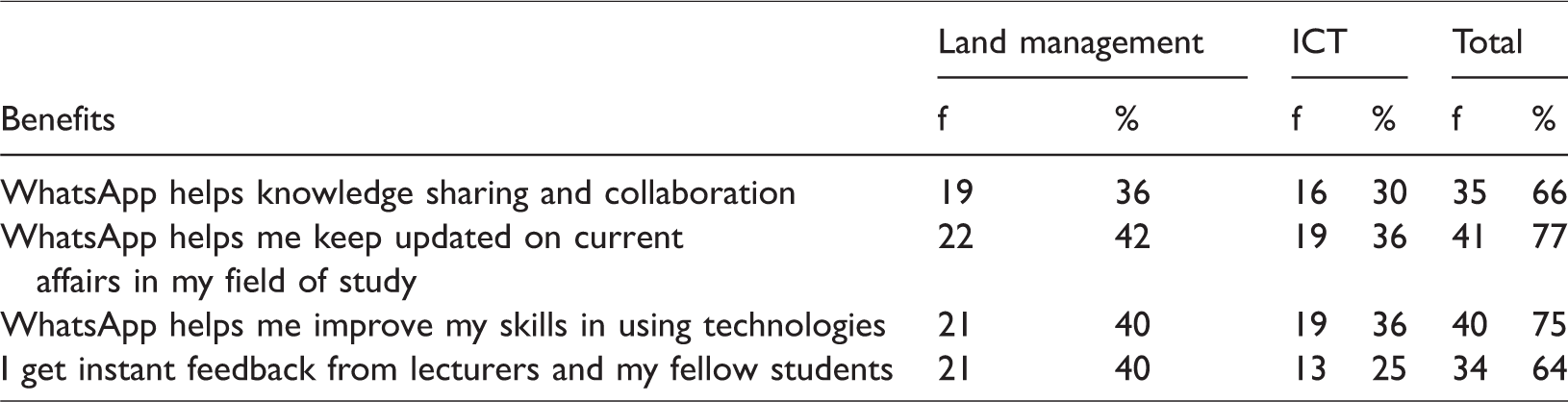
As established in the preceding section, the fact that students have embraced and assimilated WhatsApp technology in their academic activities entails that there are benefits associated with its use. In that regard, in this section, we report on the findings pertaining to what students perceive as the benefits of using WhatsApp in accomplishing their academic activities. To gather these data, we asked students to select from a list of statements in a questionnaire about the benefits presented in Table 2. It is evident from the findings that both land management and ICT students chose WhatsApp’s capability in facilitating knowledge sharing and collaboration; provision of current affairs, source of knowledge for improving ICT skills and its ability to afford student instant communication as the key benefits with scores of 35 (66%), 41 (77%), 40 (75%) and 34 (64%) in that order. For example, on instant communication, one of the land management students commented that: “WhatsApp delivers the message as soon as the sender presses the send button on the phone”. Another ICT student commented that “since WhatsApp is part of my mobile phone, messages reach instantly because I travel with my phone wherever I go”.
Benefits of using WhatsApp (n = 53).
In terms of information and knowledge sharing, students interviewed indicated that they share any education materials from instructors either in video, audio, PDF and Word formats. It was further revealed during interviews that WhatsApp is used by students even when they are on holiday as evidenced by this comment from an ICT student that: “When we are at home, we get communication from Mzuzu University Academic Office through our WhatsApp group”. These findings support those reported by So (2016), Church and de Oliveira (2013) and Amry (2014) who equally found that WhatsApp helps knowledge sharing and collaboration, WhatsApp helps students keep updated on current affairs in their field of study, WhatsApp helps students improve their skills in using technologies and students get instant feedback from lecturers and their fellow students.
Here, the aspects of perceived usefulness and compatibility which are among the two elements of the DTPB play a role in students’ acceptance of the WhatsApp technology. According to perceived usefulness and compatibility constructs in DTPB, students perceive WhatsApp as useful and compatible to their core academic activities and are therefore inspired to embrace it according to the DTPB.
Factors for use and non-use of WhatsApp technology by students
In the last section of the questionnaire and the interview guide, we explored the factors that influence students’ use of WhatsApp technology. Findings from the questionnaire show that between 33 (62.3%) and 47 (88.7%) students use WhatsApp technology because of the following: their lecturers use WhatsApp, because their fellow students use WhatsApp, because there are cheap and customised data bundles for accessing WhatsApp, Mzuzu University provides free internet access, they are personally interested in using WhatsApp and also because WhatsApp suits well with their academic activities.
Information gathered through the questionnaire corroborated with the interview results. Some comments from students as selected from the interview sessions were as follows: “Most of our lecturers are technology savvy and the usually communicate to us using our WhatsApp groups meaning if you are not on WhatsApp, you will miss important class communications” and another also commented that “our class representative will post anything related to school work including assignments from lecturers on our WhatsApp group which means you are forced to use this application because the class representative or lecturer will not communicate to an individual student”. Other students attributed their adoption of WhatsApp to affordable data bundles offered by mobile network service providers. For instance, one student said that “Using WhatsApp is cheap because TNM [Telecom Networks Malawi] and Airtel Malawi offer very competitive WhatsApp bundles that enable us access WhatsApp without worrying about Internet connections”. One student made an interesting comment about the key reason students like WhatsApp as follows: ‘Making a call via WhatsApp is very cheap as compared to making a traditional phone call which consumes a lot of airtime, these days I rarely make phone calls but WhatsApp calls”. For the purpose of clarity, students access free Internet provided by Mzuzu university and most mobile network service providers in Malawi including Telecom Networks Malawi and Airtel Malawi provide affordable customized data bundles for accessing WhatsApp.
By interpreting these findings through the lens of the DTPB model, it is possible to clearly understand the reasons why students have adopted the WhatsApp application in their academic activities. Here, the underlying elements of DTPB model in consideration are attitude (mainly an aspect of compatibility), perceived behaviour control (self-efficacy, resource facilitating condition and technology facilitation condition) and subjective norm (peer influence and superior’s influence).
Findings showed that students make use of WhatsApp to make calls, an activity which fits in well to that of making calls using a cellphone, meaning that these results conform to the argument by Taylor and Todd (1995) who argues that individuals will adopt a particular technology if it fits well with their existing routine activities. Worth mentioning is that students found WhatsApp call more appealing because they were cheap and this is in line with Taylor and Todd’s (1995) thinking that individuals will particularly adopt a technology if it adds value to their existing activities. From the findings, students indicated that they used WhatsApp because they had personal interest in using this technology and this supports the argument by Taylor and Todd (1995) that individuals are likely to accept and use the technology if they are themselves comfortable using it (self-efficacy). In their DTPB model, Taylor and Todd (1995) postulate that individuals are influenced to adopt a particular innovation if there are resource facilitating condition and technology facilitating condition. This argument by Taylor and Todd (1995) is fully supported by the findings of this study because results from questionnaire and interviews showed that students used WhatsApp because they had access to various resources such as free Internet on Mzuzu University campus and they were provided with competitive WhatsApp bundles from Airtel Malawi and TNM. For the subjective norm of the DTPB, both constructs (superior and peer influence) played a part in influencing students to use WhatsApp because the majority indicated that they used WhatsApp because their lecturers and fellow students used this technology.
Despite the findings of the study showing that students have adopted WhatsApp technology for academic activities, there are some factors which hamper its adoption. The interview results confirm the findings from the questionnaire that the following factors hinder use of WhatsApp technology: high cost of ICT gadgets for accessing WhatsApp, unreliable Internet from mobile service providers, unreliable Internet from Mzuzu University, WhatsApp distracts academic activities and frequent electricity outages. For instance, one of the land management students commented that “We are experiencing frequent blackouts these days on campus and nationally, batteries for smartphones and laptops cannot keep power for the whole day. It is even worse when you are accessing Internet [when data is on]”. ICT gadgets in this context are smartphones and their associated peripherals such as chargers and batteries which may need replacement once in a while. Although smartphones have proliferated and are seen as cheap in Malawi, according to the interviews with students, most of these students come from poor families and the fact that their parents and guardians are not working makes it difficult for them to buy or maintain these phones. However, according to the findings, since some students and lecturers prefer communicating through WhatsApp, these students have to find one although after struggles. The findings of the present study confirm the findings of the study by Chawinga and Zinn (2015), that blackouts are also a problem at Mzuzu University. The fact that Nyirongo (2009) noted the same problem implies that the problem of electricity outages at Mzuzu University has not been dealt with.
Conclusion and recommendations
The study has demonstrated that despite wide reports that access to Internet and its associated technologies is limited in developing counties, students at Mzuzu University have adopted WhatsApp which is an Internet based technology. The study has shown that students use WhatsApp to accomplish both personal and school activities. According to the findings, students mainly use WhatsApp to communicate with lecturers, to communicate with fellow students, to share academic information and to carry out collaborative learning activities. The study found further that students accrue various benefits from their use of WhatsApp in their learning activities. The key benefits include instant sharing of information, academic collaboration, and ability to communicate beyond classroom hours. Although the study recorded an impressive use of WhatsApp by students, there are some factors that hinder the effective use of the technology by students and key ones include costs of ICT gadgets, frequent electricity outages and unreliable Internet connection from mobile network service providers. The study results conformed to most elements of the adopted model; the DTPB by Taylor and Todd (1995). The three elements of the model which include attitude (perceived usefulness, ease of use and compatibility), perceived behaviour control (self-efficacy, resource facilitating condition and technology facilitation condition) and subject norm (peer influence and superior’s influence) were all used to explain student’s intention to use or not to use WhatsApp.
Consequently, in a midst of numerous challenges due to limited resources which the education sector is experiencing in most developing countries, technologies like WhatsApp have proved to enhance teaching and learning. We recommend that interaction between students and instructors through technologies like WhatsApp should be regarded as formal by Higher Education Institutions. Secondly, as most institutions are embracing Open and Distance Learning (ODL) and eLearning, technologies like WhatsApp can enhance interaction between students and instructors. We further recommend that Higher Education Institutions should strive at improving Internet connectivity by increasing bandwidths and installing more Wi-Fi access points across their campuses so that students and instructors enjoy access to Internet which is a prerequisite for learners and educators to access technologies like WhatsApp.
Footnotes
Declaration of Conflicting Interests
The author(s) declared no potential conflicts of interest with respect to the research, authorship, and/or publication of this article.
Funding
The author(s) received no financial support for the research, authorship, and/or publication of this article.