




Abstract
The focus of this article is on digital literacy and students’ use of digital sources. We are examining how students choose digital video sources when doing group work with tablets in a social studies project. The analysis centers on how students collaboratively negotiate and reason around their choice of video sources during an assignment about environmental issues. The data corpus consists of videos of group work. A sociocultural perspective on learning is employed for analyzing student participation. We explore how the tablets influence the group interaction and how the group members negotiate the process of choosing the video sources found online. The findings show that students do not discuss digital sources only in terms of the formal criteria for digital literacy, but in relation to their perception of how the video sources are presented. It is important to shed light on this aspect of students’ use of tablets in school, because being aware of this facet could materialize in greater digital skills which in turn might expand digital literacy.
Introduction
The article is focused on digital literacy and students’ use of digital sources in group work, specifically their use of tablets in school. The use of mobile digital tools is now widespread, and as tablets have become more affordable and user friendly, they have become a learning resource in daily use in many schools (Furió et al., 2015; Kim and Frick, 2011). As handheld technological devices are now widely used in different learning environments at all levels of formal education, it is important to gain knowledge about how such technology affects learning. Since handheld digital tools give students access to multiple sources when doing schoolwork, we need to gain knowledge about how students orient themselves toward the sources that are made available through these devices. We also need more knowledge about what role handheld devices have in the interactions that take place in group work in school settings.
By closely examining interaction in these groups, we can produce knowledge that is important for mapping students’ digital literacy. In this article, we examine how groups of students evaluate and negotiate around information sources in computer-supported group work on environmental issues. The group work was carried out in a social studies project in a Norwegian lower secondary classroom. We were interested in examining how students orient to different knowledge resources made available on and through their tablets. We examine the role the tablet and its content play in group dynamics and how this affects the students’ decision making. In doing so, we analyze the interaction that takes place between the students in their groups and between the students and the tablet during the assignment. By examining face-to-face and face-to-thing interaction in student groups when they are discussing available sources, we can gain insight into how the group chooses which sources to use in their assignment. Through understanding the students’ choices, we can also illuminate how they develop digital literacy and what the teacher needs to pay attention to when teaching digital skills. Employing a sociocultural and dialogic perspective, we analyze how students work in groups with tablets. This perspective emphasizes that the negotiation of meaning is carried out through interaction between people and cultural tools. To understand these interactions, we combine a sociocultural approach with the concept of affordance. Cultural tools have different affordances, and people have different abilities to perceive these affordances. Video data of group interaction that occurred during the project was subjected to a turn-by-turn analysis. When examining in detail what the digital sources afford the agents in the groups, and how the group members negotiate these possibilities, we can get a closer look at the students’ digital literacies. This enables us to understand how the various dimensions of digital literacy appear in groups. The analysis aims to illuminate the following research questions:
How do students make choices when selecting digital sources in a school assignment? How does the tablet influence the group interaction?
Background and review of relevant research
In this article, we analyze how students reason and negotiate around digital sources through dialogues within a computer-supported collaborative learning (CSCL) environment. CSCL is cooperation that is facilitated by digital tools (Stahl et al., 2014) and can mean collaborative learning supported by digital tools that takes place in different physical spaces or face-to-face communication. Arnseth and Ludvigsen (2006) make a distinction between systemic and dialogic approaches to CSCL. Systemic approaches look at how programs and apps affect the students’ interaction and how the specific programs result in learning outcomes. Dialogic approaches focus on how the meanings and functions of discourse, tools and knowledge are constituted in a social practice. We assume a dialogic approach to the collaborative work that took place in this study. Tablets enable new options for active collaboration among students in class activities (Avery et al., 2010).
The term “digital literacy” is a broad term, and it has been argued that it consists of multiple literacies rather than just one (Knobel and Lankshear, 2006). Being digitally literate means being able to understand learning and social interactions that take place in a digital context, both inside and outside educational settings (Potter, 2017: 387). Various literacies associated with the use of digital tools have been defined, such as information literacy (Eisenberg et al., 2004), computer literacy (Tobin, 1983), media literacy (Buckingham, 2007), and digital literacy (Gilster, 1997). As Talib (2018) states, agreeing upon one definition is difficult as the area of digital media is ever changing and dynamic. When seeing literacies as a practice rather than a skill, and a practice that is changing, schools should use tools in the classroom that can be used to adapt to these practices that are in motion (Stewart, 2015). This fits well with our sociocultural view on learning. According to Gui and Argentin (2011), digital literacy has three main aspects: theoretical, operational, and evaluation. Meyers et al. (2013) consider digital literacy to consist of technology skills, critical thinking capacities and contextually situated practices (Meyers et al., 2013: 361). We will focus on the evaluation dimension of digital literacy, which comes close to what is called information literacy. Miller and Bartlett (2012: 39) argue for what they call digital fluency, a form of information literacy that contains specific knowledge on how information from the internet works. The importance of source criticism is evident in the evaluation of any information source. With the internet and digitalization ever-present in all areas of our lives, we have to evaluate numerous information sources. Some of the more formal criteria as to how to evaluate sources are questions such as: Is the information objective? Is the information valid? Who is the writer and what does the writer want to accomplish? How old is the source at hand? Research shows that how students evaluate different information sources is sometimes on the basis of intuition rather than formally defined criteria (Walraven et al., 2009). Studies have shown that when students evaluate sources, they focus on why the sources are relevant to the task rather than on the reliability of the sources (Coiro et al., 2015). In their study of how students evaluate information online, Walraven et al. (2009) found that the main criteria for the students were the sources’ connection to the task they were engaged in and the title, language and appearance of the information. Metzger et al. (2015) looked at how children evaluate information they find on the internet. The research shows that the students who rely on what others tell them do not critically evaluate the internet sources in the same way as the students who are more open to exploring different perspectives. In a study about reading and navigating on the internet in secondary schools, Fr⊘nes (2017) found that only the strong readers manage to read critically and to evaluate online sources. Miller and Bartlett (2012) argue that teachers often consider students’ digital fluency to be poor and that they need to be taught how to approach information on the internet critically. Giæver et al. (2017) examined how teachers understand the part of digital literacy that concerns evaluating information and found that they mainly consider this evaluation to be about source criticism, digital bullying, and netiquette. The findings showed that the teachers did not feel they have enough competence when it comes to understanding what digital literacy is about and how it should be taught (Giæver et al., 2017; Pusey and Sadera, 2011). There exists important knowledge both about learning with tablets and digital literacy in school. However, we need more detailed knowledge about how students use and argue for the different sources and how tablets influence group work. We aim to generate knowledge about how students negotiate meaning when different sources are at hand and how this can be an implication of their literacy. In this article, we will scrutinize how students discuss and evaluate the digital information and how the tablet is affording information as part of the group discussions.
Theoretical framework: A sociocultural perspective on tablets in groups—Affordances and abilities
In assuming a sociocultural perspective on mobile learning in groups, we approach learning as a social process that takes place through dialogue and the use of cultural tools (Vygotskij et al., 1978). Learning is viewed as negotiation of knowledge and participation in social practices (Wenger, 1998). This fits well with the above mentioned view on literacy as a social practice. Learning is seen as taking place both within groups and on an individual level, and these two levels of learning are entangled in the learning processes (Greeno, 1998; Sfard, 1998). The basic unit of analysis in Vygotskij’s theory is mediated action, or action operating through mediational means, such as language (Wertsch, 1998). In the sociocultural tradition, there has been an interest in how technology can support students’ learning (Hmelo-Silver et al., 2007; Kyza, 2009; Roschelle et al., 2010). According to Koole (2009), mobile learning takes place at the intersection between the technical tools, the social practice and the persons learning with the tools—in our case, members of student groups.
The tablet as a cultural tool is both a physical object and a provider of numerous information sources. In our analytical work, we employ the concept of affordance, which guides our investigation of how the tablets provide different ways of interacting, both in relation to the tool and to group dynamics. The theory of affordances goes back to Gibson’s ecological approach to visual perception (Gibson, 1986). Gibson’s view on perception and action focuses on the interaction between the agents and the environment. According to Gibson, perception does not merely consist of how we construct the environment, but also of physical and mental processes that give information for the agent’s activity. Affordance can be understood as what the environment affords the perceiver. However, affordance is not merely what the environment has to offer the perceiver, but what the perceiver sees that the environment has to offer. This means that both the environment and the perceiver define the affordance.
The concept has also been used in the study of human–computer interaction, and Norman (1999) has redefined the meaning of affordance to include the perceiver’s earlier experiences, former knowledge, and culture. This has parallels to the sociocultural view on learning, where former knowledge and culture play an important part in the learning process; however, Norman, as does Gibson, focuses on the individual (Kaptelinin and Nardi, 2006; McGrenere and Ho, 2000). From a sociocultural perspective, Greeno (1994) has used the concepts of affordance, agents and abilities as a way of analyzing activity. As opposed to Gibson, who focuses on the individual, Greeno focuses on interactive processes where agents cooperate with other agents and the environment, or the physical systems with which they interact. This interactional view of perception is useful as we are considering group work. The activity taking place is reliant on the interaction between affordances and abilities. The activity of conversation, among other things, consists of the agent’s ability to speak and perceive the language.
The affordance is different for different agents, depending on what Greeno calls the agent’s ability to perceive. Whereas affordance refers to what it is about the environment that contributes to the interaction, ability refers to what it is about the agent that contributes to the interaction. Greeno underlines that the affordance of the environment is both dependent on the abilities and the constraints that the agent recognizes. Our focus is how the tablet affords different types of interactions as part of the learning process. We find studying face-to-face interaction to be a useful way to grasp these affordances through the students’ conversations. How do students perceive what the tablet has to offer, and how is this negotiated by the group? According to Greeno (1994), people have different abilities to gather information in their activities, as they have different learning trajectories. We focus on the ability to perceive not ability to learn and understand. All students have the ability to perceive affordances, regardless of their learning skills. We chose affordance as a theoretical viewpoint when examining the data as we were seeking to look at the individuals within the group and how they each reason for their choices. We argue that how they make their choices depends on their abilities to perceive what the tablet affords.
In our analysis, we look at different spheres of affordances, as different things, settings and situations can all have affordances. We consider affordances located in the physical sphere, the informational sphere, and the social sphere. By using affordance as a theoretical lens, we analyze how students’ orientations to the tablets’ affordances influence the student groups’ ways of carrying out the activities. By analyzing the interactions, we get an insight into the students’, or agents’, abilities to perceive. This, in turn, gives a valuable insight into the students’ digital literacy. In this article, we look at how learning is achieved through the use of tablets and how this tool is modified by the ways members of student groups use it. By examining the face-to-face interactions of students using tablets, we can gain insight into how individuals within the group view what the tablet can afford the individual and how this influences group learning.
Research design
Settings and participants
The data upon which this article builds was collected in a ninth grade classroom at a Norwegian secondary school. One class with 24 students was followed during a project in social science that lasted for 15 lessons within the course of one week. The students were 14–15 years old. All the students had their own personal tablet that belonged to the school. Some only used this tablet in school and for schoolwork, while others used it as their private tablet as well. They were working on a project on environmental awareness the whole week. The project consisted of different tasks each day, and they wrote blog entries for each task. They wrote about how they can make a difference, such as sorting trash, walking instead of driving, showering less, eating less meat, etc. Either they wrote a blog entry together as a group, or they wrote individual blog entries, which they discussed within the group.
Only one entry from each student was put up on the group blog, and only one group blog entry was put on the class blog. The students choose if the individual blog should be open. The group blog was open for the school, and the class blog was open online. During the week the project lasted, they made several different blog entrees. Within the group they agreed on which one they thought was the best, and that was the one they got graded on.
The focus was the group work that took place following the assignment to find one information video that they could discuss and explain to others in a blog entry. The setting was the classroom, and the participants were the students working in groups. We looked at six groups, each consisting of four students. The activity we observed was how the students negotiated meaning when looking at information videos. The task they worked on was to find an online video about environmental issues that they could write about in a blog entry. The teacher gave them some examples of videos to choose from, and they could either use these or find their own videos. We looked at how the students argued for or against the different videos at hand.
Method and analytical procedures
The study was a qualitative case study focusing on groups of students. The data corpus consisted of two parts: (1) interviews with the teachers and the students, two teacher meetings, observing the class before the project started, field notes, the final class blog products, and full-class video, and (2) video data of the group work. The first part of the corpus was employed as background data, whereas the second part was the primary data for this study. The first author video-filmed all 15 lessons that were collected. The total corpus of video data consisted of 15 hours, of which 6 hours were on the group work interaction. Action cameras were used to film the group work, as a way of seeing both what was happening within the group and what was happening on the tablets. The analysis of the talk-in-interaction was partly informed by ethnomethodology, where the aim of a study is to look closely at how people make sense of the world and the methods they use to follow social orders (vom Lehn, 2014). We also employed coding strategies, as described below. We studied what the conversation was leading up to and how they negotiated meaning and came to an agreement. The video data were categorized according to the different group tasks. In order to get a closer view and insight into what is happening in the material, the main part of the video material was transcribed. This made it possible to look at patterns within the total data corpus. We focused on the conversation and the use of the tablet when the students were discussing digital sources. The focus was on the conversation and tablet use when discussing the digital sources at hand. We looked at interactional episodes where the students were disagreeing and had to reason as to why they wanted to use a specific video. The students’ actions were coded according to different affordances and abilities that appear in the data material. We have selected interactions that illuminate our research questions.
Data analysis
The teacher’s aim with the project was to increase students’ awareness and knowledge about environmental issues and encourage them to reflect upon how they can make a difference in saving the planet. This was done through different assignments, that all became blog entrees. Being critical about the use of digital sources was not an explicit part of the task. The project was carried out as full class teaching, group work and individual work, and individual homework.
When the project started, the teacher distributed formal criteria to guide the students in their work on the assignment. The task we focused on was each of them finding a video online to present on their group blog. We were interested in the reasoning behind their choices that was revealed in their discussions while performing this task. The students found different videos, following either the teacher’s tips, or other information sources they pursued, such as YouTube videos about environmental issues. They also needed to write about the video in their own words. By analyzing the conversations that took place, we observed the different affordances the students explicitly make relevant in the data material. These affordances in turn gave insight into the students’ digital literacy.
Available affordances
The data show that the students approached the information sources differently. Their different arguments become a part of the meaning making and reveal the ways in which tablets affect and are affected by the group dynamics. The focus is the affordances the students see in the videos on the mobile digital tools when used in a school context. In many cases, the criteria given by the teacher for the assignment at hand also played a big part in the conversation and negotiation of meaning that occurred. Some of the affordances available to the students were similar in each group. These are the affordances provided for the activity that were physically present in the environment, and which were part of the background for the analyses. These include the physical presence of the tablet and other affordances that were located in the physical sphere. The assignment given by the teacher is defined as a set of affordances contained in the information the teacher conveyed about the assignment. Such affordances are located in the informational sphere. A third set of affordances is provided by the social practice of group work in school and represents the affordances located in the social sphere. Group work in school is a setting that the students know, but what it affords differs for different agents. As the students looked at different videos, the affordances provided by the videos and the video content was different in the different groups. This can be considered the fourth sphere, and, in the analysis, we sought to gain more insight into how these affordances, in addition to the agents’ abilities in interaction, made the activity possible. We sought insight into other affordances that were not as visible, as well as insight into the students’, or agents’, abilities to perceive the affordances.
Findings
When analyzing the data, we identified three considerations on which the students based their evaluation of sources, which are of special interest.
How a topic is presented in the sources? To what extent students can extract information from the sources and rephrase it with their own words? How easily accessible the information in the sources is?
The following episodes have been chosen to illustrate the different considerations. They show how the discussion and interaction led to the agreement as to which video they were going to use for the blog. The data show that the tablets afford different things for different students, and for different groups. What they consider to be the tablet’s affordances can be seen by analyzing their interactions. Even though the students perceive different affordances, how they constitute their meaning is part of a social and collective process and not the product of autonomous individuals alone. In the social process, the students’ knowledge and meanings are recreated, reproduced, renegotiated, reconceptualized, and recontextualized.
Evaluation of topic presentation
In the following episode, a group of four students has watched two different videos. Both videos are about environmental issues and how and what humans can do to save the planet (see Figure 1). They are discussing which one of the videos they should write about in their blog entry. In video 1, the main focus is on what we can do to save the planet. It gives the viewer tips on how we, as individuals, can make a difference. Video 2 is more descriptive and informational. It explains how the way we live affects the planet and how pollution leads to natural disasters. Student 4 (S4) has seen video 1, and students 1, 2, and 3 (S1, S2, and S3) have seen video 2. The extract starts with S4 showing the rest of the group video 1 on her tablet. She is holding her tablet so the others can see. After watching video 1 together, S4 watches parts of video 2 on her own tablet. After viewing both videos, they are discussing which one to use in their blog. S2, S3, and S4 argue for video 1, while S1 argues for video 2.
All members of the group have seen both videos and are discussing which of the two they want to use when writing a blog entry. Student 4 holds the tablet throughout, showing the others video 1. The data indicate that the tablet does not need to be held to stand up in this way and that this way of presenting the tablet is an exception. In line 1, S1 states that he prefers video 1; however, he does not provide an account of why he prefers it. He also states that it is fine by him (to use video 1). In line 2, S2 states that she likes video 1. As a response to this, S3 says that it is fine by him, repeatedly, but the rest of the conversation shows that he has arguments for preferring video 2 (line 7). In line 5, S3 nods toward S4’s tablet, thus displaying an orientation to the video it showed, and argues that this video explains what might happen as a consequence of pollution. S1 picks up on this position as a way of arguing for video 2, which is the video he prefers, by saying that video 2 gives more information about the situation in the environment. S2 responds by explaining her reasons for preferring video 1. She argues that it is more motivating, while video 2 is “bad and stuff.” In line 7, S1 argues that video 2 gives the right information and facts compared to video 1. He does not refer to the tablet to underline his argument, as the screen has gone black. S2 stresses her and S3’s argument about how video 1 leaves them more motivated to make a difference. The group ends up using video 1. While we cannot say for certain what the determining factors for these decisions were, we can follow what aspects the participants in the group work made relevant in their decision-making process. The way the information sources are being presented affects the students’ choices. What part of the presentation of sources that comes across as affordances in the video, which in turn makes the activity of writing a blog entry possible, depends on the agents’ abilities. As abilities are internal to each perceiver, this is something we cannot fully assess. However, we argue that part of their abilities can be seen in their actions. S1 has the ability to see and perceive a set of affordances in the video content. These affordances come across as something that, to him, gives trustworthiness to the video. On the other hand, it seems as if the other students see these as constraints rather than affordances, which in turn makes writing a blog entry difficult. On the other hand, these students have the ability to see the affordances in video 1 that leave them with a feeling of hope and tell them how they can make a difference to save the planet. These different affordances and abilities lead to the activity of interacting and discussing which sources to use. In the social interaction, the students’ knowledge and meaning are negotiated and renegotiated throughout the conversation. In the group work, different affordances come into play that contribute to the interaction, and the different agents have different abilities to perceive these affordances. The three girls in the group seem to perceive the same affordances in the video, and the social process strengthens these abilities as their meanings are recreated when others’ thoughts add to their abilities to perceive the affordances. In the same way, the constraints in video 1 become more evident as the interaction plays out. As one boy in the group is disagreeing with the rest, the social process does not afford for him to renegotiate his meanings and knowledge, and this might also be constrained by his abilities to do so. The example shows how different students perceive the affordance of what is being presented differently. Some have the ability to see the affordance of leaving them with hope important for the activity at hand, while others have the ability to see the affordance of the facts and trustworthiness in the sources as a way of carrying out the activity.
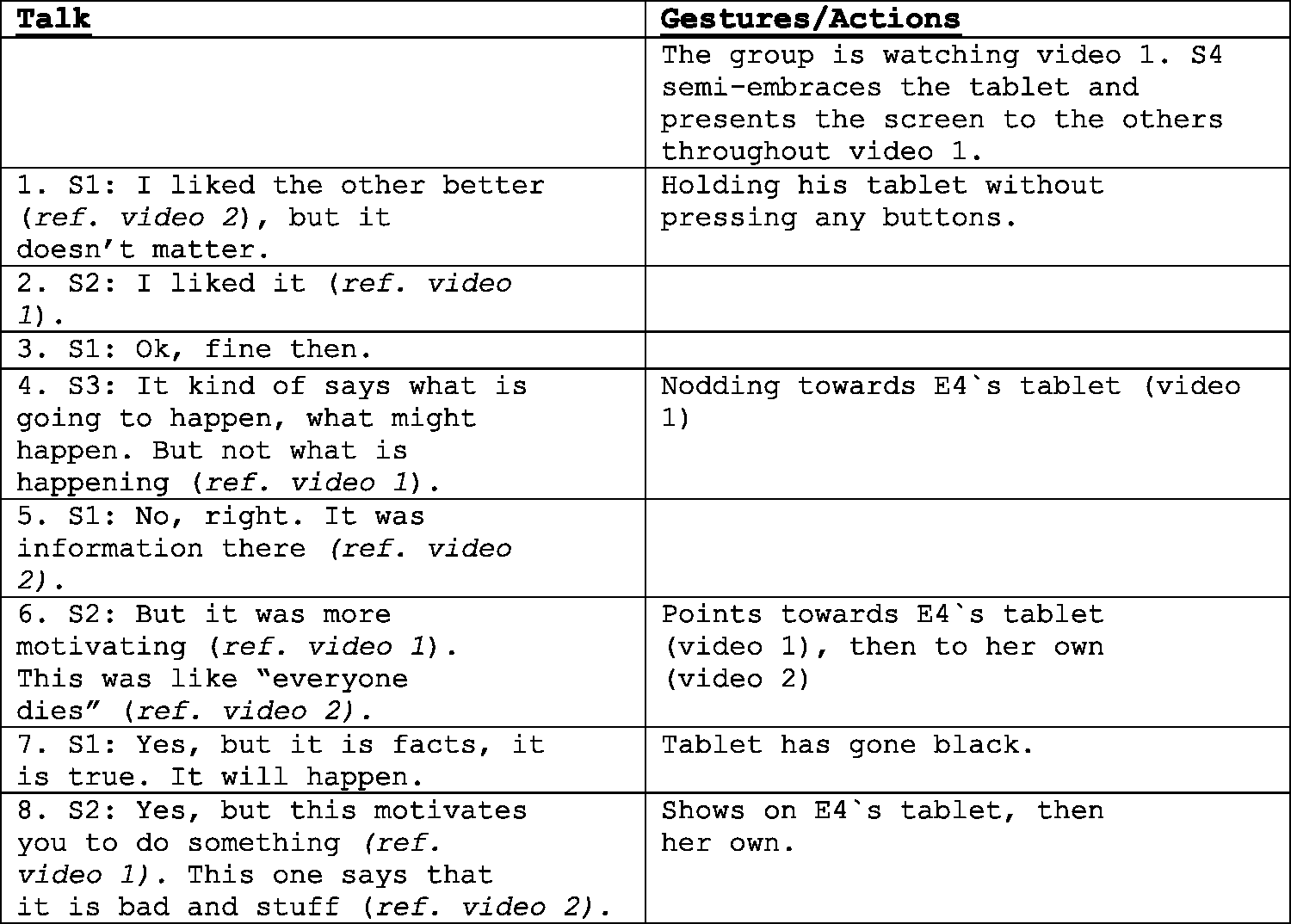
Evaluation of topic presentation.
Potential for recontextualization
The data shows that the students made their choices based on how they saw it possible to recontextualize the content and recreate it in their own words (see Figure 2). In other words, they responded to the affordance that the video on the tablet offered concerning the ease of putting the content into their own words. This is important, as they were required to write a blog entry based on the video they watched. In the following episode, this task is the focus, but their abilities to perceive the affordances they consider important for this activity differ. In the following episode, we are looking at a different group. The dialogue taking place is mainly between two students, S1 and S3. Before and after the excerpt, it becomes evident that two and two (S1 and S2, S3 and S4) are agreeing and that this is the typical arrangement within this group. Towards the end of the transcript, S2 participates in the conversation. They have all looked at two videos that are very different, one with much text and one with many pictures. They disagree on which video makes writing a blog entry easier. In the next example, the students are arguing for their preferred choices by discussing how they best can appropriate the information in the different videos they have seen.
In the opening utterance, the student presents a closing question with a positive notation: “So, should we take that video then?” without providing an opening for the discussion. S1 responds in a way that shows that she does not agree. She tries to recognize her peer’s thoughts, but she also questions his decision and wants him to elaborate on how this can be used as the basis for a text. In line 3, he tries to elaborate on how he thinks the text can be used, but his statement is cut off by S1 repeating her concerns about the difficulties of using this video to work on the given assignment and how she finds it difficult to follow. The dialogue continues with S3 explaining what can be said about the video he has seen. He tries to reason with many facts, but stutters. In lines 5–10, S3 tries to explain, and S1 responds only by repeating the acknowledgment token “hmm” to confirm that she is listening but not giving much confirmation to his reasons. S1 is not convinced, but lets him talk. After S3’s last remark in line 9, S1 responds by suggesting another video they can use. She explains that it contains mostly pictures and not so much text and that it is quite short (4 minutes). In line 12, S2 enters the conversation by underlining what S1 said about the video they have seen. In line 14, S3 argues that the video he has seen is easier to write about. In line 14, she asks S3 if he is interested in seeing the video. He does not reply, but she elaborates in line 16 how there are more pictures and not so much text and how this is better for their written assignment. The dialogue ends with the group not managing to agree on which video to use, and the teacher comes in to help by further questioning them about the reasons for their choices.
The analysis shows that one way the students reason for their choices is based on the perceived availability of the information for recontextualization. In line 2 of the transcript, S1 questions how it will be possible to write a text for the blog about video 1. Following this, it becomes clear that the focus for the interaction, or the activity, is the redistribution of the video content, and this is what the conversation focuses on. The students’ abilities to perceive the affordances of the video vary. S3 has the ability to perceive what video 1 affords when there is more text. S1 and S2 have watched another video that mostly consists of pictures. S1 has the ability to see a video with many pictures as one that affords the activity of redistribution of the content on the blog. This shows how the information in the sources is evaluated, and what it affords varies from person to person. Some evaluate a video with many pictures and less text as good for appropriation, while others evaluate the same video as a bad information source for appropriation. As the students’ individual abilities are being recreated and renegotiated in the interaction and social process, what the video affords can be reproduced. Some members of the group argue that it is easier to redistribute the information from the video with much text, whereas two others seem to think that it is easier to appropriate the information for the blog from the video that mainly consists of pictures. As Greeno (1994: 338) states, affordance and ability are reliant on each other, and it might also be a lack of ability from the agents to reach agreement on the desired activity. In a social process, meaning and knowledge are recreated, but for this interaction to take place, the agents must have the abilities to perceive the affordance, which in this scenario does not seem to be the case. Following the dialogue, it becomes clear that they each have their own reasons for their choices. The group ends up not agreeing and needs help from the teacher. With this help, the students might gain a better understanding of the abilities other individuals in the group have to perceive other affordances in the video that can facilitate completing the assigned activity.
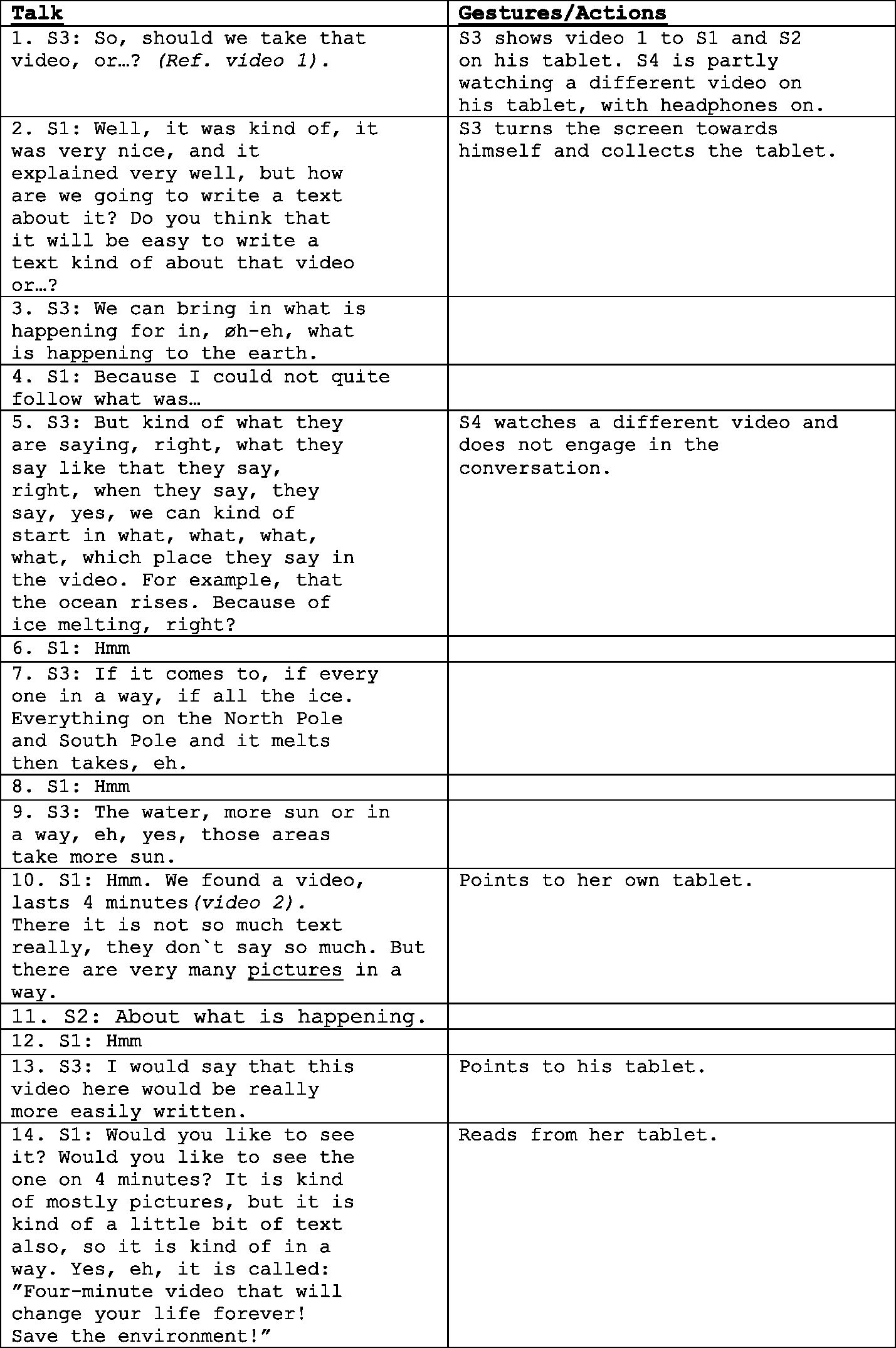
Potential for recontextualization.
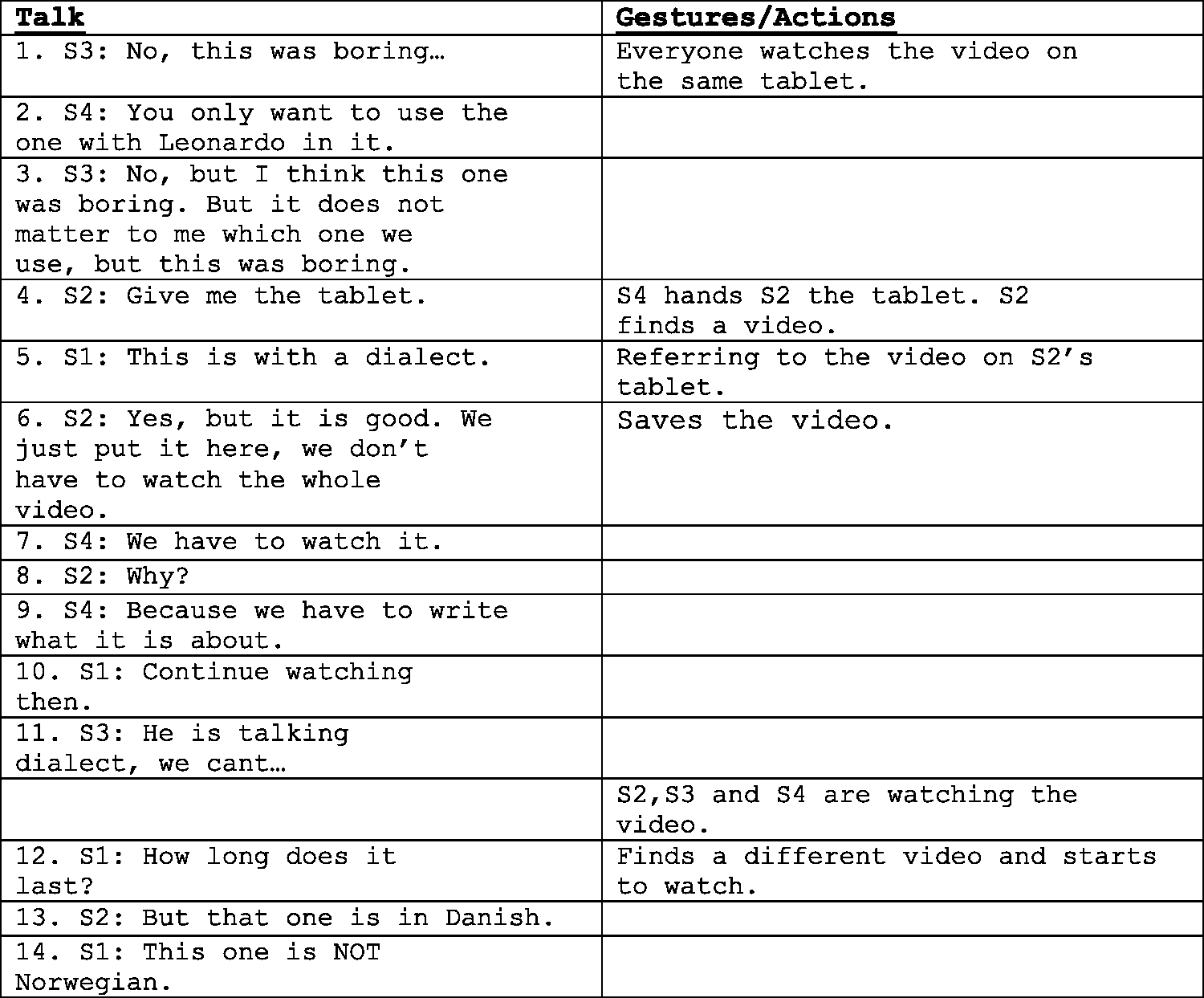
Ease of access.
Ease of access
When working with information sources, the data shows that the students have different views on what makes the videos accessible (see Figure 3). This again depends on the students’ different abilities to perceive what the video affords. In the following episode, we are looking at a different group. Their task is to write a blog text about one of the videos they have watched. Before they start writing, they have to agree on which video to write about. This activity of coming to agreement about a suitable video depends on each individual’s abilities in interaction with the video’s affordances and how these are negotiated and renegotiated in the group work. In the following dialogue, they are mainly discussing the activity of watching the video, which can be considered an intermediate goal in the assignment. When they are choosing which sources to use, they mainly focus on the video’s affordances in the activity of watching it, and not on using it as the background for a text.
In line 1, S3 and S4 are watching a video together. As S3 states that it is boring, S4 replies, asking if she only liked the one with Leonardo (DiCaprio) in it. S3 tries to convince the rest of the group that it does not matter to her which video they choose for their blog entry, when S2 says in an ironic tone (line 4), that it seems like she (S3) cares. While the others are talking, S1 is searching for a video on his tablet. He starts one and states that they are talking with a dialect, meaning that that video is not so interesting (line 5). In line 6, S2 seems to think that this is not a valid reason for not choosing the video that S1 has been watching. As they keep watching the video, S3 also comments on the video host’s dialect (line 11). S1 searches again for a different video, and finds one in Danish. S1 and S2 are agreeing, without debating, that the language makes it irrelevant to them (lines 13 and 14). The group keeps watching different videos, but they finally decide to use one of the first ones that they watched—giving the reason that they had watched the entire video, and it was not too long. This gives an insight into how they chose digital sources before they considered the assignment. In the interaction, the element of who narrates the video (Leonardo DiCaprio) is an affordance that, with this agent’s ability, makes the information in the video more accessible. This can also be seen as a preference. In this case, we argue that a preference is an affordance that can reframe the student’s ability to perceive, and thus facilitates the activity of watching the video. Another affordance they seem to focus on is the duration of the video. Again, they are focusing on affordances that do not challenge their abilities to perceive, as they chose the video with the shortest duration, which in turn does not afford as much as the longer video. S1 is watching a video where the presenter speaks a dialect. Following the interaction, this is considered a constraint of the video, rather than an affordance. The students show that, in choosing video sources, they consider the video’s accessibility to the viewer as significant. This does not relate to how accessible the information in the source is, only how it is presented. Therefore, the video in Danish might be considered in the same way as the video in the dialect. In the group interaction, constraints are made more relevant than affordances. By focusing on constraints, it is difficult to make room for one’s own abilities and in turn carry out an activity. Following this, they seem to focus on eliminating constraints rather than choosing to put their abilities into play with the video’s different affordances. The above interaction shows how abilities and affordances are renegotiated and recreated in interaction and social processes.
Discussion and concluding remarks
In this article, we examine how students interact when choosing digital sources in a computer supported collaborative learning environment. To illuminate this, we focus on two research questions: How do students make choices when selecting digital sources in a school assignment? and How does the tablet influence the group interaction? This exploration gives insight into how students reason for their digital choices and their digital literacy. The study contributes to the research by concretizing which aspects affect the choices made. The analysis shows that the students choose digital sources on the bases of different criteria. The results indicate that formal criteria for digital judgment, such as who has made/written the source, how old it is and whether the information source is based on facts are not taken into consideration in this setting. Instead, what is considered when discussing the digital sources are (1) how the topic is being presented, (2) the source’s potential for recontextualization, and (3) how easily accessible the information is.
In example 1, the students are disagreeing on which sources to use depending on the focus of the representation. Some think that the one with statistics and numbers seems more trustworthy, while others prefer the video that leaves them with more hope for the future. These preferences affect their interaction. The data also shows that how the digital sources are presented affects their trustworthiness. The students are discussing how pictures and text are presented together and also that who is presenting the film has an impact on their choices. The conversations give insights into how the tablet, and the different sources made available through the tablet, afford different things to different students. The findings show that, when choosing the sources, what the teacher says about the different videos is important for the students’ further argumentation. They discuss what is a better source to meet the teacher’s requirements for the assignment. Our findings show that even if the teacher is not present in the group, and they are free to choose their own sources, the teacher’s suggestions still have a strong influence on their choices and lend strength to their arguments. The group dynamics become evident in the way that the tablet as a physical object affords different actions for the perceivers.
Research has shown that students do not have a reflected perspective on how they evaluate information online (Walraven et al., 2009) and that their reasons for their decisions are made based on the main criteria of title, language and appearance. This also seems to be the case in our study. As mentioned, the students were not specifically asked to look critically at the sources, and, in our examples, we see in their conversations that they do not reflect on how they evaluate the information and the video sources they use. In addition, we have focused on how their decision making takes place in a face-to-face group interaction. Other studies show how the information’s relevance to the task is a main criterion (Coiro et al., 2015). This is confirmed by our analysis as well, in that the students use other than the formal criteria for information literacy to evaluate information sources. It also shows how the tablet is easy to share when working in collaboration with others (Fisher et al., 2013). As seen in our research, the tablet becomes a part of the interaction taking place, and in the meaning making between the students. This gives better insight into how they evaluate the information at hand. Metzger et al. (2015) have used different criteria, but according to our study, it seems that the lack of willingness to explore different perspectives shows a lack of digital skills.
As a theoretical framework, we have used the concepts of affordance and abilities to perceive. This is useful when analyzing the interaction, as it gives a greater understanding of how the students reason in choosing video sources. As abilities are internal in each student, we only see the parts that the students act out, but by analyzing the interaction, we get an insight into the students’ abilities to perceive the different affordances. We found that the students’ different abilities to see the affordances in the digital sources made available on the tablet vary, and in interaction the abilities are reproduced and renegotiated. This is a useful way of illuminating the students’ choices. In accordance with the above-mentioned studies, our study gives insight into how the students negotiate meaning and evaluate sources in action. We have also have focused on how the tablet is an important factor in the social interaction taking place when the students negotiate meaning concerning which digital sources to use when working on a group project in social sciences. This is seen in the conversations, as the students have to argue for their choices to their peers. It is through these interactions that we get an insight into their abilities to perceive affordances in the tablets and their content.
Footnotes
Acknowledgements
We would like to thank all the teachers and students who have been part of this project, and given us the opportunity to learn about assessment practices in school. Your hospitality and openness has been valuable to an international research community, and to the field of teacher education.
Declaration of Conflicting Interests
The author(s) declared no potential conflicts of interest with respect to the research, authorship, and/or publication of this article.
Funding
The author(s) received no financial support for the research, authorship, and/or publication of this article.