



Abstract
When conceptualising knowledge gained from tapping into an internet data pool, one may question many things which can include the role of the researcher and the researched, privacy and ethics, intention, authenticity and the vastness of scope. The researcher, regardless of research intention including moral or ethical positions, must acknowledge that there are billions of nuances affecting online user participation. Ethical boundaries surrounding available data deemed ‘public’ in a program like Twitter, for example, are not easily wrapped in a terms of service agreement. Ethical problems in virtual research are expansive, and it is necessary to frame how and why researchers should address them. In the following paper, I outline some significant ethical issues in virtual research and address perceived pluralities as enmeshment. Drawing on Barad's (2007, 2010, 2014) theoretical model of diffraction, I poke holes through ethical blurriness and think through ethical possibilities for researchers, including online presence, data collection practices and participant agency.
Introduction
Dwelling in online forums is quite different from meeting someone face to face, and this is one of the many problems that arise when researching virtual space. Driscoll and Gregg (2010) offer a question of ethical relevance to any researcher who performs ethnographic research, and in particular online community based blogging sites: ‘Is she a “member,” then, or a “participant observer”’? (p. 15). When examining groups or individuals in research, one can observe, quote, describe and analyse data but what say does a participant have when their presence is presented in research? What contextual concerns should we employ? Lin (2016) suggests that ‘online identities involve more complicated processes and potential risks than those of people only holding offline identities’ (p. 115). However, while I agree that online participation in research has a narrow history that needs further clarification in safety and ethics, I do argue that there is a dearth of humans who only have ‘offline identities’. Further to this, participant agency is needs to be addressed whether the participant has agreed to participate or is unaware of their inclusion in virtual research.
The nuances of quantitative and qualitative research bring various issues to the table of virtual research. We may predict and imagine the problems, but they are so big and continually move and change. In the following paper, I raise major ethical issues in virtual research by paying close attention to studies of social media systems (SMS) and then situate issues evident in my study of art educators’ on Twitter that considered perceived pluralities in virtual research as enmeshment.
Public and private information
The distinction between public information and private information on the World Wide Web (web) can create ethical dilemmas for researchers. Many researchers using virtual ethnographic practices postulate the boundaries (Ang et al., 2013; Baym and Markham, 2009; Boyd and Marwick, 2011; Driscoll and Gregg, 2010; Hine, 2000, 2008, 2009; Roberts, 2015; Small et al., 2012; Steinmetz, 2012; Zimmer, 2010). The literature surrounding virtual ethnographic research practices suggests an ethical ambivalence.
Online access to a social media system (SMS) such as Twitter, for example, may provide opportunities for conversation, arguments, statements and groups to emerge, but the account user may not be aware of how ‘public’ these interactions might be. Hine (2008) highlights ethical issues that can plague virtual ethnographic studies. She refers to the ‘issue of developing an effective ethnographic presence’ and the ‘role of informed consent’ (p. 265). For example, binaries such as public and private data temper at the nerve of what might be risky in virtual research. The interactions of users of any social networking site ‘might be deeply intimate and be experienced as if they were private’ (Hine, 2008: 265). Although the use of public Twitter accounts implies that anyone from the public can view information, it may not be the intention of a Twitter user that anyone reads this information but the user with whom they are interacting with, let alone used for research purposes. However, when users agree to participate on Twitter (2014), data may be taken into unknown territory regarding what information is accessed and what information is used in other contexts.
Researcher presence
When do ethnographers ‘appear’ in the data collection process? This is a historical postulation regarding ethnographic practices, and when conducting online research, lines may blur more purposefully due to the lack of face to face presence when accessing data. Time zones and geographical boundaries are also loosened. When embedded in an online community, it can be as covert or as obvious as the researcher deems fit. However, when ethnographers connect with online communities to conduct research, boundaries between what is considered intimate (including hypermedia) and what is acknowledged as in the public domain can alter and confuse, depending on the position of both the researcher and the researched.
It is an understatement that harvesting large quantities of data regarding human interaction on the web has become fodder for research (Ang et al., 2013). The availability of data deemed public property may seem irresistible. According to Ang et al. (2013), the availability of data facilitating various research motives has changed the way researchers conduct research. They name this shift ‘data in the wild’ when conducting virtual research, as data generation suiting research aims shifts to shaping a research question to suit what is available (Ang et al., 2013, p. 39). Further, they suggest that ‘trivial’ data results are included in studies as part of a data motley crew determinant on availability rather than design (Ang et al., 2013). Ethical dilemmas including limitations arise due to wild approaches to data retrieval, bringing new and challenging problems to the fore (Ang et al., 2013).
To support their investigation, Ang et al. (2013) used examples of violation of privacy that can be found in Google’s street view technology. Streets are photographed for mapping territories, which in turn invites ethical issues such as the photographing of human subjects and their accompanying residences without their consent. How does one get consent for such massive surveillance? This question can temper at the inability of any organisation or government to obtain legal and ethical consent on a Meta scale. Detailed, photographic three-dimensional maps are a great innovation, aren’t they? Ang et al. (2013) describe data in the wild as full of legal and ethical ‘gaps’ that may take the researcher (and affiliations) and the researched to unrealised areas of ethical infringement (p. 43). Further, the use of mass surveillance persuades convenience, safety and monetary compensations.
Virtual research and the intimacy of online interaction
Steinmetz (2012) points out that the ever-increasing participation of online communities fulfils a cultural and social need. The idea that a perceived lack of human connection can underpin a social desire or need to connect globally seems to be a contradiction. How does one attach intimacy to a global chat room? Gatson (2013) states ‘communities, identities, and places are contested entities’ (p. 304). For example, the word community denotes a membership, a place for commonalities. When agreeing to use a particular SMS like Twitter (2014), a formal user agreement is agreed to. How we may negotiate our participation in a SMS is an ever-changing and evolving field (Gatson, 2013). Although contested and problematic, it is for these particular reasons; virtual ethnographic researchers tap into SMS whether they take place on Twitter, Facebook or online gaming forums (Steinmetz, 2012).
Focusing on identity, Steinmetz (2012) plays with the internet as a forum for identity elasticity. Face to face contact is minimalised by current text and imagery use (rather than live video chat). It has to be stated that continually materialising in various formats. Steinmetz (2012) refers to possible identity ‘play’ and an ongoing participatory device when using the internet to connect with others. Therefore, ‘digitally projected identities’ are data that virtual ethnographers deal with during study (Steinmetz, 2012: 31). The means with which online users may alter their identity can be through the use of avatars, log in descriptors and usernames and the content with which they project online (Steinmetz, 2012). This information may have some significant relationship to the ‘true’ nature of the participant, or to the contrary, this information can be used to diffuse any relationship to the ‘original’ identity of the user. Steinmetz (2012) argues that the profile of one’s true identity can be collated through the various trail of posts, signatures links that one user may accumulate in any particular chatroom. However, the arbitrary nature of online identity brings to question theoretical implications for what is deemed original, true or representative of one’s identity.
This perceived departure from a conventional ethnographic field data requires new methodological approaches. However, this shift or identity ‘play’ may not disturb what offline ethnographers would describe in the field regarding identity; rather as according to Hine (2000) this is not necessarily something to dwell on. I argue a contrary view; when identities shift intentionally or unintentionally regardless of purpose including anonymity, play or any other variant, the complexity of identity and ethics in virtual realms needs to be addressed. There may be ambivalence or confusion concerning the welfare of human interactions, including the menace of exploitative research practices. Can we say that using so-called ‘unidentifiable’ data that does not expose the identity of the researched subject regarding name or signifier is an acceptable research practice?
Small et al. (2012) identify issues revolving around an ‘ambiguous and evolving understanding of privacy in networked communication’ as coming from all stakeholders in the pool of internet communication which include users and the researchers who mine the data (p. 174). They specifically address Twitter data to identify key complex problems that surround the use and reuse of this virtual data. When discussing the issue of privacy, Small et al. (2012) examined the issues of ‘ownership, authenticity and reliability’ (p. 175). With this in mind, the goal of their paper was to discuss appropriate guides to address issues of ethics when mining cyber data and in particular, archiving such material. As the Library of Congress in the United States continues to struggle to archive all public Tweets, I wonder if Twitter users were aware that all their Tweets would potentially be archived (McGill, 2016).
Whiteman (2012) argued when conducting online research, that due to the public nature of the forums that she was accessing it was not necessary to obtain permission to ‘observe and cite’ postings (p. 48). Her stance changed as she began to take note of the ‘status of material’ that she came across (Whiteman, 2012: 48). I can draw a line here to some of the Tweets that I have come across on Twitter. The ‘conversations’ that arise in response to Tweets are neither public nor private; they are somewhere in between. Any member of the public may read them but the sentiments expressed can be of an intimate nature, as if friends are talking on the phone. Whiteman’s (2012) approach was changed by the research process as she found that online contexts for how one may experience a chat room or public forum needed a further look.
Whiteman (2012) points towards the ‘“ethical” Internet researcher’ in her exploration of ‘unsettling of expectations and assumptions that are felt by both researchers and Internet users’ when working in virtual environments (p. 1). The position that researchers have generally relied on when applying for ethical clearance is just that, clearance that proposes that any foreseeable harm is avoided by ensuring particular guidelines are met to ensure the safety of participants. Traditional research proposes ‘certain familiar arguments’ that ensure the researcher and researched are nestled in reachable agreements, and due process takes care of the rest (Whiteman, 2012: 2). However, the researchable world that Whiteman (2012) proposes has altered; not regarding what is expected of researchers but by the known challenges that a faceless, virtual data pool can enable. This faceless internet crowd is whom I am addressing when enmeshing possible ethical blurriness and the virtual researched subject.
Further problems, Whitehall (2012) raised were the ‘covert methods of data collection’ that researchers may practice when accessing online forum data (p. 49). When joining online forums, user presence is not always known or distinguished (aliases for example) and therefore when conducting research, there are several ways in which covert data mining may be undertaken. Openly stating the intention of participating in a forum (as I did when stating my Twitter account was a site for research) needs to be done. But does this go far enough?
Davidson (2012) stipulates that ‘The fact that individuals may have multiple online personae, and that it may be difficult to connect an online persona with a living individual, is irrelevant to the fundamental principle of privacy. Finally, the inability of individual people to distinguish or separate their online and off-line lives, or their real and cyborg identities, underlines the same principle: privacy protection is paramount’ (Davidson, 2012: 324). Firstly, I acknowledge from this statement that the immersive nature of internet connectivity provides blurry boundaries (whether ‘boundaries’ might be apparent or not) and according to Davidson (2012) distinguishing between physical and virtual life may not be possible. His argument arises when discussing cyborgs and the various definitions available.
Is there ethical blurriness?
I turn to Haraway (1991, 2016) for clarification and her devotion to subspecies, namely, hybrid connections between animal and human and technology. She leads a pathway for us to follow as technology intertwines with humans and vice versa. What this does for thinking about virtual selves in research is far-reaching. We cannot detach the physical self from the cyborg in research, and therefore the need for consent to participate in research needs to be obtained despite perceived ethical blurriness, ‘An actual affirmative response is needed. Only those individuals who explicitly agree to be studied can be studied. This sets up a very tight set of requirements, but I believe that it is necessary if we are to be serious about protecting the privacy of individual people, whether as off-line humans or online cyborgs’ (Davidson, 2012: 324). Therefore, the following discussion is my consideration of ethics in virtual research, which was more process than a determined path.
Ethics and my research process
When conceptualising knowledge gained from tapping into an internet data pool, one may question many things which can include the role of the researcher and the researched, privacy and ethics, intention, authenticity and the vastness of scope. Regarding power relations, the researcher, regardless of research intention including moral or ethical positions, must acknowledge that there are billions of nuances affecting online user participation. The ethical boundaries surrounding available data deemed ‘public’ in a program like Twitter, for example, are not easily wrapped in a terms of service agreement.
Entering the virtual world to research interactions of art educators on Twitter, I had questions regarding potential participants’ data and how it could be used. I stared at my computer screen (see Figure 1) and wondered how to make decisions regarding informed consent and privacy. These decisions fall initially under the banner of ‘research ethics’ but who was I to know what was ethical regarding using and accessing virtual information? I read the Twitter (2014b) Terms of Service and received advice from my University ethics department. Some roles at any moment can change and interchange in educational research, including researcher, participant, student and teacher, which intersect and complicate ethical considerations in virtual research.

My computer screen_2 by Kerry Power, 2018: updated digital photo of an active Samsung SyncMaster S24B350 screen.

Just following a Twitter ‘trail’ … by ArtTeacherAssemblage @art_assemblage, 16 May 2014, screenshot retrieved from Twitter 31 August 2018 https://twitter.com/art_assemblage.
My Twitter study
I intended to connect with participants in some sense by becoming both a researcher and a research subject in my study of art educators’ use of Twitter (see Figure 2). Examining the interactivity on Twitter required particular levels of experience with the site, including familiarity with terminologies and behaviours and the challenges of collecting and working with data; this process invited layers of ethical concerns.
My participation in the project began with the creation of a Twitter account that declared my identity as a PhD candidate conducting research surrounding the topic of art educators’ working on Twitter. By stating this intention as a starting point for data collection, I began my request for informed consent. I was seeking to research art educators’ use of Twitter. Alongside this request, I uploaded my artwork to indicate my thinking with the research study. The artwork created in Figure 1 is a digital photo of an active computer screen which captured a swirling, pixelated image. This swirling can change when zooming in or out of an active screen. With the naked eye, this movement is invisible, but when using a digital camera, the omnipresent movement is captured. This artwork (Figure 1) provided a window into my thinking about virtual research and ethics.
I obtained a green light from my University ethics department to identify research participants on Twitter and followed the Twitter Terms of Service (Twitter, 2014b) and the online document Displaying Tweets and other Twitter content (Twitter, 2014a) guidelines. The latter document outlines how Tweets should be displayed and required the inclusion of identifying attributes (Twitter, 2014a). This meant that anonymity in my project was not possible if I displayed and quoted Tweets, so it was necessary for me to guide potential participants to an explanatory statement to obtain informed consent. But as discussed previously, how prepared can anyone be for how online information is used and interpreted?
As a new researcher needing ethics approval for the use of online, potentially identifiable material was a web of intrigue. Firstly I needed to contact Twitter to gain approval for the use of their material in my study. To contact Twitter is a difficult matter as they provide online forums for such queries. I took a chance and emailed the Twitter business team directly and was able to gain a response adequate for my University’s ethics approval board. In the reply, it was stated that as long as I followed the guidelines of the Twitter Terms of Service (Twitter, 2014b), and that the users identified in my study, I was able to proceed.
This led me to another difficulty in gaining approval from prospective participants. I started a Twitter account in 2014 to obtain access to potential participants by stating the following: “Ph.D. Student researching the ‘art teacher' Following implies consent to participate (18 yrs & over only) Unfollow to opt out. Info & explanatory statement @ http://artteacherasassemblage.com.” I directed potential participants to an explanatory statement housed on a website that would facilitate the consent process.
The challenges and perceived social rules of how a Twitter presence is built needed to be understood and allowed to develop. I had to build up my page. I would post Tweets regarding the nature of my study and post artwork. The fluidity of these artworks from one area of thought to the next can be equated to negotiating the nature and intention of the art educator on Twitter, particularly the changing positions captured in research. Tweets are not stagnated objects. They may change in tone depending on the reader, and they may change in research as context, analysis and theory are applied. This intra-activity needs to be considered regarding ethics.
I addressed ethical problems including online data collection, participant identification and consent, the consideration of online public and private spaces, data presentation and analysis and applied theoretical frameworks to support my decisions. However, despite my attempts to bridge perceived ‘gaps’ between myself and the research participants, ethical concerns considered ‘low-level risk’ research practices involving human subjects (which may include psychological or physical harm) troubled my thinking.
In human research, standards attempt to address potential harm when conducting research which is feasible regarding the protection of participants who may experience distress in low-level research participation. What is missing from this axiom of concern is the development of what is deemed ‘low-level’ regarding risk upon the subject and how online communication and data retrieval is done. For example, the brief description I applied in my explanatory statement suggests that there could be psychological distress and that contacting the named research ethics department for elaboration could be of comfort. However, how is one to know if this addresses the issue of risk, ethics and how the researched subject is presented? It was necessary for me to draw on diffraction to support my thinking about how ethics in virtual research can work.
Diffracting ethical concerns in Twitter research
The information that is contained in every Tweet includes time stamps, avatars, usernames, content such as text and imagery, statistics (follower numbers and retweets for example) and hyperlinks (Small et al., 2012). More information can be included on the user’s homepage that may contain a homepage background image, geographical data, occupation and links to other websites like blogs. The image that I created for the background to the homepage for my research site on Twitter was a digital photo of light filtering through a glass jar (see Figure 3).
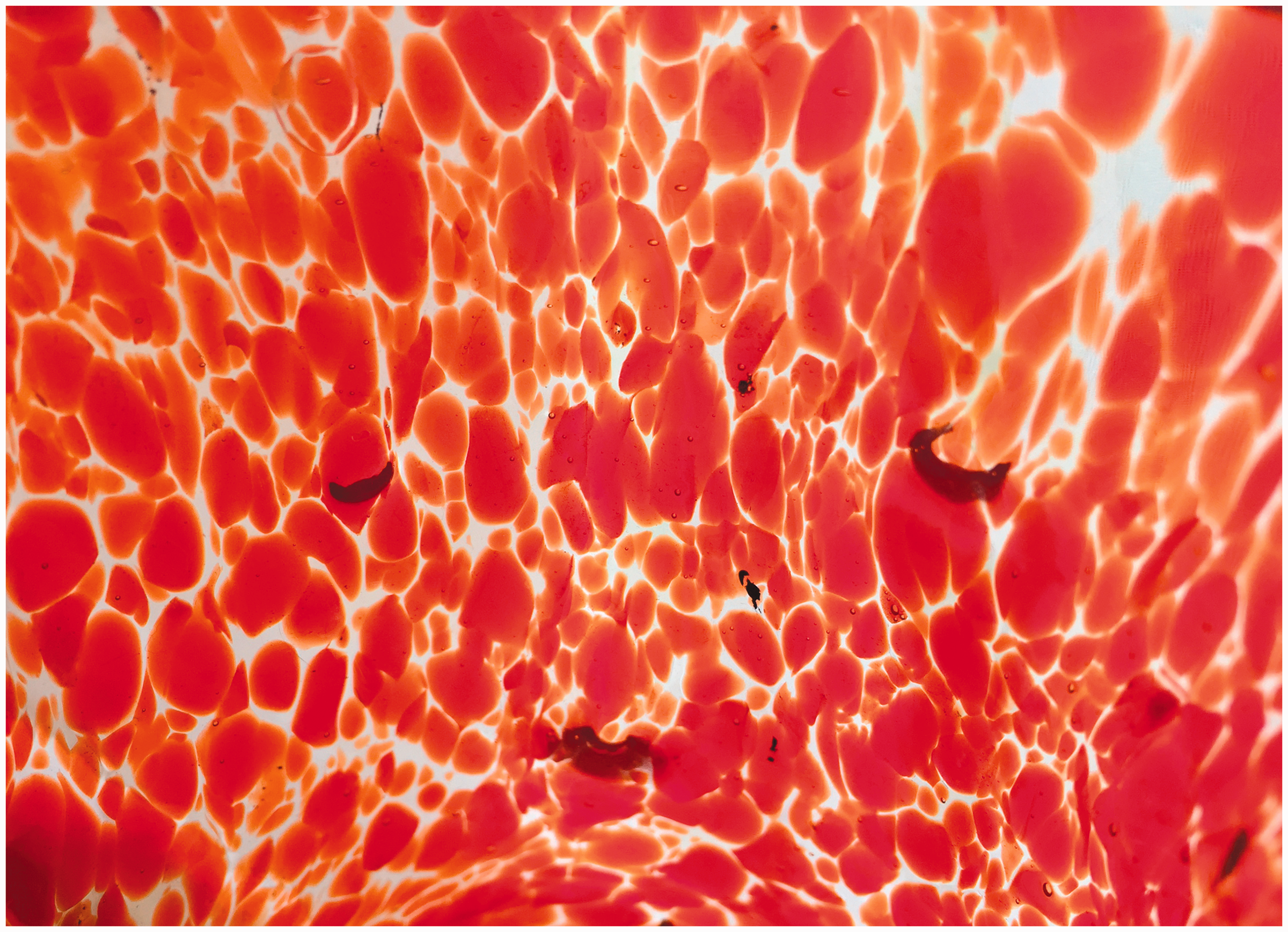
Glass_2 by Kerry Power, 2018, updated digital photo of glass.
The transparency of the glass was a hopeful gesture to my future participants that I would be transparent about how and why I was using their data in research. As the light passed through the glass, I held it up to take the photo (Figure 3). The glass bled red, orange and dark hues including bulbous passageways when light illuminated it and passed through it (Figure 3). When rotating the glass, the image in the camera viewfinder changed and melted from diffractive rays of light bouncing in and out of matter and transparency (Figure 3). This is how diffraction can work when thinking through ideas in research (Barad, 2007, 2010, 2014).
Barad (2007) defines diffraction as ‘a physical phenomenon that lies at the center of some key discussions in physics and the philosophy of physics’ (p. 71). What is significant about Barad’s (2007) definition is that it is not just analogous regarding physical phenomenon, but also a ‘methodological approach’ that enables a point of reference and continuity about how to think matter, difference and entanglements (p. 71). This sounds rather broad but can be applied to how we may think with ethical issues in virtual research.
Barad (2007, 2010, 2014) works with physics, matter and time to alert difference as an omnipresent merging of events that contribute to our thinking. Binary or oppositional thought such as right or wrong is challenged as being an archaic formularisation that promotes fixed states of being from which there may be no reprise. The challenge offered by diffraction is meshing two seemingly separate or counter-arguments to celebrate a cohabitation of thought. Diffracting decisions in my study embraced nuances in my virtual research that altered and affected my decision-making process, particularly regarding ethics. Diffraction as a concept and theory supported how, why and what I should consider when thinking about participants and data in virtual space.
Diffraction is useful considering the modes of application afforded on Twitter due to the blurriness of the here and now. Time becomes a fictitious commodity when looking back, or as Barad (2014) refers to as ‘re-turning’ (p. 168). Further, Barad (2014) describes diffraction as ‘dynamism’ and by doing this, process, movement and a lack of containment ensue (p. 169). This can be true of Twitter in its current format, as it seems the direction of this program is unclear. This again brings me to how working with a program that appears to encourage reTweets, comments and connections that continually change and grow.
Applying a diffractive analysis to Twitter data is a turn against the interpretive model (Bozalek and Zembylas, 2017). This is important as Bozalek and Zembylas (2017) provide a model that goes against categorisation or binaries by acknowledging difference as a ‘relational ontology’ (p. 112). In order to explain how this might apply to an analysis of Twitter data, I imagine that data does not prove or disprove the value of working as art educators on a public platform such as Twitter, but rather, there are various issues that run alongside one another (which can include issues past, present and future as omnipresent). If we can see difference in this way, it may provide a starting point for why and how this forum is used by educators that may support practice in a professional capacity, but also, provide a venue for how this works for individuals who learn, respond, educate and practice.
Barad (2007) provides further expression of diffractive thinking, as diffraction is finding difference rather than replicating something we already know. The limitations of working with a small group of art educators on Twitter cannot reflect or replicate what is happening now for art educators in virtual communication, but it can provide a departure from what we know now. Examining how participants are working with Twitter now, is not suggestive of the overall impact that this virtual practice has on learning; however, it is necessary to think with virtual interactivity as learning. The differences that acclimatise virtuality are new, isolating, connecting, productive and generative of educator experience beyond replicating physical practice.
Researching a global phenomenon such as Twitter and elucidating moral or ethical norms when searching, collecting and using data was a precarious task. The examination of art educators on Twitter enabled a platform from which to examine educator connectivity in virtual space. The use of Tweets provided, for example, views held by art educators regarding art pedagogy and were examined as projected in virtual space which, until recently, little was known. Therefore, my study examined the virtual realm of the art educator, as their personal and professional lives bled into areas of privacy, public life and ethical problems.
Binary apparitions
Binary terms such as ‘public’ and ‘private’ areas of concern are major issues when tackling ethics in virtual research. However, I am going to flip those ideas by considering binary terms as apparitions of how we might come to understand the human condition in the physical/virtual world with all its nuances and intricacies. Binary terms prohibit grey areas that may provide insight into complexities that are often sanitised and simplified.
If I merge what may be perceived as opposites such as public/private or offline/online experiences diffractively, I see entities or categorisations such as these as transparencies that allow light through; just as in the photo of the glass photographed in Figure 3. This glass sits at my desk as I write this; dull from lack of exposure to outdoor light. The moment I lift the glass to the window, colour and brilliance emanate, and my ongoing relationship to art-making practice continued. I argue the possibility of meeting together, merging two opposing positions, providing a place where these oppositions might meet. The ethical intentions of me, the researcher, using images and text of art educators’ virtual work in my study, can only appeal to what I perceive as ethical intent. In doing so, I respectively include their work with their consent and contextualise it throughout the study alongside my participation.
Adams and Thompson (2016) question ethical intent in the tools that we may use to survey collect and mine virtual data. Using technologies to perform data collecting tasks is not simply using tools to collect data, but part of companionship between human and technology. The decision making processes when data collecting tools are designed and used is a ubiquitous relationship between human and technology rather than ‘an unexamined belief in humanity’s domination over technology’ (p. 108). Tools such as NVivo are mentioned by Adams and Thompson (2016), but I also think that we can include using technology to access SMS and the snipping tools to create screenshots. We may view these tools as research processes and methods, but they are part of the decision-making process (if you can think about the ease of access that a smartphone provides). Continually evolving technology seems to want to break any boundaries between human participation, including our face, our thumbprint and our voice when thinking in virtual space.
In Haraway’s (1991) work, and in further discussions regarding the cyborg (Bergsdóttir, 2017), humans and technology have merged. As Bergsdóttir (2017) notes, ‘We do not have a relationship to the world, rather we are in reciprocal relationships of human, non-human, material, and technological enactments in and of the world’ (p. 1). We are in the mix; I am in the mix, and my position on ethics and participants in virtual research comes from my first experience in the field. Perceived boundaries encasing virtual/physical/technology/human are unstable (Barad, 2007). Participants may reply to a research request, and eventually what happens to their data in virtual research is out of their control. Their input such as Tweets have already merged and transformed into other Tweets, other devices and the minds and algorithms of others. Although this is not a disparate view of ethical concerns afforded in virtual research, it is an acknowledgement of entanglements. This acknowledgement brings dialogue to the complexity of ethical positions in virtual research. Diffractive positions do not wave accountability but rather trouble it; just as this paper is not a summary account of knowledge learnt through virtual research process but a continuum of curiosity and questioning (Bergsdóttir, 2017).
Conclusion
I suggest that ethics in virtual research is problematic and applying diffraction may illuminate problems and provide support for thinking with them. I have attempted to capture my approach to virtual research which frames virtual data as continual, momentous and beyond our imagination. How does one know that accessing, reproducing, reconceptualising and researching what is said and done during and after virtual interaction swipes a definitive view on any particular subject? What about the intentionality of the participant who uploads opinions, postulations, proclamations about any given issue online? Is it their opinion of who they think they are or their opinion at any given time? Alternatively, is it a projection or response that may change? Poking holes through positions of researcher/research participant, private/public information and offline/online positions bends and stretches possibilities and complexities in virtual research, and more generally, addresses ethics. When considering ethical blurriness in virtual research, we may see through tokenistic ethical approaches or even blatant neglect for who we intend to research in virtual space.
Footnotes
Declaration of Conflicting Interests
The author(s) declared no potential conflicts of interest with respect to the research, authorship, and/or publication of this article.
Funding
The author(s) disclosed receipt of the following financial support for the research, authorship and/or publication of this article: The author received the Australian Postgraduate Award to conduct the research and preliminary authorship for this article. The author received no financial support for the subsequent authorship or publication of this article