



Abstract
In the face of current socio-environmental challenges, the linear logic of cause and effect that has been the pillar of modern Western science has proved insufficient to account for the differential and multi-levelled impacts that techno-scientific developments themselves have had and continue to make on the Planet. Questions of sustainability and equity and how to ‘live well’ in the world are calling for new imaginaries, and a renovated ethical attention for how we are tangled as beings-in-relation to and with others – not only humans. Responding to such provocation, this paper draws upon Primo Levi’s story of Carbon as a conceptual and ethical frame for exploring the human condition, and through an empirical investigation, it illustrates the methodological shift that occurs when involving prospective secondary science student teachers in first-person, aesthetic-imaginative inquiries. Taking Carbon not as an object of study but as a wordly medium that comes to life, this paper concludes with a radical departure from cognitivist traditions in science education, to advance a science education in the space of the sensible: an open invitation is offered for teachers and students to venture together into the textured and sentient web of Carbon transformations, where knowledge is situated, embodied and mutually accountable.
Prologue: A world-centred education
In perhaps his most famous piece of scientific writing, ‘The Periodic Table’, the Italian chemist and Auschwitz survivor Primo Levi describes the story of a Carbon atom. Starting and ending as the journey of a single atom first burnt in the kiln, and then released into the air, the story unravels with Carbon becoming part each time of a new life, through its particular ability to entertain mutual chemical exchanges in the world: [Carbon] travelled with the wind for eight years: now high, now low, on the sea and among the clouds, over forests, deserts, and limitless expanses of ice; then it stumbled into capture […] enters the bloodstream: it migrates, knocks at the door of a nerve cell, enters, and supplants [another carbon atom] which was part of it. This cell belongs to a brain, and it is my brain, the brain of the me who is writing; and the cell in question, and within it the atom in question, is in charge of my writing (Levi, 1984, p. 75).
Levi’s writing commands the reader’s attention not only for what it communicates about chemistry, but also because of what it says about the writer and the writing process together, in their earnest attempt to understand the nature of life, and that of the human condition. Tracing the story of Carbon all the way until it is time to choose what it would become a part of, we are forced to reflect on how it got all the way to us.
Almost a century after, in the opening pages of ‘World-Centred Education’, Biesta (2021) provocatively writes that educationally speaking, ‘we still live in the shadows of Auschwitz’ (p. 6). The point is made in relation to the trend encompassing educational systems worldwide, hellbent on turning the work of teachers and schools into outcomes measured against external standards, not unlike the yields of a field industrially farmed. And in the same way that chickens and cows are laid over the supermarket shelves, in this system there is no regard for the person, but the person is regarded as an object, or number that can be tracked, estimated, added to and quantified.
Following Biesta’s provocation, the question we pose to science education today is not simply about how literate or well informed we need to be about science and its importance for social and economic development, but whether we should be concerned about our own human ability to be concerned – and affected by – the very humane and worldly matters that we hold in common.
This is the point of conjunction between Levi’s writings and a science education that is World-Centred: Carbon is not simply an object but a medium that exists in the world, and comes to life through the hearts, bodies and minds of teacher and students. This is the educational gesture that according to Biesta (2021) brings the world to attention, with the power and the authority to ‘speak’ to us and thus to call us upon – in a real and transformative sense (see Biesta 2021; see also Vlieghe and Zamojski, 2020). As Biesta (2021) argues, ‘it is this existential question – the question how we, as human beings, exist “in” and “with” the world, natural and social – that is the central … educational concern’ (p. 3). What new ethical and educational responsibilities are there for us as science educators, for how we frame the basis of our research and our teaching practices in schools, and in our teacher education institutions?
Opening: The call for the aesthetic turn in science education
Addressing Biesta’s provocation directly, in this paper I will take the fictional writing of Primo Levi as a point of departure to rethink the nature of science education. Following Todd et al. (2021), I share in the invitation to consider what education can learn from the arts, for example, by being more concerned with humanistic, democratic and even ethical purposes. In science education, such ambitions have been more commonly translated into the use of arts-based practices to transmit scientific content in a more creative and palatable way for the students, that being a narration, a performance or dramatization (Toscano and Quay, 2021). While there is a well-meaning goal of increasing participation and interest, this particular approach to the arts as a tool however, is still wedded to a utilitarian purpose, which only partially engages students’ own subjectivities. If the provocation is to bring the world (back) to attention, then the question to be addressed may be more keenly concerned with the ‘how’ we come to know, not with the ‘what’ that we already know. In this view, I will take the lead from Levi's writings and call upon the arts not as tools for transferring content, but as methodologies of first-person, aesthetic inquiry, which are concerned with the capacity to know by entering in relation with the world via our human senses.
Central to this shift is the role of Aesthetics, which is not simply the addition of a sensual element to what is commonly perceived an as intellectual endeavour: for example, drawing and colouring a leaf for the purpose of remembering its parts and its structure. Rather, the purpose here is to open up our own human organs of perception, in order to be able to discern, but also to be concerned. Aesthetics in this view is taken as a theory of general perception, which may be offered as a new, environmental perspective. Drawing on Böhme (2014): Is truly about Aisthesis, that is, sensuous awareness. It must and will be an ecological aesthetics of nature in its entire breadth. Opposite to the traditional concept of sensuousness as the perception of data, full sensuousness includes affectivity, emotionality, and imagination. The primary theme of sensuousness is not the things one experiences, but rather the atmospheres, the subject of one’s experience (Böhme, 2014, p. 15).
Moving away from the world of abstract representations, I will thus put forward a science education in the ‘space of the sensible’ to refer to a type of education stemming from the capacity to encounter the world aesthetically, as in the real and physical sense of being able to sense – that is, through the skin, via the ears – and to bring ourselves into a state of ‘attentive readiness’ for things that come to us announced, as Biesta argued (2021), and beyond our control. A science education in the space of the sensible is one that exceeds the conventional boundaries of scientific ways of thinking, in order to address the distance between the matters we care about in the world, and what is taken to matter in schools.
To illustrate this turn, this paper unfolds first through a re-view of current debates on the aims of science education to outline the aesthetic premises of a world-centred position. Secondly, through recounting the shift that occurred in my personal practice in teacher education, when prospective science student teachers took part in first-person aesthetic inquiries, and by creating their own ‘Carbon stories’, ‘entered the world of things that change’ (Levi, 1984, p.189).
Revisiting the aims of science education
Historically derived from a tradition of applied research, science education boomed in the post-war era, driven by the expanding capitalist economy and the need to secure prosperity in a scientifically literate society (Shapiro, 2015). Since then, an ongoing debate on the aims of science education has permeated the field (Carter, 2005). Being scientifically literate has been equated to being successful at ‘knowing that’ and ‘knowing how’, by mastering the skills of inquiry and argumentation that are necessary to carry out investigations and validate knowledge claims against the evidence. Reiss (2007) and more recently Erduran (2023) further qualified this aim, by stating the importance for students to understand the cultural and institutional nature of such knowledge; to appreciate the values and the contextual conditions underpinning the production of scientific knowledge, as well as the multiple and different purposes for which it may be produced and deployed (Mansfield and Reiss, 2020).
Going further, another strand of scientific literacy has focussed on the ability to weigh-up facts and values, explore matters through different points of view, and make decisions on potential courses of action vis a’ vis complex and controversial issues (Colucci-Gray et al., 2006). This area of inquiry in science education has significantly expanded in recent years with numerous international and cross-cultural comparisons (Tang et al., 2023). Extending beyond the earlier concerns with students’ preparation in science and their ability to explain scientific concepts, this strand has taken seriously the quest of students as citizens, straddling between the ambition to prepare them to handle scientific information in order to solve public problems (Ghazal et al., 2023), to encourage their active participation in matters of real and current concern for the planet, communities and individuals (Bencze and Alsop, 2014; Chung et al., 2019). When issues of social justice are taken as a central concern, these are not simply understood in terms of evidence, but at the level of human experience. In the light of the differential and unequal impacts of scientific and technological developments on diverse groups in society (e.g. the different ways in which air pollution may affect children or those who live on the margins of the road as compared to other adults), science education will also be concerned with those conditions when privileged access to information makes it possible for some voices to yield more influence and power over others (Levinson, 2023).
A constellation of different positions has thus dominated the field since its inception: one reading of the aims of science education emphasises scientific expertise, which may be more or less critically aware of its values; whereas another reading of science education is set out to guide common citizens to address the impacts and contradictions associated with an expanding scientific enterprise, to call people out, and even to garner efforts for action. Taken altogether, all the different positions aim for a usefulness of purpose. Science education aims to prepare students as competent and responsible individuals who are able to develop ‘public responsibility in shouldering collective societal challenges’ (Erduran, 2023).
Attending to ethics and matters of aesthetics in science education
Given the priority for the science education community to be relevant to current and emerging needs in society, one could argue that a world-centred view already exists, or it is at least envisaged, if not fully actualised. Arguably however, the question posed by Biesta (2021) demands a response of a different kind. It does not ask whether (science) education is useful to prepare for something, as it may be for sustainability, for society or for the future. This narrative is often concerned with the prosecution of a past project which is never accomplished, or with the projection of a distant future that seems to lie well beyond us.
Instead, it invites us to sit in with the present and the world, as unstable and unequal as it may be, as this is the world upon which we depend and are a part of. Suggestively, this possibility finds productive points of connection with a further strand of research in science education, which includes those traditions typically concerned with the relationship between the what and the how of learning in science as practical epistemologies (Gray, 2023; Wickman, 2006, 2017; Østergaard, 2017, 2019) as well feminist, socio-materialist accounts (Braidotti, 2019; Burnard et al., 2022) which have more recently concerned themselves with the ‘affective turn’ (Alsop, 2016, 2017).
Østergaard (2017), drawing on the earlier contributions of Dahlin (2001), spoke about the necessity of an ontological reversal, to transcend the emphasis on abstract models in science education in order to bring the phenomenon - as the subject of aesthetic perception - to the foreground; this may be the songbird of a robin, the recording of footsteps in the snow or the rumbles of a storm in the distance. Derived from the Greek verbs aisthesthai and aisthanesthai, the word aesthetics means to ‘perceive’, to ‘watch’, to ‘sense’ and to ‘observe’. Yet, in parallel with the growth of technical instrumentation and its capacity to filter and to convert information coming from the senses into measurable data, the aesthetic dimension has been largely subsumed to matters of intellectual appreciation.
A powerful illustration of this phenomenon is given by Jean Baudrillard (1996) in the System of Objects: ‘Objects have now become more complex than human behaviour relative to them. […] their emphatic goal-directedness has very nearly turned them into the actors in a global process in which man is merely the role, or the spectator’ (Baudrillard, p. 59). The smoothness and sleekness of a mobile phone, for example, represents the aesthetic value of a technological object that is capable of performing actions naturally without leaving apparent traces. However, through the objectification also comes a disconnection from their original, sensuous nature. According to Østergaard (2019), it is indeed this contradiction between our increasingly extended capacity to gain knowledge about nature and our ability to sense it, that sits at the heart of the environmental crisis. Not because of the lack of knowledge or data, but because of an anaesthesia of the senses, and an ineptitude to understand the nuances of sensorial perception, even when notably extended and amplified through technological means.
In line with the ontological reversal, or the turning of the tables as Biesta (2021) suggested, the question of aesthetic sensibility will thus involve a type of educational practice which relies on defamiliarization of everyday phenomena, objects and spaces, to re-seeing them before they are conceived for specific purposes, such as tools for our taxonomies, for data collection or communication strategies. Elaborating on the analogy between the work of art and science education, Toscano and Quay (2021) speak about the saliency of ordinary events by ‘making them mysterious, in the sense of being not yet objectively or cognitively understood’ (p. 158). With this suggestion, an aesthetic inquiry in science education will not seek to be educational in the calculative sense of leading a student towards a goal (e.g. to be able to diagnose or categorise an object seen at a distance by detecting its common features), but in the ecological sense of disclosing the field of relations in which the students act and are present to.
This is what I would refer to as a science education in the space of the sensible: an education that cultivates the ability to attentively attend to something and to someone before us, by virtue of a sensibility to their form, presence and movement, in a space of aesthetic, physical and affective relations. By advancing this set of premises, in the remainder of this paper, I will draw upon the inherently relational but also material and aesthetic transformations of Carbon, as a set of stories that bind us together as humans and more than humans in this world. I will draw upon my own experiences of teaching student teachers, about which I have partly written about elsewhere (Cooke et al., 2023) to focus more specifically on the gesture of the teacher as a point of departure for a science education of a different, sensorial quality.
A methodological note for the reader
For the readers who are approaching this paper with the intention to validate my claims against the evidence, I will signal here that the manner in which I wrote about this experience is more akin to the effort to write from the present, rather than to validate a truth against the past. This means that the extracts from the students I offer as ‘data’ are by no means seeking to capture the totality of students’ experiences, or to validate the effectiveness of a teaching method against a goal set in advance. Rather, following the invitation of Primo Levi (1984, see p.194), when we take a relational view of the world in which we are both subjects and makers of the story, it is our own humble making that stands as the truth. This means that as readers, we are not positioned as sceptical scrutinisers of the sole truer version, but as witnesses bearing testimonies of the many stories and viewpoints, that are all bringing homage, and all are equally true. A certain humility is involved in this telling, as Levi writes in the concluding section of the story: ‘the humility and restraint of him who knows from the start that his theme is desperate, his means feeble, and the trade of clothing facts in words is bound by its very nature to fail’ (p. 194).
In a similar vein Pirrie (2015), taking the lead from another Italian novelist, Italo Calvino, also asks: ‘What might educational research look like if it were to afford us a better understanding of all that is minute, light and mobile instead of all that can be counted, categorised or measured?’ (p.529). Whenever humanity seems condemned to heaviness, Calvino (1988) tells us, ‘I think I should fly like Perseus into a different space’ (p. 7). As I have done elsewhere (see Colucci-Gray and Camino, 2016) taking the line of dialogical writing offered by Pirrie (2015), I will thus attempt again to write this piece in the manner of an ‘essai’, as from the French ‘to try’ and move into such a space, where readers and writers are brought together as witnesses and listeners to the feeble stories of the entanglements of Carbon and its transformations.
First movement. Carbon transformations: turning attention from a world of objects to a world of relations
In the first instance, Carbon is a material entity, that in the opening pages of Primo Levi’s chapter is brought to the attention of the reader: ‘once was immobile, now turned tumultuous’ (p 227). This happens in 1840, the year in which the Swedish chemist Jöns Jacob Berzelius coined the term ‘allotropy’ for the occurrence of different forms of the same element in solid, liquid or gaseous state. In the case of Carbon, such different forms coexist as different crystalline elements, such as diamond, graphite or coal. An earlier experience — back in early 2000 — of introducing a group of science graduates to the story of Carbon as part of a lesson on the fundamentals of sustainability, led to the students seeking to map the trajectories of Carbon in the story. The result was a complex and unmanageable exercise which led to great frustration. Holding tight to their science backgrounds, students tried to detail the complex chemical transformations involved at each passage in the story, often lamenting the lack of specialist knowledge required to describe them in detail.
While the story did have an initial appeal, its aesthetic power did not go beyond the immediate interest or attitudinal disposition. However, although disappointing, the results were not surprising – as remarked by Wickman (2017) – given the way in which imagery, models and stories are often used in biology teaching: to illustrate and to explain (Hui-Jin et al., 2013), as well as ‘to elicit more explanatory and evaluative reasoning about the underlying mechanisms of the biological systems’ (King et al., 2019, p 1764). With science students in particular, so successfully trained in the acquisition of specialist knowledge, the point of the exercise was perceived as ‘extractive’ in nature, whereby the artistic licenses of the text somehow got in the way. As Rita Felski (2020) remarked quite eloquently: ‘The most influential critical schools of the last half century have prized a certain ethos: knowing, vigilant, skeptical, wary’ (p. 129), and in this same way the students put themselves before the text, and not as part of it.
Conversely, as Bachelard (2014) suggested in the Poetics of Space, our mutual relationships may be perceived aesthetically as forms or ‘material images’ that are present to us and to each other in the present, inhabiting our deeper imaginings, visual and verbal, auditory and tactile, that we re-inhabit in our own unique ways. For example, a shell on the beach sits alongside a pebble made of coal. But how does the shell with its spirals and chambers relate to the roundness of the pebble and how do they both relate to softness of the human hand that holds them is a question that goes beyond the immediate transactional exchanges of Carbon atoms that constitute them.
This dynamic tension between the fictional and the material casts the idea of the image in the two traditionally conflicting roles of either ‘imitation’ or ‘invention’. Classic in this sense is the case of allotropes that in the chemistry of Carbon poses the problem of how one element may exist in different forms which are not mutually exclusive. Instead, in Bachelard’s view, the purpose of imagery is not to confuse, but to lead beyond: ‘setting verbs in motion and turning sensations into metaphors’ (Kearney, 2014, p. xxii), thus inviting us to live figuratively, pre-figuring the world in what is and what it might be.
The tables indeed are turned: the reader is not given formulas or explanations to define and crystallise what happens in one singular view; what is offered instead is a series of Carbon-reverberating phenomena in the world-space of the narration – down the lungs of a flacon, dissolving three times in the water of the sea and jumping of a torrent – along the paths of things that change, as Levi writes. The transformations of Carbon are not contained inside a formula, but come alive through material and figurative incarnations which are set into motion as dynamic, mutual exchanges.
Second movement: Touching Carbon entanglements and partaking in conversations
Some years later, I re-proposed the same activity to a different group of prospective science students enrolled in a course in Didactics of the Biological Sciences, that was optional to their specialisation in science education (see Cooke et al., 2023 for a more detailed illustration of this particular event). It was a particular moment in time, as the COVID-19 crisis hit the world and turned educational encounters into exchanges of information through digital interfaces. The situation at the time induced some practical challenges to the usual model of teaching based on group work and practical work, either outdoors or in the lab. The environment for students and teacher to meet was that of the digital space, itself a liminal space reducing communication to the flow of information from giver to receiver and vice versa. However, from a phenomenological and aesthetic perspective, the impossibility of sharing the physical space also introduced a new, prefigurative possibility: that of seeing science education in the everyday context of the students’ own rooms, houses and intimate spaces.
As reported in Cooke et al. (2023), the students were first introduced to an activity mediated by a set of images on PowerPoint during which they were asked to discuss the characteristics of living and non-living things (i.e. an egg, a chicken, a tree stump and a section of moss covered woodland). The objective of the activity was to generate a model of a living system, including principles and processes that are essential and common to life. Not unlike the earlier experience, also on this occasion, the students approached the task with an analytical focus, and sought to categorise living and non-living things on the basis of characteristics that were mutually exclusive. For example, the image of the egg was categorised as living, because it would give rise to a living organism; but the tree stump covered in moss and mushrooms was deemed as non-living, or dead – because it was no longer functioning as a tree with the ability to photosynthesise. When invited to look again at the image of the tree stump, to consider the relationships that were visible in the wider frame of the picture, that is, the roots and shoots appearing from the side of the stump, the mushroom colonies, and the younger trees around it, relationships that are indeed based on exchanges of Carbon, and make up the communication network of chemicals in the woodlands (Kohn, 2013), students felt challenged.
Drawing on the legacy of Alfred Whitehead (1925), who was first to reject biology’s preoccupation with the primacy of objects, current readings of evolutionary and process biology place the dynamicity of change as primal. As Nicholson and Dupré (2018) remarked: ‘What we identify as things are no more than transient patterns of stability in the surrounding flux, temporary eddies in the continuous flow of process’ (p. 13). In this view, organisms are understood in their ‘becoming’, as parts and relations change themselves and one another. The contrast between these different and co-existing views of biology – one focused on material entities and the other on relations – can be understood culturally, as different understandings of aesthetics. In the way referred to earlier by Böhme (2014), speaking of sensuousness, as opposed to the appraisal of form, lends itself to an ambiguity of feeling, an emotional state of active reciprocal undergoing, rather than the passive act of being the object of somebody’s sensual perception. Paterson (2007) refers specifically to the sense of touch, as an aesthetic experience of alloiosis to mean alteration (being affected by) and change, as the act of perception of something is accompanied by the experience of feeling close to it.
Once again, the tables are turned. In the same way Carbon allotropes can show different facets of their being in relation with other elements and with each other, I invited the students to close their eyes, and to touch-explore an object reverberating in the Carbon-entanglements of their own private spaces. Some reached out for a plant on their windowsill; another for a shell and even the carapace left behind from a turtle previously kept as a pet. The act of touching their objects within the context of a lesson in biology education was a new experience for them, which entailed an act of trust when responding to the invitation, both from their side, as they swapped a posture of knowing with that of not-knowing, and from my side too, as their teacher inviting them to do something unfamiliar in that situation. I had not shared this experience with them or with other students before; and I was not in a position to anticipate or even guard against a refusal. As one of the students expressed it in their reflection at the end: ‘… then I understood that the invitation was to revisit something that is almost spontaneous and taken for granted for a naturalist, that is the different modalities though which we can “enter into contact” with natural things’ (MT).
Drawing an argument from Prange (2012a, 2012b), Biesta (2021) expresses the work of education as a ‘turning outwards’ and a ‘turning towards’ the world, by paying attention to how we see and how we attend to the world. From the perspective of the teacher then the gesture is not that of pointing to particular objects or features which are deemed to be significant and noteworthy within a frame set out a priori; instead, the challenge is to suspend common expectations, playing with the norms of schooling that instrumentalise attention. In this space, writes Paterson (2007), we are always in media res, a state which affords the possibility to disrupt and to interrupt habituated perceptions, including the obvious distinction between the senses and their association with discrete parts of the body (e.g. eyes for vision, hands for touch and ears for hearing). The focus on aesthetic perception beyond sight may afford what Merleau-Ponty described as the possibility to ‘rediscover phenomena’, by forgetting them as a ‘given fact’ of perception (Paterson, 2007, p.21). This may be a gift in the hands of the scientist seeking to take another look, or to listen with a different ear, not in the sense of checking for possible errors, but as a way of being alerted to the possibilities of the phenomenon they may come into contact with.
De-habituating perception highlights the potential for synesthesia, that Casini (2017) suggests can become a tool in the hands of the artist as well as the scientist: ‘to introduce a different politics of the senses, allowing an individual to perceive cross-sensory patterns, become more aware of the hidden correspondences among ourselves and the physical environment, and thus interact with it differently’ (p.3). The difficulty however is that sensing does not necessarily equate to acting with awareness, of even with judgment. Something more is needed here to sensitise the hand but also to guide it in its sensing, which also presupposes the need to know more about the relationship between the artist and their artistic experience.
In practical terms, following the initial activity of touching with the eyes closed, the sensuous, tactile experience was expressed by one of the students as the re-discovery of the ‘diversity of sensations’ (Figure 1), which were re-turned to them as soft marks from the pastel drawing. The allotropy of Carbon was enacted in the hands of the students first, as an emotional undergoing with the shell revealing its smooth, carbonate form at the touch, and then again, through the feeling arising at the point of contact between the pencil and paper as intersecting, sensorial domains. Pastel drawing following the experience of touching the shell with the eyes closed. Translated from the original Italian: “During the first experience with the pencil and the sheet of paper I relaxed, drawing 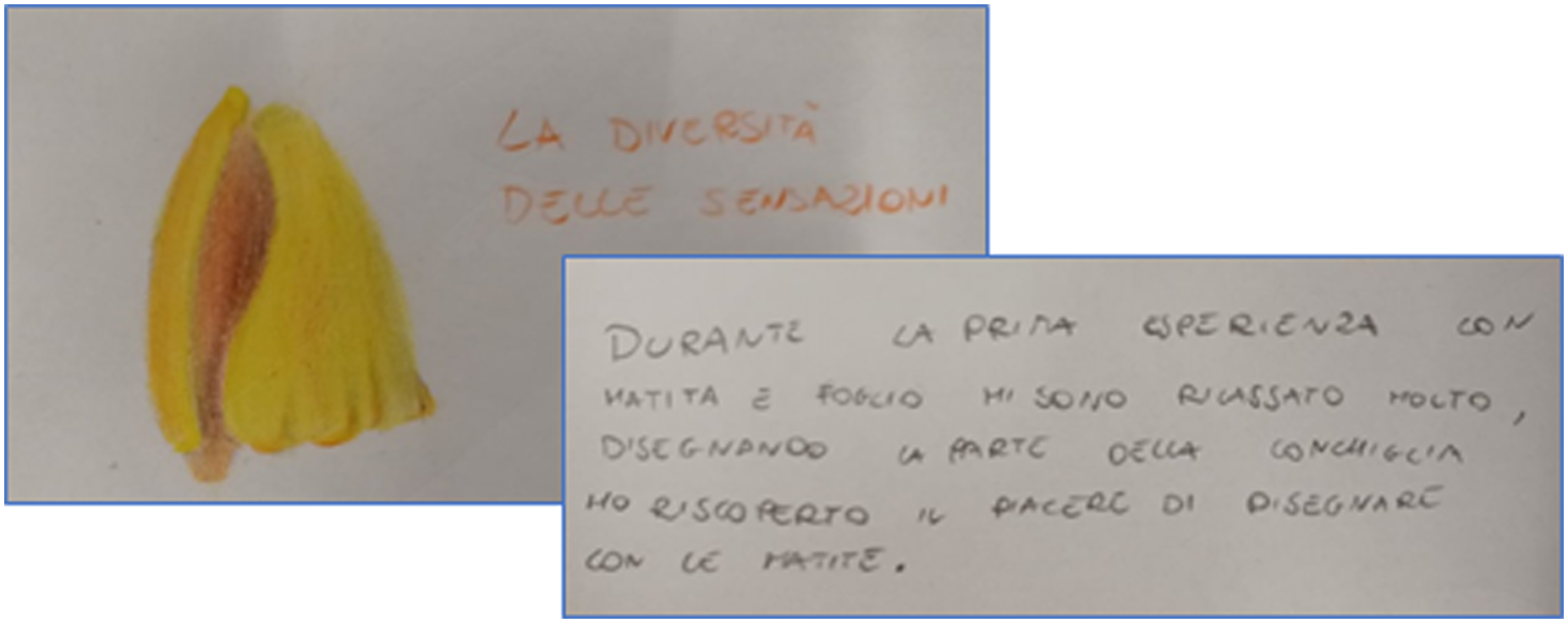
From the domain of aesthetics, Cazeaux (2015) speaks about a «performative epistemology» as the transformation of materials to exude the definition of an object or concept within given boundaries of typology or material structure. In this instance, the shell being touched and subsequently drawn was made present to the students through an abundance of qualities that were perceived at the touch: texture and volume were ‘transformed’ on paper as colour and density, yet such transformation occurred beyond any prior intention, and by remaining open to the results, the students made themselves the subject of their own sensations. As the student quoted in Figure 1 expressly said, it was about drawing ‘that part of the shell’, the one that had been touched and felt, that one, there, closer to one. In a similar manner, another student remarked the effect of the act of drawing itself, and the pleasant sensation of using the graphite pencil to smudge the contours of the image on paper
1
: ‘I focused on the pleasure of feeling the mark of the pencil on the cardboard. I like the way pencils make their mark, the sensation it affords. It is very different from the pen, it is “immediate.” With the pencil you can do a “sfumato.”
As Cazeaux (2015) also remarked, it is true that an artist familiar with the mark-making possibilities of charcoal on paper might be able to know already the effect that can be created, for example, by choosing smooth as opposed to grainy paper. But this is not the point. The invitation here comes from charcoal as the Carbon itself, a material that will dirty your hand and willingly or unwillingly will leave a mark in its combining with other materials. Such is its nature, and such is the nature of its demand: ‘working back through your body and make you think about the posture you want to adopt in preparation for making a mark’ (Cazeaux, 2015, p.381). In this sense ‘working with’ materials is not about predicting the behaviour of the material in advance – as much as one could estimate the degree of smudginess - but it involves a kind of turn from intention to attention, as the ability to respond to something or someone that is asking something of us.
As the student continued to ponder about the experience in her written reflections, there was a clear difference between this exercise – conducted during a science lesson – and the practice of drawing from life taught in school: ‘a technical task, an exercise to pay attention to proportion and perspective, usually involving some kind of assessment’ (FC), whereas in this activity the invitation had clearly something to do with their own intention and desire to draw, and mostly of ‘becoming aware, and using the intellectual honesty of admitting one’s priorities’. In this case, the admission was that not much attention had been paid that far to the act of drawing and observing closely, as compared to the time and effort spent on learning specialist content, both at school and University.
Partaking in conversations
According to Biesta (2021), such ‘turnings’ of intellectual posture are
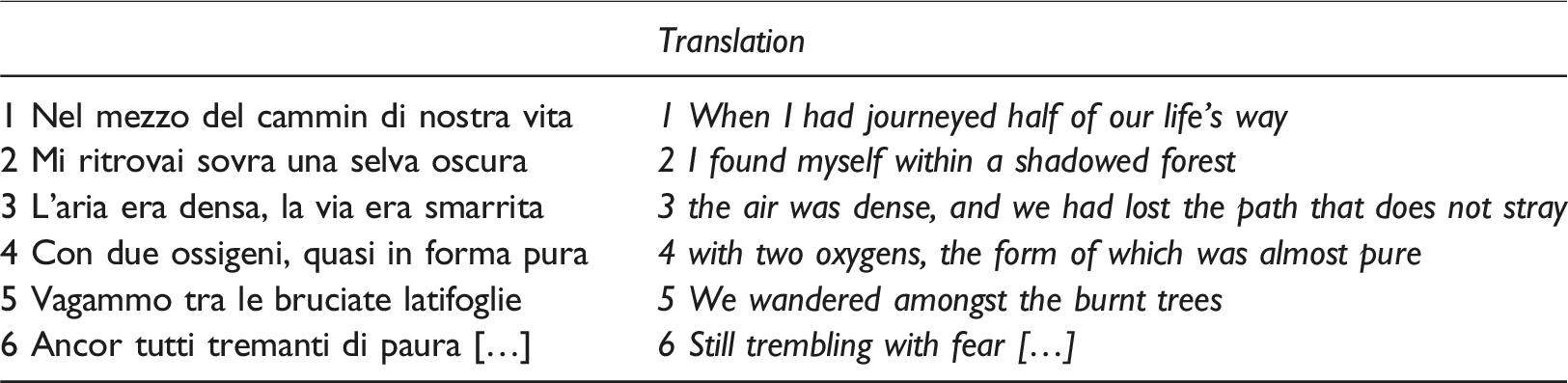
The extract presented here brings up another allotropy of Carbon: from the pencil that writes to the charcoal that exudes in the air, making it difficult to breathe and to see: ‘L’aria era densa, la via era smarrita’ (the air was dense; the way was lost). The sonnet goes on for 16 stanzas as the students took care to describe multiple Carbon’s journeys but, in the end, as per their own admission, they failed to bring its levels in the atmosphere down to expected or desired quantities.
Carbon is released further and further with actions that play out through multiple characters in the story. This inability to reach the result they aimed for is elaborated further in their own reflections, not as a lack of knowledge but as a result of the necessity to be true to context. One of the students spoke about ‘the importance of recovering the vocabulary of the mind’ in order to ‘try and express content in ways that aligned with the words and the tone being sought’ (GR). Similarly, as reflected on by another student (EP): ‘the decision on the style and form of the sonnet’ with its darker tones permeating the rhymes, ‘seriously affected the story being told’, carrying the events to their unexpected and unanticipated end.
Here we see a return to Wickman’s (2017) desire to bring back the sense of aesthetics in science education beyond the immediate intention to convey knowledge, but as an important pedagogical skill in the hands of the science educator inviting the students to meet their own selves, and to make their world. But we can also find resonance with Østergaard (2019) and Felski (2020) who are concerned with treating concepts and experiences as equal, for they can provide a compelling alternative to more guarded and sceptical ways of knowing. Aesthetic experiences are not simply felt but forged, says Felski (2020), meaning that an active disposition is taken, and it involves a deliberative and discerning capacity of making one’s own sensing the subject of one’s own inquiry. The question is no longer about what can you see, feel or hear, but how far, and in what way can you feel, see and hear, sustaining the process of working-with the materiality of experience accordingly.
For a science education in the space of the ‘sensible’
In this paper, I took the invitation from Biesta (2021) to consider the educational opportunities of a world-centred science education. The argument centres upon the possibility to move away from cognitivist and sociological traditions, which have privileged the acquisition and understanding of scientific concepts, in order to imagine a science education rooted in the domain of the corporeal and the sensuous. The physical and sensing body is where matter is felt, right at the touch of the skin, and it is through the body that we can both affect others and be affected by them, or as Sarah Ahmed (2010, p. 29) prefers to say, affect ‘is what sticks, or what sustains or preserves the connection between ideas, values and objects’. This science education is concerned with creating the opportunity to break with the ‘taken for granted’ or the ‘natural attitude’ and to ‘impose different orders upon experience’ (Greene 2001, p. 5). It is thus a way of doing science education which brings up a new set of working principles for the science teacher: such as being comfortable with working things out, as opposed to seeking hidden truths; and practicing with evoking the incompleteness of human experience as an opportunity to know again, and to know differently, rather than treating such incompleteness as an obstacle or a mark of failure. Two important considerations follow from this.
Firstly, by taking this turn, we are not necessarily dismantling the school system in order to replace it with an education solely concerned with the ordinary stuff of life, as per the older question of whether the value of science education should be measured against the pursuit of practical goals like driving the car or cooking. And similarly, by drawing on the artistic medium, we are not seeking to deny what we more commonly associate with proper science or proper scientific inquiry. Quite the contrary, what we are looking at – as Biesta (2021) calls it – is a change of educational priorities, turning the tables and putting the students as sensing subjects to the foreground. This is a condition tasked with the ethical responsibility of being present to one another, and also to a stranger, who may lie outside of our immediate perception, but to whom we are also and always present in the material space of co-existence. Secondly, this way of approaching science teaching through a literary form is different from teaching to interpret and and reveal the hidden meanings of a fictional text, but it is more akin to the act of participation, as it is common, for example, in the field of performance arts. In this case, the word ‘performance’ may be used to encompass the relationships between the performer and the viewer, who can only make sense of the event by taking part, and being part of the performance, ensuing as a co-production of social worlds (Goffman, 1959).
If the mission of art is to bring us as diverse subjects into the common world, then the mission of science education is the attempt to teach us to live in such a world that we share in common. From this particular stance, reading Levi’s work offered the possibility to engage with a world-centred science education, unfolding as a relational and embodied performance triggered by an unexpected interruption of ordinary events. In a similar vein, the digital medium offered the opportunity to remove those mechanisms that are well-known in education: the reliance on the teacher to lead and provide answers; the passive positioning of the students seeking to take away something worth of their efforts and money.
Confronted with the limits of a situation which did not afford to meet each other, and to explore a world we had in common; a situation which did not offer the chance to predict, foresee or model what was there to happen, the offer became that of experimentation. We departed from the script and we took the route of ‘being present’ to the questions and demands of the present. John Cage referred to this as the major contribution of aesthetic knowing: ‘To open ourselves up to the world, we must consider the ecology even more than the individual. It is not simply by observing the individuals, but by reintegrating individuals into nature, by opening the world to the individual, that we will get ourselves out of this mess’ (Cage, For the Birds, 1981, p. 56, italics in original).
Coda
Re-turning to science education, the recovery of an aesthetic and ecological sensibility resonates with long-standing arguments on the democratic in science curriculum reform (see Fawns, 1985, 1998), and the ambiguous place of emotion and imagination in the general science curriculum. Most significantly here, we found resonance with a much older tradition going back to Lauwery’s (1957) ideas of the role of Biology as a bridge with the humanities, a subject helping to bring forth a new humanism rooted in scientific knowledge, to supplant the technicism and staunch scientism that had dominated for the most part of 20th century (Gray, 2023). And by chance one day, browsing the shelves of a charity shop in my local community, one Sunday afternoon in August 2022, I came across a book authored by two female authors, Phillips and Cox, respectively, teacher and headteacher in an American school in the 1920s.
Some background reading tells me that their early method text was widely used in girls’ schools in England and Australia, who found in biology ‘the democratic, spiritual and aesthetic principles of nature directly observed’ (p. iv). Their biology teaching was aimed at giving the pupils ‘a reverence for nature and for natural laws, thus helping them to lead fuller lives because they would have a better understanding of, and truer contact with a world governed by these laws’ (Phillips and Cox, 1935, p. iv). Finding this book was entirely accidental and unexpected, as I ventured into the labyrinthine tangle of Carbon transformations, thinking about contemporary issues and rummaging through old ideas. Like a spectator in a staged public performance, I could not hide the disbelief at the mis-en-scéne and the revelation that followed: the entanglements of Carbon are there all the time; no explanation is really required if we are able to let ourselves in, look and be surprised.
So, the story that we have been witnessing was not so much about a group of students and their teacher involved in a digital encounter, but that of a group of people rejecting the educational space as a container, and turning to the affective possibilities of a relational experience in the world. Far from being the exclusive domain of art or science, the aesthetic affordances of sensing were mobilised to enliven and embrace in non-hierarchical ways the many varieties and possibilities of looking and listening, not simply with the ears and the eyes, but also through the nuances of language staging the experience, forging the possibility of paying attention, and attending to the consequences of doing that as well.
In this sense, returning to the methodological tentativeness of the ‘essai’ introduced by Pirrie (2015), a certain ‘lightness of language’ (p. 528) as opposed to the search for exactitude may be offered here for future practice. The story I described does not yield the promise of a protocol or evidence upon which more solid knowledge is to follow, but it is given as the humbler gesture of showing one’s poorer art to another, to take up from where it has been left. This kind of conversational exchange is built from the ground up and exists as the desire to continue on playing together, like in a musical rehearsal, picking up on: ‘… those small phrases, facial gestures or silences which open up a discussion’ (Sennett, 2012, p. 18 cited in Pirrie, 2015). And so, in this newly created cultural frame, I will let the story of Carbon to be continued by one of the student teachers, joining in this path along the paper: ‘As a future teacher I wish I was able to transfer the beauty of discovery, not only by using all the senses but also all my sentiments. It is quite a complex thing. I have myself too many inhibitions, too many preconceptions about what I ought to do and not to do as a teacher. It is for this reason that this kind of experiences are both auspicial and necessary (and most importantly together with the reflections that we derive) in the education of future teachers’ (SP).
The final question that remains is whether as science educators and teacher educators are prepared to take seriously our artistic licenses and join in just the same.
Footnotes
Acknowledgements
I wish to thank the students on the course of Didactics and Methodologies of Life Sciences at the University of Turin; Prof. Anna Perazzone, Prof. Elena Camino, Prof. Edvin Ostergaard and Prof. Gert Biesta for engaging discussions and provocations which sustained my ongoing adventures in the world of philosophy of art, science and education.
Declaration of conflicting interests
The author(s) declared no potential conflicts of interest with respect to the research, authorship, and/or publication of this article.
Funding
Part of this research was enabled by funds for a visiting professorship at the University of Turin. The author(s) received no financial support for the subsequent elaboration of the theoretical framework, authorship, and/or publication of this article.
