



Abstract
This mixed methods study focuses on the use of instructional videos in an undergraduate physics classroom. Previous research has explored the effects of videos on student performance however, limited research exists on the effects of science instructional videos with embedded quiz questions on student achievement. This study compares students’ performance when a problem-solving physics video is presented to students with embedded quiz questions versus videos with quiz questions presented after the video. Additionally, the study explores students’ attitudes and preferences toward the positioning of questions in videos when learning independently. A total of 111 college students enrolled in the introductory physics course at the large Midwestern University were randomly assigned into two groups to participate in the intervention. Students completed pre and post surveys, watched instructional video and completed quiz that covered content discussed in the video that either was embedded or was presented post-video watching. The quantitative analysis did not result in statistical significance in students’ performance when groups were compared. However, qualitative analysis demonstrated strong student preferences toward the use of video in STEM classrooms when scientific problem-solving content is taught, stronger engagement with content when quizzes were embedded, and desire for immediate feedback. The study has implications for faculty who use videos and quizzing in their classroom or consider using videos in the future.
Introduction
The conversation on how technology affects learning and student performance is not a new one by any measure. Neither is the instructor’s voyage to finding and implementing best practices for teaching. As faculty balance their research and teaching demands with their desire to maximize learning for their students, they are often selective on what instructional strategies are effective, can be set-up in a reasonable time, and will have the largest impact. One technological use for teaching that warrants further investigation and discussion is the use of instructional videos in a STEM higher education classroom. Content in STEM fields often leans toward problem-solving, critical thinking, and addressing real-world problems. Presenting content to students in these fields via videos is gaining traction. There is a need to teach STEM topics in an integrated and meaningful way (Berry et al., 2012).
Due to technological advancements, in particular, the ease of recording and producing instructional videos, college faculty are finding the process of creating their own material to be one option to diversify their teaching. In fact, universities and colleges around the nation have moved their video educational content to external hosting services such as YouTube (Gilroy, 2010). When we consider the plethora of available tools, faculty’s engagement in instructional video development and dissemination, and the ability for students to independently locate and learn from millions of available video resources, it becomes essential to study how to engage students with video content.
The literature on the use of videos for teaching and learning in the past decade is lengthy and covers a variety of topics. These topics include the effects of video quality on student engagement (Guo et al., 2014), benefits of using videos in higher education (Vieira et al., 2014), students’ attitudes toward instructional videos (Kelly et al., 2009), and use of videos in a variety of teaching modalities such as blended or flipped classrooms (Bishop and Verleger, 2013). The present paper discusses student performance and engagement with instructional videos when the nature of the content is mathematical, analytical, and science oriented.
Literature review
The theoretical framework of this study builds upon the constructivist theories of Vygotsky (1978), Jonassen (1999), and Hannafin and Peck (1988).
Vygotsky’s (1978) constructivist learning focuses on the idea that knowledge leads to further cognitive development. Instructors should use a variety of resources and teaching supports to guide student’s progress and measure it. The concept of mediation implies that learners intentionally interject items between their environment and themselves to be able to achieve specific learning gains.
Jonassen (1999) suggests that learners should be presented with interesting, relevant and meaningful tasks and activities in the constructivist learning environments that will trigger learning. The author suggests creating learning goals and objectives that are relevant but not overly structured and designing instruction using scaffolding and building on the previous knowledge of students. Essential components of Jonassen’s theory include context, representation, and manipulation. Context is a description of the physical or sociocultural environment in which the problem should be presented. Representation is a principle according to which the problem should be presented in an authentic appealing and engaging way. Manipulation implies meaningful learning activity where learners are able to interact with the environment. The primary goal of the theory is to design a learning environment that fosters problem solving and conceptual development.
The Hannafin and Peck (1988) model for e-learning adds to the theoretical framework of the study. According to the model, there are three phases in creating an effective learning environment. The first phase called assessment implies conducting a thorough needs analysis and deciding on objectives and learning activities and resources that will help to achieve them. The second phase called design implies designing the e-learning experience to fulfill needs and wants of the learners. The third and final stage called development and implementation involves actual implementation of the e-learning program.
The literature review that supports this study is comprised of three main sections: the effects of video on students’ learning and instruction, an examination of the use of interactive videos in the classroom, and faculty and students’ perceptions of video use. These three major bodies of literature serve as a foundation for this study.
Effects of video on students’ learning and instruction
Video is widely used and accepted as a teaching and learning tool in online, flipped, and blended courses (Bishop and Verleger, 2013; Borup et al., 2015; Chen, 2012; Makarem, 2015). The body of literature addressing the use of video for instructional purposes highlights its positive effects (Chen, 2012; Giannakos et al., 2015; Johnson and Cotterman, 2015; Kearney and Treagust, 2001; Kolas, 2015; Sings, 2003; Vural, 2013; Wells et al., 2012; Wieling and Hofman, 2006; Zhang et al., 2006).
June et al. (2014) conducted action research to explore the effects of YouTube videos and interactive activities on critical thinking of 50 Malaysian university students. The study concluded that YouTube videos increased students’ participation and engagement and improved their critical thinking skills. Students’ learning increased in the lectures by visualizing the content and relating the material to the real-world examples. Students perceived YouTube videos as fun and interesting.
Similarly, positive effects of videos on learning are demonstrated in a research study conducted by Johnson and Cotterman (2015). They examined how secondary science pre-service teachers used a video club to restructure their science knowledge into science knowledge for teaching. The study concluded that video clubs enabled pre-service teachers to deepen their understanding of science teaching and learning.
Giannakos et al. (2015) also found benefits of videos on students learning. This longitudinal study looked at the use of an open-access video analytics system in the video-assisted undergraduate reading course. The study showed a positive correlation between repeated views of videos and the students’ learning performance. In addition to students’ positive attitudes toward the use of video lectures, videos provided students with higher cognitive level learning and deeper engagement.
While the overall positive effects of using video are evident in the literature, new software technologies provided additional variables to the use of video. For example, when videos are combined with other software or web languages or viewed through enhanced software applications, a video lecture transforms the viewers’ experience from passive listeners to engaged watchers that interact with the content.
Examining interactive videos
Some studies specifically examined the educational effects of interactive videos. For example, Laws et al. (2015) examined the use of video vignettes (web applications written in HTML and Javascript that include videos, images, and multiple-choice questions) in an introductory physics class. Video vignettes included multiple-choice questions with branching, so that if a student selects the incorrect answer, the vignette branches to a video that explains why the answer is incorrect before the student can carry onto the next question. The study concluded that interactive video vignettes ensured interactive learning, which could not be achieved with passive online presentations.
Chen (2012) investigated the effects of self-paced interactive thematic videos. Seventy-six students from the Taiwanese university were randomly assigned into experimental and control groups and received either an interactive or traditional (passive) video. Findings of the study indicated significant differences between two groups and suggested that the group that received interactive video materials had better learning outcomes.
Kearney and Treagust (2001) also studied the engagement in two types of multimedia training: a passive videotape and a less passive interactive one. The authors measured student outcomes by asking them to complete a quiz and a questionnaire, which demonstrated stronger learner engagement when students experienced interactive computer-based training. Kolas (2015) suggested that interactive videos (videos that include embedded quizzes, link-chains, interactive maps, and interactive 3D-objects) have a positive effect on learning and educational experience in general. Kolas (2015) reported that interactive videos activate the student and raise awareness toward video content.
Similar results have been reported in e-learning environments. A study conducted by Zhang et al. (2006) looked into the influence of video on student learning outcomes and satisfaction in three e-learning environments that included interactive video, non-interactive video and no video. Participants included 138 undergraduate students from multiple departments who were randomly assigned into groups and completed the same set of tasks: introduction, pre-test, online lecture session, and questionnaire. Students in the group provided with the interactive video showed significantly better learning outcomes and expressed a higher level of learner satisfaction than students in the other groups.
Wieling and Hofman (2006) studied the effects of a combination of videos and online quizzes with feedback on students learning. In this between-subjects design study, 474 students enrolled in the European law course were randomly assigned into two groups, a group that had access to online lectures and multiple choice quizzes with feedback and a group that had access to the online lectures only. The regression analysis suggested that offering online video recordings is of practical importance because it allows students to view them if they missed the actual class.
Vural (2013) conducted a quasi-experimental study to examine the effects of question-embedded online interactive video environment on student achievement. The study participants included 318 teacher education students enrolled in the introductory computer literacy class. The researcher used two different course materials to teach the same content: question-embedded interactive video environment and the interactive video without the question component. The study found that question-embedded video-based environment promoted student learning, improved student interaction and time spent with the learning materials. The study concluded that the question-embedded interactive video environment may lead to better learning outcomes and higher learner achievement.
Sings (2003) also discussed the development of interactive video tutorial-based problems on physics students’ problem solving skills. The study concluded that the majority of students who could not solve the tutorial problems without help were able to solve them after working through the video tutorials. The research conducted by Wells et al. (2012) looked into the use of video tutorials within the university environment. This three-year study found that if the videos are well-designed, assessment-focused and available for students to access and view, they have the potential to improve student satisfaction and grades by allowing students to learn on their own pace that suits their learning preferences and needs.
While multiple studies do report on the positive effects of video on learning, some studies found no effect of interactive videos or student learning. For example, Merkt et al. (2010) conducted two studies, one in the laboratory and one in the field, and compared the effectiveness of interactive videos and illustrated textbooks in the German secondary school classrooms. Participants included 60 German high school students who were given a regular video, an interactive enhanced video or the illustrated textbook. They wrote essays covering the content from the consecutive mediums with which they were presented and were given multiple-choice tests to assess their knowledge of content. Interestingly, students in the regular video group outperformed students in the enhanced video group. The authors conducted the second study to test if the outcomes would be the same if the study was conducted in the actual classroom rather than the lab. The second study showed consistent results showing that students who had access to the regular video outperformed students in the other two conditions.
Similarly, Castro Superfine et al. (2015) also found no effects of videos. In this quasi-experimental study, the authors investigated if the use of video cases supported pre-service elementary teachers’ noticing of children’s mathematical thinking. The authors found no significant differences between experimental and control groups in terms of their noticing of children’s mathematical thinking but suggested that an additional factor to consider when using videos for instruction are the faculty and student perceptions.
The present study compares students’ performances and attitudes when students are studying from an interactive video versus a non-interactive one in physics higher education classroom.
Faculty and student perceptions on the use of instructional video
In addition to the positive effects of video highlighted in the literature review, faculty perceptions on the use of video are generally positive. In a review of 200 faculty perceptions of Web 2.0 tools, the use of instructional videos was viewed as the most adopted and popular instructional tool (Daher and Lazarevic, 2014).
Videos also tend to improve student satisfaction of the learning experience. For example, We-Jung Hsin Park and Cigas (2013) discussed the use of video mini-lectures in the introductory computer science classroom. The study revealed higher student satisfaction with the course and higher completion rate. In addition, the study showed that with the addition of the video mini-lectures students’ course grades slightly increased.
Giannakos et al. (2015) found that students have a positive attitude toward the use of video lectures. Similarly, when using interactive videos for instruction, Laws et al. (2015) found that students perceived video vignettes as engaging and enjoyable. Some studies focused on researching the effects of video tutorials on student learning and educational experience in general. For example, Hund and Getrich (2015) studied the use of short statistical video tutorials in the graduate biostatistics course. Specifically, the study focused on students’ perceptions of the use of videos in the class by conducting survey and focus group interviews. Students perceived video tutorials as a useful learning tool when it comes to improvements in their learning and course performance.
Additionally, students report that combining interactive videos with a lecture is an effective method to learning. For example, Cherrett et al. (2009) examined the benefits of interactive videos with second-year undergraduate civil and environmental engineering students. Students experienced different learning environments and were asked if they learned effectively from the lecture only, the video only, or the lecture and video combined. The results showed that interactive video enhanced students’ learning experience.
Significance of the study
The present study aims to provide guidance for instructors creating interactive instructional videos with tools that are easily accessed and available. As evident in the literature review, the use of passive and interactive video lectures has positive effects on learning. Overall, both students and faculty see the use of video for instruction in a positive manner. However, with newly developed software, like TechSmith Relay or Camtasia Studio, faculty can quickly embed questions into a video, instantly transforming it from a passive to an interactive video.
Using software such as TechSmith Relay, instructors may use a graphical user interface without an in depth knowledge of XML or flash that require some technical experience and present developmental challenges (Gravett and Gill, 2010). Given the current simplicity in developing instructional videos with embedded questions, it is important to understand if students learn better when watching an interactive video with embedded questions, versus the more commonly used strategy of watching a passive video followed by questions, as viable course design options in blended and flipped courses (Daher et al., 2016; Cheung et al., 2010; Hernández-Nanclares and Pérez-Rodríguez, 2016; Kim et al., 2014; Li and Daher, 2016)
In addition, the present study adds to the body of literature on student perceptions of interactive videos differences in students’ achievement when quiz questions are presented within a video versus after a video within the context of a higher education STEM classroom. The literature on interactive videos neglects to address how systematic inclusion of questions within a video affects students’ performance.
Research questions
The focus of this study leads to the following quantitative research question: how does embedding quiz questions in video lectures compare to quiz questions following video lectures impact students’ achievement as measured by performance on fact, concept, and relationship items in the science classroom? It is common to measure learning by testing students’ learning of facts, understanding of concepts, and their ability to identify relationships. Huitt et al. (2001) classified these three factors as scientific knowledge. The focus of this study leads to the following qualitative research questions: what are students’ attitudes toward the use of video lectures in the science classroom? What are students’ preferences toward using video lectures to learn in the science classroom? The mixed methods question in this study focuses on examining how and why quantitative and qualitative data converge.
Methodology
The present study follows a convergent parallel type of design. This type of design places equal weight on both quantitative and qualitative data and assumes that both types of data are collected separately but concurrently in one phase (QUAN+QUAL) and are later merged in the interpretation phase of the study (Creswell and Plano Clark, 2011). Convergent parallel mixed methods design allows researchers to collect different but complementary data on the studied topic, compensates for weaknesses of both quantitative and qualitative methods, and draws on the strengths of both. The quantitative phase follows an evaluation research design (Creswell, 2008; Polit and Hungler, 1999) and specifically focused on the analysis of the impact of embedded versus post-quiz questions on students’ performance in the science classroom. Subsequently, the qualitative data of the present experiment involved gathering data to provide insight into students’ attitudes and preferences toward embedded versus post-quiz questions in video lectures in the science classroom. In this phase, students from the control and experimental groups participated in an online attitudinal survey to gauge their experiences.
Participants
Random sampling was applied and was consistent with the procedures in educational research as detailed in the “Procedures” section of the study. Researchers followed the random sampling process as recommended by Gravetter and Forzano (2011). Students who were equally eligible and willing to participate in the intervention were randomly assigned into two groups. The students that participated in this study were given an equal and independent chance of being selected into either group using a table of random numbers.
Undergraduate science students, mostly engineering majors with a few chemistry and physics majors, who were enrolled in an introductory physics course at a large Midwestern university participated in the study. A total of 130 undergraduate students were enrolled in the class and a total of 111 participated in the study. Participants included predominantly engineering majors as well as physics and chemistry majors. The demographics were 80% male and 20% female. Age distribution included 58% of participants between ages 18 and 20, 15% between age 21 and 22, and 27% were aged 22 and over. Additionally, 47% were freshmen, 24% were sophomores, 26% were juniors, and the remaining 3% were seniors. Cohen (1988) recommends a minimum of 30 participants in each group when comparing the means. The sample size for comparing two groups was met in this experiment. The control group (n = 54) took quizzes following video lectures, whereas the experimental group (n = 57) took quizzes embedded in the video lectures.
Apparatus and materials
The apparatus included thirty 21.5-inch, flat-screen, iMac desktop computers that had the dual platform operating system both Apple and Windows 7. Materials included: (a) pre-survey, (b) instructional video on the physics topic developed specifically for the intervention, (c) achievement test that included 20 multiple choice items, and (d) post-survey.
Pre-survey
The pre-survey contained 10 questions. Questions focused on collecting demographic information about the participants such as gender, age, year in college, familiarity with the content covered in the video, and experiences with instructional videos used in other classes.
Instructional video
An instructional video was developed by an expert professor of physics specifically for the intervention and covered the topic of Newton’s Law of Universal Gravitation. Hannafin and Peck’s (1988) model of e-learning was well reflected during the design process of the video for this experiment. In the video, each physics concept was introduced and was followed by an example to further explain the concept. The video was 44 minutes in length and was hosted on a secure Midwestern university server. The video was created using the TechSmith Relay screen capture software that allows for quiz items to be embedded into videos for continuous interactivity. Quiz items for an experimental group were embedded in a video at a specific time during the video after a concept was introduced. Students had to answer a quiz question before they could proceed further with watching a video. Students in the control group completed the post-video quiz, which was created and distributed using Qualtrics software, and students in the experimental group watched the video with embedded questions. Both groups answered a total of 20 questions that covered material discussed in the video. Students in each group only watched a video and completed a quiz in a format that corresponded to their assigned group. They could perform other operations on the computer while watching a video.
The topic of Newton’s Law of Universal Gravitation was chosen for this experiment because it was believed that students would have general familiarity with the topic but lack direct knowledge about it. Therefore, prior to this experiment, the videos were formatively evaluated by showing them to a group of three graduate students and two undergraduate students who were asked to provide feedback on passage clarity and familiarity. The group made several suggestions that improved clarity, and they uniformly commented that the material was generally familiar to them but the exact facts were not. This evaluation was important for demonstrating that participants would likely have only general background knowledge about the lesson material.
Achievement test
The 20-item achievement test contained three types of items: concept, relationship, and fact. Items were multiple-choice format, each with five alternative answers. Items ranged from more simple to more complex ones. Some of the items asked students to solve physics problems, whereas others were more theoretical in nature. Initial questions were conceptual and tested if the listener was paying attention, followed by questions that required the use of mathematical equations; finally, questions that applied both mathematical equations and critical thinking were included (Appendix A).
Post-survey
The post-survey included 23 questions and assessed students’ attitudes and preferences toward positioning of quizzes within or after video lectures used in the experiment. Both groups responded regarding their experiences with both the video that they watched during the intervention and their other experiences with video indicating if the video was helpful for learning the material and useful for students as well as their preferences regarding both scenarios. All students responded to both multiple choice and open-ended questions.
Procedures
The present research sampled students for the quantitative and qualitative phases of the research design. Students from both groups followed the same procedure and participated in the same phases in the following order: preparation, pre-survey, watching the video with embedded quiz questions or taking a quiz after watching the video (depending on the group), and post-survey.
Preparation phase
In a class session before the experiment, students selected a random number from a bag. Depending on the number they selected, they were randomly assigned into a control or experimental group and entered into their respective groups’ online course folder pre-loaded with material relevant to the group. Then, students signed up for and attended one of six experimental sessions that took place in a university computer lab with 30 computers. Upon arrival, students were directed to sit at a computer of their choice. Once all students were seated, general instructions for the experiment were given. Participants were told to log into the course management system and then log into the course and access materials from the folder available on the course shell. In addition, they were told to turn off or mute cell phones, pay attention to their work only, and to give full effort throughout the experiment.
Pre-survey phase
Students were instructed to click the “survey” link in the materials folder in the course shell and complete the pre-survey page. Students had five minutes to complete the survey. Once the survey was complete, students were directed to click on the video link to begin the studying phase.
Studying and testing phase
Once the pre-survey was complete, students were instructed to start the video on the topic of Newton’s Law of Universal Gravitation specially developed for this intervention. They were told they were welcome to take paper and pencil notes and that the video and testing should not take more than 90 minutes. The educational intervention occurred in this phase.
For the control group, students were first presented with the video materials, followed by the achievement test. For the experimental group, the achievement test was administered during the experiment. Test items appeared from more simple to more complex ones to decrease the potential for present items to cue answers to subsequent questions.
Post-survey phase
After students completed the achievement test, they were directed to complete the 23 item post-survey. The survey took approximately 15 minutes to complete. The post-survey was the final phase in the roughly two and a half hour experimental period.
Data analysis
Convergent parallel mixed methods design seeks convergence and correspondence of results across different types of methods (Caracelli and Greene, 1993). SPSS statistical software was used to analyze quantitative data.
Two main quantitative analyses were conducted: First, a two sample t-test was used to determine if the means of two data sets differed significantly between quiz scores for students with quiz questions embedded in the video (experimental) and students that took the same quiz post-watching the video (control). Second, aggregated data on students’ perceptions toward the use of videos were analyzed from the post-survey.
The researcher conducted preliminary exploratory analysis to obtain a general sense of data by reading through text data several times and writing memos on margins of the data. Then, the researcher identified text segments, assigned code words, used in vivo codes, collapsed codes into themes and identified three themes. Three major themes emerged: “Attitudes towards the use of videos,” “Preferences towards the use of videos to learn science concepts” and “Reasons for using videos with embedded questions.” Presenting qualitative results involved the discussion of themes and their evidence. Quotes from the participants were cited and multiple perspectives of the participants were described. Convergent parallel mixed methods design implies that both quantitative and qualitative data are analyzed concurrently but separately (Creswell and Plano Clark, 2011). In this study, statistical analysis of the quantitative data was performed concurrently with coding of the qualitative data. Two data sets were merged in the second stage to develop a complete picture.
Results
Quantitative
Students were randomly divided into two groups and both groups participated in the quantitative phase of the experiment. Three instruments gathered quantitative data: pre-survey, achievement test, and post-survey. The pre-survey gathered demographic information that is reported in the “Participants” section of the present study.
Achievement test
An independent t-test was used to determine if the means of two data sets differ significantly between quiz scores for students with quiz questions embedded in the video (experimental) and students that took the same quiz post-watching the video. There was not a significant difference in the independent samples t-test p < 0.05 between the scores of post-video quiz (M = 66, SD = 19) and embedded quiz questions (M = 71, SD = 19); t(108) = 1.3, p = 2.
Post-survey
Two analyses were conducted on the data gathered from the post-survey. The same set of questions was asked to both groups. The first analysis combines students’ answers on questions regarding the videos and their viewing habit. With regards to course content and design, the results show that for students (N = 111) participating in this study, 25% of courses had instructor generated videos, 50% had at least one course that contained external (non-instructor generated) videos, 95% of their courses had online quizzes with 44% having a video followed by a quiz. With regards to students’ reported viewing behaviors, 46% expressed that they multi-task when watching a video including browsing social media cites, and 50% reported skipping portions of instructional videos provided by the instructor.
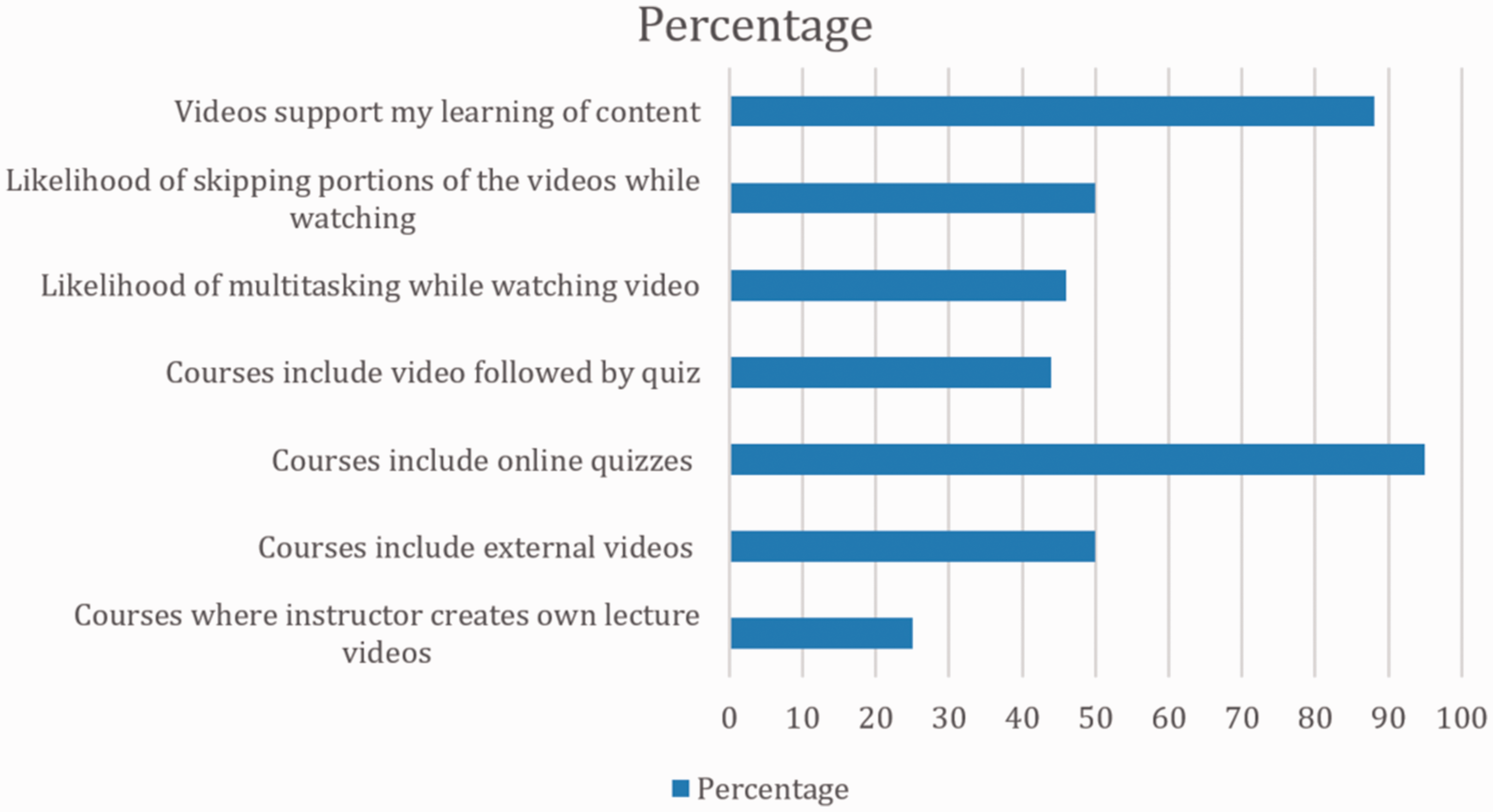
Summarizes the total percentage on items from the post survey for both groups.
The second analysis, an independent t-test, was used to determine differences in the means between both groups on post-survey questions. One group was presented with a video followed by quiz questions, and the second group watched an interactive video where they were prompted to answer questions while watching. The video content and quiz questions were the same for both groups.
In regards to video usefulness, there was no significant statistical difference between the embedded quiz questions group (M = 1.8, SD = .71) and the video without embedded questions (M = 1.86, SD = .73); t(109) = 0.6, p = 1.99. In regards to video being enjoyable to watch, there was no significant statistical difference between the embedded quiz questions group (M = 2.6, SD = 1.1) and the video without embedded questions (M = 1.86, SD = .6); t(109) = 0.5, p = 1.9. In regards to video supported learning of content, there was no significant statistical difference between the embedded quiz questions group (M = 1.8, SD = .7) and the video without embedded questions group (M = 1.9, SD = .8); t(109) = 1.2, p = 2.
The qualitative data analysis was conducted to further explain the results of the quantitative analysis. The quantitative results based on students’ achievement indicate that students performed equally regardless of question positioning. Student rankings quantitatively did not demonstrate a preference toward embedding or not embedding questions in the video; however, the qualitative section offers insights into the students’ opinions.
Qualitative
Students in both control and experimental groups participated in the qualitative data collection. All participants answered seven qualitative open-ended questions describing their attitudes and preferences for the use of video in the STEM classroom. A total of 54 students in the control group and 57 participants in the experimental group answered qualitative questions. Researchers followed analytical coding process suggested by Creswell (2007). This coding process involved identifying codes, reducing codes to themes, counting code frequency, relating categories and discussing the data. Qualitative data were coded and three major interrelated themes emerged: attitudes toward the use of videos, preferences toward the use of videos to learn science concepts, and reasons for using videos with embedded quizzes.
Attitudes toward the use of videos
The first theme “Attitudes towards the use of videos” discusses science students’ opinions and attitudes about using videos in the STEM classrooms to teach science-related concepts. For example, one participant commented: I think more instructors should use videos in their courses because it would help us remember what we learned in class or even help if we forgot we could go back to the video and re-watch that lecture video. I also feel it will improve overall grades of the students.
The other participant added: “I think more instructors should use videos because it helps me to review what I learned, even outside of class, in the way that the instructor intended to teach it.”
Students explained their positive attitudes toward using videos in the STEM classroom suggesting that when videos are used students can watch the material multiple times at their own pace, and therefore are able to understand scientific concepts and ideas better. For example, a student commented: “I believe it [video] would help me to learn better because I can pause, rewind and fast forward whenever I need to in order to help me to better understand the concepts.” Another student added: “It would allow us to have more practice outside of the classroom and we could review the videos multiple times and at our own pace instead of the class speed which could be too fast for some people.” Another student added: “I think supplementary short videos that go step by step through problems particularly the more complex ones….would be very useful.”
Students expressed interest to see more instructional videos in the future and explained that videos are more easily accessible than tutoring or office hours that are set only in particular times. A student stated: I would love to see more videos like this one in the future for all topics. As of right now, I tend to watch YouTube videos online before going to my professor or tutoring because it is easily accessible, whereas tutoring and office hours are only certain times or out of the way.
Another student added: “I would like to see more videos on Blackboard for subjects such as physics, math and other classes that deal with applying problems.” Yet another student elaborated: “I think all teachers/professors should use videos in their classes. They are much easier to learn/review from than just plain Powerpoint presentations.”
This theme shows positive attitudes that students had toward learning science concepts via instructional videos that the instructor can post on the learning management system or share with students in any other way.
Preferences toward the use of videos to learn science concepts
The second theme discussed what type of instructional videos students preferred when it comes to learning science concepts. Students in both the control and experimental groups tended to prefer videos with embedded quiz questions. For example, one student stated: “I would prefer the ‘A’ option [the option with embedded quiz questions] because the questions would check if I actually understood what was just taught.” Another student added: I believe the first scenario [video with embedded quiz questions] would help me to retain more information than the second scenario. I enjoy being periodically stopped while taking portions of a quiz. It helps me to retain and access the information with ease while understanding what to expect with the forwarded material.
Another student indicated the preference for the video with the embedded quiz questions explaining that if the science problems are included right after the section of the material is covered that relates to these problems, it helps to learn and remember better.
Students elaborated on their preferences for videos with embedded quiz questions by explaining why they prefer this option. For example, a student stated: “I believe taking quizzes during lecture will help solidify the information learned right away rather than waiting to take a quiz at a later time.” Another student added: “Quizzing myself along the way will help me retain the information better than if I took the quiz at the end.” Yet another student explained: I believe the scenario with the questions during the video would help me to remember better. I would have an easier time solving the questions. If I am able to solve the questions then I will be more likely to be able to solve them again later.
Students preferences tended to be motivated by the fact that the scenario with embedded quiz questions ensures better retention of the material. Some students acknowledged that both scenarios offer merits but indicated preference for the scenario with embedded questions. Thus, a student stated: “I believe that both have their merits but I would prefer the one with embedded questions because the questions would check if I actually understood what was taught.”
Students in both groups clearly preferred videos with embedded quiz questions when it comes to learning science material and concepts.
Reasons for using videos with embedded questions
The third theme focused on reasons for why students preferred videos with embedded quiz questions. In this theme, students discussed three major reasons that influenced their preferences: retention, chunking, and reinforcement.
Retention
Participants in the study believed that embedding quizzes inside instructional videos ensures retention of the information and facilitates deeper learning. A student commented: I would prefer the questions being embedded into the video. You are able to divide up the video in sections and answer relevant questions as you go as opposed to being thrown everything at once to you and then having to recall the entire video at once.
Another student added: “If I were to be quizzed at the video versus quizzes throughout, I would not retain the information as well.”
Students believed that when quiz questions are embedded in the video, the material is fresh and it helps them to remember it better. “Freshness” of the material helped with the information retention and in students’ opinions provided better learning outcomes. For example, a student explained preferences toward video with embedded quiz: I would choose the scenario with the questions embedded in the video. The reason being is that I will focus on the lecture and test my understanding as we progress through the video. If I took the quiz after the video, not only will I forget information, I will most likely not be as focused on the video as I liked to be….this is a great way for students to learn and understand challenging material at their own comfortable pace.
Another student commented on the “freshness” of the information stating: “I can score better on the quiz because my learning is more fresh and I can retain information better because it allows me to practice while clearly remembering the methods for problem solving.” Yet another student agreed saying: “The benefits of answering questions embedded in the video are that you are forced to answer questions as soon as you learn the concepts as opposed to later and you have the content fresh in your mind.”
Students also believed that videos with embedded questions would help them to understand the concept better and allow them to learn more simple concepts before moving to more complex ones. For example, a student stated: I think embedded quiz questions would help me to retain more information because I would be forced to immediately recall information I just learned after I learned it for the quiz. This would help me fully understand material before moving to more complex topics.
Students also commented that better retention is also ensured because students can apply what they learned from a short video segment by immediately answering the question or solving the problem, and in that way practicing the material learned in the video segment. Thus, a student stated: “you would be more likely to remember since you immediately put the new information into practice and you do so with the continuing topics.” Another student explained: “it allows people to look at a single topic, reinforce it and move on, therefore, giving a better understanding of the material and better retention of the topic.” Students explained that remembering smaller amounts of information is easier: “It is easier to retain the smaller amounts of information given in short times.”
Information retention is necessary for productive learning and students’ preferences toward the type of learning were influenced by this fact, therefore influencing their choices for videos with embedded quiz questions.
Chunking
Students indicated that one of the reasons for their preferences toward videos with embedded quizzes was the fact that this type of learning allowed to divide information into smaller “chunks” and therefore, students were able to process it better. Students frequently referred to the information chunking principle when discussing their preferences for videos with embedded questions. For example, a student stated: “It is significantly more helpful to understand the topic when it is being taught piece by piece rather than all together.” Another student further elaborated: Watching the video with embedded quiz questions would be better than having a lump sum of quiz questions at the end of the whole video. As a student, I am likely to get overwhelmed if I had to watch and comprehend a whole 40 minute video and then complete 20 or more quiz questions about the whole thing.
Students also believed that having the embedded quiz within the video helps to focus better and, therefore will help them to perform better on a quiz and not to lose attention. A student commented: I tend to have difficulty focusing during longer presentations, so breaking the video up with quizzes helped me to stay focused. Having quizzes on separate sections throughout the video made it easier to replay a specific section if for any reason I did not feel prepared to have a quiz on that material. It keeps the lesson more focused.
Participants in the study constantly repeated the fact that it is easier to remember a smaller amount of the material and be tested on it rather than waiting until all material is covered and taking a test that encompasses all of the material. A student commented: “Humans can only remember chunks at a time. You can better cement the chunks presented rather than just trying to remember the whole thing at once. You do not get overloaded with information at once.” Another student echoed the opinion: “Having the quiz questions embedded helps because students have a structural learning progression, a sort of building block method.” Clearly, the chunking principle was an important reason that influenced student preferences toward videos with embedded quiz questions.
Reinforcement
Students explained that instant reinforcement was another reason that made videos with embedded quiz questions a more appealing option for them. Having quiz questions embedded inside the video helped students to practice the reviewed material right away, and therefore facilitated learning of physics concepts. For example, a student stated: “I would prefer videos with embedded quiz questions. I think it would be better for learning because you instantly reinforce what you just learned.” Another student agreed elaborating: I believe video with embedded quiz questions is better because I am allowed to be walked through an idea with sample problems and explanations. Then right after I can better solidify the idea by having to complete an assignment that makes me apply what I just learned.
Yet another student added: “The main benefits of the scenario ‘a’ [video with embedded quiz questions] deal with reinforcing the information before a newer idea may get in the way of remembering it.” Students explained that if they are given an option, they will choose videos with embedded quizzes versus watching a video and taking a quiz afterwards because they felt like it provides extra practice. A student stated: I would choose scenario with embedded quiz questions because the quiz questions embedded in them are like extra practice even though they are quiz questions. I also like the fact that we are given the questions right after learning the material because it helps me remember what to do in the future. The questions embedded within the video also help with keeping my attention and not multitasking (checking my social media, texts, emails etc.), which also helps with retaining the information in the video.
Students in this study appreciated the fact that they are able to know immediately if they answered the question correctly before they could proceed with the further material. A student explained: I would choose the first scenario in which there are questions embedded in the video. I prefer this scenario because it allows me to immediately know if I actually understand the material or if I have to go back to watch the video again or to seek extra help.
Reinforcement of the science material covered in the video with embedded questions seemed to be an important factor that influenced student preferences for this type of scenario.
Discussion
Quantitative and qualitative data provide insights into pedagogical use of videos in the STEM classroom. Although there was no statistical significance in achievement between a group that experienced quiz questions embedded in the video and a group that took a quiz after watching physics video, qualitative analysis shows that embedded questions might assist in engaging students with the content. Findings of the study are supported by Vygotsky’s constructivist learning theory because students in the study are engaged in a meaningful content covered in the video through interactions with video learning material that benefits their learning. Findings of the study are also supported by Jonassen’s (1999) theory as videos in this study included relevant and meaningful format that could have triggered students’ learning. In the present study, 46% of students reported that they are likely to multitask when watching videos and 50% reported the likelihood of skipping portions of the video. With this video watching behavior in mind, embedding questions might provide useful for keeping students engaged. This finding is consistent with the previous literature in the field as presented in the studies by June et al. (2014), Giannakos et al. (2015), and Kearney and Treagust (2001). Students showed positive attitudes toward the use of videos in the STEM classroom. The positive attitude is especially important since 25% of students reported that their instructors generate video lectures and 50% use external videos such as YouTube videos. Previous studies in this area arrived at similar conclusions regarding positive students’ attitudes toward the use of videos in the classroom and are reflected in the research by Giannakos et al. (2015), Laws et al. (2015), and Hund and Getrich (2015).
Based on the findings from the study, although embedded quiz questions do not seem to increase performance, they do have other benefits. Videos with embedded quiz questions add interactivity and enhance engagement in the STEM classroom. They also keep students engaged longer and help them retain material better. Based on the findings of the study, the researchers recommend the following strategies and techniques consistent with the major learning theories. If available and when logistically possible, it may be a good idea to use software with video embedded options and to use a Learning Management System that can be integrated with video capturing features. In addition, it is suggested that faculty use chunking as a pedagogical technique to scaffold the new material and help students remember new material better (Miller, 1956).
Conclusions
The study revealed student positive attitudes toward the use of embedded quiz questions in the video lectures in the STEM classroom. The study is comprehensive but includes certain limitations. Only one experiment and one instructional video with 20 quiz questions were used in this study, which may pose a limitation. In addition, students in both groups were asked about their perspectives on embedded versus post video questions and students who were in the control group might have never seen or experienced the scenario with embedded questions. Future research is needed with more than one instructional video, a larger number of quiz questions, and with a larger number of participants. The subject matter of the video poses another limitation to the study. Video was developed for the physics classroom and covered physics topic. Students might have had a strong attitude toward science and physics in particular which in turn might have influenced their performance and self-reported data. It would be beneficial to investigate the use of instructional videos in other disciplines and examine if there is a difference in student achievement. Self-reported data can seldom be independently verified and can cause social desirability bias and exaggeration in student responses serving as a potential limitation. Future research should examine students’ behaviors over the longer period of time, such as, for example, one semester. Finally, it will be beneficial to examine if, when students are more engaged and show better material retention after engaging in interactive videos, they are more likely to continue in the program and finish their degrees. Future research should focus on examining potential benefits of interactive videos on students’ retention in a program.
The study has implications for the university faculty who are using or are interested in using videos in their classroom. It can help them to better understand how to integrate videos in the classroom and make best uses of pedagogical advantages of using videos to enhance students learning experiences.
Footnotes
Declaration of Conflicting Interests
The author(s) declared no potential conflicts of interest with respect to the research, authorship, and/or publication of this article.
Funding
The author(s) received no financial support for the research, authorship, and/or publication of this article.