




Abstract
This article aims to enlighten how individuals apply and develop cooperative and computational thinking in online collaborative challenges, and what ludic features support or discourage such approaches. Over n = 1400 subjects have been involved with a quantitative survey about three collaboration-based video games – i.e. Overwatch, For Honor, and Tom Clancy’s Rainbow Six: Siege. Results point to malleable factors in strengthening teamwork – i.e. asymmetrical roles, sharing information mechanics, broad game community – and provide empirical evidence of the correlation between cooperative and computational thinking. Implications for educational activities and cooperative learning interventions are outlined in terms of design strategies and concrete applications.
Keywords
Introduction
Digital Entertainment’s educational potential embraces a broad range of applications, from professional development to special needs and primary formation, and gaming genres. However, little efforts have been done to enlighten a relevant category in the sector, that is, online action arenas. This type of games asks players to work in asymmetrical groups in fast competitive/cooperative sessions based on First Person Shooter (henceforth, FPS), Fighting, or Action gameplays. Such a gap is relevant because collaborative games with divergent profiles have been proved to support cooperative thinking (COT) and teamwork, and these products may show potential in entailing collaboration and shared thinking.
This article aims to address such a lack by presenting the results of an explorative survey involving the players of three flagship Asymmetric Action Arenas (henceforth, AAA) – i.e. Overwatch, Tom Clancy’s Rainbow Six Siege, For Honor –, which were selected by popularity and specific features. The aim was to investigate three related issues: if and how game features affect COT; how personal orientations are related to COT in playing; if and how COT is related to computational thinking (henceforth, CT) in gaming. The third objective was motivated by the fact that the bridge between COT and CT is a further overlooked topic, and the targeted type of games represents an ideal ground of inquiry because it may embed both.
The article is structured as follows: the next section introduces the concepts of CT and COT; then the research design followed is depicted; the results are illustrated next; and finally the discussion and conclusions are given. Findings show how some features support COT and CT rather than others and point to insights and strategies for planning educational applications of AAAs. In addition, a significant correlation between the two concepts emerged in both quantitative and qualitative analyses.
Collaborative and computational thinking(s)
Collaborative thinking
COT has been widely explored in the last decades, and its relation with media innovations is among the current trends in educational technology. Several studies and proposals have addressed it providing best practices, facilitating conditions, and malleable factors to consider. The rising of the Constructivism approach moved to a new attention to the social context of learning (Jonassen and Land, 2012), while online features and mobile devices have strengthened the sharing potential of current devices and virtual environments (Traxler and Kukulska-Hulme, 2016), including video games. They may embed social features that can strongly affect cognition and then cooperative learning indeed (Dale and Green, 2017; Granic et al., 2014; Morschheuser et al., 2017), and they have been found to increase prosocial behaviors and attitudes (Gentile et al., 2009; Saleem et al., 2012; Schmierbach, 2010), especially when they rely on collaborative dynamics (Badatala et al., 2016; Ewoldsen et al., 2012). In addition, teamwork has been proven to support critical thinking (Abrami et al., 2008; Lee et al., 2016) if it is not moved by self-interest (Bechtoldt et al., 2010). Asymmetric roles and information represent an increasingly used mechanic in supporting cooperative gameplays. It can be argued that when a ludic experience requires cooperation and sharing between players, collaborative thinking is promoted because it is embedded in game dynamics (e.g. Badatala et al., 2016; Lee et al., 2016; Schmitz et al., 2015). This is aligned with the evidence that individuals with different cognitive styles work together better than uniform groups (Woolley et al., 2015). The interplay between complementary characters moves people to reflect about specific differences and the effectiveness of teamwork and collaboration, which can work as strong learning drivers (Skalicky and Brown, 2009). By contrast, when roles are symmetric (e.g. same resources and roster of abilities), results point to a lower social synergy (Lee et al., 2016). Johnson and Johnson (2009) suggest five dimensions to consider in staging cooperative sessions – positive interdependence, face-to-face promoting interaction, individual and group accountability, social skills, and group processing. From a game-related perspective, Szewkis et al. (2011) outline a partially similar array in making cooperative games effective: positive interdependence, common goal, coordination and communication, awareness, and joint rewards.
However, researchers and game designers (e.g. Badatala et al., 2016; Brathwaite and Schreiber, 2009) observe that digital games are still characterized by aggressive and competitive gameplay, which would be in the lineage of the medium itself (Crogan, 2011; Koster, 2013). On the contrary, AAAs’ flourishing suggests a different scenario that needs to be addressed.
Computational thinking
Wing proposed the term of CT in 2006 by defining it a tendency to use “abstraction and decomposition when attacking a large complex task or designing a large complex system” (2006: 33). Along with the increasing popularization of the term, several interpretations have been advanced from different and complementary perspectives (above all Educational Studies and Computer Sciences) to engender an effective operationalization of computational attitudes (e.g. Cuny et al., 2010; The Royal Society, 2012). Grover and Pea (2013: 39–40) collected several guidelines emerged in last years across CT curricula such as “systematic processing of information” and “conditional logic”. Angeli et al. (2016: 48) argue that two major educational challenges arise from CT implementation: “(a) what computer science content to teach across different educational levels, and (b) what body of knowledge do teachers need to have to be able to teach the computer science curriculum”. By summarizing the previous literature, they categorize the computational concepts as follows: data, processing, information, sequencing, loops, parallel processing, events, conditions, operators, variables, and dataflow of control. The authors suggest an interplay of explanations and practical examples following five different processes: abstraction, generalization, decomposition, algorithmic thinking, and debugging (Angeli et al., 2016: 49). Despite learners, teachers’ approaches, and topics taught range considerably in research (Aho, 2012; Lye and Koh, 2014), the switch across multiple layers through decomposition, abstraction, debugging and generalization (a further element regards algorithmic thinking, which is strictly related to coding and then it is not considered in the current study) is at the core of this approach (Angeli et al., 2016; see also Eisenberg, 2010; Sengupta et al., 2013; Wilkerson-Jerde, 2013). Videogames are an ideal match for CT interventions beyond the glaring technological dimension; they tend to stage critical thinking, problem-solving skills, and meta-cognition processes (Annetta, 2008; Gee, 2007), which are CT’s objectives too (Wing, 2006). Surprisingly, little efforts have been done in uncovering CT in online games, which are currently thriving. A related question regards the role of COT in this scenario considering the aforementioned potential. What happens when we add a social dimension to CT interventions? Otherwise, what occurs when cooperative tasks are informed by CT-related concepts? AAAs provide an ideal ground of inquiry for answering these questions because they may include both.
Research design
According to the aforementioned premises, three research questions emerged: RQ1: What game features and dynamics influence COT and CT in playing AAAs? RQ2: What is the relation between personal orientation and COT/CT in playing AAAs? RQ3: Is there a correlation between COT and CT in playing AAAs?
In order to answer these questions, a questionnaire was spread among players of three reference AAAs.
The first is Overwatch. This squad-battle FPS was released in May 2016 by Blizzard Activision for PC, PlayStation 4 (PS4) and Xbox One (XOne). It has reached over 30 million users and received critical acclaim (aggregate score on Metacritic.com: PC 91%; XOne 90%; PS4 91%). The gameplay is based on different six versus six modalities and a roster of 26 characters grouped in four self-explanatory categories – i.e. offense (attacking enemies), defense (defending allies), support (helping allies), and tank (taking damages). The second is For Honor, which was released in February 2017 for PC, XOne and PS4 (aggregate score on Metacritic.com: PC 76%; XOne 78%; PS4 79%). Set in a fantasy world, this melee compact game asks players to fight in one versus one, two versus two, and four versus four with 12 different heroes. The interaction is based on the so-called art of war system, which allows three types (left, right, high) of guards and attack directions. The third is Tom Clancy’s Rainbow Six Siege (henceforth Siege) by Ubisoft. Released in December 2015 for PC, PS4 e XOne (aggregate score on Metacritic.com: PC 78%; XOne 74%; PS4 73%), this five versus five tactic FPS has involved over 20 million players with several modalities, from hostage (saving hostages versus guard them) to bomb (defusing bombs versus protect them). Its mechanics emphasize planning over impulsiveness with destructible and large environments and 20 characters (the so-called operators).
These games were selected for their popularity and the different approaches for staging an asymmetrical gameplay (see Szewkis et al., 2011). Overwatch relies on a fast gameplay with a wide roster of roles and static maps, Siege suggests a more cautious approach and careful planning asking players to constantly share information (e.g. about enemies’ positions), and For Honor focuses on individual matches (attack directions versus guards) even in team versus team sessions. Aside from the shared complexity in terms of game mechanics and variables, it could be argued that the first two require more teamwork than the third. H1: While CT should be alike in all the three games, Siege and Overwatch enable more COT than For Honor.
Survey structure
Aside from socio-demographic information, the survey was structured in three different sections (see Appendix 1). The first addresses game consumption and relation with digital entertainment. Items 1–7 to target weekly playing hours, staring playing moment, reference gaming platform, overall in-game experience/achievements, and favorite game modalities and weapons/roles. Item 8 is about game mates, who can be face-to-face friends, people known online, or selected randomly. Item 9 asks about expertise in term of the game itself, its genre, and digital entertainment as a whole (internal consistency reliability = 0.82). Item 10 targets on the word gamer as potential identity affiliation in terms of self-description, importance, tagging by others, and sharing of the attribution with peer. It has proven to be reliable in depicting subjects’ bond to the sector (Gandolfi, 2017).
The second (Item 11) enlightens the orientation of the player with the General Causality Orientations Scale (12 vignettes and 36 items) (Deci and Ryan, 1985), which measures three individual motivational orientations – i.e. Autonomy, Controlled, and Impersonal. The first assesses how much a person reacts to intrinsic motivators and is led by self-initiation, independence, and responsibility. The second measures how much a person is attracted by extrinsic motivators and external pressures, in other words the level of dependency. The third frames how much a person thinks that outcomes and consequences of his/her actions are out of control and ruled by case/fate, entailing a low motivational attitude. This scale has been widely adopted for deepening well-being motivations (Williams et al., 1996), work predispositions (Baard et al., 2004), and gamification drivers (Mekler et al., 2017), and it can be aligned with the focus of the present article. The first two orientations are directly associable with the difference between extrinsic and intrinsic stimuli in instruction and gaming (Ryan and Deci, 2000; Keller, 2007); the latter would be more effective than the former in engaging subjects (Kang and Tan, 2014; Kohn, 2017). The Impersonal one refers to a feeling of being unable to control situations and experiences, which is supposed to be narrowed in video games because they tend to provide a controlled environment ruled by intuitive mechanics. Uncovering this personal predisposition points to understand if such orientations are correlated to CT/COT within AAA experiences due to the common empowering (A, C, COT, CT)/weakening (I) crossroad – i.e. the ludic system per se. H2: In all the three case studies, the correlations between COT/CT and Autonomy and Controlled should be positive, while the ones between COT/CT and Impersonal negative.
The third targeted COT and CT. Item no. 12 addresses CT asking to grade the agreement with the following sentences: “You are able to read a match and its dynamics” (decomposition); you use game strategies and “lessons” beyond X (e.g. other games, everyday life) (abstraction); You constantly update your game strategies (debugging); “You are able to adapt yourself in dealing with other situations (e.g. different maps, different players)” (generalization). If subjects check medium-high scores, they were asked (Item 13) to describe which factors (game features, community, etc.) motivate and support those perceptions. Item no. 14 targets COT inspired by Johnson and Johnson (2009) list. Subjects had to grade the following sentences: You are receptive to your game mates (promotive interaction); You share game strategies and tips with your game mates (positive interdependence); You plan game strategies and tactics with your game mates (individual and group accountability); You feel to be “more than the sum of the parts” with your game mates while playing group and individual accountability (group processing). The social skill dimension, which is actually a pre-given trait that is hard to enlighten, was possibly addressed by Item 15, which is similar to Item 13 but about COT. H3: A positive correlation occurs between COT and CT because the three case study games rely on a mutual synergy of both.
Both the scales rely on four items measured with a four-point Likert Scale. The internal consistency reliability (Krank et al., 2011) proved to be reliable (0.76 for COT and 0.72 for CO). Text entries allowed to gather personal opinions about malleable factors to consider following a user-centered approach (Gandolfi, 2017). The need to deal with CT with a quantitative scale was motivated by the fact that this concept is usually assessed with artifact analyses (e.g. students coding) (Chen et al., 2017), which was not compatible with the scope of the present study. 1–4 Point Likert Scale (1–2 negative; 3–4 positive) was generally preferred for avoiding participants’ tendency to check the median point when they are asked to provide self-assessment (Marradi, 2007).
Analysis and timeline
SPSS software was used to handle statistical processing. Pearson correlation coefficient between proper variables (see below) was applied as a main technique of inquiry. Results from text entries were explored by using NVivo (v. 10) with a two-cycle process (Saldana, 2016: 234). First, several labels were used to map terms and concepts in detail (e.g. game community traits, other players’ behaviors, specific mechanics); then, a thematic re-grouping followed (e.g. character roster, communication, predisposition to learn) for generating a more concise overview. To summarize, the present study follows an exploratory orientation (Canossa, 2013: 259), which aims to explore relevant variables and processes with neither strong hypothesis (the suggested ones are indicative) nor arguments due to the newness of the topic. Therefore, the focus is on describing the data gathered for supporting future investigations and inquiries. The survey was spread from May 2017 to July 2017 through social media (Facebook and Reddit) and the academic newsletter Gamesnetwork. Over n = 1400 adult subjects completed it (660 Overwatch, 437 Siege, 321 For Honor). The study was approved and monitored by the Institutional Review Board committee of the author’s university.
Results
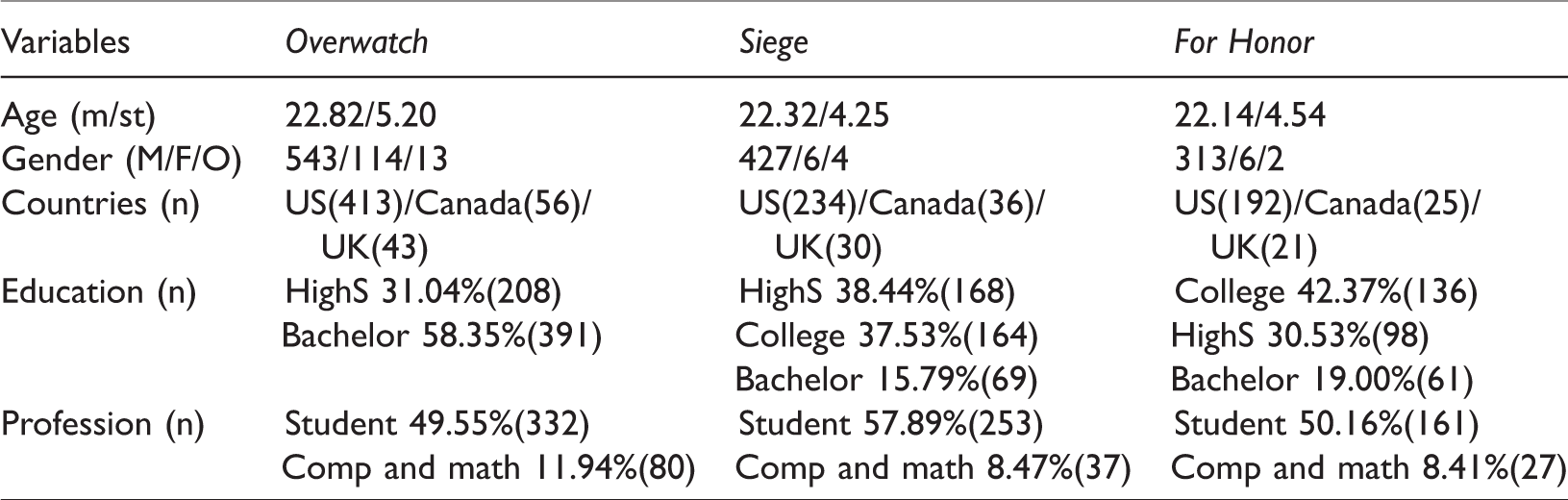
Table 1 provides a snapshot of socio-demographic data, which are quite similar in all the three cases. Subjects are young adults and prevalently male. Student is the most relevant profession, while high school and bachelor lead the way under education. Table 2 depicts game attitudes and affiliation. Subjects are strong consumers (the majority in all the cases plays 8 h or more weekly) and flexible in playing with real/online friends or random allies. The expertise is medium-high in all the three items; the only exception is the genre for For Honor. Such a confidence is reiterated when the tag gamer is addressed, presenting the predominance of medium-high values in all the four dimensions composing the item. PC is the preferred platform, while several subjects have started to play the games since the beta testing or the release, pointing to a veteran audience. Aside from the game achievements, which are relative and variegated (samples recruited included experts as well as less competitive players), the three case studies entailed variegated preferences in terms of maps, characters, and modalities. It is interesting to notice that For Honor players particularly appreciated DUEL (21.50%), which is the 1vs1 mode, and that the supportive role – focused on helping and empowering game mates – is the most favorite (44.18%) by Overwatch’s subjects.
Socio-demographic information.
Game habits and affiliation.
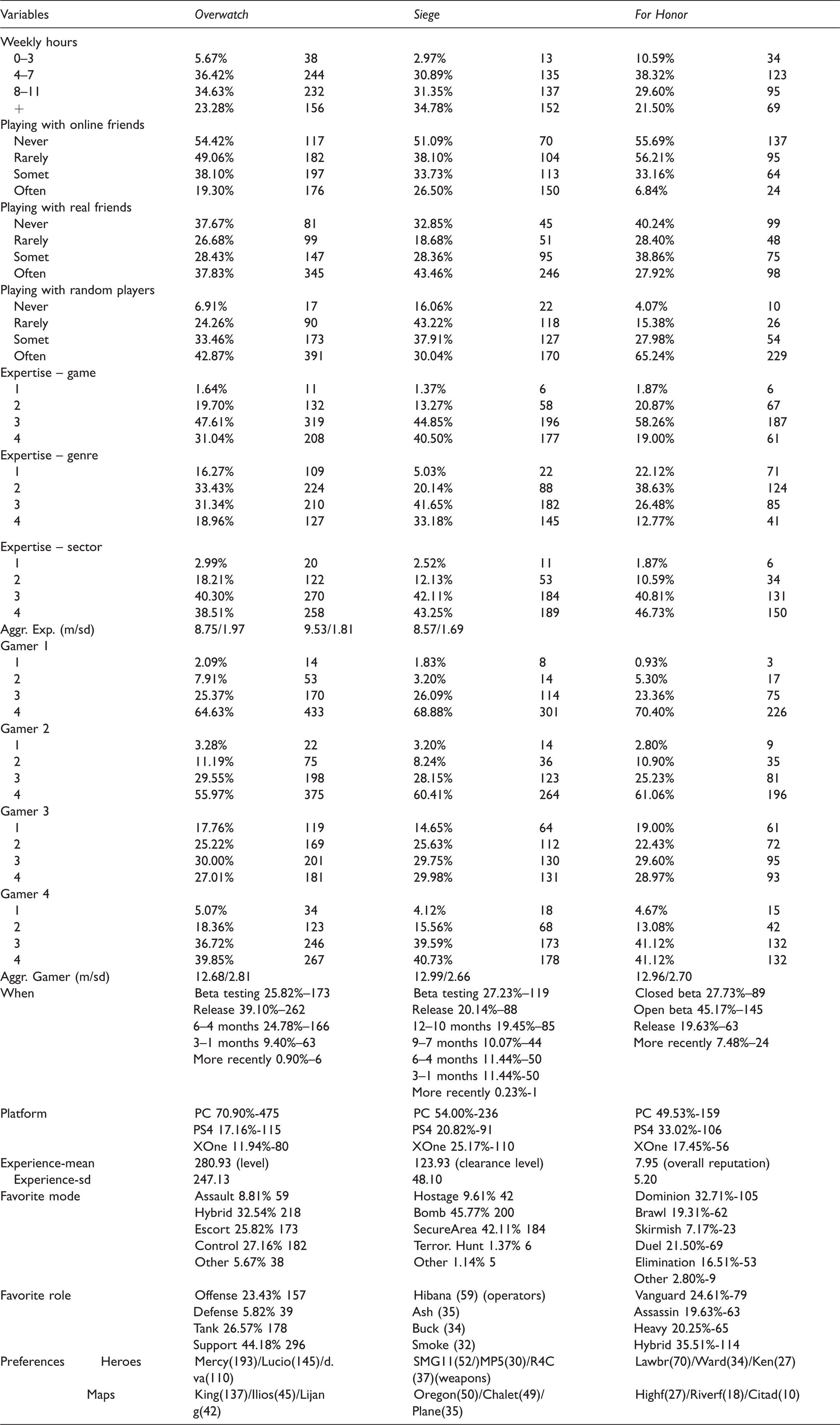
Somet: sometimes.
Table 3 summarizes personal orientations and COT/CT. Addressing the first, subjects show an especially prominent level of Autonomy (A) (2-tailed t-tests p<.01) and lower scores of Controlled (C) and Impersonal (I) attitudes. Therefore, they seem to be especially attracted by intrinsic motivators (i.e. the gameplay per se) rather than by trophies and rewards (e.g. the score, additional equipment). Regarding the second, CT/COT means are all positive; while CT is alike in the three subgroups, COT in For Honor is significantly lower (m:10.83/st:2.96) in comparison with others (2-tailed t-tests p<.05). Therefore, H1 seems to be confirmed.
Orientations, expertise, and COT/CT.
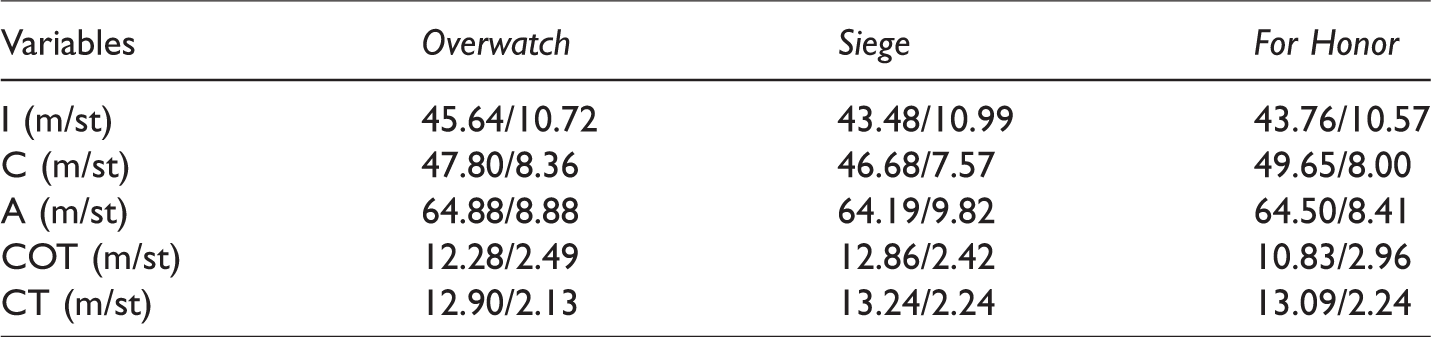
Table 4 reports Person’s correlation coefficients; partially matching H2, they show to be positive (even if weak) between CT/COT and A/C, whereas I orientation was negatively associated. Moreover, medium correlations emerged between CT and COT (especially in the Siege group), supporting H3. Further correlations were tempted between gaming affiliation/expertise and COT/CT/A; the only significant ties were the one between CT and expertise (all three games) and between COT and expertise (Siege). Accordingly, mastering the games is aligned with computational and cooperative skills.
Pearson’s correlation coefficients.
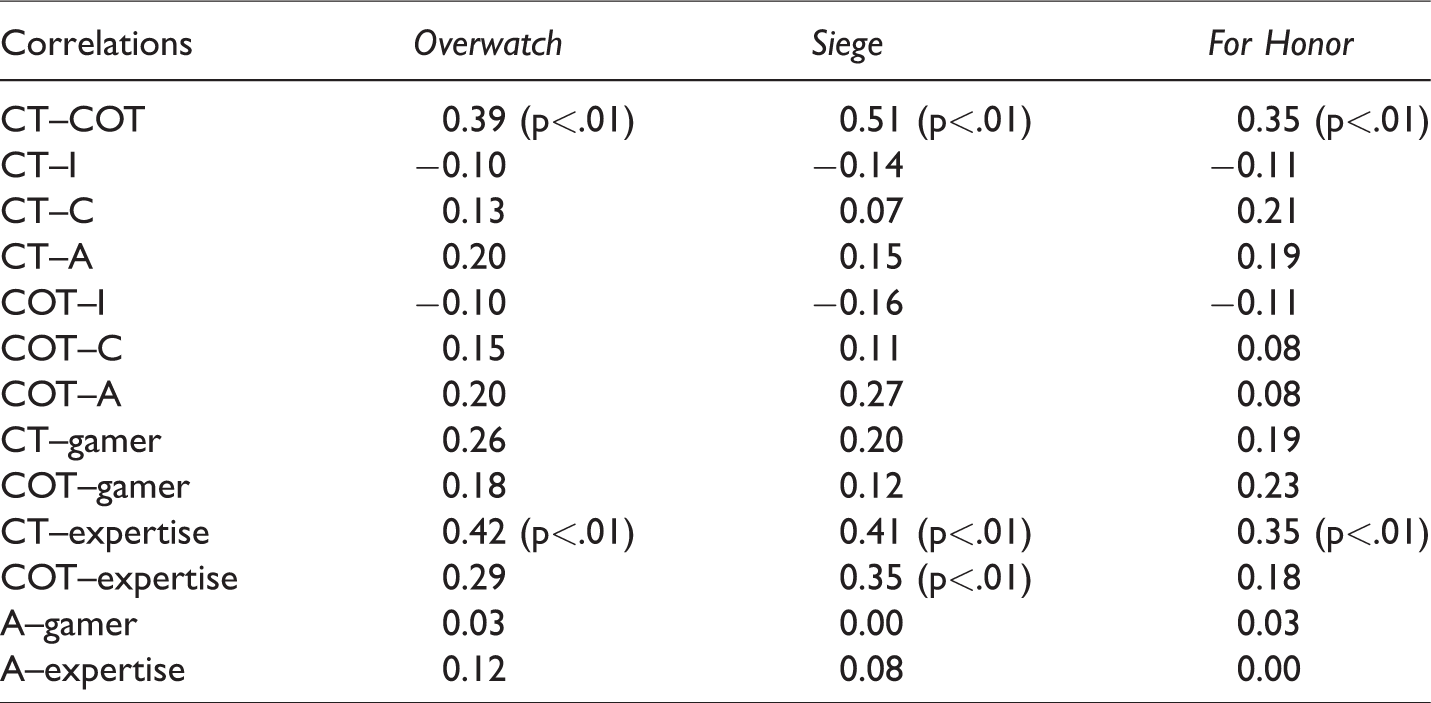
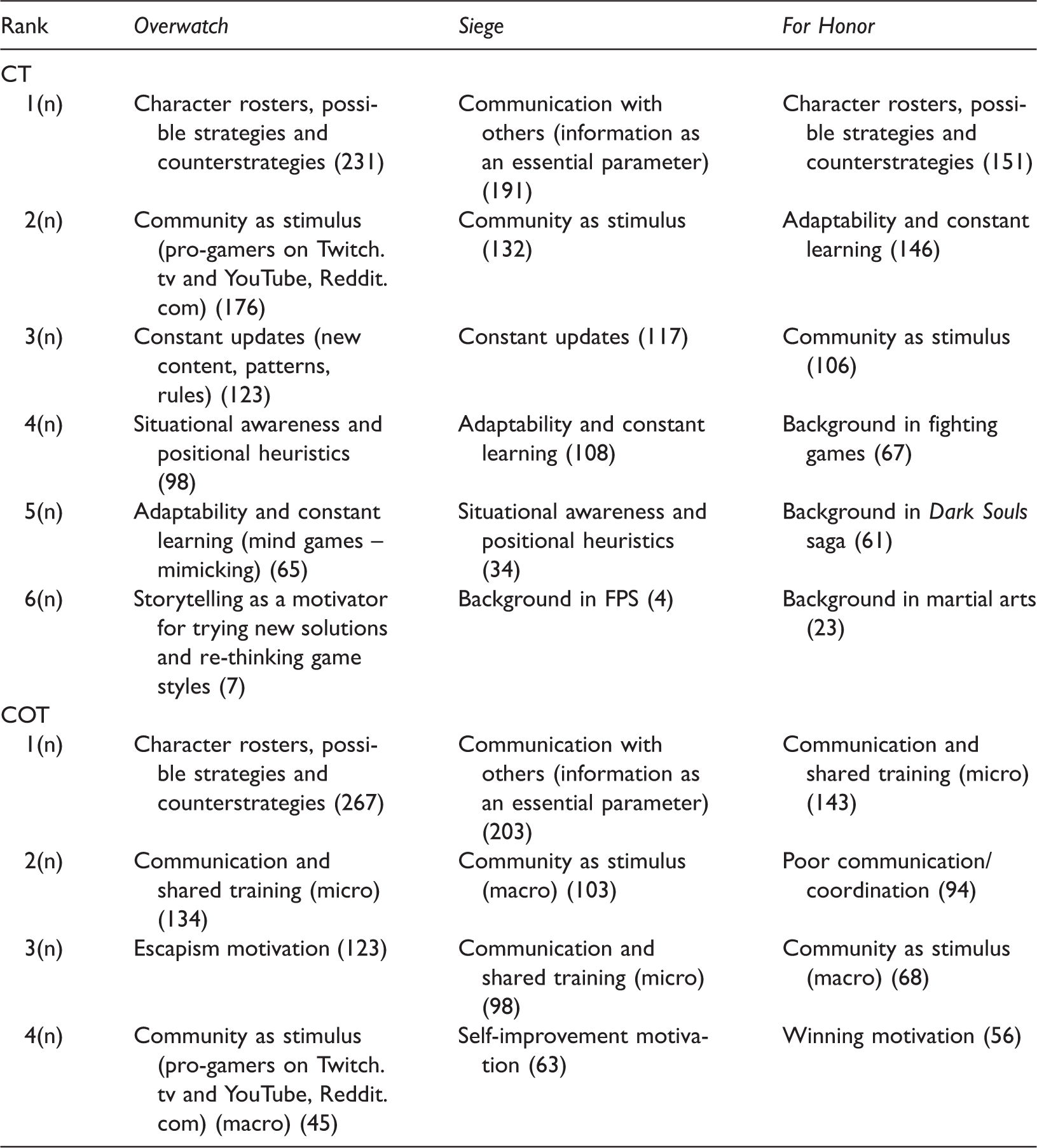
Table 5 lists main CT and COT factors. Overwatch facilitates CT with its asymmetrical roster of characters and abilities (the asymmetric core of the game and its satisfactory balance), the strong community surrounding it (online debates and pro-gamers on YouTube and Twitch.tv, who inspire players in improving themselves), the constant updates (e.g. new content, new rules), the need to read the environment during the play (the so-called situational awareness, which asks to read the game and its development), the adaptability and predisposition to learning and improve by players (imitating and learning from better competitors – the human-factor), and the storytelling about characters (the so-called lore of a game, which is particularly articulated in Overwatch and move to change strategies for be aligned with the narrative). CT in Siege relies on communication between players for sharing vital information – e.g. about enemies’ movement (a sort of dynamic asymmetry based on combining intel during the match), community (see above), updates (see above), efforts in learning and adapting (see above), situational awareness (see above, here complicated by the fact that Siege’s environments are destructible and then constantly changing), and background in FPS genre. This last concept is noteworthy because it points to a previous experience that affects CT in gaming (an entry-level skill, which is a pre-given attribute). Such an influence is present in For Honor too, whose CT is informed by backgrounds in fighting games (for several subjects its real genre), martial arts (because they facilitate envisioning enemy’s moves) and Dark Souls series (because they teach how to read patterns of attack and distances, making the battlefield intelligible). However, leading CT factors are the character roster and divergent abilities (similarly to Overwatch), player’s adaptability (see above) and community (see above).
CT and COT drivers (snapshot).
FPS: First Person Shooter.
It is interesting that COT in Overwatch and Siege has the same CT drivers (character roster and communication/information, respectively), reiterating the combination of these two processes as suggested by H3. Overwatch teamwork is also supported by micro-community efforts (relation and mutual sharing of tactics with close friends, player met online, random mates), an escapist orientation (stay together for having fun), and community at large (which promotes collaboration and provides topics and strategies to discuss with peers). Siege COT is influenced by macro- and micro-community dimensions as well, however, also a self-improvement motivation emerges (others are a way to improve). Finally, COT in For Honor is characterized by an ambivalent micro-communication. Although it is essential to rule the game, several participants notice that is poorly implemented and followed, triggering chaotic matches and mono-directional playstyles even in collective sessions. Pursuing this line, it is interesting to point that this group tends to play with strangers (sometimes: 27.98%-54/often: 65.24%-229). Broad community and winning motivation (play together for winning) follow as further relevant factors. When mentioned, other players’ social skills were usually well assessed, depicting a supportive and non-toxic community (just few For Honor’s subjects described their peers as solitary and non-assertive players, but this could be explained by the solo-direction of this game).
Discussion
Starting from RQ1 and according to the scales developed for this study, the three games enable a significant level of CT and a more variable outcome in terms of COT. For Honor is the least cooperative game due to its focus on singular battles and the poor use of in-game chat (grouping with random players and motivation to win are aligned with these features). Nevertheless, its combat system (and the evolving ability of other players) is as deep as in the other two case studies according to the level of CT. Siege is especially appreciated due to the importance of information, which becomes a fluid element of asymmetry between players. Overwatch is ruled by the pre-given set of heroes and related abilities entailing a lower COT than Siege (2-tailed t-tests p<.05). Therefore, it seems that asymmetry is more effective when it is constantly reformulated (tracking a moving enemy and coordinating the reaction) as in Siege rather than when is pre-given (an already set of profiles and related skills). Nevertheless, the three games were described as COT bearers by several subjects, who highlighted their innovative and game-changer gameplay in comparison with other products and genres. On the contrary, their CT dimension was considered familiar with digital entertainment per se. Therefore, AAAs frame a well-established orientation of the medium with a novel layer – i.e. the cooperative one. Ruling this type of games means to develop a mixed CT–COT approach, and this mastering process provides a remarkable cooperative caveat. The correlations between expertise (which describes subjects’ proficiency in playing) and CT were indeed found significant, while the connection between expertise and COT was especially relevant in Siege, whose gameplay is characterized by a strong bond between CT and COT. Conversely, the gamer affiliation plays a marginal role, which means that also casual/non-passionate audiences can be targeted with this genre. It is interesting to notice how much community inspires subjects in both macro- and micro-terms. The former dimension suggests to monitor social media and gaming platforms surrounding the game, while the latter outlines a dramatically improving “game capital” (Consalvo, 2007) and virtuous practices across the three case studies, in which several players are open to learn from and assist others (even strangers) mirroring a community of practice (Wenger and Trayner, 2015) and peer-tutoring techniques (Bowman-Perrott et al., 2014).
Despite the low correlation between personal orientations and COT/CT experienced during the play (addressing RQ2), it is noteworthy to observe how subjects recruited show an elevated level of Autonomy, which is the most desirable attitude – the other two weaken self-confidence and motivation. This predisposition was not found to be correlated to game expertise and affiliation. However, it is interesting that such an autonomy-oriented sample – which is even more challenging to involve (they judge the experience per se rather than lists of achievements) – has been successfully engaged with the three AAAs analyzed (the majority are long-time players, and the CT scores and related text answers indicate gratifying gameplays). Unsurprisingly, trophies and scores (external motivators present in each case study) were marginally mentioned in subjects’ feedback. The shared cooperative dimension may have made a difference in reaching this result, especially in the long-term (single-player games are usually easier to master due to absence of the human factor and a more static set of rules). Indeed and as proven by the aforementioned correlations and common factors, COT and CT are strongly tied in this genre (answering RQ3), which promotes both and can be harnessed for instructional purposes, from teaching social skills to collaboration and coordination with multiple heuristics and variables. AAAs seem a perfect match to address both, and their communities may be supportive and committed to help players in need (like several subjects involved with this research) overturning “toxic” trends (Phillips, 2015) in online interactions.
Nevertheless, this study shows four main vulnerabilities. First, it addresses few case studies with ad hoc scales targeting COT and CT in playing rather than per se. Therefore, further researches and leading concepts are required to stress these methods and results. Possible developments (alone or for a triangulation) span the use of qualitative methods such as focus groups and interviews, directing participative observations of play sessions, and applying data analytic tools for gathering performance information. Second, the comparison staged is an internal one (between the targeted products). Other criteria of comparison are necessary to better frame the findings and move ahead toward other media experiences, from divergent genres to new competitors. Third, the AAAs are just one of the genres bearing asymmetrical elements. For instance, MOBA (Multi Online Battle Arena), MMORPG (Massive Multiplayer Online Role-Playing Game), and hybrid typologies (e.g. Destiny 2, Warframe, Player Unknown’s Battlegrounds, Elite Dangerous) embed different roles and playstyles, and they should be covered in future for potential matches and differences. Fourth and as already mentioned, this inquiry is exploratory at its core. Despite some hypotheses have been advanced, the main objective is to stage a first step in analyzing COT and CT in a specific genre that shows their potential synergy.
Aside from these considerations, implications are significant for both practitioners and scholars. The first group has now an overview of a widespread type of games that can be easily embraced for educational goals due to its popularity and quick and accessible gameplay. Benefits and weaknesses are reported too in order to plan and stage their adoption carefully. In essence, asymmetrical information can represent a great opportunity for supporting both CT and COT in the long term, while communication features must be exploited within and outside the game. The latter aspect is essential for supporting “affinity spaces” (Gee, 2004) – i.e. discursive environments in which from common interests (e.g. playing a game) is possible to address reciprocal differences and divergences (e.g. netiquette, everyday life, socio-cultural expectations) – and mediated learner–learner interactions, which play a key role in fostering multi-functional working, understanding, and comprehension (Bergmann and Sams, 2012; Roehl et al., 2013). The latter group can take advantage of these results and insights for conducting investigations and researches enriching and problematizing the present study. Different COT and CT scales can be adopted for stressing its findings, and potential inquiries may target how online communities work in promoting or weakening cooperative efforts, best teams’ (e.g. e-athletes, pro-gamers) strategies, effective techniques for handling formative evaluation during or after a match, and different samples (e.g. with other personal orientations).
Regardless, findings point to keep enlightening such a rising genre. AAAs are flourishing with a rising online community and million players working together every day, and such a media laboratory demands to be fully uncovered from an educational perspective. Article’s wished outcome is to have provided a first step in this direction.
Footnotes
Declaration of Conflicting Interests
The author(s) declared no potential conflicts of interest with respect to the research, authorship, and/or publication of this article.
Funding
The author(s) received no financial support for the research, authorship, and/or publication of this article.