




Abstract
Algorithms are the essence of computational thinking, which refers to a set of problem-solving processes that help children become logical thinkers in this increasingly digital society. It is important for teachers of young children to carefully plan and implement algorithm design tasks that involve repeated step-by-step procedures to build strong foundational computational thinking skills. In this article, the authors present algorithm tasks, including following a recipe, creating a treasure map, modeling how to perform a task, and sharing a routine, which can be easily integrated in the daily activities in early childhood classrooms. Fostering young children’s aptitude for algorithm-specific thinking-and-doing processes creates a foundation for logical thinking.
Why algorithms?
According to the International Society for Technology in Education and Computer Science Teachers Association (2011), algorithms are the essence of computational thinking, which is a set of critical thinking processes that help Prekindergarten–12 students become effective and creative problem-solvers. Computational thinking involves four major thinking skills—algorithm design, decomposition, pattern recognition, and abstraction—which are especially useful in our technology-rich society (International Society, 2011). Although these four skills are intertwined, algorithm design is the most critical computational thinking component. Defined as a detailed step-by-step procedure involving repetition that enables children to solve complicated problems more effectively (Voiland, 2017), algorithm design requires children to use decomposition, pattern recognition, and abstraction. However, the concept of algorithms is rarely addressed in the early childhood education literature. In this article, we provide practical guidance to early childhood educators to promote children’s algorithm design skills in early childhood classrooms.
Supporting algorithm design through plugged and unplugged activities
Our research team is currently conducting a pilot study to investigate the development of three- to five-year-old children’s computational thinking skills and dispositions. Computational thinking can be introduced to young children through plugged activities (computer programming exercises) and unplugged activities, which do not require using computers or coding tools (Lee and Jo, 2019). During plugged activities, the children in our project were able to understand algorithms in association with coding materials (e.g. Beebot and Colby, the codable mouse toy) and used coding tools correctly to find the correct paths (creating correct algorithms). We promoted the children’s algorithm design skills by using unplugged activities that connected to their daily lives. For example, we used algorithm design skills to understand rules, follow rules, find routes, analyze sequences, and correct sequences. Unplugged activities, like those described in this article, offer the additional benefit of being easy to implement in a variety of different settings and classrooms.
Algorithm design in early childhood classrooms
Algorithm design is often associated with computer science and upper-level mathematics. However, algorithms are often present in early childhood and elementary classrooms, including in classic number and operations tasks such as adding, subtracting, dividing, and multiplying (University of Chicago School Mathematics Project, 2001). Children may use invented or standardized algorithms when solving number and operations problems (e.g. addition). For example, when children are asked to solve 2 + 3, they may count out each set (1, 2 and then 1, 2, 3) and then count all the numbers (1, 2, 3, 4, 5). A child may start with zero fingers up and unfold them one by one by counting “1, 2” on one hand, then repeat the procedure for three fingers on the other hand. Children may then count all their raised fingers to find 5 or subitize (“see” 5). Other children start with two fingers up and unfold their fingers, one by one, while counting on, “3, 4, 5.” These “strategies” are all algorithms that are used by young children.
Children can also practice algorithm design in their daily lives, especially when they use language to explain their problem-solving processes (Kelley, 2018). For example, young children may use algorithms as they build puzzles, construct with blocks, and participate in routines. A child’s morning routine is an excellent example of an algorithm in daily life: get out of bed, brush teeth, wash face, get dressed, and so on. Each step is sequential, is repeated every morning, and can be broken down into additional algorithms. For example, “brushing teeth” has numerous steps: picking up the toothbrush, getting it wet, uncapping the toothpaste, adding the toothpaste, brushing front teeth, brushing back teeth, rinsing mouth, spitting, turning on the faucet, rinsing the toothbrush, wiping face, and cleaning the sink. Each of these steps can be further broken down so that algorithms are nested, with smaller tasks building into more complete routines.
Algorithm design builds a strong foundation of computational thinking skills and further supports children to become logical thinkers. Children with algorithm design skills tend to have advanced abilities to regulate, control, and evaluate their own actions (Voronina et al., 2016). When children understand and can design their own algorithms, it is also easier for them to solve problems with the same or similar patterns of algorithm tasks.
Algorithm tasks in the early childhood classroom
Algorithm tasks involve step-by-step procedures with some repeated steps (Voiland, 2017). Teachers may be implementing algorithm tasks in their early childhood classrooms, but they may not recognize that they are doing so. When implementing activities, it is important to intentionally emphasize each main step by using explicit language. This process helps children build algorithm thinking skills. Some examples are provided below.
Following a recipe
Following a recipe to make an ice cream sundae can promote children’s algorithm design skills. There is a clear algorithmic order to be followed: leave out the bowl and you end up with a mess; forget to include the spoon and enjoying it will not be easy. A recipe itself involves a step-by-step procedure that exactly matches the goal of an algorithm. It is important to model using ordinal words, such as first, second, and third, with each step. For example, after the children make the ice cream sundae, ask them to list the steps they followed using the ordinal words: “First, get a bowl and spoon”; “Second, scoop ice cream into the bowl,” and so forth. Having children do this helps reinforce remembering each step in a sequence and also develops new language skills. Teachers must make explicit links between the order of the steps in a task and the idea of an algorithm to help students develop the ability to follow and design their own algorithms for solving complex problems.
Creating a treasure map
Asking children to hide treasure and create their own treasure map helps them think about repeated step-by-step procedures. This process allows children to locate a place to hide treasure and to describe where the treasure is located using ordinal and directional words (like forward, backward, left, right, up, down, under, etc.). When children create a treasure map, they are actually creating the whole algorithm to find the treasure. Teachers can help to scaffold children’s algorithm design skills when asking them to follow and create treasure maps that include the number of steps with directional words or arrows. Figure 1 displays a sequence in which a child goes forward two steps, turns right and goes five steps, turns left and goes two steps, turns right and goes three steps, and then turns left and goes four steps. The child will then reach the treasure.

Treasure map with directional arrows.
When children locate the treasure using the treasure map, they are following the algorithm. Creating and following a treasure map involves repeated algorithm practices (creating the whole algorithm and following the algorithm). Teachers can reinforce children’s knowledge of algorithm design by using language to describe the processes, and engaging children in conversations about how the algorithm helps them to complete the task successfully.
Modeling “how to”
When modeling a step-by-step procedure, a teacher is, in fact, developing children’s algorithm design skills. To take this to the next level, the teacher should use language to describe and break down the steps. When modeling how to create a caterpillar in a craft activity, for example, a teacher may glue down seven circles (see Figure 2).
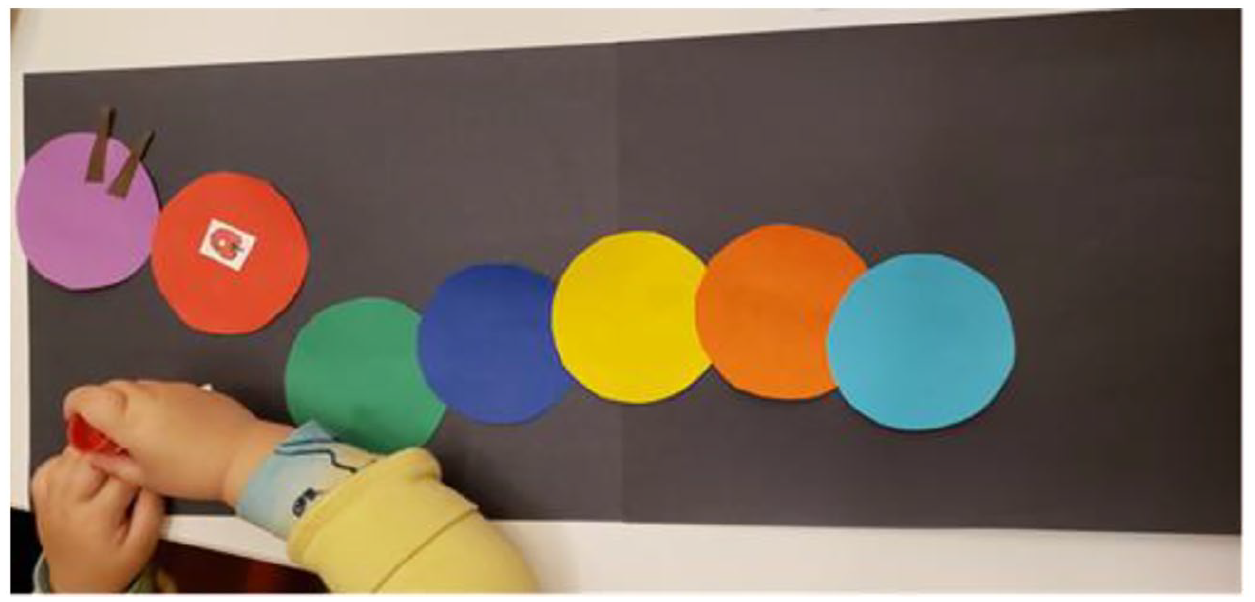
A child gluing down seven circles in a caterpillar craft activity.
This is a repeated procedure of gluing once circle at a time. This is also known as a “loop” in computer science—children will loop seven times in gluing circles. Teachers can use the word “loop” to describe the repeated action of gluing down each circle. Then, as children create their own caterpillars, they can practice creating their own loops. Teachers can build in additional support by asking children to count the number or loops or describe the series of repeated actions needed to glue down each circle (e.g. “How many loops did you do?”). Whenever a teacher plans to model “how to,” this is a teachable moment to help children practice algorithm design skills and to introduce the term “algorithm.” For example, the teacher may say: “I’ll show you the algorithm for how to create a caterpillar with seven circles.” This will intentionally expose children to computational thinking terms so that they become familiar with the language and understand the language in context.
Morning routine/daily routine
Language-mediated daily routines play an important role in helping children understand how procedures contribute to predictable routines. Furthermore, daily routines involve algorithms about what children will do in a sequence. A teacher may share a daily routine during whole-group circle time in the morning to introduce what the children will do during the day, such as free play time, snack time, outdoor play time, and so on. When sharing daily routines, event-based sharing using ordinal words helps children build algorithmic thinking skills. A teacher can model the use of these words by saying: “First, we will have free play time. Second, we will have a snack time,” and so forth. Sharing and outlining these routines on posters or co-creating them with children can also promote algorithmic communication about routines in a sequence. The teacher can then refer to the poster and discuss routines in a sequence using ordinal numbers (e.g. first, second, etc.). Teachers can also build in opportunities throughout the day to reinforce new skills by asking children to use the posters to talk with their peers about upcoming events and routines using ordinal words.
Conclusion
Algorithms are the essence of computational thinking. Thus, it is important for teachers of young children to carefully plan and intentionally implement algorithm tasks in daily classroom activities to build computational thinking skills. Language is an important mediating tool in helping children learn to think logically to solve problems. Using ordinal words that help children practice algorithm skills enables them to logically organize and structure their thinking to create the steps to solve problems (Lee, 2020).
Algorithm tasks in early childhood involve any step-by-step procedures, such as creating a recipe, creating a treasure map, developing and following how-to activities, and sharing daily routines. Daily tasks with step-by-step procedures can be highlighted to promote children’s algorithm design skills and ultimately their computational thinking.
To help children become more logical problem-solvers in an increasingly digital world, more work is needed to develop explicit algorithm designs and computational thinking activities for early childhood classrooms. In this paper, we have provided multiple layers for supporting and promoting children’s algorithm thinking skills—a repeated daily routine, read-aloud texts with clear story structures, anchor charts, think-alouds, and opportunities for children to articulate algorithm designs. Our future work aims to refine and study how these scaffolds can be utilized in early childhood classrooms.
Footnotes
Funding
The authors received no financial support for the research, authorship, and/or publication of this article.
