




Abstract
This study compared the achievement of male and female students who were enrolled in an online univariate statistics course to students enrolled in a traditional face-to-face univariate statistics course. The subjects, 47 graduate students enrolled in univariate statistics classes at a public, comprehensive university, were randomly assigned to groups that used either online instruction or traditional face-to-face instruction. The effects of the independent variables of online univariate statistics instruction versus traditional face-to-face instruction on the dependent variable of statistics achievement were analyzed with a two-way analysis of variance. There was a significant difference between the achievement of students who used online univariate statistics instruction and those who used traditional face-to-face instruction (p = .001). The traditional face-to-face group scored higher with an effect size of 0.979, indicating that, on the average, those who were enrolled in a traditional face-to-face univariate statistics class outperformed 83.4% of those enrolled in the online statistics course. Moreover, females using online instruction outperformed males using online instruction and males enrolled in a traditional face-to-face course scored higher than females, with an effect size of 0.651, indicating that, on the average, those males outperformed 74.22% of the females enrolled in a traditional face-to-face statistics course.
Introduction
Based on survey responses from over 2800 academic leaders, the number of students taking at least one online course throughout the United States has now surpassed 6.7 million. Moreover, the adoption of Massive Open Online Courses is increasing. However, before embracing online courses into curricular offerings, institutions of higher education are waiting for confirmation of online learning’s effectiveness (Allen and Seaman, 2013). Since the arrival of early computers that performed complex calculations at more efficient rates, the literature has been overwhelming in the number of studies showing that electronic and digital technologies are useful tools to enhance learning. Subsequently, as technology has developed over time, computers have become available to the vast majority of people in the United States. In addition, access to the Internet has increased the accessibility and mobility of learning for students (Allen and Seaman, 2014).
Following this trend, at a time when colleges are competing for students and trying to maintain enrollment levels, the omnipresence of microcomputers and widespread access to the Internet, as part of an online learning program, is a necessary mechanism for institutions to attract students. Hence, with universities embracing online learning, digital technologies are having a significant impact on the lives of students (Kerr, 1996). In a broader technological sense this is not new of course. Segal (1996) suggests that America’s ongoing interest with technology has gone on since the advent of television, with the novelty appeal of technology continuing to be the canon of progress. This may explain online learning’s appeal and why most educational planners agree that online enrollments in the U.S. show no signs of slowing (Allen and Seaman, 2010).
However, at the same time as this growth, there is a significant concern regarding the development of online teaching methodologies that will accommodate the growing diversity of America’s online education students. Despite the praises heralding online learning as an effective teaching methodology, there is very little documented evidence verifying its perceived effectiveness when compared to traditional face-to-face instruction. More than this, there arguably remains a strong suspicion of the quality of online learning experiences for university students. Regardless, schools and universities are embracing online learning at a constant rate, but often without giving full consideration to the effectiveness and efficiency of online learning in specific subjects.
Existing studies have shown a variety of contradicting differences in the achievement results of students enrolled in online and face-to-face courses. For example, Enriquez (2010) found that students enrolled in online coursework had higher grades than students enrolled in face-to-face classes. However, Plumb and LaMere (2011) found no significant differences between online and face-to-face students’ course achievement. Smith et al. (2015) examined the achievement between graduate-level students enrolled in online learning and a traditional face-to-face setting. Smith’s et al. (2015: 54) research contends “…that certain coursework might be inappropriate for online learning and certain students might benefit from face-to-face coursework. Hence, there are mixed results in the reported differences between online and face-to-face instruction. In addition, there is a paucity of research in the effect of online instruction in specific content areas (e.g. statistics, mathematics, etc.).
This study attends to this paucity through analysis of teaching methods in a statistics class. Statistics, as a branch of mathematics, provides students with a foundation for conducting research. The presentation of statistics to students, however, is often methodologically obscure, requiring the application of problem-solving skills (Christmann, 2009). This being the case, students sometimes need additional guidance with computations and clarification of various statistics concepts. Perhaps this is why, to give students a foundation, the National Council of Teachers of Mathematics (NCTM) has mandated the teaching of statistics from early grades through high school (NCTM, 1989). Additionally, statistics is mandated content in colleges for coursework in both undergraduate and graduate programs.
It is also of interest to uncover whether gender achievement differences within online and traditional face-to-face statistics courses exist, given an ongoing sociological and academic concern with gender disparities in mathematics study and achievement and in adoption of new instructional technologies to bolster statistics achievement. Subsequently, there is a call for additional research regarding the most effective ways for improving statistics achievement in academic settings (Christmann and Badgett, 1999). One investigation of the online learning achievement of males and females found that there are differences in achievement based on gender (Eisenchlas, 2013). Moreover, Wladis et al. (2015) found that in the online STEM courses, females have significantly lower achievement—performing better in face-to-face settings.
For several years, the academic differences between the achievement levels of male and female students in statistics courses have been investigated (see, for instance Christmann, 2009). Therefore, in this paper, that interest is extended to determine whether a difference exists in the statistics achievement among students enrolled in online and traditional settings. Hence, the study focuses on the following two null hypotheses:
There will be no significant difference between the statistics achievement of university students who were enrolled in an online univariate statistics course and those enrolled in a traditional face-to-face univariate statistics course; There will be no significant difference between the statistics achievement of male and female university students who were enrolled in an online univariate statistics course and those enrolled in a traditional face-to-face univariate statistics course.
Methodology
Subjects
The subjects were 47 graduate students enrolled in two different univariate statistics courses at a northeastern public, comprehensive university enrolling approximately 8100 students. The subjects were 14 males and 33 females who were enrolled in two separate and compulsory one-semester graduate univariate statistics courses, one online and the other traditional face-to-face. The sample size was limited to those students who were required to study univariate statistics as a graduate program requirement.
Intervention
Students were enrolled in either a traditional face-to-face univariate statistics course or an online univariate statistics course, which was the intervention. Both univariate statistics courses integrated the same learning objectives and univariate statistics content. Students enrolled in the online course used Desire2Learn as its online learning management system and the instructor was trained as a Quality Matters certified instructor, which is a certification program that enables online instructors to demonstrate their knowledge mastery of online teaching. Moreover, both the online and the traditional face-to-face univariate statistics courses incorporated the same instructor, content materials (i.e. textbook, SPSS Software, assignments, etc.), and identical student evaluation instruments, e.g. the content and tests in both courses covered the same descriptive statistics through one-variable inferential statistics.
Research design
The study employed Gall et al. (2006) description of a quasi-experimental static group comparison design that observed differences between two separate intact groups of univariate statistics students. One group was enrolled in an online univariate statistics course, with “online instruction” as the intervention. The other group was enrolled in a separate traditional face-to-face univariate statistics course that was taught on campus and was the control group. This design was selected in efforts to avoid pretest contamination in that if students in either of the two different intact groups had perceived low scores on a pretest, they realistically could have begun working on problems independently outside the confines of the intervention, thus distorting the effects of either online or traditional face-to-face learning.
Results
Online learning versus traditional face-to-face learning
Means and standard deviations for the posttest scores are given in Table 1. Two-way ANOVA results yielded a significant difference between the univariate statistics achievement of students who used online univariate statistics instruction compared to those who used traditional face-to-face instruction (p = .001). Students who took the course in a traditional face-to-face setting scored significantly higher than those who took the course in an online learning environment (F(1,43) = 11.872, p =.001), The overall mean posttest score for the group using online learning was 83.14 (SD = 7.75), while the overall mean posttest score for the group taking the course in a traditional face-to-face setting was 90.53 (SD = 7.33).
Means and standard deviations for overall achievement.

The traditional face-to-face group scored higher with an effect size of 0.979, indicating that, on the average, those who were enrolled in a traditional face-to-face univariate statistics class outperformed 83.4% of those enrolled in the online statistics course.
Statistics achievement based on gender
The means and standard deviations of male and female students who used online or traditional face-to-face instruction are reported in Table 2. The two-way ANOVA results yielded no significant posttest results with respect to gender (F(1,43) = .470, p =.497). However, effect size differences were disclosed with respect to gender and the type of instruction. Consequently, it is important to note that when comparing males (M = 93.66, SD = 6.74) and females (M = 89.07, SD = 7.78) who used traditional face-to-face instruction, a mean effect size of 0.650 resulted. Cohen (1977) classifies such an effect size as a large effect. Hence, this mean effect indicates that, on the average, a male student using traditional face-to-face statistics instruction showed academic achievement that was greater than that of 74.22% of the female students who used traditional face-to-face statistics as the method of statistics instruction.
Means and standard deviations for overall achievement.
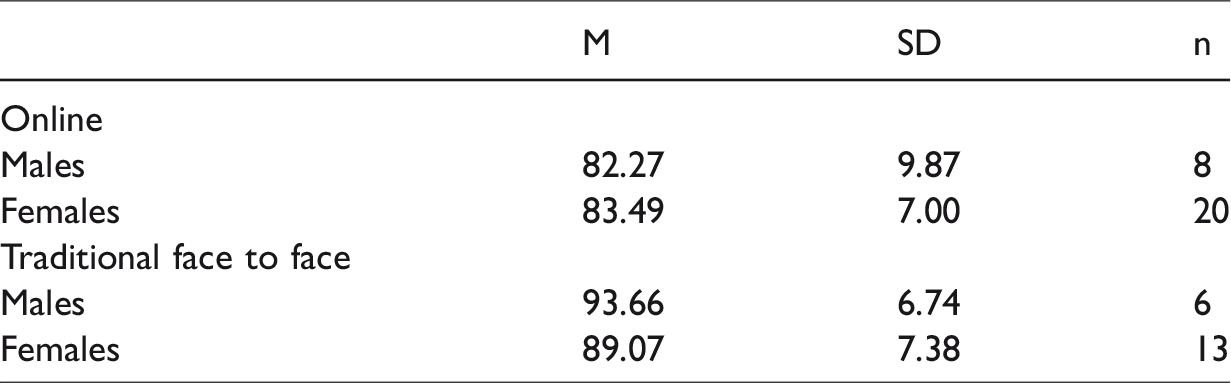
When comparing males (M = 82.27, SD = 9.87) and females (M = 83.49, SD = 7.00) who used online-based instruction, a mean effect size of 0.143 was calculated, which is very small and indicates that on average a female student using online-based instruction showed academic achievement that was greater than that of 55.5% of the male students who used online-based instruction.
Nevertheless, it is important to remember that the students of both genders who used traditional face-to-face statistics instruction performed at a higher level than those students who used online-based statistics instruction, which is illustrated in the interaction displayed in Figure 1. Thus, if given the same learning objectives, it is reasonable to expect that students of univariate statistics using traditional face-to-face statistics instruction would perform at a higher level of achievement. Moreover, although there was no significant difference found with the two-way ANOVA, it is noteworthy that both males and females performed better when exposed to traditional face-to-face statistics instruction.
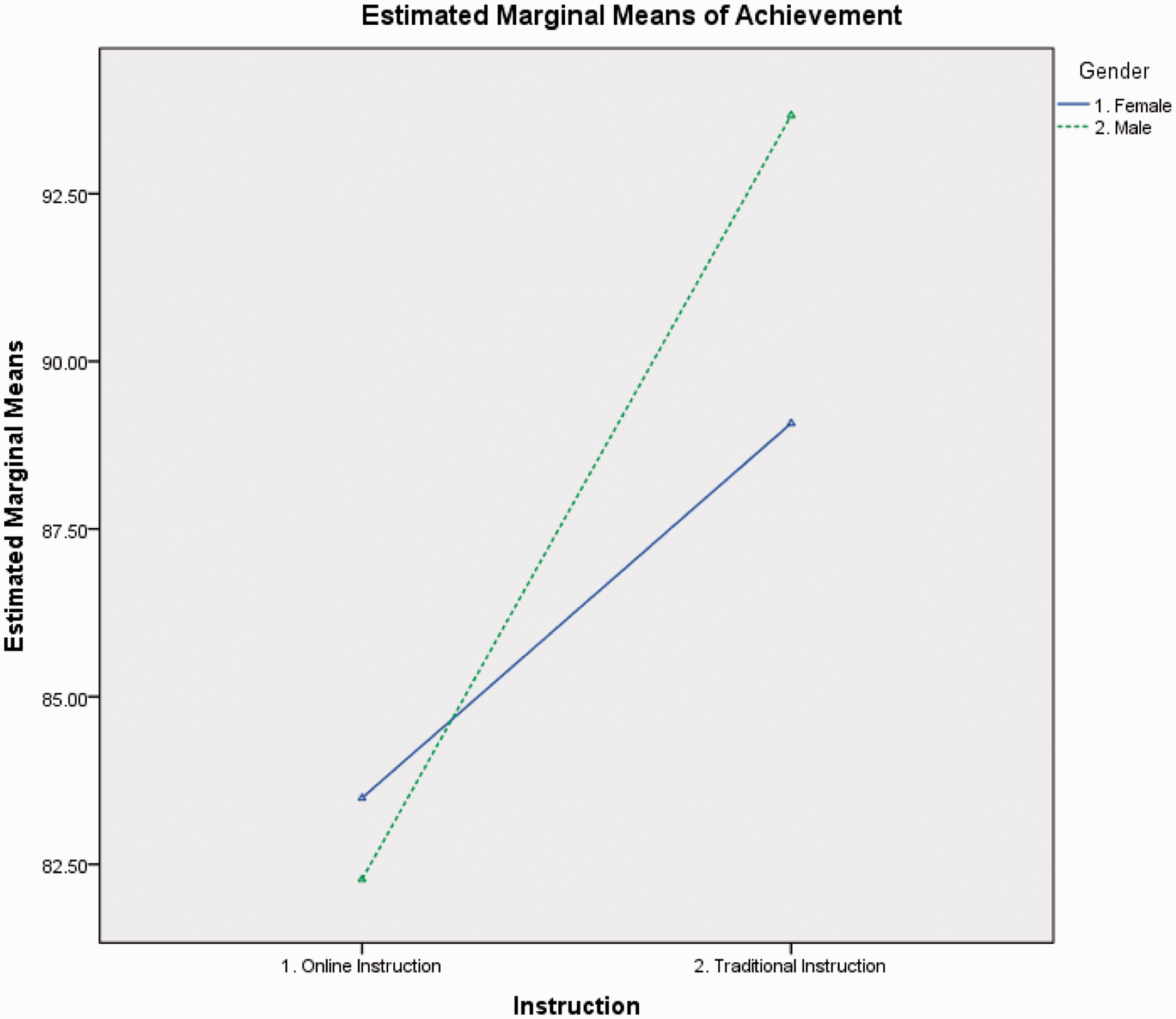
Interaction effects of achievement and gender versus the use of either online or traditional face-to-face instruction in a univariate statistics course.
Discussion
The results of this research disclose a significant difference between the mean achievement scores of students who used online learning and those who were enrolled in a traditional face-to-face univariate statistics course. Subsequently, the students in traditional settings had higher achievement than those in online settings, which confirms Ya Ni’s (2013) study showing that students in traditional settings outperformed students in online courses. As a possible explanation for the lower performance of online students, Ya Ni (2013) suggests that if students in online courses are not persistent, their achievement levels could decrease. Furthermore, previous research shows that online learning environments experience higher dropout rates as compared to traditional face-to-face settings (Carr, 2000; McLaren, 2004). This is problematic in that it implies to better prepare students for success in online environments, there is a need for preparation and/or counseling prior to enrollment in an online course.
Although the results reveal no significant differences between the scores of males and females who used online or traditional face-to-face instruction, the calculated effect sizes show that 74.22% of those male students who were enrolled in traditional face-to-face learning scored higher than the females in traditional face-to-face settings. Yet, as disclosed by an effect size calculation, those females who used online learning outperformed 55.5% of the male online learners.
It is notable to point out that the results of this study support the earlier findings of Ya Ni (2013); however, the results of this study again suggest a need for further research that is geared toward determining the most proficient and efficient instructional methodology that can be implemented in collegiate or scholastic statistics courses. Moreover, it is conceivable that certain courses such as research methods and statistics present more complicated issues when taught in online learning environments (i.e. theoretical concepts, applied mathematics, specialized notations) that may not be commensurate with online learning environments. Hence, researchers need to explore which courses are the best fit for online learning environments and determine how to improve the design of online courses with challenging content.
Consequently, these figures reflect the necessity for continuing research regarding the effectiveness of online learning on university statistics achievement. Undoubtedly, such studies could provide additional research to better determine which methods of instruction are most appropriate for statistics courses.
Conclusions and future research
This current study explored the achievement differences of male and female students who were enrolled in an online univariate statistics course and students enrolled in a traditional face-to-face univariate statistics course. Results indicated that students who used traditional face-to-face instruction outperformed students who used online statistics instruction. Moreover, females using online instruction outperformed males using online instruction and males enrolled in a traditional face-to-face course scored higher than females.
At this time, the current research was limited to the comparison of online statistics instruction to traditional statistics achievement, as measured by a teacher-designed test. Further research in this area might include pre- and posttests to determine the level of prior knowledge of the statistics content. Moreover, interviews with students to ascertain course perceptions could reveal additional strengths and weaknesses of the different instructional methodologies for statistics instruction and beyond. For example, students could help researchers better understand the quality of instruction and interaction between students in both settings.
Since online instruction offers a convenient avenue for learning across a wide geography of learning opportunities, it is imperative that the research community examine how best to integrate online instruction into the warp and woof of curriculum and instruction. Thus, additional research is needed to prevent online learning from evolving into a potentially useful, but misunderstood, overused, and eventually unsuccessful educational tool.
Footnotes
Acknowledgement
The author would like to thank the Slippery Rock University Institutional Review Board (IRB), who approved this research study and assured that it complied with Federal and state regulations and SRU policies.
Declaration of Conflicting Interests
The author(s) declared no potential conflicts of interest with respect to the research, authorship, and/or publication of this article.
Funding
The author(s) received no financial support for the research, authorship, and/or publication of this article.