




Abstract
This paper presents a case study of one College of Business (College of Business and Law from 2013) impacted in 2011 by earthquakes in New Zealand. Analyses from interviews of nine staff and documents were used to describe processes of increasing resilience with e-learning over the worst seismic events. Increasing deployment of the University’s learning management system by staff and students plus audio recordings and video recordings of lectures enabled the College to continue its teaching. The Technology Acceptance Model and the generic model of organisational resilience by Resilient Organisations informed the analysis of the adoption and adaptation of e-learning than continued after the crises in the university.
Background
There has been rapid evolution in the range of software since the beginning of the 21st century to support learning in universities. The range of software available can be used in teaching/learning during disasters. ‘Online education is established, growing, and here to stay’ (Mayadas et al., 2009: 1). When disasters and crises, both man-made and natural, occur, resilient higher education institutions adapt in order to continue teaching and research. Chang-Richards et al. (2013: 117) define organisational resilience as ‘the ability of an organisation to survive a crisis and thrive in a world of uncertainty’. It also refers to how organisations improve their ability to respond to, and quickly recover from, crisis events such as natural disasters. Such events can interrupt the activity of an academic institution. The University of Canterbury (UC) was affected by seismic events, which resulted in the closure of the University for two weeks at the start of the 2011 academic year (Agnew and Hickson, 2012; Dabner, 2012).
There has been little research into the evolution of e-learning in a university that has been subjected to a disaster such as a series of earthquakes. This case study research provides an illustration of how e-learning assisted a College to remain open and even to improve learning and teaching as it recovered from three seismic events in two years. The research question that guided the study was: How can learning technologies be used to assist academic institutions in the face of natural catastrophes? The research was delimited to staff of the College since students who were in the University at the time of the seismic events had graduated.
The UC, one of eight universities in New Zealand, is a research-led institution. In 2015, it had 11,931 students and 1886 staff (Universities New Zealand, 2015) in five Colleges (Arts; Business and Law; Education, Health and Human Development; Engineering; and Science) and offered degree programmes from bachelor to doctoral level. UC School of Law and UC College of Business and Economics merged to form the College of Business and Law (CoBL) in 2013. The School of Business and Economics was one of the first business schools in higher education in New Zealand. The adaptations of UC to the seismic events were on-going from the occurrence of the first seismic event in September 2010. The major activities in the academic year in UC are shown in Table 1. Table 1 also shows the time in the academic year when the three major seismic events occurred and how they impacted on the activities of the University. The southern hemisphere academic year closely follows a Gregorian calendar year.
The academic year in University of Canterbury.
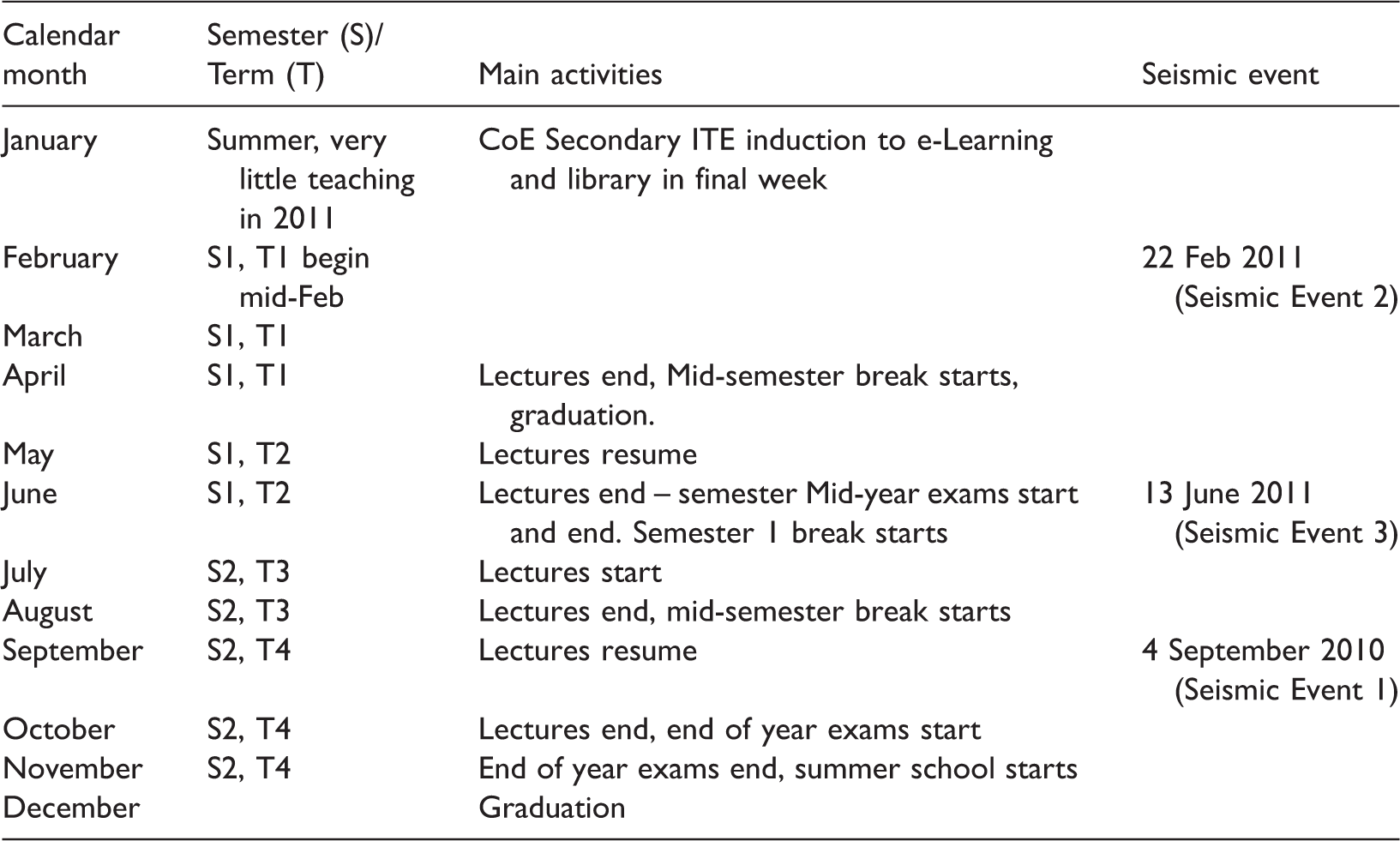
CoE: College of Education; ITE: Initial Teacher Education.
Literature review
Seaton et al. (2012) who reported on the earthquake disaster in Christchurch at Christchurch Polytechnic Institute of Technology noted that communication was seen as critical in the aftermath of the February 2011 seismic event. In addition, the degree of disruption and uncertainty immediately following the earthquake on 22 February 2011 significantly impacted on the ability of individuals, and the organisation as an entity, to communicate both within and outside the organisation. Todorova and Bjorn-Andersen (2011) in a position paper noted that the vision of UC in the aftermath of the earthquake on 22 February 2011 was to communicate and teach in the online world. Dabner (2012) indicated that a new Facebook community was immediately established, after the 2011 earthquake, enabling on-going dialogue and information sharing between staff at the institution and the wider educational community. In addition, the management team decided that the UC website would become the central portal for official information for the UC community. DiCarlo et al. (2007) reported that in the aftermath of Hurricane Katrina in 2005 at Louisiana State University School of Medicine, communication with dispersed faculty, staff, students, and residents was essential so the IT staff were mobilised and immediately established an emergency website with daily messages from the chancellor and vice chancellors. Bird et al. (2012) noted a lesson learnt during the Queensland and Victorian floods in Australia was that social media are a good way to disseminate emergency information, as they are effective and fast, because they are part of everyday life in that region.
Methodology: Method and materials
This case was nested inside a larger study of the University in a qualitative intrinsic, single case study design (Gray, 2009; Patton, 2002; Stake, 1995; Yin, 2008). Sources of data included documents such as policy, reports and guidelines; emails and personal documents from leaders of the College and academics; communications from the Senior Management Team (SMT) posted on the University website during and after the seismic activity of 2010 and 2011; and semi-structured interviews of academics, support staff and members of SMT. Interviews were conducted between July 2014 and August 2014. The UC was selected because it is a research-based higher education institution in New Zealand that was affected by seismic activities. Permission and approval were sought from the University’s Educational Research Human Ethics Committee to carry out the research. The sampling technique was a snowball strategy where the early key participants were encouraged to recommend further participants to be invited to volunteer to participate in the study (Fraenkel et al., 2012; Trochim, 2006). A saturation point was reached when key people, already interviewed, were repeatedly recommended (Sotirios, 2013).
The interviews involved two Learning Advisors of the Electronic Learning Media of Learning Resources, one leader of CoBL of the University, and academics in the College. The snowball technique started with an informal discussion with the Leader of the Electronic Learning Media to find key participants. Informal discussions with the key participants then led to identifying some participants of the study. As participants were interviewed, other individuals were recommended who might be helpful to the study.
A search for relevant publications and unpublished reports of the University and CoBL was conducted. Some of the documents were public documents available on the University’s website. Others were working documents that were not readily available as public documents and were made available by key participants and others who participated in the study. In addition, some of the participants of the study provided personal documents following enquiries at the end of interviews. Documentary analysis was then done on the publications and reports collected. Any document that did not have any information with regards to e-learning was not included.
Following the recommendations of Savin-Baden and Major (2013), steps were taken to ensure that the documents were authentic, credible and representative. As the documents were created independently and prior to the research, credibility was enhanced (Savin-Baden and Major, 2013). Stored emails relating to e-learning from interviewees who were willing to share them were also included. As Patton (2002: 294) points out, ‘… with permission and proper safeguards to protect confidentiality, some information from private documents can be quoted directly and cited’. There were communications from the SMT and other officials of the university on the university website after the seismic activity in 2011. These were analysed regarding issues relating to e-learning.
Three sets of semi-structured interview schedules were developed for the interviews with the SMT, academics, and support services. The interview schedules were developed using themes informed by the literature reviewed to aid in data triangulation (Sotirios, 2013). All interviews were validated using ‘member checking’ (Sotirios, 2013: 446). In addition, data extracted from the materials collected for the study was then used in generating the themes and subthemes as documented in the Results section.
NVivo qualitative data analysis software was used for analysis of data collected. The Technology Acceptance Model 2 (TAM2) (Venkatesh and Davis, 2000) and the Indicator of Resilience Model (Resilient Organisations, 2012) were used for additional analyses of the case.
Results
This section presents the findings from analyses of documents, reports and UC websites as presented in Table 2. In addition, findings from interview analyses are also discussed.
Sources and type of data for the study.
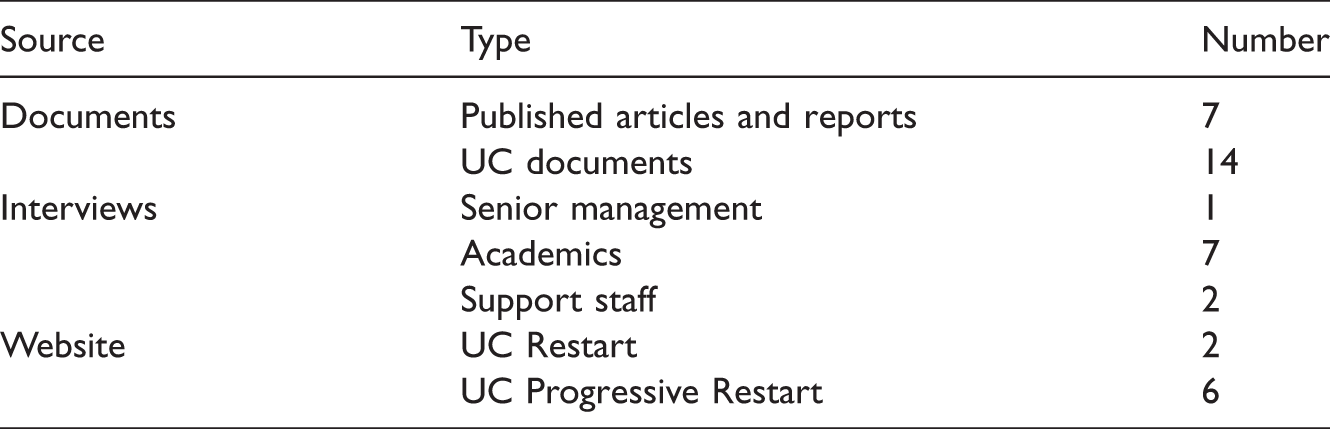
UC: University of Canterbury.
The College of Business and Economics Strategic Plan 2010–2012 showed the College's planned activities for the period 2010–2012. This document gave an overview of 2009, especially the global financial crisis and its effect on education in New Zealand. The document also elaborated on how the College of Business and Economics responded to these challenges. There were two instances of the use of e-learning in the Strategic Plan. These were in the Key Strategic Area 2: Teaching and Learning.
The UC set up a website UC Restart, in the aftermath of the Seismic Event 1 (2010) that kept staff and students up to date with all the latest announcements and information relating to the Seismic Event 1 (2010) and UC’s re-opening. This contained all the information posted on the University website following the earthquake. The
E-learning tools were invaluable during the crises and facilitated teaching and learning whilst freeing limited campus space for essential activities. There were two categories of e-learning technologies used by academics in UC in the aftermath of the February 2011 earthquake to engage with students. These consisted of technologies supported centrally by the UC e-Learning support team and IT tools that were not supported. These supported technologies included:
Learning management system (LMS) that had been available since 2000. In 2000, the LMS were WebCT, then Blackboard in the University, and StudentNet (LMS developed in-house) in Christchurch College of Education. Learn (an instance of Moodle open source software) became the only LMS in early 2010. Manual lecture capture by academics was streamed using a QuickTime server that had been available since 2002. In addition, there had been the use of DVDs since 2007 in the College of Education. The web conference software, AdobeConnect, was available since 2007 but only became centrally supported in 2010 after the September 2010 seismic event. Automatic lecture capture, Echo 360, was added in July 2011, including personal video capture and a streaming server. Some academics posted multimedia files on the LMS in the aftermath of the February 2011 seismic event. Some of the technologies academics used were Camtasia for video recording and Audacity for audio recordings. These technologies were, however, not supported by the e-Learning support team.
Immediate response
In the aftermath of the Seismic Event 1 (2010), the reaction was across the University and not College specific. The University had secured unprecedented access to global learning resources from national and international suppliers that had offered ‘free access for staff and students to thousands of e-books, online journals and global databases potentially worth millions of dollars’ (University Executive Leader, Learning Resources, UC Restart website). Students and staff were provided with online and in-person support to help them utilise the new online services which they will be able to access through their university IT accounts (University Executive Leader, Learning Resources, UC Restart website). The UC Progressive Restart website, set up after the Seismic Event 2 (2011) to give information on how the University was re-organising to continue with the 2011 academic year, had a posting from the College of Business and Economics on the processes the College had put in place to restart on 14 March 2011. The College Executive Leader, Business and Economics also made postings on the UC Progressive Restart website including a message that ‘we have been actively engaged in assessing our capacity to deliver our programmes, utilising diverse learning platforms, changed facilities and drawing on the capabilities of our experienced and knowledgeable staff’ (College Executive Leader, Business and Economics message on Restart website on 7 March 2011). As indicated by the College Executive Leader, Business and Economics on the UC Restart website, It seems that we will be restarting on March 14 with very limited lecture theatre capacity, which is why I have asked staff teaching the critical 100-level courses to try and ensure that they could begin online, using their UC Moodle sites to get students started. Our level 100 courses all began on Monday, each with a face-to-face lecture in ‘Tent City’ supplemented by flexible learning support through UC Learn [Moodle]. Our MBA and MBM resumed teaching in facilities generously provided to us by Lincoln University.
Emergent themes
The transcripts from the semi-structured interviews of nine participants in the College of Business were coded into three categories and then into 17 inductive themes that emerged from the data. The 17 inductive themes are arranged from the highest number of units of meaning (UoMs) to the lowest and across three deductive categories of Positive, Mixed and Negative. The distribution of responses across themes is shown in Table 3.
The distribution of units of meaning from the interviews arranged in descending order of total units of meaning.
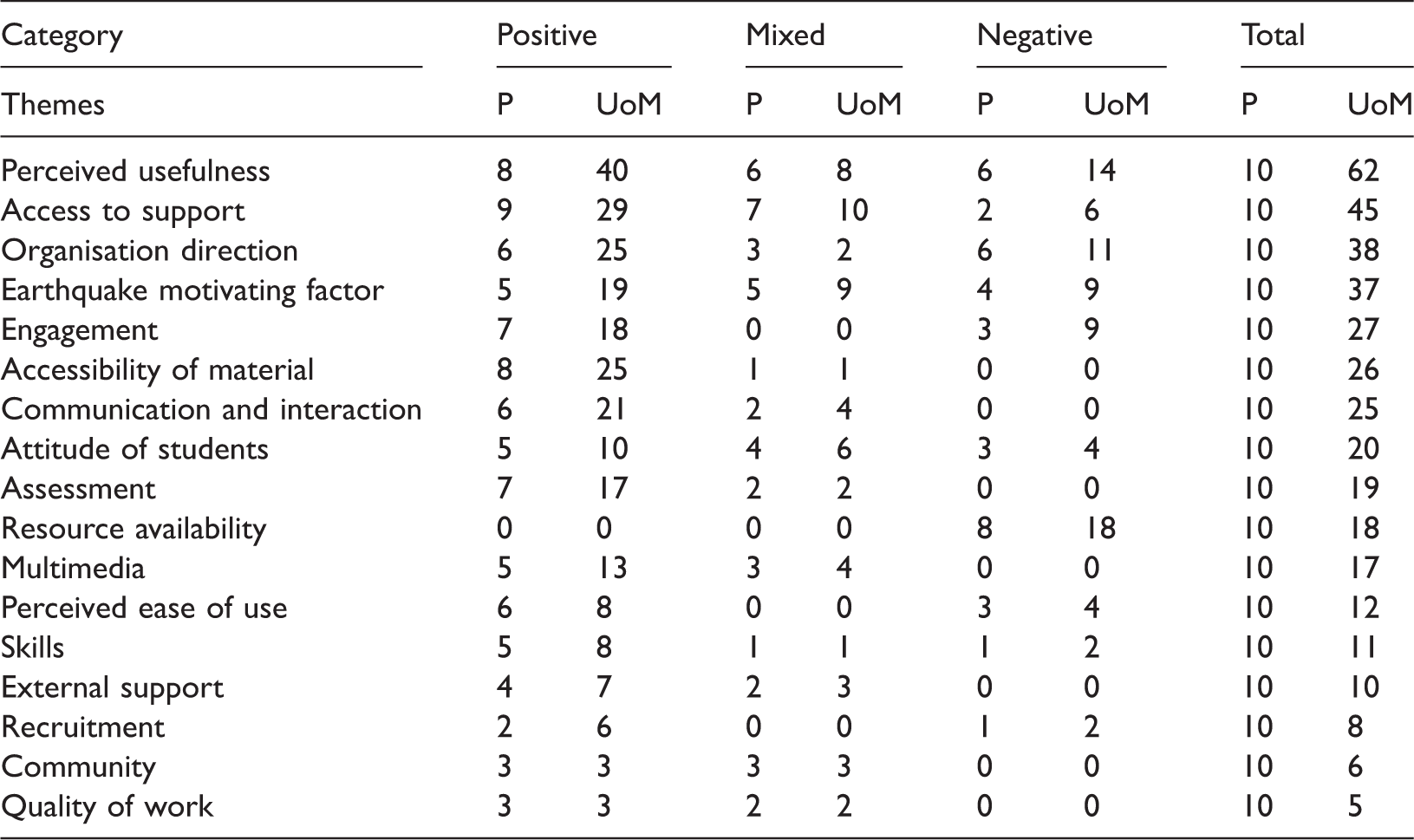
P: number of participants in the study included in the UoM; UoM: unit of meaning.
Due to limitations on space only six themes of inductive themes are discussed. These are themes with the highest UoM. In addition, Attitude of students and Assessment themes were selected for discussion. The Perceived usefulness theme UoM related to how participants perceived e-learning as being useful for teaching and learning in the aftermath of the earthquakes that occurred in 2010 and 2011. Some of the participants of the study were using e-learning in their courses prior to the earthquakes. Eight participants of the study had 40 positive UoMs. The Perceived usefulness theme had the highest number of UoMs in the study indicating widespread relevance to the participants.
Under Perceived usefulness theme, an example of an interview transcript under UoM from the positive category is below: I mean, it’s certainly very useful when a campus is closed, physically it’s certainly very useful to have those tools that you can then use … in the short term it was very useful when there was no physical campus – CoB 6. all the other things that I do on Learn [Moodle] like quizzes, tutorial things and posting files and links to other places and stuff, I’ve done that for a long time and so nothing really changed long term – CoB 6. You have to remember a lot of people weren’t using Learn [Moodle], that is, before the February 2011 earthquake then. A lot of people were not using Learn [Moodle] at all – CoB 4.
The UoMs from the participants of the study in the Perceived usefulness sub-theme indicate that most viewed e-learning as useful. As noted by CoB4 in an interview, ‘e-learning was useful when there were no teaching spaces because of damage to lecture theatres’. Academics had to find other ways to continue teaching students and e-learning was used to engage with students. One academic described e-learning as ‘a silver lining’ in the aftermath of the earthquake as the earthquakes made people think of e-learning and led to academics ‘putting stuff up online which they might not have put up before such as Head and Shoulders Video lectures’.
Some academics said Learn [Moodle] sites helped facilitate classroom activities. One academic said that lecturers had had virtual meetings with students because there were limited facilities following the February 2011 earthquake. Two academics were having their lectures manually recorded and hosted on the Learn [Moodle] site before the September earthquake. However, due to the small number of students, academics teaching postgraduate courses were reluctant to use [Moodle] in spite of its advantages. An academic confirmed that ‘the higher up you went, the less it [e-learning] was used’.
The Organisation direction theme UoMs related to how participants of the study perceived organisational direction in the use of e-learning in the aftermath of the earthquakes in 2010–2011.
In the positive category, an interviewee noted, After the earthquake I think there had been a shift on the part of Senior Management team. A recognition that we’d better keep this thing that we call e-Learning and in fact we’d better perhaps make more use of it – LR 1. I mean the problem is I think that very often it’s all about return in investment so people think that if I put all this extra work what do I get and there’s not that much difference– CoB 1.
The responses from participants of the study indicated that some got information that they could use e-learning while others were of the opinion that the information to use e-learning was received late. Some academics too were of the opinion that the University had been advertising itself as an on-campus University.
The Earthquake motivating factor theme is related to how participants of the study perceived the earthquakes of 2010 and 2011 as a motivating factor in the use of e-learning.
In the positive category, an interviewee noted, Following that February earthquake, that’s where I saw the maximum innovation, because the idea of a tent, a canvas tent, obviously it was a very, very poor substitute for a lecture theatre or a lecture room. I mean you couldn’t use whiteboards, because these were really big tents, you couldn’t see them, so people kept very, very innovative, finding online alternatives at that point – LR 2.
The participants of the study were of the opinion that the earthquakes of 2010 and 2011 were motivating factors in encouraging them to use e-learning. Nevertheless, some participants were of the opinion that e-learning was imposed on them.
The Attitude of students theme is related to the reported perceptions of the interviewees about the attitude of students to the use of e-learning.
In the positive category, an interviewee, CoB 4 noted, ‘…what I was doing was kind of gradually moving with what was possible and what the students would accept and [with] LearnTrack, you can see who’s viewed what’.
In the mixed category, the same interviewee remarked, ‘…what I find is with e-resources here, that the level of take-up by students, you can see it on LearnTrack, varies a great deal’ – CoB 4. For the negative category, this interviewee remarked, ‘basically they sort of said, right, everything can go online and you know, students, the students they were meant for just couldn’t cope technically and just I guess psychologically, socially with that’ – CoB 4. Participants of the study were of the opinion that students were accessing materials which helped them study at their own pace and kept them from worrying about the earthquakes.
The Assessment theme had UoMs that related to how the participants of the study used e-learning assessment in the aftermath of the earthquakes. In the positive category, an interviewee, CoB 5 confirmed, ‘I used the Learn [Moodle] site for online quizzes and for online assessment’. In the mixed category, a participant of the study remarked, ‘the students had to, were given it [exams], received it online but they had to submit it physically and they had to handwrite it’– CoB 4.
Participants of the study were using e-learning for online assessment and submission of assignments especially for large classes. Some academics however wanted students to handwrite and submit exams.
The Access to support theme UoMs related to how the participants of the study related access to support to their use of e-learning. The support could be from the University in providing staff such as Flexible Learning Advisors (FLAs) to assist in using Learn, and other e-learning tools such as audio and video tools. The theme also had UoMs that related to support from colleagues in the College or elsewhere.
In the positive category, an interviewee noted, ‘…I don’t know what their title is, e-Learning advisors or something … if you’ve got a question, you can contact them, and they’ll answer it for you’ – CoB 5.
In the mixed category, one interviewee remarked, ‘… at the time [in the aftermath of the February 2011 earthquake] we really were kind of left to sink or swim and find your own way, and Audacity [software] was free so, we just had to find something for ourselves’ – CoB 1. CoB 1 continued, ‘everybody just tried different things by themselves and then we would sort of say what we’ve tried, so it was a lot more, peer to peer help as opposed to actually somebody from the University helping us’.
A participant of the study understood that ‘some of them [staff] work very closely with two colleagues to design courses, but they feel quite unsupported by the Institution and then they say, well where does this fit because UC can’t compete with Massey [University] in that space’ – CoB 7.
In the negative category, the same interviewee remarked, ‘I mean one of the things I discovered when we had the earthquake and they said well try to do it online and there was nobody to help out’.
From the UoMs on Access to support, it can be deduced that some of the participants had support either from colleagues or FLAs in using e-learning. Others were of the opinion that the support was inadequate or non-existent.
Interpretation of the case study using theoretical models
Two models were used to interpret the data of the study. TAM2 (Venkatesh and Davis, 2000) was used to interprete data from the participants of the study and Indicators of Resilience model (IRM) (Resilient Organisations, 2012) was used to interpret the resilience of the College of Business and Economics/CoBL to the seismic activities of 2010 and 2011 using e-learning. TAM2 incorporates ‘additional theoretical constructs spanning social influence processes (subjective norm, voluntariness, and image) and cognitive instrumental processes (job relevance, output quality, result demonstrability, and perceived ease of use)’ (Venkatesh and Davis, 2000: 187). The components of the TAM2 were found in data collected for the study.
The results from the participants of the study were used to find out how Business and Economics/CoBL demonstrated resilience in carrying out its activities using e-learning. The IRM posits there are 13 indicators that can be used in assessing the resilience of an organisation (Resilient Organisations, 2012). The interpretation of the results using TAM2 indicated that the adoption of technologies during crises aids in overcoming barriers to learning in times of crisis. The interpretation of the results using IRM showed that the model was useful. Having 11 out of the 13 indicators of the IRM showed that the College has become more resilient with e-learning in the aftermath of the seismic activities.
Discussion
This section examines strategic findings from the study in relation to the data on e-learning in the College.
The themes from the data analysis were reorganised into the following for discussion: Communication about crises, IT infrastructure, availability of e-learning technologies, support in the use of e-learning technologies, timing of crises in academic year and strategic planning for e-learning.
Communication about crises
The use of communication channels, which students were familiar with and already using, aided the dissemination of the information that UC would be using e-learning as one of the options to complete the academic year. For a university like the
Seaton et al. (2012), academics at Christchurch Polytechnic Institute of Technology, who were also affected by the seismic events, confirmed that communication was seen as critical following the Seismic Event 2 (2011) and facilitated the ability of individuals, and the organisation as an entity, to communicate both within and outside the organisation. Dabner (2012: 69), an academic in UC Collge of Education, confirmed that the Facebook community enabled ‘on-going dialogue and information sharing between staff at the Institution and the wider educational community’. Seville et al. (2012: 34), another UC academic, reported, ‘we found social media to be very effective, particularly in keeping staff and students engaged and interested, not only in what the University was doing, but also how it was going about reopening campus’. The University used Facebook in disseminating the information that UC would be using e-learning as one of the options to complete the first semester. It is important to communicate strategically during a crisis and, by 2011, UC’s communication strategy during the crises was greatly improved. In 2011, as reported by Seville et al. (2012: 32), ‘very early in the response process, our leadership team made a conscious decision to invest a lot of effort in communications’. This included a cascading effect. With so many sources of information operating simultaneously, communications were centralised and the University created a policy that its website, UC Progressive Restart, would be the single source of ‘truth’ (Healey, 2011; Seville et al., 2012) and the main method of communication. The VC was prominent in all the communications and a top-to-bottom approach was used as all communications were from the SMT.
IT infrastructure
The ability of the IT infrastructure to provide continued services in the aftermath of a disaster is essential, particularly in an organisation such as UC, which was closed due to safety concerns in the aftermath of the Seismic Event 1 (2010) and Seismic Event 2 (2011). From lessons learned in the aftermath of Hurricane Katrina at Louisiana State University School of Medicine, DiCarlo et al. (2007) were of the opinion that all administrative units and schools within a tertiary institution must have their own disaster plans that include communication systems and data back-ups. In the aftermath of Hurricane Katrina, IT staff at Louisiana State University School of Medicine backed up critical data and records with tapes, to support all administrative operations remotely (DiCarlo et al., 2007). UC now has a robust IT infrastructure which includes two data centres (Marshall, 2009; Thomas and Hollis, 2013), confirming observations that institutions require a communications network and associated equipment to link classrooms, buildings and dormitories together (Schmidtlein and Taylor, 2000). The loss of power to the IT infrastructure as a result of Seismic Event 2 (2011) created a security issue as the electronic locks on buildings were set to ‘unlock’ in an event of power failure. Parts of the IT system needing backup power supply could be identified for redundancy. A redundancy in the IT infrastructure whereby electronic locks in buildings revert to an alternate power supply in an event of a crisis would aid in securing buildings in the University.
Nevertheless, there were many limitations to the use of e-learning in UC in the aftermath of Seismic Event 2 (2011). First, changes in the mode of teaching to use e-learning required permission from the Tertiary Education Commission. This fell under Type 2 changes of the New Zealand Qualifications Authority (2015: 14) guidelines which relate to ‘changes to components that have an impact on an accredited programme as a whole’. The New Zealand Qualifications Authority (2015: 15) recommends that ‘Type 2 changes must be approved by the NZQA before they can be implemented’. In addition, the College of Business and Law (CoBL) was required to seek permission for the use of e-learning in the UC School of Law from The Council for Legal Education because e-learning had not been offered this way before.
In the CoBL, Learn [Moodle] sites for some courses had to be developed from the very beginning. Also, as some Learn [Moodle] sites in the CoBL were only used as a repository of course materials, they needed rapid development to serve a wider function. The College Executive in the CoBL responded to the crises by directing that courses that had large student enrolment should use online learning. Academics in CoBL, Nesbit and Martin (2011: 198), reported that ‘a decision was made [by the executive] that the courses that make up the core of the first year of the Bachelor of Commerce would commence online delivery as soon as possible’. Individual academics in this College responded in a number ways. Some academic staff used Facebook to engage students even though Facebook had remained unsupported by the UC e-Learning support team. A FLA, who supported academics in using e-learning in the aftermath of the earthquakes, remarked, ‘…academics saw Learn [Moodle] as a vehicle for resources and providing audio and video’.
Availability of e-learning technologies
The range of e-learning tools and their deployment evolved over the years influenced by repeated crises and facilitated by the availability of centrally located support from the e-Learning support team for a limited set of tools, as well as more localised support and collaboration with colleagues. It was revealed from the study that having support in the use of e-learning technologies was indeed essential to its uptake by academics and students. Also, lack of knowledge in use of e-learning by some academic staff negatively influenced their engagement with students through the use of available e-learning tools. The availability and ease of use of tools were both factors that influenced the use of those tools. Moreover, the University found it challenging to provide professional development on e-learning technologies during crises, especially when the crises continued over two years and included three closures of the University campus. Nesbit and Martin (2011: 198) confirmed that ‘there were many challenges involved in enabling delivery to commence with many of these surrounding the lack of experience of some of the staff in delivering courses online’.
Support in the use of e-learning technologies
Two types of support were available for academics to use e-learning in UC. These consisted of a centrally supported e-Learning support team delegated to particular Colleges and support from academics who had expertise in the use of e-learning. The central e-Learning Support team provided expert online course design advice from FLAs, and technical and administrative support from Educational Technology Consultants. Todorova and Bjorn-Andersen (2011: 559) reported that ‘the e-learning teams quickly provided short courses and tutorials for academics on how to convert to an e-learning platform’. The support has been on-going. The e-Learning Support team also provides help for staff using Learn [Moodle], such as course design or re-design (including assessment), LearnTrack and engagement. However, it was impossible to provide assistance to all academics who made requests for a FLAs during the crises as there was only one allocated to provide assistance for the College and a total of three for the University.
Timing of crises in academic year
Furthermore, the reasons and/or rate of e-learning adoption in an educational institution during crises varied with the time of the academic year and the needs of the institution at the time. The duration of the crises also affected the adoption of e-learning. Academics’ use of technology differs within an academic year and thus the support they require for using technology will also differ within the academic year. In the aftermath of Seismic Event 1 (2010), there was the need for support for staff and students in utilising the gift of online resources from publishers of journals and other e-resources. Following Seismic Event 2 (2011), there was the need for support for academics and students to use e-learning for teaching and learning. In the aftermath of the June 2011 earthquake, there was the need to support academics to assess students using e-learning. The time a crisis/disaster occurs is important as the crisis determines the response required to fulfil the needs of an educational organisation, which vary within the academic year. It is conceded that organisations have little control over natural catastrophes. The adaptations of UC to the seismic events were on-going from the occurrence of Seismic Event 1 (2010). In September 2010 there was realisation in UC that there would be loss of access to buildings in the aftermath of the seismic event. Library access was vital for students at the end of the academic year when they were working on complex assignments and theses. Thus, the gift of extensive online library resources until the end of the year [2010] from some publishers fulfilled a vital need. Some publishers offered free access to their resources while other publishers gave access to their databases until the end of February 2011. The gift of the electronic resources was of great benefit to the University as the main library was inaccessible to staff and students over the summer.
The College do not appear to have responded with e-learning to Seismic Event 1 (2010) because of the time of the year the event occurred when lectures were over, or nearly over. Most programmes in the College were able to cope with teaching until the end of the year utilising the gift of extensive online library resources. The need of the University in the aftermath of Seismic Event 2 (2011) was teaching spaces, and e-learning was seen as a viable option for students who did not need to be on campus and thus compete for the limited teaching spaces. For the
In the UC case, students had prepared in June 2011 for a paper-based summative end of semester examination. Students were therefore not prepared for assessment using e-learning. As recommended by Parkes and Reading (2013: 785) ‘giving students information about how to organise and plan their learning can be an important determinant of their success online’.
Strategic planning for e-learning
Finally,
Conclusion
The case study reveals that the College became more resilient with e-learning in the aftermath of the seismic activities in 2010 and 2011. TAM2 provided evidence that the adoption of technologies during crises aided in overcoming barriers to learning in times of crisis. Communication about crisis and subsequent recovery to members of an organisation and the general public is important. The use of communication channels which students were familiar with and already using aided the dissemination of information that the University would be using e-learning as one of the options to complete the academic year. The availability of an IT infrastructure in an organisation has tangible benefits. Also, having a robust IT infrastructure is essential to e-learning. The ability of the infrastructure to provide continued services in the aftermath of a disaster is essential.
E-learning was invaluable to UC in its crises. A variety of tools were used in the aftermath of the seismic events. There were some e-learning tools that were already available in the University; there were also tools that were introduced after the earthquakes, some of which were not centrally supported thus the tools may not have been efficiently used by academics to their fullest potential. Adoption of e-learning will increase if academic staff are motivated to use e-learning to engage with students. In addition, students’ engagement and familiarity with the technologies are essential to its adoption. This is evident in the adoption of e-learning post-earthquakes in UC.
Recommendations
It is recommended that in times of crisis, educational institutions take advantage of Cloud computing to communicate with members of the institution and stakeholders. Also, an alternative website for the institution may be hosted externally that can be activated when required. IT Infrastructure should not be ignored in disaster planning. The architecture for an IT infrastructure can be made more resilient by increasing redundancy, backup and security, centralisation and Cloud computing. However, Cloud computing can be contentious because it has implications for security and control of sensitive data. When under stress it is recommended that new tools are only introduced when they are essential. Also, ways in which existing and new partnerships may be leveraged to facilitate access though e-learning may be considered. However, it is also important to recognise that adoption of a gift, such as the free use of Echo360 and AdobeConnect, sets in motion long-term expectations that need to be managed. Consideration of the rapid adoption of additional library resources and digital lecture capture described in the UC case study may assist such longer term planning. E-learning adoption in an institution depends on the availability of centrally located support for e-learning tools that are used in the institution. Adoption of e-learning also depends on the motivation for the adoption of e-learning, which will vary with the crisis and the time of the academic year because of varying needs within the academic calendar. It is also recommended that organisations and their staff plan for the simultaneous occurrence of multiple crises. In addition, they should plan for a single crisis event that could set off a chain reaction of crises. This should include access to e-learning and its support. The case study may be recommended for use by senior managers as a scenario in disaster planning exercises.
Footnotes
Acknowledgements
This research has been supported by supervision of Distinguished Professor Niki Davis and Associate Professor Una Cunningham. We would also like to thank the participants and the University for giving us permission to use the relevant data.
Declaration of Conflicting Interests
The author(s) declared no potential conflicts of interest with respect to the research, authorship, and/or publication of this article.
Funding
The author(s) disclosed receipt of the following financial support for the research, authorship, and/or publication of this article: This research has been supported by a UC College of Education PhD scholarship, 2012-2015.