




Abstract
This article provides evidence about differences in the recent tertiary education expansion in Austria, Germany, the Czech Republic, Poland and Slovakia. Focusing on these differences, we have examined private returns to tertiary education acquired before and after the tertiary education expansion. We compare these returns as follows: Austria with Germany and then the Czech Republic with Poland and Slovakia. Estimating private returns to education by applying the Mincerian (Mincer, 1974) approach on European Union Survey on Income and Living Conditions micro data (EU-SILC, n.d.), we show the differences that arise concerning the evaluation of tertiary education in the labour markets of these countries. While in Austria and Germany a more recent tertiary education is related to higher private returns, this is not the case in the Czech Republic, Poland and Slovakia where a declining trend towards private returns in more recent tertiary education is observable.
Increasing access to tertiary education (TE) is a common pattern observable across all developed countries and is often referred to as the ‘TE expansion’. It is approved and supported by national governments. In the European Union this policy has also been promoted on the supranational level, with a clearly articulated target of at least 40% of 30 to 34-year-olds having been in TE by 2020. This is one of the main goals of the Europe 2020 Strategy (European Commision, 2012). Although individual member states are allowed to set up their own quantification of their TE policy targets, a contribution as far as the achievement of common goals is concerned is required from each of them. In reality, the context of every member state differs significantly. This triggers questions regarding the advisability of common educational goals formulated in this manner.
This article aims to show the international differences within the context of TE expansion. In particular, we are focusing on one of the consequences of these differences, namely on the private returns to TE, and look at an earnings’ bonus related to obtaining TE before or after the expansion.
The TE expansion in selected countries
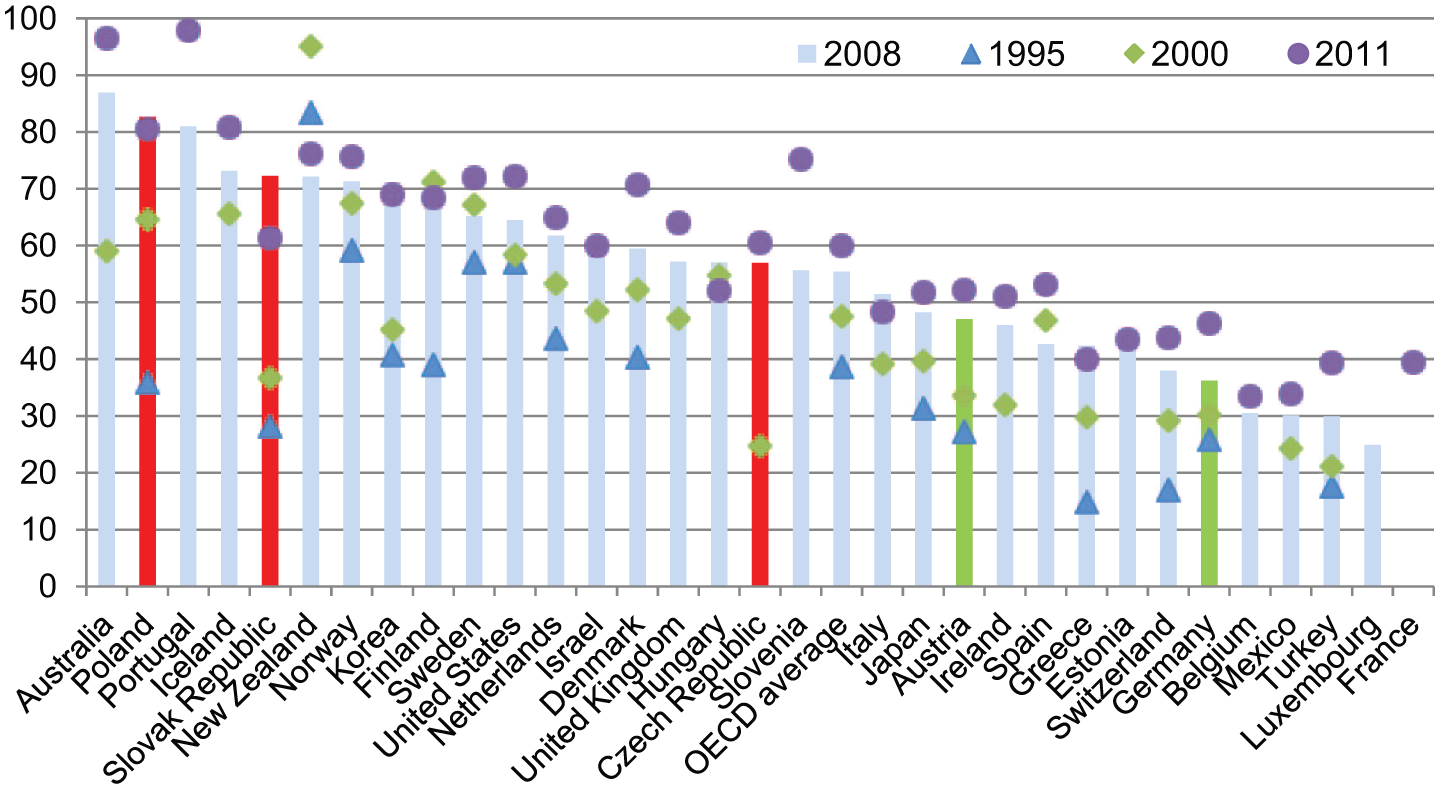
One of the indicators where TE expansion is clearly visible is the OECD’s Entry Rate into TE. Here, the entry rate is defined as the ratio between two aggregate figures: the number of newly enrolled students and the reference age group. In the case of most countries, the reference group is the population of 19-year-olds (OECD, 2013). Figure 1 shows the entry rates into TE for the OECD countries between 1995 and 2011.
Entry rates into tertiary-type A education (1995, 2000, 2008 and 2011).
Figure 1 shows that there are significant differences between countries concerning the way TE was expanding between 1995 and 2011. There are countries whose entry rates were already high in 1995, for example New Zealand, Norway, Sweden and the US. In these countries the further TE expansion after 1995 was only moderate. Or, as in case of New Zealand, there was a decline in entry rates. Then we have the largest group of countries with average initial values and intensive growth during the observed period. In the case of countries with low initial values, we can distinguish two groups based on the pace of subsequent TE expansion. Focusing on the EU member states, Austria, the Czech Republic, Germany, Poland and Slovakia showed nearly the same below-average levels of entry rates in 1995. While Germany and Austria also remained at the below-average figures during the following years until 2011, the Czech Republic, Poland and Slovakia entered a period of rapidly increasing entry rates. The most intensive growth is observable between 1995 and 2008 (countries in the graph are sorted according to the 2008 figures) when Poland and Slovakia changed from the countries with the lowest entry rates into TE into countries with the highest entry rates among the OECD countries. The Czech Republic shows the same pattern but with a slightly less intensive shift. We will refer to this latter group of countries as the ‘V4’ 1 countries.
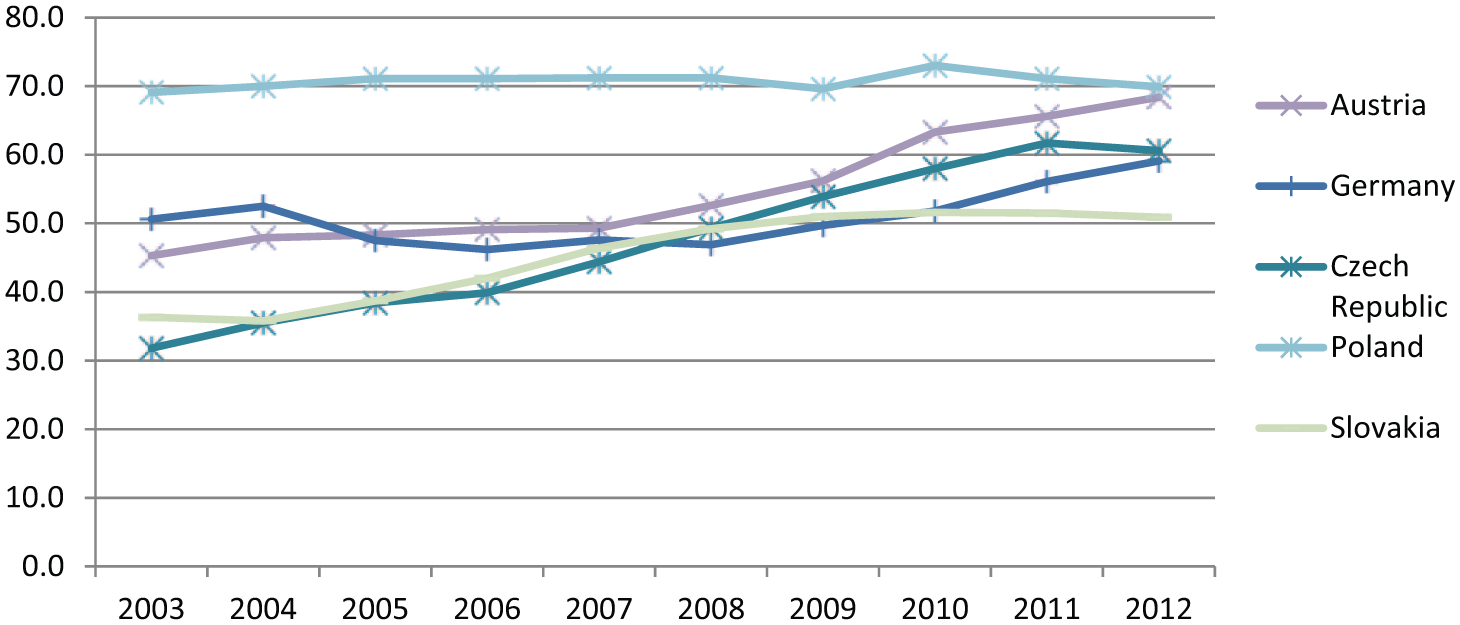
The participation by younger age groups in TE has increased dramatically in V4 countries since 2000. In Poland this process started a few years earlier. By comparison, Austria and Germany entered the process a little later. In Austria stagnation has given way to an increase since 2007, while in Germany the same process has been ongoing only since 2010.
Figure 2 shows the participation in TE based on the EU Labour Force Survey (EU-LFS) data. This indicator is constructed from individual level data 2 and shows that over 50% of the population aged between 25 and 29 in all the countries have been participating in TE since 2010.
Participation in TE, age group 25–29 in % (based on the European Union Labour Force Survey (EU-LFS))
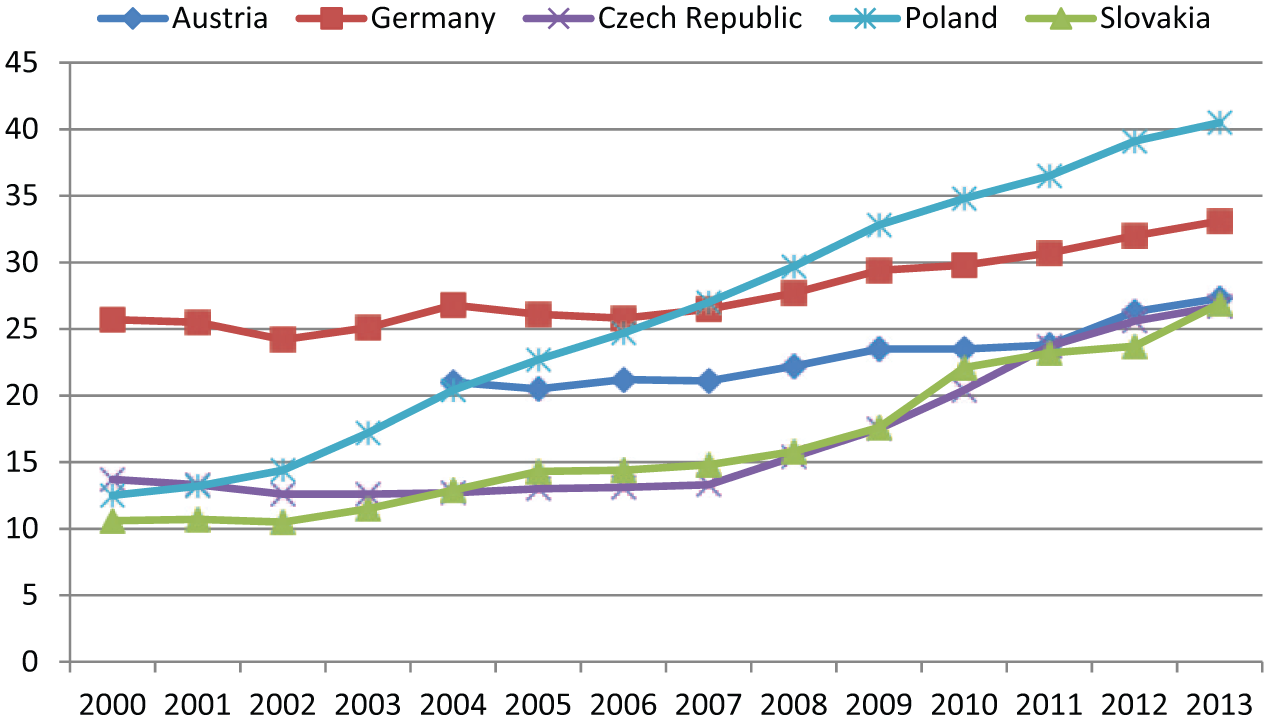
The increased participation in TE is reflected in the growth as far as TE attainment of the population is concerned. In addition, the results of recent expansions are better viewed when looking at younger age groups. The Europe 2020 Strategy therefore follows the indicator of TE attainment focused on the age group of 30 to 34-year-olds. Figure 3 illustrates this.
TE attainment 30–34 in % (based on EU-LFS).
Shortly after 2000 Germany and Austria have shown a relatively higher proportion of TE in the 30 to 34-year-olds age group in comparison to the V4 countries. In the V4 countries TE was also being repressed before 1989 for ideological reasons. An egalitarian society needed to control the proportion of the population that was able to obtain the highest level of education. On the other hand, providing wide access to secondary education was in line with the socialist ideology which was underlining the social role of the middle class, in particular blue-collar workers (Večernik, 2009). For ideological reasons both access to TE as well as the proportion of TE in the population were constrained regardless of the real needs of society and the labour markets.
In Austria and a large part of Germany, this factor did not play any role. Their starting position within the TE expansion was therefore more advanced, with higher proportions of TE in the population. After 1989, as a result of switching to market economies, the V4 countries soon started to recognise their undersupply of TE workers. Consequently, private returns to education in V4 countries grew in the 1990s (Chase, 1997; Štefánik, 2012). A higher labour market evaluation of TE led to a higher demand for TE. New TE institutions have emerged, supported by governments, trying to meet educational policy goals. In order to reach the main peloton of EU countries, the V4 countries, together with other post-socialist countries, had to increase their enrolment into TE. In combination with declining cohorts of secondary school graduates, 3 this led to a much higher increase in TE participation among the younger age group than in countries without a previous central planning experience.
The question is whether this difference in trajectory of TE expansion between the V4 countries on the one hand and Austria and Germany on the other, is observable in the private returns to TE in these countries.
TE expansion and private returns to education
Educational systems of developed countries are experiencing a shift in historical importance. Keller and Tvrdý (2008) identified three historical phases of higher education systems. In the first phase education (in general) was considered as something transcendent. To a decisive extent it was provided in and by religious institutions and it attracted an enormous social respect. In the second phase higher education was changing with the introduction of modernism and its main principles. In the context of a modern society, education changed into a social elevator through which meritocratic principles were implemented in society. In the third phase higher education is changing its role from an elevator to an insurance. This basically means that once a person is not able to obtain higher education, they are going to face significantly higher risks during their career (Keller and Tvrdý, 2008).
Since Trow (1947) identified the problems relating to the transition from elite to mass education, educational expansion 4 has been the focus of various aspects of research. The legitimizing function of education with regards to its massification was underlined by Mayer (1977). Questions about the effects of TE expansion on social and economic equality have also been widely discussed (see, for example, Bratti et al., 2008; Kivinen et al., 2007). But questions concerning the inflation of the economic value of education, as seen from an individual perspective, have not been raised as often as one would expect. This is based on the fact that TE expansion is clearly observable and also recommended by supranational institutions, such as the European Union. This study aims to contribute to this rather thin stream of literature represented, for example, by Keep and Mayhew (2004), or in a more empirical way in Fersterer and Winter-Ebmer (2003).
Classical economic literature deals with three main concepts, which bring together the theoretical approaches as far as understanding the value of education is concerned. Each of these concepts is linked with different expectations regarding the expected impact that TE expansion would have. Based on the classical economic theory principle of Walrasian equilibrium, we could expect the price of education in a TE expansion to decline as a reaction to its increased supply. An educated workforce is, according to this concept, considered to be a marketable commodity and its price is set by the market: a supply-demand relationship. As the price of TE labour falls, a lower number of individuals demand TE which forces down the price of education. This type of reasoning was later complemented by the ‘human capital’ theory (Becker, 1964; Schultz, 1971). According to this theory, investment in education and training directly contributes to the productivity of a worker (recipient) regardless of the supply and demand relationship. In TE expansion the value of education seen from the individual’s perspective would, other things being equal, remain constant in time. In reality, there are processes possibly working against the stable value of education, such as skills obsolescence (Blechinger and Pfeiffer, 2000; De Grip et al., 2002)
In contrast to the human capital theory, studies pointing at the screening (filtering or signalling) functions of education have emerged. These studies (Arrow, 1973; Spence, 1973) argue in favour of the main assumption of a relationship between an individual’s education and their working productivity. On the other hand, they formulate the screening hypothesis stating that the value of education comes from additional information concerning an individual’s skills, abilities, other personal characteristics or motivation. In other words, education works as a filter, sorting individuals according to their qualities. An increase in accessibility to education weakens the filter and decreases the value of education on the labour market. As a result, the value of TE during and after the TE expansion should be decreasing. Several empirical studies have attempted to look for evidence in favour of the screening hypothesis (Layard and Psacharopoulos, 1974; see also Heywood and Hiangdong, 2004).
Empirical studies on private returns to education in selected countries
Out of the human capital related stream of literature, a popular way of measuring private returns to education arose in the 1970s based on the work of Jacob Mincer (1974). This simple and intuitive way measures the variability of earnings, which can be ascribed to an individual’s education, while still taking into consideration other observable characteristics of that individual. This methodology also enabled the buildup of a tradition of empirical studies comparable in time and between countries.
There is a rich set of studies estimating the private returns to education in V4 countries, Austria and Germany. While private returns to education in Germany are reported to remain stable (Fitzenberger, et al., 2001), they have been falling in Austria (Fersterer and Winter-Ebmer, 2003). A more recent study points to declines in private returns to the education of older people (Boockmann and Steiner, 2006). In the Czech Republic, Poland and Slovakia private returns to education were growing in the 1990s (Rutkowski, 2001; Štefánik, 2012; Večernik, 2009). Further studies on private returns to education in the V4 countries include Chase (1997), Filer et al. (1999), Flabbi et al. (2008), Lubyova and Sabirjankova (2001) and Štefánik (2011). This growth has stopped since 2000 as the transition period effect has faded away.
Methodology and data
This article adopts the above-mentioned methodology of measuring private returns to TE, introduced by Mincer (1974). According to Mincer (1974), private returns to education are measured using a simple, one equation regression model, with the wage logarithm as the dependent variable and the individual’s characteristics as explanatory, independent variables. One of the individual characteristics included in the model is schooling, in our case operationalised as a dummy variable referring to whether an individual has undertaken TE or not. The equation can be formalised as follows:

The β1 coefficient represents the value of private returns to TE quantified according to the Mincerian (Mincer, 1974) methodology. Some studies interpret this coefficient as a percentage change in an income caused by one unit change in the schooling variable. In the case of years of schooling, originally used by Mincer (1974), it means the percentage change of an average income related to one additional year of schooling. 5 This analysis uses a dummy variable referring to whether the individual undertook TE or not. In this case, the coefficient can be interpreted as an average bonus income among those who undertook TE and those who have not. The analysis covered in this article focuses particularly on differences in this coefficient between countries and subgroups, defined according to the period when the highest level of education was obtained.
Based on the classic Mincerian (Mincer, 1974) approach, we have complemented our schooling variable with the variable referring to potential work experience, which is the difference between the age of an individual and their years of schooling. Potential experience is, in line with Mincer (1974), complemented with its exponential function in order to grasp the decrease of earnings at a higher age. Experience is further complemented by an individual’s characteristics, which we were able to include based on the restrictions of the dataset used. The final list of variables relevant for an individual’s characteristics is:
Potential experience;
Potential experience squared;
Gender;
Size of an employing entity;
Country;
Number of hours usually worked per week;
Supervision;
Country.
In order to deal with the problem of endogeneity of schooling within the earning regression equation (see Card, 2001), measurements using an instrumental variable approach were performed as well. The instrumental variable used in the analysis was constructed using the age when full-time employment first began (see Workie, 2012: 125). Estimates acquired by using the instrumental variable approach were obtained by performing the standard procedure of two-stage least square estimation. The results are reported for both ordinary least square estimates (OLS) and estimates based on the instrumental variable approach (IV).
The analysis is based on the comparison of private returns to TE of individuals completing such education before and after 1995 (those who graduated in 1995 were included in the earlier group (<=1995)). Coefficients were estimated separately according to the population of the post-socialistic Central European countries (V4 countries), with the exception of Hungary, and the populations of Austria and Germany. Austria and Germany were chosen because of the similarity in their education systems in contrast to those in the V4 countries. Measurements provide evidence to support the main findings and also hold true if the analysis is performed at the level of individual countries. 6
The equation has been estimated based on micro data from the EU-SILC (EU-SILC, n.d.). Data refer to the period from 2005 to 2009. Individual data were pooled into two groups, referring to the population of V4 countries – the Czech Republic, Poland and Slovakia – and referring to the population of Austria and Germany together. All other countries were omitted from the analysis. Further division of the sample was done depending on whether an individual obtained the highest level of education before or after 1995.
Results
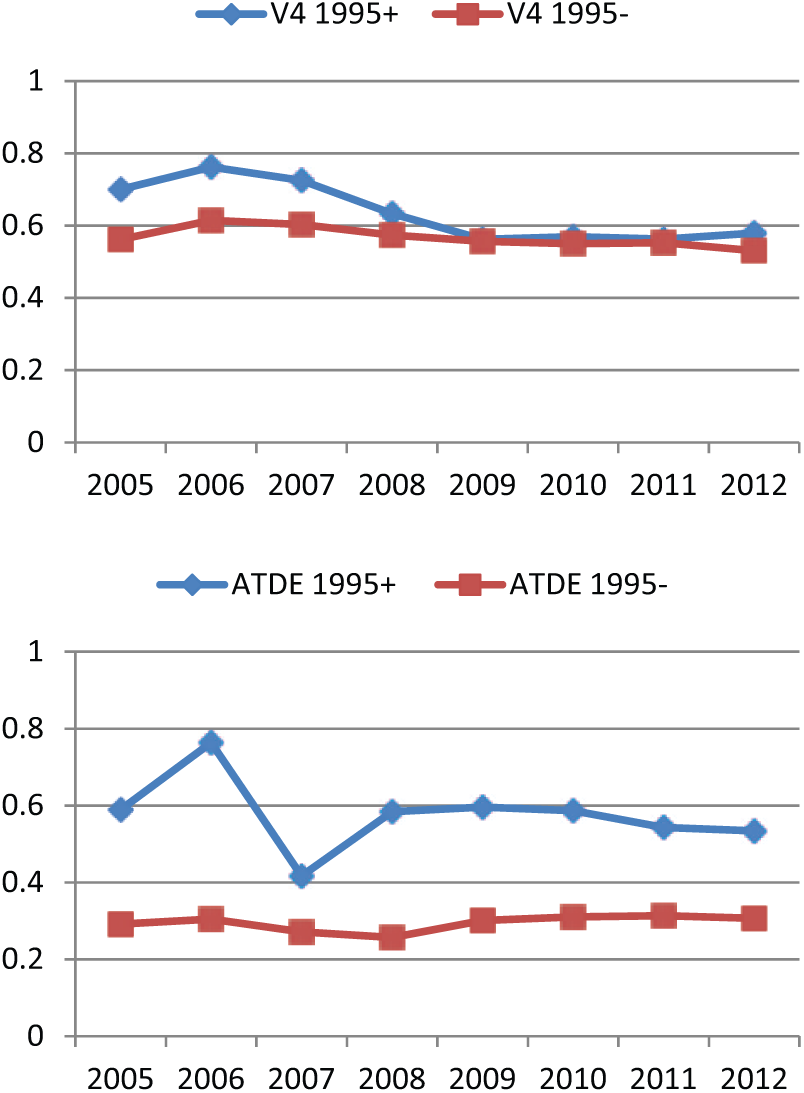
By applying this methodology, the following results were obtained (see Figure 4). When looking at the OLS estimates for the V4 countries, private returns to education of those who graduated after 1995 were slightly higher at the beginning of the observed period, namely in 2005. This pattern could have been expected based on the obsolescence of education. More recent education should be more highly evaluated in the labour market as can be seen in the case of Austria and Germany.
Private returns to education in selected countries (OLS method).
In the V4 countries private returns to education converge during the observed period. From 2009 there is practically no difference in private returns to education of those who finished before or after 1995. Around 1995, TE expansion in the V4 countries started to increase its current intensity from 1995. In Austria and Germany those who graduated after 1995 benefited more from their TE in comparison to earlier graduates. This difference remains present in the data during the whole observed period. In these countries, TE expansion was less intensive and steadier.
The IV estimates provide a slightly different picture, because of the nature of estimation. In V4 countries the coefficients for both groups are similar. In Austria and Germany, again, private returns to TE acquired after 1995 remain higher (see Figure 5).
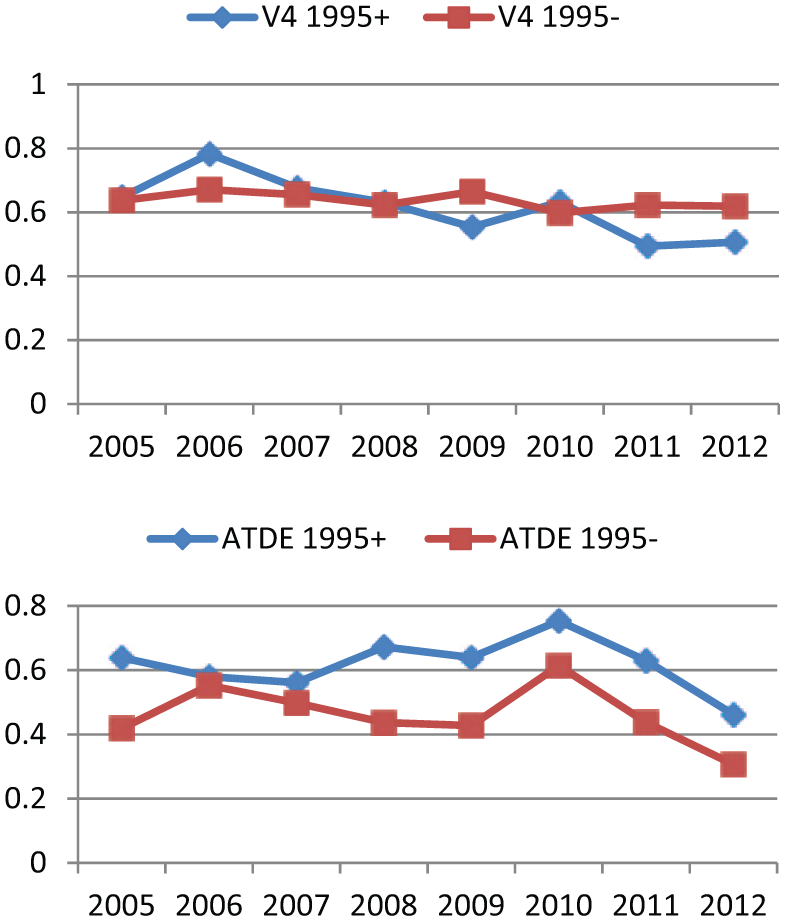
Private returns to education in selected countries (IV method).
The IV estimates basically confirmed the OLS estimates, when the higher evaluation of more recent education can be observed only in Austria and Germany. In the V4 countries, this pattern is not observable either in the OLS or in the IV estimates. 7 Moreover, in V4 countries in both OLS as well as IV estimates, private returns to newer TE show a declining trend.
These results are not sensitive if we divide the groups based on a graduation year before and after 1996, or if we estimate the coefficients for the male population separately. 8 Differences in the female labour market activity may bias estimated coefficients. This bias does not influence our main results, as these are observable in the overall population as well as in the male population separately. The same findings are also confirmed when comparing individual countries, for example the Czech Republic and Germany. 9
Discussion
This study posed the question of whether there is an observable impact of TE expansion on private returns to TE. Data from EU-SILC (EU-SILC, n.d.) show that there is some impact in the V4 countries. This is observable mainly in the absence of a gap between private returns to the newer and older TE. In contrast, Austrian and German data do show such gap, when a more recent education is relatively more valued by the labour market. Furthermore, private returns to TE acquired after 1995 have been gradually declining in the V4 countries.
Clear evidence on differences concerning the pace of TE expansion between the V4 countries and Austria with Germany is available. Nevertheless, this analysis, as with any analysis based on observational data, is not strong enough to confirm any causal relationship. At this point, there are good reasons to believe that the nature of TE expansion plays a role in explaining the differences in patterns of private returns to TE.
Emphasising the decline in private returns to recent TE does not necessarily impose claims about the lowering of the quality of TE provided. Decline within the labour market evaluation of TE could simply be linked to the weakening of its signalling function or also to a change in supply-demand settings in the labour market. Fersterer and Winter-Ebmer (2003: 81) claim that a decline in overall private returns to education in Austria is not linked to a decline in the quality of the education provided, as the returns in Austria are falling for all subgroups. The evidence provided in this article aims to show that the opposite is true for the V4 countries, namely that the dynamics in private returns to education differ between subgroups.
Recent results from the Programme for the International Assessment of Adult Competencies (PIAAC) survey (PIACC, n.d.) shed some light on the changes behind the TE expansion from the perspective of competences. Indexes of the TE competences bonus can be constructed as the ratio of average competences of TE to the total population. Such an index, constructed using numerical scores, shows a weak negative relationship to participation within TE (see Figure 6).
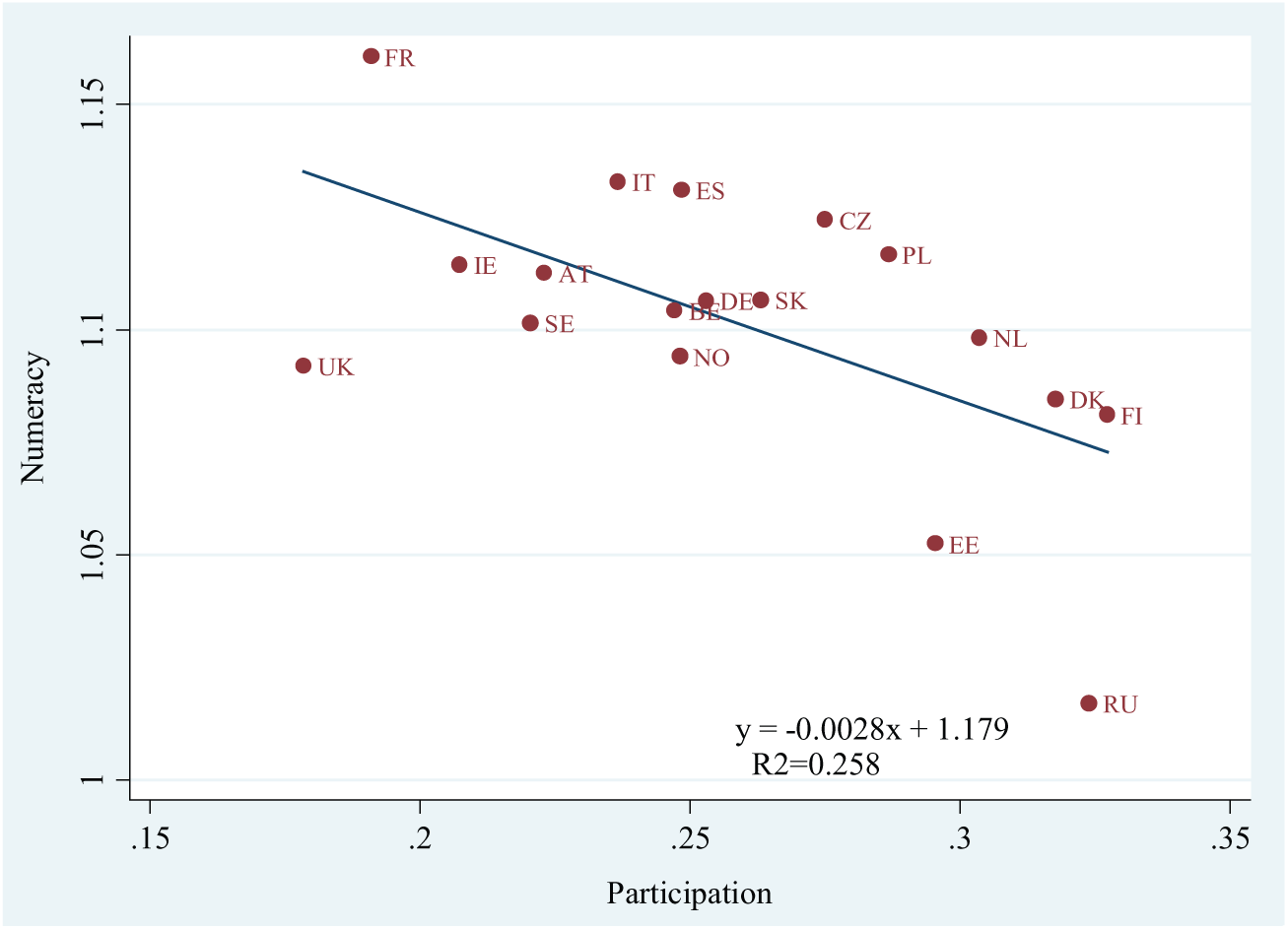
Numeracy index 10 and participation in TE based on PIAAC.
But this relationship is mostly driven by Finland, Denmark and Estonia, which have well performing education systems able to provide TE to a major part of the population, while their overall population scores in numeracy are high. A similar conclusion can be drawn for literacy as well.
Nevertheless, such evidence cannot support any claims concerning declining competences in relation to TE expansion. Moreover, if we look at average competences of TE in absolute terms and compare them between individual countries, we could find some positive correlations between the level of competences and the participation in TE. 11
TE expansion is an indisputable phenomenon observable across developed countries. Some of the countries moved towards an expansion in TE earlier than others. The intensity of this expansion also differs between individual countries. Besides these features, many country-specific factors play a role in the final consequences that TE expansion has on societies and individuals. This article suggests that it is the intensity of TE expansion that causes the differences in private returns to either earlier or later TE in selected countries. By selecting countries with similar education systems, some of the contextual factors could be eliminated, but most of them still play a role. The data show that education obtained after TE expansion started in the V4 countries is related to declining private returns, which are not higher than the private returns before 1995. In contrast, in Austria and Germany, private returns to TE before 1995 remain lower than private returns to more recent TE.
Footnotes
Declaration of conflicting interest
The authors declare that there is no conflict of interest.
Funding
This work was supported by the Slovak Research and Development Agency under the contract No. APVV-0541-10.