




Abstract
Technologies that expand the learning environment to include interactions outside of the physical space of the classroom, such as the use of Google as an aid to memory, represent one aspect of learning that occurs within several seemingly decentralised spaces. On the other hand, it can be argued that such interactive technologies are enclosed in what Bruno Latour calls a ‘Black-box’: a ‘totalising’ enclosure that delimits interaction and channels users towards yet another form of centralised learning space.
Used as a starting point, the focus of this article rapidly shifts from the constraints of the ‘Black-box’ towards a type of engagement that embraces material agency: an engagement with materials and fragments of knowledge that emerge from the ‘non-totalising’ assemblage. To assist in this trajectory, Karen Barad’s concept of intra-activity is employed, where agency is seen as distributed between human and non-human actants.
The space in which this engagement between human and materials occurs, as a non-totalising learning space, is the concern of this article, which uses an interactive audio/visual performance event called Bingodisiac as a case study to examine various ways in which we can learn to move beyond the constraints of totalising structures. Bingodisiac is a project initiated by the researcher in 2002, as an informal collection of musicians who are assembled for a one-off improvised performance. This article draws upon interviews and journal notes collected at the time of the performances to explore the analogy of ‘noise music’ and how this can be related to ways in which the learning space of the classroom and the types of knowledge produced have become decentralised.
Keywords
Introduction
Through the interaction of technology, the learning environment is becoming an increasingly decentralised performative space in which multiple elements, both human and non-human, are assembled. Certain technologies, such as Google, have replaced traditionally human functions, such as memory; hence, when we fail to remember some detail or other, and the fact remains ‘on the tip of the tongue’, there is always some technology to assist human function. These technologies present a complete or ‘totalising’ solution to e-learning: an environment that is decentralised from the physical space of the classroom, but that also delimits the learning experience within the prescribed containment space of predetermined technological forms.
The space in which this engagement between technology and human occurs, as a decentralised learning space, is the concern of this article, which uses an interactive audio/visual performance event as a case study to examine and discuss various ways in which the learning environment can be non-totalising. A non-totalising learning environment means that in addition to the decentralising effects of technology, there is also an engagement with the more basic materials and components of learning: the basic building blocks of information and knowledge rather than vast disciplines and structured linear tracts of knowledge as we shift from ‘book form’ to the types of fluid transversal learning trajectories suggested through the use of e-learning and new technologies. This idea of the transversal, as a way of cutting across different strands of knowledge, is typical of the fluidity of a decentralised learning environment where information is not presented in a linear and highly structured fashion but, instead, is more concerned with a decentralised personal trajectory that is not centred within recognised forms and structures but is free to traverse as: A conceptual tool to open hitherto closed logics and hierarchies and to experiment with relations of interdependency in order to produce new assemblages and alliances. (Kelly, 2005)
By examining the non-totalising environment of the Bingodisiac Orchestra, e-learning technologies become less concerned with containment and structures of knowledge, instead focused on ‘other concerns’: the types of non-totalising knowledge that emerge from an engagement with the basic materials of technology.
Have you ever had that experience of standing in front of a class of students, all silently staring at you whilst you struggle to remember the name of some filmmaker, author or artist? I had this experience the other week. In this particular classroom students were encouraged to bring laptops so I was confronted with various silver and black miniature walls, barriers to communication punctuated with the illuminated logo of semi-masticated fruit, with me distractedly thinking: ‘are we really present in the same room?’. Since my brief was to lecture a large group of computer graphic design students on the subject of interactive art, I decided to begin with constructing the classroom as a site-specific interactive installation, in which they, as a captive audience, would interact with me, so that we could collaboratively develop the kind of two-way dialogue that, for me, forms the basic idea of interaction.
Struggling to remember the name of the interactive artist was when I realised that there were other elements present in the room with us: the materials of technology that at first seemed an obstacle to communication but in this instance could be evoked as part of the interactive dialogue we were engaged in: it was then that the phrase ‘it’s on the tip of my.. Google’, was first coined (as substantiated via a Google search this July 2016 morning, which reveals an absence of the phrase within the realms of electronic interaction).
Substitution of memory with the artificial intelligence of Google algorithms, I believe, is a common strategy in our technology saturated environments. Perhaps a more critical approach could be taken: that it is not the machines that have become more intelligent but that we have ‘gotten’, relatively speaking, ‘more dumber’: an idea promoted by Brian Reffin-Smith in his article Zombie-Pataphysical approach (2014), and also as suggested in the term Zombie Media (Parikka and Hertz, 2015) that explores the ‘undead’ materials of media technologies returning as landfill chemicals and other environmental zombie-isms.
I will use the idea of Bruno Latour’s Black-box (1987, 1999) in this introduction to illustrate the difference between decentralised knowledge and the more contained ‘validated knowledge’ of the expert. The Black-box refers to a grouping of ‘validated knowledge’ that is collated into a functional unit of thought. Simply put, once ideas have been validated and are put to use, the workings which have created that result are hidden, leaving only the purely functional items. In the case of the Black-box, which could also be a technological device, the workings behind the functioning of the device become opaque and are not opened to participation. In this way, the Black-box groups together multiple operations and agents in an enclosure that resists tampering, tinkering or participation beyond the validated functions.
The link I wish to make here is that of the Black-box as a container of knowledge: as a discipline in contrast with the fluidity of e-learning propagated by new media technologies; decentralised knowledge that encompasses an expanded view of the classroom as a decentralised learning space that cannot be contained within a particular environment or area of knowledge.
The Black-box is a process that can be applied to any idea, physical object or technology in which the processes and workings within the Black-box become imperceptible, since in its normal operation there is deemed no reason to examine how or why functioning is achieved if the device is working well, or as Latour says ‘made invisible by its own success’: [The Black-box describes] the way scientific and technical work is made invisible by its own success. When a machine runs efficiently, when a matter of fact is settled, one need focus only on its inputs and outputs and not on its internal complexity. Thus, paradoxically, the more science and technology succeed, the more opaque and obscure they become. (Latour, 1999: 304)
Parikka and Hertz use the term ‘depunctualisation’, from Latour’s actor network theory, to describe the ‘breaking apart [of] the device into its components’ (p.149), which then become available as participatory elements. If DiY culture exemplifies a participatory culture that engages with materials and fragments of technology, such as the ‘depunctualised’ objects of garbage, then the Black-box represents a barrier to the participatory potential of materials. In this article the term ‘de-territorialisation’ or ‘decentralised’ or ‘non-totalised’ is used in place of the concept of ‘depunctualisation’, and describes the same processes of breaking down the territory of the Black-box so that the multiple actants within can become participatory actants.
In this sense, the case study presented in this paper is used as an example of a decentralised performative ‘learning environment’: adopting a wider definition of ‘learning environment’ that extends outside of the constraints of classroom furniture. In this article the ‘expert territory’ of music and sound production is explored through the case study of the Bingodisiac Orchestra: an interactive performance that attempts to break down the structures of musical form so that the raw materials of sound become participatory elements. To allow this analogy between decentralised learning and the Bingodisiac Orchestra, I have included some background information on noise music and its theoretical concerns, so that readers can better grasp the relevance of decentralised forms of knowledge and their relevance to e-learning.
Noise music as interactivity beyond musical form
Within New Zealand, ‘noise music’ has attained an almost genre-like status as a form of sound art that operates using aspects usually excluded from conventional music. As seen below, the practitioners of noise music attempt to produce sounds that cannot be categorised as any particular form of music. To do this, noise musicians use various strategies, such as improvised atonal sound, the avoidance of recognisable structures and/or repetition and the incorporation of invented instruments and sounds produced or appropriated from non-musical sources. ‘Noise music’, distinct from ‘noisy’ or simply loud rock music, supports several specialist performance venues, such as The Wine Cellar (Auckland), the Audio Foundation of Aotearoa (AFA, Auckland), Happy (Wellington), Fred’s (Wellington), and Arc café (Dunedin). There are also several organisations dedicated to improvised noise music, such as Vitamin-S, which perform regularly at the Auckland Wine Cellar venue.
Some of the more well-known practices of noise music involve a history of DiY home-made instruments, designed to create sounds that are not available to conventional instrumentation. An example is the instruments made by Phil Dadson and the New Zealand-based group From Scratch, who have performed internationally for over 30 years (Dadson, 2004). Both AFA and Vitamin-S regularly feature the music of Phil Dadson.
The significance of noise music for this article is in its strategies of resisting structures imposed over sound to create music. Sound, in this context, is viewed as the ‘material’ aspect of ‘music’: with sound viewed as material prior to its formation as music; with music viewed as an ‘enclosed’ structure that can be compared to a language system.
In terms of defining noise music it can be useful to employ Harold Lasswell’s model of communication: ‘who/says what/in which channel/to whom/with what effect’ (Lasswell, 1948, cited in Jensen, 2010: 49), with ‘noise’ being the undesirable aspect that interferes with the linear coherence of communication. In this sense, noise is the part of communication that does not belong to the language system of the message. In more technical terms, the phrase ‘signal to noise ratio’ is a measurement used to describe the efficiency of electronic audio equipment in which the signal is the desirable component in ratio to the unwanted elements of noise. In most definitions noise represents that which is usually excluded from what is considered the more desirable signal of communication. However, in terms of noise music it is the traditionally useful signal elements that are excluded, in the form of ‘notes’, ‘recognisable musical genres’ and ‘musical structures’, leaving a residue of activity that is intentionally stripped bare of its coherent elements.
One strategy of noise musicians is to de-emphasise human-biased structure by valuing improvised spontaneity over prescribed form. A similar strategy can be applied to e-learning, where instead of situating the learning experience within a recognised structure, or ‘idiomatic’ form, ‘other concerns’ are brought to the foreground, such as the qualities and abilities to transverse different areas of knowledge in a fluid and performative manner.
The New Zealand collective Vitamin-S describes improvisation as belonging to two main variants as follows.
Idiomatic improvisation: much the most widely used and concerned with the expression of an idiom – jazz or flamenco, for example, and taking its identity and motivation from that idiom. Non-idiomatic improvisation: here other concerns are fundamental. It is usually found in so-called ‘free’ improvisation (Vitamin-S, 2013).
Vitamin-S utilises the non-idiomatic form of improvisation, emphasising the ‘other concerns’ (Vitamin-S, 2013) of music and bringing forth elements that are usually excluded from ‘idiomatic improvisation’. Idiomatic structures of knowledge are, therefore, the types of knowledge that are centralised within a particular discipline, a particular Black-box of knowledge, whereas non-idiomatic improvisation can be related to the types of knowledge that can be produced within a decentralised learning environment. In terms of music, the strategy of avoiding known idiomatic forms of music, such as ‘jazz or flamenco’, combined with the tendency of modifying and creating new instruments situates Vitamin-S on the experimental side of sound rather than music: an attitude of disrupting the structures of music which means that intuitive reflexes are valued above containment within a recognisable sphere of music. In this sense, non-idiomatic sound is based on intuition, spontaneity and improvisation and can be seen as a practice that resists the structural language of idiomatic forms.
The suggestion here is that e-learning can benefit from adopting a non-idiomatic approach to knowledge, so that students are free to transverse across different disciplines, using the full potential of internet technologies, and to create a decentralised learning environment that may be more relevant in the production of tools for new and emerging formations of knowledge based on the decentralising influences of new technologies.
The activities of Vitamin-S are aimed at providing cultural forms that are lacking in mainstream culture, spontaneously created within the localised situation created by each performance: Our music is about the inadequacy of traditional imagery and symbols to convey meaning in today’s world. By abandoning representationalism [sic] we are free to express ourselves with pure form. Specific interpretation gives way to a more visceral response. (Vitamin-S, 2013)
Through engaging with the qualities of sound, the musicians of Vitamin-S engage in making connections between sounds that are not contained within a centralised structure of idiomatic music, instead transversing musical forms to create new forms of music with more fluid structures than those of traditional idiomatic forms. The significance for e-learning is that the growth of new technologies, it can be argued, has had a similar effect on exposing the ‘inadequacy of traditional imagery and symbols to convey meaning in today’s world’, the argument being that a decentralised approach to the learning environment can be considered more effective in creating structures of knowledge that better reflect and engage with contemporary mediascapes.
One of the main outlets for experimentation in a decentralised non-idiomatic environment is the weekly Vitamin-S event comprising a random selection of four players from a pool of musicians who are allocated to perform together spontaneously without practice or, ideally, without having played together live before. Vitamin-S acts as a context to some of the strategies of the Bingodisiac Orchestra, a collaborative project that features some of the Vitamin-S musicians and also utilises random elements in its cueing system.
From my own experience of taking part in a Vitamin-S event, it seemed that each of the four musicians, myself included, brought with them their own interpretation of ‘formlessness’, of what it meant to resist the structures of music. This created an atmosphere in which ‘coherent’ music was biased against and the 20 minutes allocated each quartet generated a sketch-pad of dislocated ideas. This was far too short a time to find any common elements beyond the situation of the moment, painful though it was, which passed without resolve. In speaking after the event to Paul Winstanly, 1 who was part of the quartet, we recognised a moment in which each musician was performing their interpretation with minimal interaction and response to other musicians, a strategy of oblique-listening that was our collective solution to that site-specific event. This created a polyvocal, discordant and polyrhythmic form of music, a decentralised form of learning space that reflects the potentials of electronic and e-learning environments to produce polyvocal, multi-stranded forms of knowledge that are more suited to the multi-authorship mode of production compared to the single author more commonly associated with the ‘book learning’ mode of education through more linear media.
In the Bingodisiac Orchestra, I have termed this type of non-structured multi-layered sound as the ‘fairground effect’, a strategy of decentralising musical structure so that the material of sound and its various interactions becomes an active participant in the ‘form’. The ‘fairground effect’ is also a way to disrupt the structure of music using multiple overlapping musical sources to transform idiomatic music into non-idiomatic sound. The breaking down of music into elements of sound can be said to allow interaction between the human and the material elements and, in part, this defines an aspect of interactivity as discussed in this article.
One of the issues that arises from the concept of idiomatic and non-idiomatic improvisational music is that, whilst reproduction of musical form can be avoided within single performances, the reuse of similar strategies and repeated performances can be seen to create a ‘non-idiomatic’ language base. This is a recurrent theme in which the ‘outside’ becomes the ‘inside’ the sphere of ‘validated knowledge’, a movement in which structure is adapted to allow what was once outside of comprehension a place within the language. Therefore, it would be wise to consider non-idiomatic and decentralised forms as contingently functioning as non-totalising, rather than as any permanent spaces that exist ‘outside’. However, rather than viewing non-idiomatic music as being ‘outside’ of conventional musical forms, it seems more relevant to look at it in terms of its attitudes to breaking down recognisable musical structures, creating the basis for a decentralised performative learning experience.
The decentralised interactivity of the Bingodisiac Orchestra
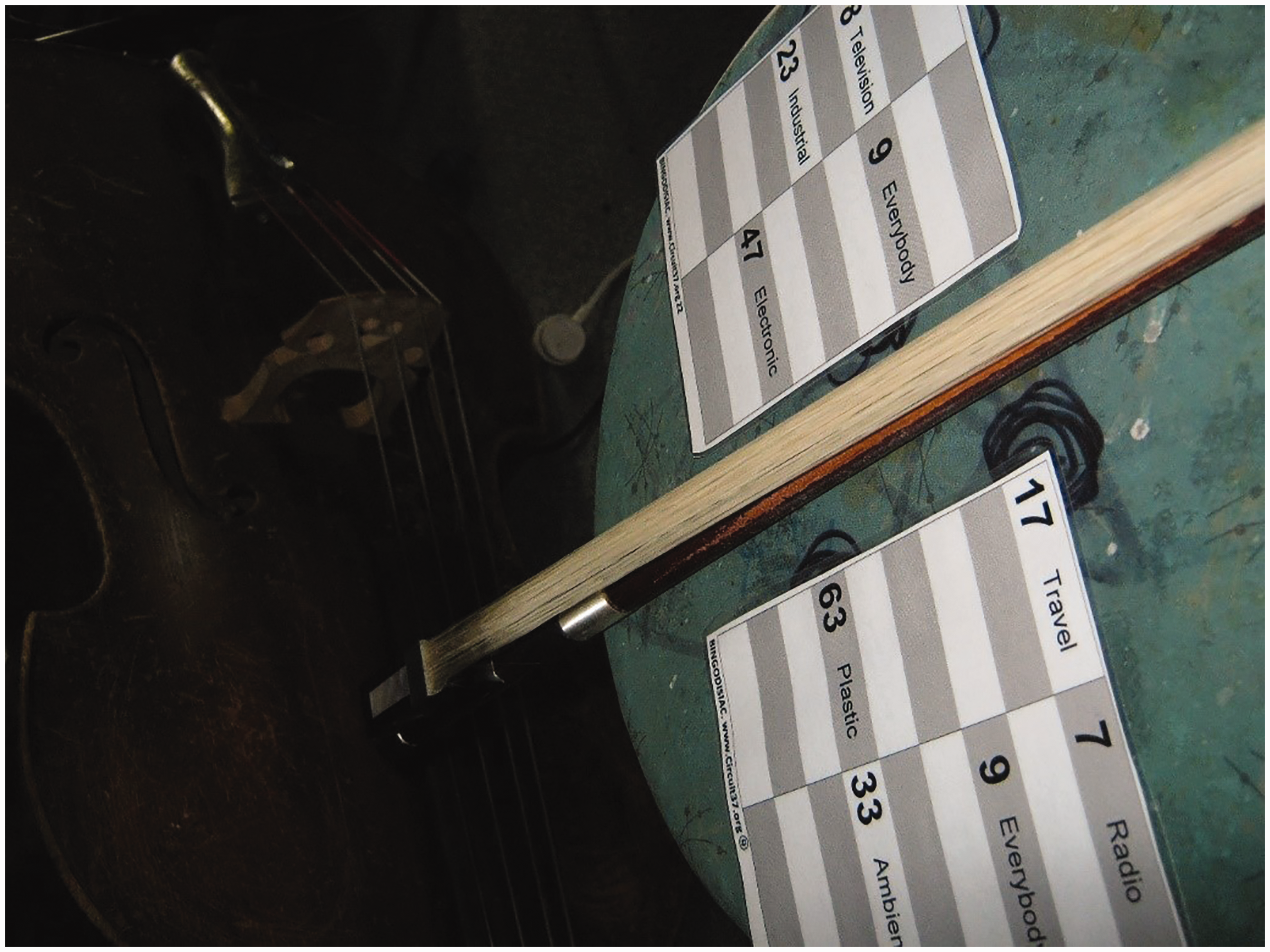
The Bingodisiac Orchestra is an informal collection of diversely oriented musicians who are predominantly brought together for a single performance to create a soundtrack to a non-narrative video projection made by the author of this article. The event is an experiment, in terms of sound, since there is no set directive of what type of sound goes where in the course of the projected video. Although musicians are directed using a numbered cueing system located at the side of the screen, the content of what they produce is left entirely to the participating musicians, providing an environment that creates unexpected connections between diverse musicians and diverse sounds that would not usually be connected if left entirely to the choices of musicians.
The Bingodisiac Orchestra presents alternative ways of organising sound through the allowance of ‘non-totalising assemblages’, that is, structures that emerge from multiple sources, rather than from a central ‘totalising’ point of control. This manifests as a strategy of preventing the organisation of familiar musical forms by fragmenting the flow of interaction between musicians, using various strategies designed to disrupt the social conventions of improvised music. Prevent[ing] music… to encourage sound. (Journal entry dated 15 June 2011)
This is related to Karen Barad’s concept of intra-action, which involves emphasising the actions and ‘enactment[s]’ that occur amongst multiple actants: Agency is a matter of intra-acting; it is an enactment, not something that someone or something has. It cannot be designated as an attribute of subjects or objects […] Agency is ‘doing’ or ‘being’ in its intra-activity. (Barad, 2007: 178)
This entanglement between human and non-human suggests that the technology of producing knowledge is influential on the mode of knowledge produced, so that decentralised knowledge will inevitability emerge from a decentralised learning environment; so that our technological world reflects that of human knowledge.
Therefore, it seems necessary, in a decentralised learning environment, to remove the barriers and boundaries that separate the various elements and encourage a ‘two-way’ dialogue to occur between human and non-human actants. One of these boundaries, discovered in the Bingodisiac Orchestra, was that of different musical forms acting as barriers to an exploration of the more basic materials of sound, as discussed below in terms of the engagement of the musician with the elements of sound.
The organisation of Bingodisiac consists of three elements: a film; musicians; and a cueing system that organises the interactions between the musicians through providing instructions of when certain musicians or groups of musicians will make sound or be silent. Over the years different cueing systems have been tried as strategies to de-territorialise the human-biased practices of musicians. The different variations of the cueing system work on the same principle of stopping or starting the individual musicians, dictating when they can and cannot play and also to organise musicians into spontaneous and unexpected groupings. The main aim of Bingodisiac is to prevent musicians from imposing a consistent structure of sound, to prevent a common ground of musical style and to open the Black-box of music to the potentials of the components of sound within.
The aim of using a cueing system comes from the experience of predictability that has occurred when large groups of musicians improvise together, whether searching for a common ground of consensus or that the sound is dominated by the loudest instruments, such as drums, creating a structure from which it is difficult to escape. Musical common ground can mean some form of variation of ‘the blues’ or another dominating musical style, but can also mean a consistent lack, or avoidance, of structure, discussed below, which can also be categorised as a particular musical form. The cueing system also functions to de-territorialise the volume of instruments, adding sound dynamics to avoid the potential of a homogenous density of high-volume amplified sound that prevents quieter sounds being heard. This strategy of avoiding a dominating musical style is reflected in my research journal dated 15 June 2011: The cue system attempts to break down the predictability of the ‘musical jam’. To prevent music and to encourage sound… This is part of the paradox of control used to destroy control – to prevent structure.
As a way of avoiding centralised ‘idiomatic’ forms in Bingodisiac, the cue system involves a transferral of agency to non-human actants, since its operation is based on random elements generated by a machine. However, random can also become a recognisable structure or, to put it another way, the lack of conventional structure can also become a recognisable trait of sound. This concern is reflected in an entry in my research journal dated 15 June 2011: ‘Using conventional instruments combined and controlled in a chaotic way, but not to go too far so that another structure emerges: that of the “predictably random”‘. If random means allocating agency to chance and accident, then, in this sense, control and order are also part of the truly random, since something that is consistently chaotic can become predicable in its repetitions of strategies to be non-structured. What this is saying is that the ordering effect of structure should also be a part of the vast pallet of possibilities opened up by accident and chance. This is not to suggest that the use of random elements in a classroom environment would be of particular benefit, but that as a process, the strategies of Bingodisiac can be related to the types of connections that can potentially be made across disparate forms of knowledge, that fragments of knowledge can be utilised in a more fluid approach to the structuring of knowledge, made possible through the use of technologies, such as the internet, which cut across traditional boundaries of discipline-based knowledge. This means that fragments of musical forms are also valid outcomes from the effect of a non-human random cue generator, just as random also means occasional order may emerge from the seemingly chaotic. 2 Therefore, the design of an ideal cueing system would be a strategy of avoiding these two extremes: purely idiomatic musical forms and also the chaos of the ‘predictably random’, creating something that transverses the containing structures of idiomatic musical forms and also the equally predictable human-based strategies of avoiding style.
This is an attitude that favours the ‘opening’ of the Bruno Latour’s Black-box: as an engagement with the basic materials of sound rather than with the prescribed forms and structures of musical forms. Here, musical forms are paralleled with the Black-box as a ‘totalised’ structure. It is this attitude of exploratory sound that underpins the aims of Bingodisiac: an attitude or approach that enables sound to transverse idiomatic and non-idiomatic forms of music, treating all sound as valid components in a non-totalising assemblage. The non-totalising assemblage is defined in this article as a ‘structure’ that resists organisation by a ‘totalising’ centre of power, as an ‘ad hoc grouping of diverse elements, of vibrant materials of all sorts’ (Bennett, 2010: 23). Influenced by Gilles Deleuze and Félix Guattari (2013), the connections created in the non-totalising assemblage disrupt ‘structure’ in a similar way to the aims of Bingodisiac in creating a decentralised interactive experience for all participants: The effects generated by an assemblage are… emergent in… their ability to make something happen… distinct from the sum of vital forces of each materiality considered alone… [it] is never a stolid block but an open-ended collective, a ‘non-totalizing sum’ (Bennett, 2010: 24)
As an example of how this can be enacted in a learning environment, the non-totalising assemblage is produced, in Bingodisiac, through combining musicians who would not usually play music together, due to conflicting styles and abilities. The aim of this is to create an assemblage that is non-totalising and produces unexpectedness and ‘unpredictability’, as expressed by participating musician Carlos Pla (26 September 2011 interview). As a way of increasing the unpredictability of sound, one of the strategies of Bingodisiac has been to introduce random elements into the cueing system, so that the human musicians are cued and combined together using a randomly generated algorithm. Another part of this strategy of the cueing system, as discussed below, has been to provide the musicians with seemingly random words to trigger responses. These strategies are identified by participating musician Erikka Griffiths-Keam as ‘aleatoric processes’, randomised processes in which the human musician can extend their own limitations: Aleatoric processes always force you to think, try [to] reach for something to use as a response to a particular word, image or adjust to the pace of cues. (26 September 2011 interview)
As well as using random numbers in the cueing system, there are other strategies in Bingodisiac used to disrupt a centralised structure of performance, such as the fairground effect discussed below.
The fairground effect as a decentralised learning environment
The ‘fairground effect’ is the name I have used for one of the strategies used by Bingodisiac to de-territorialise idiomatic musical forms: this technique can also be applied to the learning environment. In Bingodisiac the fairground effect is created by distributing multiple sound sources around and amongst the listening space of the event. The fairground effect is named after a personal experience of sound within a fairground environment, where numerous different idiomatic music styles blend together to create a non-idiomatic soundscape. Imagine that each of the many attractions at the fairground, dodgems, tombola and coconut shy, are playing a different form of music to attract their customers. As the listener walks through the fairground space individual styles of music may be heard clearly for a brief moment before fading into the background cacophony of sound elements. This backdrop of multiple simultaneous musical styles, interacting, shifting and mutating as the listener strolls through the subjective sound space of the fairground, means that even idiomatic forms of music have the ability to produce non-idiomatic sound if so arranged that no one particular dominant style can subsume the other elements. This can be related to a decentralised learning environment and the way in which knowledge is less contained within distinct areas of disciplines, but instead is allowed to move more fluidly across boundaries and emerge from multiple polyvocal sources.
In the fairground effect, the combination of diverse styles all playing at once and from different directions results in a non-idiomatic soundscape comprised of fragmented elements of idiomatic musical forms (Figure 1: the dispersed and chaotic distribution of sound during an early performance). This tacit experience of the fairground, de-territorialising music and allowing a re-functioning of sound, has been noticed independently by Paul Smith, in which the combined multiple sources of the music of the fairground become mutated into a non-idiomatic exploration of sound: I remember going into a fairground and thinking ‘that sounds exactly like improvised music’… and that sparked off in my brain a notion I’ve had before, which is, no matter what we humans do, we are going to find it interesting, we are going to find the structure. It’s like finding faces and patterns, we are going to find it. Whether it’s idiomatic or non-idiomatic, whatever it might be. (19 November 2013 interview) Bingodisiac Orchestra, 2005 performance (photo: author). Bingo cards and instruments, 2011 performance (photo: author).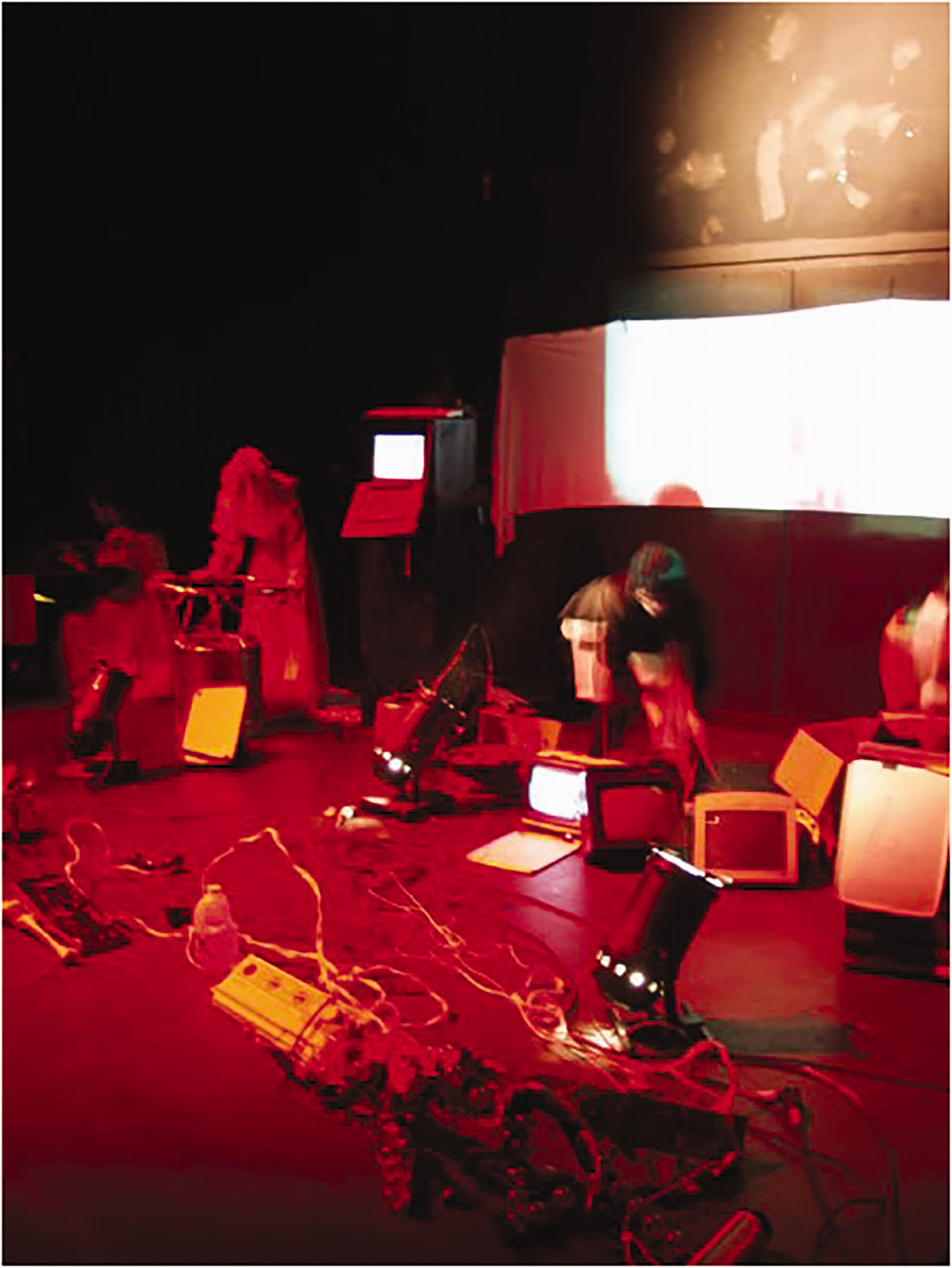
Reflections on interactive performance as non-totalised
In conclusion of this article I wish to reflect briefly on how the above discussions of interactive performance of the Bingodisiac Orchestra can be applied to other types of interaction, such as those encountered in other learning environments. For example, to return to the classroom and the title of this article that refers to systems of interactive knowledge, such as Google, the classroom can be viewed as an interactive installation that consists of both human and non-human participants. However, in regards to the technologies of e-learning, this case study presents an analogy to the dominance of certain ‘totalising’ technologies over the learning environment and has presented ways in which engagement with basic non-totalising components, such as sound, can be encouraged rather than an engagement with a complete system in which structure is a predetermined non-participatory element. Through acknowledging the non-totalising aspects of this learning environment, these human/technological actants, in the interactive performance, form a non-totalising assemblage, in the sense that knowledge is decentralised and instead emerges from the two-way dialogue between multiple actants. In a fully interactive classroom learning is performative and therefore knowledge ceases to be contained within a particular space, opening the Black-box to situations outside of the physical space of the classroom, to incorporate the electronic corridors of the internet so that both human and non-human actants are involved in intra-activity. This means that, like the types of engagements sought by the Bingodisiac Orchestra, learning becomes non-idiomatic, less to do with containment and structures of knowledge but, instead, focused on the ‘other concerns’: the types of knowledge that emerge from performative interactivity between human and the more basic materials of technology. It is these ‘other concerns’ that are, I have argued, of importance to the generation of new modes of knowledge that may better serve our changing technological world.
Footnotes
Declaration of Conflicting Interests
The author(s) declared no potential conflicts of interest with respect to the research, authorship, and/or publication of this article.
Funding
The author(s) received no financial support for the research, authorship, and/or publication of this article.
1
Personal unrecorded conversation.
2
Taking this line of thought perhaps too far is the dubious idea by French mathematician Émile Borel that an infinite number of monkeys randomly striking the keys of a typewriter, over an infinite span of time, can create seemingly non-random results, such as the complete works of William Shakespeare.