




Abstract
The paper uses actor-network theory (ANT) to analyze the sociotechnical networks of three groups of adolescents who played online games in different physical and social contexts. These include: an internet café, which allowed the players to be co-present; a personal laptop, which gave the player more control over how he played; and at home through game consoles using Xbox Live, which let the players communicate with one another through a headset. Using ethnographic research methods, I describe how their decisions about when, with whom and how they played were shaped by different sets of circumstances that were connected to real world issues and constraints. The ANT analysis focuses on three dimensions: network assemblage (what humans, technologies and routines need to be in place for them to play); translation (what holds their network together, and how these networks can be disrupted); and multiplicity (what other actor-networks exist that affect their play experience, in-game strategies and relationships). Finally, I conclude by reflecting on research on games and learning, and argue that it is important to avoid over-generalizing what makes up “games” and “players” because different players are part of different actor-networks, and that understanding these networks help us understand how games fit into the lives of those who play them.
Keywords
Introduction
Studies on games and learning often bring up gaming communities and “geeking out” activities (Ito et al., 2010), such as the creation and sharing of user-generated content, as examples of how games can transform learning and cultivate productive forms of participation (Gee, 2003; Squire, 2011). Gee and Hayes (2015) contrast these forms of participation against traditional schooling, where learning is seen as more restricted, hierarchical, and increasingly ineffective at preparing students for today’s society. However, cultural anthropologists have pointed out that geeking out practices are relatively rare among youths, even to those who have access to the tools needed to participate (Jenkins et al., 2015). Others have found that learning in games may have more to do with the surrounding physical and social environment than the design of the game itself (Stevens et al., 2008). Many studies rely on testing learning technologies in controlled, laboratory conditions (Weintrop et al., 2016) and fail to consider the real world contexts in which these technologies are deployed (Sanford et al., 2015; Stevens et al., 2008; Wright and Parachoma, 2011). Research is also limited by what researchers choose to study. This refers not only to what games are selected for study and what players and settings researchers have access to, but also to what is made visible to study. Artifacts such as user-generated content (e.g. game mods, fan-fiction, and websites) are concrete evidence of productive content, making them more available for study. Conversations are more ephemeral but can still be captured or remembered. Other factors are less visible or harder to notice. In part, this is due to limitations that all methodologies and data collection procedures have and because some factors are taken-for-granted, or “black-boxed” (Latour 1987, 1992, 2005) in conventional accounts.
This article uses actor-network theory (ANT) to uncover some of these black-boxed factors that have been under-represented or missing from current accounts of gaming practices. It draws on data from three groups of adolescent players: Kevin and Andrew 1 played online games together in an internet café; Lien played online games on his laptop; and Mitch, Grant and Perry were part of a group of friends who played and interacted through their Xbox 360 consoles. I use ANT to trace the actor-networks that make up their gameplay and examine what makes up their play experiences. By comparing these actor-networks, I argue that their play experiences are deeply embedded in particular actor-networks that consist of a variety of entities, each of which affect what and how they play. These actor-networks also present them with different sets of constraints, challenges and opportunities and define what they learn from and through the game, and their physical and social environment.
Games and learning
In this review of literature, I put research on games and learning into three broad, overlapping approaches, with each approach putting varying degrees of emphases on games and players. As shorthand, I refer to these as game-centered, player-centered, and user-centered approaches. Game-centered approaches look primarily at how the game’s design supports learning by creating compelling environments and contexts (Gee, 2003; Prensky, 2006; Salen and Zimmerman, 2003; Shaffer, 2006; Squire, 2006, 2011). Players are sometimes mentioned in abstract or as ideal-types. Player-centered approaches put more emphasis on the social aspects of learning and focus on players, communities, and the different ways in which people participate, both within games as players and beyond games as producers and consumers of content (Black and Reich, 2015; Chee et al., 2010; Steinkuehler, 2007a, 2007b). Learning is seen in terms of the player’s identity and how this is shaped through meaningful participation over time. Many of these studies look at players of massively-multiplayer online games (MMOG) and virtual worlds, where participation involves not only knowing how to play and what tools to use (Martin et al., 2013), but also knowing the social norms and interactional styles of fellow players (Chen, 2012). These studies look at participation in terms of the production and consumption of user-generated content, such as game mods, art, fan fiction, walkthroughs, videos, remixes, and so on.
User-centered approaches look beyond the participant’s player-identity and considers games as part of a larger media ecology that includes other digital technologies, people and environments (boyd, 2014; Ito et al., 2010; Stevens et al., 2008). In Ito et al.’s (2010) seminal set of multi-sited ethnographies, they describe how youths engage in different genres of participation, some of which are defined more by friendship and others more by shared interest in particular activities. They term these genres of participation as “hanging out” (most friendship-driven), “messing around,” and “geeking out” (most interest-driven). While “geeking out” has drawn a lot of attention in research on games and learning, perhaps because they leave the most visible traces, are readily available for study, and are concrete evidence that games are not just a waste of time, they may be overrepresented as a genre of participation. boyd points out in Jenkins et al. 2015 that “geeking out” and fan communities are not mainstream practices, and reflects that “scholarly communities often gloss over issues of what’s considered culturally valuable, without recognizing the ways in which stratification and inequity are part of the interpretation of value” (Jenkins et al., 2015: 67). Similarly, Andrews (2008) suggests that “geeking out” (although she does not use this terminology) activities may be less widespread than reported in studies, and that many youths are not even aware of their existence.
Actor-network theory (ANT)
This study is more aligned with user-centered approaches and considers the player’s non-player identity as an important facet of why and how they play. Many user-centered approaches to games and learning draw on ANT as a way of situating games within a larger network of users, technologies and environments. ANT emerged in the works of Michel Callon, Bruno Latour, and John Law as a framework for describing why certain phenomena, ideas, and facts come to exist and take on particular configurations. A key tenet of ANT is that it does not privilege the social or the technological; instead it includes any entity – or “actant” – as a relevant part of the phenomenon if it is observed to have an effect on the network. This includes humans, objects, technologies, and abstractions such as time, space, geography, and so on (Law, 2009). ANT rejects essentialist and tautological explanations, particularly ones that suggest any technology is innately good or bad without considering its use within specific contexts. The notion of “network assemblages” (Fenwick and Edwards, 2010) argues that all phenomena are part of multiple actor-networks. The stability of an actor-network depends on how the actants are held together and whether new networks emerge to disrupt or eclipse it. For example, a classroom is held together by actants such as teachers, students, school schedules, educational standards, accountability policies, standardized testing, and so on. Games, or any form of educational technology, may have trouble entering or staying stable in the actor-network if they do not fit well into its organizational structure (Leander, 2007; Scollon and Scollon, 2004) or if the organization is not redesigned to accommodate the new technology. Games that cannot be completed within the classroom period, that are difficult or take too long to set up, that have challenging technical requirements, or that demand more time than is typically devoted to a topic may have trouble being properly integrated. This failure would not necessarily be the result of a poorly designed game; instead, it would be because it has not been successfully translated into the school’s actor-network. Indeed, poorly designed games, such as Math Blaster or review activities built into a Jeopardy! game – examples Squire (2006) calls “exogenous games” – are more likely to be used because they fit better with a traditional classroom structure.
Actor-networks can give the illusion of permanence when they are “black-boxed” (Latour 1987, 1992, 2005) and taken-for-granted. By “following the actors,” ANT research exposes the underlying actants and reveals how they hold the actor-network together (Latour, 2005). ANT research typically focuses on “translations,” which are processes in which disorderly phenomenon and observations are transformed into orderly, durable forms (Law, 1992, 2009). In the wild, this often means enrolling and taming different actants and incorporating them into a “web of relations” (Law, 2009). When an actant is successfully enrolled into an actor-network, it changes the roles of those connected to it and allows new kinds of actions to be performed. In ANT’s view, the actants that make up the actor-network are inseparable and should be studied as such.
ANT in education
In education, ANT has been employed as a way of rethinking conventional concerns of educators (Fenwick and Edwards, 2010). Sørensen argues that ANT “makes us ask what practice is constituted through … socio-material arrangement[s], what knowledge comes about, what kinds of pupils and teachers are created, and what learning is achieved” (Sørensen, 2009: 2). Leander and Lovvorn (2006) draw on ANT to juxtapose the different literacy networks that a youth, Brian, enters into as a student in different classrooms and as a player in an online game. They trace the way texts are used and circulated in these different networks, for example, in the way the teacher’s lecture and classroom notes are translated into the Brian’s writing, homework and tests, which are graded and used to stand for his achievement in class. These notes – inscribed on notebooks or notecards – become crucial components of the network that represent classroom literacy practices. In the online game, texts refer to Brian’s avatar, as well as tools, weapons, skills display, and maps, which are used selectively, depending on the task at hand. His status as a player is more fluid and dependent on what he is trying to achieve in the game.
Bigum (1998) employs ANT to examine how discourses about computers in the classroom fall into four general categories. Discourses that support computers portray them as learning technologies that can improve existing practices (booster discourses); some go further and view schools as outdated institutions that should be replaced (anti-schooler discourses). At the other end of the spectrum are discourses that express concern over issues of access and equity (critical discourses) or reject technologies entirely (doomster discourses). Many game-centered approaches would be examples of anti-schooler discourses. Wright and Parchoma (2011) use ANT in their review of mobile learning research, in which they problematize studies that position mobile devices as “technologies for learning.” In their view, not only are definitions of “affordance” inconsistently applied in the research, they point out that the “ubiquitous” nature of mobile devices is assumed to be inherent, unproblematic, and an obvious property of the technology. Mobile technology becomes a black box (Latour 1987, 2005) that outputs learning, while what actually goes on when people use mobile devices in the wild are obscured. Many of the studies they reviewed also draw on Lave and Wenger’s (1991) “situated learning” and “communities of practice,” but fail to consider their concerns about the social and political implications over power dynamics and access.
ANT in game studies
Game studies have also drawn on ANT to examine the relationships between heterogeneous groups of people, systems, and circumstances. Steinkuehler (2006) describes online gaming as a “mangle of play” that involves players, game designers, game studios, government policies, and emergent issues that arise over time. She argues that the goals of players can sometimes be at odds with the game designer’s intentions, especially when games are considered in a broader context of play. Similarly, Taylor (2009) points out that gaming involves not just the players alone but an “assemblage” that includes broader structural contexts, histories, and evolving practices. She examines mods used by World of Warcraft (WoW) players and how the mods reconfigure how people play by representing information and user interface in new ways. Chen’s (2012) auto-ethnography reflects on his own trajectory as a WoW player and as a member of an expert group. Over time, game-play evolved as the WoW community grew and as more user-generated content were created and disseminated. Using ANT, he describes how a particular add-on that displayed information about a player’s attacks was enrolled into his group’s actor-network and how they used the information to diagnose their strategy against a major boss fight.
Stevens et al. examine in-room and in-world activities and argue that many of the claims presented in game-centered approaches are usually not backed by empirical evidence, and that there is “a persistent bent that analyzes video game play as largely disconnected from the other moments and activities of people’s lives” (Stevens et al., 2008: 43). Without presuming whether games are inherently good or bad for learning, they set out to study how games fit into the lives of the kids who play them. They argue that what players do with a game is not determined just by how the games are designed or what learning principles are embodied in the game, but also by what the players want to do. They also show that players and those in the room with them are all connected to the play experience. Sometimes, this takes the form of players enrolling their siblings or friends to teach them how to play or coach them how to overcome difficult encounters in the game. This coaching can involve gestures, shifts in posture, use of additional tools (e.g. extra controller) or passing of the main controller from novice to expert, which allows the experts to demonstrate their expertise both on the controller and on the screen. They conclude that learning in games cannot be disentangled from the players’ contexts and suggest that future research should “[put] a spotlight on gaming, but also keeping a close eye on all the other activities in young people’s lives that are tangled up with gaming” (Stevens et al., 2008: 64).
Participants and data collection
This article uses ANT as an overarching framework to analyze the play experience of three different groups of adolescents. The first two groups were part of a multi-sited ethnography in which I followed different Chinese-speaking adolescents who were recent immigrants and who played video games. I focus on three of these youths: Kevin and Andrew, 18- and 16-year old respectively, played an English-language MMOG together at an internet café; and Lien a 16 year old, played Chinese-language MMOGs on his own laptop. With all of them, I took ethnographic field notes in my observations, asked questions during these observations, and made audio-recordings of conversations. I met Kevin and Andrew at the internet café where they played and virtually in the online game during the summer. I met Lien at my institution, where he preferred to meet me (for reasons that will be clear later). With Lien, I was also able to make video-recordings. The second study involved a group of Caucasian American adolescents who hung out on Xbox Live after school. This was an auto-ethnography, in which I was a participant observer in the party chats and games I was invited to. The data consisted primarily of their audio-recordings of their party chat conversations. I also collected screen-recordings of what I saw on my end to help me reconstruct and contextualize the data. Both studies were approved by the institutional review board and data were collected with the participants’ consent.
Data analysis
Actor-network theory research is messy (Fenwick and Edwards, 2010) and is intended to be so. However, this also makes ANT research somewhat unconventional: by definition, Latour’s (2005) notion of “follow the actors” means that researchers often do not know where the actors will take them. ANT research embraces multiplicity, heterogeneity and ambiguity (Fenwick and Edwards, 2010), with the understanding that actors are part of many actor-networks, and that actor-networks are fluid. In that spirit, I use ANT to examine what makes up their context of play as it relates to video games, focusing on these analytic dimensions in particular:
Network assemblage: What actants hold up the actor-networks? Translation: How does the process of translation connect the actants? What disrupts these translations and how do(es) the actor-network(s) re-stabilize, if at all? Multiplicity: What are the different actor-networks and how to they influence one another?
Following Leander and Lovvorn (2006), I focus on particular episodes that reveal aspects of the actor-network that have been previously hidden. I then compare actor-networks of these three groups along the analytic dimensions outlined above: network assemblage; tools of translation; and multiplicity. Finally, I conclude the article by using ANT to reflect on research on games, learning and participation, and argue that it is important to avoid over-generalizing “games” and “players” because different players are part of different actor-networks and these actor-networks shape what and how they play.
Gaming together: Kevin and Andrew
The internet café where Kevin and Andrew spent their afternoons after school was located in Manhattan’s Chinatown. The game Kevin and Andrew played together was called Dragon Raja, a free-to-play MMOG set in a world loosely based on a Korean fantasy series (Wikipedia, 2016). The game was multilingual, but the computers at the internet café were only set for English input. Since Kevin and Andrew were mostly interested in playing together, the language barrier was not a huge issue when they were within speaking range of one another. If they could not get computers next to each other, they could still raise their voices and be heard. The location of the internet café was important because it was near their school. Both of them lived in Brooklyn and their routine while school was in session involved heading over to the internet café after school for a few hours before taking the subway home. Gaming was more difficult when the internet café was not part of that routine. Although they both had computers at home, Kevin’s internet connection was slow and he would often be dropped from the game. The times I shadowed them within Dragon Raja, Andrew would complain about Kevin’s connection whenever this happened and he had to wait for Kevin to come back. Their choice of Dragon Raja was chosen largely because it was free and because they could play it at the internet café. It was also a 2D isometric game, which was graphically less demanding than more popular 3D games. This meant that, if they had to, they could still play from home, even if that meant putting up with slow connections. The internet café charged a fee of one dollar per hour. Even though this was affordable, it did add up. However, paying in small hourly chunks seemed more justifiable, especially since the cost was not going directly to the game. Andrew did spend real world money on an in-game accessory once –armor for his avatar – but that quickly drew complaints from Kevin. He was called “stupid” and jau cin zai – which means “rich kid” in Cantonese but can be interpreted as “show-off.” Both of them understood that Kevin did not have the means to spend real world money on in-game purchases and it only happened once, more out of curiosity than out of a desire to one-up Kevin.
As mentioned earlier, Dragon Raja is based on a Korean fantasy series that seems to draw on Tolkienesque themes of magic and fantasy. MMOGs tend to draw on familiar themes and settings, usually based on fantasy or science fiction contexts. These conventions make MMOGs more familiar to players who can draw on their available knowledge if they have already played role-playing games (RPGs) before. While RPGs are unique in the own way, both in terms of narrative and game design, they share a set of rules and conventions that usually include different character classes, each with different strengths and weaknesses that complement one another and work most effectively when different classes are assembled into a team. There are jobs, quests, and skills that players have to complete and items they have to collect in order to level up their characters. These shared conventions also make it easier for those who have trouble with the game’s language to overcome it because it allows them to use what they know as a scaffold for a new RPG (Hung, 2006). The distinction between narrative and game design also means that it is possible for a player to understand how the rules work and not fully pay attention to the narrative. 2 In such a way, Kevin and Andrew were able to ignore the game’s story, which would have required a more sophisticated grasp of English, and focus on their interactions with each other.
During an in-game observation, we ran into a “player killer” or “PK,” who are players whose primarily goal is to kill other players for fun. Player-killing has been a common issue in other MMOGs (Steinkuehler, 2006). In her study of Lineage I and II, Steinkuehler examined two cases of player-killing. In one case, high-level players were targeting low-level players for fun and making it hard for newcomers to enjoy the game. In response, other high-leveled players banded together to protect the newcomers and hunt down the player-killers. In another case, players were hunting down the adena farmers, who were players hired to collect in-game currency (called “adena” in Lineage) in exchange for real world currency. The adena farmers were usually Chinese. Since this practice threw off the game mechanics that were designed to balance out the class system, anti-Chinese rhetoric emerged in Lineage, both in-game and on its discussion forums, although most players expressed that they were against the practice of adena farming, and not Chinese players in general. In Dragon Raja, player-killing was often specifically anti-Chinese, and was shrouded in discourses about English as a global language as well as anti-Chinese (both the language and the people) rhetoric. For example, on the forums, one player posted: “International Langauge (sic) is not ONLY ENGLISH As the United Nation defined There is FIVE International Language accepted by UN Chinese is one of them.” “People all around the world can understand English but for Chinese I guess few people can get it if they r not Chinese accept the truth man! English is the only international language screw the UN defined” “good old f2p .MY. was dam fun to hunt cn xD. ran through all lvling maps and killed all cn-s who I saw. ah good old times.”
To summarize, Kevin and Andrew’s network assemblage consisted of a MMOG that was graphically unsophisticated enough that they could play both at the internet café and at home, if necessary. The proximity of the internet café to their school and the school’s academic calendar helped hold the network together. This rhythm was particularly important for them as school-aged players because they had less control over their schedules and leisure time. The layout of the internet café made it easier for them to speak in person, which was an important part of their play experience because it was easier to communicate that way than through the game’s chat channel. The game’s design, especially the conventions of RPGs, enrolled them as players of the MMOG. They enrolled one another as friends through the strategies they employed. While in-game purchases might be a way for other players to boost their characters, it was less permissible for Kevin and Andrew because it changed the dynamics between their characters; in other words, not using in-game purchases was crucial to their friendship. The payment structure of the internet café made it possible for them to continue playing in the long run, even though it amounted to a significant sum over time; the broader politics that unfolded on the forums and elsewhere was another network that affected them indirectly. Their encounters with player-killers exposed them to terms and phrases (e.g. “noob,” and “PK”), which became part of their lexicon.
Gaming alone
Lien affectionately referred to his Hewlett-Packard laptop as lou-po (“wife” in Cantonese), signaling it not just as a tool but also a close companion. It not only gave him access to the online games, but also more flexibility in choosing what games to play and when to play them. This seemed to have been a relatively expensive purchase for his parents, who bought him the laptop but did not want to pay for a home broadband connection. Although his computer could run more graphically demanding games, his lack of broadband at home still constrained what games he chose to play. When I first started observing him, he was playing a Chinese-language game called mung-waan sai-jau, a game inspired by the Chinese fantasy world of Journey to the West. Unlike Andrew and Kevin, he did not have another friend in New York City to play with, but he did have regular interactions with players in Hong Kong and China. These were players he only knew through their online interactions.
Lien typically had multiple windows open. One of these was usually a cartoon, like Tom and Jerry, which he liked because it did not have much English in it. He also had several game windows open, through which he controlled several avatars at once. The most I observed was four, and these were usually balanced between male and female. In the Chinese-language MMOGs he played, male and female avatars were not depicted visually in hyper-sexualized ways, perhaps because Western representations of hyper-masculinity are not a Chinese aesthetic (Louie, 2002). Lien focused on leveling up only one or two of these avatars, usually male, while using the other avatars as storage because the game imposed a limit on how many objects each avatar could carry at once. He juggled his attention between the multiple game windows and internet browsers on which he had open the show he was watching and the game’s forum if he was looking for help. He attended to the actual-avatars he was actively managing, sending them off to adventures to collect objects and experience, while keeping an eye on the storage-avatars to make sure they were safe. While he did not spend a lot of time socializing in the game, he still had to manage conversations during the times when a stranger did approach. The following kind of conversation occurred a few times when a male avatar approached one of his female avatars: Other player: Are you really a girl? Lien: Maybe. What do you think?
There was recognition between him and other players that avatars were often not controlled by the original player who created them. Every time he encountered an avatar he recognized, he would type in the chat, “ni shi ben ren?” (“Are you the actual player?”). Since practices similar to adena farming were familiar to him, this question, which preceded any greeting or recognition, was important to establish the relationship. If the other party turned out not to be the actual player, he would end the conversation and they would part ways because any further interaction would not have counted towards their virtual relationship. In other words, his relationship within the game was with the original player, not the avatar.
After playing Journey to the West for almost a year, someone hacked into Lien’s account and drained all his credits, which was not uncommon in Chinese online gaming (cf. Lindtner and Dourish, 2011). Frustrated, he switched to another game called tian-long ba-bu, based on a martial arts-themed book series of the same name. To register, he had to go through a cousin living in Hong Kong because the game asked for a Hong Kong residential address and also because he would not have to go through his parents. The account would then generate a unique code for him to log in. Unfortunately, a few months later, this account was also hacked and since each account was tied to the unique code, he was locked out completely. He ended up having to start over again. Digital games are played on physical machines, and owning your own machine means having to take care of the machine itself. Lien was not a computer expert. His laptop came with Windows Vista installed, but since he was more familiar with Windows XP, he got his friend to install an overlay to make Vista resemble XP’s interface. However, this led to stability issues, with some drivers not loading up properly, causing his dial-up modem and audio to fail. Without any internet access, he was barred from his online games. This was the reason why he preferred to visit me at my institution, since he could use its Wi-Fi instead of the modem. When he asked me to help him figure out a solution, I discovered a number of malware that was slowing down his system. I helped him remove the malware, but the only way I could fix the drivers issue was to restore it to factory conditions.
When controlling multiple avatars, Lien was able to enroll the game’s design to let him treat some characters as main ones and others as secondary. His attention was divided between the multiple screens and other video players he may have open, and he seemed to be able to attend to these different information sources proficiently (cf. Martin et al., 2013). He used his understanding of online players and social norms to manage how he represented himself to other players, enrolling them and the game’s rules regarding character relationships to further his goals. He visited online forums, which were in Chinese, when he needed help on how to complete a quest and he used his phone’s camera to take photos of his screen so that he did not have to come back to the forum later. It also made it easier for him to follow the directions since it was visible on a second screen, and not blocked by the multiple windows already open. Concurrently, the actor-networks connected to online currency theft, phishing, and proliferation of malware such as Trojans and viruses impacted not just his gameplay but his hardware as well. The individuals behind these practices have their own actor-networks, and they exist because there is real world value in in-game currency and because there are configurations of humans and technologies that open up opportunities for individuals to hack into other people’s accounts. In other words, individuals like Lien can be unwittingly enrolled into others’ actor-networks for nefarious reasons. Lien also tried to enroll the Windows XP interface because he did not like the Vista interface, but the overlay his friends installed failed to be properly translated into his gaming actor-network. Actor-networks stabilize when the interactions in the network stabilize through translation, but these translations are fragile. Lien’s laptop, when it was functioning properly, was a powerful actant that let him run several windows at once and multitask; when it failed, that actor-network fell apart.
Gaming on consoles
I studied a group of adolescents who were friends from high school on Xbox Live party chat. Their Xbox consoles were usually in their bedrooms or basement, which afforded them varying degrees of privacy. To use the party chat, they had to be an Xbox Live gold member, which was a paid subscription that enabled them to talk to one another via voice chat, usually through a headset. Xbox’s support for cross-game chat was an important feature for them because it allowed them to talk even if they were not in the same game; in fact, most of the times I observed them they were not playing together. They had varying financial constraints, which became more apparent when a highly anticipated game was released and some of them were able to purchase it on the day it came out, perhaps even picking up a more expensive special edition that came with bonus features, while others had to wait until they could borrow a copy or wait until the price dropped. Unlike Andrew and Kevin, they seemed more comfortable boasting about having access to hardware (e.g. owning a more expensive Turtle Beach headset) or software (e.g. owning a special edition game) that others in the group did not own. 3
The following vignette about Mitch illustrates the multiplicity and fluidity of actor-networks and how these different networks can shape game strategies. Mitch’s parents used his access to the Xbox as a bargaining chip to ensure that his grades and behavior were satisfactory. The amount of time he could spend on the Xbox depended on his school and extracurricular activities, and was renegotiated regularly. Sometimes he had to leave the party at 9 PM; other times he was allowed to stay till 11 PM, even on a school day. Unlike most of his friends, his Xbox was located downstairs in a semi-private space that was easier for his parents to do surveillance on his Xbox activities. His parents seemed to trust him to log off at the right time, and most of the time he did. When he did not, one of his parents would come down and physically unplug the console. Even so, sometimes Mitch would still try to stay on a bit longer, especially if he was part of an intense game. In one such observation, I was invited to play with him, Perry and Grant on the zombie scenario of Call of Duty: Black Ops, in preparation of Black Ops 2, which was set to be released in a few days. The zombies were designed to arrive in waves. Once all the zombies in a given round have been killed, the next round would begin and a new horde of zombies and undead creatures would emerge. One strategy they developed was to keep one zombie around, preferably a slow moving one, till they had time to upgrade or switch weapons, prepare their defense, or take a real life bathroom or smoke break. As his 11 PM curfew approached, Mitch lowered his voice so that his parents would not hear him playing. Since game and chat audio went through the headset, he could stay relatively quiet and lower his voice, and the rest of us could turn up the chat volume on our end if we wanted to hear him better. Grant suggested that Mitch could turn off the TV but leave the game on so he could go upstairs for his parents to see that he was not on the Xbox. That way, he could still benefit as the rest of us moved up the rounds without getting in trouble with his parents. However, Perry pointed out that that would bring down everyone else’s score because the game penalized players for letting a teammate die. The group’s strategy changed as 11 PM approached. By then we had been playing for over three hours and had reached round 32. First, Mitch killed the remaining zombie without first checking in with the group because he wanted to start the next round sooner. This generated some mild protests from Grant and Perry. In round 33, three of us – first myself, then Mitch, and then Grant – were killed. We entered spectator mode, which allowed us to view the game from the remaining player’s (Perry’s) point of view. If Perry was able to complete the round, we would all be able to rejoin the game. He was an expert player, and told Mitch he was trying to finish the round as best he could. Even so, he teased Mitch by pretending to put himself in unnecessary danger, such as letting zombies get really close to him, or by making humorous sound effects such as “pew pew pew.” Since the rest of us were amused by Mitch’s growing panic and whispered threats, Perry played to our reactions. The game ended unexpectedly when a lag occurred, during which the screen froze, then skipped a few frames. In that time Perry lost control of his character and the zombies got to him. This led to a conversation between them about why the game ended, and who was better at the game. Mitch was upset that Perry put himself at risk. Perry argued that he still outlasted Mitch and had a higher score, but Mitch pointed to the Leaderboard and statistics display, where Mitch had higher numbers because he had been playing this game for a longer period. Grant did not take any particular side, only pointing out that Mitch was ahead in the statistics but that Perry was behind Mitch by only 20 points. Perry also joked that Mitch could not raise his voice because that would alert his parents that he was still on Xbox. Then they started talking about why the game really ended. Although Mitch witnessed the lag from spectator mode, he blamed Perry’s reckless play as the cause for the game to end. He pointed to the last few seconds of the game, when Perry was out of ammunition and had escaped into a room with a trail of zombies close behind. Perry’s last words before the lag were “You know what? Fuck it!” which Mitch interpreted as Perry giving up. Perry explained that he meant “Fuck it, I’ll spend 4500 on ammo.” By that time, the exchange, which seemed to begin half-jokingly, became more heated and Mitch eventually left the chat without saying good-bye (which he usually would).
This episode is illustrative of the multiplicity of actor-networks that can impact in-game and real life behavior. As they developed their game strategies, they were attentive to how the game was designed and exploited features, such as holding off on starting the next round by leaving one survival zombie around while they prepare. Real life matters began to affect how they played when Mitch’s curfew approached, shaping not just Mitch’s strategies but others in the group as well. At times they even tried to strategize ways that Mitch could prolong his stay on Xbox, which involved lowering voices and discussions about whether he should turn off his TV and make a physical appearance upstairs. Their actor-networks were fluid, and they managed the constraints of each as best they could. They enrolled selective parts of their actor-network, such as different game statistics, to position themselves in favorable positions. Teasing, threats and curses were common among them and these did not stop them from coming back to the party chat the next day. 4
Discussion
Summary of actor-network analysis.
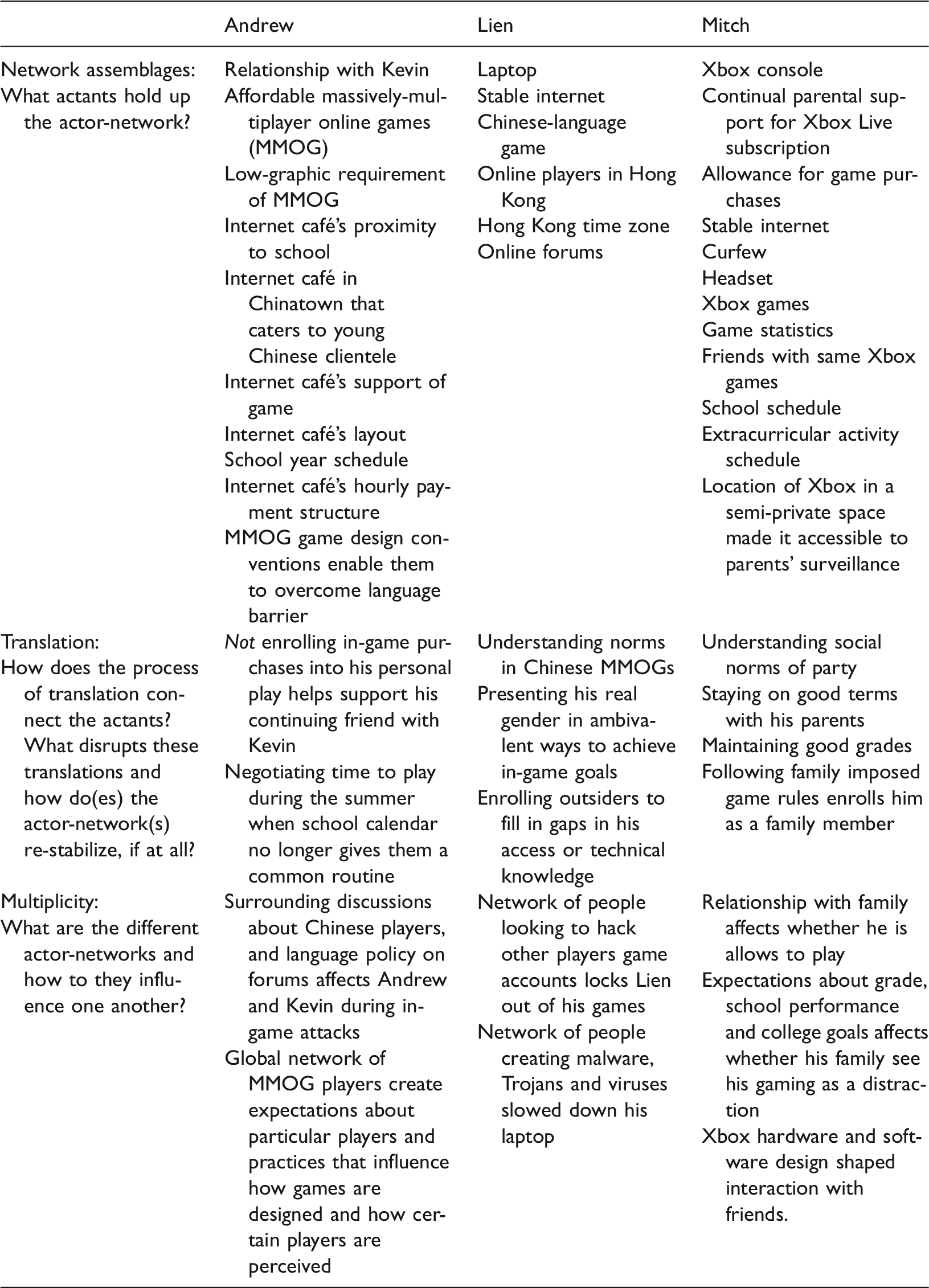
Using ANT, the focus of the analysis shifts from games and players to what kinds of players, practices, roles, and knowledge are created by different sociomaterial configurations. “Games” and “players” are often described in broad terms, but there are considerable variations in the types of sociotechnical networks different players belong to. Thumlert et al. argue that: “ANT helps make perceptible the material and symbolic constraints that obstruct agency, name the unqualified, or exclude certain bodies from participatory status” (Thumlert et al., 2015: 792). The experiences of playing a game on a computer or console, of owning your own laptop or leasing it hourly from an internet café are very different not just from a technical point of view. Different machines shift or hide different parts of the network. These contexts and networks are less invisible when no issue turns up. But as ANT studies have shown, these networks are not stable; taking away or changing any actant in the “network assemblage” described in the table below would fundamentally impact how or whether they can play.
It should be emphasized that, despite the obstacles that these adolescents faced at times, they were content in their circumstances. None of them showed any interest in creating user-generated content. For Andrew and Kevin, games were the venue for them to maintain their friendship. For two adolescents new to the United States and still gaining proficiency in English, Dragon Raja was an important space for them. For Lien, his games allowed him to connect with people from his home country. He was adept at navigating the social space of the game and knew how to use strategic moves, such as pretending to be a girl and marrying off an avatar, to accomplish his goals. For Mitch and his friends, meeting on Xbox Live every night was a big part of their peer socialization. Although games and the game console brought them together, the conversations that occurred as a result were arguably more important than the games themselves in maintaining their relationships.
Marginalized youths are often more resourceful at overcoming barriers to participation (Jenkins et al., 2015). Andrew and Kevin both found a system that worked for their relationship, and managed to overcome some of the language barriers they encountered in Dragon Raja by accessing their background knowledge of RPGs. When they came across esoteric words, they looked them up; when they came across obnoxious player-killers, they fought back; when one of them was knocked off the game by a slow connection while trying to play from home, they waited (albeit impatiently). Lien, who found himself shut out of games, knew to find others to fix his problems. He was able to bypass the avatar’s limited storage issue by loading up different instances of the game and controlling multiple avatars at once. Mitch did his best to extend his time on the Xbox, and his friends did what they could to figure out how Mitch could make the most of his time he had left without getting in trouble. They disputed among themselves, and sometimes even got upset at one another, but they were able to return the next day and start over. These analyses show that games are not standalone entities, and that players are not only players, but also individuals with real-world identities, and these identities are a non-trivial part of how, why, and what they play.
Conclusion and further research
Games allow players to take on new identities (Gee, 2003), such as warriors and wizards, Link and Lara Croft, heroes and villains. But players also have real world identities. They are friends, siblings, children, adolescents, students, employees, immigrants, citizens, and so on. The players described here engaged in both friendship- and interest-driven activities; indeed, it is almost impossible to separate them. They were not producers of content that might be shared in an online forum but they possessed specialized knowledge of the games they were playing. Concurrent with ongoing research on games, players, and participatory culture, more studies that examine how games fit into players’ lives can offer on-the-ground perspectives that are often lacking in educational technology research (Bigum et al., 2015; Selwyn, 2010, 2012; Wright and Parchoma, 2011). Researchers should also study more players who are different from themselves, who play games that researchers might not play, and include more games that are underrepresented in existing literature. ANT studies abound with accounts of scientific discoveries and technological innovations and the conditions in which they succeeded or failed (Callon, 1986; Latour, 1988, 1996; Nespor, 2012). Good innovations do not always succeed and the most efficient or effective products do not always make it to market. When they fail, it is usually because they failed to enroll all the necessary (human and non-human) actors.
Footnotes
Declaration of Conflicting Interests
The author(s) declared no potential conflicts of interest with respect to the research, authorship, and/or publication of this article.
Funding
The author(s) received no financial support for the research, authorship, and/or publication of this article.