



Abstract
It is understood that microblogging (tweeting) which is a form of Web 2.0, has been a centre of attraction in some institutions of higher education. However, despite its hype and pomp as reported by some scholars in developed countries, integration of Twitter in a classroom environment in developing countries is just beginning to flourish. In Malawi for example, it remains unknown how Twitter can be effectively assimilated into a university classroom to enhance teaching and learning. In this study therefore, I report on the findings about the practical use of Twitter in two university courses offered in the Department of Library and Information Science at Mzuzu University in Malawi. Findings of the study show that if properly deployed, Twitter is indeed an impetus of the much hailed learner-centred approach to teaching and learning. With the use of Twitter, I found that students shared and discussed course content with colleagues and me (lecturer) 24/7. Specifically, with the proliferation of Internet enabled phones and other mobile devices in Malawi, the study found that it was possible for students to generate out-of-class discussions and learn from each other without necessarily meeting physically. In addition, students were key contributors to their own learning as it was possible to effectively search, generate and share their own content through creating knowledge collaboratively. However, limited access to the Internet (due to unavailability of Wi-Fi) by students coupled with exorbitant Internet bundles, remain key challenges against the effective appropriation of Twitter in a university classroom.
Introduction
For the past 15 or so years, the web has been undergoing major metamorphoses, departing from a Web 1.0 (‘read only’) location where users were seen as visitors and consumers of already uploaded content to Web 2.0 (‘read-and-write’), an enabler of users as active contributors of content through creation, use, remixing and sharing (Greenhow et al., 2009). Some of the most popular forms of Web 2.0 technologies that have made their inroads into higher education include blogs, wikis, Really Simple Syndication feeds, YouTube, Flickr, Facebook, Twitter, Skype, podcasts, Google Apps and WhatsApp (Armstrong and Franklin, 2008; Al-Qirim, 2010; Bista, 2015: 83; Bosch, 2009; Harinarayana and Raju, 2010: 74; Hough and Neuland, 2012; Luo, 2010: 38; Huang et al., 2013: 57; Sandars and Schroter, 2007). In this study, I focus on Twitter; a Web 2.0 technology alternatively called microblogging. Literature shows that predominantly, the microblogging service has social network features (Veletsianos, 2012: 337). Launched in October 2006 (see Bista, 2015: 84; Welch and Bonnan-White, 2012: 326), Twitter is a form of Web 2.0 technology that is hailed to effectively support teaching and learning in modern times (Elavsky et al., 2011; Leaver, 2012; Savage, 2011). According to Menkhoff et al. (2014), “Microblogging via Twitter represents a new form of classroom communication, enabling both instructors and students to send and read messages (tweets) of up to 140 characters to each other”. Using any Internet enabled devices (mobile phones, laptops, desktop computers, etc.), Bista (2015: 83), Oulasvirta et al. (2009) and Veletsianos (2012: 337) observe that microblog is a service that allows users to write brief text updates. In the context of higher education, pedagogical tweeting represents a proficient and natural way through which lecturers can identify students’ thoughts hence making learning more meaningful, fun and enjoyable, and effective (Menkhoff et al., 2014; Wankel, 2009). Here, students participating in Twitter activities create their own individual and unique networks in which learning occurs (Boyd and Ellison, 2007: 211). This study is inspired by my former lecturer and supervisor, Dr Sandy Zinn at the University of the Western Cape (South Africa) who used Twitter in a Master’s course she taught. As my supervisor for my Master’s thesis, the lecturer also extensively used Twitter to communicate with me. The use of this Web 2.0 worked perfectly well and I, therefore, decided to experiment it with my own undergraduate students at Mzuzu University (MZUNI) in Malawi. I found it worth carrying out the study because according to Menkhoff et al. (2014), studies on the use of Twitter in teaching and learning in universities are still rare despite the increasing use and popularity of microblogging in business and societal settings. The study has been conducted, particularly in response to calls by most universities across the world as reported by Morgado (2011) that “More and more, universities proactively support innovative teaching methods and encourage instructors to bring social media into the classroom as a platform for student discussions, project works and assessment”. Furthermore, “it has been argued that the current generation of youths, often described as Generation Net or Digital Natives, may be resistant to traditional methods of teaching and learning” (Bosch, 2009: 185). Generation Net or Digital Natives also called millennial generation students (see Drumheller et al., 2010: 23) in this context are described by Welch and Bonnan-White (2012) as a human generation that was born in the 1980s onwards. These Generation Net or Digital Natives need distinctive ways of thinking, communicating and learning (Barnes et al., 2007); after all, it is strongly argued that these Digital Natives are brought up in an environment which is characterised by the presence of technological surge, and that they “have an innate knowledge and regular usage pattern of information and communication technology” (Prensky, 2001). In this case study, I understand the term learning as promulgated by Lave and Wenger (1991) and Wenger (1998) who consider learning as a situated activity that takes the form of a network of individuals who pursue scholarly endeavours. Although most Web 2.0 technologies including Twitter were not necessarily developed for purposes directly related to both formal and informal education, Veletsianos (2012) makes a strong point that these technologies have been co-opted and repurposed by scholars, in part, to satisfy educational and scholarly pursuits. Worth noting is that this study with both elements of quantitative and qualitative research approaches, does not aim to generalise the findings. Rather, it is indicative and it attempts to provide a key springboard for further research in microblogging and perhaps, related technologies. The study only provides key understandings into a unique group of students about the use of Twitter which might possibly, be transferable to other university contexts, particularly, public universities in Malawi. Increasingly, efforts are being made by public universities in Malawi such as MZUNI to bring the Internet to a wider university community, particularly students and lecturers (Chaputula, 2012). It therefore becomes important to carry out a study that attempts to demonstrate how such technologies become an impetus of teaching and learning. This is important because similar studies (Bista, 2015; Blair, 2013; Galagan, 2010; Lee and Kim, 2014; Veletsianos, 2012) which were conducted in other counties were case studies in nature and it could be impractical to generalise their results to Malawian universities which operate in unique technological and economic environments; hence, there is a justification for this case study. In fact, Flyvbjerg (2006: 224) argues that case studies are used to provide and produce concrete and context- dependent knowledge of a phenomenon.
Context of the study
As a lecturer, I noted that most of my students owned Internet enabled phones. Some of them had Twitter accounts already via which they communicated with their friends and sometimes with me. In addition to students having access to several Internet access points on campus (University Library and computer laboratories) at a subsidised fee, laptops are a common sight amongst my students and fellow lecturers. More importantly, my students are taught two compulsory information and communications technology (ICT) courses when they are in year one in which most basic elements of Internet technology are adequately covered. The aforementioned factors are the backdrop to my study because one may expect students and lecturers to adopt some Internet technologies such as microblogging in their teaching and learning endeavours. However, it appears that lecturers at MZUNI are yet to formally adopt Twitter as a teaching tool. Thus, I conducted this study to uncover and demonstrate the power of Twitter in teaching and learning at a University located in an economically developing country where Internet technologies are slowly but promisingly thriving. To answer the research problem, the following specific research questions are addressed:
What are the devices students use to access Twitter? What are the purposes and benefits of using Twitter in teaching and learning? What are the reasons for students’ use or non-use of Twitter for academic purposes?
Literature review
This section provides a brief discussion about Twitter, following the major themes which are the focal point of literature discourse (particularly, in higher education). I have mostly limited my review to scholarly works that directly address issues of Twitter in higher education and in line with the research questions identified above. My search of major library databases returned no results about the use of Twitter and related technologies within a Malawian context, with the exception of an unpublished Master’s thesis of Chawinga (2014). This underlines a research gap about the use of Web 2.0 in higher education in Malawi, hence a justification of my study. Bista (2015) reports four main purposes that Twitter is used for by students at a public university in the mid-southern United States: to receive immediate and frequent course information; to ask questions to the instructor; to update course assignments; and to share helpful information from outside the textbook with their fellow classmates and instructor. Similar findings were earlier reported by Veletsianos (2012) who researched scholars from the USA, Canada, Spain and Portugal about their naturalistic practices in social networks in general and on Twitter in particular. Veletsianos (2012) equally found that, Twitter was used to share course work, communicate and to connect with professionals in the study area. It is clear from the literature that, generally, Twitter provides an ideal space on which students and lecturers instantly interact, either inside or outside the classroom. In more specific terms, Bista (2015), Blair (2013), Chichester (2010), and Veletsianos (2012) highlight the following common purposes:
Information, resource, and media sharing; Requesting assistance and offering suggestions; Living social public lives; Digital identity and impression management; Connecting and networking; Presence across multiple online social networks, for example, linking Twitter to blogs (Chichester, 2010); and Communication, for examples, sending questions and queries to one another, sending student to student direct messages, sharing resources, linking Twitter to student blogs, and exchange of personal information (Bista, 2015; Chichester, 2010).
Prior studies reveal that instructors have experimented with Twitter in delivering various courses in university environments. For example, Welch and Bonnan-White (2012) experimented with Twitter in teaching undergraduate students enrolled in Sociology and Anthropology courses at Western Illinois University in the USA, Jones (2015) used Twitter in a literature class of 30 undergraduate students at the University of California, Yuan (2012) used Twitter in teaching English at a Taiwanese college, and Luttrell (2012) focused on examining the effectiveness of Twitter in delivering a Public Relation course at a university in the Midwest in the USA. In all these studies, the authors observed that Twitter proved to be reasonably beneficial as it provides an ideal space on which students and lecturers instantly interact, either inside or outside the classroom. To this end, some specific benefits of microblogging when used in a university classroom environment have been highlighted and previous studies have put emphasis on three benefits of microblogging: enabler of students to seek and share content and fostering of relationships with their peers (Lee and Kim, 2014); enhances self-directed learning by placing students within the frontiers of the course objectives (Menkhoff et al., 2011); and microblogging has a capability to nurture concrete learning outcomes amongst Gen Y students by allowing them to communicate in a collaborative fashion with the instructor or lecturer, inside and outside the frontiers of the classroom (Veletsianos, 2012). Another notable benefit of Twitter is that it enhances social presence amongst students (Al-Khalifa, 2010; Lang, 2013). In this context, social presence is expounded by Bista (2015) as the arrangement where students participating in Twitter present themselves to other students as if they are ‘real people’ but in practice, are physically and geographically separated. There are a number of factors that encourage students to use Twitter. Naturally, Twitter is used for both formal and informal purposes and this seems to work to the advantage of instructors intending to use it in a classroom environment. For example, findings by Veletsianos (2012) provide evidence that scholars’ networked participation via Twitter is a complex and multifaceted human activity where personal and professional identities blend. It may therefore, be safe to suggest that although the instructor’s overarching purpose may be to have students use Twitter solely for academic purposes (resource sharing for instance), “scholars’ participation on Twitter varies to accommodate multiple intended audiences, goals, and motivations” (Veletsianos, 2012: 345). Literature provides evidence about some factors that block the use of Twitter in higher education which, principally, emanate from students’ and lecturers’ attitudes. For example, some students and lecturers often dismiss Twitter as a platform of meaningless soliloquies and dull updates (Veletsianos, 2012: 337). As a result, some instructors in higher learning institutions have adopted a zero tolerance technology policy (Galagan, 2010) because they view Internet technologies such as Twitter and Facebook as distracters. At the University of Cape Town (UCT) for example, Bosch (2009) reports that some educators also listed the potentially distracting nature of Web 2.0, arguing that students spend more unproductive time online, instead of focusing on their studies. Some very early studies (Grosseck and Holotescu, 2008) about Twitter identified a very definite challenge which still stands today. Grosseck and Holotescu (2008) perceived Twitter as time consuming, addictive, and perhaps, encouraging bad grammar as a result of its 140- character limit. To access Twitter, one has to be connected to the Internet which is usually not for free especially if accessed outside university campuses. Bista (2015) reports that one of the factors that commonly frustrates students and lecturers when using Twitter is that they (students and lecturers) may be charged data fees if they access Twitter on their cell phones. Other factors are, however, technological in nature. Bandwidth problems have proved to be key roadblocks against the use Web 2.0 in most developing countries such as at UCT (Bosch, 2009).
Method
This study presents the perspectives of undergraduate students using Twitter as a pedagogical tool for 14 weeks as a required activity in the classroom. The study is part of a larger research which investigated the combined role of blogs and Twitter in a classroom environment. In this paper however, the focus is on the use of Twitter only.
As revealed in the literature review section, some studies that experimented with the practical use of Twitter in a classroom environment targeted unique groups of students such as Sociology and Anthropology (Welch and Bonnan-White, 2012), Literature (Jones, 2015), English (Yuan, 2012) and Public Relations (Luttrell, 2012). In this study, the focus is on students doing a course in Library and Information Science. The study took place at a mid-sized public university (MZUNI) in Malawi. Participants of the study were undergraduate students pursuing a four year Bachelor’s degree in Library and Information Science (LIS). Although the Department of Library and Information Science has levels one to four, in this study, I only included level two and three students because these were the students I was teaching in this particular semester. The students enter the university in year one with very basic ICT skills (mostly for using mobile phones) because they do not study any ICT-related courses in secondary schools from which the University selects them. Upon enrolling with MZUNI (Department of Library and Information Science) in the first year, students are required to register for various compulsory introductory ICT-related courses such as End-user Computing (ICT1101) and Computer and Communication Technology (ICT1103). The aim is to equip these students with necessary ICT skills that enable them excel in their academic pursuits as they progress to higher levels of study and to ready them for their future work places where ICTs are inevitable; in levels three and four, students pursue other ICT courses such as Databases Management Systems (ICT 3506), Web Design (ICT 2404), Media and Technology in Information Science (LIS 2403) and Computer Networks (ICT 3504). Methodologically, this study is informed by prior studies such as that of Menkhoff et al. (2014). I used two procedures to collect both quantitative and qualitative data for this case study research: analysis of tweets by students followed by feedback from course participants (students). First, I drew lessons from previous studies (see, Barczyk and Duncan, 2011: 271; Comm, 2009; Jones, 2015: 101; Menkhoff et al., 2014; Szapkiw and Szapkiw, 2011: 361) about the best practices of how Twitter can be applied in a classroom environment. Some of the guidelines that I adopted as proposed by these studies were as follows: I established a Twitter account just for my teaching; I chose hash tags for the courses I was teaching, that is, #DL and #IR for Digital Librarianship (LIS3604) and Information Storage and Retrieval (LIS2303) respectively; I set expectations from my students; I rewarded students for their participation in Twitter; and I chose to use students’ real names as Twitter user names. Content analysis was applied to collect data from tweets. Content analysis is a detailed and systematic examination of the contents of a particular body of material in order to identify patterns, themes or biases (Leedy and Omrod, 2005: 142; Neuman, 2006: 322). A questionnaire (see Connaway and Powell, 2004: 146) was used to solicit feedback from students. The questionnaire had four sections that included: background information; devices used to access Twitter; purposes and benefits of Twitter; and reasons for students’ use or non-use of Twitter. I self-administered the questionnaire which had a mix of closed-ended and open-ended questions to all 36 level two and 28 level three undergraduate students respectively. I distributed the questionnaire in December 2015 as soon as students had finished writing end of semester examinations of my courses. I purposefully distributed the questionnaire at this time because some questionnaire questions required students to provide their perceptions about the contribution of Twitter towards their performance in the end of semester final examinations. I used the Statistical Package for the Social Sciences to analyse questionnaire data. Frequencies and percentages were depicted in tables and they formed the basis for discussion of results. I analysed qualitative data (tweets) thematically. Thematic analysis is a method for identifying, analysing, and reporting patterns or themes within data (Braun and Clarke, 2006). In this study, I looked for commonly recurring and prevalent tweets which assisted in answering the research questions. In this case, I used data gathered through analysis of the tweets by students and that gathered through a questionnaire to validate with each other. This research technique of comparing findings from different data sources in a single study is called triangulation (McMillan, 2004). Thus, to come up with a more credible report, I drew conclusions based on the information that was consistently supported by the two data sources. To ensure that validity and reliability of data were upheld, prior to data collection, the questionnaire content was rigorously perfected through pretesting. Pretesting focuses on instrument clarity, question wording and validity (Lin, 2014). In this study, I piloted the questionnaire with level two and four LIS students at MZUNI. In addition, I sent the questionnaire to some experts in the fields of ICT and Pedagogy. Corrections and refinements were made based on the comments and feedback that I received from the pilot study. Prior to the commencement of the study, I sought permission from and granted by MZUNI through the Office of Director of Research to conduct this study. To make sure that participation was voluntary, before answering the questionnaire, respondents were asked to read the following statement: “I understand that my participation is voluntary and I am free to withdraw at any time without giving any reason”. Respondents were not asked to indicate their names and they thus remained anonymous.
Results and discussion
In all, there were 9000 students’ tweets over a period of 12 weeks with the least student Twitter user having tweeted 20 times and the highest student Twitter user having tweeted 320 times. In my effort to communicate with students, I tweeted 500 times within the same period of time. This section dwells on presenting and discussing the results in line with the following specific research questions:
What are the devices students use to access Twitter? What are the purposes and benefits of using Twitter in teaching and learning? What are the reasons for students’ use or non-use of Twitter for academic purposes?
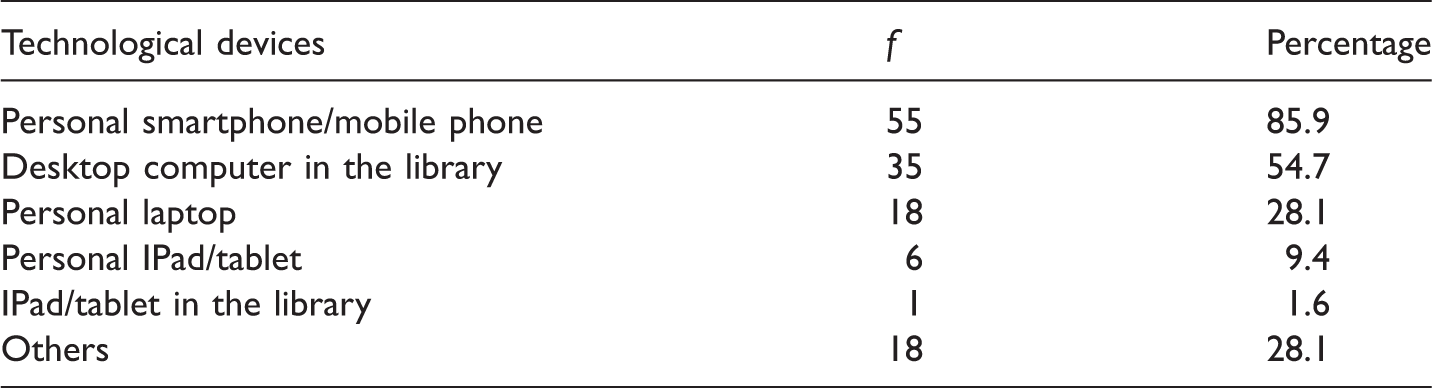
Research question 1: What are the devices students use to access Twitter?
Devices used by students to access Twitter (n = 64).
Research question 2: What are the purposes and benefits of using Twitter in teaching and learning?
Purposes
Analysis of both questionnaire data and students’ tweets revealed three themes relating to academic practice and activities of Twitter among students which include: communication; content sharing; and collaborative learning.
Communication: Whether graded or not, some studies (see Menkhoff et al., 2011) provide evidence that the use of Twitter can promote communication among students and learning among peers. The current study reveals that communication is one of the most innovative uses of Twitter that facilitates teaching and learning. Communication in this regard encompassed and occurred in various ways and scenarios. Firstly, as a lecturer I used Twitter to communicate with students by making course-related announcements. Such announcements included class cancellations, change in venue for lessons and announcements about the upcoming events. From the data I collected through a questionnaire, it was revealed that 39 (60.9%) of the students used Twitter to communicate either to each other or with the lecturer (me). Some of the statements from the students read as follows:
I used Twitter to communicate with the lecturer that I was to miss the lesson because I had to cherish my father who was sick in Lilongwe [Lilongwe is the capital city of Malawi and is located some 300 kilometres away from MZUNI];
I usually used Twitter to remind my colleagues about the time we were supposed to meet and work on our group work; and
At times, I used Twitter for personal reasons, i.e. announcing to my colleagues via this platform that I was selling a laptop.
From the statements above, it is also observable that students used Twitter to communicate items relevant to their non-professional life. Indeed, Twitter acted as a powerful and efficient communication link between me and students and students themselves. Analysis of the students’ tweets corroborated well with students’ statements. For example, students used Twitter to communicate to me about their failure to attend classes due to illness or other sensible inconveniences, to request that I extend the assignment deadlines and to ask for relevant information materials that could be used to accomplish their course assignments. For example, one student asked me by sending a private message as follows: “Sir, may you kindly send me any link of a website that provides details about predatory journal publishers”. To sum up, based on these findings, it is plausible to suggest that Twitter is a powerful tool that affords students to have a voice, to be more participative and interactive with their lecturers as well as with their colleagues in the learning process.
Content sharing: The practice of sharing information, media, and resources is one of the dominant purposes students and lecturers use Twitter for (Bista, 2015; Blair, 2013; Chichester, 2010; Veletsianos, 2012). Indeed, in this study, both questionnaire data and analysis of students’ tweets reveal that students used Twitter to share and exchange information about their course of study in a collaborative fashion. Specifically, questionnaire data showed that between 38 (59.4%) and 56 (87.5%) of students used Twitter to share course materials and to work collaboratively. Principally, students shared course content such as interesting books (electronic or print) available in the University Library or online, online journal articles and databases and previous examination papers available online and websites that cover topics in a particular course of study. These findings echo those previously reported by Veletsianos (2012) who found that students used Twitter to share both, professional and non-professions items using Twitter.
Collaborative learning: Another pedagogical area where Twitter plays a central role is collaborative learning (Bista, 2015; Blair, 2013; Chichester, 2010; McArthur and Bostedo-Conway, 2012; Veletsianos, 2012). In fact, “Collaboration is a central tenet of the social Web” (Pifarré et al., 2014: 72). In my study, data collected through a questionnaire and analysis of students’ tweets revealed that a large number of students used Twitter to collaborate in course-related endeavours such as accomplishing group assignments, sharing ideas, working on course-related projects and announcements. The following statements selected verbatim from students give substance to the claims by Bista (2015) that Twitter fosters and strengthens academic success of students:
It [Twitter] allowed me to discuss with colleagues in real-time when planning for our group assignment and what to include;
Twitter allowed me to instantly share and discuss course materials available in the web but not covered in class with a lecturer;
Twitter’s interactive nature allowed me to contribute and respond to the comments of classmates; and
My colleagues and I had a full hour everyday (evening) dedicated to discussing what we had covered in a particular lesson. This was done using Twitter without meeting physically and this was so convenient for me and my friends.
The findings of the current study therefore suggest that Twitter is an ideal tool for realising collaborative learning amongst students themselves and with lecturers.
Benefits
Expanding learning opportunities beyond the confines of the classroom: I noticed from the 12 week period I had an interaction with students that Twitter is a scaffolding tool for enhancing learning and teaching beyond the formal teaching and learning time. With Twitter, I spent more time discussing the most pertinent points in the classroom with students while reading and notes were discussed online outside the classroom hours. Routinely, I could tweet a topic of the forthcoming lesson for students to discuss before the commencement of the lesson, thereby allowing students to discuss the subject before class time. Through this arrangement, it was possible for me to focus deep discussions on issues that students found difficult to comprehend on their own. Some statements selected verbatim from students’ questionnaires that denote the use of Twitter as an avenue for learning outside the classroom are as follows:
It was interesting that I was able to ask the lecturer any questions [using Twitter] that I could not ask during class time during odd hours and weekends;
The fact that the lecturer could tweet a topic to be discussed well in advance before class began allowed me and my colleagues to explore more concepts about the topic; and
Commonly, I was not worried about missing some concepts in class as I could later send either a private Twitter message or post to the lecturer’s timeline seeking clarification.
Indeed, students’ statements give a lot of sense because I usually made a number of tweets before and after class times. Examples of such tweets included: “#IR, we will discuss elements of an IRS tomorrow”, and “#DL, we will continue looking at licensing in commercial databases”. After the lessons had finished, students independently continued to discuss the concepts anytime. In most cases, I also joined the discussion. This approach of teaching and learning using Web 2.0 technologies such as Twitter to extend teaching and learning beyond the formal time is referred to as flipped learning (Alharbi, 2015: 1466; Flipped Learning Network, 2014; Wanner and Palmer, 2015). Throughout the semester, I acted as a facilitator of the courses I taught leaving students to play an active and central role in the learning process. The fact that Twitter helped me interact with students in a flexible manner (no time limitation) and made my students take a leading role in the learning process, supports the idea that Twitter is a catalyst for flipped learning which according to the Flipped Learning Network (2014): puts emphasis on the importance of interactive and flexible teaching and learning rather than a passive form of instruction; characterises the educator as a facilitator rather than a dominator for the learning process; and that instructors guide students to engage in activities that lead to better learning outcomes.
Presence across multiple online social networks: An analysis of both questionnaires and the students’ tweets revealed that the use of Twitter motivated students to engage in other Web 2.0 technologies. Students searched more course content from multiple online platforms such as YouTube, blogs, Wikipedia among others which they shared with their colleagues and me. For example, the following selected extracts from students’ tweets illustrate that Twitter connected students to other online spaces:
#IR, the following YouTube link [Video title and Uniform Resource Locator (URL)] provides a good summary about the creation of amazing blogs;
#IR, I visited this Wikipedia page [Video title and URL] which gives a good outline about the concept of multimedia information retrieval;
#DL, I read more about three types of metadata as illustrated by Witten, Bainbridge, Paynter and Boddie (2014) here: [URL]; and
#DL, I found an article about the challenges against a smooth implementation and adoption of digital libraries in Malawi at this link: [URL].
Data from the questionnaire corroborated well with the above listed students’ tweets because some statements extracted from the questionnaire revealed the same as follows:
I was able to visit a number of websites searching for information relevant to my course of study which I shared with colleagues via Twitter; and
I could always depend on my colleagues’ information they had shared with me on Twitter and it was easy for me to click on the link to access the information.
Since Twitter only allowed them to write 140 characters or less, students had to direct their colleagues to various URLs that helped to clarify and substantiate their claims especially, where students held divided views or opinions about a particular topic under discussion. All students also used Google Drive (another form of Web 2.0) because of my influence. This was possible because I usually uploaded my lecture notes, course materials and grades on this platform, and I usually tweeted asking students to access this information. It is safe to conclude that despite using Twitter as a learning tool in a classroom, it also helps to inspire students to explore, visit and use more online resources from various online platforms such as YouTube, Wikipedia, blogs, Google Drive and other interactive applications that provide a wealth of relevant educational content. The results reinforce those findings reported by Veletsianos who equally found that the use of Twitter in a classroom environment allowed students to “consolidate and reinforce their digital presence and share online activities that occurred across numerous spaces on Twitter” (Veletsianos, 2012: 345).
Reflective learning: In this study, Twitter helped students achieve reflective learning, and in this context, reflective learning entails students’ ability to think critically about what they have learnt thereby being able to “apply previous learning to new situations” (Wheeler, 2010: 106). From the questionnaire data, overall, of all 64 respondents, 55 (85.9%) said they used Twitter to reflect on what they had learned. Students posted to Twitter what we had covered in the previous classes or lessons. One student commented that “I could easily read my friends’ comments about what we had covered in the previous lesson and this helped me understand the subject and easily link it with the next lesson” and another who agreed said, “I found an examination paper easier because I could easily recall what I had discussed or debated with the lecturer and colleagues via Twitter”. These comments suggest that reflection leads to internalisation of knowledge hence life-long learning. One more advantage of reflective learning is provided by Wheeler (2010: 106), who argues that Twitter enables students to “apply previous learning to new situations”. More interestingly, in this study, 18 (28.1%) students indicated that using Twitter which unintentionally connected them to other Web 2.0 tools (blogs, YouTube, and Wikipedia) prepared them for their future work places where they are expected to use social media technologies. However, it may be impractical to categorically make a sweeping conclusion that students’ use of Twitter prepared them for their work places, as it is difficult to prove at this stage unless a follow-up study is conducted in their work places when they leave university.
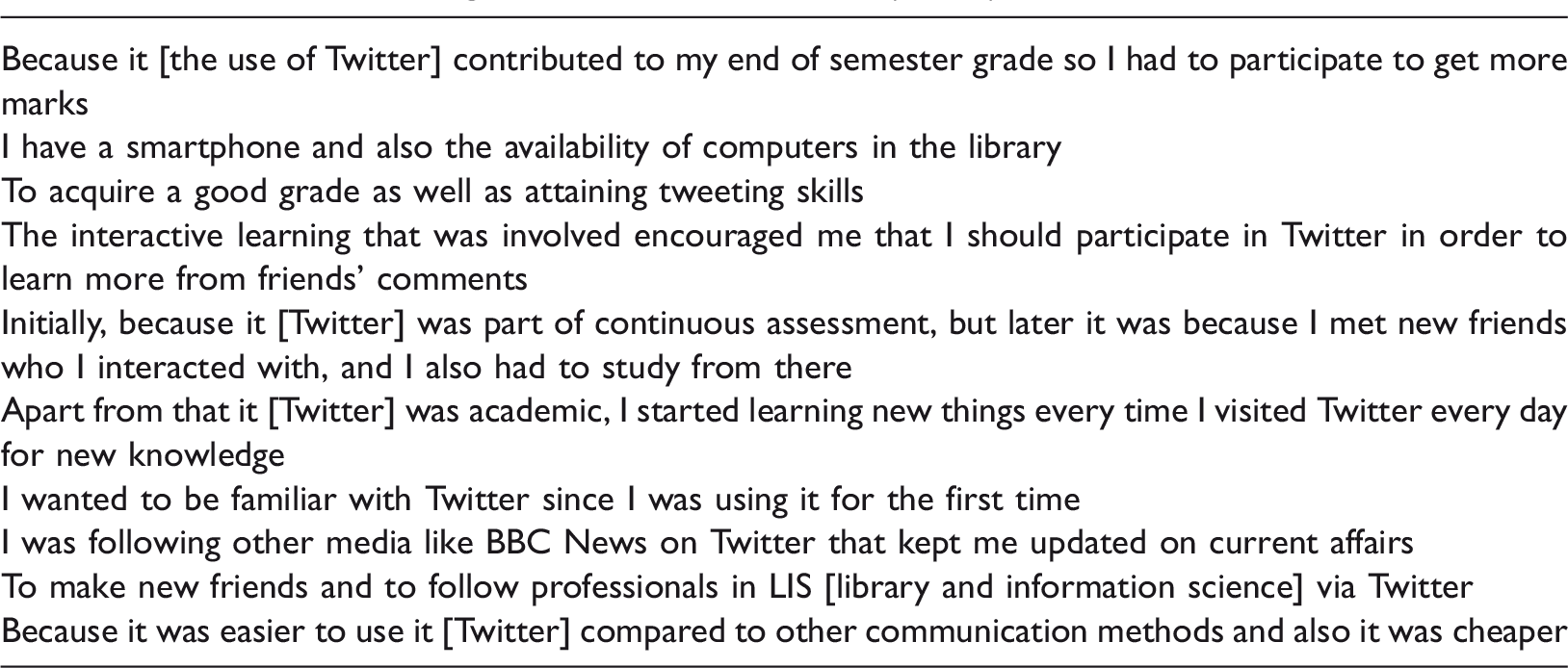
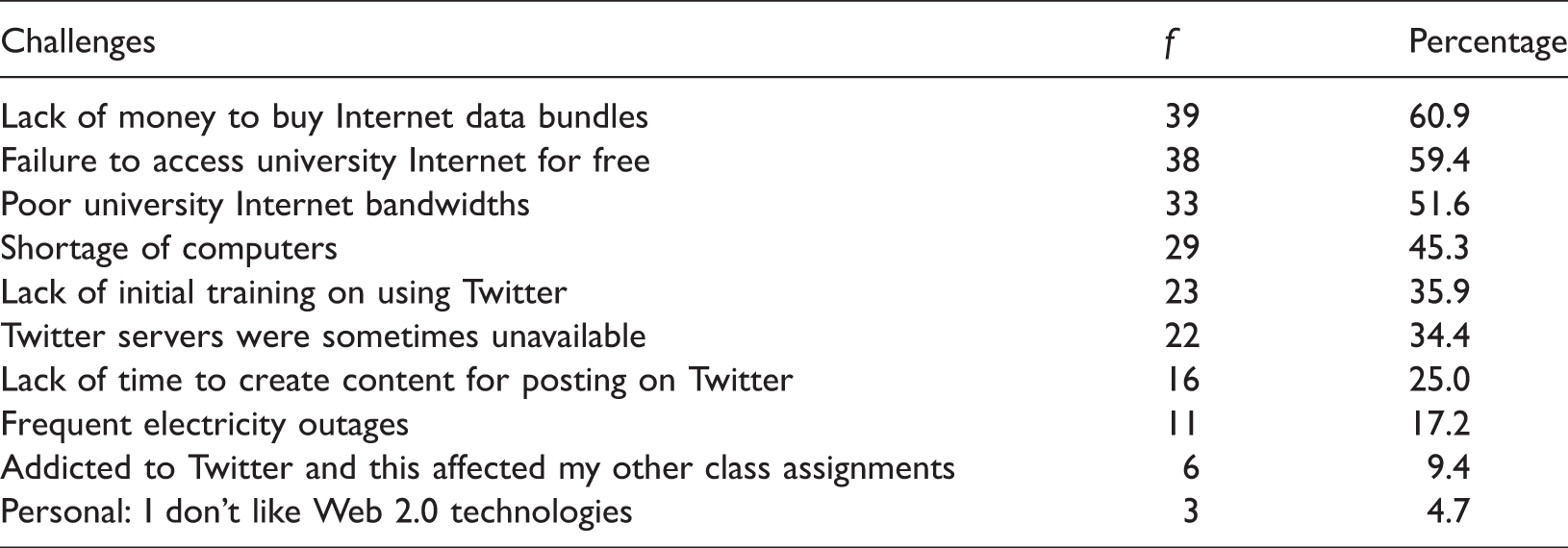
Research question 3: What are the reasons for students’ use or non-use of Twitter for academic purposes?
Factors that encouraged students to use Twitter (n = 64).
Reasons for non-use of Twitter (n = 64).
Conclusion
The study has provided a picture about the benefits of microblogging in an economically developing country where technologies are promisingly proliferating. Although the study is seen as the first of its kind in Malawi (a case study), it offers several insights about the innovative power of Twitter to enhance teaching and learning, especially if appropriately deployed. Taking into consideration that in most cases, the study findings mirror similar prior studies conducted in other courtiers, I am optimistic that the results can as well be generalised to other higher education settings especially in Malawi where universities operate in more similar environments. In more specific terms, the study finds that microblogging increases student generated content and evidently, increased students’ presence on multiple and seamlessly interconnected Web 2.0 technologies such as blogs, Google Documents and other interactive websites. In this way, microblogging has proven (at least according to the findings of the study) to be an impetus tool for teaching and learning based on the followings roles and benefits: it effectively complements blended learning by allowing students contextualise the learning outcomes in relation to course objects; it affords students an opportunity to participate in comprehensive learning where they either individually or collectively help each other; it helps students internalise the course content through reflective learning; and it influences students to tweet a wide range of professional items (though at times nonprofessional items are also tweeted) related to their course of study. The potential use of Twitter in higher education is met with equally convincing challenges. Mainly, the study found that lack of money to buy Internet bundles and inaccessible Wi-Fi on MZUNI Campus contributed to students’ non-use of Twitter for class activities. This means instructors intending to adopt Twitter and related technologies for teaching, should seriously consider the blocking factors mentioned.
Footnotes
Declaration of Conflicting Interests
The author(s) declared no potential conflicts of interest with respect to the research, authorship, and/or publication of this article.
Funding
This research received no specific grant from any funding agency in the public, commercial, or not-for-profit sectors.