




Abstract
Twitter and other social networking sites have much to offer doctoral students, especially given that models for doctoral education are increasingly becoming more diverse with more students studying part-time for traditional PhDs, or on programmes such as professional doctorates. Prior research has highlighted the benefits of Twitter but, as other studies show, its use amongst doctoral students is not always common place. Social networking sites such as Twitter allow for virtual networks to develop and supplement traditional institutional networks, and for many students these are becoming increasingly vital to combat the loneliness of the doctoral researcher. In this paper I have reflected on some of my own uses of Twitter and argue that its impact upon my development can be theorized through Margaret Archer’s notion of the internal conversation. This is done through drawing on autoethnographic reflections of my own doctoral experiences and through this extends understandings of reflexivity into digital spaces. In doing so, this paper also highlights different ways in which Twitter can support these conversations. This paper also foregrounds some of the potential challenges of moving these conversations into a public space, such as the need to build networks, and the potential implications of putting emerging thinking into a permanent form. In considering these issues, this paper offers suggestions on how effective Twitter use can be supported in doctoral training to ensure that doctoral students can enjoy its affordances and be prepared to navigate the potential challenges it poses to the emerging researcher.
Introduction
This paper explores the ways Twitter has been central to my own doctoral development through examining autoethnographic reflections (Holman-Jones, 2005) on particular moments through Margaret Archer’s (2003) theory of the internal conversation. These reflections highlight not only the affordances Twitter provides but also some of the challenges of having these conversations in public. The paper concludes with suggestions of how doctoral training may need adapt to take these affordances and challenges into account and thus contributes to understandings of how Twitter can support doctoral training.
An increasing number of doctoral researchers and experienced academics use Twitter to create and support their academic networks. Twitter has many uses in academia such as: a platform for networking (e.g. Weller, 2011), impact (e.g. Schnitzler et al., 2016) publicity and promotion (e.g. Terras, 2012), as a learning space (e.g. McPherson et al., 2015) and to develop communities of practice (e.g. Lewis and Rush, 2013). However, as Carrigan (2016) outlines in his comprehensive handbook Social Media for Academics, there are also many potential pitfalls in its adoption, such as the enduring nature of posts, the potential for misinterpretation of simplified ideas to fit into 140 characters and the possible impacts upon professional image. Furthermore, Lupton (2014) also cites examples of academics failing to gain promotion based on their Twitter posts. It can therefore be seen that Twitter is a complex platform that may require deeper understanding in order to use it most effectively. Donelan (2015) cites negative perceptions and lack of time as one reason for low usage among academics, and this paper seeks to show some of the ways in which Twitter has had a positive impact on my own doctoral development to argue for the value of dedicating time to using this platform.
Whilst there is a growing body of research on Twitter and its use in education, this often focuses upon either students or experienced academics. Knight and Kaye (2014) found that undergraduates and staff placed different relative emphasis on different uses, however they both used Twitter for information seeking, information sharing and networking. The position of the doctoral student sits between these bounds and it is to this area of scholarship that this paper contributes.
Doctoral ‘becoming’
Study for a doctorate can be thought of not just as completing a qualification but of ‘becoming’ (Barnacle, 2005; Barnacle and Mewburn, 2010). For full-time students, this becoming is often negotiated in shared physical spaces, however, for many students, this full-time mode of study is not possible. This has led to more diverse modes of study: part-time study for a traditional PhD, one of the more employment focused professional doctorates, or combinations of full-time and part-time study. With full-time work and part-time study, it can be easy to feel on the outside of the academy looking in. However, regardless of the mode of study, isolation is seen as one of the biggest challenges to doctoral students (Ali and Kohun, 2006). Advances in digital technologies can to some extent reduce this isolation, and this paper will foreground some of the ways in which Twitter has reduced my own sense of isolation through affording access to a digitally enabled community. Before examining some examples, the paper will first outline the role of reflexivity and the internal conversation for the emerging doctoral researcher.
Reflexivity and the internal conversation
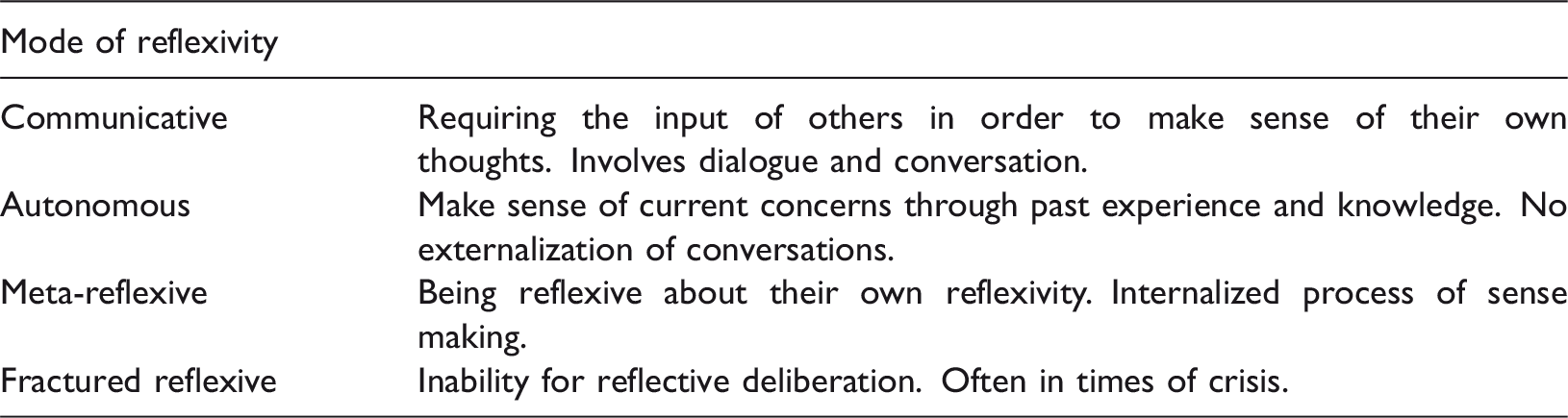
Reflexivity is the ‘generative ability for internal deliberation on external reality’ (Archer, 2003: 20). However, in order to be able to carry out these internal deliberations, the individual needs knowledge or experience to draw upon. These internal deliberations or conversations, as Archer terms them, can be thought of as a form of sense making. They can adopt one of three main modes: Communicative, Autonomous and Meta-reflexivity. A fourth mode that she terms the ‘Fractured reflexive’ is also possible. I have theorized more extensively elsewhere (Rainford, 2016) how these modes are enacted within Twitter but to briefly outline these modes:
More recent work by Popora and Shumar (2010) proposes that individuals may draw upon multiple modes of reflexivity in different situations, depending on their novelty and the individual’s resources to make sense of them without external inputs. If we consider this in terms of doctoral ‘becoming’, despite having a relatively high level of education, there are many experiences and situations that are novel upon which the doctoral researcher does not have existing resources to make sense of, and therefore, I would argue that individuals move between modes of reflexivity based on the resources and experiences they have developed.
Twitter as a tool for reflexivity
Archer (2003) focuses on face to face interactions within personal networks to support communicative modes of reflexivity. Since her initial research, technological advances have changed the way we communicate, and as Neil Selwyn and Eve Stirling (2016) highlight, social media is now, for many, part of peoples’ everyday lives and their main engagement with the internet. As such, I would argue that Twitter affords previously unavailable opportunities to make sense of experiences, both in terms of providing a tool for communicative reflexivity and offering a window into the experiences of others to build up a wider set of experiential resources to draw upon when working in a more autonomous mode of reflexivity.
The virtual common room
For full-time doctoral researchers, much time is spent in either shared physical spaces with peers or academics who may have faced similar experiences or challenges. Twitter affords the opportunity for these spaces to transcend the physical limits of offices and common rooms to move into a geographically unbounded digital space which has the capacity for a multitude of voices being present with whom the individual can dialogue. Depending on the issue in question, a single question may elicit tens to hundreds of responses, therefore Twitter affords a space to draw upon a much wider pool of experience in order to make sense of current situations.
When I was first trying to find a theoretical model to support my ideas on doctoral becoming, it was through conversations with more experienced researchers that I was able to understand how theory can be adapted and developed. As an early stage researcher, this is something I could not have understood autonomously due to a lack of experience. Having access to a number of people to talk through my thoughts allowed me to develop my thinking in the same way a face to face discussion with more experienced colleagues or a supervisor might. This dialogue is an example of an internal conversation that is supported by a communicative mode of reflexivity. What Twitter has enabled in this case is access to others who have experiences on which to draw. These conversations are different to those had in a private space, however, as not only are they in a public space but the digital footprint of them remains long after the conversation is over, and it is this concern to which I will now move.
Private deliberations in a public space
There is a paradox created by Twitter being a public platform. Whilst this affords access to a large number of interlocutors, it also makes these deliberations public. Once content has become digital ‘it is easily and perfectly reproduced’ (Weller, 2011: 29). In terms of a democratization of knowledge this may be a benefit, but it also means that for new scholars, their emergent thoughts are etched into permanence if these communicative dialogues take place on Twitter. It is also important to note that in the context of some professions such as health care, discussing certain issues may be inappropriate and break rules of professionalism (Chester at al., 2013). In the early stages of doctoral becoming individuals often need to seek answers to questions that expose their naivety. This can create real anxiety when the networks that doctoral researchers draw upon may be those who offer future employment. This concern manifested itself in my own experiences when I was discussing the rejection of a conference paper. Would exposing myself as having not had my paper accepted cause people who I respected to have a lesser view of me? The dilemma was that I did not have the experience to draw upon so could not reflect on this autonomously and instead needed to draw on a communicative mode of reflexivity which, due to my remoteness, ended up taking place on Twitter. As it turned out, this concern was unfounded and actually in sharing this experience it brought to the fore stories of rejection from many people. In this case, the potential benefits outweighed the risks and yet, as Lupton (2014) notes, what is said on Twitter can have a very real impact on career trajectories so these worries were not unfounded.
This risk is one that is associated with the use of Twitter as a mode of communicative reflexivity, but in fact for those who are not comfortable with putting their concerns out there, the public nature of Twitter can still offer a resource on which they can draw as, by being exposed to similar conversations, they can make sense of their own experiences, understanding how they are often a wider concern. Mayes (2015) explored the notion of vicarious learning in terms of viewing recorded tutorial dialogues. Adopting a mode where Twitter is simply used to find content could therefore provide the resources for an individual to reflect autonomously on their own experiences. Unlike in the communicative mode, by seeing how others make sense of their own dilemmas, an individual can then develop vicarious experience to reflect autonomously on their own situation. This, however, is only possible when they are able to view such conversations. Without a suitable network, Twitter can simply become devoid of content, or an echo chamber where an individual gets no responses.
The dangers of the echo chamber
Framing the role of Twitter in internal conversations through a communicative mode of reflexivity means that at least one other person is needed to enter into dialogue with. For this reason, Twitter excels over other SNS for reflexive deliberations as it is predicated on shared conversations, not just shared content as on services such as Tumblr or Pinterest. That being said, its ability to support these conversations is reliant on developing a suitable network of possible interlocutors.
One way in which I have built my own networks is through participating in tweetchats or through viewing tweets indexed with hashtags. Following the #Acwri hashtag, for example, has enabled me not only to discuss writing with others but to extend my own network to incorporate those beyond my own discipline with useful experiences on which I can draw. Others, such as #PhDchat offer a wide range of voices with whom to converse or on which to view the conversations of others vicariously. These conversations often transcend disciplinary boundaries and therefore offer unique insights into specific topics.
Implications
Through reflections on my own experiences, it can be seen that there are a number of key benefits of Twitter to the doctoral researcher through reducing isolation and in building a network of experience and knowledge to draw upon to make sense of these experiences. I would suggest that Twitter can afford opportunities for doctoral development beyond the traditional supervision model and allows a democratization of power and knowledge. As I have highlighted, this is only possible once a network has been developed and therefore there is a clear case for doctoral training programmes to support new doctoral researchers in effectively building networks.
Existing literature (Carrigan, 2016; Lupton 2014) and my own concerns have also foregrounded a number of potential pitfalls of Twitter and therefore this training should also make new researchers aware of these in order to reduce the potential risks that using Twitter may pose to their sense of self.
Conclusions
Footnotes
Declaration of Conflicting Interests
The author(s) declared no potential conflicts of interest with respect to the research, authorship, and/or publication of this article.
Funding
The author(s) received no financial support for the research, authorship, and/or publication of this article.