



Abstract
Twitter is increasingly accepted as an important educational technology and has been shown to serve a range of purposes. In fact, this variety suggests that Twitter has the potential to serve as a foundational technology: one capable of supporting teachers’ learning across multiple formal and informal contexts. To explore this possibility, we examined the purposes that Twitter serves in one educational technology graduate program. We collected over 9000 tweets containing any of 12 program-related hashtags and coded a sample of them to describe the purposes they served. This resulted in six themes: contribute to disciplinary conversation, engage with disciplinary conversation, build community, make connections with other communities, ask for and provide support, and unclear or irrelevant purpose. These themes—and the varied contexts they were associated with—suggest that Twitter serves as a foundational technology in this program and has the potential to do so in other educational communities.
Introduction
Twitter is becoming increasingly accepted as a powerful technology for educational professionals. However, as with any technology, there is reason to question the assumption that Twitter has “intrinsic powers that affect all people in all situations the same way” (boyd, 2014: 15), an attitude known as technological determinism. Rather, any technology plays different roles and has different consequences when it is applied in different contexts (Kranzberg, 1986). This has been demonstrated in prior research about the educational use of Twitter, which has served a variety of purposes, ranging from self-reflection (Wright, 2010) to sharing course information (Lowe and Laffey, 2011).
However, Twitter also has the potential to act as a foundational technology; that is, while it does not have the same effects or affordances across all contexts, it may be able to serve key purposes in a number of different areas. In this paper, we highlight this potential by examining how Twitter serves as a foundational technology for teachers enrolled in an educational technology master’s program. By demonstrating the diversity and variety associated with these uses of Twitter, we aim to invite researchers, teachers, teacher educators, and others to expand their conception of Twitter and more closely consider how this tool may be of value in their practice and their context.
Background
We will use this section to highlight the role of technology in the processes of teaching and learning, introduce the ideas of foundational technologies and learning ecologies for teachers, and review existing research on educational uses of Twitter.
Technology in teaching and learning
It has long been recognized that technology plays a mediating role in humans’ teaching and learning. Indeed, Molenda (2008) suggests that it may be possible to trace the history of educational technology as far back as the beginning of human history. Beginning in the 19th century, teachers began to recognize the power of technologies such as the blackboard to change education in important ways (Bumstead, 1841), and the list of technologies designed or adapted for teaching and learning is now changing at a rapid rate (Mishra and Koehler, 2006).
In fact, theories of learning now put technologies at the center of the learning process. The influential educational psychologist Lev Vygotsky saw tools as an important part of the developmental and learning processes (Vygotsky, 1978). Scribner and Cole (1978)—who were influenced by the work of Vygotsky and his contemporaries (see Cole, 1998)—framed literacy as a kind of practice; that is, as “the carrying out of a goal-directed sequence of activities, using particular technologies and applying particular systems of knowledge” (Scribner and Cole, 1978: 457). This conceptual marriage of technology and literacy has been influential; indeed, researchers have suggested that the technological innovations associated with Twitter have given rise to new kinds of literacy (Greenhow and Gleason, 2012).
However, the vast range and continuous evolution of contemporary technologies complicates their role in education. Given the range of technologies now available, new literacies researchers have argued that learners cannot possibly master them all and must therefore decide which ones will best support them in their efforts (Coiro et al., 2008). Likewise, teachers can no longer expect that the technologies they learn about during their training will continue to be useful throughout their career and must learn to evaluate, adapt, and adopt technologies as they come and go (Mishra and Koehler, 2006).
Teachers, foundational technologies, and learning ecologies
Teachers not only facilitate others’ learning but are also expected to continue their own learning and professional development. Indeed, whether it is through professional development activities, graduate degrees, or informal discussions with colleagues, teachers have many opportunities to foster their professional practice. Whatever these settings have in common in terms of continued learning, they remain distinct from each other in some important ways. For example, graduate degrees can be thought of as very highly structured learning opportunities with a set curriculum and formal requirements for completion; on the other hand, interactions with other teachers are looser forms of professional development that may have no requirements at all.
Participating in several of these contexts may put a strain on teachers’ knowledge and resources. Because “particular technologies have specific affordances and constraints” (Borko et al., 2009: 4), it is not difficult to imagine that a different technology could be best suited for supporting learning in each of these settings. However, each new technology that teachers must use to support their learning increases the amount of technology knowledge (Mishra and Koehler, 2006) that they must acquire, increasing the cost of engaging in new contexts for continued professional development. It goes without saying, then, that any technology that can support learning in multiple contexts drastically eases the burden teachers face when implementing technologies into their continued professional development.
In this paper, we refer to these technologies as foundational technologies. This term has previously been used to describe important technologies in the fields of national security (Chameau et al., 2014), industry (Allenby and Rejeski, 2008), and chemistry (Conley et al., 2006). In borrowing the term, it is not our intention to suggest that any educational technology will have the same influence on education that these authors describe technologies like fossil fuels or railroads as having on the world. However, Chameau and colleagues (2014: 45) describe foundational technologies as those that “can enable progress and applications in a variety of … domains”; we find this description to be apt for describing certain educational technologies, even if they meet the description at a smaller scale.
Indeed, foundational technologies may play a key role in supporting what Barron (2006) has referred to as a learning ecology. This term refers to “the set of contexts found in physical or virtual spaces that provide opportunities for learning” (Barron, 2006: 195). That is, a teacher’s learning ecology may be composed of both formal settings such as graduate degrees and informal settings such as brief chats with colleagues at the end of a school day. Central to the learning ecology concept is the idea that these informal and formal contexts interact with and inform each other as individuals pursue knowledge; a foundational technology that supports learning in several of these contexts is therefore likely to assist in the transition and translation of knowledge across them.
Educational uses of Twitter
Prior research suggests that Twitter has the potential to serve as a foundational technology for teachers in that it illustrates a variety of purposes that this technology can serve in learning settings. For example, Twitter has been used to invite self-reflection during student teaching experiences (Wright, 2010), develop teachers’ professional learning networks (Holmes et al., 2013), and guide self-directed learning (Greenhow and Gleason, 2012; Visser et al., 2014). Likewise, Carpenter and Krutka (2014) have shown how educators at the primary, secondary, and university levels use Twitter for professional development, emotional support, and other purposes.
In fact, research suggests that Twitter could be even more of a foundational technology by supporting not only teachers’ continued learning but also their facilitation of students’ learning. Greenhow and colleagues (2014) examined how adolescents used Twitter to develop their identities and interests, thereby demonstrating that students are also using Twitter as part of their own learning ecologies. Some teachers have capitalized on this in their classrooms while continuing to use Twitter for their own purposes (Carpenter and Krutka, 2014). Research demonstrates teachers’ use of Twitter to share information and engage students (Lowe and Laffey, 2011), and Junco and colleagues (2011) describe a particular undergraduate class in which Twitter was used for everything from continuing class discussions to providing reminders for campus events.
Purpose
As previously mentioned, prior research demonstrates that Twitter can serve a wide range of purposes in both formal and informal educational contexts. Inspired by this research, we have explored and described the purposes that Twitter serves in a graduate program of educational technology. Taking an entire graduate program as our scope has allowed us to examine the different contexts that teachers participate in and the different purposes that Twitter serves within and between these contexts. When enrolled in a graduate program, teachers are engaged in completing formal requirements for a structured form of professional development but are not restricted from continuing to participate in more informal learning settings. In addition to these diverse contexts, teachers are also members of multiple, overlapping educational communities, including the schools where they work and the institutions at which they study. Furthermore, they move from course to course and from being newly admitted to being program alumni. Yet, despite the diversity and transitions that exist within the scope of this program, one technology seems to remain constant: Twitter.
The purpose of this paper is therefore to demonstrate how Twitter serves as a foundational technology in this program. We highlight the distinct purposes that Twitter serves and demonstrate how these purposes play out in a variety of different contexts. Although our findings are grounded within one particular graduate program, our intention is that they will provide an example of how Twitter can serve as a foundational technology for teachers in a wide variety of other contexts.
Research context
In this paper, we focus on the use of Twitter in Michigan State University’s Master of Arts in Educational Technology (MAET), a mostly online graduate program that also provides opportunities for hybrid and face-to-face learning. While all graduate programs—especially those that offer courses online—use technology to accomplish their purposes, educational technology programs like MAET are unique in that they must not only feature diverse and innovative technologies but also prepare teachers to apply and use these (or other) technologies in service of students’ learning. In conjunction with this responsibility, the MAET program aims to prepare teachers to think flexibly and creatively about the relationship between technology, pedagogy, and content and how the ways in which they use technology are appropriate for their needs (DeSchryver et al., 2013).
Referring to those enrolled in the MAET program is a complicated affair, but we have adopted a standard vocabulary for the purposes of this paper. Although it is mostly primary and secondary school teachers who join the program, there are also community college instructors, instructional coaches, and a variety of other education-related careers represented in the MAET ranks. Further complicating the issue is that while most of these individuals exercise a teaching profession during the workday, they become students when they participate in the classes they are taking. To acknowledge the professional roles they play and their choice to engage in an educational career, we have chosen to refer to all those enrolled in the MAET program as teachers. In contrast, we refer to those who administer, design, and teach MAET classes as instructors. We refer collectively to all those affiliated with the MAET program (including teachers, instructors, alumni, and others) as the MAET community.
We have all been instructors in the program, which has afforded some insight that has guided this paper. For example, we know that the MAET program intentionally uses social media in an effort to foster community (Terry et al., 2013), and we are familiar with most of the classes and many of the assignments that make up the MAET curriculum. However, this familiarity has not replaced the role of honest inquiry: Even if MAET has programmatic goals for the use of social media in the program, all technology has effects beyond those that were originally anticipated (Kranzberg, 1986). Emergent behavior and emergent elements of the community made it impossible to anticipate all of the purposes that Twitter might serve within the context of MAET.
Method
In order to describe the purposes of tweets related to the MAET program, it was first necessary to collect and analyze those tweets. In this section, we describe the method we used to collect MAET-related Twitter data, our ethical considerations during the collection process, and the steps we took to analyze the data.
Data collection
Hashtags collected for this study.
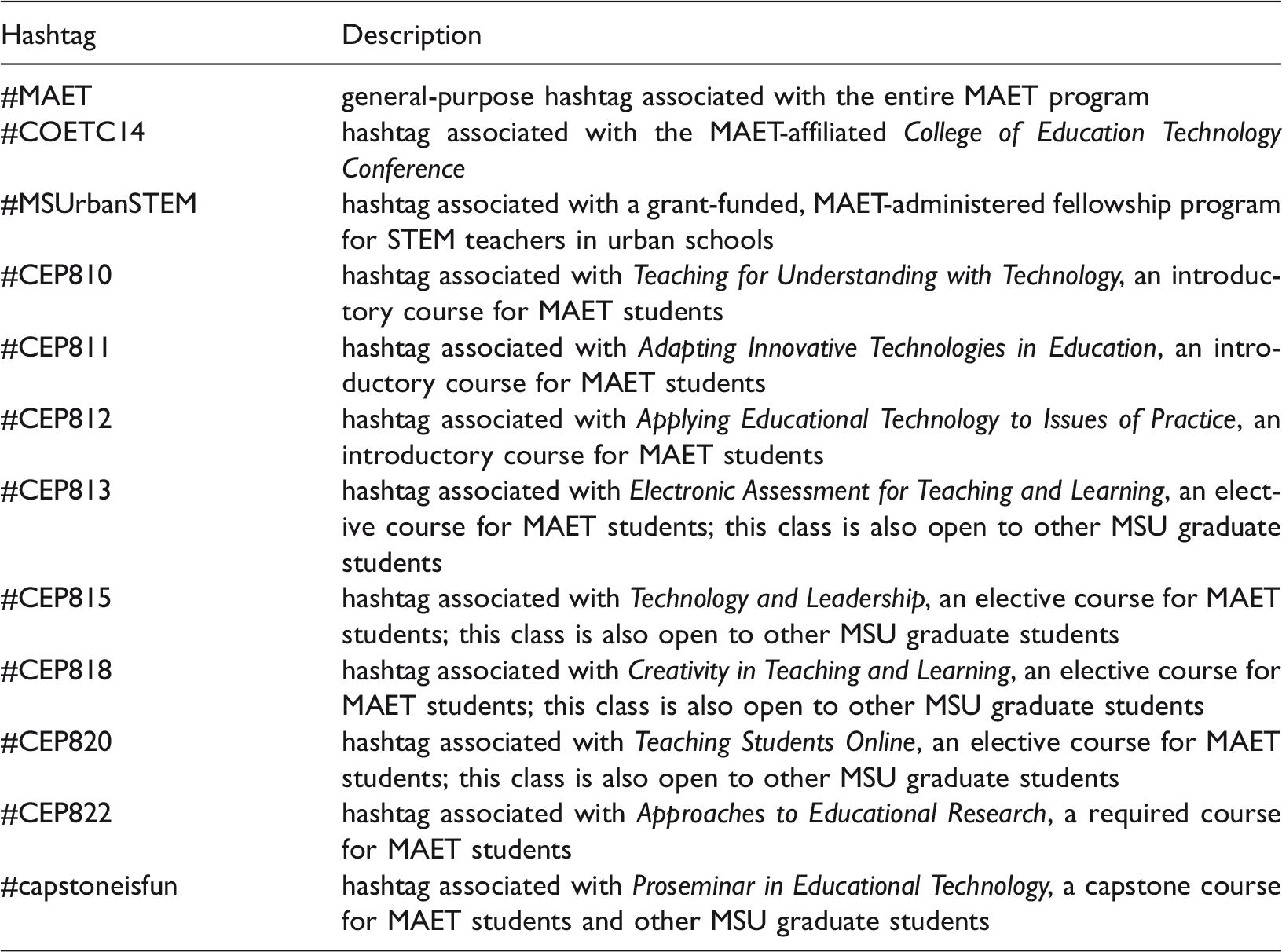
Having identified these hashtags, we took steps to begin collecting data. On 7 July 2014, we set up two instances of the Twitter Archiver (Agarwal, 2015), a tool that uses the Twitter application programming interface to continuously collect in a Google Spreadsheet up to 50 tweets per 15-minute block of time that (a) use a particular hashtag and (b) are sent after the activation of the Archiver. These first two instances collected tweets associated with the #MAET and #CEP810 hashtags and were meant to determine the viability of this data collection method. After establishing that viability, we began collecting tweets for the remaining 10 hashtags on 15 August 2014. We collected data through 23 June 2015: a total of 352 days for #MAET and #CEP810 and of 313 days for the remaining hashtags. The total number of tweets collected in our 12 Archivers was 9333; however, this number counts some tweets multiple times because they were logged in more than one Archiver. The number of tweets per hashtag is displayed in Figure 1.
Number of tweets per hashtag. We collected tweets from #MAET and #CEP810 from 7 July 2014 through 23 June 2015 and from 15 August 2015 through 15 June 2015 for the remaining hashtags.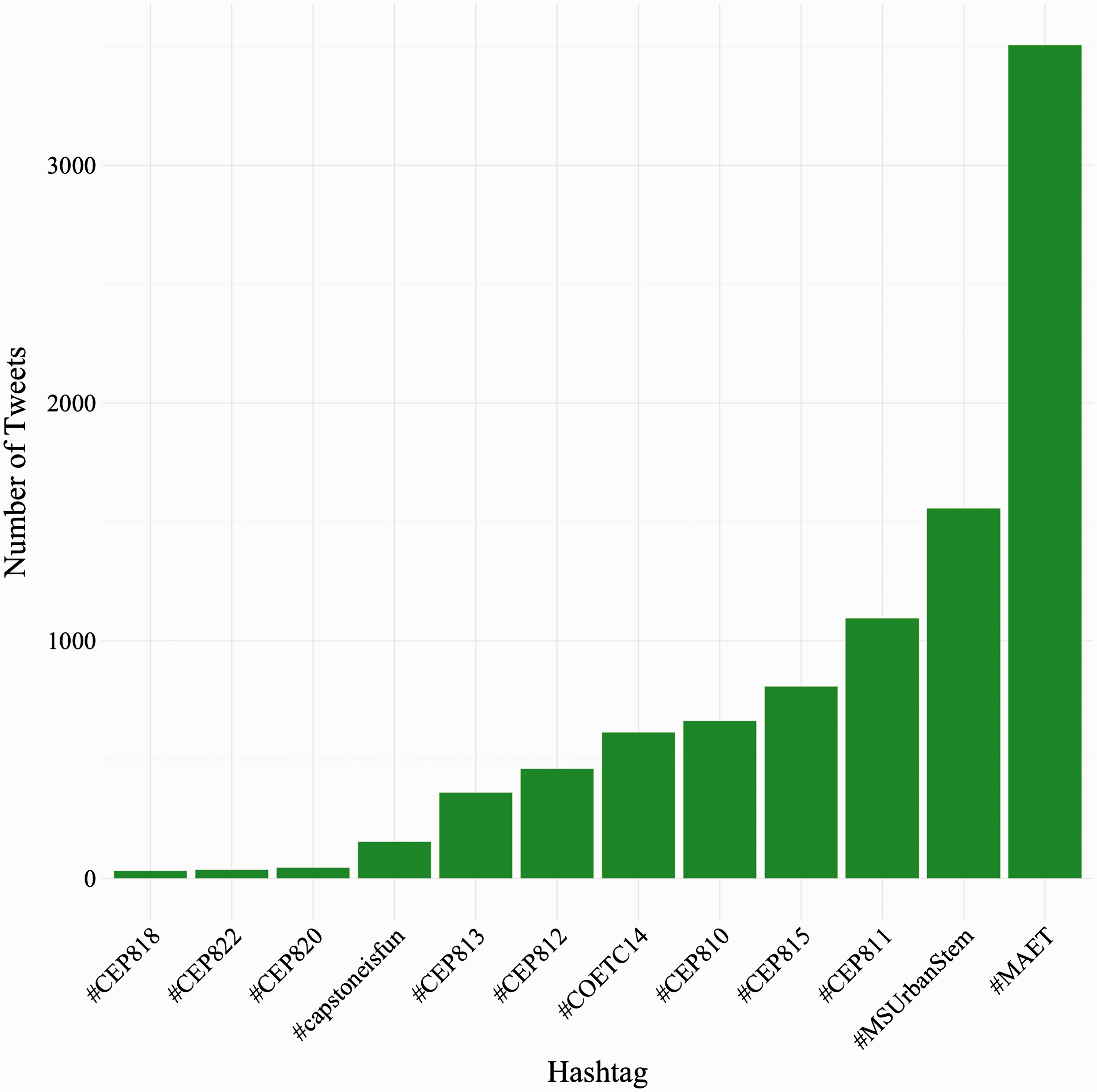
Research ethics
Twitter and other Internet data provide new ethical challenges for educational (and other) researchers. Inspired by medical research, the concept of human subjects research has long been the distinguishing factor in whether researchers are required to submit their work to institutional review boards (IRBs) for ethical review (Markham and Buchanan, 2012). However, data such as the collection of tweets described above frequently do not qualify as human subjects research; indeed, this study did not require review by an IRB according to the definitions set out by Michigan State University. However, Internet researchers are increasingly vocal in their arguments that existing ethical frameworks are not well suited to digital data (Markham and Buchanan, 2012) and that the limits established by the law are also inadequate for determining what constitutes ethical Internet research (Eynon et al., 2008).
In response to the absence of universal, clear guidelines for Internet data, we have taken explicit steps of our own to report our findings ethically. Most notably, we have tried to avoid the use of direct quotation throughout the paper, even when referring to particular tweets. Twitter’s search function is powerful enough that even a small but distinct quotation may be sufficient for identifying a particular tweet, and while tweets can be considered public documents, we feel that it is important to acknowledge that notions of publicity and privacy on the Internet are mediated by varying expectations, intentions, and contexts (Eynon et al., 2008; Markham and Buchanan, 2012) and that no one has provided explicit consent for their tweets to appear in this paper. When we have chosen to quote from tweets, we have made modifications such as excerpting tweets and removing URLs to personal blog posts in order to preserve as much anonymity as possible.
Procedure and data analysis
The first step of our data analysis was to develop themes that described the purposes that individual tweets served in the MAET context. We initially developed these themes during the course of an earlier study of these tweets (Greenhalgh et al.,2016). At that time, we had collected 8235 tweets, and we took a random sample of 5% (n = 412) of these tweets, stratifying the sample by hashtag. Although we sampled without replacement, it was possible for a tweet to show up more than once in our sample. For example, if a tweet was retweeted (i.e. reposted by another user) at least once, it was logged more than once in a Twitter Archiver, and the random sample could have included it more than once. Furthermore, if a tweet included multiple MAET-related hashtags—and was thus logged in more than one Twitter Archiver—the random sample could have included it as part of multiple strata. Although it sometimes led to coding the same tweet more than once, we felt that this was an important part of faithfully representing the MAET tweets. For example, as reposts of original ideas, retweets typically serve to echo the original sentiment of a tweet. Therefore, retweets can be seen as reinforcing particular purposes of Twitter use by implicitly adopting whichever purpose was associated with the post being retweeted. Likewise, we felt that an accurate depiction of the MAET Twitter community hinged on using a stratified sample, even if that involved the possibility of including a tweet more than once.
As part of this initial analysis, the first two authors divided the sample into two sets of 206 tweets. Each author worked separately on a single set, identifying purposes for each tweet in that set through in vivo coding (Saldaña, 2015), the process of reviewing data and making notes of what themes emerge and what patterns arise. When determining these purposes, they considered the text of the tweet, the destination of any links included in the tweet, and—as needed—the conversation that the tweet was a part of.
The authors then met to turn their initial notes into a single, parsimonious set of themes. They initially identified 26 possible themes that, through repeated reviews of the data and extensive discussion of the themes, were collapsed into six major themes. To test the suitability of these themes, the authors returned to the 412 tweets and individually coded each tweet as belonging to one of these six themes. The authors then met to make changes to the themes through reviewing their efforts and resolving any disagreements arising during the coding process. Throughout this process, the authors made two considerations that anticipated future research in this vein: First, they developed codes that were mutually exclusive, so as to facilitate future quantitative and mixed-methods analysis of tweets using these themes as a coding frame. Second, they developed codes that were not too deeply rooted in the specific context of the MAET program, so as to facilitate future repurposing of this coding frame.
For this study, we took additional steps to further ensure the suitability of the initial coding frame for our purposes. The first two authors coded additional tweets to test and refine the initial codes; throughout this process, they regularly met to refer back to the original coding process, resolve disagreements, and refine the themes. After coding a total of 854 tweets, the raters felt they had achieved saturation and that the resulting themes were descriptive and accurate enough for the purposes of this paper.
Results
Summary of themes emerging from open coding.
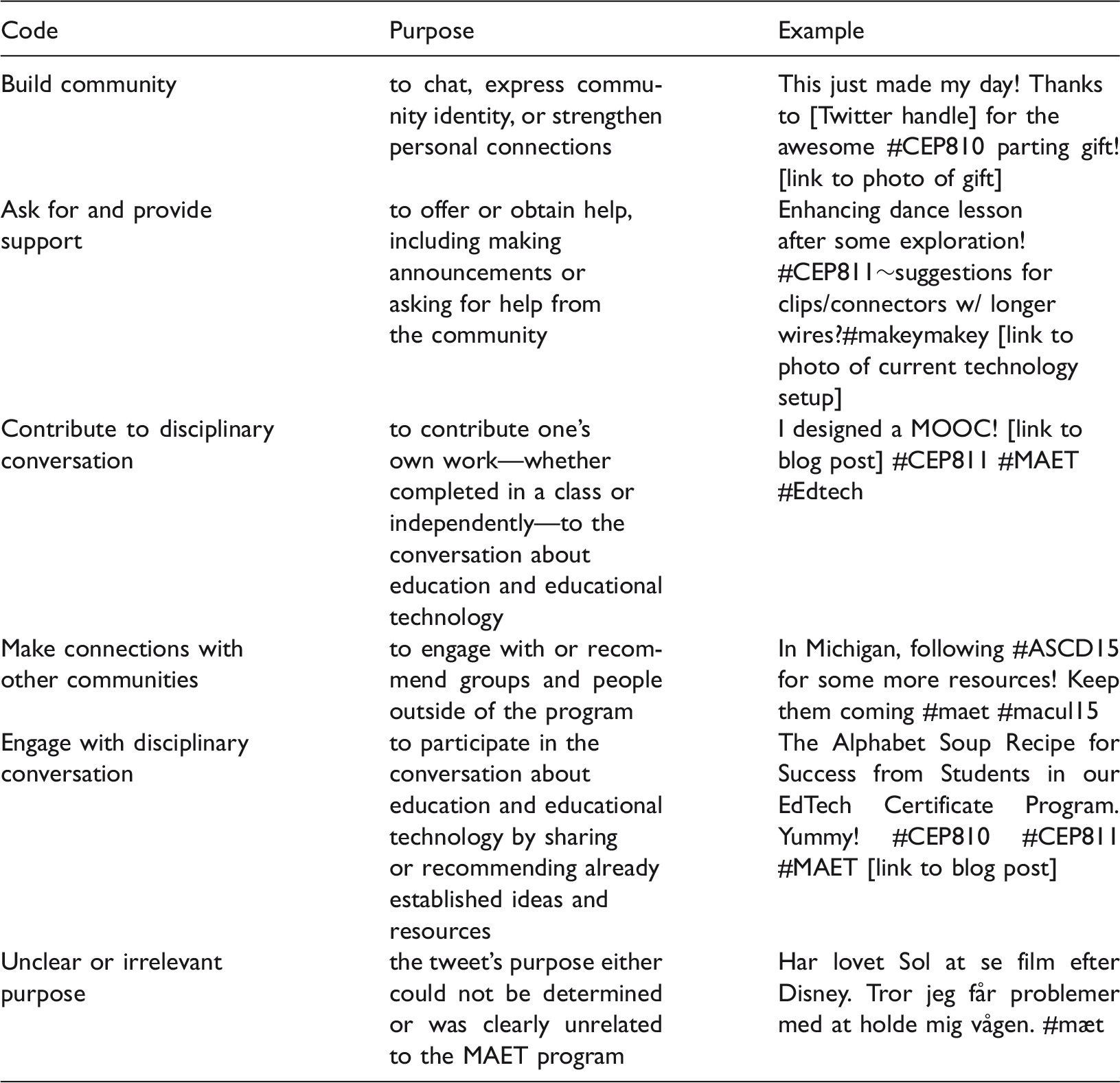
Contribute to disciplinary conversation
Our first theme is characterized by tweets that served to contribute original work to conversations about education and educational technology. Members of the MAET community are—by definition—involved with these fields, and it is unsurprising that they would use Twitter to add their own thoughts or work to broader conversations on these topics. Tweets associated with this theme emerged from several contexts, including MAET assignments, face-to-face MAET classes, teachers’ own classrooms, and unprompted personal work.
Many of the tweets in this theme involve teachers tweeting links to the homework assignments they completed in the MAET courses that they were enrolled in. However, it is interesting to note that teachers appear to have responded to this invitation in different ways. For example, consider the following two excerpts from tweets, each of which was presumably composed in response to the same homework assignment challenging teachers to learn about productivity techniques and software:
“Starting using @Wunderlist to help me collect ideas and increase my productivity - Check out my blog post” “Check out my blog for my assignment of GTD using Wunderlist!”
These tweets seem to differ in how they frame the conversation that they are contributing to. The first tweet is written in terms of a broad educational conversation, to the point that readers would be forgiven for not realizing that it was associated with a class assignment. The teacher who composed this tweet did not frame her use of Wunderlist—a task-management application—in terms of MAET homework but presented it instead as a choice that she had made and even mentioned the official Wunderlist Twitter account in an attempt to reach out and engage with them in a public space. Although it is not included here, the blog post she links to demonstrates a similar approach, describing her experience with the software in general (rather than assignment-specific) terms. On the other hand, while the second tweet is still an original contribution of a teacher’s experience with productivity software, this teacher has emphasized that the work is associated with a class assignment, thereby directing his comments to a smaller, class-specific conversation.
Members of the MAET community also used Twitter to show what was going on in graduate classes. Although MAET is primarily an online graduate program, there are opportunities for teachers to take face-to-face and hybrid classes. Twitter seems to continue to serve a purpose in these face-to-face settings by allowing instructors and teachers to show others in the MAET community, or even the outside world, what they are up to. For example, one group of students in one of the MAET overseas cohort proudly announced to other students that they had come up with a logo for their group; in another instance, an MAET instructor took a short video of teachers in her class completing an activity and tweeted it for others to see. These contributions are notable in that they consist of expressions of the learning process rather than of any finished product.
In some cases, teachers used Twitter to share with the rest of the MAET community what they were doing in their classroom. For example, one teacher took a picture of her third grade students using a particular piece of software in the classroom and posted it to Twitter, using an MAET hashtag to alert the community at large as well as specifically mentioning an instructor who had inspired the work. Although this could have easily remained a semi-private conversation between a teacher and her instructor, her use of the hashtag was a way of contributing her experiences and ideas to a broader conversation about educational technology. Even when teachers shared what they were doing without mentioning specific instructors, they used hashtags to tap into an ongoing conversation and to share their classroom practice with a larger audience.
Finally, some contributions to the disciplinary conversation consisted of original work that was being presented to the MAET community through the use of hashtags. For example, one person used Twitter to share presentation slides he had developed for an MAET-related conference, and another attached an MAET hashtag to the Twitter announcement of a blog post, presumably feeling that other members of that community would appreciate the message.
Engage with disciplinary conversation
Other MAET-related tweets were distinguished by their connection to concepts and resources already existing in the disciplines of education and educational technology. Unlike the previous theme, these tweets seem to represent not original contributions to the educational technology conversation but rather endorsements of, reactions to, or comments on contributions that others had already made. Members of the MAET community engaged with a number of existing phenomena, including words and ideas, educational resources, tweets, and even class assignments.
Many students and instructors engaged with the disciplinary conversation by composing tweets that highlighted or commented on ideas being discussed at conferences or in classes. For example, students in one class watched a documentary about teenagers and social media for one of their homework assignments, and some of them used their class hashtag to record their thoughts about or reactions to the documentary’s content. Similarly, participants in an MAET-sponsored educational technology conference took to Twitter (and the #COETC14 hashtag) to share excerpts from and comments on the keynote speaker’s address. In both cases, the inspiration for these tweets was someone else’s work, but members of the MAET community used Twitter to engage with that work.
Other tweets consisted of recommendations of Web pages, technologies, and other resources. Although the people who sent these tweets had not created these resources themselves, they were familiar enough with them to engage with them and suggest that others do so as well. These tweets sometimes took the form of general recommendations to everyone in the conversation (i.e. everyone following the hashtag). However, in other cases, the tweet was specifically directed at one or more people that the original poster felt would benefit from the recommendation; for example, after one teacher tweeted a link to a blog post about a particular technology, someone else following the course hashtag responded with a link with some additional resources about that technology.
Yet another manifestation of this theme was the use of MTs—or modified tweets—to redirect someone else’s tweet to the attention of the MAET community. Although the MT convention has since largely disappeared in favor of Twitter’s “quote tweet” function, it was at this time a standard way to comment on and redirect tweets. For example, in these cases, the original tweet did not include an MAET-related hashtag; indeed, the original poster may not even have known about the existence of the MAET program. However, members of the MAET community saw these tweets and presumably felt that they were relevant to a particular MAET class or the broader MAET community. Accordingly, these people copied the text of the tweet and made some modifications, including appending the “MT” label to give credit to the original poster and adding an MAET hashtag in order to reach out to the new audience of the tweet. These tweets were often also further modified to clarify the intent of the new tweet or to respect the 140-character limit imposed by Twitter.
One final category of tweets that fell under this theme was those that shared the work of other members of the MAET community. As previously discussed, sharing one’s own work on Twitter falls under a different kind of purpose since it represents using tweets to make or link to original contributions. However, instructors and classmates occasionally composed tweets to draw attention to the work that others in the community had done; that is, these tweets seemed to serve as signals to engage with others’ work rather than to promote one’s own contributions.
Build community
Whereas the previous two themes highlighted purposes related to conversations and subjects related to education and educational technology, it appears that tweets were also employed to create and strengthen ties within the MAET community. Members of this community accomplished this in several ways, including recognizing their peers’ accomplishments, expressing connections with the MAET program, or even through casual chatting.
Some of the tweets falling under this theme were sent by people to give credit to others or congratulate them for their work. For example, when one of the MAET courses won a university award for online teaching and learning, one of the affiliated instructors composed a tweet to announce the good news and congratulate her colleagues. Alternatively, one member of the MAET community used Twitter to check in on teachers’ work in a class he had helped develop and to provide specific praise for one student.
Similarly, members of the MAET community also took to Twitter to express gratitude for or identity with the program. For example, some teachers composed tweets mentioning specific MAET instructors to praise their work or thank them for their support. Other teachers expressed pride in or affiliation with the program without mentioning anyone by name; one even jokingly mentioned that her positive experiences in one class made her willing to identify herself with Michigan State University even though her father was a supporter of the university’s rival school.
One of the most interesting ways that tweets served to build community was simply by taking the form of casual chatting. For example, a number of teachers used Twitter to comment on seemingly inconsequential events such as finishing up an essay before a basketball game or going to bed because it was too late to continue proofreading. Without context, this kind of tweet could easily be interpreted as merely a throwaway remark. However, the inclusion of an #MAET hashtag—and the associated understanding that other members of the community would therefore see the tweet in the context of the program—changes the tweet in an important way. Rather than simply serve as an idle comment for one’s Twitter followers to read, it instead acts as the kind of casual chatting that might occur in a face-to-face classroom but does not happen as naturally in an online setting. In the same vein, tweets also served to share humor or inside jokes; one instructor referenced both the subject matter of the class he taught and a then-popular Internet meme by quipping, “Honey badgers don't care about your behaviorist assumptions.”
Make connections with other communities
MAET-related tweets were not completely insular when it came to a sense of community. Whereas the previous theme involved creating or strengthening ties within the program, this theme refers to attempts to create or strengthen ties between MAET and other like-minded Twitter communities. This involved recommending outside communities to MAET students and instructors as well as inviting people outside the MAET community to join in community conversations.
Some members of the MAET community used hashtags to invite the attention of other members of the community—but for the purpose of recommending that they learn about or join another group of educationally-minded people. For example, some tweeters pointed to other educational hashtags that people could follow. Likewise, one instructor used an MAET hashtag to invite members of the community to participate in an educational event that she felt could be useful for them even if it wasn’t connected with the program.
Members of the MAET community also used Twitter to reach out to other communities in the hopes of getting their attention and engaging them in conversation. For example, the MAET-affiliated Urban STEM fellowship program mentioned the Twitter handle of Chicago Public Schools in a tweet announcing that a new application period had just opened; this called their attention to the tweet and actually enlisted their help in spreading the word. In a slightly different vein, two MAET instructors used Twitter to talk with an instructor in another MSU-based online program and to suggest that there might be room for collaboration between their two programs. The instructors used hashtags associated with both programs to show their respective communities the conversation that they were having between them.
Ask for and provide support
Members of the MAET community also seemed to rely on Twitter to invite, ask, and answer questions or otherwise engage in requesting or providing support. In the same way that the previous two themes involved building community ties, these tweets essentially leveraged those ties in order to share recommendations or obtain help. There were a number of contexts associated with this theme, including MAET courses, particular assignments within those courses, and teachers’ professional lives outside the program.
In many cases, asking for and providing support happened in the context of a specific MAET class. For example, one course hashtag sent out regular tweets announcing the opening of new course modules and instructors’ office hours. Other instructors also took to Twitter to kick off the new semester, provide general course information, or ask teachers if they had questions.
In other instances, tweets served the same purpose but focused more specifically on particular assignments or activities within a class. For example, one instructor used Twitter to warn teachers completing an assignment about common mistakes people make when working with YouTube. Teachers also used Twitter to get in touch with course instructors and ask about whether certain choices were appropriate for assignments that they were working on or about what to do when certain setbacks came up. Occasionally, teachers even bypassed course instructors to ask and provide support among themselves. For example, two teachers used Twitter to comment on the difficulty of a particular piece of software that they were using and to ask each other if they had any advice. In another case, a teacher identified a technology that might be helpful for completing a particular assignment in the hopes that it might help his classmates.
However, the MAET community pushed the limits of—and even went beyond—the formal scope of MAET classes to provide career and other support for each other. For example, when the MAET program was hiring a new program specialist, they advertised the opportunity on Twitter, thereby allowing teachers enrolled in the program, adjunct instructors affiliated with the program, and alumni of the program to consider the new job opportunity. Members of the community also used MAET-related hashtags to announce other educational jobs to their friends and colleagues. Furthermore, teachers took advantage of course hashtags to expand the scope of their support community when asking for help with fundraising efforts and or classroom issues.
Unclear or irrelevant purpose
While examining tweets, it became clear that a small number of them would not fit within the themes that we had identified. Although Twitter’s 140-character limit was used to great effect by many of its users, there were some cases in which it was simply too difficult for the coders to tell what the purpose of a particular tweet was. Other tweets fell into this category because despite using MAET-related hashtags, they actually served purposes that had nothing to do with the program. In Danish, for example, the word mæt means “full” or “satisfied,” and we therefore unwittingly collected a number of Danish tweets related to food and eating. Some tweets even had malicious intent. It is not uncommon for spam accounts on Twitter to employ commonly used or trending hashtags in order to force themselves into a conversation and thereby expand their audience. A number of the tweets we collected were using the hashtag associated with the MAET-affiliated Urban STEM fellowship program in order to advertise services completely unrelated to education.
Discussion
In coding tweets related to the MAET program, we identified five themes that characterize MAET tweets and that—we argue—represent different purposes that Twitter serves in this community. Teachers, instructors, and others used Twitter to contribute to and engage with conversations about education and educational technology, to build community within and even beyond the program, and to offer and obtain support in their educational pursuits. However, there were also a small number of tweets that had an unclear or irrelevant purpose; this may be an inevitable part of this kind of Twitter research, and future scholarship should keep it in mind.
Furthermore, each of these purposes was associated with a number of contexts, suggesting that Twitter has helped teachers establish a learning ecology for their continued professional development. As previously described, a learning ecology is composed of a range of contexts that a person uses to expand their knowledge and skills. In the case of teachers enrolled in MAET, these contexts ranged from those closely tied to the program’s formal structure to more informal contexts and even to teachers’ own classrooms. In the Contribute to Disciplinary Conversation code, classwork appears alongside purely voluntary personal work. Likewise, sharing job opportunities is just as much a part of Ask for and Provide Support as reminding students about due dates. Furthermore, the Build Community theme is almost completely divorced from the formal elements of the MAET program, putting the emphasis instead on a group identity and interpersonal relations grounded in a common profession and passion—almost as if the institutional aspects of MAET were only circumstantial.
Although the contexts in a learning ecology may be distinct, they are interrelated, each building on learning occurring in other spaces as well as serving as a foundation for other spaces to build on. There are a number of instances of this happening in the data that we have analyzed: For example, when members of the MAET community redirect tweets using the “MT” convention, they are explicitly taking what they have learned in another context and introducing it into the MAET context for their continued learning and that of their peers. Likewise, when teachers use an MAET-related hashtag when asking for help with a problem of practice, they are leveraging the power of group, formal learning contexts in order to advance their personal, informal learning.
That Twitter serves to create learning ecologies for members of the MAET community points to its service as a foundational technology in this program. Not only do these teachers use a single technology—indeed, a single set of hashtags—to accomplish a diverse range of learning tasks, but the community also allows and encourages members to use this technology to engage with a wide range of contexts, including formal classes, informal conversations, classrooms, and other spaces. Our results’ demonstration of the foundational nature of Twitter may serve as a compelling reason for teachers and researchers alike to turn more of their attention to this technology: Twitter’s ability to mediate and support teachers’ work in a number of different areas gives them the power to use technology to support learning in several different contexts without necessarily learning new technologies for each context, thereby reducing the amount of total technology knowledge that teachers must develop in order to continue their learning.
Twitter’s role as a foundational technology for teachers in the MAET community may serve as a model and example for other academic programs or educational communities. It is important to note that the MAET program explicitly works to “facilitate a professional community among [teachers] that extends beyond their being in the program” (Terry et al., 2013: 36); furthermore, this program’s explicit focus on technology not only gives it a clear mandate to use tools such as Twitter but may also attract teachers that are predisposed to actively use social media. In contrast, other programs may not have (or desire) the blurred boundaries that have emerged in these tweets, and associated instructors and enrolled teachers may not have the same levels of familiarity and expertise with Twitter itself, especially if the program is not focused on educational technology. However, whether and how Twitter can serve as a foundational technology in other contexts can ultimately only be ascertained by further study of Twitter use throughout entire degree programs, and this study provides an example of how this can be done and a model for other studies to follow.
Nonetheless, there are some gaps in our understanding of the purposes of tweets associated with the MAET program that highlight potential areas for future research. Although we generated themes that describe different tweets, we did not investigate how these themes differed quantitatively between different groups. To investigate this, the themes presented in this study could be adapted as a coding frame that researchers could use to compare different Twitter communities within the MAET program or even in other communities and programs in which Twitter is shown to serve the same purposes. By comparing the proportions of tweets in these communities, scholars may be able to determine what community characteristics and what teaching and learning contexts lead to different uses of Twitter. Furthermore, our analysis has not provided any indications of how members of the MAET community may be leveraging Twitter not only in their learning but also in their teaching. Exploring these phenomena could provide more insight into Twitter’s status as a foundational technology for teachers.
Conclusion
Technologies serve different purposes—and are of different levels of value—in different contexts (Kranzberg, 1986), but foundational technologies are capable of serving valuable purposes in a range of important contexts. In this paper, we have examined tweets associated with Michigan State University’s MAET program to demonstrate how Twitter acts as a foundational technology in this setting. We found evidence suggesting that tweets served five over-arching purposes: contributing to disciplinary conversations, engaging with disciplinary conversations, building community, making connections with other communities, and asking for and receiving support. The range and distinctiveness of these purposes—and the fact that each purpose was associated with a number of different contexts—suggests that Twitter does indeed serve as a foundational technology for the MAET program and that it may have the potential to do so in other programs, communities, and contexts.
Footnotes
Funding
This research received no specific grant from any funding agency in the public, commercial, or not-for-profit sectors.
Author biographies
 .
.
.