




Abstract
This study uses interpretive sociological methods to explore parallels between fictional accounts of cyborgs and educational technology-based practices currently present in some e-learning environments. Specifically, the cyborg in fictional accounts (Star Trek and Doctor Who) and the cyborg in academic accounts (Donna Haraway’s A Cyborg Manifesto) are used to frame an analysis of the potential of regarding e-learners as cyborgs. Two social scientific concepts are revisited in this analysis: cognitive dissonance (social psychology) and temporal refusal (critical sociology). These conceptual lenses reveal that the various modes of operating in the online classroom have assimilating tendencies threatening to draw us into a mass social delusion. Considering the science fiction trope, “Resistance is Futile”, the author proposes that the promotion of “best practices” sublimates us into the domination of a particular educational philosophy. Recognizing this type of oppression provides space for temporal refusal – withdrawing from the potentially assimilating “Borg” when it threatens to be disadvantageous to education. Her conclusions lead the author to suggest the need for a critical reflexivity in teachers to identify and take advantage of opportunities to resist the absorption of distinctiveness in the online educational environment.
Keywords
Introduction: A personal account
We are the Borg. Lower your shields and surrender your ships. We will add your biological and technological distinctiveness to our own. Your culture will adapt to service us. Resistance is futile. (Star Trek: First Contact, 1996 Movie)
As I read the call for papers for this special issue on “Networked Realms and Hoped for Futures”, I took to heart the editors’ invitation “to step back from the never-ending quest for new concepts and ideas and to revisit past insights into the relationships between education and technologies”. I was instantly transported to the 1990s, during my own early days as a theorist, entrenched in a relationship involving education, technology, and a “hoped for future”. In the 1990s, shortly after the dawn of the information age in the United States, a popular television show, Star Trek: The Next Generation, introduced my all-time favorite villain to fear: “the Borg”. The Borg was a collective that captured and assimilated all useful life forms and technology into its being. Gone was the individual, gone was the creative creature, and gone was the ability to seek your own goals. At around the same time, I was introduced to Donna Haraway’s A Cyborg Manifesto (Haraway, 1991). I began to understand through her work the necessity of viewing the boundary between science fiction and social reality as (in Haraway’s words) an “optical illusion” – our construction of experience is as much a fiction as the construction of a science fiction story, but both can be useful for interpretation.
The metaphorical, psychological, sociological, and intellectual battles that ensued upon my re-education as a graduate student seeking a PhD made me feel trapped between the realms of the positivists, the modernists, the postmodernists, the racists, the sexists, the homophobes, the mentally unstable, the power-mongers, the sideliners, the tenured, the untenured, the techies, the technophobes, the friend, the foe, the teacher, and the student. The boundaries of these realms were, for me, at best, fuzzy and blurry – perhaps the educational environment was already Borg-like in attempting to transform people into cyborgs to serve a larger entity.
In retrospect, my survival in that educational setting, where I saw no boundaries and struggled to forge a safe “space”, was founded on the psychological deployment of two core concepts: cognitive dissonance and temporal refusal. My early studies majoring in psychology introduced me to Festinger’s (1957) theory of cognitive dissonance. Festinger’s work was originally based on participant observation of a cult expecting to be rescued from a flood by a flying saucer, and the means in which “believers” reconcile the contradictions among their beliefs, behaviors, and a failed prophecy (Festinger et al., 1956). Cognitive dissonance came to refer to the social psychological response to the discomfort experienced through exposure to conflicting beliefs and/or experiences. Cognitive dissonance can arguably be a response to those who see a blurring of science fiction and reality.
My first real significant experience with cognitive dissonance in education was in the graduate school environment. I witnessed how some that I perceived as slow-witted were protected, pampered, held with esteem, granted PhDs, and positioned into fourth-tier colleges and universities as if they were of high intellectual capacity, while others with high intellectual capacity were brought to tears, rejected, and pushed out of the academic setting sometimes with a PhD, sometimes without. The mind-trip that was created in experiencing such cognitive dissonance in an educational establishment (an establishment that I had personally reified as an intellectually and ethically sound realm) was resolved through my exploration of feminist critical analysis and discourse and critical race theory, as well as action that is characteristically known as “temporal refusal”. Temporal refusal is a term used by Anthony Lemelle (1996) to describe black young men’s resistance to aspects of oppressive practice. I was able to use my knowledge of Lemelle’s concept as a survival strategy to cope with the coercive nature of power-mongers in the educational setting.
I revisit and expand on these two core concepts – cognitive dissonance and temporal refusal – as I explore the emergent/present relationship between the networked realms of education and technology. Again, I am drawing on personal experience. I have been teaching in the college/university classroom since 1993 and have consistently and increasingly taught online classes for over six years. This past year, for the first time, my entire teaching load was completely online. This transformation from all face-to-face classes, to some online classes, to mostly online classes, to the present at 100% online, mimics for me the transformation from an independent organism, to a cyborg, to a fully fledged machine. I am seeing a battleground between a “collective” that seeks capital, power, and control and an “individual” seeking the sharing of knowledge, peace, and well-being.
This paper is an attempt to take my experience in higher education and reframe it in a way that, to some extent, imitates Haraway’s (1991) “rhetorical strategy and political method” as well as employs her understanding of our roles as cyborgs. I hope to revitalize the core concepts of cognitive dissonance and temporal refusal in exploring the present and future relationships of education and technology in the e-learning environment. I shall show that they may have played their own part in our oppression, while continuing to offer a route away from it.
I find the following are useful tools and strategies in this task: irony, exposure of illusion and social delusion, and critical reflexivity. After some observations on my methodological approach, I first examine the ironic connections of cybernetic fictions in the online learning environment in terms of narratives, tropes, metaphors, and myths (drawing from Star Trek’s Borg and Doctor Who’s Daleks). Next I seek to reveal the illusion of networked realities in certain educational practices. I show how cognitive dissonance and temporal refusal have themselves been implicated in the manipulation of low-choice preference for online courses/learning, mirroring the assimilation practices of these cybernetic fictions. The resulting shared social delusion – which also has parallels in science fiction – is the creation of assimilated cyborg learning through increasing connections between technologies and education. Finally, I employ critical reflexivity to generate a practical response to the assumptions and actions of such e-learning realms. In this way, a more collaborative, responsive, and ethical learning environment may be both imagined and developed to resist absorption and assimilation in inappropriate online educational environments.
Methodology
The paper combines several interpretive approaches to bring together personal experience, a cultural context, and a social structure as data in a social environment. If labels are necessary, it might be seen as a manipulated ethnomethodology using fictional characters to construct parallels connecting culture, structure, and the plight of the individual. In this study, the interpretation reveals and demonstrates why resistance does not have to be futile, even in cases where there has been an attempt to ensure that it is. Because such revelations and demonstrations are typically elusive and covert, I regard this method as most appropriate in both constructing empirical data for analysis and in identifying means to construct a “hoped for future” in online educational environments. This method is particularly useful in situations where educators themselves have been subordinated to the will of an organizing elite and resistance must take different forms to be effective.
Ironic connections of cybernetic fictions in the online learning environment
Cybernetics is commonly understood as the automated, interconnected functioning of computers, machines, and organisms. The organism is typically understood as human-based but with freewill and independence incapacitated. Formally, the term cybernetics is defined as follows: Science of regulation and control in animals (including humans), organizations, and machines when they are viewed as self-governing whole entities consisting of parts and their organization. It was conceived by Norbert Wiener, who coined the term in 1948. Cybernetics views communication and control in all self-contained complex systems as analogous. It differs from the empirical sciences (physics, biology, etc.) in not being interested in material form but in organization, pattern, and communication in entities. Because of the increasing sophistication of computers and the efforts to make them behave in humanlike ways, cybernetics today is closely allied with artificial intelligence and robotics, and it draws heavily on ideas developed in information theory.
In this sense, cybernetics (and the cyborg) can be treated as tropes of a grand narrative of computerized control and manipulation where power rests on an elusive integrative entity. This narrative is the foundation of science fiction like Star Trek’s Borg on the quest to assimilate organisms and technology, or Doctor Who’s Cybermen set to upgrade the universe by cyber-conversion, or the Daleks set to rule the universe by exterminating all other life forms.
The development and structure of the educational system has evolved, to some extent, like the Borg, with both instructors and students assimilated into cyborgs to do the work of the collective. Ironically, the means to become the critical thinker, the intellect, in the online classroom is absorbed by the technology and tools. At its worst, the result is a cyborg using developed software, and engineered machines to do the job of teaching and learning. The technology forces an assimilation in the structure through the processes of downloading, uploading, and submitting. Yet, while the distinctiveness of teaching, the classroom, the teacher, and the student are all easily subject to absorption and assimilation, particularly in the e-learning environment, there are also many unique experiences in the assimilation process.
In my own past experiences at other institutions of higher learning, I have been contracted to teach online classes in which the courses were fully populated with narratives written in the first person to give the student the sense that the professor has constructed those narratives. In reality, however, the learning objectives, the lessons, the examples, and the assignments along with the introductory narratives were constructed by a group made up of other contract professors and administrators. This group is typically primarily concerned with quality control and student satisfaction, with the goal of learning as secondary. My notion is that when this group – a collective most likely subjected to groupthink and deadline driven – is approving courses to be offered by the institution, then managerial practices override pedagogical strategies. This group is concerned with (and wants to be assured that there is a level of) consistency and quality in which any rank-and-file professor can easily be slotted to teach almost any course. Rank-and-file professors (or the pool of intellectual reserve labor) are those individuals that have undergone the rigor of being granted a master’s degree and/or doctorate degree but perhaps lack the opportunity, privilege, rights, and/or economic means of a typical tenured faculty member. Such rank-and-file professors are many times subjected to “training” to use the software package to “deliver” the course without much authority to modify the course on the basis of pedagogy. (Most modification includes adding one’s name and contact information, with the agreement to monitor the progress of students.) As such, “teaching and learning” seems to be a manipulated practice.
In these circumstances, teaching and learning in networked environments are also subjected to a number of factors beyond the control of those affected, particularly corruption of files, surveillance of practice, and routinization. Files that are viewable/not viewable, audible/inaudible, and readable/incomprehensible can be responsible for haphazard experiences in the online, e-learning experience. The experiences for both student and teacher or professor are monitored and documented (or recorded) via keystrokes, file size, and time spent online (Rose and Hibsman, 2014). The move to routinize curriculum, course objectives, and class discussions, as well as the dictates of a common textbook and common assignments, creates a combined imposition of “best practices” and assimilation of intelligence. This move seems to be done in a robotic, cybernetic fashion whereby the expression “best practices” is utilized in an insidious manner, creating an environment where resistance is portrayed as futile.
“Best practices” is a business buzzword meaning to follow the lead of others in an industry. In the case of networked realms, education in some instances is treated as a complex industry competing for the market share of both proprietary funds and government funds. Shareholders in the proprietary education industry as well as administrators seek increasing profits and/or departmental budgets in which salaries and new hires are sometimes dependent. Routinized practices in e-learning environments are easily constructed as “best practices” because others are doing it, constructing documentation or “benchmarks”, and seeking to further the project of routinizing the practice. The questions, “Who is doing what and is it working better than what we are currently doing?” and “How can we then move to the next level?” are business models proposed by and shared with business leaders (for example, Bogan and English, 1994). In e-learning environments, the irony of this is that innovative teaching and learning strategies have been reduced to those that could best fit the need for asynchronous delivery of previously synchronous practices.
The pleasure of a shared experience taking into account time, space, and immediacy (such as in an artistic performance) is not captured in the differential experience of one-way (asynchronous) communicative modes that I have experienced. I cannot help but think of Goffman’s (1959) dramaturgy, the analogy between life and the theatre. There are interactions that take place on the front stage – performance – as opposed to the backstage interactions where participants put on less of a show, but where things are still being done. In the traditional teaching environment, a performance might be an experience shared by lecturers and students. Online, a lecture downloaded and disseminated to the whole class may not actually be experienced as intended or in a shared manner. Listening to a pre-recorded lecture, while watching your kids play and cooking dinner for the family, is a differential experience from that of someone listening to the lecture at a desk with headphones and taking notes, or someone napping on a bed with the lecture as background. There are as many experiences as there are students. The cyborg is thus cut off from an intellectual collective – that is, there is no-one immediately there to share the experience. “Best practices” have become the route to quality assurance that easily leaves monitoring and evaluations to the rote practices of a right/wrong (credit/no credit) dichotomy rather than coming to an intellectual shared understanding among thought-provoking individuals.
The producer as well has a role in managing the constructed (cybernetic) presentation. This is done in terms of deciding how to produce a presentation in the digital format, such as audio recording or video recording. The constructed length of the produced digitalized presentation breaks down the performer from a human real-life performance to a static performance at the mercy of the one that is watching, manipulating (by either pausing or fast forwarding), or ignoring the performance on some type of digital device.
Furthermore, online environments can easily be manipulated and limited to one of several major educational virtual learning environments that are attempting to embody “best practices”, such as Blackboard, E-college, and Moodle. These virtual environments compete in the marketplace and limit that competition by seeking patents. Universities typically adopt a virtual learning environment at the institutional level. Such uniformity has the effect of siphoning resources to industry of educational software, which is typically external to universities. This relationship is quite complex in that some virtual learning environments were initially developed within the university settings and then migrated to the marketplace – some immediately as entrepreneur enterprises, and others as free/libre/open source systems. Most major management systems are now at some level connected to a proprietary industry that offers its services as a commodity to educational institutions. The provision of services (as well as the complexity of the software) limits the creativity and can have the effect of forcing an outside structure on online teaching and learning. This is especially evident in the development of universal, user-friendly interfaces that can easily inhibit and dictate the duties, roles, and performances of the class environment, the teacher, and the student.
The marketing tools additionally lead to the reifying of one’s brand. “Branding” is further used in the assimilation process to create a common, non-negotiable experience for users where choices in some settings are many times presented as illusory. As Žižek (2002) has observed: “the reduction of freedom is presented to us as the arrival of new freedoms”. Think about some of the apparent choices facing a university and also those within it. The associated battles are presented as strict binary dichotomies even though they are quite complex and dialectical. This “battle” is reminiscent of a dialogue between Doctor Who’s Cybermen and the Daleks (see Figure 1).
Conversation between the Cybermen and Daleks (BBC, 2006).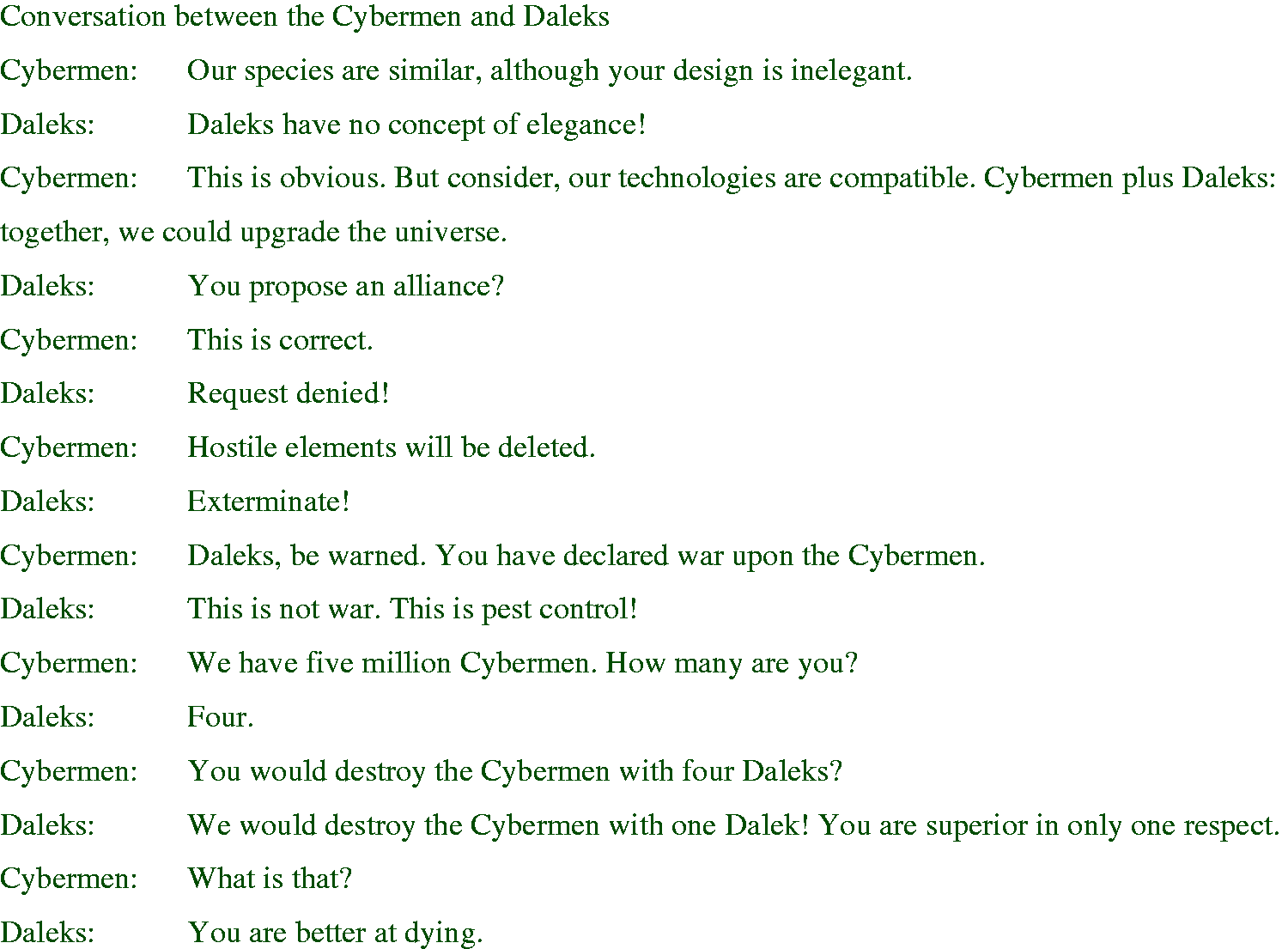
A similar exchange might happen with a virtual learning environment provider proposing an “upgrading” alliance with a university – or a university engaging in such an alliance facing ultimate threat of extermination or assimilation. Cyborg students and professors require the updating of their own systems through information and communication technology. This in turn may be affected by complex alliances between a university, multiple internal and external stakeholders, and industries.
The illusion of networked realities
In the 1980s and 1990s, the “assimilation” characteristic for the civil rights movements of the 1960s and the drug culture of the 1970s seems to have been replaced with the rhetoric of multiculturalism, reassertion of individualism and hedonism, and a strong commitment to the free market. So, it should be no surprise that the emergence of science fiction villains like the Borg, the Borg Queen, Cybermen, or the Daleks has played into a socially constructed fear or social delusion. In other words, perhaps these types of villains indicate the subconscious fear of a culture in the digital age – that the world’s citizens will be assimilated into robot-like, establishment-servicing cyborgs.
The development of online e-learning environments was initially treated by most established institutions of learning as suspect. However, nowadays resistance to the online model of education seems futile. How did that happen? Perhaps the acceptance of online education, e-learning, and online networking is an outcome of a psychological response (cognitive dissonance) and a sociological response (temporal refusal). While my recognition of these as conditions and strategies helped me to cope with graduate school, I now see how their deployment can be an aspect of the oppression as well as a potential response to it.
Cognitive dissonance is a concept developed by Leon Festinger and described in his book, A Theory of Cognitive Dissonance (1957). This theory has been summarized as follows: … pairs of cognitions (elements of knowledge) can be relevant or irrelevant to one another. If two cognitions are relevant to one another, they are either consonant or dissonant. Two cognitions are consonant if one follows from the other, and they are dissonant if the obverse (opposite) of one cognition follows from the other. The existence of dissonance, being psychologically uncomfortable, motivates the person to reduce the dissonance and leads to avoidance of information likely to increase the dissonance. The greater the magnitude of the dissonance, the greater is the pressure to reduce dissonance. (Harmon-Jones and Mills, 1999)
The concept of cognitive dissonance has had a tremendous impact in the field of social psychology and can arguably be utilized to understand the widespread acceptance of online education in even the most unlikely of educational environments. Along with the mantra of “If you can’t beat ‘em, join ‘em”, comes the psychological outcome that once you “join ‘em” the only way to reduce the resulting uncomfortable psychological effects is to realign the dissonance by looking at the positive sides of virtual learning environments in teaching and learning. An example of this would be a teacher assigned an online class and then being strongly persuaded (perhaps socially coerced if a precariat member of the faculty – i.e. tenure-track, non-tenured, or seeking promotion) to present to a group of peers, or the like, on the positive aspects of teaching online and the benefits to students. Such “forced compliance” is closely associated with cognitive dissonance in the literature (Festinger and Carlsmith, 1959).
The advancements of technology and technological communications allows for the advancement of knowledge using even less sophisticated tools. Take, for example, the excerpt in Figure 2 from a tongue-in-cheek history of cognitive dissonance created using the rules and practices of the widespread modern-day communication tool, Twitter, creating typical “tweets”.
Excerpts from Cognitive Dissonance: A History in Tweets (Unknown Author, 2014).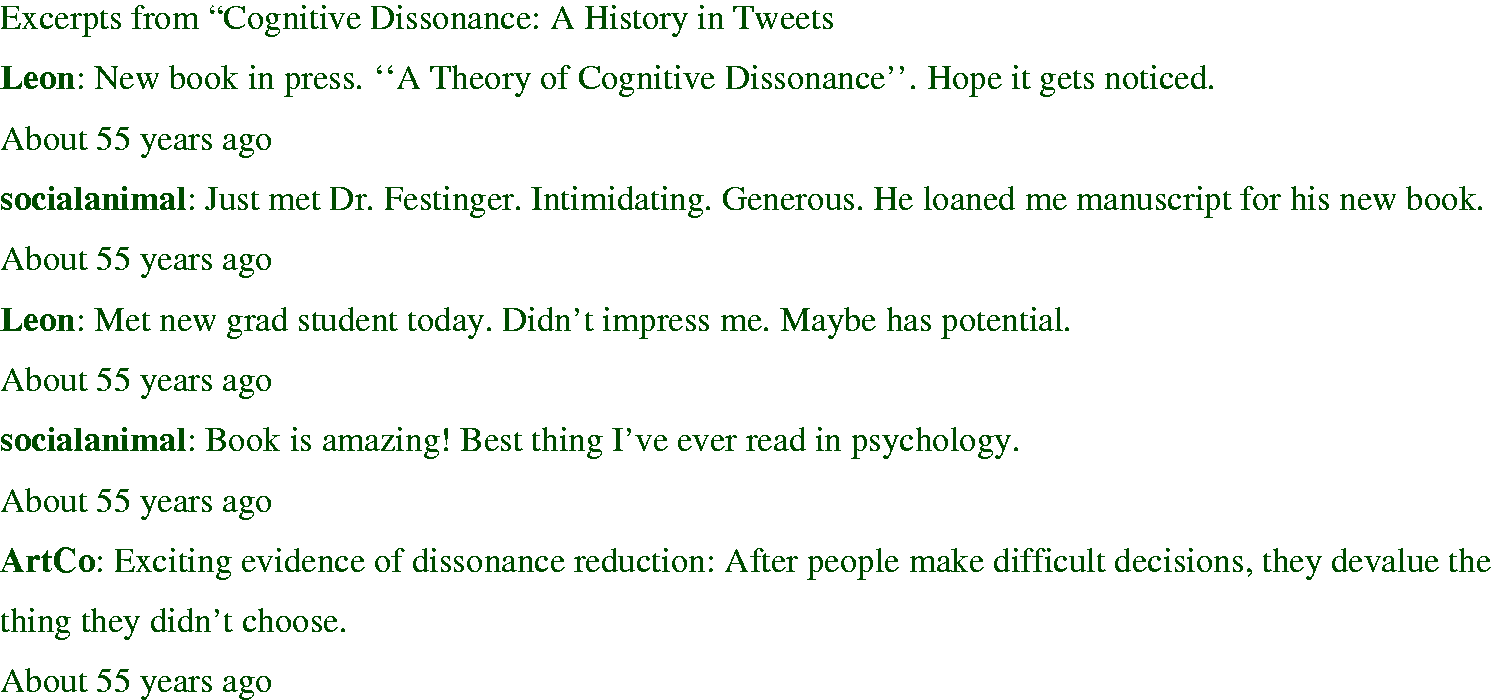
I particularly like the last tweet: “After people make difficult decisions, they devalue the thing they didn’t choose.” This is the crux of cognitive dissonance. In addition, and ironically, a sophisticated theory can cognitively be reduced to unsophisticated tweets drawing one to accept the theory as relevant and sophisticated to reduce any cognitive dissonance. Our preference and what we value is very much a constructed or contrived illusion, a mind game (perhaps a game of the heart) where we come to see networked realities in the e-learning environments as real and just. The science – which tells us ubiquitous online education is just, fair, and awesome – may really be an illusion of networked realities or, in terms of cognitive dissonance, the effect of “ideological” and “technological” propaganda. It seems today that nearly every major educational establishment seeks online presence, creates virtual classrooms, and markets their online environment as less “Borg-like” than the next. Simultaneously, many institutions embrace the cybernetic cloning in e-learning thorough institution-imposed (or possibly soon to be imposed) “best practices”. As such forced compliance becomes institutionalized, the illusion is revealed as one reminisces about the learning environment of the face-to-face classroom and the manipulation tactics using dissonance theory to covertly elicit compliance and “buy-in”.
Social delusions, cybernetics, and temporal refusal
Auster (1965) uncovered empirical evidence of how cognitive dissonance theory is connected to mass persuasion. In linking Auster’s work with modern-day networked realities of teaching and learning, we may come to see the widespread dissemination of online education as a virus that has already replicated itself, perhaps as a shared social delusion.
When proprietary schools entered the online educational market and found themselves within a certain social niche, an evolution in education resulted. The outcry of those in opposition to online, mass education has been successfully squelched through assigning an online class to “try-out” a form of forced compliance (Festinger and Carlsmith, 1959). Perhaps through the process of an orchestrated, networked reality there was a systematic exposure to mass cognitive dissonance resulting in a shared social delusion. The educational needs of the student were networked with the needs of being economically sound. In addition, as the 24/7 model of available study time was psychologically introduced and marketed to potential students, an evolution of social relationships outside of the educational environment has suddenly been constructed as a part of the educational environment.
This refers to social delusions as arbitrary constructions of a reality that are shared by the masses. In the process, they become reified as the one and only reality. An excellent example of this is the movie The Matrix. In the movie, the masses were engaged in a shared social delusion, which blinded all from the “truth” that all were born into bondage. In some sense, social structure, social institutions, and social cultures are all a form of bondage in which we are collectively enslaved. The Borg enslaved the human mind and body so that one could not step out of the delusion and resistance was futile.
The practice of credentialing education can be viewed as such a delusion. Having constructed documentation regarding one’s educational attainment deludes one into a false sense of being educated. The same occurs in the virtual learning environment that is charged with moving students through a networked labyrinth. Here, students become transformed from human beings to cyborgs with wireless, Bluetooth devices coming out of their ears, pockets, glasses, and hands as well as their living spaces. In understanding how social delusions may be utilized as tools to examine the manipulation of online low-choice preference for online learning, we can resist – resistance is not futile.
A possible strategy may be to create and utilize space for temporal refusal. Temporal refusal is a term used by Lemelle (1996) to refer to everyday interactions that take advantage of opportunities to challenge and oppose the existing structures of domination and oppression. Lemelle (1996) describes temporal refusal in terms of black male deviance as the following: “In the situations in which they are placed [black males], they must, given their experience, select, check, suspend, regroup, and transform the direction of their statements and behaviors” (1996: 37). In other words, perhaps this means that one can participate in the delusion when it is advantageous and disengage when it becomes a disadvantage. Perhaps it is even possible to reconstruct a different social delusion.
Lemelle (1996) is describing temporal refusal to explain and account for black male deviance. However, temporal refusal can also be observed in online educational networks and environments. The most prevalent kinds of temporal refusal practices are those in which students can objectively decide: what school they will attend; what class they will register to take; and what activities in that class they will fully participate in. Teachers or professors also operate using a form of temporal refusal in terms of if and when they will respond to a particular student; when they will accept a paper or not; and when they will produce new ways of educating students using digital technologies. Constructing an illusion of networked realities (between and among teachers and students as well as between and among various technologies) cognitively (and often covertly) affects the ability to think critically about a model of online education, thus resulting in a non-thinking, non-sensing cyborg.
Critical reflexivity to imagine, develop, and exert resistance
When the structure is dictated and monitored, resistance in the online environments can indeed seem to be futile. However, there are strategies that can serve the purpose of moving beyond a networked cyborg existence as professor or student. One strategy is critical reflexivity.
Cunliffe (2004) describes critical reflexivity as the practice of generating a practical response to thinking more critically about the assumptions and actions whereby a more collaborative, responsive, and ethical learning environment may be both imagined and developed. A “practical response” means action that can be employed by stakeholders, such as online professors, without imposition. Some of the current issues that make a response impractical are related to the micromanaging or centralization of course design by institutions or proprietary entities, software/password security access, or even the impact of uncertain outcome for precariat faculty. Critical reflexivity includes a strategy to try new ideas in the e-learning environment by moving away from the managerial style of learning and focusing on the continued resistance to assimilation. In this process, imagination plays an important role. The practice of imagining, developing, and trying-out new ways of utilizing networking technologies just might be a strategy that both the professor and the student can exert resistance in a system that potentially focuses only on assimilation and absorption.
In virtual learning environments, resistance can be exerted in many different ways. However, lessons in micro-resistance can be learned from many other groups outside of educational establishment. For example, Cooper and McCoy (2009) presented the notion of showdown boxing as a way that African American mothers exerted resistance towards biased ideologies. I can only imagine how showdown boxing could be used in a networked environment to resist assimilation. When professors or students log into online classes and run up the time to show that they are “working”, they thwarted time used in managerial realms and engage in a form of shadow boxing. Certainly, this example is only the tip of the iceberg, and it will be interesting to see various strategies that could emerge in utilizing critical reflexivity.
Conclusion
In this paper, I introduced the theory of cognitive dissonance as a strategy to unveil assimilation by recognizing how resolving dissonance walked us into tightly woven networked realities. Temporal refusal may be a strategy to disconnect from the cybernetic devices that are plugged into our ears, strapped to our hips and pockets, and/or connected to an outlet until we are fully charged. Perhaps, these strategies might help us place brakes on the contemporary process of absorbing distinctiveness in the online educational environment.
My own early days as a theorist entrenched in a relationship involving education, technology, and a “hoped for future” was a decade in which resistance was futile. However, I have not given up, as I continue to try and resist being plugged in as a cybernetic being. In this paper, I have shown that understanding the key uses of cognitive dissonance and temporal refusal might be useful for deploying and manipulating networked realms for the greater good. My overall practice is to continually seek a better world for my students. Sometimes it seems that we are free to embrace new technologies for the betterment of learning environments. At other times, we must resist various modes of operation in the online environment in order to be able to inhibit assimilation. Each day, resistance to hyper-controlled and constructed online models of education seems to become more and more futile: traditional universities are less frequently searched for online than the newer technology-governed ones (Coughlaan, 2014). With so many major educational establishments offering opportunities to earn certificates, associate degrees, bachelor degrees, and graduate degrees, the mass-produced online presence is taking the online classrooms into the cube of the Borg. But there, “resistance is futile” is not the only option. We need to find methods – and this paper modestly outlines some early attempts – through which we can understand and perhaps seek a means to manipulate the e-learning environment and the constructed cybernetic networked relationships for the betterment of everyone.
Footnotes
Funding
This research received no specific grant from any funding agency in the public, commercial, or not-for-profit sectors.