



Abstract
The world population is ageing. In the UK alone, it is projected that by 2035 those aged 65 and over will account for 23 per cent of the total population whilst the number of people aged 85 and over will account for 5 per cent of the total population. At the same time, the digital transformations of the last few decades are leaving behind many older adults who, for reasons ranging from accessibility issues to work biographies to personal preference, are less likely to engage with digital technologies. Research undertaken in this area to date has largely been policy led and concerned with providing hardware access and basic skills (e.g. Race Online in the UK).
In this article we are concerned with the powerful capacities of digital technologies for communication, archiving, and self-representation, which are under-used by this group, meaning that their cultural histories and experiences are often less visible in the digital world (Loe, 2013; Potter, 2013). While large digital companies such as Google are beginning to consider and provide resources to help people to plan for their ‘digital afterlife’ (Graham et al., 2013) – mainly restricted to issues of specifying what happens to social media presence and email accounts after death – there is little work that examines older people’s experiences of attempting to use the digital to tell stories that will leave a personal and public legacy towards the end of life.
This article begins to examine the challenges and the opportunities that might characterise this area. In doing so, it explores two research studies with ‘third’ and ‘fourth’ agers that have examined, in very different settings, the diverse challenges of knitting together the fragmented and scattered ‘data’ of life experience into private and public narratives. The first study is a case study of three community filmmakers working with an artist to create a film based on their peers’ experiences as first generation Caribbean immigrants to the UK; the second is a study comprising three workshops and five detailed case studies examining how older adults use existing ‘data’ to recollect, to curate and to reflect on their lives and learning for personal purposes.
Introduction
The UK population is aging. It is projected that by 2035 those aged 65 and over will account for 23 per cent of the total population whilst the number of people aged 85 and over will account for 5 per cent of the total UK population (ONS, 2012). This significant demographic change is echoed across Europe and the United States, with Asia and Africa also expected to experience significant population aging in this century (Harper, 2006). How we respond to this shift is likely to be critical in determining wider societal wellbeing. Current policy rhetoric, however, tends to paint a gloomy picture of the consequences of this change and emphasises the coming ‘drain’ on the economy, on health provision and on other services as a result of our aging societies (e.g. Willetts, 2010). An alternative view, and one which we adopt in this paper, is one which realises the benefits that can accrue to societies by better recognizing and learning from the rich personal and social contributions that older people can make, and have previously made, to shaping our world. As Unwin (2012) suggests,
If we start to see growing old as an important and natural transition in our own lives, we will also be able to build a society that makes this transition in a just, considered and creative way.
This realisation of older adults’ positive role in society is only likely to be achieved, however, if we are able to find better ways in which older adults are enabled to represent themselves in both private and public spaces. Without greater insights into older adults’ life experiences and histories, the public sphere risks being dominated by accounts that foreground the risks and anxieties surrounding population aging.
Today there are a new set of tools that are becoming available for curating and representing life experience. These include, in particular, the massive proliferation of devices and social practices that enable individuals to generate ever more personal data and document and share life experiences in ever more diverse forms and forums (Facer, 2012; Enyon, 2013). People are able to accrete increasingly diverse and substantial amounts of personal information that can be circulated, shared and saved for posterity, from photographs posted on social media networks to hard drives full of recorded TV, music and radio; from bookmarked lists of websites visited, to a lifetime of bank statements. At the same time, the tools that enable stories to be constructed and published from multiple data sources, for both personal and public purposes, are increasingly accessible (Ito et al., 2010; Rheingold, 2008).
There is no disputing the potential of these collections of personal data to act as a resource to support people to tell stories about their lives. The ‘Quantified Self’ movement, for example, is a group of early adopters of these technologies who explore the possibilities of self-tracking for issues of health, personal development and learning (e.g. Feltron report). They have relatively recently become interested in the sharing of stories constructed through this data. There are a number of commercial products available already that allow individuals to keep an automated but editable record of their lives through, for instance, ‘tracking’ their movements in space and time and sharing these with others (www.getsaga.com) or through continually taking photos of our lives (2 every minute) through a wearable device (getnarrative.com).
The ongoing collation of personal artefacts, ambient information, biological and environmental data, and institutional records creates a powerful resource of personal data for each individual. This resource brings with it the potential to support the evocation of memory; to tell stories and share them with others; to reflect upon and interrogate personal biographies; and to compare these narratives with those of friends, colleagues and others as a basis for exploring whether we have, within us, the potential for lives as yet unlived. The challenge is to understand how best such data might be used to knit together a life and to support the social narration of experiences.
In this paper, therefore, we explore what might happen at the intersection between these demographic and technological changes. Very few older adults (or indeed, adults in the wider population) achieve the giddy heights of self-curation in evidence in the Quantified Self movement. Nonetheless, we believe that it is now becoming important to better understand how ‘analogue’ processes of collection and curation (e.g. the objects, photos and diaries we collect over our lives) might segue into and combine with the use of more multi-modal forms of data to curate processes of older adults’ learning and creation of legacy in later life. In particular, we want to explore the new practices and difficult questions that are emerging around cultural memory and (digital) identity when older adults collect and share data and stories about their lives in both personal spaces and public settings.
Older adults, digital technologies and processes of life curation
Discourses that circulate about digital technologies often compare older and younger generations in stark terms. For instance describing young people as ‘digital natives’ (Prensky, 2001a, b) or as ‘Gen C’ (the YouTube generation 1 ), and older people as generally marginalised from technology use and in need of support in order to ‘get online’ (http://www.go-on.co.uk/). In addition, discourses around older people and technology tend to highlight aspects of surveillance and/or the need for ‘assistive’ technologies to help older people struggling with failing bodies or the physical demands of living at home. Although generational accounts of digital technology use have been critiqued widely (Buckingham, 2001; Facer, 2002; Jones et al., 2010) for not engaging with the cross-cutting experiences of race, class and gender, they remain powerful; not least because older people themselves often reproduce these arguments, comparing their own ‘lack’ of skills with those of the younger generation (Buse, 2010).
Notwithstanding the persistence of such generational rhetoric, however, there are clearly significant contours within the ‘older generation’. In this article, we use the term ‘older people’, for example, to include two quite distinct generational groups: ‘third agers’ and ‘fourth agers’. Third agers are those older people who are considered active, vibrant contributors to society, who experience agency and choice in their lives (Gilleard and Higgs, 2005; Katz, 2001; Westerhof et al., 2010). In contrast fourth agers are defined as those older people who are considered to be in a period of decline and experiencing an existential fatigue or loss of sense of self as they approach death (Lawton, 2000). Lloyd et al., (2012) suggest that the combined effects of ageing, illness and disability that characterise the fourth age results in inevitable changes in how lives are lived which, in turn, calls into question a sense of self.
Significant differences within older generations are also in evidence when we look specifically at the use of computers by these groups, which is highly stratified not only by age and health but also gender, marital status, and educational background (Selwyn, 2004; Selwyn et al., 2003). More recent studies of Internet use have consistently shown that older people are less likely to use the Internet (Dutton and Helpser, 2007; Jensen et al., 2010; Zickuhr, 2011). In addition, age has been associated with greater anxiety about information technologies (Czaja et al., 2006, Lee et al., 2011). Meanwhile, a recent study points to socioeconomic disparities in the use of the Internet suggesting that higher socioeconomic status in childhood correlates directly with increased likelihood of using the Internet in older adulthood (Silver, 2013).
The overarching policy response to an aging population in the context of technological change has been a drive to improve access to digital technologies for this group (see Race Online). While this is evidently welcome, we believe that it is now also time to explore cultural issues relating to digital technology use amongst older adults. In particular, we believe it is important to understand how the digital might be mobilised to support processes of older adults’ learning and construction of legacy in later life and that understanding how the digital might inform processes of personal and public self-representation will be critically important in shaping wider social perceptions of older adults in an aging society.
In intimate home and care settings, sharing life narratives through reminiscence and life-histories work is proving important to older adults in maintaining a sense of self and good relationships with others (Buchanan and Middleton, 1995; Bornat, 2001; Schweitzer and Bruce, 2008). In reminiscence work older adults share and communicate their memories with others with the aim of understanding each other or a shared experience, or of bringing about change in their current lives (Bornat, 2001). It can foster the development or preservation of identity (Kitwood, 1997) and enable people to feel more in control of their life stories, to claim ownership and to retain the right to interpret their own lives (Bornat and Walmsley, 2008; Thompson, 2000). The work can support older adults to retain the ‘dignity of identity’ as their bodies and memories falter and they experience a growing sense of social dislocation (Lloyd et al., 2012; Nordenfelt, 2009). Such reminiscence and life narration work, moreover, is likely to influence the capacity of older adults to learn and adapt to change; recent studies of learning across the life course (Biesta et al., 2011) for example, have suggested that the experience of telling reflective life stories is an important element of learning and identity development.
Processes of life-narration, however, have the potential to act not only as personal learning and reflection experiences but can make an important wider contribution. Older adults often express a desire to ‘leave a legacy’, for others to know more about their lives and experiences, so that others can learn from their experiences (Manchester, 2007; Wallace et al., 2013). The growing field of oral history and testimony also makes visible the critical importance of more public recollections in informing all of us of the complexities and contours of our history (Cole, 2013; Thompson, 2000).
The cultural practices of life narration towards the end of life, however, are also deeply tied into questions of reconciliation towards death. There is often a desire to tell stories so that the individual can feel that they will continue to play a role in their loved ones lives after they’ve died (Exley, 1999). The nearness of death can create feelings of ‘the possibility of social erasure and the annihilation of identities they have lived out’ and creating lasting memories can go some way to solving this ‘terror of the forgettable self’ (Hallam and Hockey, 2001:4.) Material objects and artefacts can be important markers of a life lived and older people will often begin to engage in a process of giving away of possessions in the period of decline up to death (Lawton, 2000). Although powerful markers and provocations these tangible memories are perishable and ‘mortal’ whereas digital representation can be stored and preserved in multiple places (Sherlock, 2013). Some studies are now beginning to explore the process of recording memories using digital tools. Touchscreen technology such as the iPad, for example, has been used to stimulate ‘memory’ and reminiscence work for older people experiencing dementia (Upton et al., 2011). While other studies have explored the use of intergenerational digital storytelling and involved younger people ‘interviewing’ elders and then managing the editing and curation work for them (Loe, 2013). The appeal of such digital technologies is that they seem to offer the possibility of symbolic immortality or a life after death in which the Internet is reconceived as a ‘receptacle for the dead, a place from which they can reappear or be heard at any time’ (2013:166).
Personal and public curation: two studies
In this paper we argue that the powerful capacities of digital technologies for communication, archiving, and self-representation are currently under-used by older people, meaning that their cultural histories and experiences are often less visible in the digital world (Potter, 2012; Loe, 2013). While large digital companies such as Google are beginning to consider and provide resources to help people to plan for their ‘digital afterlife’ (Graham at al., 2013) – mainly restricted to issues of specifying what happens to social media presence and email accounts after death – there is little work that examines older people’s experiences of using the digital to tell stories that will leave a personal and public legacy towards the end of life.
This article is a first step to open up this area with a view to mapping out some of the challenges and the opportunities that might characterise these practices for future research. To that end, we reflect on two research studies with ‘third’ and ‘fourth’ agers that have examined, in very different settings, the diverse challenges of knitting together the fragmented and scattered ‘data’ of a long life experience into private and public narratives. Neither of these two projects were initially designed to address these questions. However, they provide useful complementary perspectives on the processes of personal and public narration of personal stories by older adults through digital media. They also suggest that processes of digital curation often draw on and include a range of more familiar and complementary analogue processes. The first study provides insights into how older adults are already capturing and recording data for themselves and into their motivations to tell their personal stories to fellow participants in research workshops, to family members and to a familiar researcher. The second study provides insights into the processes through which a small group of older adults negotiated the creation of a shared public narrative.
Conducted in 2011, the first of these projects was a study (Facer and Manchester, 2011) of adults’ learning experiences in which we explored how adults aged from 18–94 recorded and archived events and relationships of importance to them for personal purposes, both digitally and using analogue processes. In this paper we report in particular on the data from three workshops conducted with around 45 adults from the University of the Third Age, and on five case studies with adults aged 63, 65, and 81, 83 and 84. These case studies were designed to elicit the sorts of intentional data collection that people might engage in to support their learning lives. The participants were interviewed once about their life and recording processes at the beginning of the week, and again on completion of the week. Each person was given an iPod touch loaded with the Evernote application; this allowed them to create a virtual ‘notebook’ over the week. They could take a photograph, make an audio or video recording, capture a webpage or make a note for each entry. Unlike the workshops, where our focus was participants’ broad experiences of learning throughout life, here we were interested in the potential for individuals to act as active authors of learning narratives curated from their life experiences.
The second project we report on is a study of a process of public storytelling, in which one of us (Manchester, 2007) observed a group of older adults working with an artist to create a film about their shared history as first generation Caribbean immigrants to the UK in the 1950s. The group of community film-makers had been meeting for several years with an artist to make films about and for their community, a multicultural, deprived geographical area in a large northern city in the UK. The film-makers were three Caribbean men aged 45 (James), 65 (Vernon) and 71 years old (Clinton). Two were first generation immigrants to the UK and the third had grown up in the city. The group wanted to make a film about immigration to the area in the 1950s and they felt strongly about the importance of doing so, as the artist explained, ‘We went through a whole host of different suggestions and that was the one that kept coming up and it kind of built as an idea. It’s an idea that belongs to the group.’ (Simon, artist with the group). The film-making was funded by a local community television channel who paid for a new artist to work with the group over a 12 week period. Returning to their experiences enables us to look in detail at the process of constructing and making public a digital story about the cultural histories of a community particularly the practical difficulties, identity work and ethical dilemmas encountered by the older adults involved.
In the remainder of the paper we use the two studies to explore different aspects of our overall concern around how older adults might best be supported to use digital curation practices to both learn and leave a legacy in later life. In particular, we are interested in revisiting this data to explore:
The different motivations for curation of personal data and life stories amongst older adults. The strategies used by older adults in gathering, making sense of and choosing data for digital curation processes. The ethical issues posed by dependence on others for support in the processes of digital curation.
Through this, we hope to generate productive new areas for inquiry and practice for those with interests in the fields of digital curation and in addressing the huge opportunities and challenges that emerge with our aging populations. In particular, we hope to provide useful insights for those seeking to support and work alongside older adults in building on current ‘analogue’ practices of life curation towards using digital resources in curation processes.
‘Leaving a legacy’: motives for curating personal data
During the three workshops that we ran with 45 vibrant and very busy older adults in the Mapping Learning Lives project, we were struck again and again by the timescales they invoked when reflecting on their lives as a resource for learning. In these workshops we were exploring with them the different elements of their life experiences that were useful in supporting their learning experiences today, and were particularly interested in recent experiences. What was notable, however, was that the experiences invoked were rarely from the last two weeks. Instead, events that happened years before were much more commonly recounted as significant.
At first, our instinct as researchers was to treat these narratives as slightly frustrating if fascinating distractions. Over time, however, we learnt to read them as highly significant for understanding how narration, material objects and even the city itself are used in processes of personal identity construction and learning. As one 82-year-old woman pointed out to us, rather than more recent experiences being significant, ‘my most vivid memory is from when I was 8 and my father died.’ Another 83-year-old man explained the joy of taking the bus today into the local city because it passes through areas that evoke memories of younger days and the pleasure he takes in the process of remembering a younger self. We met many older people who, when asked about their experiences in the near past, wanted to tell us much longer life stories. One 83- year -old man who had recently had a triple heart bypass was very keen to tell stories from his life with the help of photographs, from his adventures driving a motorcycle around France in the Second World War, to his job at the local bleachworks that no longer exists, and his insight into local life through his work as a plumber. We were interested to hear that he was keen to share these stories more publically and to this end had started to write down some of the stories on a computer, but that after painstakingly typing six pages he had unfortunately lost the file and had to start again.
These narratives of earlier life experiences can too easily be interpreted as an inevitable and unconscious result of decline in short-term memory processes, and indeed, memory loss was often invoked playfully by the adults we were working with. This form of recollection, however, can also be interpreted as playing other roles. For these groups of older adults, the purposes of storytelling in this context were multiple – they were reinforcing claims to dignity and respect; were a means of ‘replaying’ pleasurable experiences; were a way of knitting together narratives that helped to make sense of the present (Goodson, 2013). Consider, for example, the story of Ruth, from one of the University of the Third Age groups (Figure 1). When asked to ‘map’ her recent learning experiences, she responded with what could be seen as, instead, a highly personal linear narrative of adversity and personal development. The narrative structure suggests three phases to her learning – first, the unremitting series of difficulties faced; second, the personal development she had to go through to deal with these and the working through of this process; and finally, a third act implying a future and a new sense of interest and possibilities. Here narrating her experiences seemed to provide her with space to ‘let go’ of some of her past responsibilities, moving into a new phase of her life.
Ruth's recent learning experiences.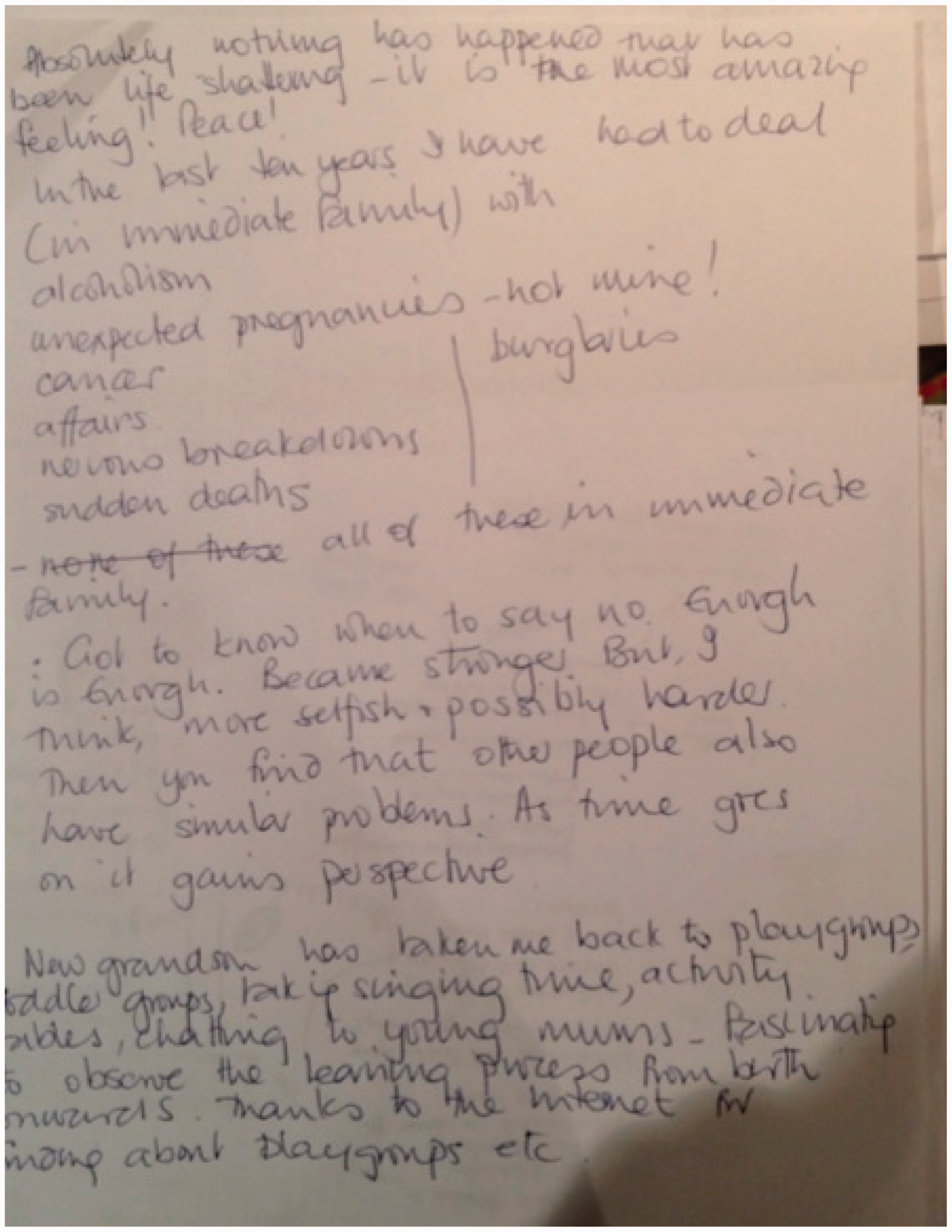
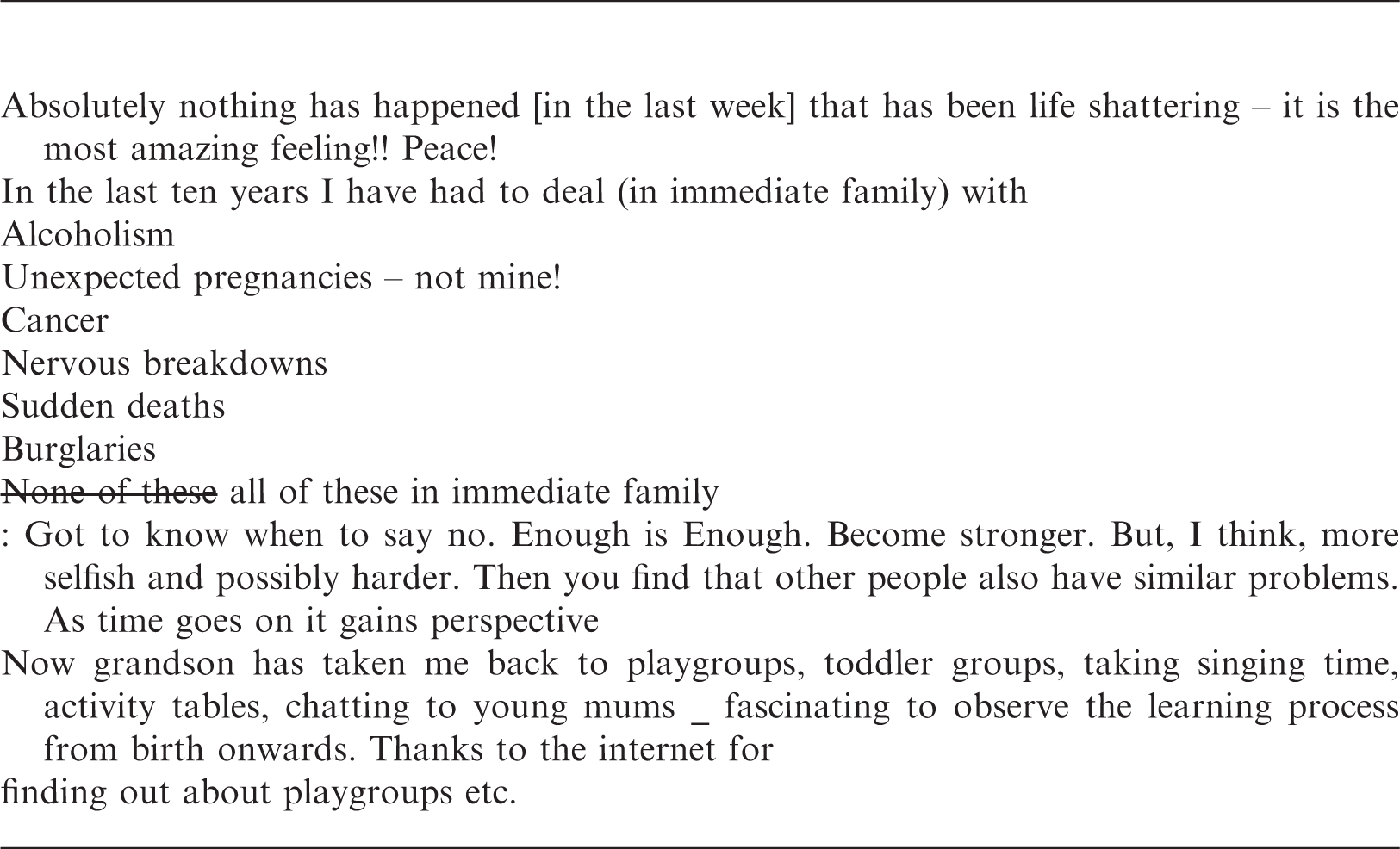
There were also other reasons for storytelling amongst this age group, as the older adults who described themselves as nearer to death were very keen to both tell and find a way of recording their lives. In telling longer-term life stories, the older adults we spoke to dissociated themselves from their contemporary conditions to offer a different representation of themselves. Indeed, Norrick (2009) suggests that when older people are asked about their lives they frequently present multiple identities from across their life course and will also generally reinterpret the past in ways that establish meaningful continuity with their present construction of identity. As one 80 -year- old man told us, ‘We’re all products of our past and most of us are quite elderly. So what we do now is often affected by things that happened many years ago.’
In the second project we discuss in the paper, the community film-makers were involved in making a film that represented the collective histories of their community. The film-makers’ original motive in making the film was to produce a resource that could be used in schools to help young Caribbean people to learn about their heritage. The idea had been to collect ‘audio-visual’ histories from first generation immigrants and weave these accounts into a video about their experiences. Clinton was clear about the group’s reasons for wanting to make the film and his commitment to it as a community film maker. He explained,
I think we need to go into it professionally and get a good storyline, get people participating, and portray the feeling as it were 60 or 70 years ago. So I would like to see it properly researched and discussed before we do it and ask local people to take part in it and I think it’s a great idea.
The film makers were enthusiastic about the project because they felt it could be used as an educational tool, particularly in encouraging intergenerational understanding within their community. As Clinton suggested,
we wanted something that… our grandchildren and great grandchildren can look at and say well this is what the pioneers did.
These public purposes for curation and narration of history, therefore, bring different and distinctive challenges for the older adults involved from the more personal purposes in the Learning Lives project. They bring the familiar (to any documentary film-maker) challenges of representation, ethics, accountability and audience. These public challenges, however, need to be better understood if the experiences and insights of older adults are to be fully and equitably represented in the public sphere.
From data to narration
Using the digital to curate both personal and public life narratives brought familiar and similar difficulties for participants in both projects. These ranged from the process of selecting and buying a new device (‘I want to get a computer but this is going to be a very difficult experience’), to the speed that hardware and software changes (‘I bought a new computer, why isn’t it like the last one?’), to the feeling that others’ views of them as ‘lacking’ in skills affects their behaviours (‘I went into the Apple store but I felt uncomfortable. I felt like the assistants were thinking the old fart, bet he doesn’t know what he’s doing’).
The community film-makers also had limited experience with digital technologies before their involvement with the Internet community TV channel who funded their work. The artist who had worked with the group over a period of several years explained that learning how to use digital technologies was a time-consuming process for all of them that involved patient support. In addition, they did not own the cameras they used or have access to a computer or the Internet at home. Access to the Internet was generally through computers at the local library (ironically a firewall initially prevented them from accessing the community TV website) and cameras were provided by the funding organisation. Edit suites were not accessible for the participants raising problematic ethical and political questions around the ownership of the final film produced.
Getting access to, learning to use and becoming sufficiently familiar with digital technologies to allow a fluent control over the digital as a site of self-representation is, therefore, far from a straightforward task for these older adults. These difficulties are relatively familiar from the existing literature on community film-making and the digital divide (Howley, 2005; Lewis, 2006) but they should be restated here given the significant barriers for older adult participation in these processes and the possible gap in the representation of a growing generational group that could be the result.
Perhaps more unexpectedly, both of these studies encourage us to think that a better understanding of the relationship between material artefacts and analogue records and digital representations needs to be developed if we are to support older adults in processes of digital curation.
One practice in which this becomes particularly visible is the practice of taking and sharing photographs. The photo album recurred as a particularly important tool for telling life stories and for reflecting on identity. One 76-year-old woman, for example, talked about the time she spent ‘thinking back to the past a lot lately and the wonderful holidays spent with my sister. Looking at the photo albums.’ Another, Douglas, talked about how he used albums as tangible and accessible prompts for conversations with his family ‘I could walk in there and pick up a photo album and I’d be full of it.’ He told us, for example, of the time when his grandson would not believe that ‘grandma had ridden an elephant’. Douglas was able to find the photo album and show him the photo, a prompt for a further conversation between grandson and grandma about the event.
Indeed, for Douglas, material objects were particularly useful as tools for telling stories of a life, for prompting conversation and exchange around these experiences. He has recorded his extensive life travels through collections and photos that remind him of places. For example, he had made a substantial collection over time of a particular sort of tourist souvenir from all the places he had visited which was now on display in the hallway of his home. Interestingly, this material display encouraged other people to participate in creating this shared record, bringing him similar objects from their travels as presents; he also found that these objects could create a conversation, that people would reach for them and that different narratives emerged depending on who he was speaking to. Douglas’ relations with these objects and the process of looking together through photograph albums was a very physical and personal experience ‘not like someone leaning over your shoulder whilst you search through millions of photos on a computer.’ Indeed, the shift to digital photography for Douglas, has begun to militate against this process of shared storytelling, as he says ‘digital caused a problem because you don’t have instant access to your photos. I mean I’ve got thousands of them on the computer but what do you do with them? I don’t want to print them out as there’s too many.’
Working with material objects was also a significant element in the process of curating a community film. Members of the film group visited the Ahmed Iqbal Ullah 2 resource centre, which specialises in materials concerning race and minority ethnic communities. The participants borrowed books and photographs that they thought would be of use for the film. These material traces to other times helped them to reflect on their own and their families’ histories. For instance, looking at photographs of Caribbean families on British streets they thought about the bright clothes that they wore on arrival in the UK and the white British reaction to their clothes. This led to a conversation in which Clinton’s previous views on the way that families were integrated into British life were challenged.
Through the process of making the film the older participants made links with others in their community who met at a thriving social club for older people at a local church. Through this physical contact with people who had lived through similar experiences they began to explore their personal as well as their collective identities and histories. Importantly the most personal and engaging interviews were conducted in the interviewees own home. In these settings they were able to reach for the material objects and artefacts that helped them to describe and remember what life was like when they first arrived in the UK. For one older man a photograph of himself in the 1950s evoked bodily memories of the long walk to work and the heat of the iron smelting factory where he worked which he was then able to describe in detail. The film makers were active participants in these interviews, adding their own stories and memories as the interviews progressed.
The materiality of the objects located in real places and the threads and echoes of lost objects that connected the film-makers and the interviewees were important in enabling stories to emerge of a time long gone. The connections these created between interviewees and film-makers encouraged the film-makers to consider not only the personal but also the public representations of their community. As Clinton, a first generation immigrant to the UK, arriving from Jamaica in the 1950s described here,
Even though black people have been in this country for maybe four or five thousand years we’ve always been under represented and we’ve always been represented as being people that are only into crimes, into drugs, prostitution and all the bad things in society. But these people that are here on this video these are all people that came to England to work, I don’t think any of them in that centre have got a record.
This sensitivity to the materiality of a life lived amongst objects and artefacts, and to the importance of physical and embodied objects in processes of both deeply personal (relations between grandparents and grandchildren) and highly public (production of accounts of historic race relations) story-telling, implies the need to think about ‘digital curation’ as a process of translation between the material and the immaterial. This raises questions around what it might mean to try to connect up and curate embodied and tangible objects as part of the processes of learning and legacy at the end of life. It is clear that objects and artefacts play an important role in carrying and evoking cultural memory and narrative (Lachiotte et al., 1998; Miller 2008; Pahl and Roswell, 2010; Turkle, 2007) and can support reflection across timescales, as Lemke (2002) suggests,
meaningful material objects shaped in one moment’s activity, can provide the link to another, related activity, in another moment of time. And the result is the construction of continuity on a longer timescale than that of each momentary activity.
In thinking about possible futures for digital curation with older adults, therefore, it is likely that consideration of the role of the material as a key part of and as a bridge to digital curation is vital.
Representation: ethics, trust and authenticity
The final issue we wish to discuss is one that arose much more clearly in the case of the Community Film-Making project because its purpose was a public narration: namely, the issue of the ethics of representation of older adults’ life experiences, in particular when older adults are dependent upon others for the processes of editing these narratives. We anticipate that these issues will also become important in the production of personal narratives using digital media, concerns we are exploring in a current research project 3 .
As discussed, the three film-makers were deeply motivated to challenge mainstream representations of the history of Caribbean presence in the UK. Despite this feeling of ownership over the content and message of the film, however, their limited technical skills and the difficulty of accessing editing studios meant that they were dependent on their collaborator (an artist) to create the final edit. At the same time, the film-makers also had the challenge of faithfully representing not only their own experience, but the experience of a wider community. The group of older people recruited for interviews in the film expressed initial concerns about contributing their experiences, as they had had bad experiences with other film makers in the past where they had not been consulted or even seen the final film made about them. The film makers were surprised and concerned by this which increased their understanding of the need to build trust if they were to curate public (digital) stories of their community histories. James described the process of gaining the trust of the group,
When we first went they wouldn’t talk to us, they were very closed up…it was like a private thing … They didn’t want to talk about their feelings… so we got friendly with the people that we knew and then we drew others in.
The film makers were able to draw on personal connections but also shared cultural practices and the ‘stuff’ of everyday life (Miller, 2010) in order to enable trust to grow – for instance through evoking the colours, smells and textures of the community, and using the same dialect to embody their membership in the community. James explained this in more detail,
I can say… do you still eat salt fashanki every Sunday morning, or do you have hard dough bread, or do you have plantain, … or do you have yam and okra and… we can talk, we can try and lead them into a conversation.
These connections were made in a particular space in a community and were bounded and shaped by the neighbourhood histories in which all of them had played a part. This helped the film makers to begin to understand better the challenging ethical responsibilities they had as community film makers. For instance, the need for reciprocal participation and mutual respect, informed consent and fair representation, principles they felt had not been adhered to in previous projects they had been involved in. As James suggested,
They didn’t want a misrepresentation because a lot of them had done a video before for some other company. We now know we have to make sure that people got two copies. We made sure that everybody participated, asked permission to use certain things. I mean ask permission of the group and also the people that run it. So we didn’t just go in there and do what we had to do.
The initial motives in making the film – to create a legacy for others to learn about the histories of their community – and the strong connections made during the process of filming meant that the film makers were committed to making a film that (re)-presented their community to others. However, it is through editing that the tone, pace, message and overall ‘feel’ of a film is created. In this project there were no editing suites readily available for the group to use and the artist used edit suites in a place not familiar to the older participants. In addition, there was not enough time for them to learn how to edit or for the artist to listen to their ideas – making it difficult for them to participate in the final meaning making process. In fact the artist had been commissioned to produce a film by a particular date, which was in tension with the aims of the film makers themselves to create a resource for intergenerational understanding. For the product-orientated artist, editing with the film makers felt like ‘nitpicking to Olympic gold medal standards’ whereas for the film-makers their lack of involvement at this stage of the production meant that the authenticity of the final (public) message was compromised. As Clinton suggested,
If I had control over the editing I would have done more, as I see it a film worthwhile watching and a film that my son and grand-kids could learn from… I like to be part of things, I don’t like to complement things. If you are part of it you have control, if you are only complementing it you only go with the flow.
Earlier in the paper we described the development of personal connections between the film makers and the church social group as they shared material and cultural experiences of the past. At a final screening event at the church the film makers were able to see the facial expressions of the audience, to feel the emotional connections with the content, to experience the sighs and shared laughter and the anger and emotion as they shared cups of tea and cake with audience members. A convivial atmosphere helped to create a space where the audience felt able to comment on and critique the film, opening up a space for some discussion of the social and political implications of the film and its authenticity as a public representation of a particular time in history.
Discussion centred around the political message of the film illustrating the complex processes involved in curating a public record of a community’s experiences across time. For instance, Charles, the community group leader, felt that the film should have said more about the communities' ‘struggle’ to survive within a political system and dominant community that gave them no support. Discussion at the screening event made the participants question their decision to make the film non-political, particularly in a present day context of austerity. As James stated, We could have made a political stance on it, to say that these people are pensioners now and they’re not getting the service … we decided to try and keep away from the political stance of the film, but we could have make it political because… [the locality has] got one of the worst money, funding records in our communities for ethnic minorities.
Their personal involvement with the topic of the film encouraged them to consider more carefully the appropriation of their final media product and to take a strong critical stance on ethical issues, as well as recognising their political and social roles in representing a community in a public arena.
Conclusion
In this paper we have reflected on the challenges, issues and possibilities for older adults’ curation of their life narratives in both personal and in public settings. In so doing, we aimed to identify a number of areas for potential fruitful research and collaboration. To conclude, we want to reflect on these:
First, it is clear to us that older adults’ processes of digital curation are likely to be for highly diverse audiences, from family members to wider public figures. One common element, however, seems to be that motivations are often about inter-generational transfer of knowledge and insight. A rich future area for development, therefore, would be in understanding both how older and younger adults can be productively brought together around the processes of digital curation. This also raises substantive theoretical questions that may be of interest in the broader field of narrative research – what does it mean intentionally to tell stories across generations and for future generations after death?
Second, the processes of digital curation discussed here are never solely digital. Instead, it was clear that material artefacts, from photograph albums to historical archives, were important in provoking and enabling reminiscence and discussion. Similarly, face-to-face interactions between older adults was particularly important in generating rich insights and in producing relationships of reciprocity and mutual concern in public curation processes. The shift towards digital accretion of information around the person, therefore, may have to be understood within the much richer context of lives lived in embodied and material ways. The return to the material that is becoming evident in digital technology development may hold powerful insights for future research in this field – the augmentation of physical artefacts, the creation of tangible digital artefacts, for example, may provide a particularly interesting focal point for curation by older adults.
Third, the very live ethical issues raised by representation processes when older adults are not fully in control of editing processes, are particularly important in this age group. There are clear needs to both ensure that older adults themselves are able to play a meaningful role in editing processes; and also a need for ethical procedures for older adults and their collaborators in this field. As it becomes increasingly easy for community organisations and community film-makers to publish rapidly to the web, these procedures need treating with even more care. The possibility of ‘one-click’ online publishing is of particular concern here where community-curated films, such as the one we have discussed, might be seen as an authentic representation of a community at a particular time in history, when in fact a number of ethical shortcuts were taken. In curating narratives in later life, therefore, the ethics, codes and conventions of digital storytelling become particularly pertinent as the challenges of communicating meaning across time and, potentially beyond the grave, become particularly pressing.
In the context of our aging populations there are important concerns around the representation of older people in the public sphere. The ability for older people to tell personal and public stories about their lives that challenge mainstream representations in the digital landscape is a crucial area for future development. To date, however, research in the area of digital cultures has tended to be dominated by inquiry into emergent youth cultures. Significantly more research is now needed into the different challenges and opportunities presented by the digital to the older adults who will shortly make up the bulk of our populations. Such research, we would conclude, may take a different character from research into children and young people in digital environments, in that the real insights are likely to be best achieved not by studies ‘of’ older adults, but studies ‘with’ older adults into these changing practices. The rich life experiences and highly diverse practices of these age groups suggest that the most fruitful future research directions are likely to be those that seek to create partnerships with research subjects in the definition of the problems, methods and analysis of the issues. After all, if we are concerned about the ethics of editing and representation in digital curation, we also need to reflect on the ethics of analysis and representation in academic writing. While we have not achieved this here, a sustained commitment to collaborative research with older adults will now inform our future activities and, we hope, may provide generative avenues for other researchers who wish to work in this area.
OVERMATTER
In these policy discourses suggestions that neighbours, relatives and friends can help older people to ‘get online’ and become technologically literate appear to ignore the complexity of the difficulties that some older people may face. Indeed older people have grown up in a largely analogue world and therefore may need long term, structured support in order to access and develop capacities to use digital tools to improve the quality of their lives. This is not only important in response to familial notions of the role digital technologies might play in combatting social isolation and in the provision of functional/physical assistance in their lives but also in relation to their cultural lives and memories.
Footnotes
Acknowledgements
Our thanks to Howard Baker and the BBC for supporting the Mapping Learning Lives project.
2
The Ahmed Iqbal Ullah Race Relations Resource Centre was founded in 1999 specifically to combat racist ideas about Black people, and is named in honour of Ahmed Iqbal Ullah who was murdered in 1986 in the playground of a Manchester High School. The archive contains material that documents the contributions of Black people to British and American history, and the struggle against racism in its many forms. 