



Abstract
Biodegradable scaffolds have been extensively studied due to their wide applications in biomaterials and tissue engineering. However, infections associated with in vivo use of these scaffolds by different microbiological contaminants remain to be a significant challenge. This review focuses on different sterilization techniques including heat, chemical, irradiation, and other novel sterilization techniques for various biodegradable scaffolds. Comparisons of these techniques, including their sterilization mechanisms, post-sterilization effects, and sterilization efficiencies, are discussed.
Introduction
Tissue engineering is a growing field that attempts to provide solutions for regeneration of tissues that have been damaged due to diseases or injuries. In order to achieve this, tissue engineering scaffold is commonly used to promote repair and regeneration of tissues. The scaffold, a three-dimensional construct, is designed to support cell infiltration, growth, differentiation, and enhance new tissue development and guide new tissue formation. 1 Many biomaterials have been used to prepare the scaffold, including metals, ceramics, glasses, and polymers. 2 Recently, there is a growing trend in the use of biodegradable polymers for the fabrication of scaffolds and other implants for various tissue engineering applications. In addition to their well-established biocompatibilities in vivo, biodegradable polymers are preferred for two main reasons: (1) scaffolds fabricated from these materials provide desirable mechanical strength which, in combination with controlled degradation rates, leads to gradual reduction in mechanical strength during tissue regeneration, and (2) complete degradation of the scaffold structure over time eliminates the need for a secondary surgery for the retrieval of the implant, thus allowing faster recovery at the site of injury.
Sterilization is a process by which a product can be made free of contamination from living microorganisms, including bacteria, yeasts, and viruses. 3 When sterilizing biodegradable scaffolds, the chosen sterilization technique must maintain structural and biochemical properties of the scaffolds, thereby ensuring that the scaffolds will fulfill their intended purposes post-sterilization. This requirement renders the sterilization of biodegradable scaffold a formidable task. 4 Most standard sterilization techniques used in the clinical settings, such as ethylene oxide (EtO) and gamma irradiation, have also been used to sterilize biodegradable scaffolds over the last several decades, but these attempts have been largely unsuccessful. 5 This is because that biodegradable scaffolds are more sensitive, due to the nature of their chemical properties, to the conditions required by these standard sterilization methods. While some emerging sterilization techniques have shown reasonable performances, specific drawbacks associated with these procedures still exist. In this review, we first discuss the mechanisms of these sterilization techniques for microorganism inactivation and subsequently focus on comparing sterilization efficiencies and post-sterilization effects of these sterilization techniques for different biodegradable scaffolds.
Sterilization mechanisms and post-sterilization effects
A biodegradable scaffold has a potential to be infected by a wide range of microorganism, such as virus, bacteria, and fungi. These microorganisms can cause serious infections and diseases, including tetanus, influenza, yellow fever, AIDS, candidiasis, and histoplasmosis.6,7 Different microorganisms possess different characteristics, and as a result, their resistance levels to sterilization or disinfection techniques differ from each other. In terms of their resistance to sterilizations, in the order from high to low, bacterial spores have been proven to be the most resistant followed by mycobacteria, nonenveloped virus, fungi, bacteria, and enveloped virus.
Various sterilization techniques have been attempted on biodegradable scaffolds. Due to the lack of techniques designed specifically for such scaffolds, conventional sterilization techniques previously established for clinical applications, such as heat treatment, EtO, irradiation, and plasma become the initial choice. Other sterilization techniques that have previously been used only for disinfection purposes such as iodine, peracetic acid (PAA), and some recently developed sterilization techniques such as freeze-drying and supercritical carbon dioxide (sCO2) are now being experimented for the sterilization of biodegradable scaffolds. Based on the ability to kill different types of microorganism, the inactivation level (commonly defined as high, medium, and low) of these sterilization techniques and their ability in inactivation of certain types of microorganism are summarized in Table 1. 8 Besides incomplete microorganism inactivation, toxic residues and changes in scaffold structural and biochemical properties can be problematic to the safety and efficacy of scaffolds for studies in vivo. Detailed operation conditions of each method are summarized in Table 2; the advantages, residue effects, penetration abilities of each technique, and their post-sterilization effects on structural and biochemical properties of biodegradable scaffolds are summarized in Tables 3 and 4.
Microorganism inactivation ability of different sterilization techniques.

UV: ultraviolet; EtO: ethylene oxide; sCO2: supercritical carbon dioxide.
Operation conditions of different sterilization techniques.

UV: ultraviolet; EtO: ethylene oxide; PAA: peracetic acid; sCO2: supercritical carbon dioxide.
Summary of effects of sterilization methods on biodegradable scaffolds.

PLA: poly(lactic acid); LLA:
Advantages and disadvantages of sterilization techniques.
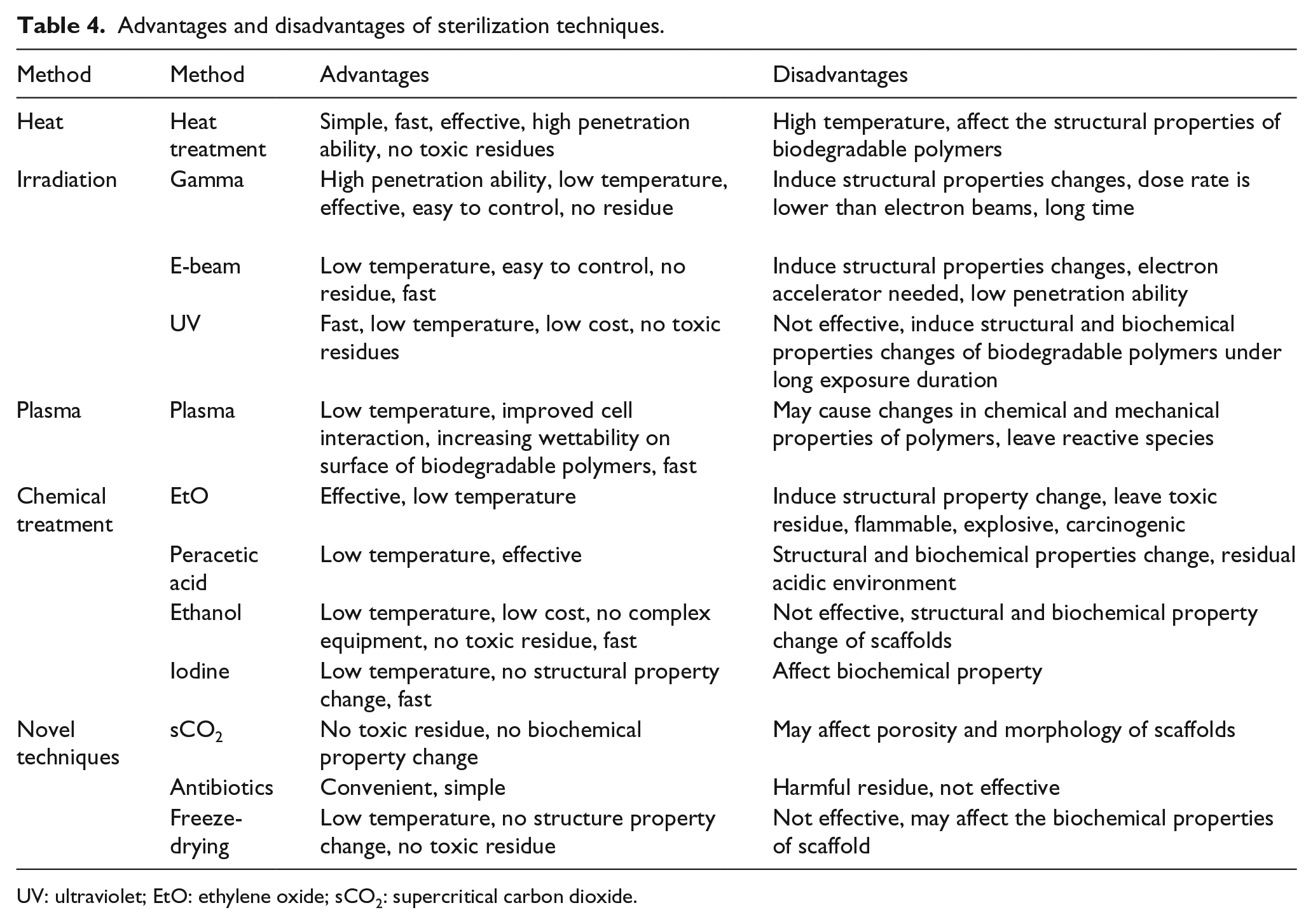
UV: ultraviolet; EtO: ethylene oxide; sCO2: supercritical carbon dioxide.
Heat treatment
There are two most extensively used heat treatments for sterilization: steam sterilization and dry heat sterilization. They are realized by treating the product with either saturated steam at 125°C to 130°C for around 20 min or hot air at 160°C for 2 h, respectively. 8 The advantage of heat treatment is that it is effective, fast, simple, and without any toxic residues (Table 4). 40 The penetration ability of heat treatment is one of the best among all of the sterilization techniques, 41 and it can completely eliminate all viable microorganisms (see Table 1). Destruction of essential replication metabolic and structural components of microorganism is lethal during steam heat sterilization, while the killing mechanism of dry heat is mainly due to direct heating and oxidation effects. 8
However, since most biodegradable polymers have low glass transition temperatures (Tg), the use of heat treatment as a sterilization technique for these scaffolds is problematic (Table 3). 42 In addition, in the case of steam sterilization, the presence of water vapor has been shown to cause hydrolytic degradation of the material to be sterilized. 43 To minimize this side effect, Rozema et al. 14 modified the steam sterilization process for poly(lactic acid) (PLA) scaffolds by introducing cycles consisting of individual phases for air removal, sterilization, and steam removal. However, a substantial loss in molecular weight was still observed, along with an increase in mechanical strength due to recrystallization of the polymer. Similarly, Gogolewski and Mainil-Varlet 15 applied vacuum or inert gas atmosphere in their modified dry heat process in order to reduce operation temperature for PLA sterilization. The researchers observed both increases in PLA molecular weight and decreases in material bending strength. Therefore, when considering heat treatment sterilization approach to sterilize degradable scaffolds, one must be careful about its side effects on material mechanical strength and molecular weight in addition to its possible side effects on the structural properties of the scaffolds due to its high-temperature operation conditions.
Irradiation
In comparison with heat treatments, radiation methods offer features such as low temperatures, short processing time, and comparatively lower cost of operation, making the radiation techniques promising candidates to sterilize biodegradable scaffolds.
Gamma and electron beam irradiation
Gamma (γ) and electron beam (e-beam) irradiation are both categorized as ionizing radiation techniques and are often compared. Gamma irradiation, being electromagnetic in nature, is usually obtained from a source of 60Co and is produced within a dose range of 10–30 kGy/h. 44 In comparison, e-beam irradiation is produced by an accelerating stream of electrons; its dosage depends on the power of the source emitting it. Both treatments work by transferring energy to valence electrons, causing electrons to be ejected from materials to be sterilized through which gamma rays pass. This directly breaks DNA and RNA strands and generates reactive oxygen species (ROS) that damage other important cellular components.45,46 The ROS have also been shown to cleave phosphodiester backbones of DNA molecules, causing the DNA molecules to degrade. 45 Gamma and e-beam irradiation have the ability to inactivate both gram-negative and gram-positive bacteria, molds, yeasts, most viruses, and some bacterial spores. 47 Some endospores are shown to be able to withstand high doses of ionizing irradiation and are not destroyed by it. 48 Although the reasons for spore resistance to ionizing irradiation are not fully understood, it has been suggested that low core water content plays a role. 49
While γ radiation sterilization technique is simple, rapid, and effective, it is known to result in changes in scaffold material chemical characteristics, reduced compressive mechanical properties and molecular weights, and increased rates of degradation post-sterilization (see Table 3).16–18 For example, Cottam et al.
18
studied the effects of γ irradiation on the tensile strength of poly(ε-caprolactone) (PCL). It was found that the yield point was much higher for the irradiated samples than that for the nonirradiated controls. This indicates that γ irradiation considerably altered the mechanical property of the material. Similar effects were reported by Hooper et al.
20
who used γ irradiation to sterilize biodegradable scaffolds made from poly(
In comparison, e-beam sterilization is known to cause less degradation to materials as the exposure time of e-beam is usually shorter (see Table 2).
41
For example, in a study to compare the two radiation sterilization techniques, biodegradable scaffolds fabricated from
Ultraviolet irradiation
Ultraviolet (UV) irradiation is a new approach to sterilize biodegradable scaffolds. It is often used to sterilize material surfaces and transparent biodegradable scaffolds. UV irradiation results in excitation of electrons and accumulation of photoproducts. This causes damages to DNA molecules and prevents DNA replication, leading to inactivation of microorganisms. 45 Different microorganisms have different sensitivities to UV irradiations. For example, vegetative bacteria are easily destroyed by UV irradiation, while bacterial spores are more resistant. 49 In comparison, prions are not sensitive to UV irradiation at all. 52 Viruses are somewhere in between: some viruses are easily inactivated, whereas others are quite resistant. For instance, naked viruses tend to be more resistant to UV irradiation than enveloped viruses. 53 Two parameters have been reported to be important to sterilize biodegradable scaffolds: (1) duration of UV irradiation4,27 and (2) specific wavelength of UV irradiation 26 —usually between 200 and 280 nm, although 260 nm is reported to be most lethal. 48
UV exposure time appears to be one of the most important factors affecting material post-sterilization properties. For example, Fischbach et al.
4
reported that a short UV radiation exposure of 2 h was able to effectively sterilize poly(
Plasma
Plasma sterilization technique is a method that recently has found applications in sterilization of biodegradable scaffolds. Gas plasma offers many advantages, such as low-temperature operating conditions and improved cell-material interactions likely due to plasma surface modifications. 29 Plasma is created by subjecting gas to pulsed discharges of direct current, radio frequency, or microwaves that generates chemically reactive species due to excitation, dissociation, and ionization of electrons. While the mechanism of bacterial inactivation by plasma is still not well understood, it is believed that etching, charged particles, and oxidation from the reactive plasma and radicals are all involved. 54 Plasma can physically destroy and inactivate spores, 55 and it is also effective in inactivating bacterial endospores and vegetative bacteria. Although plasma sterilizations would still occur even if the carrier gas on its own has no effect on viable bacteria, most current plasma sterilization protocols include gas mixtures that have bactericidal properties of their own; 56 generally gas choices are those with high oxygen contents to allow for many ROS to be generated. 55 The flow rate of gas is also important since it affects the rate at which reactive species are generated. Other important factors include operating pressure, gas temperature, and plasma excitation frequency. 54
Inert gas plasma sterilization technique is a preferred sterilization technique for biodegradable scaffolds when power and exposure time can be precisely controlled. For example, complete sterility of PLGA scaffold was obtained with the use of high power (100 W) inert argon gas plasma with radio-frequency glow discharge at an exposure time of 4 min. However, a lower power at 33 W and longer exposure time of more than 10 min resulted in significant damage to the three-dimensional structure of the scaffold. 28
To improve the microorganism inactivation ability, reactive gas mixtures, especially those with higher oxygen contents, are generally used. 55 While these reactive gas plasmas are shown to be more effective than inert gases to inactivate highly resistant microorganisms, especially spores, 54 they are reported to cause material cross-linking or degradation that lead to compromised mechanical properties.29–31 In addition, the use of reactive gas plasma has been shown to contribute to continued presence of reactive species within the scaffolds even long after sterilization, resulting in potential side effects if the residual reactive species are not properly removed before in vivo studies.57,58
Chemical sterilization
EtO
EtO is commonly used to sterilize a wide range of medicinal and clinical products, such as rubber and plastic products, due to its low-temperature requirements and extensive range of antimicrobial activity. 59 EtO causes irreversible alkylation of cellular molecules that may contain amino, carboxyl, thiol, hydroxyl, and amide groups, resulting in permanent suppression of cell metabolism and division. 15 Vegetative gram-negative and gram-positive bacteria, fungal, spores, DNA and RNA viruses, and enveloped and naked viruses are easily inactivated by EtO. 60 The effectiveness of sterilization by EtO is dependent on operation parameters such as concentration, temperature, duration, and relative humidity (see Table 2).59,61
As summarized in Table 3, EtO sterilization is known to affect structural and biochemical properties of biodegradable scaffolds. Hooper et al. 20 investigated post-sterilization effects of EtO treatment on tyrosine-derived polycarbonates for degradable bone fixation devices and drug delivery applications. The material showed considerable reduction in yield strength and increase in stiffness after sterilization, and the rate of degradation post-sterilization was faster when compared to nonsterilized controls.
Interestingly, EtO sterilization was shown to substantially affect the release pattern of drugs embedded in a biodegradable scaffold. Hsiao et al. 59 studied the effects of EtO sterilization on the release of vancomycin, an antibiotic, from PLGA scaffold. The study found that EtO-treated scaffolds did not exhibit any burst release during the first 7 days as was seen in the nonsterilized controls. Additionally, the total drug-releasing period for the EtO-treated samples was much shorter than that of an untreated controls, and the overall amount of released antibiotic was also less. Contrasting to this observation, there are other reports showing evidence suggesting that EtO treatments did not alter drug delivery performances post-treatment.62,63
Residual toxicity of EtO is a major concern for EtO sterilization, especially if small amount of EtO continues to reside inside the scaffold after sterilization. To this end, the American Health Industry Manufacturers Association (HIMA) and the American National Institute for Occupational Safety and Health (NIOSH) have set guidelines of 25–250 ppm as the maximum EtO residual concentration in medical devices post-EtO sterilization, with recommended range of 10–25 ppm. 64 Given these restrictions, aeration of scaffolds after EtO sterilization is mandatory in order to remove residual EtO. However, one should be cautious about using EtO to sterilize biodegradable polymers, particularly those with low diffusion coefficients as studies have demonstrated that materials that have slow EtO release rates exhibit higher EtO residual concentrations than the allowed 250 ppm upper limit even after 15 days of aeration. 64
PAA
PAA is a low-temperature sterilization technique with relatively high penetration ability, which can effectively inactivate a wide variety of microorganisms. The production of hydroxyl radicals has been reported to be an important mechanism in bacterial inactivation. 65 In addition, the oxidizing property of PAA has been shown to cause inactivation of important enzymes in microorganisms. 45 PAA can effectively inactivate large varieties of microorganisms, including vegetative bacteria, spores, enveloped and naked viruses, and fungi. 66 Factors that affect PAA antimicrobial activities include PAA concentration, temperature, pH, and relative humidity (see Table 2). 8 It has been established that the higher the concentration and temperature, the greater the antimicrobial activities. 8 Furthermore, a synergistic sterilization effect has been reported when PAA is used in combination with hydrogen peroxide. 67
However, the oxidative and acidic environment created during PAA treatment can cause adverse effects on the biodegradable scaffolds to be sterilized (Table 3). 32 For example, Shearer et al. 33 noted increased PLGA scaffold pore sizes and surface roughness after PAA sterilization in their study. In addition, the oxidative PAA process resulted in protein denaturation, thereby significantly limiting its potentials in sterilizing scaffolds loaded with protein-based growth factors for tissue engineering applications. Furthermore, the presence of acidic residuals within the biodegradable scaffold after PAA sterilization raises concerns about the biocompatibilities of the sterilized scaffolds in vivo.56,66,68
Ethanol
The low cost of treatment and ambient-temperature operating conditions are some of the advantages that ethanol treatment offers. 69 However, its limited ability to kill microorganisms remains a significant concern. Ethanol causes denaturation of proteins, cellular dehydration, and dissolution of lipids present in cell membranes, resulting in inactivation of certain microorganisms.34,48 Concentrations of ethanol ranging from 60% to 80% have the ability to inactivate gram-positive, gram-negative, and acid-fast bacteria, as well as lipophilic viruses, while hydrophilic viruses and bacterial spores are known to be resistant to ethanol. 70
The side effects of ethanol remain controversial in the literature. On one hand, there is documented evidence suggesting that soaking PLGA scaffolds and hollow fibers in 70% ethanol significantly altered their structural and mechanical properties, reduced scaffold porosity, and increased sample surface wrinkling; 33 on the other hand, ethanol sterilization treatment has been shown to have no effect on PLGA scaffold molecular weights and scaffold structures. 28
Iodine
Iodine treatment can be carried out at ambient temperature, which makes it an ideal candidate in sterilizing temperature-sensitive biodegradable scaffolds. The exact mechanism of iodine sterilization process on bacterial cells is not well studied. Oxidation, ionization, and membrane immobilization are believed to be possible killing mechanisms. 10 Depending on sterilization parameters, iodine can inactivate vegetative bacteria spores, molds, yeasts, and viruses. 17 Although bacterial spores are resistant to some forms of iodine, it has been shown that when povidone is used as an iodophor for iodine sterilization, some species of spores, such as Bacillus globigii spores, can be significantly reduced (>99%). 71 The efficiency of microbial inactivation decreases significantly with increases in pH. 45 The concentration of free iodine within the iodine solution has been shown to affect its biocidal effects. 72
While there are very few studies reporting the effects of iodine on biodegradable scaffolds, it has been established that 0.1% iodine solution does not affect the structure of allografts for use in implants. 11 However, it should be noted that iodine treatment will likely affect biochemical properties of the scaffolds, especially if these scaffolds are loaded with growth factors or viable cells.73,74 Therefore, further investigation is needed before iodine can be deemed safe to sterilize biodegradable scaffolds, especially those loaded with bioactive ingredients, such as growth factors or cells.
Other novel techniques
sCO2
The use of sCO2 as a sterilization technique for biodegradable scaffolds is a relatively new approach. Features such as mild operating conditions, nontoxicity, nonflammability, and low reactivity make sCO2 an attractive option when compared with other sterilization techniques.75,76 In addition, zero surface tension allows easy penetration of sCO2 into complex and porous structures of degradable scaffolds to destroy a host of microorganisms. 5 While the mechanism of sCO2 bacterial inactivation process is not completely understood, acidification, lipid modification, inactivation of vital enzymes, and removal of intracellular substances are possible mechanisms; 77 in particular, acidification has been identified as the most likely cause of inactivation of microorganisms. 75 Vegetative bacterial cells and certain viruses can be inactivated by sCO2. For example, Checinska et al. 37 achieved inactivation of Bacillus pumilus using sCO2 with a sterilization process at 100 atm and 50°C that involved three cycles and additional 0.1% hydrogen peroxide. Wayne et al. 78 established a sCO2 sterilization protocol with a pressure from 7 to 24 MPa and a temperature from 25°C to 60°C to destroy bacterial spores and sterilize biomedical scaffolds within time periods ranging from 20 min to 12 h. As listed in Table 2, the effectiveness of microbial inactivation by sCO2 is a function of many parameters, including pressure, temperature, and sCO2 contact time. 35 Sterilization using sCO2 has been found to be more effective when it is modified with certain compounds, such as acetic acid, tert-butyl hydroperoxide, and hydrogen peroxide. 79 This is likely due to either acidic or oxidative properties of these modifiers. In addition, some modifiers may also help to improve sCO2 penetration abilities through cell walls and cytoplasmic membranes, thus enhancing its ability to inactivate microorganisms. 79
The mild operating conditions at the supercritical state of CO2 do not cause damage to structural properties of biodegradable scaffolds; the low reactivity of sCO2 does not cause the formation of radicals and reactive species, thus well maintaining structural properties of biodegradable scaffolds. Dillow et al. 35 showed that sterilization with sCO2 did not cause any changes in the physical and chemical properties of PLGA and PLA. Jimenez et al. 36 evaluated the sterilization efficacy of sCO2 on poly(acrylic acid-co-acrylamide), a model hydrogel biomaterial, and reported that at a pressure of 27.6 MPa and a temperature of 40°C, the hydrogel was effectively sterilized.
Interestingly, sCO2 method is commonly used to prepare degradable tissue engineering scaffolds.80–83 For example, Ennett et al. 83 incorporated vascular endothelial growth factor (VEGF) and bone morphogenetic protein-2 (BMP-2) into PLA using sCO2 process and successfully regenerated bone tissue in vivo. Therefore, it would be advantageous to fabricate degradable scaffolds and sterilize these scaffolds simultaneously using sCO2 in a single step.
Antibiotics
The use of antibiotics as a technique for sterilization of biodegradable scaffolds has not been researched in depth, and there is limited information available in the literature. It is a convenient and simple method. Antibiotics inactivate bacteria by interfering with essential processes such as DNA replication, cell wall synthesis, and protein synthesis. Antibiotic sterilization can be either broad spectrum if they interfere with universal bacterial processes (such as DNA replication) or narrow spectrum if they interfere with processes specific to one group of bacteria. 84 However, it is only effective against vegetative bacteria and spores while fungi, molds, and viruses are not affected. In addition, bacteria, especially gram-positive bacteria, are rapidly developing resistance to antibiotics. 84
Antibiotic treatment can be a useful sterilization method if used in combination with other methods or used independently if an effective antibiotic cocktail is employed. For example, it has been shown that UV irradiation followed by antibiotic treatment can be used as an effective sterilization protocol. In addition, antibiotic cocktails are generally used for sterilization applications as different antibiotics act in different ways to inactivate bacterial cells, targeting cell walls and cell membranes, or inactivating essential enzymes in bacteria. 48 Braghirolli et al. 12 and Shearer et al. 33 reported complete sterilization of PLGA scaffolds using an antibiotic cocktail, which contained penicillin, streptomycin sulfate, and fungizone. However, changes in morphology and dimensions of the PLGA scaffolds were observed. Additionally, antibiotics were shown to leave harmful residual traces in scaffolds after treatment. 85
Freeze-drying
There are very few studies on the use of freeze-drying (lyophilization) as a sterilization technique for biodegradable scaffolds since its primary use has been preserving tissue transplants. 86 The microorganism inactivation mechanism of freeze-drying involves the use of low temperature that results in denaturation of proteins and enzymes. 87 The process of freezing and dehydrating is believed to break intact membrane structures of microorganisms and to remove bound water, resulting in microorganism inactivity.
In general, freeze-drying is a gentle sterilization technique that is not completely efficient and, therefore, has been suggested to be used in combination with other sterilization techniques, 88 such as γ irradiation 89 and EtO 90 in order to improve its overall efficiency to inactivate microorganisms. Markowicz et al. 13 investigated the effects of freeze-drying combined with gas plasma on collagen sponges. The researchers showed that the combination was effective in inactivating microorganisms. However, more research is needed to establish whether the procedure causes any changes to mechanical and structural properties of the scaffolds. Additionally, proteins have been reported to completely lose their bioactivities due to cold denaturation from freeze-drying process. 91 Therefore, the potential side effect of protein denaturation by freeze-drying should be fully evaluated when this sterilization method is being considered to sterilize degradable scaffolds loaded with bioactive protein-based growth factors. 92
Besides the above-mentioned techniques, some other techniques, such as ozone and formaldehyde, have also been evaluated for their potential use to sterilize biodegradable scaffolds. However, their performances in sterilizing biodegradable scaffolds are barely satisfactory. For instance, ozone sterilization has been shown to have detrimental effects on polyurethane (PU) foam in that it significantly altered the PU foam morphology and degradation behavior due to oxidations by ozone. 31 Similarly, formaldehyde has been shown to affect structures and surface properties of biodegradable polymers. Furthermore, its known toxicity and carcinogenicity also cause major concerns. 38
Conclusion
It is a critically important task to choose an appropriate sterilization technique in order to effectively sterilize biodegradable scaffolds but at the same time to maintain their structural and biochemical integrity. Detailed comparisons of commonly used sterilization techniques for biodegradable scaffolds are discussed in this review. It is evident that there is no “perfect” sterilization technique that can achieve excellent sterilization for a wide variety of degradable materials without any adverse post-sterilization effects. As a result, to sterilize biodegradable scaffolds, the operation conditions of a chosen sterilization technique should be precisely controlled and evaluated case by case. In addition, biodegradable scaffolds involve a wide range of materials with different structural and biochemical properties; therefore, different effects might occur with different biodegradable scaffolds with the same sterilization technique. The effectiveness and post-sterilization effects of new emerging techniques need to be further investigated before they can be declared safe and effective for use for biodegradable scaffolds. Finally, with more complex tissue engineering scaffolds being designed and fabricated, combinations of different techniques appear to become the trend to sterilize these tissue engineering devices.
Footnotes
Acknowledgements
The authors acknowledge Angela Melhuish and Grace Zhang for their help with the manuscript.
Declaration of conflicting interest
The author(s) declared no potential conflicts of interest with respect to the research, authorship, and/or publication of this article.
Funding
The author(s) disclosed receipt of the following financial support for the research, authorship, and/or publication of this article: Jennifer Ronholm was supported by Banting and Best Canadian Graduate Scholarship from the Canadian Institutes of Health Research (CIHR), and Yiping Tian was supported by a scholarship from China Scholarship Council (CSC).