



Abstract
Determining the velocities of target objects as we navigate complex environments is made more difficult by the fact that our own motion adds systematic motion signals to the visual scene. The flow-parsing hypothesis asserts that the background motion is subtracted from visual scenes in such cases as a way for the visual system to determine target motions relative to the scene. Here, we address the question of why backgrounds are only partially subtracted in lab settings. At the same time, we probe a much-neglected aspect of scene perception in flow-parsing studies, that is, the perception of the background itself. Here, we present results from three experienced psychophysical participants and one inexperienced participant who took part in three continuous psychophysics experiments. We show that, when the background optic flow pattern is composed of local elements whose motions are congruent with the global optic flow pattern, the incompleteness of the background subtraction can be entirely accounted for by a misperception of the background. When the local velocities comprising the background are randomly dispersed around the average global velocity, an additional factor is needed to explain the subtraction incompleteness. We show that a model where background perception is a result of the brain attempting to infer scene motion due to self-motion can account for these results.
Background
During everyday activities such as driving through a busy intersection and catching a ball on the run, it is important that the visual system accurately calculates the motions of objects in the scene that are relevant to the task at hand. In both of these examples, the observer is in motion and their self-motion adds systematic velocity signals to the scene making the task of extracting the motion of attended objects potentially more difficult. The flow-parsing hypothesis proposes that, under such conditions, the visual system determines what motion signals are due to self-motion and subtracts them from the object-motion signals to get object-motions relative to the scene, rather than the self. In other words, the observer perceives allocentric or world-centered object motions (Rushton & Warren, 2005; Warren & Rushton, 2007). See Figure 1 for a depiction of this process. This hypothesis has received overwhelming support in recent years (e.g., Dupin & Wexler, 2013; Fajen et al., 2013; Falconbridge et al., 2022b; Foulkes et al., 2013; Mayer et al., 2021; Rogers et al., 2017; Warren & Rushton, 2008; Warren & Rushton, 2009) and provides an explanation for the misperception of target motion in the classic Induced Motion Illusion (Falconbridge et al., 2022b; Rushton & Warren, 2005; Warren & Rushton, 2004).
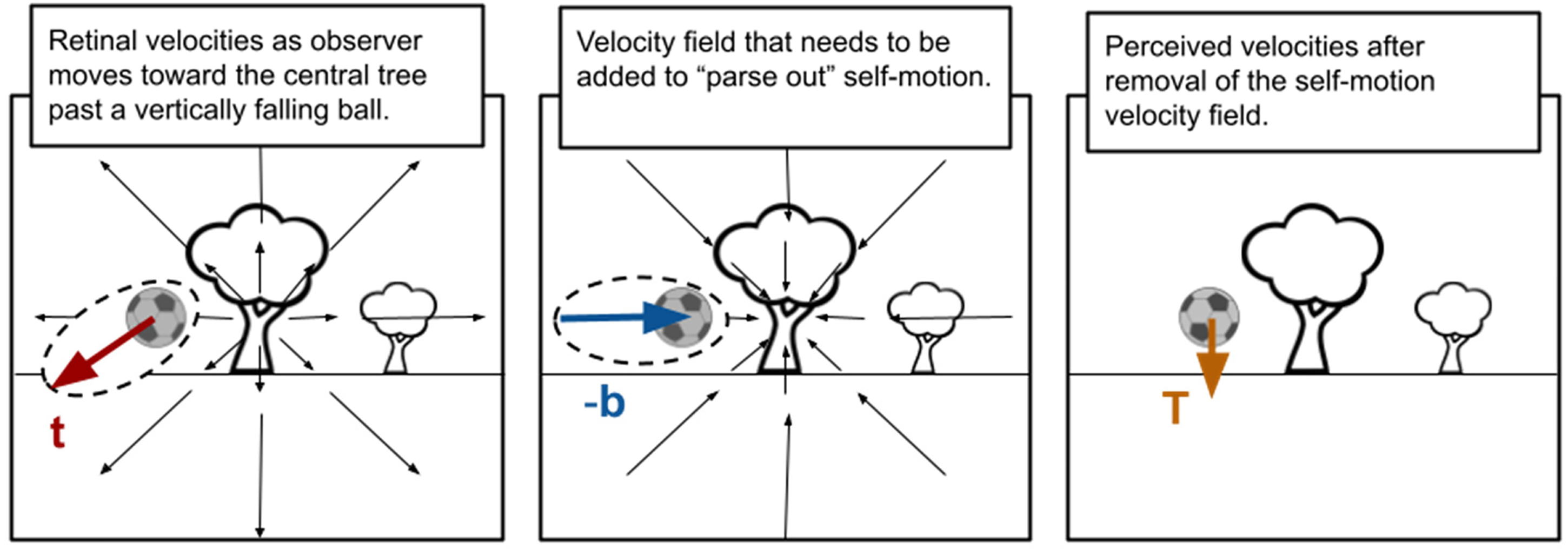
Depiction of the flow-parsing hypothesis. In order to calculate the actual (world-centered) motions of the objects in a scene (e.g., the soccer ball velocity,
The process depicted in Figure 1 can be described using vector notation. The perceived target motion


Experimental Questions
In this study, we are interested in two questions related to β. Both questions have received little attention in the literature: what mechanism underlies the subtraction incompleteness in lab settings and how is the background motion perceived in scenes such as those depicted in Figure 1? We wondered, in particular, whether the two questions might be related, that is, is the incompleteness of the background subtraction due to a miscalculation of the background motion by the visual system, or is it due to a shortcoming in the subtraction process itself? If it were due to a miscalculation of the background motion then, we surmised, there should be an associated misperception of the background.
The way our two questions relate to one another can be depicted simply in the following way: there is a process within the visual system that links the stimulus background motion

Bisection of the background pathway by probing the perception of the background
By examining perceived background motion
By probing a participant's perception of the background motion we aim to (1) localize β (<1) to a position in the background processing pathway—before the area associated with background perception, after that area or a component of β before and a component after—and (2) gain a sense of how participants perceive the motion of the background. This will allow us to see if a misperception of the background (βpercept ≠ 1) is responsible for βtotal being less than one.
Note that we cannot be sure that perceived background motion
In order to answer our two questions we took the following two steps: (1) we measured βtotal under a range of conditions and (2) we measured βpercept under those same conditions so that βtotal could be parsed into its two components (βpercept and βutilize). The three conditions under which βtotal and βpercept were measured are distinguished by background motion type: one background was composed of uniform horizontal translation, one was composed of radially expansive flow as in Figure 1, and the last background was composed of random local motions with a global average horizontal translation. The reasons for these particular choices are outlined in the introductory sections for each experiment.
Note that step 1—the measuring of βtotal under a range of conditions—has been performed extensively in a range of Induced Motion and Flow-Parsing studies (Dokka et al., 2013; Dokka et al., 2015; Falconbridge et al., 2022b; Mayer et al., 2021; Niehorster & Li, 2017; Xie et al., 2020). Our study is distinguished from these previous studies by the fact that we measured βtotal using a continuous psychophysics approach described below. We argue that our continuous approach allows for the study of this phenomenon under more natural conditions and offers other advantages over traditional trial–based approaches. We could find only one study that performed step 2. Rock et al. (1980) used a moving rectangular frame as a “background” and a spot of light as a “target” and asked participants to judge the motion of the frame (as well as the spot) thus directly quantifying background perception. Again, our study is distinguished by our use of a continuous psychophysics approach.
Having presented the two questions we wish to address in this study and having outlined the steps we took to answer them, we describe the continuous regime employed in our experiments as this regime was key in allowing us to take these steps in a reasonable amount of time and was important for a number of other reasons outlined below. Below we also briefly outline the unique method we needed to employ to analyze the continuous data.
A Continuous Approach
Our continuous psychophysics paradigm was previously developed in our lab (Falconbridge et al., Under Review). In this paradigm, participants experience a constantly varying stimulus and are tasked with responding to the changing stimulus continuously over an extended period of time. Each continuous session in our current study lasted just over 4 min. To collect the equivalent amount of data to that in a 4-min session using trial-based methods took about 3 h in a study conducted previously in our lab (Falconbridge et al., Under Review). Thus, the continuous approach offers significant savings in participation time. Collecting data quickly allowed us to test various conditions that might affect βpercept and βutilize for each participant in a reasonable amount of time. As well as offering a means of rapid data collection, four more considerations make a continuous approach desirable in a flow-parsing study:
Accurate heading perception, which is essential for knowing what parts of the motion field are due to self-motion (Foulkes et al., 2013), requires exposure to simulated self-motion scenes that vary with time (Burlingham & Heeger, 2020). The unchanging or “instantaneous” optic flow stimuli that are used in typical trial-based experiments are, thus, impoverished when it comes to the study of flow-parsing. One thing that has been shown to affect flow-parsing gain is multisensory stimulation (e.g., Mayer et al., 2021; Xie et al., 2020). In particular, the addition of vestibular cues that are conducive with the background motion has been shown to increase βtotal. It is difficult and time-consuming to add natural-feeling and appropriate vestibular cues on a trial-by-trial basis. A continuous approach allows for the seamless addition of physical motion that is either congruent or not with the continuously varying background motions. In the General Discussion, we discuss an experiment conducted previously in our lab where such physical motion was employed. A continuous method uses stimuli that vary continuously with time and engages natural perception-action loops. This mimics situations that the flow-parsing mechanism evolved to deal with. Using a continuous approach one can test whether the results obtained using more abstract, trial-based approaches hold under more natural conditions. A positive side-effect of this naturalistic interaction with the stimulus is that the participant's task is engaging and requires sustained attention which alleviates boredom effects (Huk et al., 2018).
The component of the scene that was adjusted continuously in all experiments was the background motion
Recall that step 1 for answering our experimental questions was to measure βtotal under a range of background conditions. Measuring βtotal equates to measuring the extent to which the background motion vector in the vicinity of the target
In relation to step 2, measuring βpercept equates to measuring the extent to which perceived background motion in the vicinity of the target
In order to analyze the inherently noisier data produced using our continuous approach, a Bayes-optimal model of the participant was employed. Here, both the sensory and action components of the model participant perform in a Bayes-optimal manner (Falconbridge et al., Under Review). Using this model, we traced the stimulus via the sensory stream and the actions via the action stream to the “decision center” of the model which gave us a sense of the stimulus properties to which the participant was ideally responding and the ideal actions they planned as a result. We have shown previously that these ideal stimuli and responses are comparable to actual stimuli and responses in much more controlled trial-based experiments (Falconbridge et al., Under Review). More detail about our analysis method is offered under the Methods section of Experiment 1 below.
In summary, the continuous approach combined with our analysis method offers reliable data, similar to that obtained from trial-based experiments, but in a fraction of the time with the added benefit of employing engaging and naturalistic data-collection sessions. These sessions more closely simulate environments under which the visual system evolved its target-background parsing mechanism and the continually changing stimulus allows for more accurate perception of heading direction.
Experiment 1: Induced Motion
In this experiment, we estimated both βpercept and βtotal using a continuous version of a stimulus similar to that typically used in Induced Motion experiments (e.g., Zivotofsky, 2004). The reason for using this stimulus is that it connects our study to the large body of literature on the Induced Motion effect and it represents an uncomplicated background—one where all local elements move at the same speed and direction. The background motion consisted of uniform horizontal translation but the magnitude and sign of that motion varied with time so as to perform a random walk. At each time step (duration 0.1 s), a left or right facing low-magnitude motion vector was added to the current motion of the background with a 50% chance of each.
Methods
Participants
All but RS were experienced, psychophysical observers. All but ED were aware of the purposes of the study but only MF was aware of how the experimental tasks related to that purpose. Participant ED had a divergent squint and completed the experiments using an opaque eye patch over the nondominant eye. All participants gave their informed consent to the study which had ethics approval (RA/4/1/4503) from the Human Ethics Committee at the University of Western Australia and therefore conformed to the tenets of the Declaration of Helsinki.
Apparatus
Stimuli were displayed on a SONY Trinitron G420 monitor (1024 × 768 pixels at 100 Hz) placed 57 cm from a chin rest. Stimuli were generated and updated using Unity version 2018.4.7f1 running on a pc with a Windows 10 operating system. The target direction or speed was adjusted by participants using left-right motion of a mouse.
Stimuli
We used the same flexible visual stimulus across all experiments. In order to have target and background motion without either stimulus component changing their position relative to fixation and without them leaving/entering the display area during a continuous session we used “dynamic global plaid” stimuli (c.f. Global Gabor Stimuli in Amano et al., 2009) where the target and background were each made up of small plaid patches where each Gaussian “container” remained in place but the plaid patterns within the containers drifted with time. Target plaid patterns drifted in the global direction and at the global speed of the target, and background patterns drifted at the local velocity that was congruent with the optic flow of the background. It has been shown previously that the subtraction (of background from target velocity) effect, thus produced, is the same as that obtained when using more traditional moving stimuli like fields of dots (Falconbridge et al., 2022b). This stimulus is capable of representing a range of optic-flow types without requiring a change to the layout or composition of the scene.
In Experiment 1, the background motion was uniform sideways translation. See Video 1 for a movie of the Experiment 1 stimulus.
The sideways background motion shown in this video simulates one of two real-world scenarios: sideways translation of the participant where all background elements lie on a plane at a certain distance from the participant or rotation of the participant with no restrictions on the distance of background elements from the participant. Varying the background motion continuously simulates continuously changing the sideways motion or rotation of the participant. Note that the background motion just described is a continuously varying version of backgrounds used in most traditional induced motion experiments.
The target consisted of 30 Plaid patches evenly distributed around a 4° radius ring centered on the display. The background consisted of 40 Gabor elements randomly scattered over a 20° by 20° region centered on the display (elements were free to also appear inside the target ring). Plaids were composed of a pair of orthogonal 3 cycle/degree orthogonal gratings, each with a Michelson contrast of 0.40, within an 8′ Gaussian window. Orientations for both the target and background were randomized at the beginning of each data-collecting session. The background direction was always horizontal but the speed varied with time, stepping more leftward or rightward by a certain amount every 0.1 s with a 50% chance of each. The step size was exactly equal to the horizontal component of a 1° change in direction for a virtual “background” that moved at the same speed as the target and whose horizontal component of motion was equal to the horizontal speed of the actual background. This meant bigger step sizes when speeds were low and smaller ones when speeds were higher. This was to compensate for the fact that a larger change in direction for the target would be needed for the same change in background speed when background speeds were higher. The reason for this is that the target direction would be further away from vertical so a given change in target direction would produce a smaller change in the horizontal component of motion. For the continuous correction task, used to determine βtotal, the target plaids “drifted” at 2.5 °/s at all times with the direction of drift being controlled by the participant. A right movement of the mouse caused a clockwise change in direction and a left movement caused an anticlockwise change. This process is referred to as target “steering” in what follows. For the continuous matching task, used to determine βpercept, the target direction of motion was horizontal, and the speed was controlled by the participant. A leftward mouse movement caused an increase in leftward speed and rightward movement an increase in rightward speed.
Procedure
The Bayesian Participant model was used to analyze experimental data. In order to fit the model parameters to each participant, participants first took part in a training session. In this session, they practiced using left-right movements of the mouse to steer the target toward a 2° Gaussian luminance blob that moved around the outside of the display area along an arc with a radius of 12° centered on fixation. This blob stepped 10° either clockwise or anticlockwise of its current position, with a 50% chance of either, every 5 s. The steering responses of participants to this stepping blob were used to estimate damped spring constants and noise variances needed to fit the parameters of the Bayesian Participant model to each participant for future data analysis. Each background plaid in the display drifted in a random direction and at a random speed (up to 2.5 °/s) set at the beginning of the training session to get participants used to movement in the background. Training sessions lasted 2 min and 10 s where the first 10 s were not used. See Falconbridge et al. (Under Review) for more detail on training sessions.
Participants then took part in three continuous correction sessions and three continuous matching sessions. Each session lasted 4 min and 10 s where the first 10 s were discarded from analysis thereby allowing time for participants to get a “feel” for the scene and for the control of the target prior to data collection. In the continuous correction sessions, the participants were tasked with keeping the target moving vertically upward. This required correcting for any perceived deviations from vertical motion whenever this was perceived. In the continuous matching sessions, they were tasked with matching the sideways motion of the target with the perceived global sideways motion of the background. For both types of sessions, so that the background sideways speed could undergo a true random walk, random walks were simulated offline prior to each session until a walk was found that covered the desired speed range—from 2.5 °/s leftward to 2.5 °/s rightward with a buffer of 0.15 °/s either side.
Participants were free to take part in as many practice sessions for each task/condition as they needed to get comfortable with the task before completing data-collection sessions. This is the case for all conditions that follow. The number of practice sessions tended to lie between one and five 4-min sessions.
Data Analysis
Training sessions were analyzed using the BP_training_analysis.m Matlab script in the Supplemental section. This script takes the responses to each blob step and uses the average response to estimate how long it takes for a participant to begin a response to a stimulus change, how much noise there is in their internal representation of stimulus direction, and how “springy” and “damped” their movements are. These estimates are used in the analysis of data for all following sessions.
Continuous correction sessions were analyzed using the BP_correction_analysis.m Matlab script in the Supplemental section. This script converts the target motions set by the participant,
Continuous matching sessions were analyzed using the BP_matching_analysis.m Matlab script in the Supplemental section. This uses the Bayesian Participant model in the same way the continuous correction analysis program does. It does so because the matching task involves the same underlying mathematics as the correction task. For the matching task, we created a new variable
As the background motion is horizontal only, we looked only at the horizontal components of
Results
In the left panel of Figure 3, typical raw data are shown from one of the 4-min data-collection sessions. On the right is the processed data following the application of our Bayesian Participant model. The best-fit line where the slope represents β is shown in red. The slope specifically represents βtotal as these data comes from a continuous correction session.

Raw and processed data. Plotted on the left are the horizontal components of target and background velocities sampled 20 times per second during a 4-min continuous correction session for participant RS. On the right is the same data after being processed with the use of our Bayesian Participant model. In red is shown the line of best fit. The slope represents β as, assuming perceived target direction is straight up, then, for the horizontal components,
Consistent with previous work in our lab (Falconbridge et al., Under Review), the relationship between the target and background is clearer in the processed data; there is less variation in the data and the data are more consistent with the (linear) model. For example in Figure 3, R2 increased from 0.908 to 0.943 and the standard deviation of the residuals (Sy.x) fell from 0.137 to 0.108. For the group, average R2 rose significantly from 0.934 to 0.957 (t[11] = 6.28, p = 0.000006, paired two-tailed t-test) and Sy.x fell significantly from 0.127 to 0.097 (t[11] = 7.88, p = 0.0000008, paired two-tailed t-test) for the continuous correction data. This pattern was consistent throughout this study for both the continuous correction and the continuous matching tasks.
Reduction in noise aside, the β values themselves were not significantly altered by the application of our Bayesian Participant analysis method.
There were no discernible systematic patterns in the residual plots indicating that a simple linear model of the form
Mean βpercept and βtotal values are plotted for each participant on the left side of Figure 4. On the right are shown group means for βpercept and βtotal along with calculated βutilize values. The same four participants were used in Experiments 1–3 so that comparisons between conditions could be easily made. Error bars represent 95% confidence intervals.

Induced motion results. On the left are bar graphs depicting mean β values for both the matching (“percept”) and correction (“total”) tasks under the Induced Motion condition. Here, the background motion was laminar translational flow as in standard Induced Motion experiments. On the right is a summary of the group means for both βpercept and βtotal plus calculated βutilse values. Error bars represent 95% CI.
As expected from previous studies, βtotal values were less than 1; significantly for RS (t[2] = 5.50, p = 0.03, two-tailed t-test), MF (t[2] = 4.70, p = 0.04, two-tailed t-test), ED (t[2] = 6.10, p = 0.03, two-tailed t-test), and the group as a whole (t[3] = 3.43, p = 0.04, two-tailed t-test). Perhaps surprisingly, the mean βpecept is also significantly less than 1 for the group (t[3] = 15.62, p = 0.00006, two-tailed t-test). Mean βpercept is also very close to mean βtotal for the group making mean βutilize close to 1 (not significantly different to 1; t[3] = 0.69, p = 0.54, two-tailed t-test).
Included in the Supplementary section is a video (Video 4) of the target and background while MF performed the matching task used to calculate βpecept. While focussing on the target it may appear that its motion matches, on average, that of the background with deviations occurring when the background motion randomly changes in a significant way. But if the video is sped up, either forward or backward by sliding the bar on the timeline, it becomes clear that the target is moving at a slower rate than the background, thus βpecept < 1.
Our participants all reported that during both the matching and correction tasks, the background motion was only rarely noticeable. Some readers may experience this as they focus on the target in Video 4. This is consistent with many Induced Motion studies where a moving background appears stationary (and the stationary target appears to be moving) (Reinhardt-Rutland, 1988). As the aim of the participant in Video 4 was to match the target to the background some readers may experience a complete absence of motion, both in the target and the background.
Discussion
The matching results may be surprising. In this experimental condition, the motion of the background was uniform across the entire display and it was clear (no noise). Even so, participants failed to match the target to the actual motion of the background. Instead, the target was set, on average, to about 0.88 of the background speed and this was consistent across participants, that is, βpecept was about 0.88 on average. This average was not significantly different from that for βtotal. That is, there is no evidence to suggest that the misperception of the target (βtotal) was not entirely due to a misperception of the background (βpecept).
Experiment 2: Expansive Optic Flow
Experiment 2 stimuli were composed of local elements whose speeds were proportional to distance from the Focus of Expansion (FOE) and whose directions were along with radii emanating from the FOE similar to the motion depicted in Figure 1. See Video 2 for an example video. This represents an incremental increase in background complexity compared to Experiment 1 and it links our study to a bulk of the flow-parsing literature where this type of flow is commonly employed. Linear expansive optic flow simulates forward motion of the participant toward a plane. The FOE was randomly perturbed horizontally in a manner similar to the horizontal velocity in Experiment 1—stepping left or right by a certain amount every 0.1 s. Having the FOE off to one side of fixation represents the participant directing their gaze to one side of the direction they are heading in. This is depicted in Figure 5. Fixing one's gaze to one side of the heading direction introduces a sideways motion to the background. This sideways motion is equivalent to the sideways motion in Experiment 1 already described and is the only part of the background motion that should be used in the

Optic flow when fixation is offset from heading direction. The top image depicts a person facing a red circular target that is to the right of where they are traveling. The actual velocity of the person (their heading velocity) can be decomposed into two components—one in the direction they are facing, and the other orthogonal to that direction. The bottom panels show that the resulting optic flow pattern can be decomposed into two parts corresponding to self-motion in the two-component directions. It is only the “sideways” optic flow component corresponding to motion in the direction orthogonal to the facing direction (right panel) that affects perceived target motion if optic flow is subtracted from the target motion (as motion in the central panel is symmetric near the target). Note that this motion is the same as that at the center of the target in the leftmost panel. A visual system capable of correctly using optic flow information in the subtraction process will be able to extract the sideways component depicted in the right panel and use it in the subtraction process.
As in Experiment 1, we measured βpercept and βtotal. To measure βpercept, participants attempted to match the target to the sideways motion in the display in the vicinity of the target which is equivalent to the sideways motion depicted in the right panel of Figure 5. To measure βtotal they attempted to keep the perceived target moving vertically upward. These are the continuous matching and continuous correction tasks, respectively.
Method
Participants
The participants were the same as Experiment 1.
Stimuli
The target stimulus and the control of the target motion by the participant was the same as in Experiment 1. What differed was background motion. Here, the horizontal position of a point representing the FOE underwent a random walk just as the sideways speed of the background underwent a random walk in Experiment 1. Step size was 0.15° with a 50% chance of a leftward or rightward step every 0.1 s. The drift of each plaid patch was determined by its relationship to the FOE; speed increased proportionally with distance from the FOE at a rate of 0.5 °/s per degree and direction was always radially away from the FOE. See Video 2 in the Supplementary section.
Procedure
Participants took part in three continuous correction sessions and three continuous matching sessions. The continuous correction and continuous matching tasks were the same as in Experiment 1. Participants kept the target moving upward in the correction sessions and matched the target to any perceived global sideways motion in the background during matching sessions.
Random walks were chosen prior to each session so that the FOE covered a 12° horizontal range centered on the display, making the maximum global sideways motion 3 °/s.
Data Analysis
Continuous correction and continuous matching results were analyzed in the same way as they were for Experiment 1 except that the background sideways motion used as input to the analysis program had to be extrapolated from the position of the FOE. The extrapolation was based on the vector addition mechanism depicted in Figure 5, for example, when the FOE was at its maximum rightward position of 6° from fixation the global sideways motion was 3 °/s leftward. Participants were presented with stimuli like that in the lower left panel of this figure. The sideways motion used as input is represented in the lower right panel and is the motion orthogonal to the simulated fixation direction of the participant.
Note that only the first 3 min of the 4-min session were used for analysis for one of RS's matching sessions because, in the participant's own words, they “lost control of the target” toward the end. This manifests in the data as a large sweeping of target direction across direction space, presumably in an attempt to regain verticality in target perception.
Results
As with Experiment 1, all processed data were well modeled with the linear equation
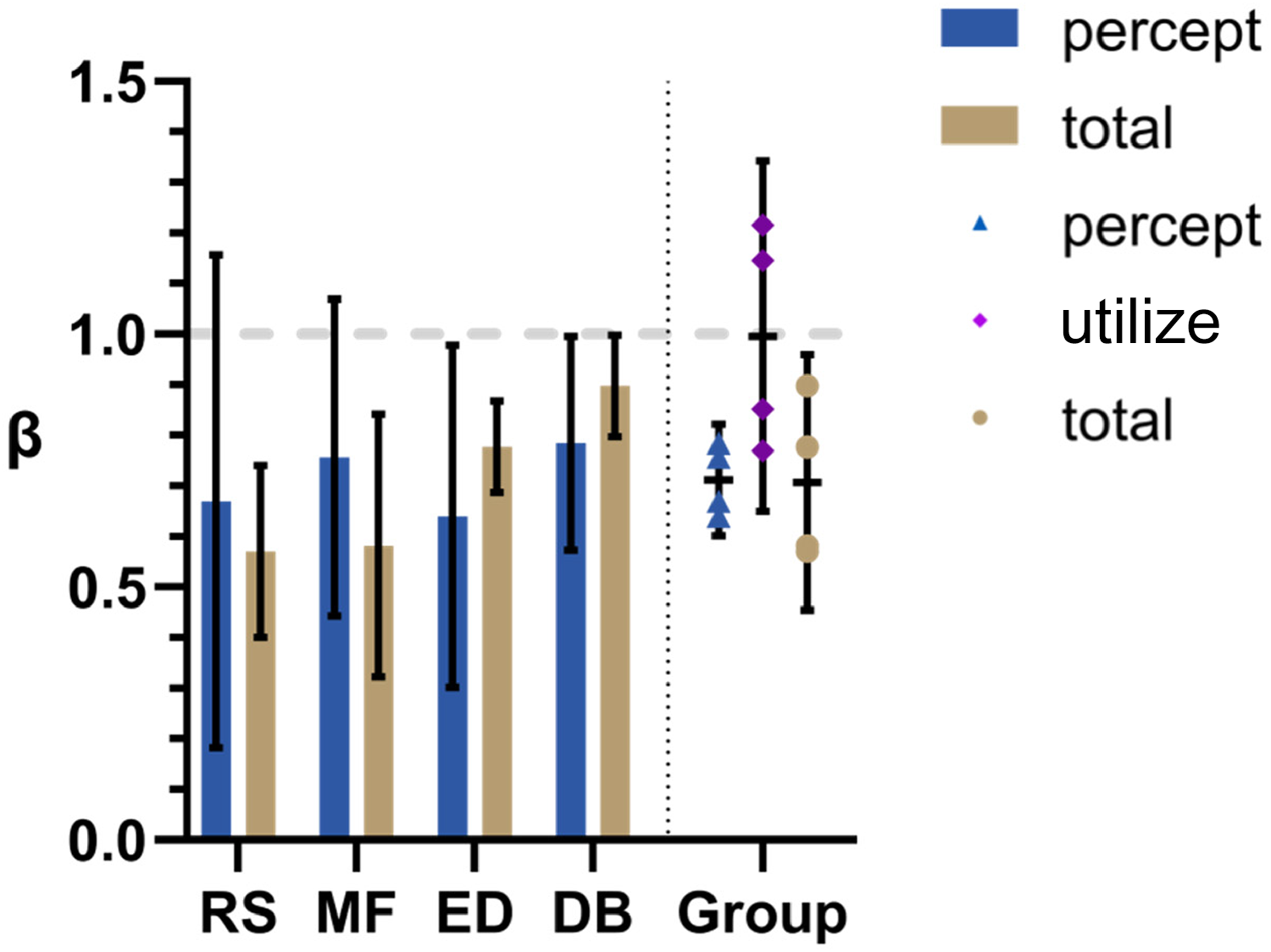
Linear expansive optic flow. Here, participants viewed radial optic flow where the speed varied proportionally with distance from the FOE. Mean βpercept and βtotal values are shown for individuals on the left and group means are shown on the right. Error bars represent 95% CI.
The pattern of results for the Optic Flow condition was very similar to that in Experiment 1. Both mean βpercept and βtotal values were significantly less than 1 for the group (t[3] = 8.33 and 3.69, p = 0.004 and 0.03, respectively, two-tailed t-test) and both means were very similar. As with Experiment 1, this made mean βutilize almost exactly equal to 1 for the group (not significantly different from 1 with t[3] = 0.04, p = 0.97, from a two-tailed t-test). The only difference between these group results and those in Experiment 1 is that mean βpercept and βtotal values were smaller for this (Optic Flow) condition. This difference was significant (t[3] = 4.58 and 4.00, p = 0.02 and 0.03 for βpercept and βtotal, respectively, from a two-tailed paired t-test).
Discussion
The Experiment 2 results lend further support to the idea that βtotal (misperception of the target) is entirely due to βpercept (misperception of the background).
Experiment 3: Randomized Flow Field
For the Randomized Flow Field condition, the stimulus generation process was exactly the same as for the Optic Flow condition in Experiment 2 but the random position in which each element appeared did not correspond to the random position used for calculating the motion of that element. This is comparable to Warren & Rushton’s (2008) “vector shuffling” technique. It meant that the distribution of speeds and directions of elements was exactly the same as that in the flow condition but the radial expansive structure was absent—replaced with a field of apparently randomly moving elements. What was common between conditions in a global sense was the 2D average motion.
This condition was used for three reasons. Firstly, and most importantly, it was a means of testing how target and background perception is affected by the addition of noise in the background optic flow pattern. In this case, the global optic flow was sideways translation and the noise was in the form of a random spread in the velocities of the local elements about the global velocity. Secondly, it was used to confirm the findings of Warren & Rushton (2008) that background optic flow structure is important to target perception. Does using the same local elements as Experiment 2 but randomizing their positions so that the optic flow structure disappears change the target perception as was found in Warren & Rushton (2008)? We wanted to confirm that this was the case under the continuous conditions used in our study. Thirdly, if there is a difference in target perception when optic flow structure is destroyed, we wanted to determine where the difference occurs in the visual processing stream; is it due to a change in the background perception (βpercept) or a change in the way the background is used to get target perception (βutilize)?
Method
Participants
The participants were the same as in Experiments 1 and 2.
Stimuli
The stimulus framework and the method of control of the target motion by the participant was the same as in Experiments 1 and 2. All that differed was the background. Here, each plaid patch had two random positions (within the 20° by 20° background area) assigned to it. The first was used to calculate the continuously varying drift rate for the plaid pattern in exactly the same way it was calculated in Experiment 2. The second described the position in which the plaid patch appeared on the display. In this way, the average motions of the local motion elements were exactly the same as that in Experiment 2, but the positions in which those elements appeared were random, replacing the global radially expanding optic flow pattern with a field of apparently random motions. See Video 3 in the Supplementary section.
Procedure
Participants took part in three continuous correction sessions and three continuous matching sessions just as in Experiments 1 and 2.
Data Analysis
Data were analyzed in exactly the same way as Experiment 2 except that the background sideways motion was taken as the average of the local motions. Note that, because the relationship of speed to distance from the FOE is linear, this is exactly equivalent to working out the sideways motion based on the position of the FOE as was done in Experiment 2.
Results
The pattern of results was not the same as that in Experiments 1 and 2 (see Figure 7). Here, the mean βtotal value was significantly smaller than the mean βpercept value for the group (t[3] = 3.65, p = 0.04, from a two-tailed paired t-test). This led to the calculated mean βutilize value being significantly less than 1 (t[3] = 3.91, p = 0.03, from a two-tailed t-test). Note that the different pattern was not due to a significant difference in βpercept (t[3] = 0.84, p = 0.46, from two-tailed paired t-test), but to a decrease in βtotal (t[3] = 2.94, p = 0.03, from a one-tailed paired t-test).

Randomized condition. Here, the stimulus generation process was identical to that in the Optic Flow Condition of Experiment 2 except that local elements did not appear in the position that was used to calculate their velocity, rather they appeared in a randomly assigned position on the display. This meant that the average sideways motion in the background was the same as that in Experiment 2 but the global optic flow pattern was absent; local motions were, instead, “random”. Mean βpercept and βtotal values are shown for individuals on the left and group means are shown on the right. Error bars represent 95% CI.
Discussion
The finding that the pattern of results was different for this condition compared with the Optic Flow condition supports the notion that it was not simply the average of the local 2D motions in the optic flow pattern that was used in the subtraction process under the Optic Flow condition in Experiment 2. Average sideways flow was the same in both conditions, what varied was the absence of optic flow structure in Experiment 3. This indicates that optic flow structure is important to target perception under our continuous psychophysics conditions just as it is under trial-based conditions (Warren & Rushton, 2008). The difference between Experiment 2 and Experiment 3 appears to be due, not to a difference in the perception of motion in the background (βpercept), but to a difference in how that background motion is used in the subtraction process (βutilize). This point is taken up in General Discussion.
Speaking to our primary drive behind Experiment 3, our results also suggest that when noise is added to the optic flow pattern in the form of a spread in the local velocities around the global mean, target misperception (βtotal) cannot be entirely put down to a misperception of the background (βpercept). Here, the extent to which the misperceived background is used in the subtraction of background motion from target motion (βutilize) also plays a role, that is, βutilize is significantly less than 1.
Another pattern in the data that suggest that βutilize plays an important role in target perception is the fact that, despite the group average βutilize being close to 1 for both Experiment 1 and Experiment 2, it varied systematically with participants across all three experiments; βutilize was smallest for RS and MF and largest for ED and DB. This participant effect was significant (F(3, 6) = 9.83, p = 0.01, a two-way ANOVA). This is discussed further in General Discussion.
General Discussion
Our results support those cited in the Introduction showing that, in lab settings, the subtraction of background motion from target motion is incomplete, that is, βtotal tends to be less than 1 (Dokka et al., 2013; Dokka et al., 2015; Falconbridge et al., 2022b; Mayer et al., 2021; Niehorster & Li, 2017; Xie et al., 2020). Whether this is a result of the background motion being perceived as something other than the true background motion in the optic flow pattern (βpercept < 1) or whether it is a result of making less use of that perceived motion (βutilize < 1) has not been clear until now. Here, we show that for the case of laminar translational flow and radial expansive optic flow, a misperception of the relevant motion component in the background flow (βpercept < 1) accounts, on average, for all of the deviation of βtotal from unity.
Our matching results indicate that even when the appropriate velocity for subtraction is signaled very clearly—all parts of the background moving at the appropriate velocity—the perceived background flow is of a lower magnitude than it actually is. In other words, the participants do not match the target to the actual, very obvious, sideways velocity but instead, match it to a slower-moving version of the background. This finding has significance when considering the processing of background information during target perception tasks—a topic that has received little attention. What these results suggest is that, in lab settings, not only is target perception altered by the presence of a moving background but also the perception of the background is also altered by the presence of a target (Rock et al., 1980).
In fact, for Experiments 1 and 2, the misperception of the target can be fully accounted for, by a misperception of the background for the group. There is no evidence in the group data that βutilize is different from 1, leaving the deviation of βtotal from 1 to βpercept's deviation from 1. On the other hand, in Experiment 3, βutilize is significantly less than 1 for the group. That is, there is strong evidence that something other than a misperception of the background is affecting target perception. Comparing the Experiment 3 stimulus to those of Experiments 1 and 2 should provide clues as to what that other factor may be.
In all three experiments, there is a global sideways motion for the background where that motion can be obtained by taking the average of the motions of all local elements. The thing that distinguishes Experiment 3 background from those of the other two experiments is that in Experiments 1 and 2, the local elements have motions that are precisely aligned with the global optic flow pattern. That pattern was translational in Experiment 1 and expansive in Experiment 2. In Experiment 3, on the other hand, the local element velocities were scattered randomly around the global velocity. This random scattering of local velocities around the mean can be considered noise.
Below we present two models that can account for our results. The first accounts for those of Experiments 1 and 2, and the second includes a modification that is needed to account for the results of Experiment 3.
Models
By probing perceived background motion, we propose to have decomposed β in equation (2) into two parts in an effort to understand the contributions of each part to the incompleteness of subtraction during flow-parsing in lab settings. The right panel of Figure 2 in the Introduction depicts the resulting relationship between the various quantities made available for study by this parsing. Here, we begin by presenting a model that assigns specific meanings to these quantities and predicts specific value ranges for some of these quantities. This model is depicted in Figure 8.

First model being tested. On the left is a depiction of the proposed process in the visual system for producing perceived target and background motions from stimulus target and background motions and on the right is a proposed internal model of the stimulus generative process that is the basis for the process depicted on the left. We test the hypothesis that perceived background motion,
The model leans heavily on the Inferential/Bayesian Brain proposal (Clark, 2013; Knill & Pouget, 2004) that perceptual systems attempt to estimate the hidden causes of sensory stimuli, that is, that perceptual systems contain “generative models” of the stimuli they encounter. For a scene like that depicted on the bottom left of the right half of Figure 8, there are many possible real-world causes for the stimulus motion vectors. For the target, there are two possible causes: the actual motion of the target (relative to the world) and the scene motion at the location of the target due to the self-motion of the observer. The target motion in the stimulus is precisely a vector sum of the two. For the background motion, the possible causes are self-motion and “Other Causes” such as wind and the actual motion of components making up the background (e.g., one component of the background may be wind-blown leaves in a tree). These motions are also vector summed to produce the actual motions of the background elements in the stimulus.
Previous research and the flow-parsing hypothesis itself equate perceived target motion
It is possible that the perceived background motion
In terms of target and background perceptions, if βtotal is completely attributable to βpercept then the target misperception in flow-parsing and induced motion studies is entirely due to the subtraction of a misperceived background.
The central model prediction, that βtotal is entirely due to βpercept, has surprising implications when one considers the way we measured βpercept. We did so by continuously adjusting the sideways component of background motion randomly in the vicinity of the target
Our Experiment 2 results further confirmed the predictions of our simple model. The optic flow pattern was expansive but, just as in Experiment 1, there was a global sideways background motion. This could be obtained in three ways: by using the background motion at the very center of the target, by taking the global average background velocity over the whole scene, and by parsing the global motion into its facing direction component and the orthogonal, sideways component as shown in Figure 5. All three methods give the same result but, surprisingly, the participants matched the target to a slower version of the background making βpercept less than 1. The average βpercept value for the group accounted for the group βtotal confirming our model. For these two experiments, βutilize plays no significant role in the group results, that is, βutilize is equal to 1 on average.
Two notes about “causes” of stimulus motion need to be made before Experiment 3 results are discussed. The first begins with an observation: following the flow-parsing hypothesis, it only makes sense to subtract the background if an observer believes the background motion is due to self-motion. So why would the visual system assign any credence whatsoever to background motion being caused by self-motion in a lab setting where the observer is stationary? In other words, why should we expect βtotal to be anything other than zero when a participant is not actually in motion? In this case, there will be no nonvisual cues to self-motion such as vestibular and proprioceptive cues. This question can be answered by considering two everyday experiences. The first is sitting in a moving vehicle such as a train while looking out of the window. As long as the train is not accelerating by speeding up, slowing down, or turning, the observer will not experience any self-motion cues other than a visually moving background. In such cases, the visual system correctly assigns background motion to self-motion and treats the motions of objects outside of the window accordingly. For example, a car traveling alongside the train would appear stationary relative to the observer, but it is seen correctly as moving, not stationary. The second common experience is that of being “tricked into thinking we are moving” by watching footage from a moving camera as, for example, at the cinema. Just like in the train example, a camera following a moving vehicle gives us the sense that we are moving with that vehicle and we treat objects in the scene accordingly—seemingly without hesitation. It is not unreasonable to expect that moving dots on a screen in a lab setting might cause a similar assignment of that motion to self-motion, even in the absence of nonvisual self-motion cues.
The other thing to note about causes of background motion relates to the “Other Causes” depicted in Figure 8. Returning to a lab setting with moving dots on a screen, it is clear from past studies already alluded to that the illusion of self-motion is rarely complete, that is, βtotal rarely reaches 1 in such settings. What we propose in our model is that this is due to the partial assignment of background motion to other causes. An example of another cause might simply be “the dots are moving on a screen.” In this case, the observer's visual system (partially) “sees past the illusion” to the real cause of the background motion. The weighing up of possible causes of background motion is likely informed by other perceptual modalities such as the vestibular and proprioceptive systems.
Our Experiment 3 results call for a more complex model than that depicted in Figure 8. That is because, in this experiment, βutilize accounts for a significant portion of βtotal. A possible model update is depicted in Figure 9.

Updated model. An extra node has been included in the mechanism depicted on the left to account for the fact that βutilize can be less than 1 as shown in Experiment 3. Compare with Figure 8. The visual system is still proposed to estimate optic flow due to self-motion but that is not what is perceived as the background. Instead, what is perceived is an estimate of a “Motion Field” that is intermediate between
In Figure 9, the two causes of target motion in the scene are “Optic Flow” due to self-motion and the actual motion of the target, “Targ. Actual,” just as before and just as required by the vector summation processes involved in generating an image at the retina. What is different is that perceived background motion

Motorized chair. Shown for MF, ED, and DB are βtotal values for individual sessions and for each condition along with means and error bars representing 95% confidence intervals. On the right are plotted mean values based on two sessions for each of a group of 5 students (note, though, that one student only completed a single Incongruent session). In the first condition, participants were stationary, in the second the motorized chair moved congruently with the background optic flow, and in the final condition, the motion of the chair was opposite to that in the congruent condition. Some of these data have appeared previously in a different form in Falconbridge et al. (2022a).
The results of Experiment 3 randomized condition will serve to illustrate what is meant by the intermediate “Motion field.” It is possible that “Other Causes,” such as “moving patterns on a stationary screen” were partially assigned to background motion,
A noncentral finding in our study noted in Experiment 3 Discussion section is that although βutilize was equal to 1 on average for the group, it tended to vary among participants rather consistently across all three experiments. This is reflected in the generally ascending pattern of βtotal values as you move from left to right in Figure 4, Figure 6, and Figure 7, while the βpercept values remain fairly consistent. According to our updated model, this reflects a varying tendency to hold to the preconception, furnished by nonvisual perceptual modalities, that self-motion is zero in the face of visual data suggesting nonzero self-motion; RS and MF were less “convinced” by the visual cues and DB was most convinced. According to a strict Bayesian perspective, being “less convinced” is due to either a greater variance in the incoming sensory data or lower variance in the prior.
In considering where the process depicted on the left of Figure 9 might be implemented it is important to note that βpercept did not vary between the expansive optic flow condition of Experiment 2 and the randomized condition in Experiment 3 where the average of the local motions was the same but the global optic flow structure was absent. This indicates that the perceived background sideways motion was indifferent to optic flow structure. At the same time, βtotal was affected by the removal of the optic flow structure indicating that the intervening step between perceived background,
The Link Between the Matching and Correction Tasks
At first glance, the matching task used to measure βpercept is about matching one speed to another, and the correction task used to measure βtotal is about direction perception. How can we assume the matching task results tell us anything about perception of the background during the correction task? What ties these two tasks together?
There is a long tradition in the Induced motion literature of using a background that moves horizontally (or vertically) and, simultaneously, using a diagonally moving target whose direction is changed to find the point where it appears to move only vertically (horizontally) (see review of Induced Motion studies by Reinhardt-Rutland (1988) and more recently, Zivotofsky (2004), Farrell-Whelan et al. (2012), and Falconbridge et al. (2022b)). The logic is that the diagonally moving target will have a motion component in the direction of the background, and the direction of the target is changed until the magnitude of that component cancels out the motion induced by the moving background (the induced motion is in the opposite direction of the background motion). Following that tradition and logic, our correction task is simply about finding the horizontal component of motion in the target that matches the background component that is being subtracted by the visual system from the target (which we label βtotal
When that is understood, the link between the matching and correction paradigm becomes clear. Both are about horizontal components, but in the correction task, it is about finding the horizontal component that is perceptually subtracted from the target, and in the matching task it is about finding the perceived horizontal motion of the background.
Can βtotal Equal 1?
A prediction of the model depicted in Figure 9 is that (1) when the optic flow pattern is clear and (2) when that motion can be readily assigned to self-motion, βtotal should equal 1. In a previous study conducted in our lab (Falconbridge et al., 2022a), we tested whether a βtotal value of 1 was obtainable using physical self-motion that was consistent with the simulated self-motion in the visual stimulus. Our experiment employed a motorized chair that was under the control of the participant and a Virtual Reality (VR) headset where the visual stimulus was displayed. Participants were tested under 3 conditions: no physical self-motion (Stationary), self-motion consistent with the visually simulated self-motion (Congruent), and self-motion inconsistent with the visually simulated self-motion (Incongruent). The data are reproduced here in a little more detail than in the original study. Plotted in Figure 10 are the βtotal values from each of three sessions for each condition for participants MF, ED, and DB. Also shown are means and 95% confidence intervals for each condition. A line at β = 1 is shown for reference. As the pattern of results for DB differed from those of MF and ED, results are included for a group of 5 naive and unpraticed students. Each data point represents a mean taken from two sessions for each student, except in the case of the Incongruent condition where one of the participants ran out of time and only did a single session.
The central finding, here, is that mean βtotal values were close to 1 for MF, ED, DB, and the student group as a whole for the congruent condition. None of the means for this condition were significantly different to 1 (t[2] = 2.00, 1.00 and 0.33, p = 0.18, 0.42, and 0.78 for MF, ED, and DB, respectively, and t[4] = 0.08, p = 0.94 for the student group, two-tailed t-test). That is not the case for either of the other conditions. MF and ED were very well practiced in using the motorized chair at the time of testing, DB had very limited experience, and the students had no experience. It is telling that the results of the more practiced participants were more consistently close to 1 for this condition (see the general decrease in a spread for purple data points moving right to left in Figure 10); unfamiliarity with the chair was associated with higher levels of data variability and as familiarity increased (and variability decreased), βtotal values were more consistently close to 1. This result is consistent with other studies showing that the addition of vestibular cues and other cues consistent with visual cues makes βtotal approach 1 (Dokka et al., 2015; Dupin & Wexler, 2013; Fajen & Matthis, 2013; Xie et al., 2020). Our study may be the first to demonstrate a group average of exactly 1.
For the group as a whole, and for MF and DB individually, the mean βtotal values for the Incongruent condition were significantly less than 1 (t[3] = 4.38, p = 0.02 for the group means and t[2] = 18.52 and 4.72, p = 0.003 and 0.04 for MF and DB, respectively, using a two-tailed t-test). This finding indicates that it was not simply the use of a motorized chair that produced βtotal values of 1, but it was a result of the motorized chair moving congruently with the background motion in the display.
The results for the Stationary condition are less consistent across participants. For ED, βtotal was not significantly different from that in the Induced Motion condition in Experiment 1 (t[2] = 0.83, p = 0.45, from two-tailed t-test), for MF, βtotal was higher than in Experiment 1 (t[2] = 2.87, p = 0.045, from two-tailed t-test), but in both cases βtotal was less than 1 just as in Experiment 1 (t[2] = 4.62 and 6.55, p = 0.04 and 0.02 for MF and ED, respectively, from two-tailed t-test). This is not surprising as the stimulus was the same, only presented via a Head Mounted Display (HMD) rather than on a computer monitor. For DB, the mean βtotal value was greater than 1, though not significantly. For this reason, the student data were obtained. These data confirmed the suggested trend in DB's results in that the mean βtotal value was significantly greater than 1 (t[4] = 3.10, p = 0.04, from two-tailed t-test). Establishing a reason for the inconsistency in the stationary condition is beyond the scope of this study. A simple explanation is that due to previous extensive use of the motorized chair, both MF and ED interpreted the visual background motion as being caused by self-rotation, whereas a lack of exposure to the chair and a lack of depth cues in the visual stimulus led DB and the students to interpret the background motion as being caused by sideways self-translation with the target being nearer to the participant than the background. The latter interpretation of the scene allows for βtotal values greater than 1. This is discussed in more detail in the Appendix.
Summary
The continuous approach used here has allowed for the study of flow-parsing within the context of natural perception-action loops, has allowed for engaging testing experiences for participants, and has dramatically shortened the time needed for data collection. We also showed in the General Discussion that our continuous approach allowed for the seamless integration of nonvisual self-motion cues in a previously published study by employing a rotating chair that was controlled by the actions of the participant. Our continuous approach is an attractive alternative to slower, less interactive trial-based approaches used traditionally to study this naturally rich subtraction phenomenon.
This study provides proof-of-concept for the continuous approach presented in Falconbridge et al. (Under Review), including the data analysis method. Despite the relatively low number of participants in the current study, there was a consistent pattern across participants in the substantial within-participant data sets, and the main results were statistically significant.
We introduced our study by asking why the subtraction of the background from the target tended to be incomplete in lab settings, that is, why βtotal tends to be less than one. What some of the studies cited here, including our motorized chair experiment, demonstrate is that under more natural conditions where participants are in control of their physical motion and when that motion is congruent with the visual stimulus, βtotal approaches 1. This lends support to the idea that the flow-parsing hypothesis is correct under natural conditions, that is, the optic flow background due to self-motion is fully subtracted, producing perceived target motions that are relative to the scene. This concept is supported by other studies not yet cited here (Fajen et al., 2013; Ilg et al., 2004; Matsumiya & Ando, 2009).
When visual self-motion cues are not consistent with nonvisual cues as in most lab settings, the subtraction tends to be incomplete. We have shown that the incompleteness of the subtraction can be entirely accounted for by a misperception of the background in the case that the local background motion elements are consistent with the overall global optic flow in the background. When they are not consistent then the degree to which perceived background is utilized in the subtraction process also plays a role.
Finally, in setting up our approach in the Introduction, an assumption was made that perceived background motion
Supplemental Material
sj-m-1-ipe-10.1177_20416695231214439 - Supplemental material for Target motion misjudgments reflect a misperception of the background; revealed using continuous psychophysics
Supplemental material, sj-m-1-ipe-10.1177_20416695231214439 for Target motion misjudgments reflect a misperception of the background; revealed using continuous psychophysics by Michael Falconbridge, Robert L. Stamps, Mark Edwards and David R. Badcock in i-Perception
Supplemental Material
sj-m-2-ipe-10.1177_20416695231214439 - Supplemental material for Target motion misjudgments reflect a misperception of the background; revealed using continuous psychophysics
Supplemental material, sj-m-2-ipe-10.1177_20416695231214439 for Target motion misjudgments reflect a misperception of the background; revealed using continuous psychophysics by Michael Falconbridge, Robert L. Stamps, Mark Edwards and David R. Badcock in i-Perception
Supplemental Material
sj-m-3-ipe-10.1177_20416695231214439 - Supplemental material for Target motion misjudgments reflect a misperception of the background; revealed using continuous psychophysics
Supplemental material, sj-m-3-ipe-10.1177_20416695231214439 for Target motion misjudgments reflect a misperception of the background; revealed using continuous psychophysics by Michael Falconbridge, Robert L. Stamps, Mark Edwards and David R. Badcock in i-Perception
Supplemental Material
Supplemental Material
Supplemental Material
Supplemental Material
Footnotes
Author contribution(s)
Declaration of Conflicting Interests
The author(s) declared no potential conflicts of interest with respect to the research, authorship, and/or publication of this article.
Funding
The author(s) disclosed receipt of the following financial support for the research, authorship, and/or publication of this article: This work was supported by the Australian Research Council (grant number DP160104211, DP190103103, DP190103474) and the University of Manitoba.

Supplemental Material
Supplemental material for this article is available online.
Appendix: The Chair Experiment
The aim of the Chair experiment was to determine whether a βtotal value of 1 was obtainable. Recall that βtotal is composed of βpercept and βutilize. Our model suggests that βpercept should approach 1 as other possible causes for the background motion in a scene are eliminated. We sought to achieve this by having self-motion be completely congruent with the background motion in the display. The medium for self-directed motion was a rotating motorized chair controllable by a handheld VR controller, and the medium for visual stimulation was an HMD.
The results of our third experiment along with our second model in Figure 9 suggest that βutilize will approach 1 as the noise in the background global motion is minimized. Where there was no deviation of local motion signals around the global optic flow pattern in Experiments 1 and 2, βutilize was equal to 1. When local deviations about global flow were introduced in Experiment 3, βutilize values became less than 1. For this reason, a clear optic flow pattern was used in the chair experiment where each local motion element does not deviate from the global optic flow pattern. The Induced Motion background of Experiment 1 was used as it is conducive to self-rotation.
Note also that previous studies indicate that autonomy of physical motion is an important factor in making βtotal as close to 1 as possible; compare passive movement (Dokka et al., 2015; MacNeilage et al., 2012) with active (Dupin & Wexler, 2013; Dyde & Harris, 2008; Xie et al., 2020) and note Wexler et al. (2001). To that end, the physical rotation of the participant was under their own control. As we wanted to test the effect of the congruency between self-motion and visual background motion, these two things were linked—either being congruent or not. As a result, participants kept the target moving vertically, not by controlling the target directly, but by adjusting their own motion so that it produced background motion that was appropriate for making the target appear to be moving vertically. Accordingly, opposite to Experiments 1–3, in the chair experiment the target motion was randomly perturbed and participants kept it perceptually moving upward by adjusting the background. Note however that all participants reported being unaware that they were controlling the target only indirectly. Instead, it felt as if they were in direct control of the target's motion.
In the main Congruent condition, the participant controlled the rotation of the chair using the VR controllers and the visual background moved congruently with head rotation as if the participant were rotating within a stationary world. A participant could make a target that was moving up and to the left, for example, appear to move straight upward by rotating the chair rightward, causing the background to translate more leftward.
There were two other conditions included to allow comparison of the results with those of Experiments 1–3 and to shed further light on the contribution of the chair. In the first stationary condition, the visual stimulus and the method for correcting for deviations in target velocity from vertical were the same as the congruent condition but there was no chair rotation. In the second incongruent condition, all was the same as in the congruent condition except that the chair rotated in the opposite direction to what it did in the congruent condition. A deviation of the target to the left of vertical was still fixed by moving the controller to the right, but the chair moved leftward in this case, not rightward. The accompanying head rotation caused the background to visually flow more leftward which is inconsistent with rotation of the participant in a stationary world.
Note that an interesting difference in the pattern of results between the three participants who took part in all four experiments led us to expand the participant pool. Five students, naive to the experimental goals and unpractised in the task, were also included in this study.
How to cite this article
Falconbridge, M., Stamps, R. L., Edwards, M., & Badcock, D. R. (2023). Target motion misjudgments reflect a misperception of the background; revealed using continuous psychophysics. i-Perception, 14, 1–28. https://doi.org/10.1177/20416695231214439
References
Supplementary Material
Please find the following supplemental material available below.
For Open Access articles published under a Creative Commons License, all supplemental material carries the same license as the article it is associated with.
For non-Open Access articles published, all supplemental material carries a non-exclusive license, and permission requests for re-use of supplemental material or any part of supplemental material shall be sent directly to the copyright owner as specified in the copyright notice associated with the article.
