




Abstract
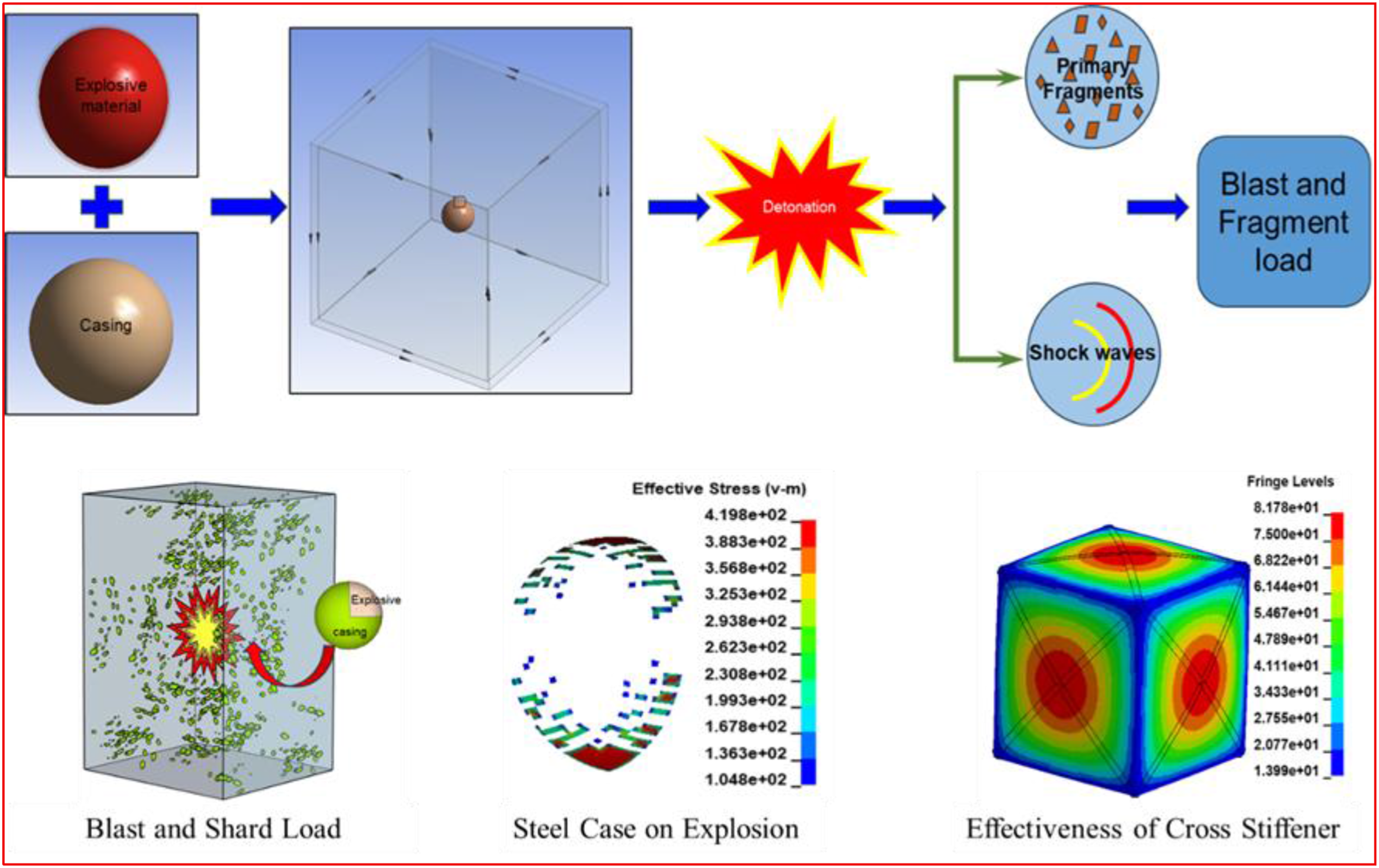
The confined explosion is a very complex and is a critical problem in various sectors such as defense, petrochemicals, important structures, and industrial structures. The explosives are generally enclosed in a casing. Steel is a commonly used explosive casing material and exhibits intricate and disastrous effects on the container structure, after the detonation of explosive sealed in it. The rupture of casing material develops shards, and these shards are responsible for damage to the container structure. Structure geometry and the material used for the explosive casing, affect the response of the structure subjected to explosions. The cubical or rectangular-shaped structures are generally used for blast resistance of structures. In this study, a finite element-based numerical investigation is conducted to estimate the dynamic response of steel cubical structure subjected to confined explosion. The influence of different lightweight explosive casing materials such as carbon fiber-reinforced polymer (CFRP), glass fiber-reinforced polymer (GFRP), and steel material on the response of the structure is assessed and compared. The initial velocities of the shards generated from explosive casings after the explosion are estimated and compared with code-based guidelines. Furthermore, the response of the un-stiffened and stiffened cubical structure with different stiffener configurations i.e., cross, plus vertical, horizontal, and v-type is compared, and an effective configuration of the stiffener is proposed with the highest blast resistance of the structure. It is observed that the CFRP and GFRP explosive casings show an enhanced energy dissipation ability compared to the steel explosive casing. Edge tearing and maximum central deflections are identified as the dominant failure modes, which can be controlled by using adequate stiffener configurations on the structure. The v-type stiffener and vertical stiffener configurations are found to be the most effective in resisting the effect of confined explosion compared to other configurations considering the strength and serviceability criteria.
Get full access to this article
View all access options for this article.