



Abstract
Members of small groups fundamentally desire status as status underpins members’ self-concept and dictates behavior in groups. Moreover, group members readily orient and update status perceptions that index the social standing of themselves and other members. Yet, our understanding is obscured by variability in how researchers study status. In the current review, we crystallize knowledge regarding the nature of status by characterizing variability in definitions, measures, and analytic frameworks. We advocate a definition of status that draws together attributes of respect, admiration, and voluntary deference. We also distinguish reputational and relational status operationalizations and address implications pertaining to measurement along with downstream decisions involving data management and analysis. We encourage a deliberate approach to ensure congruency in how status is defined, measured, and analyzed within a research program. This review also guides theory and hypothesis generation regarding how status-related processes may vary based on different forms of status or differing contexts.
Plain Language Summary
Distinctions in group members’ status naturally arise during group interactions. High status tends to be associated with an array of benefits, such as receiving more respect and attention, enjoying better psychological and physical health, and having greater access to valued resources and opportunities. As such, people fundamentally desire status, vigilantly attend to their own and others’ status, and actively pursue status. Status also powerfully influences group functioning. Whereas a consensually formed status hierarchy may provide order and increase coordination, disputes over status rank can undermine cooperation and encourage conflict among group members. Despite the critical role status plays in social interactions, researchers continue to disagree about how status should be defined and studied. Without a consistent definition and a measurement guideline, it is difficult to produce cumulative knowledge regarding when, for whom, and why status is afforded to others, and the consequences of gaining, losing, or threats to one's status. In this review, we advocate a status definition that identifies respect, admiration, and voluntary deference as three essential attributes of status. We also distinguish status that is consensually conferred by a group (i.e., reputational status) from status conferred by a particular group member (i.e., relational status). We conclude this paper by providing a guide of measurement options and data management strategies that are suitable for studying distinctive research questions.
As status profoundly shapes how individuals behave, feel, and act toward one another (e.g., Anderson et al., 2008; Bendersky & Hays, 2012; Carlson & DesJardins, 2015; Kilduff et al., 2016), the topic of status continues to garner widespread interest from scholars across many disciplines. The term status is also embedded within the common lexicon of everyday language—suggesting, perhaps, that people have an intuitive grasp of what having status signifies. Given how important status is for understanding how individuals navigate social interactions (Anderson et al., 2015; Magee & Galinsky, 2008), coupled with the considerable interest this topic has attracted, one might assume there is a well-established consensus among scholars in how a person's status should be conceptualized and measured. In the current article, we show how the construct of status suffers from inconsistent and ill-defined boundaries. In fact, scholars disagree about the core features of status and there remains considerable heterogeneity in how researchers define and measure status.
Directly addressing such conceptual and methodological issues is essential to developing cumulative (rather than piecemeal) knowledge about status and its important role in regulating and shaping our social lives. Indeed, articulating the conceptual domain of a target construct and developing measures that accurately capture the phenomenon of interest are fundamental goals of psychological science (Clark & Watson, 2019; Flake & Fried, 2020). As such, this review highlights the conceptual and methodological issues around status and provides recommendations regarding how status can be defined and studied. More precisely, this review aims to help researchers recognize the varying ways to theorize and measure status and enable them to leverage this understanding to align their selected research questions with appropriate measures and analyses.
To facilitate theoretical and methodological coherence in the study of status, the current article is organized into two sections. In Section One, we identify and address the dominant tensions surrounding how status is conceptualized and its overlap with related concepts. Leveraging and synthesizing existing research, we describe a tripartite model of status, which provides a potential basis for determining how many and which dimensions should be addressed when defining status. Next, we articulate the rationale and benefits of differentiating status from status hierarchy and social rank. Finally, we differentiate and compare two types of status, namely, reputational status (i.e., shared status perceptions) and relational status (i.e., directly conferred status). In Section Two, we provide a practical roadmap from study design to measurement and data analysis to help researchers identify options to operationalize status in ways that align with distinct theoretical foci and aid decision-making. We emphasize the importance of explicitly deciding on the substantive research focus (i.e., absolute status or status hierarchy), determining the source of status (i.e., reputational or relational status), selecting the specific measure (e.g., status rating, status rank, status nomination), and considering the role and implications of different analytic decisions. This section concludes by reviewing several empirical studies that reflect the alignment between the research question, measurement approach, and analyses.
Scope of this review
Prior to characterizing how status is defined and studied, we first describe the scope of this review and how we determined sources of knowledge upon which to base our insights. Considering the purpose of addressing inconsistency in how status is conceptualized and measured, we followed a configurative approach to reviewing the literature. As noted by Gough et al. (2012), a configurative narrative review aims to identify patterns provided by heterogeneity in literature, “aiming to find sufficient cases to explore patterns and so are not necessarily attempting to be exhaustive in their searching” (p. 4). The configurative nature of our search implies that we considered the articles collected as a launching point to critically consider how and what status researchers study. Our search was also narrative—not systematic—for two key reasons. Firstly, small group status literature spans disciplines and has rarely been defined as a de facto “field,” making it difficult to capture through a systematic search. Secondly, our focus was to articulate novel claims about theory and methodology as opposed to summarizing present findings or completing a scoping review, meaning it was not necessary to exhaustively incorporate all work. In essence, the success of this review does not hinge on retrieving every possible academic manuscript involving small group status. Rather, the quality of our review should be judged based on the richness and vividness of insights we derive and their utility in describing current and future studies. However, given the vastness of research involving “status” and the multidisciplinary nature of the literature, it is important to clarify which type of status-related literature is reflected-upon in Section One (i.e., defining status) and Section Two (i.e., characterizing the measurement and analysis of status).
The scope of this review includes literature that considers members’ status within small groups, for which we focused on settings where status dynamics have been examined with real-life or experimental small groups. Eligible scholarship spanned the disciplines of social psychology, management, and organizational psychology along with other relevant disciplines in applied psychology. Regarding group context, we sought scholarship in which the social context is a small group environment with clear membership, and interdependence between members, and where interaction among all members is possible. Regarding the form of status, our review focused on how individual member status is viewed and considered relative to other members. Regarding the nature of literature informing our review, we integrated both review articles and chapters along with empirical studies of status—those describing or assessing status contributed to this review. Section Two narrows the focus toward how status is measured and analyzed, and thus the literature for that section solely included original empirical studies that included status measures. Beyond the scope of this review were: (a) other settings where broader uses of status are common, like community psychology, sociology, and political science, (b) considerations involving forms of status that are relevant beyond the group context (e.g., considering socioeconomic status in groups or organizations), and (c) examinations that reflect the structure of status or patterns of status across groups.
Our characterization of small group status literature is multidisciplinary, which also means that it is important to communicate how we ensured the comprehensiveness of our definition of status and commentary about measurement and analysis. For instance, Section One includes definitions and approaches to studying status from which we ground the current definition and recommendations that integrate several disciplines where small groups are studied. The collected definitions enabled the creation of a synthesized conceptualization of status, the identification of its key features, and the differentiation between status from its related constructs. These status definitions mainly come from three sources. The first is review and theoretical papers that have advanced definitions or specific measures of status in small groups or organizations. The second source is empirical studies involving examining status in small-group or organizational contexts. Third, we sought review and theoretical papers that were frequently cited by the empirical studies we identified. We searched for published articles that address status in small groups and organizations using the term status and prioritized recent articles (i.e., after 2000). The search keyword stems included the term status and a term denoting either the context or status-related keywords using the AND Boolean operator. Context keywords included social, group, team, management, and organization*. The status-related keywords used included power, influen*, rank, hierarch*, prestig*, and leader*. See Appendix A for a full list of journals we consulted for definitions. We focused on contemporary theorizing and scholarship to ensure the recency of our review, and because the nature of research in this domain has advanced substantially.
Section One: Defining Status
Status definitions (and resultant operationalizations) vary in the specific attributes of status, the bases of status, and whether status is inherently hierarchical (e.g., Anderson et al., 2001; Bitterly et al., 2017; Piazza & Castellucci, 2014). Our analysis of how scholars describe the construct of status reveals two overarching points. First, scholars agree that status is inextricably tied to a person's social standing in a particular setting, with broad implications for how individuals think, feel, and interact with one another both within and outside the groups to which they belong. The second point, however, is an absence of a unified perspective on which attributes underpin the concept of “status.” Table 1 summarizes a range of status definitions proposed or frequently adopted by empirical and review papers. This table illustrates how researchers have defined status through an assortment of one or more attributes, such as admiration, respect, influence, prominence, and voluntary deference. For example, Anderson et al. (2001) defined status as involving admiration, influence, and prominence. Magee and Galinsky (2008), however, did not consider influence and prominence as core attributes of status, and instead, defined status as encompassing respect and admiration. Anderson et al. (2015) agreed with this perspective but further added voluntary deference—as a specific form of influence—to their conception of status. Nonetheless, others have continued to emphasize that prominence is central to how status is conceptualized and measured (Djurdjevic et al., 2017).
Contemporary Definitions of Status.
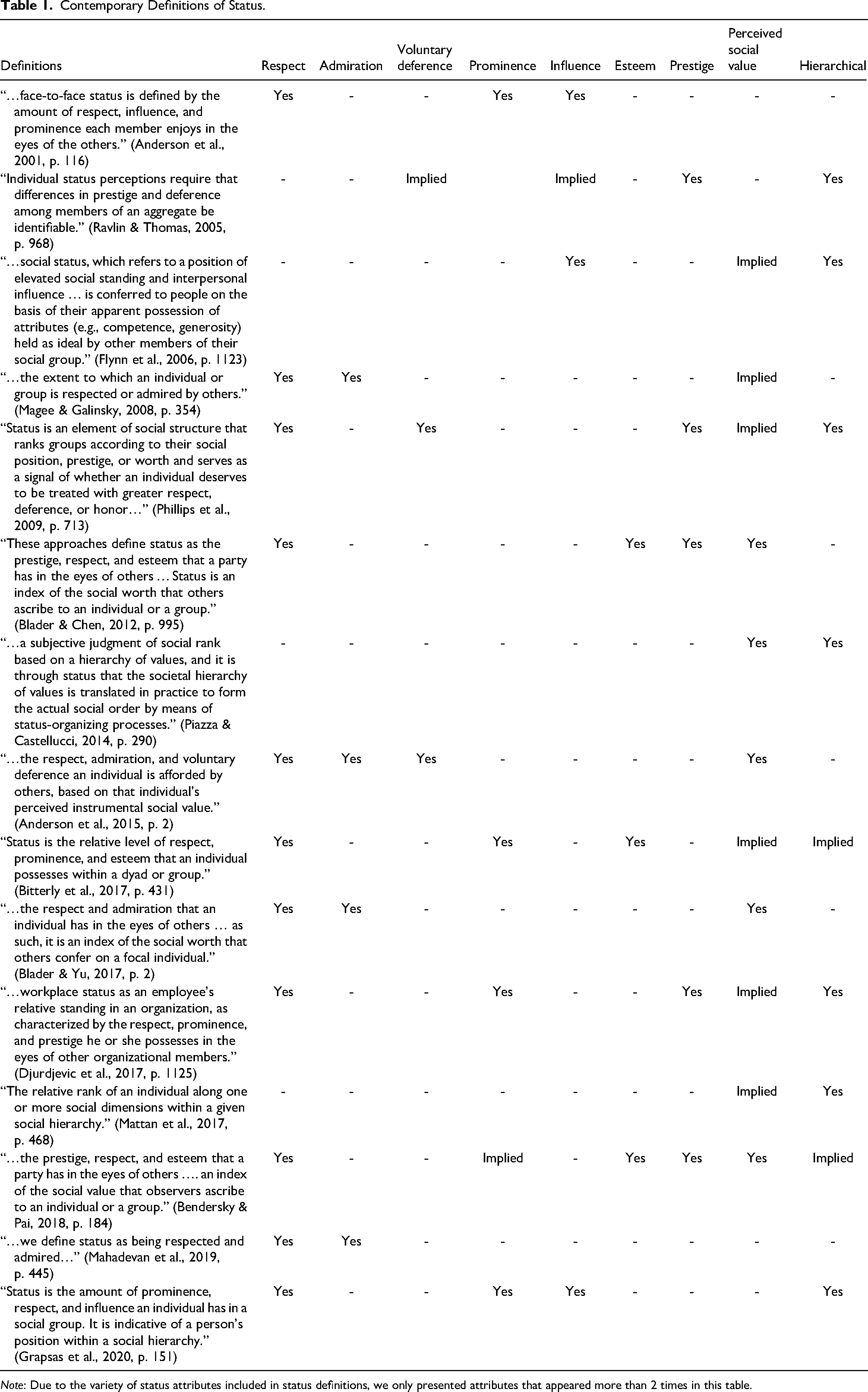
Note: Due to the variety of status attributes included in status definitions, we only presented attributes that appeared more than 2 times in this table.
Researchers also vary in what they identify as the basis for status conferral. For example, Bitterly et al. (2017) suggest that status is conferred based on one's displayed competence. Anderson et al. (2015), although along the same line, more specifically indicated that status is conferred based on one's perceived instrumental social value. More recently, influenced by the dynamic perspective of status, Pettit and Marr (2020) suggest that the evaluator's personal status concerns (i.e., fear of a decline in status rank due to other's status gain) can also influence status conferral.
There is further variability regarding the extent to which the status ascribed to an individual is tethered to other members. Some researchers define status as inherently hierarchical by emphasizing relative rank. Bitterly et al. (2017), for example, described status as the relative level of certain key attributes that one possesses within a dyad or group. Mattan et al. (2017) agreed by defining status as one's relative rank along certain social dimensions. Magee and Galinsky (2008), however, explicitly distinguished status from status hierarchy by specifying that status hierarchy is the rank ordering of individuals according to their status. There are also cases where the term status is used synonymously with the broader concept of social rank, such as in Piazza and Castellucci's (2014, p. 354) definition, status is “a subjective judgement of social rank based on a hierarchy of values.”
In addition, we identified differing approaches in concept definitions to incorporate others’ evaluations into an index of a person's status. For example, Djurdjevic et al. (2017) emphasized that status is conferred through group consensus, 1 suggesting that all members’ status evaluations of a target are relevant when determining the target's status. Definitions that place an emphasis on group consensus also carry an underlying assumption that group members share similar perceptions of a target's status (e.g., Berger et al., 1972; Djurdjevic et al., 2017). Researchers such as Bitterly et al. (2017), however, indicated that status can be possessed within a group or a dyad, which opens the possibility that status can be conferred at the dyadic level and relaxes the assumption that the level of status conferred to the same target should be shared among group members (Kilduff et al., 2016). In summary, researchers differ in terms of the attributes included in their status definitions, the extent that status is defined by virtue of someone's value or rank relative to others, and the extent that group consensus is central in defining status.
At the conceptual level, the lack of definitional consistency creates ambiguities regarding the nature and function of status. This undermines theoretical precision regarding when, for whom, and why status is afforded to others, and the consequences of gaining, losing, or experiencing threats to one's status. Moreover, such conceptual confusion bleeds into how status is operationally defined, as researchers will encounter difficulties when deciding on how to measure and analyze status-related questions. For example, should receive attention and interpersonal influence be considered as appropriate behavioral proxies for status or downstream consequences? Should researchers ask group members to explicitly rank one another when measuring status (i.e., forcing individuals to specify a status hierarchy), or is it more appropriate to directly index the level of status afforded to each member? Relatedly, is status an additive or consensual property of others’ evaluations? In sum, the lack of conceptual consistency blurs the phenomenon being studied and creates confusion regarding when, for whom, and why status is consequential in groups. Lack of consistency also clouds the decision-making process regarding how to optimally measure and study status.
In reviewing existing definitions with the goal of promoting greater theoretical integration in the study of status, we specified a matrix of attributes that underpin contemporary definitions in Table 1. This attribute focus is critical to concept definitions, as highlighted by Podsakoff et al. (2016) who consider concepts as tools to discern the characteristics that underpin an abstract phenomenon and—as a conglomeration—distinguish the focal concept from other related concepts. Considering that an abstract concept like status is distillable through attributes in its conceptual definition, a critical first step was to review existing literature, organize themes from definitions into potential attributes, identify attributes that are necessary and sufficient, and consider key issues that relate to the concept definition (i.e., dimensionality, stability) and its uniqueness (i.e., similar concepts, antecedents/consequences).
Based on this analysis, we recommend defining status with the three attributes identified by Anderson et al. (2015) and introducing a tripartite model that provides a logical explanation for choosing these attributes. Synthesizing existing status definitions, we define status as a dynamic and multidimensional construct that reflects the extent to which a person is voluntarily conferred respect (i.e., cognitive attribute of status), admiration (i.e., affective attribute of status), and deference (i.e., behavioral attribute of status) in a particular context, and it is conferred based on that person's perceived instrumental social value. In contexts where status is perceived to be zero-sum, the conferral of status may also be affected by other group members’ personal status concerns. To account for the multilevel nature of status, we further propose distinguishing two forms of status: reputational status, as the overall level of status afforded to an individual by others in the group, and relational status, as the level of status conferred to an individual by a specific group member.
In the sections below, we unpack this definition of status. First, the nature and basis of status is clarified. Second, the key attributes of the tripartite model of status are identified and explicated. Third, the value of distinguishing status from status hierarchy is explained. Finally, we end this section by proposing how status can be conceptualized through either a relational or reputational lens—depending on the question at hand.
The dynamic and context-specific nature of status
Status hierarchies emerge almost instantaneously during group interactions (e.g., Bales, 1950), yet these hierarchies are not static structures resistant to change. Status is an index of one's perceived instrumental social value, which stems from expectations of one's performance and/or one's ability to contribute to the group's collective goals (Berger et al., 1972; Leary et al., 2014). These performance expectations are inferred from cues signaling one's competence, including diffuse (i.e., general personal attributes) and specific (i.e., task-relevant skills and experiences) status characteristics (Berger et al., 1972), as well as other high-status attributes (e.g., extraversion and overconfidence; Anderson & Kilduff, 2009; Anderson et al., 2012a; Fragale, 2006; Kennedy et al., 2013). However, performance expectations can change over time as group members learn more about each other's actual abilities (Bendersky & Shah, 2013). Such changes are especially likely when performance expectations are based on diffuse status characteristics (e.g., race and gender) and noisy attributes such as overconfidence (Kennedy et al., 2013).
Although status is conferred by others, individuals are not passive recipients of status. People desire and compete for status (Anderson et al., 2015), meaning group members may enact strategies to increase or protect their status, such as sharing expertise or devaluing others’ contributions (see Bendersky & Pai, 2018 for a review). The perceived mutability of status hierarchies especially encourages members to advance their own relative position (Hays & Bendersky, 2015). At the same time, high-status individuals may employ strategies to defend their status or strategically downplay their status (Benson et al., 2022). For example, dominance-oriented individuals may exclude talented group members from participation, withhold information from the group, closely monitor potential rivals, and prevent talented members from finding other allies (Case & Maner, 2014; Maner & Mead, 2010; Mead & Maner, 2012). In sum, a dynamic perspective acknowledges that status is continuously reevaluated and can be gained or lost based on the social interaction processes that unfold within a particular group context.
Status is also contextual. Specifying an individual's status fundamentally demands an appreciation for the social context from which an individual's status is indexed. For example, an individual's status in a project team at school might differ from their status in a workplace team (Fernandes et al., 2021). Using the term “status,” as opposed to “social status,” to indicate an individual's status in teams may help clarify the construct and the local context being discussed. Although in the domain of psychology, both the terms “status” and “social status” can be used to refer to one's value-based status in teams without eliciting confusion, in fields outside of psychology (e.g., sociology and anthropology), social status has a very direct connection to someone's position in society (e.g., social stratification approaches like caste systems are seen as being sources of social status; Gane, 2005). Therefore, to prevent applying the terms and theory presented in this review to the study of broader forms of status outside of specific and concrete group and organizational contexts, we refer only to “status” throughout this article. We also recommend a consistent use of the term “status” to refer to one's value-based status in teams and organizations, reserving the term “social status” for one's position in society at large.
The Basis of Status
Drawing from work on status dynamics, we emphasize that status is conferred based on a person's perceived instrumental social value in conjunction with other group members’ personal status concerns. Three key aspects of this emphasis involve how status relates to instrumental social value, that status conferral is grounded in perceptions, and that personal status concerns influence how people ascribe status. First, regarding the instrumental value, the notion that status is conferred by others based on one or more valued social dimensions is widely accepted (e.g., Bendersky & Pai, 2018; Greer et al., 2018; Magee & Galinsky, 2008; Mattan et al., 2017; Piazza & Castellucci, 2014). In task-oriented groups specifically, one's perceived instrumental social value (Leary et al., 2014) is consensually appraised by groups and serves as a basis for status conferral (Berger et al., 1972; Berger & Zelditch, 1985). Perceived instrumental social value refers to the extent to which one seems to possess resources or personal attributes that contribute to the group's success (Anderson et al., 2015). As status stems from expectations of one's ability to contribute to the group's collective goals (Berger et al., 1972; Leary et al., 2014), status is often conferred based on the extent to which an individual's characteristics or attributes explicitly (e.g., skills, experience) or implicitly (e.g., personality) reflect such ability (e.g., Anderson & Kilduff, 2009; Fragale, 2006).
Second, one's perceived instrumental social value is of concern because status evaluation is a subjective process (Bendersky & Pai, 2018). Perceivers may differ on what they believe is instrumental to the group, or they may even base their judgments on diffuse status characteristics that are not clearly linked to group outcomes (e.g., gender, age, ethnicity, personality; Anderson & Kilduff, 2009; Berger et al., 1972; Kennedy et al., 2013). They may also differ in the extent to which they can observe these status cues and the way they interpret these cues (Kilduff et al., 2016). The subjective nature of the status evaluation process, therefore, makes an individual's perceived—as opposed to their “true”—instrumental social value central to status conferral.
Third, despite being essential for status conferral, the target's perceived instrumental social value is not the only factor that matters. In contexts where status is perceived to be zero-sum, personal status concerns may feature prominently in how status is conferred within groups. Status is a fundamental social motive (Anderson et al., 2015), and attaining status tends to confer access to valuable resources and opportunities (e.g., Magee & Galinsky, 2008). As such, people are often motivated to behave in ways that advance or protect their own status. Personal status concerns, therefore, influence how people behave toward others or willingly confer status to others in the group (Pettit & Marr, 2020). Given that an individual's status has the potential to change, people perceive others as on status trajectories and form expectations of others’ future status based on their past or present status (Pettit & Marr, 2020). If an individual perceives status through a zero-sum mindset and anticipates a decrease in status rank due to others’ status gain, they may actively employ strategies to prevent others from gaining status. For example, high-status individuals may ostracize other talented group members due to fears that another member's instrumental social value threatens one's own status (e.g., Maner & Mead, 2010). As another example of the role of personal motives, individuals are less likely to assist or help group members with whom they share similar status rank relative to members with clearly higher or lower status (e.g., Doyle et al., 2016; Menon et al., 2006). This is ostensibly because—similar to competition between cars in a road race—members with similar status represent the greatest threat of overtaking one's own position or the greatest opportunity to advance in rank (Pettit & Marr, 2020). These examples demonstrate that people are less likely to confer status to those whose status gain may threaten their own position in a status hierarchy. Overall, in contexts where status is viewed as zero-sum, the actual status conferral decision may also be influenced by individuals’ personal status concerns.
A Tripartite Model of Status Attributes
Status is a relationally based construct that emerges from locally defined value judgments. Following Podsakoff et al.'s (2016) recommendations, it is important to identify the necessary and sufficient concept structure (i.e., identifying sets of individually necessary and collectively sufficient attributes) of status. Existing status definitions have included a variety of status attributes (e.g., respect, admiration, prominence, influence; Anderson et al., 2001; Bitterly et al., 2017; Djurdjevic et al., 2017), but what is missing from the literature is the justification of these attributes being individually necessary and collectively sufficient. As status is based on the recognition one receives from other group members rather than what someone is or does specifically, we believe the attributes of status should reflect the distinctive avenues through which status is recognized. Moreover, the attributes that cover all the avenues through which status can be recognized are individually necessary and collectively sufficient in defining status.
Human experience in social interactions is often examined through affective, behavioral, and cognitive perspectives in social psychology (e.g., Allport, 1924; Aronson et al., 2016). Accordingly, we adopt a tripartite model of status to encompass these three aspects, which collectively contribute to the production of meaningful social interactions. In other words, we presume that people confer status through cognitive, affective, and behavioral responses. Cognition refers to the perceptions, concepts, and beliefs one holds about an object. Affect refers to one's feelings toward an object. Behavioral responses reflect how one acts toward an object. Conceptualizing status using the tripartite model, one's status rests upon the belief, feeling, and behavior that group members hold or demonstrate toward the target individual. Leveraging existing definitions, we recommend defining status with the three attributes identified by Anderson et al. (2015): respect (i.e., cognitive), admiration (i.e., affective), and voluntary deference (i.e., behavioral). We acknowledge that the three attributes likely exhibit patterns of mutual influence. For instance, Magee and Galinsky (2008) argued that influence is a downstream result of respect and admiration. As voluntary deference is a form of influence, a similar argument might be raised. However, our tripartite conceptualization does not intend to focus on how attributes relate to one another, but instead emphasize the fact that they contribute to status evaluations through three distinct avenues. In the following sections, we articulate why these attributes reflect the three avenues through which status can be conferred and thus are individually necessary and collectively sufficient for the concept status.
Respect
Respect is often identified as a core attribute of the concept (e.g., Anderson et al., 2001, 2015; Magee & Galinsky, 2008). Nonetheless, the term respect is multifaceted, which may result in a lack of clarity around this concept and its relation to status. Rogers and Ashforth (2017) differentiate between particularized respect (i.e., perceived worth accorded to someone based on their socially valued attributes, behaviors, and achievement) and generalized respect (i.e., worth accorded to someone based upon a sense of shared humanity). Based upon this distinction, it is evident that status researchers use the term respect in a way that parallels particularized respect, which is afforded to individuals based on the possession or expression of certain valued dimensions.
Respect is a cognitive attribute of status because granting respect involves cognitive processes such as perceiving the target's attributes, achievements, and behaviors, evaluating the relevance of the perceived information based on certain metrics, and judging the social worth of the target individual in a given context based on the evaluated results. Assessing one's social worth might be deliberate and conscious, such as when an individual intentionally decides on evaluation criteria and searches for information that aids their judgment of someone's social worth and then affords respect accordingly. Individuals may also rely on intuitive shortcuts or heuristics, such as when individuals judge someone's social worth based on stereotypical beliefs associated with certain diffuse status characteristics (e.g., race and gender). Either way, fundamental cognitive processes are involved in the accordance of respect, such as perception, evaluation, accessing stereotypical beliefs, and forming judgments. Therefore, the extent to which someone is respected based on their perceived instrumental social value in a specific context constitutes the cognitive attribute of status.
Admiration
Admiration is an affective response that is positive in valence and directed toward individuals who perceive others as competent, prestigious, and accomplished (Steckler & Tracy, 2014). A person expressing admiration might be motivated to improve themselves in areas that the one being admired excels (Algoe & Haidt, 2009), and imitate and learn the behaviors of the admired, which can potentially help the admirer obtain higher status (Algoe & Haidt, 2009; Henrich & Gil-White, 2001; Steckler & Tracy, 2014). As noted by Witkower et al. (2020), “others’ admiration is a critical emotional mechanism underlying prestigious individuals’ ability to attract and retain followers who willingly defer to them” (p. 19). As admiration is a positive affective response that can generate an aspirational and deferential orientation toward the target person (Witkower et al., 2020), there is a strong theoretical basis for including admiration as the affective attribute of status.
Voluntary deference
Voluntary deference has been described as the behavioral manifestation of status relations between two parties (e.g., Anderson et al., 2015; Henrich & Gil-White, 2001). As status is freely conferred, such deference is voluntary, meaning that individuals are willing to comply with a target's orders, suggestions, and wishes in the absence of threat or coercion (Anderson et al., 2015). From an evolutionary perspective, individuals provide freely conferred deference as a means of gaining proximity and preferential access to a target's socially valued knowledge and skills (Henrich & Gil-White, 2001). Henrich and Gil-White (2001) further emphasize that voluntary deference is costly to provide to others, which makes deference a relatively honest signal of perceived social worth. As such, individuals signal their recognition of a person's perceived instrumental social value through voluntary deference, behaviorally rendering status to the target individual. Thus, we include voluntary deference as a behavioral attribute of status.
Distinguishing Status Proxies From Necessary and Sufficient Attributes of Status
We see value in distinguishing status attributes from status proxies. Status proxies are often covariates or consequences of status, meaning they are often closely related to status. However, status proxies differ from status attributes in that proxies are neither necessary nor sufficient in defining status. For example, power refers to asymmetric control over resources, and individuals can possess power in the absence of status (Anicich et al., 2016). As a second example, although both status and belongingness represent two important dimensions of a person's social standing, a person can be well-liked and accepted (i.e., belongingness) but have low status (Anderson et al., 2015). Indeed, scholars have articulated how status is distinct from power, belongingness, socioeconomic status, reputation, and popularity and thus we refer readers to Anderson et al. (2015) and Djurdjevic et al. (2017) for a discussion of these conceptual differences. Below, we illustrate the value of distinguishing status attributes from status proxies with the case of two status proxies that are frequently included as core status attributes.
Prominence as a Proxy of Status
Prominence is included as a key attribute within some status definitions and at times included in status measures. According to Anderson et al. (2001), prominence is “the extent to which [an individual] stands out, is visible, and receives asymmetrical levels of attention compared to other organizational members” (p. 116). Based on this definition, researchers have included prominence as a core feature of workplace status (e.g., Djurdjevic et al., 2017, “I possess a high level of prominence in my organization”). Nonetheless, in arguing status as a fundamental human motive, the term prominence was absent from Anderson et al.'s (2015) descriptions of the core attributes of status. Why is there disagreement around whether prominence constitutes a core feature of status? First, although high-status individuals might be prominent, prominence is not a unique result of status. Individuals might be prominent for factors that are independent of, even contrary to, possessing high status. For example, powerful individuals tend to receive asymmetrical amounts of attention from the powerless (Fiske, 1993). Individuals who are taken as token minorities, even with low status, may receive excessive attention (Kanter, 1977). People may become prominent for being obnoxious or making consequential errors, which highlights how achieving prominence does not entail possessing high status. In sum, prominence is neither uniquely nor necessarily related to status. Thus, prominence is perhaps better viewed as a potential consequence rather than a defining characteristic of status.
Influence as a Proxy of Status
Although influence is no longer included in most of the contemporary definitions of status, it continues to be incorporated in status measures and treated as a defining attribute (e.g., Anderson et al., 2008, Anderson et al., 2012a; Bendersky & Shah, 2012; Carlson & DesJardins, 2015). A common source of influence is power, which is defined as “asymmetric control over valued resources in social relations” (Magee & Galinsky, 2008, p. 361). Although power and status tend to be highly correlated (e.g., Yu et al., 2019), and influence is a shared consequence, knowing someone is influential does not allow researchers to trace the status level of the individual. In fact, it is possible for an individual to be powerful and influential but receive low status (e.g., an abusive manager who relies on coercion to demand compliance). Taken together, influence introduces construct contamination by including elements that are not a component of status (i.e., power) and it is neither unique nor sufficient as an indicator of status.
Differentiating Status From Status Hierarchy and Social Rank
Scholars vary in whether they have defined and measured status as interchangeable with one's position in a status hierarchy. Whereas some researchers define status through the extent that an individual is afforded key attributes like respect, admiration, and deference (e.g., Anderson et al., 2015), others define status as hierarchy—considering status in terms of experiencing being higher-than or lower-than the rank of other members (e.g., Mattan et al., 2017). To complicate things further, status hierarchy is sometimes considered equivalent to the concept of social rank (e.g., Piazza & Castellucci, 2014). To add theoretical precision and guide measurement selection, we argue it is crucial to delineate status, status hierarchy, and social rank, and to avoid conflating these constructs.
Following Magee and Galinsky (2008), we define status hierarchy as the rank-ordering of individuals based on their status in a particular group. In this sense, a hierarchy represents how status is structured. Embracing our definitions of status and status hierarchy, the key difference between status and the status hierarchy relates to the extent to which status is presumed to be a limited resource. Status within a group as discussed thus far in this manuscript is not a limited resource, such that it is possible to raise one's received respect, admiration, and deference without changing others’ status attributes. Changes within a status hierarchy, however, are inherently zero-sum. That is, any gain (or loss) in one member's status rank would lead to a loss (or gain) in at least one other member's relative rank. By considering status as a hierarchy, then, one applies assumptions about how an individual's status relates to others within their group.
Status and status hierarchy are often conflated because status tends to be unequally distributed (Magee & Galinsky, 2008), and thus status organizing processes tend to reinforce and amplify such inequality. This adds a zero-sum flavor to the status conferral process, where status distribution is often hierarchical by nature. People with high status tend to be perceived more positively and receive more status-enhancing opportunities compared to low-status individuals, and low-status individuals tend to behave in accordance with their status to avoid backlash (Magee & Galinsky, 2008). As a result, structural forces facilitate both the maintenance and/or pursuit of status and status hierarchies. Nevertheless, knowing a group's status hierarchy does not necessarily enable insight into the level of status held by each member. Put simply, relative status rankings do not directly translate into the amount of status possessed by a particular group member. We acknowledge that the difference between status and status hierarchy is contingent upon our definitions of status and status hierarchy. Thus, the key question for researchers commencing a study is to determine which definitions of status and status hierarchy should be adopted and why. Specifically, researchers should be explicit in their theorizing about the zero-sum or nonzero-sum nature of status, and such assumptions should be reflected in analytical and measurement decisions.
Status should also be distinguished from one's social rank, which is a broader construct that “reflects the degree of influence one possesses over resource allocation, conflict resolution, and group decisions” (Cheng & Tracy, 2014, p. 4). As such, a person may occupy a high social rank through forced compliance rather than having voluntarily conferred respect, admiration, and deference. This form of rank is evident, as an example, in situations where individuals are ascribed organizational power that they wield over others who are often compelled to defer. These individuals may be deferential, but it is neither inherently voluntary nor accompanied by perceptions of admiration and respect. Therefore, although a high-status individual may occupy a high social rank, a high social rank does not necessarily reflect high status.
Distinguishing status from status hierarchy and social rank offers two potential benefits. First, distinguishing these constructs opens up avenues for research. For example, status and status hierarchy are useful for examining different research questions. Studying individuals’ status in teams allows researchers to focus on the absolute amount of respect, admiration, and voluntary deference each individual receives. Studying status hierarchy, on the other hand, shifts the focus to group members’ relative positions in a status hierarchy as well as the social structure within teams.
Although there are compelling arguments for why a person's status ranking relative to others may be particularly important for understanding differential access to organizational resources and opportunities (e.g., Djurdjevic et al., 2017; Magee & Galinsky, 2008), a range of topics could benefit from examining the degree to which a person's absolute status level and their status ranking uniquely relate to relevant outcomes (e.g., offer unique explanatory power in psychological well-being) and antecedents (e.g., how different targets of prosocial behaviors relate to conferred status and status rank). Moreover, the distinction between status and status hierarchy may be more consequential for certain individuals. For example, those who are preferentially attuned to social comparisons and view interactions through a zero-sum lens may place greater weight on their relative status ranking in the group than the absolute level of status they are afforded (i.e., individuals high in grandiose narcissism, Grapsas et al., 2020). Distinguishing between these concepts and testing them empirically will enhance theoretical precision and can generate opportunities to address novel questions. A second and interrelated issue is that separating status from status hierarchy brings clarity around the selection of measurement. Measurement selection and implications are expanded in Section Two of this article, but the key point is that measures of status hierarchy should reflect the zero-sum nature of a hierarchy while other approaches for gathering status perceptions embed more variability.
Differentiating Reputational Status From Relational Status
Most definitions define status as something (e.g., respect and admiration) being afforded by others (e.g., Anderson et al., 2001, 2015; Bendersky & Pai, 2018; Magee & Galinsky, 2008), without addressing whether “others” are (a) a group of individuals holding consensual status beliefs or (b) separate individuals who may uniquely afford a different level of status to the target. We argue that status is characterized by both of these processes and emphasize the importance of differentiating them as reputational status and relational status.
We propose that reputational status reflects one's perceived instrumental social value to the group as a collective. The most substantial evidence that status has a reputational dimension is that individuals’ status perceptions are generally accurate and consensual, even in the absence of formally assigned roles or positions that signify one's status (e.g., Anderson et al., 2001, 2006, 2008). Of course, evidence for social consensus of status perceptions does not mean that status disagreements do not occur within groups or that all individuals are equally accurate in perceiving others’ status (Kilduff et al., 2016; Yu & Kilduff, 2020). Nevertheless, this shared perception allows the emergence of workplace status effects and is fundamental to understanding workplace status (Djurdjevic et al., 2017). That is, the functional benefits of status, such as enjoying preferential access to group resources, often hinge on consensual beliefs about a person's social standing. But does this mean social consensus is a fundamental property of status?
Despite the importance of consensus in status perceptions, status conferral is also a process that can occur at the dyadic level between specific group members (e.g., Bitterly et al., 2017). Differences in the extent to which members of the same group afford a target status is a substantive area of interest, as evidenced in studies involving status self-enhancement, relationship-specific status, and status disagreements (e.g., Anderson et al., 2008; Kilduff et al., 2016). We refer to the level of respect, admiration, and voluntary deference each observer personally affords to an individual as relational status. The term “relational” represents the status conferred by a particular individual to a particular target—independent of how other group members may perceive the target person. Early work posited that “a [status judgement] about either the total person or relatively stable segments of the person constitutes the social status of that person (for the individual making the judgment)” (Goldhamer & Shils, 1939, p. 179), suggesting that someone's status can be discussed with respect to each observer. Researchers have highlighted that people within the same group may differ in their subjective evaluations of a person's status, and questions such as who confers status to whom and why would benefit from zooming in on the interpersonal dynamics of status exchanges (Bendersky & Pai, 2018).
Although status-organizing processes often coalesce into an overarching perception from groups that is generally agreed-upon, variations in status perceptions among group members still exist. In other words, status can be parsed into the consensual social value held by others (i.e., reputational) versus the relational status that is contingent upon dyadic relations with others (i.e., relational). As researchers have been interested in both group-consensus status and status conferred by specific individuals, making a distinction between reputational and relational status has value in, first, bringing conceptual and operational clarity, and second, opening up greater avenues for research.
Section Two: Measuring and Analyzing Status
Selecting an appropriate measure of status can be challenging because the status literature is characterized by diverse measurement approaches. Divergence in topics of interest, sample characteristics, and feasibility considerations often necessitate differing approaches to how status is operationalized. Indeed, it would be unrealistic and unhelpful to provide a one-size-fits-all approach to measuring status. Nonetheless, programmatic theory demands theoretical and methodological coherence in how status is operationalized, measured, and analyzed. This section offers a practical roadmap of key issues to consider when selecting status measures so that the decision-making process is transparent, deliberate, and aligned with theory. As will become clear throughout these sections, each point in the decision-making process is interconnected and requires consideration (see Figure 1).
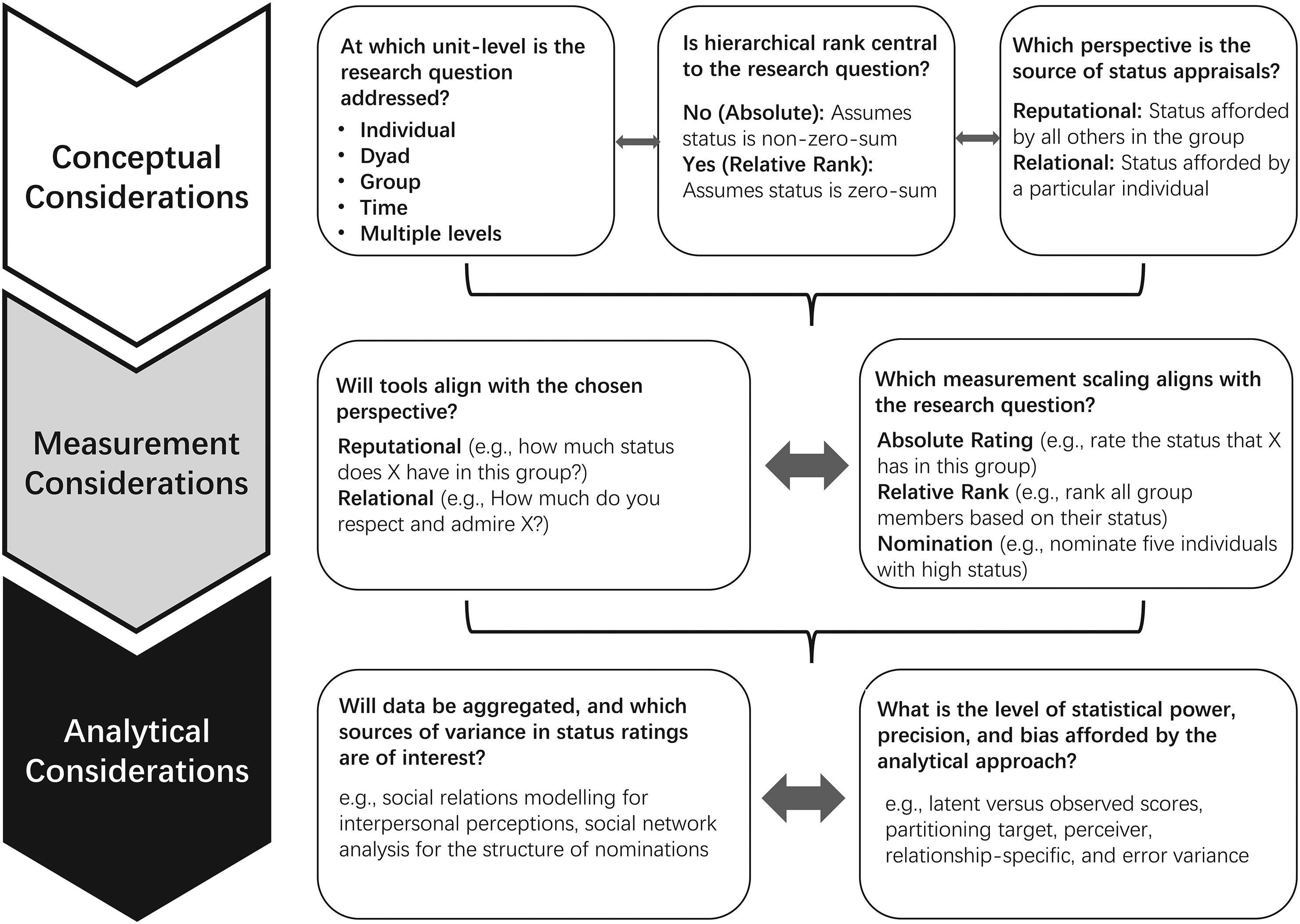
Key considerations when conceptualizing and measuring status.
Does the Research Question Necessitate a Focus on Absolute Status or Status Rank?
Theorizing about the role of status differs in the extent to which the focus is on the absolute level of status a person (or multiple members) is afforded by others in the group or relative social comparisons within a group. This conceptual distinction between absolute and relative status aligns with a similar distinction in how participants report status in self-reported measures: absolute status level and relative status rank. When choosing status measures, one of the first considerations is to identify whether interests lie in the level of status afforded to group members, relative ranking within a status hierarchy, or a combination of both. Below, we explain the characteristics and advantages of each measurement approach.
We propose that the level of respect, admiration, and voluntary deference afforded to group members—independent of how much status is afforded to others within the group—represents the absolute status level. This measurement approach reflects the non-zero-sum nature of status. When participants rate one-another using an absolute scale, there is no explicit reference to other members. Instead, a real or hypothetical scale is used (e.g., from 1 to 7, with seven representing high status). This approach relaxes a traditional assumption imposed by ranking measures that status is inherently zero-sum. That is, researchers who use absolute scales open an opportunity for all group members to hold relatively high levels of respect, admiration, and voluntary deference—or for all to be rated low on this value.
Relative status rank refers to an individual's position in a status hierarchy compared to their group members. When researchers ask participants to rank other group members, they identify one or more status attributes, or provide an ad hoc definition of status within that group context, and ask participants to assign every member in the group a relative rank in comparison to all others. Relative rank focuses on social comparisons within groups and brings the zero-sum nature of a status hierarchy to the fore. Some modifications to relative rank measures might be especially useful if researchers are interested in investigating the hierarchical structure within a group. For example, one strategy researchers may use is to permit “ties” where members assign several members the same status rank. This approach allows more variability in participant responses and provides an opportunity to examine the structure of participants’ individual hierarchies (e.g., flatness/equality relative to steep/inequality; Cantimur et al., 2016).
Absolute status level provides more information than relative status rank. Status hierarchies may come in different assortments (Bunderson et al., 2016) and the intervals in terms of the increase of status from one member to the next can be nonlinear. Absolute measures allow researchers to account for this variability. Absolute measures also provide a way to account for status patterns that are indistinguishable when using status rankings. To illustrate this point, consider two flat status hierarchies (assuming ties are allowed): In the first group, everyone is perceived to hold a great deal of instrumental social value, despite possessing similar relative levels of status. In the second team, there is a minimal level of admiration, respect, and deference between members, but similarly, there are no rank-order differences in status. Being conferred status in each of these groups would represent a fundamentally unique experience. Measuring rank-orders in such a team would detach the status rankings from the reality that members of each team differ quantitatively regarding absolute status conferral.
In sum, absolute status ratings (e.g., Likert-style evaluations of other members) permit natural and group-specific variability in status compared to rank measures. However, there are situations where rankings may align with research questions, such as questions that specifically theorize about the consequences of disagreements in participants’ perceived social rank or when researchers examine how status perceptions interact with the structure or form of status hierarchies. Notwithstanding such circumstances, absolute ratings provide flexibility and additional information about status relations between group members.
Whose Perspective Is of Interest? Determining the Source of Status
A key decision-making point is considering who is the source of status. The theoretical landscape of questions addressed by status researchers incorporates questions that focus on status conferred by the group (i.e., reputational status) and status conferred at the dyadic level (i.e., relational status). Aligning with the source inferred in a given research question, researchers have several decisions that may prioritize either the perspective of the “group” or the dyadic nature of status.
This first involves how status perceptions are captured from group members, as the implied “source” of self-reported status perceptions is evidenced in the divide between relational and reputational measures. Researchers interested in reputational status commonly ask participants to rate status in a way that implies perceptions are held by all members within the group (e.g., “This person had a lot of status within the group today”; Anderson et al., 2006, p. 1098). In contrast, relational measures entail rating the extent to which they would confer status to a target individual (e.g., “I defer to this person's work-related opinions and inputs in the lab”; Joshi & Knight, 2015, p. 68). Beyond a determination of source informing this preliminary decision about measurement, there is a similar cascade of related data management or analytical decisions. The source of interest based on the nature of the research question or theory guides decisions throughout the research process.
To demonstrate how researchers have navigated this coherence in existing research programs, we describe the level of status conceptualization commonly used for five categories of research questions in Table 2. Common research questions tend to pertain to: (a) accuracy in status perception, capturing processes and correlates of participants’ accuracy, (b) status hierarchy, examining patterns relating to the structure of status perceptions as a hierarchy, (c) consequences of status, examining individual and dyadic correlates of status, (d) status conferral, reflecting exclusively relational processes dictating how members confer status onto one-another, and (e) status attainment, pertaining to features of individuals or dyads related to status gain. The categories of status research questions provided in Table 2 are not meant to be exhaustive; rather, the purpose is to provide categories as “test cases” to reflect on how each dominant theme relates to reputational and relational aspects of status.
Examples of Alignment Between How Status Is Conceptualized and the Research Question.
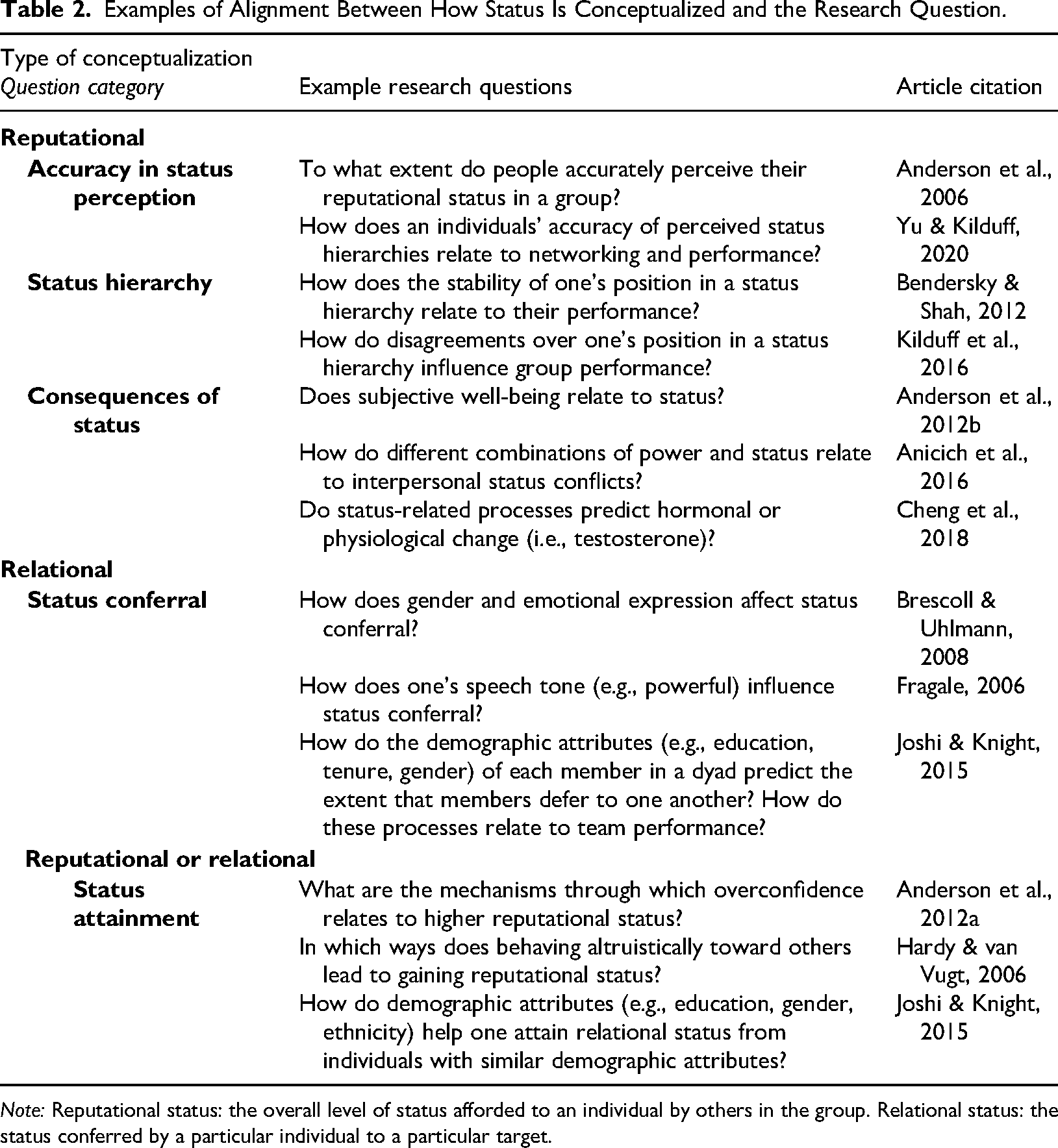
Note: Reputational status: the overall level of status afforded to an individual by others in the group. Relational status: the status conferred by a particular individual to a particular target.
As seen in Table 2, reputational status tends to be prioritized when examining research questions related to accuracy in status perceptions and status hierarchy. When examining the accuracy of status perceptions, one's perception of their own or a target's status is compared with the “true” status. This true status is often operationalized as the status consensually conferred by the group. As a result, reputational status is often of interest when assessing status perception accuracy. As status hierarchies vary in the extent to which members coalesce around shared beliefs about each member's status, an individual’s position in a status hierarchy is assumed to reflect the rank order of their reputational status. Thus, reputational status is perhaps the default option when investigating questions related to status hierarchy.
Reputational status also tends to be prioritized by researchers studying the functional consequences of status. A critical assumption of theory regarding when and why high-status individuals are afforded additional group resources is that group members develop shared beliefs around individuals’ status and allocate resources accordingly (e.g., more opportunity to succeed, more help received, greater influence; Anderson et al., 2015; Djurdjevic et al., 2017; Magee & Galinsky, 2008). In such cases, operationalizing and measuring consensually recognized status (i.e., reputational status) is justified. In fact, Djurdjevic et al. (2017) argued that: “It is not enough for one person to perceive another as high or low status; this perception must be shared by other organizational members for workplace status effects to emerge, as it is often the collective that ultimately opens and closes a number of important doors throughout an employee's career” (p. 1127).
Whereas some research questions target status perceptions conferred by all members, other researchers have examined the portion of status perceptions that are unique to each dyad. Such questions necessitate examining how status dynamics unfold at the dyadic level. Consider, for example, researchers who focus on the degree to which group members differ in who they accord status based on unique relationship factors (e.g., [dis]similarity on demographic or personality variables, personal history) and how this impacts relationship-specific resources (e.g., social support, information sharing, mentoring). This latter question would necessitate a shift toward relational status measures and complementary analytic decisions. Documenting relational status enables researchers to uncover underlying interpersonal status relationships (i.e., who confers/does not confer status to whom), which are critical for understanding questions related to status conferral. Relational status is uniquely useful in examining dyadic status conferral and thus provides insight into bottom-up status organizing processes and the pattern of the status conferral in groups. Taken together, operationalizing status based on consensual beliefs is often warranted, but it is not the only potential avenue for status researchers to explore.
Some research topics, such as status attainment, can be examined with both conceptualizations of status yet with different foci and assumptions. Reputational status carries an assumption that factors predicting attainment will affect each group member in the same way (i.e., encourage or discourage all group members to confer status to the target individual). Thus, the purpose of these research questions is often to identify factors that have general effects on all group members which lead to a status gain of the target individual (e.g., social boldness, overconfidence, sense of humor, altruistic behavior). When examining predictors of relational status, however, researchers explore factors that predict status conferred by one or more particular individuals of interest. For example, by focusing on relational status, Joshi and Knight (2015) found that one is more likely to be conferred relational status by individuals who possess similar demographic attributes (e.g., education, gender, ethnicity).
Our narrative draws direct lines from key types of research questions toward related measures and analyses, but this distinction is rarely explicitly acknowledged or discussed. As a result, it is common to observe a mismatch between researchers’ conceptualization or theory, measurement decisions, and related analytic decisions. Carefully identifying and selecting the source of the status of interest is an important step leading to a coherent alignment with subsequent methodological decisions.
Getting Specific About Status Measures
After examining the two key issues mentioned above, researchers should be able to select measurement approaches that suit their subject of interest and are compatible with the context of the study. We consider status measures as those that attempt to capture the three attributes of status (i.e., respect, admiration, and voluntary deference). These measures may assess status holistically (e.g., capture all three status attributes with one overarching item; how is X respected, admired, and voluntarily deferred to in your group?) or examine each attribute individually (e.g., separate item[s] for each attribute; how is X respected in your group?). Assessing status attributes individually allows researchers to assess such factors that may result in different combinations of status attributes and explore the consequences of different combinations. By assessing status as independent attributes—via separate items—researchers can also address psychometric and conceptual issues by studying how each attribute relates to one another and to the concept of status as a whole.
Focusing on participant-reported measures of status, several aforementioned distinctions regarding measurement span the implied source behind status perceptions (i.e., reputational, group; relational, dyadic), the style of rating employed (i.e., absolute scaling or rank scores), and the content of measures (i.e., status attributes or proxies). These dimensions, alongside the potential to use nomination-style items (e.g., nominate as many or as few members that you consider as possessing high status), distinguish four distinct types of status measures that can be employed by researchers. Table 3 presents a set of examples of questionnaire-based status measures, categorized along two dimensions: (a) use of reputational items regarding the conferral of status from the “group” versus relational items focusing on the respondents’ own attitudes or cognitions regarding the referent, and (b) the approach to garnering responses, with primary approaches including an absolute Likert-type scale, a rank-ordering of members in a linear hierarchy, and an unvalued nomination of specific members.
An overview of self- and other-report status items.
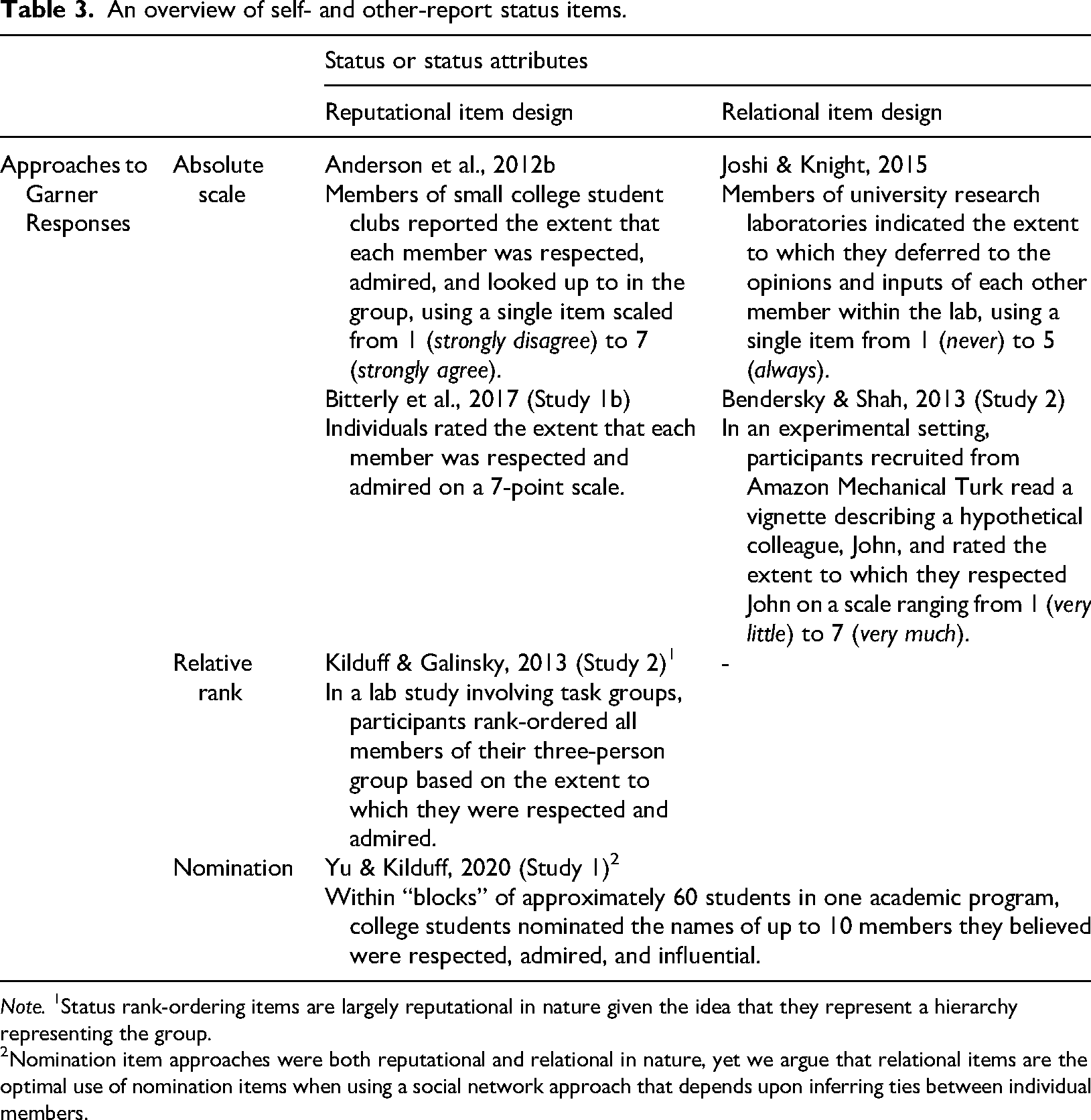
Note. 1Status rank-ordering items are largely reputational in nature given the idea that they represent a hierarchy representing the group.
Nomination item approaches were both reputational and relational in nature, yet we argue that relational items are the optimal use of nomination items when using a social network approach that depends upon inferring ties between individual members.
Status Rating Scales
Status rating scales have participants rate the status of all group members and has been used in lab studies, survey studies, and studies conducted with all types of groups (e.g., task groups, class sections, social group, experimental scenarios; Anderson et al., 2006; Anicich et al., 2016; Carlson & DesJardins, 2015). Status rating scales provide a measure of absolute status level, such that the rating itself reflects the absolute amount of status one receives. Highlighting its versatility, however, the rank order of status can be derived from status ratings to capture relative status rank.
Status rating is also capable of measuring both reputational status and relational status by changing the target referent. When examining reputational status, researchers might ask participants to rate the overall status of other group members by focusing on what are presumed to be shared beliefs of the “group” (e.g., “How much status [i.e., respect, prominence] does X have among people in the organization?”; Anderson et al., 2008) 2 . To measure relational status, participants would rate the extent to which they confer status to a target individual (e.g., “How much do you respect John?”; Bendersky & Shah, 2012). Ratings of relational status directly reflect the level of status conferred by one to another at the dyadic level.
Status Ranking
The status ranking approach involves asking participants to rank group members based on their status and is suitable for measuring relative status rank but not absolute status level. Status ranking is predominantly used to capture reputational sources of status (e.g., Bendersky & Shah, 2012; Kilduff et al., 2016; Kilduff & Galinsky, 2013). That is, researchers ask participants to rank each other based on their overall status within a group. When status is conceptualized as reputational, a person's status rank reflects their position in a consensually formed status hierarchy. Using ranks of reputational status, researchers may investigate topics such as status rank disagreement and implications of rank stability. For example, Kilduff et al. (2016) examined the impact of status rank disagreement on group functioning using the status ranking measure. Specifically, group members ranked each other based on the extent to which they “led the group (made decisions, coordinated group activities, and motivated the group)” (leadership was used as a proxy for status in this study; p. 378). The number of cases in which two members both rank themselves above each other was calculated and used to predict group contribution and group performance. Although we did not find any studies that measured relational status with a status ranking approach, it is possible for researchers to ask participants to rank other group members based on the extent to which they would confer status to each specific member.
Status Nomination
Status nominations involve asking participants to nominate individuals conferred status from the group or whom they personally ascribe status. Although nominations in groups may be either relational or reputational, the most important distinction is whether nominations are handled by researchers in such a way to highlight their reputational or relational nature. Researchers might use this approach to capture individuals’ reputational status by calculating the total number of nominations each member receives, where the amount of status one receives can be reflected in the number of nominations they receive. As an example, Yu and Kilduff (2020) asked participants to nominate blockmates who were “especially respected, admired, and influential” (p. 163), and used the total number of nominations as the indicator of status (see Table 4). Other approaches consider the nature or structure of the group in ways that incorporate a relational perspective (i.e., who nominates whom).
Distinguishing Empirical Studies in Relation to Guiding Questions.
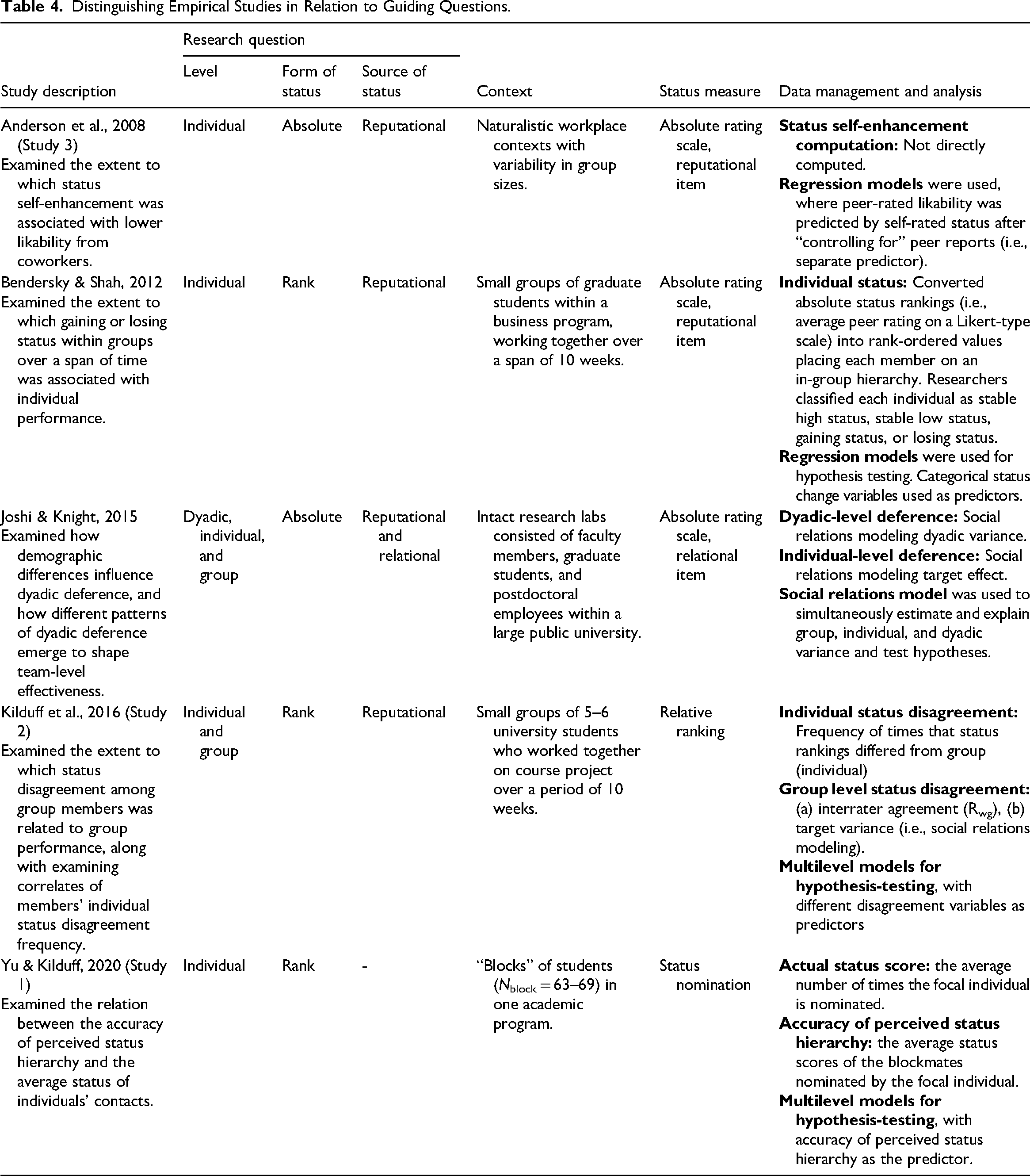
Nominations sacrifice the variability and specificity gained when forcing participants to rank or rate every single member of their group, so are uncommon within small groups where it is feasible to ask participants to evaluate the status of every member of their group. This may be practically required in the context of large social groups (e.g., large classes, fraternity and sorority groups), where it can be taxing for participants to evaluate every member of their group. Participants may not have the chance to closely interact with one another and thus may not be able to accurately evaluate all coworkers. In larger social settings, then, nominations might be advantageous or even necessary.
Moving Beyond Questionnaire-Based Approaches: The Role of Status Proxies
Although proxies of status can be assessed using self-reported measures the way status does, the observable nature of some proxies opens the possibility for researchers to move beyond questionnaire-based methods. Proxies like influence and prominence have behavioral markers and, therefore, researchers have come up with creative observational ways to capture status proxies. For example, influence has been assessed with behavioral scores computed based on the extent to which group members changed other's decisions in a group task (e.g., Bottger, 1984). Prominence (attention) and rank can be captured by tracking the amount of gaze each participant received (e.g., Cheng et al., 2022; Foulsham et al., 2010). Participation has been measured by counting the number of times one spoke and the length of their speech during group discussions (Rosa & Mazur, 1979). Status proxies may therefore serve as an alternative if directly measuring status is impossible, or if researchers are using observational tools to complement status attribute perception measures. Nonetheless, researchers should be careful in such situations to characterize the potential confounds of proxy measures to indicate status.
How Analytical Decisions Impact How Status Is Operationalized
Characterizing status is not limited to the specific measures chosen; analytic decisions factor heavily in how status is indexed. As a person's status is accorded by others, status researchers frequently use advanced techniques to partition and examine the distinct sources of variance involved in peer-ratings. One approach to index status is to aggregate peer ratings of status—usually by taking the average or sum of peer ratings—as a means of capturing one's reputation within the group. Acceptable levels of interrater agreement (i.e., rwg index) and reliable mean scores (intraclass correlation coefficient [K]; Krasikova & LeBreton, 2019) are often used to justify such aggregation procedures. However, these blended peer ratings conflate multiple sources of variance and provide a low-resolution picture of status ratings. For example, how John rates Ringo's status not only reflects the social consensus of Ringo's status, but also John's general tendency to rate others, and their unique relationship (i.e., perhaps John and Ringo get along particularly well). Fortunately, alternative methods are available (e.g., social relations modeling [SRM]) to parse these distinct sources of variance in status ratings, which are described below.
Another way analytical decisions directly impact the nature of status is by the extent to which one emphasizes the social comparative element of peer ratings. Whereas forcing participants to rank where each member sits within a group's status hierarchy produces relative status ranks (e.g., Kilduff et al., 2016), a person's relative status can also be achieved when cluster-mean centering is applied to items with absolute scaling. Imagine, as an example, an item with absolute scaling phrased as: “On a scale from 1 (not at all) to 5 (very much so), to what degree do you admire, respect, and voluntarily defer [group member A]).” A researcher could cluster-mean center each person's status score by first assessing the reputational status of an individual through approaches such as aggregation or SRM, and then transforming values within a group (i.e., centering, standardizing) to calculate each member's deviation from the group average. It is beyond the scope of the current article to cover the assumptions specific to multilevel data that researchers must consider (e.g., cluster-mean centering is particularly important when assessing between-group effects instead of contextual effects; inclusion of the cluster mean scores in a regression model tends to improve estimation accuracy; Antonakis et al., 2021). However, our main point is that cluster-mean centering changes the substantive meaning of each person's status score by shifting the focus from an absolute status score to one's relative standing in the group. Compared to the rank-order method, computing relative scores by cluster-mean centering allows researchers to retain information about the magnitude of differences in status ratings between group members while enabling insight into how groups differ in the average level of status they afford to members. Of course, one could derive rank-order differences from cluster-mean scores, but this sacrifices information about the magnitude of differences in status ratings between each member, and thus we caution against further transforming scores unless researchers have a strong theoretical justification for doing so. Overall, data transformation decisions have direct implications for how status is operationalized, and the inferences afforded by status ratings.
SRM
SRM is an elegant approach to decomposing the sources of variance that factor into peer status ratings and broadens the scope of research questions researchers can address. SRM emphasizes how the status rating a person receives is a result of variance specific to the target, perceiver, and relationship—similar to the example involving John and Ringo—and that each source variance can address different substantive questions (Back & Kenny, 2010). SRM decomposes peer status ratings based on (a) the consistency with which a person is evaluated by others in the group (i.e., target variance), (b) the consistency with which a person evaluates others (i.e., perceiver variance), (c) the unique relationship between two individuals (i.e., relationship variance), and (d) error variance if a latent variable approach is used. As an example, DesJardins et al. (2015) used the TripleR package (Schönbrodt et al., 2011) to evaluate the degree of consensus in status ratings, with 34% due to target variance in Study 1, and then extracted target effects to index each member's status within the group. Next, they regressed these target effects onto extraversion and agreeableness—demonstrating how extraversion positively related to status across both experimental conditions, but agreeableness only positively related to status in the mutual self-disclosure condition (i.e., a more affiliative context). Importantly, target effects are not confounded with the substantial amount of variance attributable to the raters, with 20% due to perceiver variance. These conceptually distinct sources of variance are conflated when aggregating peer ratings. Perceiver effects can also be extracted to address theoretically relevant questions, such as estimating how personality differences (e.g., narcissism) may relate to the tendency to devalue others’ status in the group (e.g., Back et al., 2013).
SRM also enables researchers to zoom in on the relationship dynamics between group members by estimating the variance in ratings that are unique to each dyad. Focusing on voluntary deference specifically, Joshi and Knight's (2015) study exemplifies how theoretically rich questions can be addressed through a relational lens. Whereas those who received deference tended to defer less to others at the individual level, factors such as the educational status of one's partner shaped deference patterns at the dyadic level and revealed a more nuanced pattern (e.g., patterns of lateral deference between highly educated group members). Altogether, this further speaks to the point that evaluating the degree of social consensus in status ratings is valuable, but this does not need to come at the expense of examining other forms of status (i.e., relationally conferred status).
Social Network Analyses
Our review of status-related literature also uncovered several studies using a social network approach. A social network approach to understanding status involves using peer nominations or ratings to create networks, and in turn, incorporate information about the structure of a group when testing associations focused on (for instance) “who” peer nominations come from, how nominations are structured in a group, or temporal changes in nominations. The most common use of this approach when studying status is to extract distinct variables for participants’ status or to estimate the extent an individual's nominations are reciprocated or located within subgroup clusters. Researchers have, for example, weighted the number or strength of status nominations from peers by the status of those nominating to incorporate the relative status of those who nominate them (i.e., eigenvector centrality; Rubineau et al., 2019). The assumption is that status nominations from high-status individuals carry unique meaning relative to nominations from lower-status members. Another approach involves examining cognitive social structures, whereby each participant estimates the group's network (e.g., who is connected to whom), along with providing their own personal nominations, to examine how well individuals’ estimated structure aligns with the “actual” structure (Marineau et al., 2018). Existing uses of social network analysis therefore align with theory but generate nuanced measures of status and enable insight into the accuracy of members’ hierarchical perceptions.
There are alternative network approaches that, while not yet applied to status, could address inherently network-related theory using specialized analyses. One way in which social network approaches may help advance theory relates to identifying status structures in small groups. For example, researchers could theorize about the extent to which nominations for status are reciprocal (i.e., are members motivated to ascribe status toward people who reciprocate by viewing them as being high status), clustered into subgroups (i.e., do members sharing friendships experience pressures to perceive the same individuals as possessing status), and distributed throughout an organization (i.e., is status a property well distributed throughout organizations or highly centralized). Exponential random graph models focus on understanding the underlying structure of given social networks and would be useful for advancing theory in this domain (Lusher et al., 2013). A second theoretical domain could involve examining the evolution of status nominations alongside social influence, by considering how status nominations might relate to peer influences on behaviors at work. Stochastic actor-oriented models, which focus on the nature of change in network ties and member attributes or behaviors (Kalish, 2020), could be useful for advancing research in this domain. For example, researchers with longitudinal status data regarding how group members nominate one another over time could use this model to examine the extent to which individuals perceived to have high status shift the behaviors of those who nominate them (e.g., do people with high status convey workplace attitudes onto others), relative to the extent to which status nominations are “shuffled” to assign nominations to individuals with more representative or normative behaviors for the group (e.g., do nominators change how they allocate status over time, to more highly rate those who hold workplace attitudes that are most similar to themselves). These are exciting frontiers for research that involve novel theoretical lenses.
Integrating Perspectives of Theory, Measurement, and Analysis in Context
Building from the distinctions made above, Table 4 illustrates how the research question, measurement approach, and analytical strategies collectively determine the operationalization of status. First, research questions determine whether the subject of interest resides at the dyadic, individual, and/or group level. Moreover, research questions would specify the form (i.e., absolute status level vs relative status rank) and source (i.e., reputational vs relational) of the status of interest. Next, based on the research question and the context of the study, researchers may select a measurement approach (e.g., absolute rating, relative ranking, nomination) and decide on the focus of the measurement items (i.e., reputational vs relational item) used to collect information. Finally, the chosen analytical strategies influence which types of insights can be derived from the collected data. Below, we demonstrate how each decision is involved in characterizing status with one specific example.
Drawing from one of the studies referenced in Table 4 as an example case, Joshi and Knight (2015) conducted a study examining how demographic differences influence dyadic deference—one attribute of status—and how different patterns of dyadic deference emerge to shape team-level effectiveness. Their research question spans the dyadic, individual, and group levels. To investigate this question, it was necessary to consider relational and reputational sources of status. Considering the intact nature of the target groups, they measured deference using surveys that had participants rate group members’ absolute levels of deference with a round-robin format. As their study investigated dyadic-level status conferral, their items were worded to ensure participants considered their unique relationship with each group member (i.e., relational status, “I defer to this person's work-related opinions and inputs in the lab,” Joshi & Knight, 2015, p. 68). Nevertheless, the analyses undertaken enabled them to also generate a reputational index of deference. That is, they used social relations modeling to partition patterns of deference that are unique to each dyad (i.e., relationship-specific variance) from the general tendency for others to defer to a specific group member (i.e., target effect of deference). In a subsequent step, they also examined how patterns of status conferral (i.e., status conferral based on task contribution vs social affiliation) related to group performance. Overall, measuring status or specific status attributes requires consideration of multiple interrelated issues to optimize alignment between the concept and operationalization. This example also highlights that relational and reputational status are not mutually exclusive foci. In fact, considering both sources of status by selecting the appropriate measures and analyses can yield nuanced and important insights into the nature and function of status in groups.
Conclusion
In this article, we highlighted the varying ways that researchers define and measure status in the contemporary literature. Why does this merit attention? Measurement matters—it lies at the heart of the scientific process. Similar to many social cognitive concepts that are abstract in nature, there have been inconsistencies in the ways in which status has been defined and measured. Status is often assumed to reflect an emergent reality rather than what someone is or does specifically. Complicating matters further, status questions often span multiple levels of analysis (i.e., individual, dyadic, group, time). Although we anticipate that scholars will continue to disagree about the exact nature of status, a critical issue is the need to transparently communicate why and how specific measures were selected (Flake & Fried, 2020). In critically appraising the status of the literature, we sought to identify and resolve conceptual confusion by distinguishing necessary and sufficient attributes of status (i.e., admiration, respect, voluntary deference) from status proxies (e.g., prominence, influence, social rank).
One important consideration is that we adopted a configurative review approach, which means this review does not provide evidence relating to the nature of associations in this literature or the characteristics of the evidence base in its entirety. Instead, by characterizing status in small groups and distinguishing between reputational and relational forms of status, this review has established a conceptual framework upon which researchers could develop meta-analyses or related reviews of literature. One plausible meta-analysis could include observational small group studies and examine the extent that key predictors of status (e.g., personality attributes; group tenure) vary in magnitude with which they relate to status depending upon whether status measures were relational or reputational in nature. Similarly, the applied nature of scholarship comprising this literature means that there could be value in systematically reviewing the quality or risk of bias of the evidence base.
Rather than provide a one-size-fits-all approach, we outlined a list of interrelated considerations to guide status researchers throughout the study design process as they strive for theoretical and methodological coherence. Further, we show how analytic decisions shape how status is characterized, and how the complexities involved in studying social perception in groups (e.g., confounding variance) afford valuable research opportunities (e.g., examining relational and reputational status dynamics) when the appropriate tools are applied (e.g., social relations modeling, social network analysis).
Footnotes
Declaration of conflicting interests
The authors declared no potential conflicts of interest with respect to the research, authorship, and/or publication of this article.
Funding
The authors disclosed receipt of the following financial support for the research, authorship, and/or publication of this article. This work was supported by the Social Sciences and Humanities Research Council of Canada, (grant number 1).

Notes
Author biographies
Appendix A
Journals Reviewed for Identifying Status Definitions